Cold Email for Consulting: A 2026 Playbook That Books Calls
Cold email is still the cheapest way for consultants to land discovery calls in 2026 — if you target sharply, write like a peer, and follow up. Here's the full playbook.
Cold email is still the most cost-effective channel a consultant has for starting conversations with buyers who have never heard of you. The problem is that most consultants run it like a spam campaign — 500 identical messages, one follow-up, then a shrug and a "cold email doesn't work." It works. You're just doing the version that doesn't.
This is the playbook for cold email for consulting in 2026: how to pick targets, write messages that read like a peer reaching out, sequence follow-ups, stay out of spam, and measure the only metrics that matter — replies and booked calls.
TL;DR#
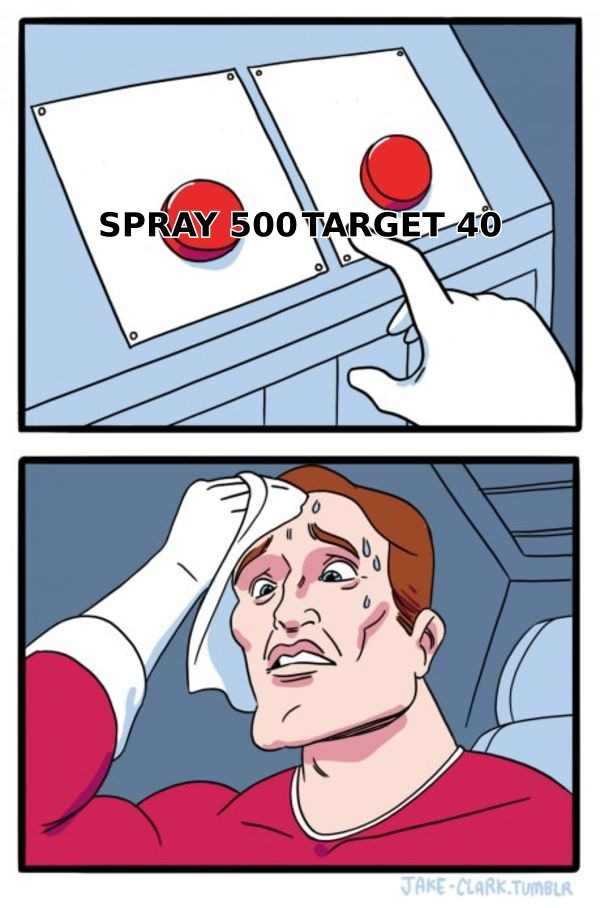
- Narrow beats broad. A list of 40 sharply-qualified prospects with personalized first lines outperforms 500 generic sends almost every time.
- Sell the call, not the engagement. Your only goal in a cold email is a 15-minute conversation — never the six-figure project.
- Follow-ups do the heavy lifting. 50–70% of replies come from emails 2–4, not the first touch.
- Deliverability is a prerequisite, not a tactic. Warm the domain, authenticate it, and keep volume sane or nothing else matters.
- Accurate contact data is the foundation. A verified decision-maker email beats a clever subject line sent to
info@.
Does cold email still work for consultants in 2026?#
Yes — with an important caveat. Cold email works for consulting when you treat it as targeted outreach to a specific buyer with a specific problem, and it fails when you treat it as volume marketing. The channel didn't change; inbox filters and buyer patience did.
Think of it like knocking on doors in a neighborhood you understand. If you know which houses have the problem you solve, and you lead with that, people answer. If you knock on every door reading the same script, you get ignored and eventually reported. Modern spam filters are the neighborhood watch — they escalate fast when you look like a stranger blasting everyone.
Three things make consulting a good fit for cold email specifically:
- High deal value — one booked engagement can pay for a year of tooling and list-building.
- Named decision-makers — you're emailing a VP or founder, not a faceless queue.
- Problem-led positioning — consultants sell outcomes, and outcomes make great email hooks.
What makes a consulting cold email different from a SaaS one?#
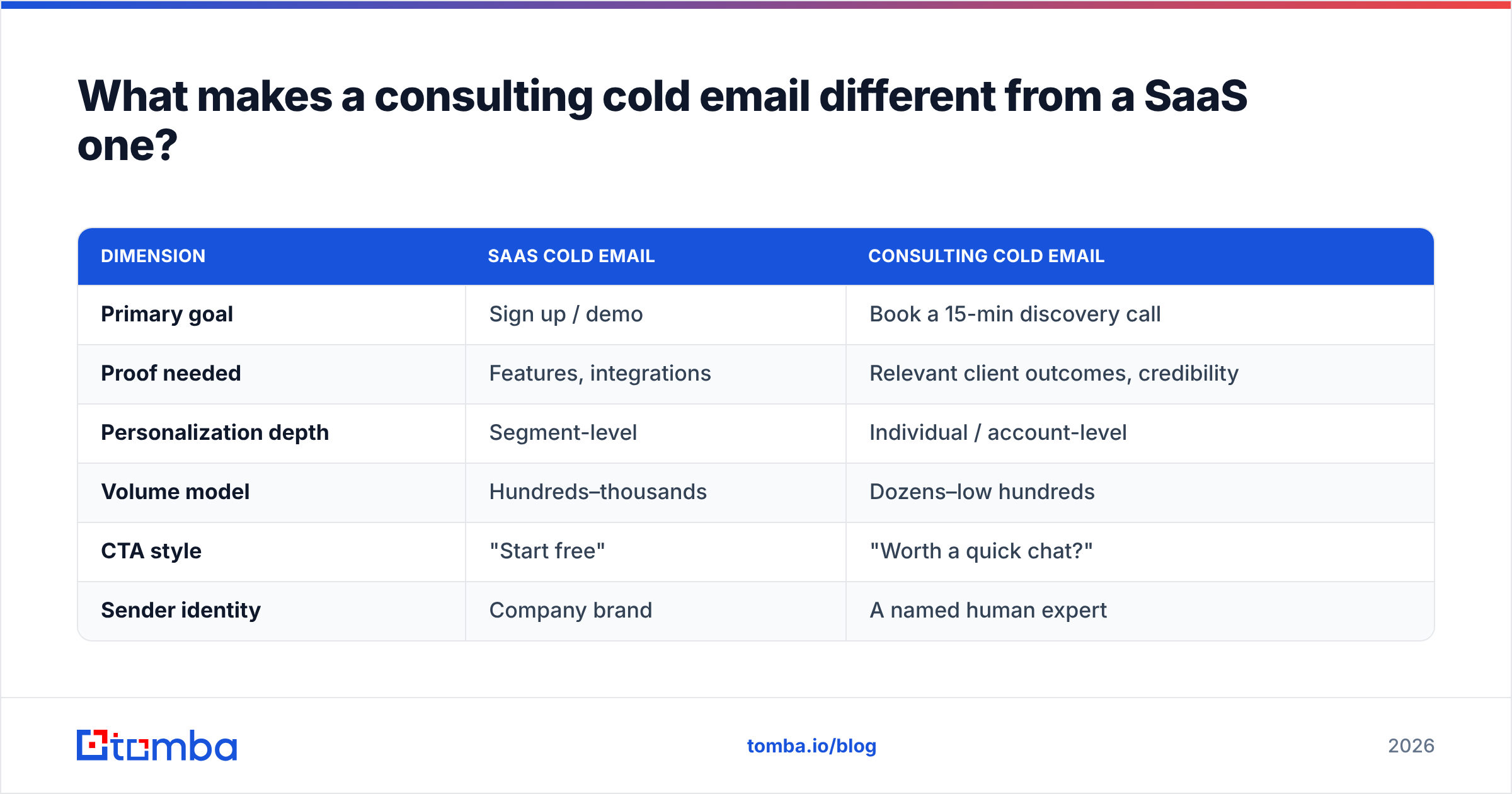
A SaaS cold email sells a product with a free trial and a self-serve path. A consulting cold email sells you — your judgment, your track record, your ability to fix a specific expensive problem. That changes the whole message.
| Dimension | SaaS cold email | Consulting cold email |
|---|---|---|
| Primary goal | Sign up / demo | Book a 15-min discovery call |
| Proof needed | Features, integrations | Relevant client outcomes, credibility |
| Personalization depth | Segment-level | Individual / account-level |
| Volume model | Hundreds–thousands | Dozens–low hundreds |
| CTA style | "Start free" | "Worth a quick chat?" |
| Sender identity | Company brand | A named human expert |
The practical takeaway: your consulting email should sound like it was written by one senior person to another, because it was. No feature lists, no "revolutionary platform," no five links. One insight, one relevant proof point, one small ask.
How do you build a targeted prospect list?#
Your results are capped by your list quality before you write a single word. A brilliant email to the wrong person is a wasted send; an average email to exactly the right person still books calls.
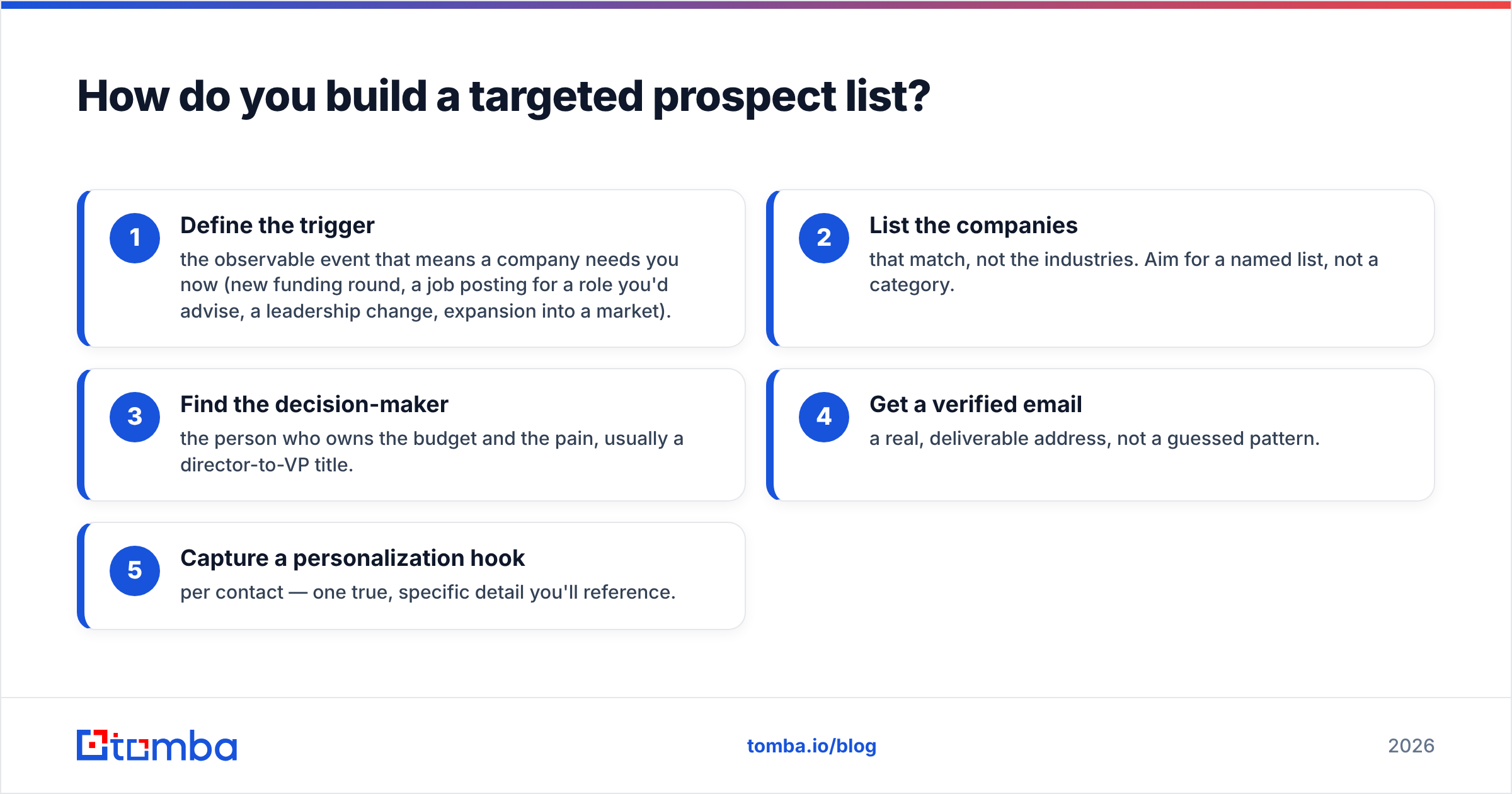
Start with a tight ICP (ideal customer profile) and work down to named contacts:
- Define the trigger — the observable event that means a company needs you now (new funding round, a job posting for a role you'd advise, a leadership change, expansion into a market).
- List the companies that match, not the industries. Aim for a named list, not a category.
- Find the decision-maker — the person who owns the budget and the pain, usually a director-to-VP title.
- Get a verified email — a real, deliverable address, not a guessed pattern.
- Capture a personalization hook per contact — one true, specific detail you'll reference.
Steps 3–5 are where most consultants either burn hours in manual research or, worse, send to unverified guesses that bounce and wreck their sender reputation. A tool like Tomba Email Finder resolves a name-plus-company into a verified professional address, and domain search pulls the right contacts for a whole target account at once. Run the results through an email verifier before your first send so bounces never touch your deliverability.
For a comparison of how these data tools stack up, G2's sales intelligence category is a useful neutral reference point.
What does a cold email for consulting actually look like?#
Here's the anatomy that consistently books calls. Keep the whole thing under 120 words.
- Subject line: 2–5 words, lowercase, specific. "quick question re: your Q3 launch" beats "Transform Your Business Today."
- Opening line: about them, not you. Reference the trigger or personalization hook.
- The bridge: one sentence connecting their situation to a problem you solve.
- Proof: one relevant, quantified result — ideally from a similar company.
- The ask: a low-friction question, not a calendar demand.
A working example:
Subject: onboarding drop-off
Hi Dana — saw Northwind just doubled the sales team. Usually when headcount jumps that fast, ramp time balloons and new reps miss quota for two quarters.
I helped a 40-person SaaS team cut ramp from 5 months to 9 weeks last year. Might be relevant as you scale.
Worth a 15-minute call next week to compare notes? No pitch — happy to just share what worked.
— Sam
Notice what's absent: no résumé, no "I'd love to introduce my consultancy," no three-paragraph credential dump. The email earns curiosity and asks for a small yes.
How many follow-ups should you send?#
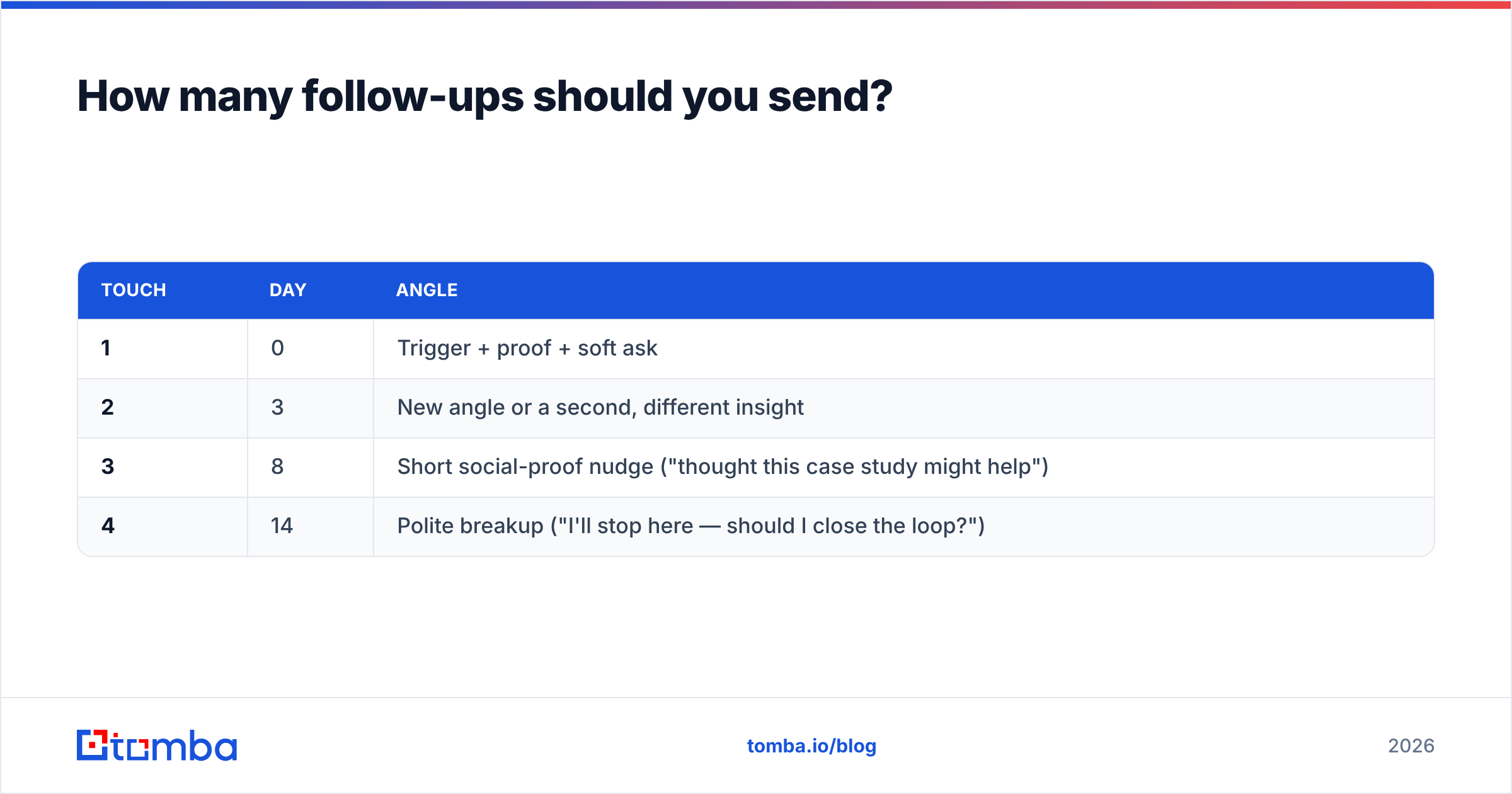
Send 3–4 follow-ups, spaced 3–5 business days apart. This single habit separates consultants who book calls from those who conclude "cold email is dead." Most positive replies arrive after the first message — people are busy, your email got buried, and a polite nudge surfaces it.
A proven cadence:
| Touch | Day | Angle |
|---|---|---|
| 1 | 0 | Trigger + proof + soft ask |
| 2 | 3 | New angle or a second, different insight |
| 3 | 8 | Short social-proof nudge ("thought this case study might help") |
| 4 | 14 | Polite breakup ("I'll stop here — should I close the loop?") |
Each follow-up must add something. Never send "just bumping this to the top of your inbox" — it adds zero value and trains the reader to ignore you. Change the angle, share a resource, or ask a sharper question. The breakup email, counterintuitively, is often the highest-reply message in the sequence because it removes pressure and triggers loss aversion.
How do you keep consulting cold emails out of spam?#
Deliverability is the plumbing. If your emails land in spam, nothing above matters, so treat this as non-negotiable before you scale. Strong email deliverability rests on a few fundamentals:
- Authenticate your domain — set up SPF, DKIM, and DMARC records. Google and Yahoo now effectively require them for bulk senders; see Google's sender guidelines for the current bar.
- Use a separate sending domain — never send cold volume from your primary company domain. Buy a lookalike (get-yourbrand.com) and protect the main one.
- Warm up the domain — ramp send volume gradually over 3–4 weeks before hitting normal levels.
- Keep volume human — 20–40 cold sends per inbox per day, not 500. Consulting is a low-volume, high-value game anyway.
- Verify every address — bounces above 2–3% flag you as a spammer. This is why list verification isn't optional.
- Protect sender reputation — monitor blacklists and reply rates; a sudden drop means back off.
Because consultants send low volume to high-value targets, you have an advantage here: you can afford to be surgical. Ten deliverable, verified, personalized emails a day beat a thousand that never leave the spam folder.
What metrics should you track?#
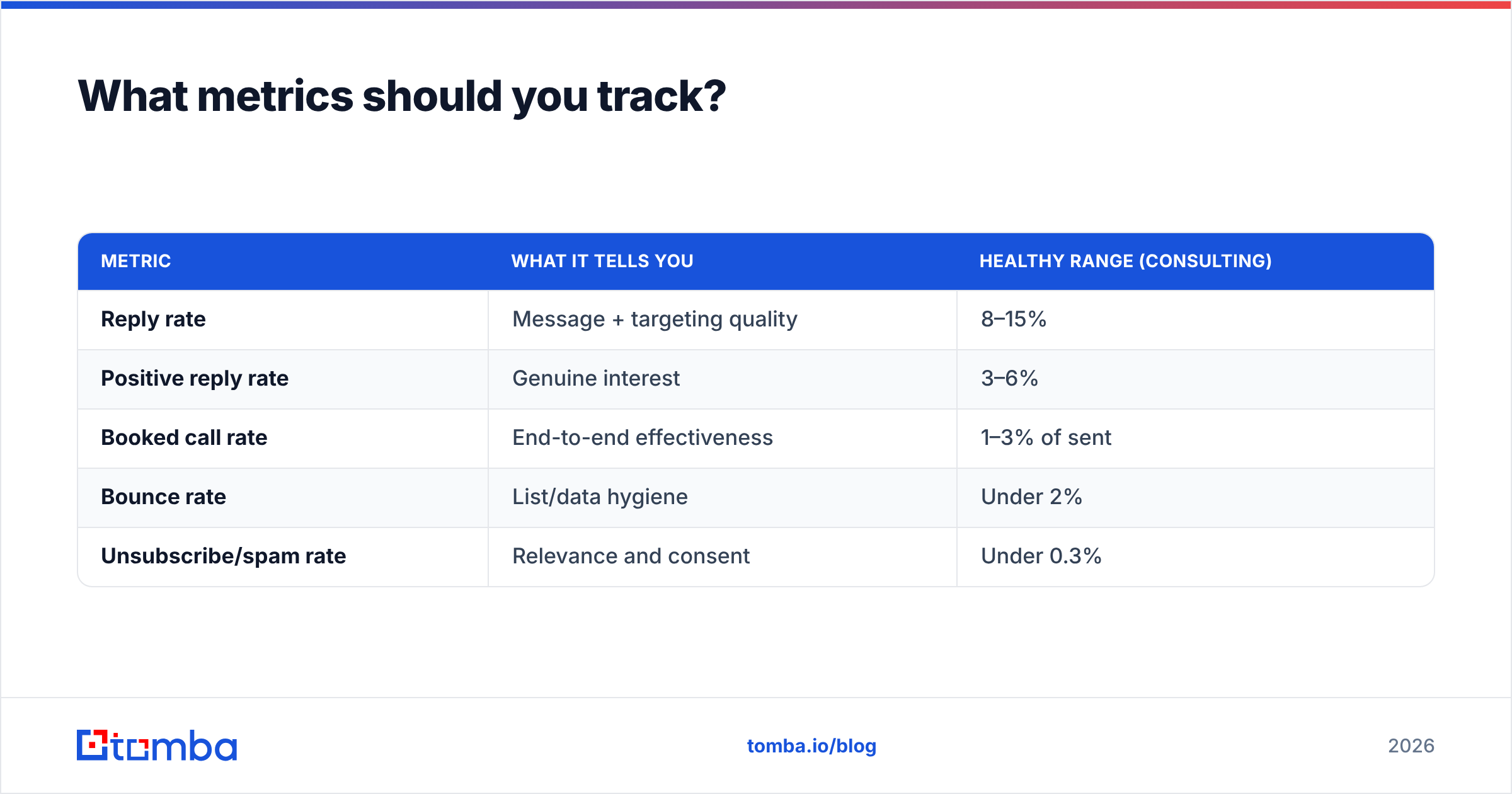
Track outcomes, not vanity. Open rate has become unreliable since Apple Mail Privacy Protection inflates it, so anchor on the metrics that predict revenue.
| Metric | What it tells you | Healthy range (consulting) |
|---|---|---|
| Reply rate | Message + targeting quality | 8–15% |
| Positive reply rate | Genuine interest | 3–6% |
| Booked call rate | End-to-end effectiveness | 1–3% of sent |
| Bounce rate | List/data hygiene | Under 2% |
| Unsubscribe/spam rate | Relevance and consent | Under 0.3% |
Do the math backward from your goal. If you need 4 discovery calls a month and you book roughly 2% of sends, you need about 200 well-targeted, verified emails a month — call it 10 a day. That's a completely manageable manual-quality campaign, which is exactly why targeting beats blasting for consultants.
If your reply rate is fine but calls don't convert, your targeting is off. If replies are low across the board, it's usually the subject line, the opener, or deliverability — check those in that order.
Cold email vs LinkedIn: which is better for consultants?#
Both, sequenced together, beat either alone. LinkedIn builds familiarity and warms the contact; email carries the specific ask and the paper trail. A common high-performing pattern for consultants:
- View + engage with the prospect's LinkedIn content (day 0).
- Connection request with a light, no-pitch note (day 1).
- Cold email with the real value proposition (day 2–3).
- Follow-up sequence by email, with an occasional LinkedIn touch.
This multi-channel approach lifts reply rates because you show up as a real person in two places rather than an anonymous email. For a deeper look at combining channels, Tomba's guide to LinkedIn outreach is a good starting point. The key is that email remains the workhorse for the actual ask — LinkedIn just lowers the stranger tax.
Common mistakes that kill consulting cold emails#
- Pitching the engagement instead of the call. Nobody buys a $30k project from one email. Sell the 15 minutes.
- Making it about you. "I've spent 15 years in..." — the reader doesn't care yet. Lead with their problem.
- Sending to unverified addresses. Bounces destroy deliverability faster than anything else.
- One-and-done. No follow-up means you're leaving the majority of your replies on the table.
- Fake personalization. "I loved your recent post" when you didn't read it is transparent and worse than no personalization.
- Wall-of-text credentials. If it looks like a résumé, it reads like spam.
Putting it together#
The consulting cold email that books calls in 2026 is short, specific, and human: a real problem you noticed, one proof point, and a small ask — sent to a verified decision-maker who actually has that problem, then followed up three or four times with genuine value. None of the individual pieces are hard. The discipline is in doing all of them, every time, instead of blasting a big list and hoping.
Start with the foundation everything else depends on: a clean, verified list of the right people. Use Tomba Email Finder to turn your target accounts into verified, deliverable decision-maker emails, run them through the email verifier to protect your sender reputation, and check Tomba pricing — the free tier gives you 25 searches a month to test the approach before you commit. Get the targeting and the data right, and the emails start booking calls on their own.
Related guides#
// get started
Find, verify and enrich your first contacts today
Start on the free plan with 25 searches a month, then scale when your team is ready.
Free plan · No credit card required · GDPR & CCPA
// about the author