Cold Email for Digital Marketing: The 2026 Playbook for Agencies
Most cold email for digital marketing fails before the first send. Here's the 2026 playbook agencies use to land in the inbox, book calls, and stay compliant.
Cold email is still one of the cheapest ways for a digital marketing agency to start conversations with decision-makers — but only if you treat it like a system instead of a numbers game. Blasting 5,000 unverified addresses with a "quick question" subject line is how agencies land in spam and burn their domain. This guide breaks down what actually works in 2026.
TL;DR#
- Cold email for digital marketing still works, but reply rates now hinge on list quality and deliverability, not volume.
- Verify every address before sending. Bounces above 3% wreck your sender reputation faster than bad copy ever could.
- Sell one outcome, not your service menu. "More qualified leads from paid search" beats "full-funnel growth marketing."
- A 4-email sequence over 12–14 days outperforms one-and-done sends by a wide margin.
- Warm the domain, authenticate it (SPF/DKIM/DMARC), and keep daily volume low to protect the inbox placement you depend on.
Does cold email still work for digital marketing agencies in 2026?#
Yes — when the fundamentals are right. Cold email works for agencies because your buyers (marketing directors, founders, e-commerce owners) live in their inbox and make vendor decisions there. What has changed is the margin for error. Inbox providers are stricter, buyers are more skeptical, and a single spammy campaign can tank a domain you spent months warming.
The agencies still winning with cold email in 2026 have quietly shifted from "spray and pray" to precision: tighter lists, verified contacts, sharper offers, and disciplined sending. The result is fewer emails sent and more meetings booked.
If you send to a scraped or purchased list, this is the outcome you should expect. The rest of this playbook is about avoiding it.
What are the building blocks of a cold email campaign?#
A cold email campaign for digital marketing has five moving parts. Weakness in any one of them drags down the whole system.
- Targeting — a narrow, well-defined list of companies and roles that actually need what you sell.
- Contact data — accurate, verified email addresses (and ideally direct phone numbers) for the right person.
- Deliverability — authentication, domain warmup, and sending discipline so your emails reach the inbox.
- Copy — a relevant, specific message that earns a reply without sounding like a template.
- Sequence & follow-up — a paced series of touches that stays useful instead of nagging.
Get the first two right and everything downstream gets easier. Most "my cold email doesn't work" complaints trace back to a bad list, not bad copy.
How do you build a targeted prospect list?#
Start with a tight Ideal Customer Profile, then find the humans inside it. For a digital marketing agency that usually means filtering by industry, company size, tech stack (e.g., Shopify, HubSpot, WordPress), and a trigger — recent funding, a new marketing hire, or a competitor they just lost ground to.
Once you know who, you need how to reach them. This is where most agencies leak money by buying stale lists. Instead, pull verified contacts on demand:
- Use a domain search to surface every public email pattern at a target company, then narrow to the marketing or growth roles.
- Use an email finder to get a specific decision-maker's address from their name and company domain.
- Layer in a phone finder so your best-fit accounts get a multi-channel touch, not just email.
Then — non-negotiable — run the whole list through an email verifier before your first send. Verification catches invalid, role-based, and risky addresses so your bounce rate stays low and your domain stays trusted.
The argument is always the same. One side insists a cheap bought list is "good enough." The other side just quietly keeps landing in the inbox because every address was verified first.
Why does deliverability matter more than volume?#
Because an email in the spam folder converts at zero, no matter how good it is. Deliverability is the single most underrated lever in cold email for digital marketing, and it's mostly technical hygiene you set up once.
Before you send a single campaign:
- Use a separate sending domain (e.g.,
getagency.coinstead of your primaryagency.com) so a reputation hit never touches your main site's email. - Authenticate it with SPF, DKIM, and DMARC records. Google and Microsoft now effectively require this for bulk senders. See Google's sender guidelines for the current thresholds.
- Warm the domain for 3–4 weeks, ramping volume gradually before real outreach.
- Cap daily volume at roughly 30–50 cold emails per inbox and rotate across a few inboxes if you need more.
- Keep your bounce rate under ~3% and your spam complaints under 0.1%.
Deliverability and list quality are joined at the hip: the fastest way to destroy sender reputation is a burst of bounces from unverified addresses. Verify first, warm properly, and send modestly.
What does a cold email that gets replies look like?#
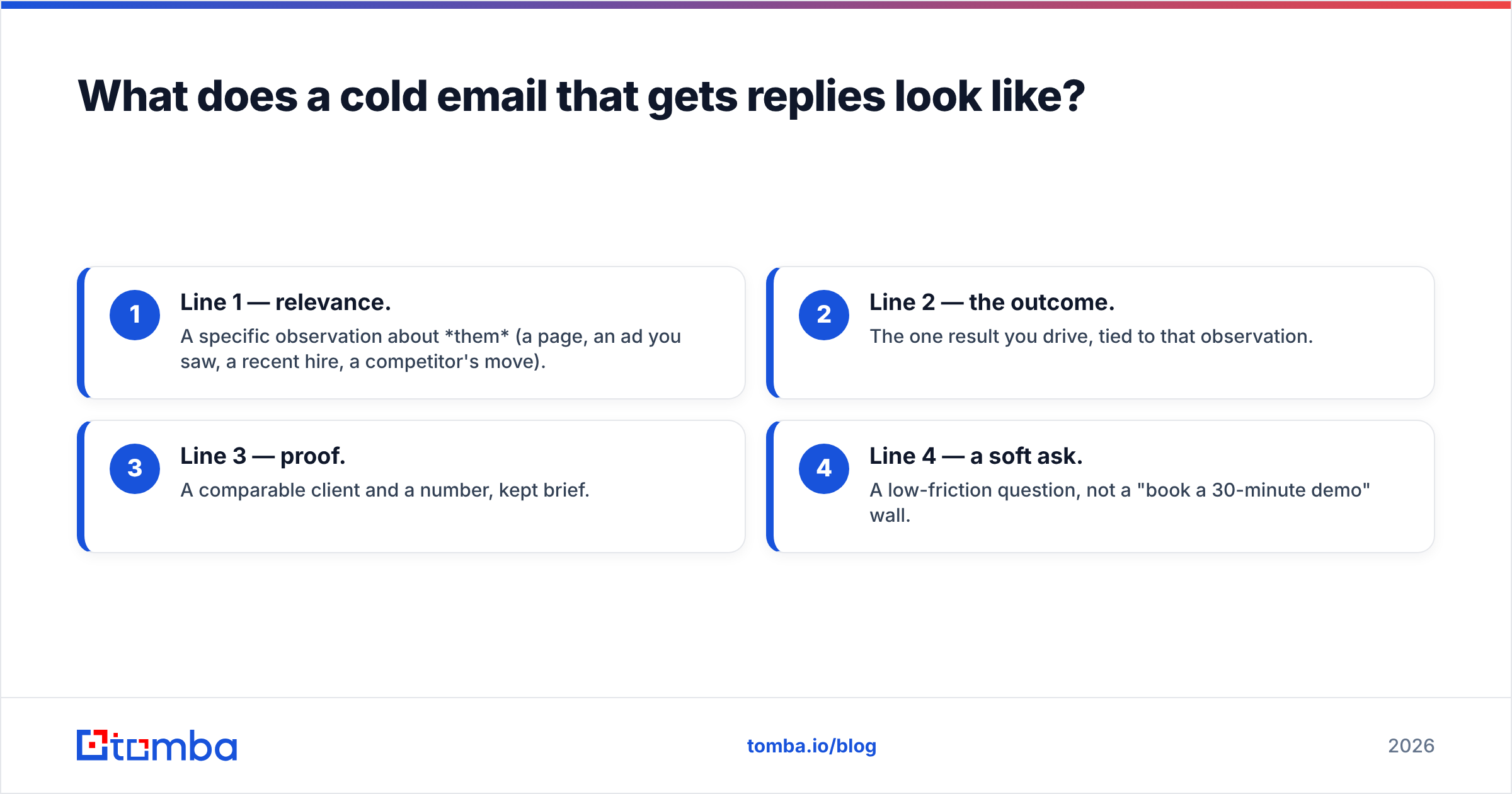
It's short, specific, and about the prospect — not your agency. The template most agencies send ("We're a full-service digital marketing agency offering SEO, PPC, social, and content...") reads like every other pitch and gets deleted. Rewrite it around one outcome the prospect cares about.
A reliable structure:
- Line 1 — relevance. A specific observation about them (a page, an ad you saw, a recent hire, a competitor's move).
- Line 2 — the outcome. The one result you drive, tied to that observation.
- Line 3 — proof. A comparable client and a number, kept brief.
- Line 4 — a soft ask. A low-friction question, not a "book a 30-minute demo" wall.
Weak: "We help businesses grow with data-driven digital marketing. Do you have 30 minutes this week?"
Stronger: "Saw your team just launched Google Ads for the new product line — your landing page is loading in ~5s on mobile, which usually drags Quality Score. We took a Shopify brand from a 4.1s to 1.9s LCP and cut their CPA 22%. Worth a quick teardown of yours?"
You can draft variations fast with a cold email AI helper, then edit for voice — never send raw AI copy. If you want the message pressure-tested before it goes out, run it through a spam checker to catch trigger words and formatting that hurt placement.
How many follow-ups should you send?#
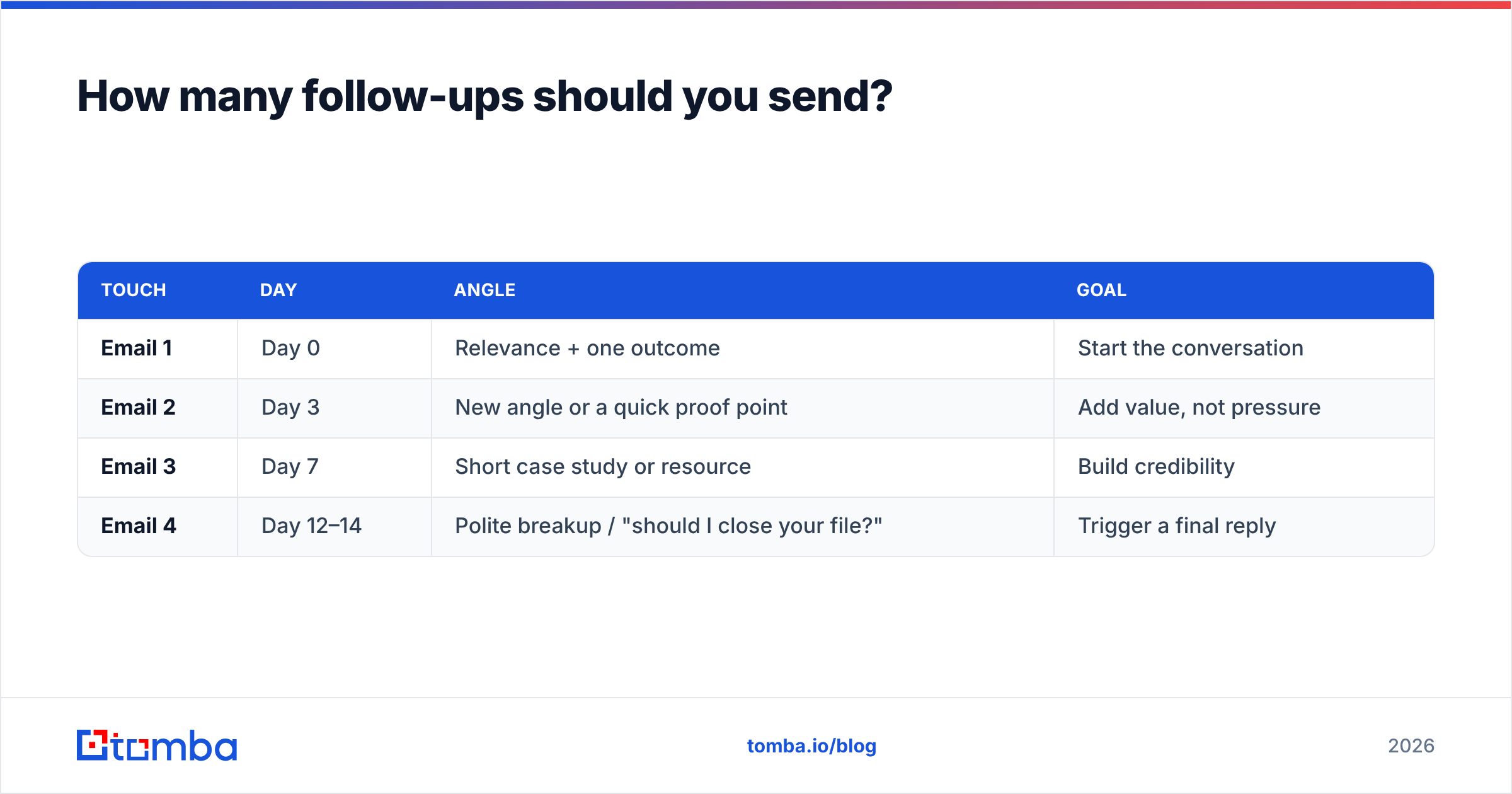
Three to four total touches over about two weeks. Most replies to cold email come after the first message, so stopping at one send leaves the majority of your pipeline on the table. But there's a line between persistent and annoying — respect it.
A sequence that works for agency outreach:
| Touch | Day | Angle | Goal |
|---|---|---|---|
| Email 1 | Day 0 | Relevance + one outcome | Start the conversation |
| Email 2 | Day 3 | New angle or a quick proof point | Add value, not pressure |
| Email 3 | Day 7 | Short case study or resource | Build credibility |
| Email 4 | Day 12–14 | Polite breakup / "should I close your file?" | Trigger a final reply |
Each follow-up should add something — a relevant stat, a mini-audit, a link — rather than "just bumping this up." The breakup email is often the highest-replying message in the whole sequence because it creates a gentle deadline.
Which tools do you actually need?#
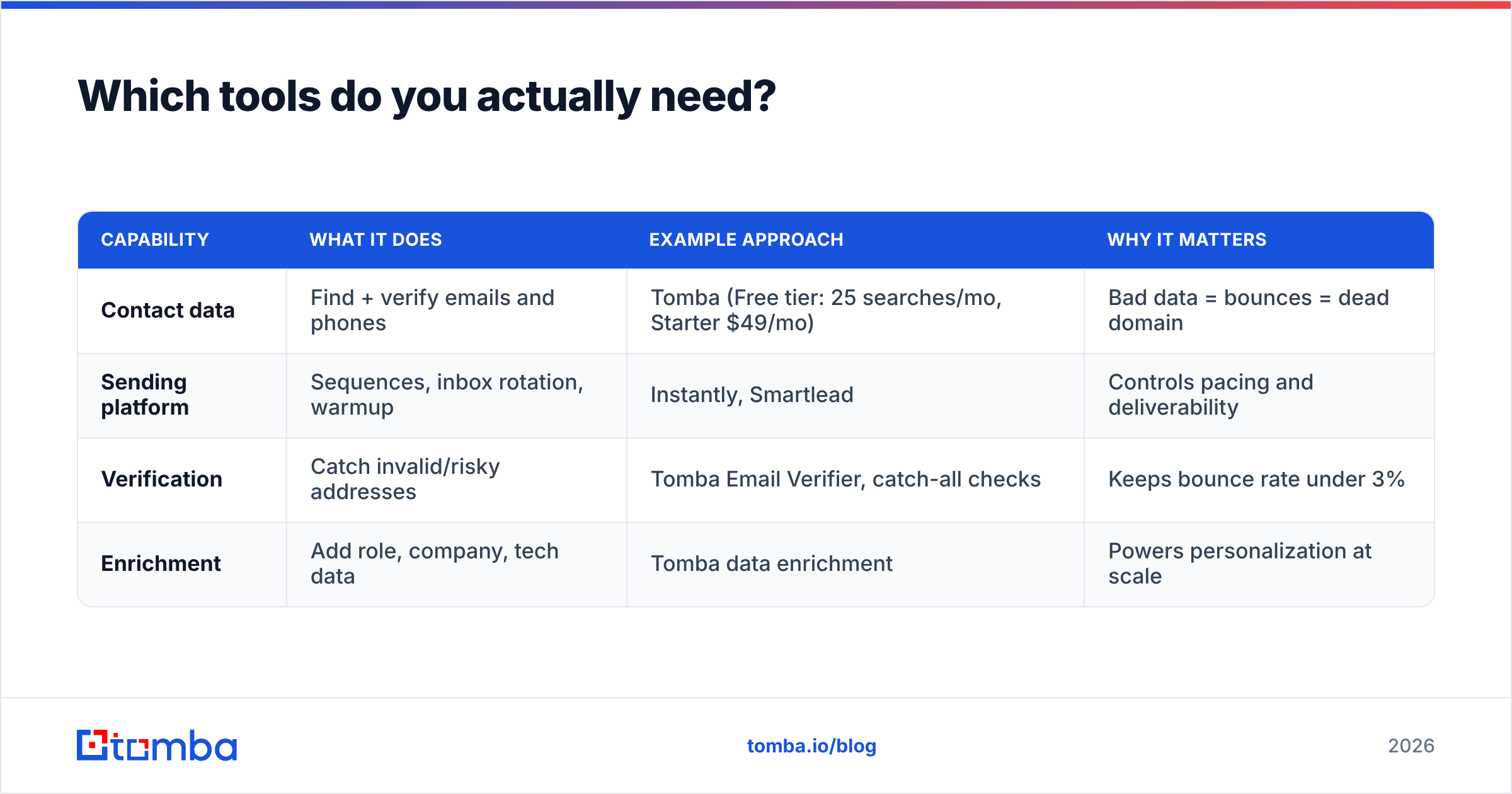
Fewer than the market wants to sell you. Cold email for digital marketing needs three capabilities: find contacts, verify them, and send in a sequence. Here's how the core categories compare.
| Capability | What it does | Example approach | Why it matters |
|---|---|---|---|
| Contact data | Find + verify emails and phones | Tomba (Free tier: 25 searches/mo, Starter $49/mo) | Bad data = bounces = dead domain |
| Sending platform | Sequences, inbox rotation, warmup | Instantly, Smartlead | Controls pacing and deliverability |
| Verification | Catch invalid/risky addresses | Tomba Email Verifier, catch-all checks | Keeps bounce rate under 3% |
| Enrichment | Add role, company, tech data | Tomba data enrichment | Powers personalization at scale |
The mistake agencies make is buying an all-in-one platform for its "database" and then discovering the data is stale. Decouple the two: use a dedicated data source for accurate contacts and enrichment, and a sending tool for sequences. You can compare full plan details on Tomba pricing and cross-reference reviews on a neutral marketplace like G2 before committing. If you already lean on a purchased list from a provider like BookYourData, still verify it before your first send — even good lists decay ~2% per month as people change jobs.
How do you stay compliant with cold email laws?#
Compliance is table stakes, and it's simpler than most agencies fear. You're allowed to send cold B2B email in most markets if you follow the rules for the recipient's region.
- CAN-SPAM (US): include a real physical address, a working unsubscribe/opt-out, and no deceptive subject lines. The FTC's CAN-SPAM guide is the authoritative source.
- GDPR (EU/UK): you need a lawful basis — for B2B, "legitimate interest" usually applies, but you must be relevant, offer easy opt-out, and only process business contact data.
- Always let people unsubscribe in one click and honor it immediately. It also protects deliverability.
Compliance and good targeting reinforce each other: if your list is tight and relevant, you're already most of the way to a legitimate-interest justification.
What metrics tell you it's working?#
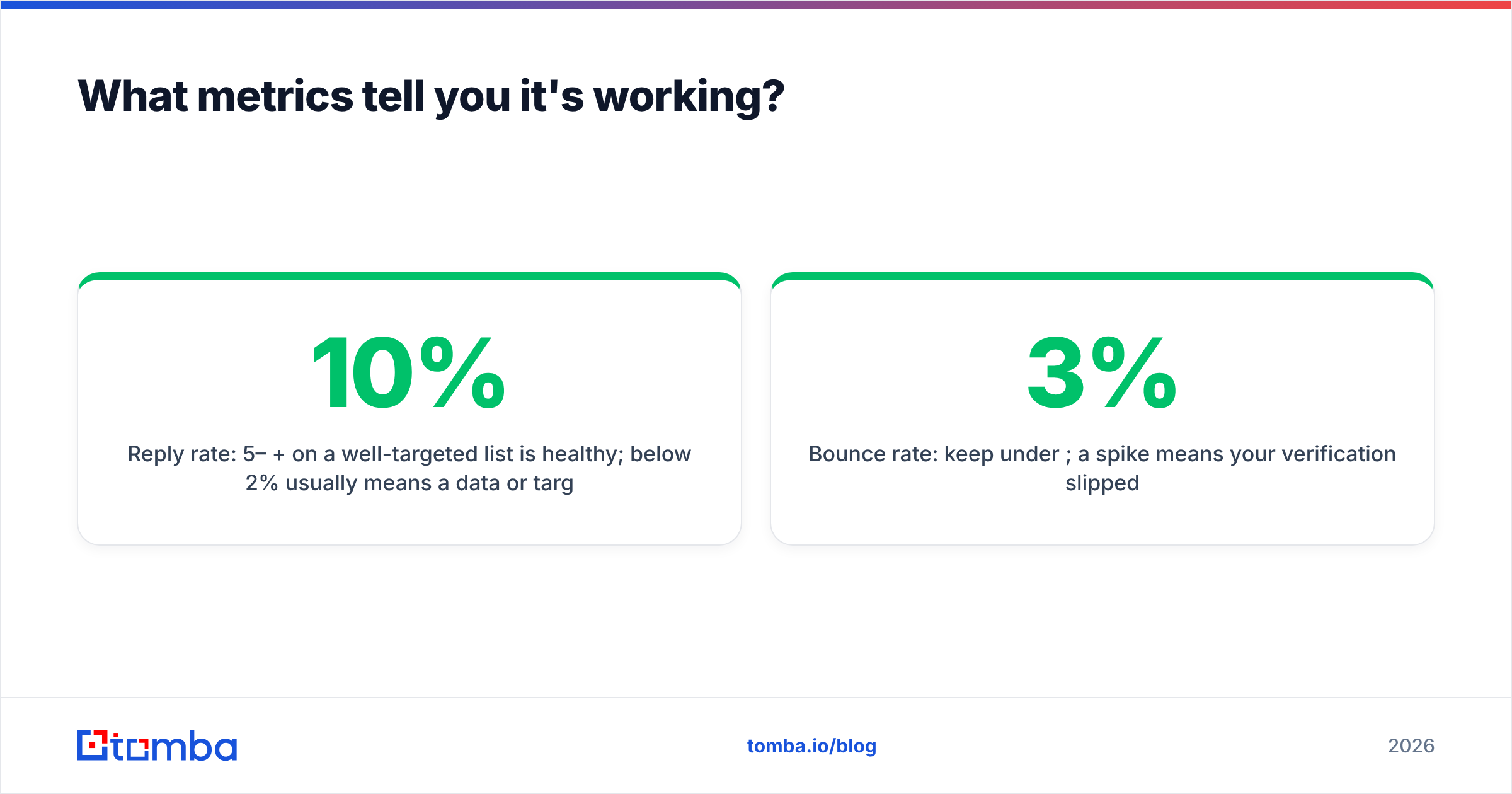
Track replies and meetings, not opens. Open tracking is increasingly unreliable (Apple Mail Privacy Protection inflates it), so lean on the metrics that map to revenue:
- Reply rate: 5–10%+ on a well-targeted list is healthy; below 2% usually means a data or targeting problem.
- Positive reply rate: the share of replies that are actually interested — this is your real signal.
- Meetings booked: the number that pays the bills.
- Bounce rate: keep under 3%; a spike means your verification slipped.
If reply rate is low but bounce rate is fine, fix your copy and targeting. If bounces are high, fix your data — go back and verify.
Putting it together#
Cold email for digital marketing rewards discipline over volume. Define a narrow ICP, find and verify the right contacts, authenticate and warm your domain, write like a human about one outcome, and follow up four times with something useful each round. Do that consistently and you'll book meetings from campaigns a fraction the size of what "growth hackers" recommend.
The foundation of all of it is clean contact data. Start with the Tomba Email Finder to pull accurate, verified emails for your exact target roles — 25 free searches a month to test it, then $49/mo when you're ready to scale. Feed a verified list into your sequence tool and let deliverability, not luck, decide where your emails land.
Related guides#
Ready to find emails that actually work?
Join 150,000+ professionals who stopped guessing and started sending. Free credits on signup — no credit card required.
Get the Tomba newsletter
Practical outbound tactics and product updates — once every two weeks.
About the author