Cold Email for SaaS Product: A 2026 Playbook That Gets Replies
Cold email still books demos for SaaS in 2026 — but only if you nail targeting, copy, and deliverability. Here's the full playbook, with a channel comparison and templates that actually get replies.
Cold email is not dead for SaaS — lazy cold email is. If you sell software and your outbound has gone quiet, the problem is almost never the channel. It's the list, the copy, or the inbox placement. Fix those three and cold email is still one of the cheapest ways to book qualified demos in 2026.
This is the practical playbook: who to target, what to write, how to stay out of spam, and how to measure whether it's working.
TL;DR#
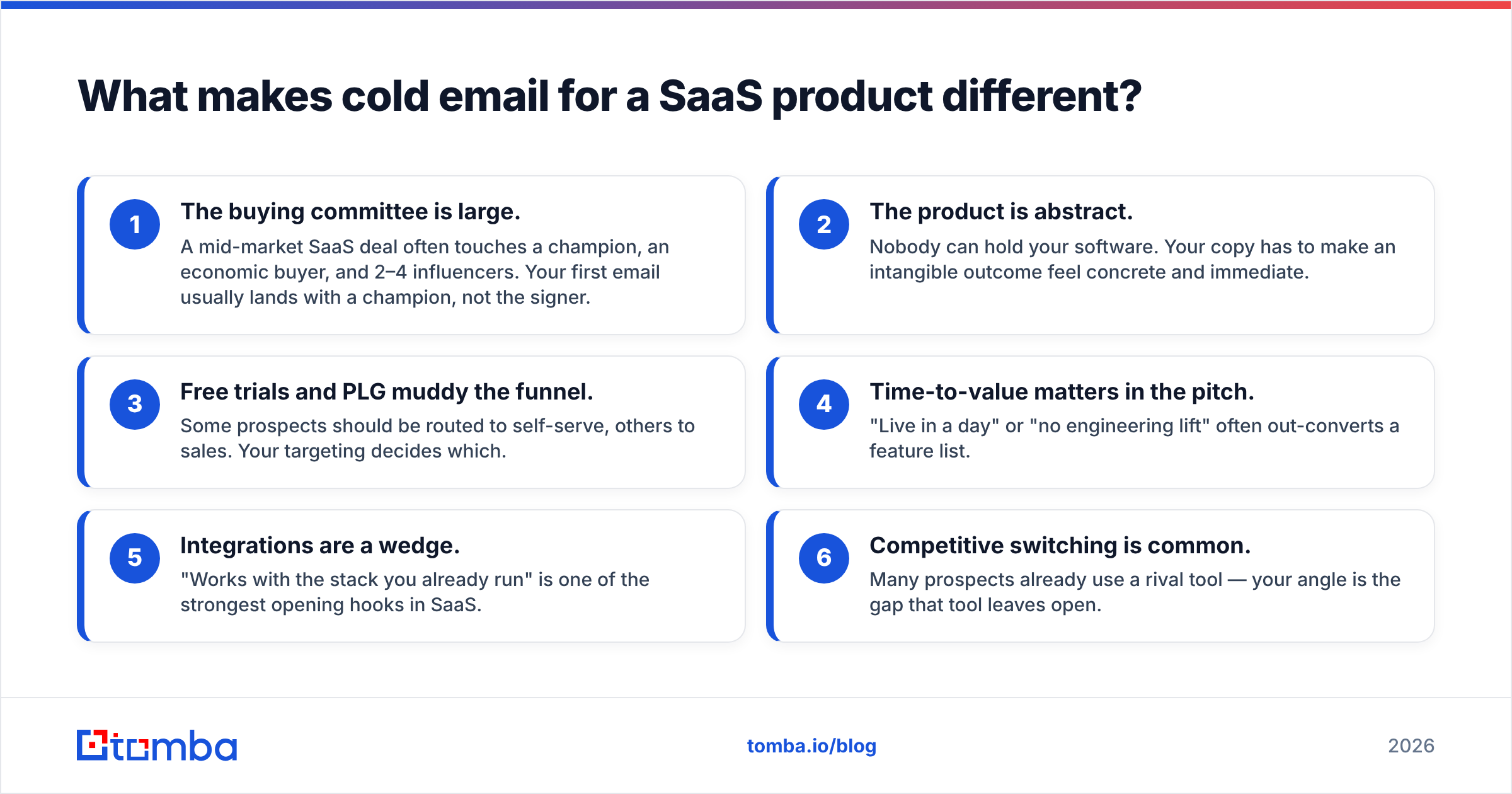
- Cold email for a SaaS product works when it's precise, not when it's loud. A tight, verified list of 200 right-fit accounts beats a scraped list of 20,000 every time.
- Deliverability is a prerequisite, not a tactic. Warm your domain, authenticate it (SPF, DKIM, DMARC), and verify every address before you hit send.
- Copy should sell the demo, not the product. One problem, one proof point, one clear ask.
- Sequences beat single sends. Plan 4–6 touches across email and one other channel over 2–3 weeks.
- Track replies and meetings, not opens. Apple Mail Privacy Protection made open rates a vanity metric.
Does cold email still work for SaaS in 2026?#
Yes — with a narrower definition of "works." Reply rates on well-targeted SaaS campaigns typically land in the 3–8% range, and positive-reply rates of 1–3% are healthy. If you're sending to a verified, well-segmented list with relevant copy, those numbers turn into a repeatable meeting engine.
What has changed is the tolerance for spray-and-pray. Mailbox providers got smarter, buyers got busier, and Google and Yahoo tightened bulk-sender rules. The senders who still win treat every email like a 1:1 message that happens to be scaled — not a broadcast.
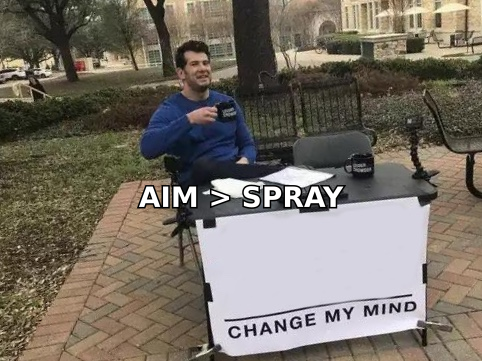
What makes cold email for a SaaS product different?#
Selling software cold is its own discipline. A few things separate it from generic B2B outreach:
- The buying committee is large. A mid-market SaaS deal often touches a champion, an economic buyer, and 2–4 influencers. Your first email usually lands with a champion, not the signer.
- The product is abstract. Nobody can hold your software. Your copy has to make an intangible outcome feel concrete and immediate.
- Free trials and PLG muddy the funnel. Some prospects should be routed to self-serve, others to sales. Your targeting decides which.
- Time-to-value matters in the pitch. "Live in a day" or "no engineering lift" often out-converts a feature list.
- Integrations are a wedge. "Works with the stack you already run" is one of the strongest opening hooks in SaaS.
- Competitive switching is common. Many prospects already use a rival tool — your angle is the gap that tool leaves open.
Get these right and the rest of the playbook is execution.
How do you build a targeting list that converts?#
Start from your ideal customer profile, not from a scraper's default filters. The best SaaS lists are small on purpose.
Work top-down:
- Define the account. Industry, size band, tech stack, funding stage, region. Tools like G2 and public tech-stack data help you find companies already primed for your category.
- Find the right person. Title alone is weak — pair it with a trigger (new role, recent funding, a job posting that signals your pain).
- Get the contact data. Use a dedicated email finder to pull professional addresses by name and domain, and a domain search when you want every relevant contact at a target company at once.
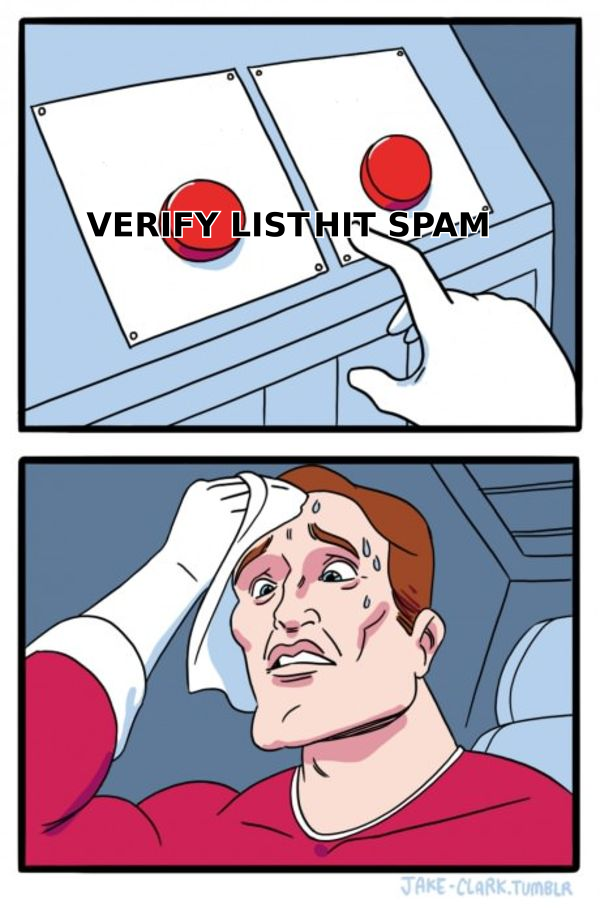
- Verify before you send. Run the list through an email verifier so invalid and risky addresses never reach your sequence. This single step protects your sender reputation more than any subject-line trick.
A 300-contact list you actually researched will out-perform a 30,000-contact list you bought, both on reply rate and on inbox placement.
Which channel mix should a SaaS team use?#
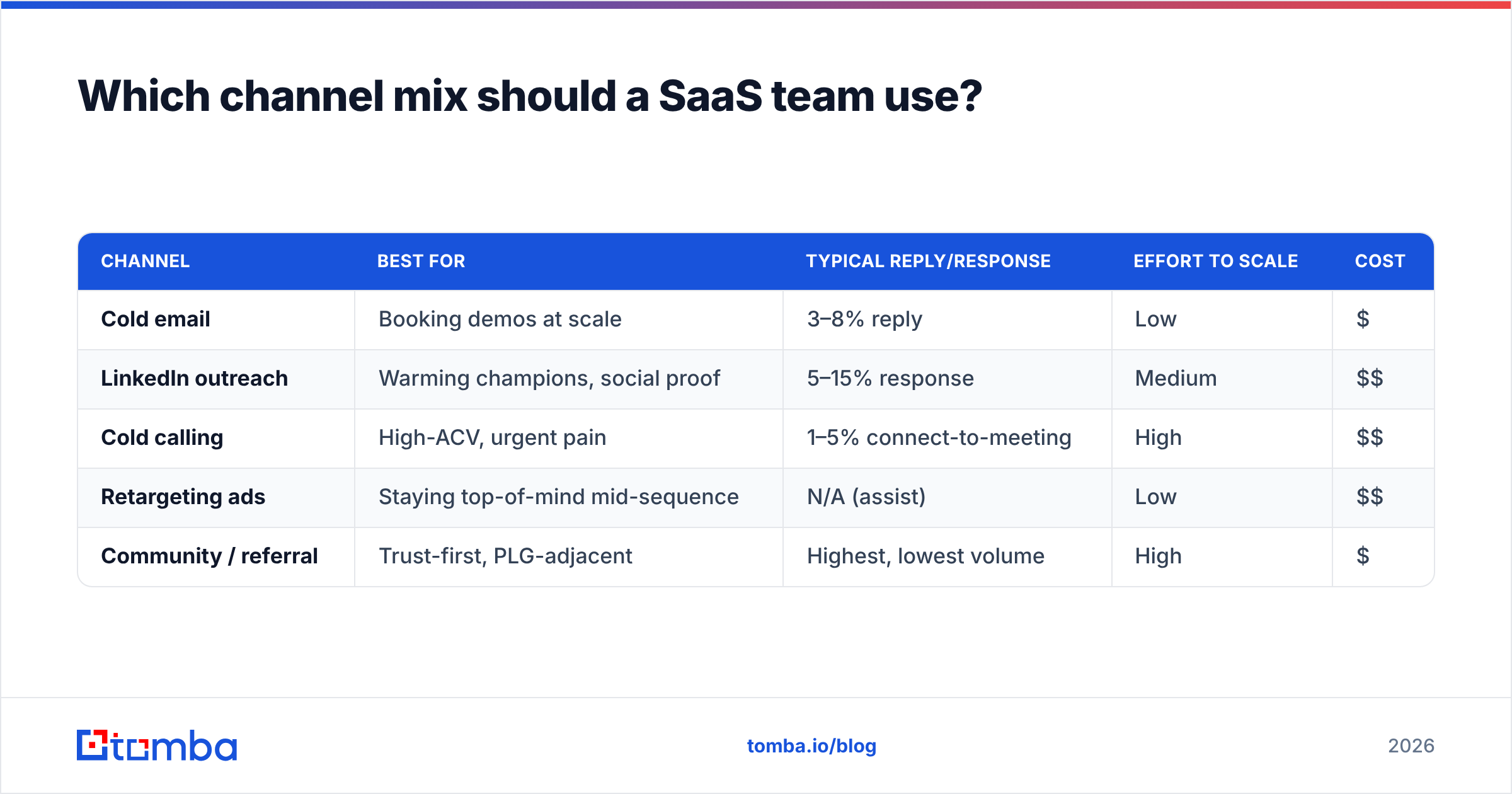
Cold email rarely works in isolation anymore. Pairing it with one or two other touches lifts reply rates without much extra effort. Here's how the main outbound channels stack up for a SaaS motion.
| Channel | Best for | Typical reply/response | Effort to scale | Cost |
|---|---|---|---|---|
| Cold email | Booking demos at scale | 3–8% reply | Low | $ |
| LinkedIn outreach | Warming champions, social proof | 5–15% response | Medium | $$ |
| Cold calling | High-ACV, urgent pain | 1–5% connect-to-meeting | High | $$ |
| Retargeting ads | Staying top-of-mind mid-sequence | N/A (assist) | Low | $$ |
| Community / referral | Trust-first, PLG-adjacent | Highest, lowest volume | High | $ |
The pragmatic default for most SaaS teams: email as the backbone, one LinkedIn touch to add a face and credibility, and calls reserved for high-value accounts. Layering a second channel onto an email sequence commonly adds several points to your meeting rate.
What does high-converting SaaS cold email copy look like?#
Great cold email copy is short, specific, and about the reader. The template below is deliberately boring in structure — it works because it removes friction.
The anatomy of a SaaS cold email:
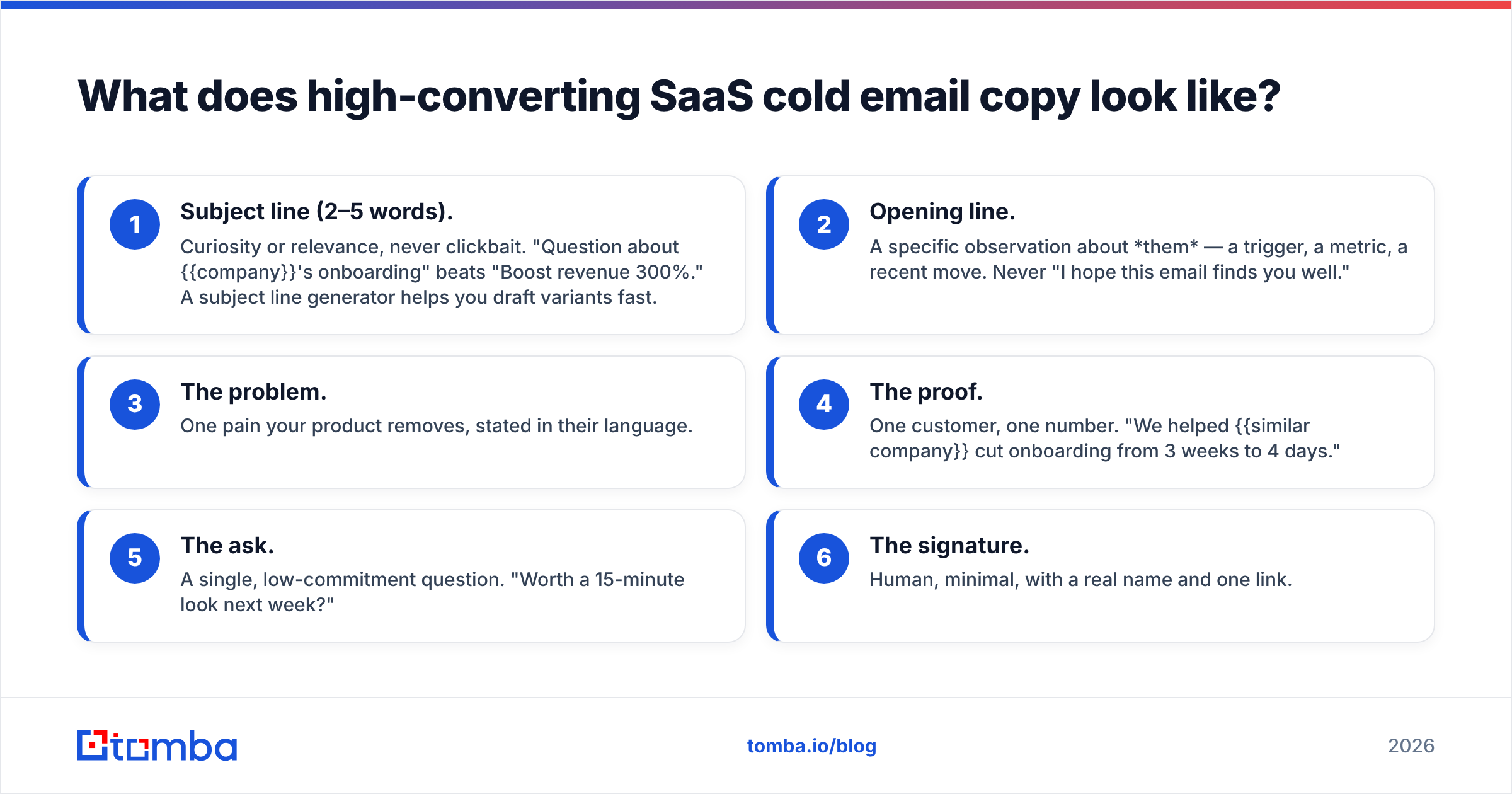
- Subject line (2–5 words). Curiosity or relevance, never clickbait. "Question about {{company}}'s onboarding" beats "Boost revenue 300%." A subject line generator helps you draft variants fast.
- Opening line. A specific observation about them — a trigger, a metric, a recent move. Never "I hope this email finds you well."
- The problem. One pain your product removes, stated in their language.
- The proof. One customer, one number. "We helped {{similar company}} cut onboarding from 3 weeks to 4 days."
- The ask. A single, low-commitment question. "Worth a 15-minute look next week?"
- The signature. Human, minimal, with a real name and one link.
Keep the whole thing under 120 words. If your email needs scrolling on a phone, it's too long.
Here's a working example:
Subject: {{company}} + faster onboarding?
Hi {{first_name}},
Saw {{company}} just doubled the CS team — usually that means onboarding is the bottleneck, not the product.
We helped {{competitor_customer}} take new accounts live in 4 days instead of 3 weeks, without adding headcount.
Worth a quick 15-minute look at how? Happy to send a 2-minute video first if that's easier.
{{your_name}}
Notice what it does not do: it doesn't list features, it doesn't mention a discount, and it doesn't ask for an hour. For more ready-to-adapt frameworks, browse a library of cold email templates and swap in your own proof points.
How do you keep SaaS cold email out of spam?#
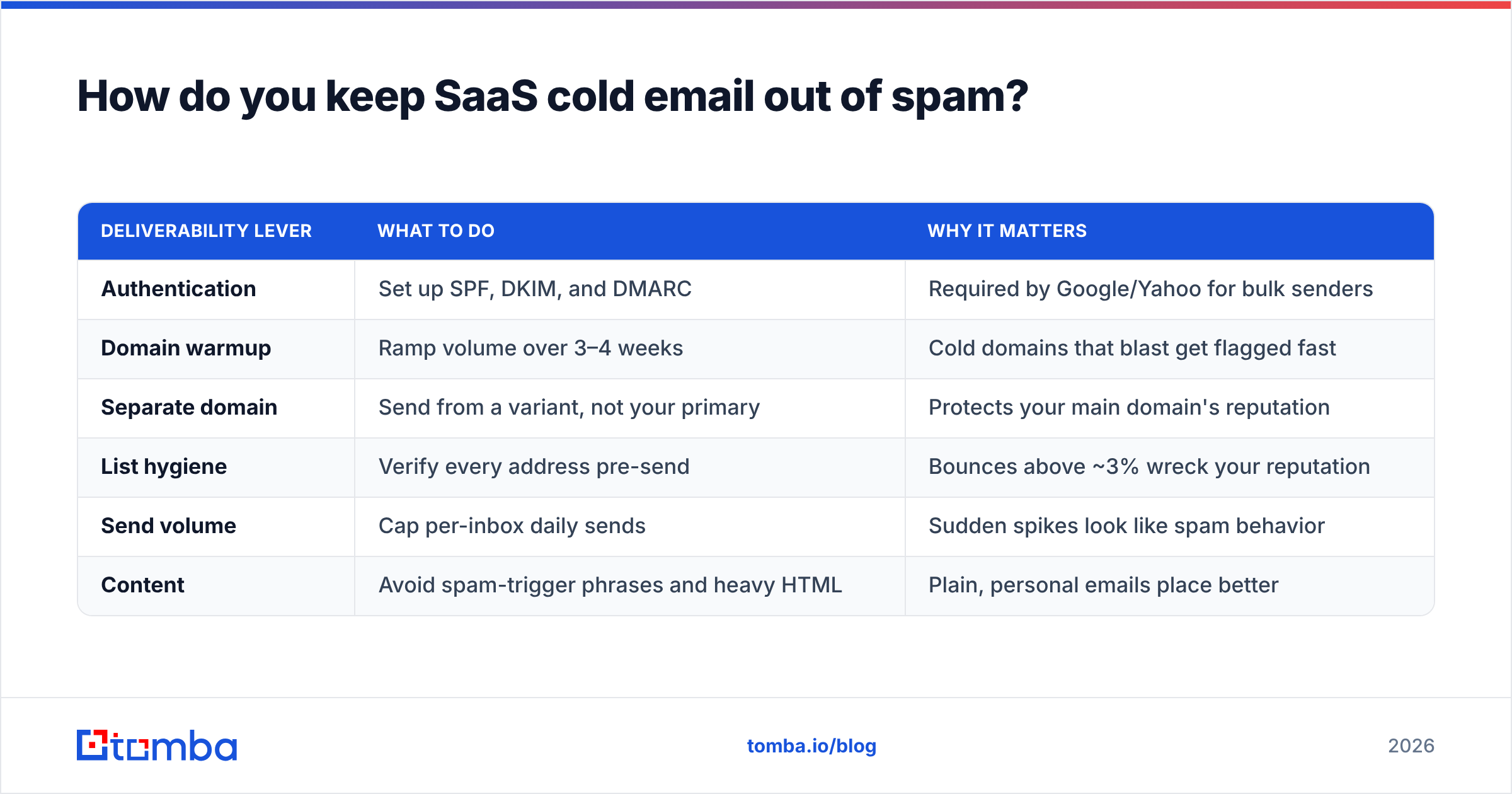
Deliverability is where most SaaS outbound quietly dies. You can write the perfect email, but if it lands in spam, none of it matters. Protecting your email deliverability comes down to a repeatable checklist.
| Deliverability lever | What to do | Why it matters |
|---|---|---|
| Authentication | Set up SPF, DKIM, and DMARC | Required by Google/Yahoo for bulk senders |
| Domain warmup | Ramp volume over 3–4 weeks | Cold domains that blast get flagged fast |
| Separate domain | Send from a variant, not your primary | Protects your main domain's reputation |
| List hygiene | Verify every address pre-send | Bounces above ~3% wreck your reputation |
| Send volume | Cap per-inbox daily sends | Sudden spikes look like spam behavior |
| Content | Avoid spam-trigger phrases and heavy HTML | Plain, personal emails place better |
Two rules carry most of the weight. First, authenticate your domain — Google and Yahoo now effectively require SPF, DKIM, and DMARC for anyone sending at volume, and their official sender guidelines spell out the specifics. Second, verify before you send. A clean list keeps your bounce rate low, and a low bounce rate is what tells mailbox providers you're a legitimate sender.
If you're sending to catch-all domains (common at larger companies), use a catch-all verifier so you're not guessing which addresses are safe.
What sequence and cadence should you run?#
A single email is a coin flip. A sequence is a system. For SaaS, a 4–6 touch cadence over 2–3 weeks is the sweet spot — persistent without being annoying.
A reliable structure:
- Day 1 — Email 1: The core pitch (the template above).
- Day 3 — LinkedIn: A connection request or light comment. No pitch.
- Day 5 — Email 2: A new angle or a piece of proof. Never "just bumping this."
- Day 9 — Email 3: A short, specific case study or a relevant resource.
- Day 14 — Email 4: The break-up. "Should I close the loop on this?"
- Optional Day 16 — Call: For high-value accounts only.
Each touch should add something — a new angle, new proof, or new context. The "just following up" email trains prospects to ignore you.
How do you measure whether it's working?#
Track the metrics that map to revenue, and ignore the ones that don't.
- Positive reply rate — your north star. It reflects targeting and copy quality.
- Meetings booked — the outcome that pays rent.
- Bounce rate — keep it under ~3%; if it climbs, your verification step slipped.
- Reply rate — a useful health check on relevance.
- Open rate — treat as directional only. Apple's Mail Privacy Protection inflates it, so don't optimize your business on it.
Run one experiment at a time — subject line, opening line, or offer — so you know what actually moved the number. HubSpot's ongoing sales benchmark research is a useful reality check when you want to know whether your rates are normal or need work.
Cold email for SaaS: the quick-reference checklist#
Before any campaign goes live, confirm you've done the following:
- List is built from your ICP, not scraped defaults.
- Every address is verified and bounces are removed.
- Domain is authenticated (SPF, DKIM, DMARC) and warmed.
- Copy is under 120 words, one problem, one proof, one ask.
- Sequence runs 4–6 touches across at least two channels.
- Tracking is set on replies and meetings, not opens.
Miss one and results dip. Nail all six and you have a compounding pipeline engine.
Where does Tomba fit?#
The two steps that make or break SaaS cold email — finding the right contacts and verifying them — are exactly where a purpose-built tool pays off. Use the Tomba Email Finder to pull accurate, professional email addresses for your target accounts by name or domain, then verify the whole list before you send so your reputation stays clean and your emails reach the inbox. It's a free tier to test the waters (25 searches a month), and paid plans start at $49/mo when you're ready to scale — see Tomba pricing for the full breakdown.
Build the list right, verify it, warm your domain, and write like a human. That's the whole game — and it still books demos in 2026.
Related guides#
Ready to find emails that actually work?
Join 150,000+ professionals who stopped guessing and started sending. Free credits on signup — no credit card required.
Get the Tomba newsletter
Practical outbound tactics and product updates — once every two weeks.
About the author