Cold Email Frameworks: 7 Proven Structures That Get Replies
AIDA, PAS, BAB and four more cold email frameworks compared — with when to use each, real templates, and the setup that gets them delivered and replied to in 2026.
Most cold emails fail before the first sentence lands — not because the offer is weak, but because the message has no structure. A cold email framework is the skeleton that decides what you say, in what order, and why it earns a reply instead of a delete.
This guide breaks down the seven frameworks that still work in 2026, when to reach for each, and the templates you can steal today.
TL;DR#
- A cold email framework is a repeatable message structure (hook → value → ask) that removes guesswork and makes A/B testing possible.
- AIDA and PAS are the workhorses — start here for most B2B outreach; they convert because they map to how buyers actually make decisions.
- BAB, QVC, SCQA, the 3-B, and the "star-story-solution" frameworks each win specific situations: pain-heavy markets, technical buyers, or crowded inboxes.
- Framework alone won't save a bad list. Deliverability and targeting decide whether your perfectly-structured email is ever seen — verify addresses first.
- The best senders don't pick one framework — they match structure to segment and rotate to avoid pattern fatigue.
What is a cold email framework?#
A cold email framework is a pre-defined structure for organizing a persuasive message — think of it like a recipe. You can improvise a meal from an empty fridge, but a recipe guarantees the salt, fat, acid, and heat land in the right proportions every time. A framework does the same for outreach: it guarantees you open with relevance, build a reason to care, and close with a single clear ask.
Frameworks matter for three concrete reasons:
- Consistency at scale — When you send 500 emails a week, you can't reinvent each one. A framework lets you keep quality high while your bulk lead generation volume grows.
- Testability — You can only improve what you can isolate. With a fixed structure, you know whether a lift came from the subject line, the hook, or the call to action.
- Speed — New reps ramp faster when they fill in a proven template instead of staring at a blank draft.
The catch: a framework is a container, not content. It won't rescue a generic pitch to the wrong person. Structure and targeting are partners, and skipping either one guarantees silence.
Which cold email frameworks actually work in 2026?#
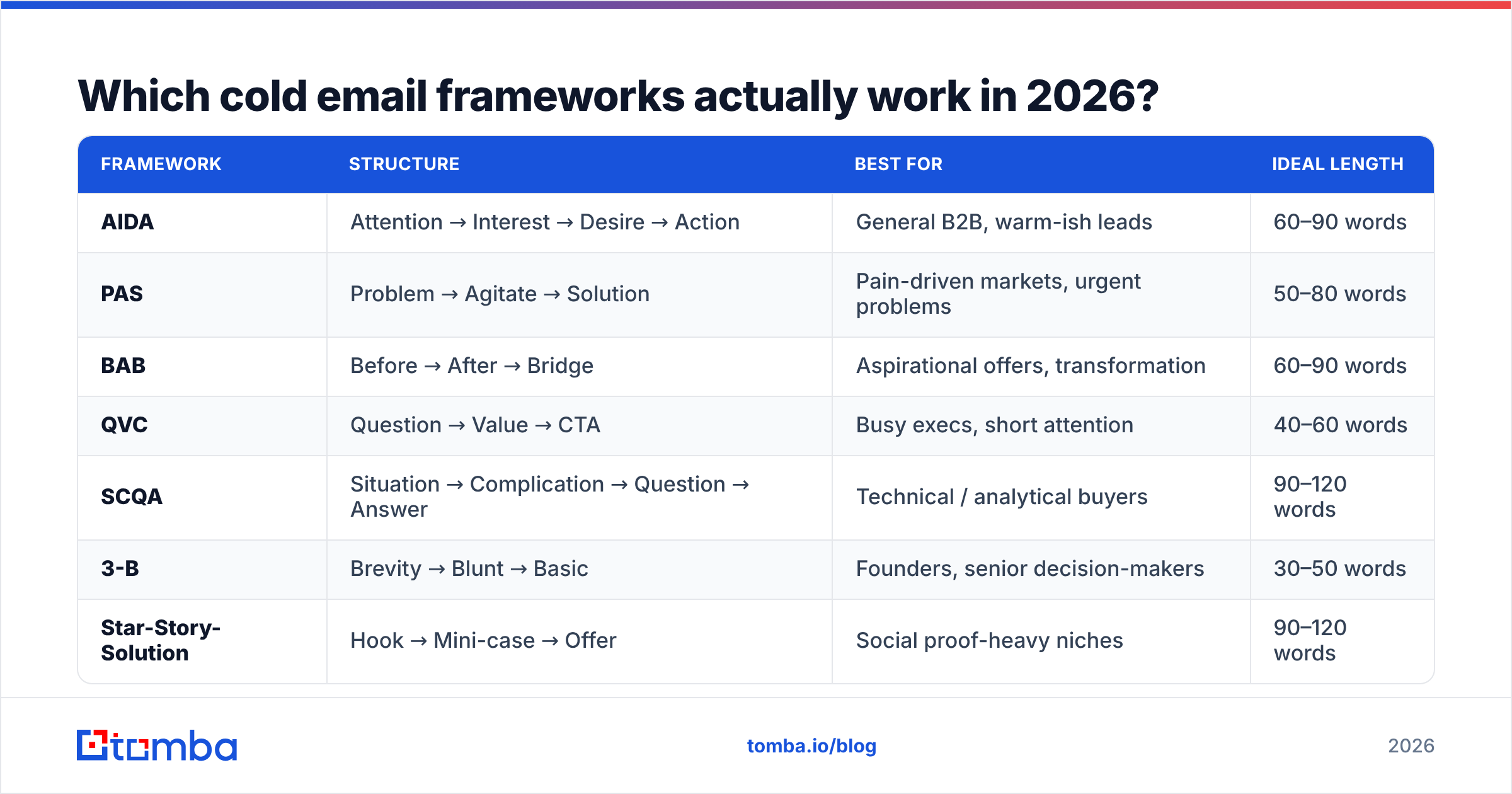
Here are the seven that still earn replies, mapped to when each one wins.
| Framework | Structure | Best for | Ideal length |
|---|---|---|---|
| AIDA | Attention → Interest → Desire → Action | General B2B, warm-ish leads | 60–90 words |
| PAS | Problem → Agitate → Solution | Pain-driven markets, urgent problems | 50–80 words |
| BAB | Before → After → Bridge | Aspirational offers, transformation | 60–90 words |
| QVC | Question → Value → CTA | Busy execs, short attention | 40–60 words |
| SCQA | Situation → Complication → Question → Answer | Technical / analytical buyers | 90–120 words |
| 3-B | Brevity → Blunt → Basic | Founders, senior decision-makers | 30–50 words |
| Star-Story-Solution | Hook → Mini-case → Offer | Social proof-heavy niches | 90–120 words |
1. AIDA — the default that still delivers#
AIDA is the oldest framework in the book, and it survives because it mirrors the buyer's mental journey. You grab attention with a relevant hook, build interest with a specific insight, create desire by showing the payoff, and drive action with one ask.
Subject: quick idea for {{Company}}'s onboarding
Hi {{First}}, noticed {{Company}} just rolled out self-serve signup — nice move. Teams that do this usually see a spike in trial users but a drop in activation. We helped {{Similar company}} lift activation 22% by fixing exactly that gap. Worth a 15-minute look next week?
Use AIDA when you have a genuinely relevant observation and a proof point. It's the safest starting structure for most outbound.
2. PAS — when the pain is real#
Problem-Agitate-Solution is AIDA's sharper cousin. You name a problem, twist the knife on its consequences, then offer relief. It works because loss aversion is a stronger motivator than gain.
Subject: manual lead routing at {{Company}}?
Hi {{First}}, if reps at {{Company}} still assign leads by hand, you're probably losing the fast-lead advantage — 78% of buyers pick the vendor that responds first. Every hour of delay quietly hands deals to competitors. We automate routing so hot leads hit a rep in under 5 minutes. Open to seeing how?
PAS shines in markets where the pain is obvious and expensive. Don't over-agitate — one sentence of consequence is persuasive; three feels manipulative.
3. BAB — sell the transformation#
Before-After-Bridge paints the current struggle, the improved future, and positions your product as the bridge between them. It's ideal for aspirational or outcome-driven offers.
Subject: from 2% to 8% reply rates
Hi {{First}}, most SDR teams grind at 2% reply rates and blame the copy. The teams hitting 8% aren't better writers — they just verify their lists first. That's the whole bridge. Want the 3-step process we use?
4. QVC — respect the busy inbox#
Question-Value-CTA is built for executives who read email on their phones between meetings. Lead with a sharp question, deliver one concrete value statement, and ask.
5. SCQA — for the analytical buyer#
Situation-Complication-Question-Answer, borrowed from consulting, works when your buyer is technical and skeptical. You establish shared context, introduce the tension, pose the question they're already thinking, then answer it. Longer, but it earns trust with people who distrust hype.
6. The 3-B — brevity as a weapon#
Brief, Blunt, Basic. Three sentences, no fluff, one ask. Founders and C-levels often reply to these precisely because they signal you respect their time.
7. Star-Story-Solution — proof does the selling#
Open with a mini-case ("We took {{Company}} from X to Y"), tell the two-line story, then offer the same. Great in niches where social proof outweighs claims.
Is one cold email framework better than the others?#
No — the "best" framework is the one that matches your segment, offer, and buyer's awareness stage. A framework that crushes it for a pain-heavy ops audience can flop with skeptical engineers. Awareness stage is the deciding variable:
- Unaware of the problem → PAS or SCQA (you must surface the pain first).
- Aware of the problem, not solutions → BAB or Star-Story-Solution (show the transformation).
- Aware of solutions, comparing → AIDA or QVC (differentiate and drive action fast).
- Senior / time-poor → 3-B (brevity signals respect).
This is why elite senders keep two or three frameworks in rotation and assign them by segment, rather than forcing every prospect through the same template. Rotation also fights pattern fatigue — if every email you send has an identical shape, gatekeepers and spam filters start to recognize it.
What makes a cold email framework fail?#
The framework is rarely the problem. These four issues sink structurally-perfect emails:
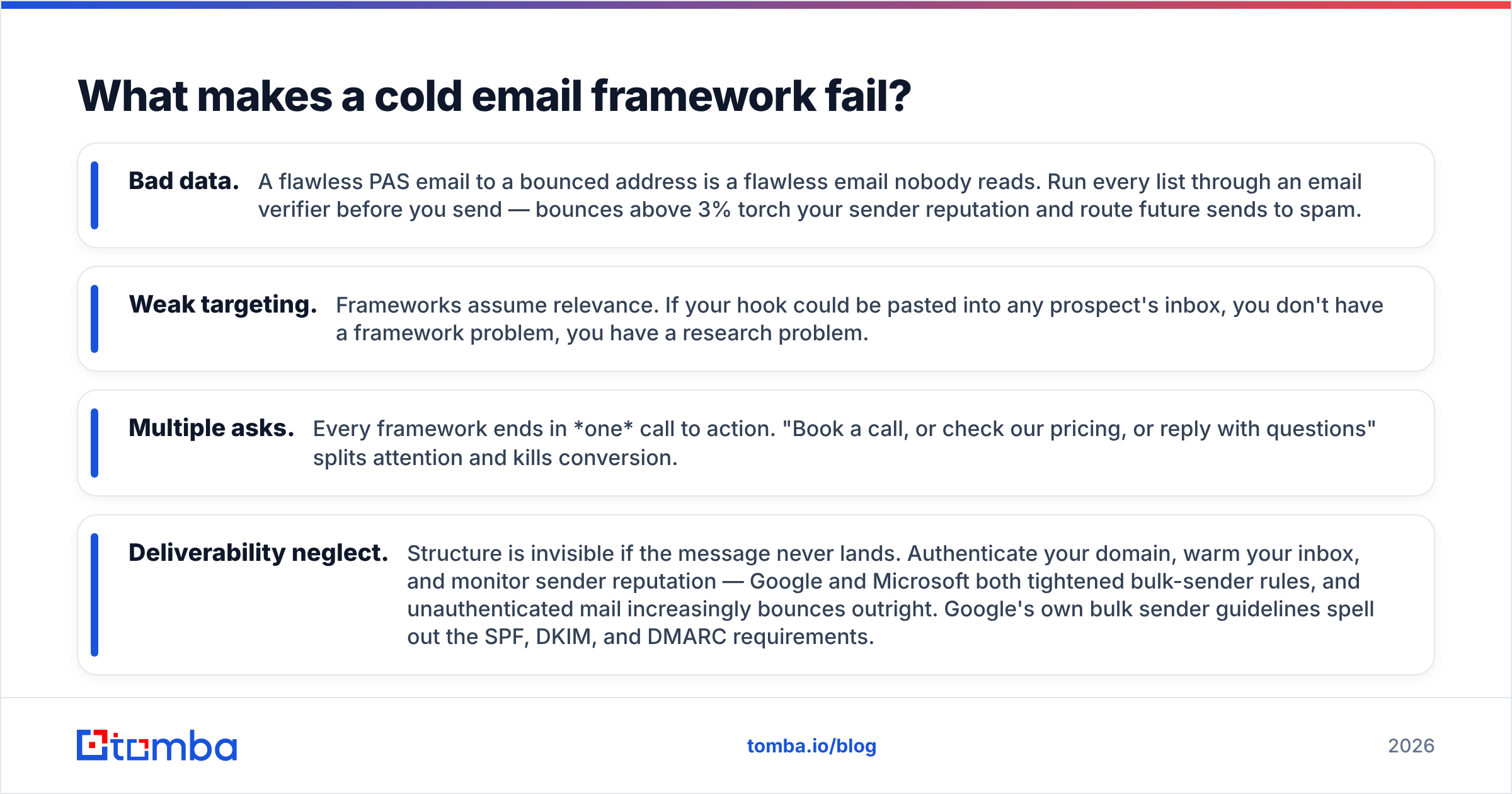
- Bad data. A flawless PAS email to a bounced address is a flawless email nobody reads. Run every list through an email verifier before you send — bounces above 3% torch your sender reputation and route future sends to spam.
- Weak targeting. Frameworks assume relevance. If your hook could be pasted into any prospect's inbox, you don't have a framework problem, you have a research problem.
- Multiple asks. Every framework ends in one call to action. "Book a call, or check our pricing, or reply with questions" splits attention and kills conversion.
- Deliverability neglect. Structure is invisible if the message never lands. Authenticate your domain, warm your inbox, and monitor sender reputation — Google and Microsoft both tightened bulk-sender rules, and unauthenticated mail increasingly bounces outright. Google's own bulk sender guidelines spell out the SPF, DKIM, and DMARC requirements.
Here's the honest hierarchy: list quality → deliverability → targeting → framework → copy. Most people obsess over the last two and ignore the first three. Fix the foundation, and even an average AIDA email outperforms a brilliant one sent to garbage data.
How do you build a repeatable cold email system?#
A framework is one gear in a larger machine. Here's how the pieces fit:
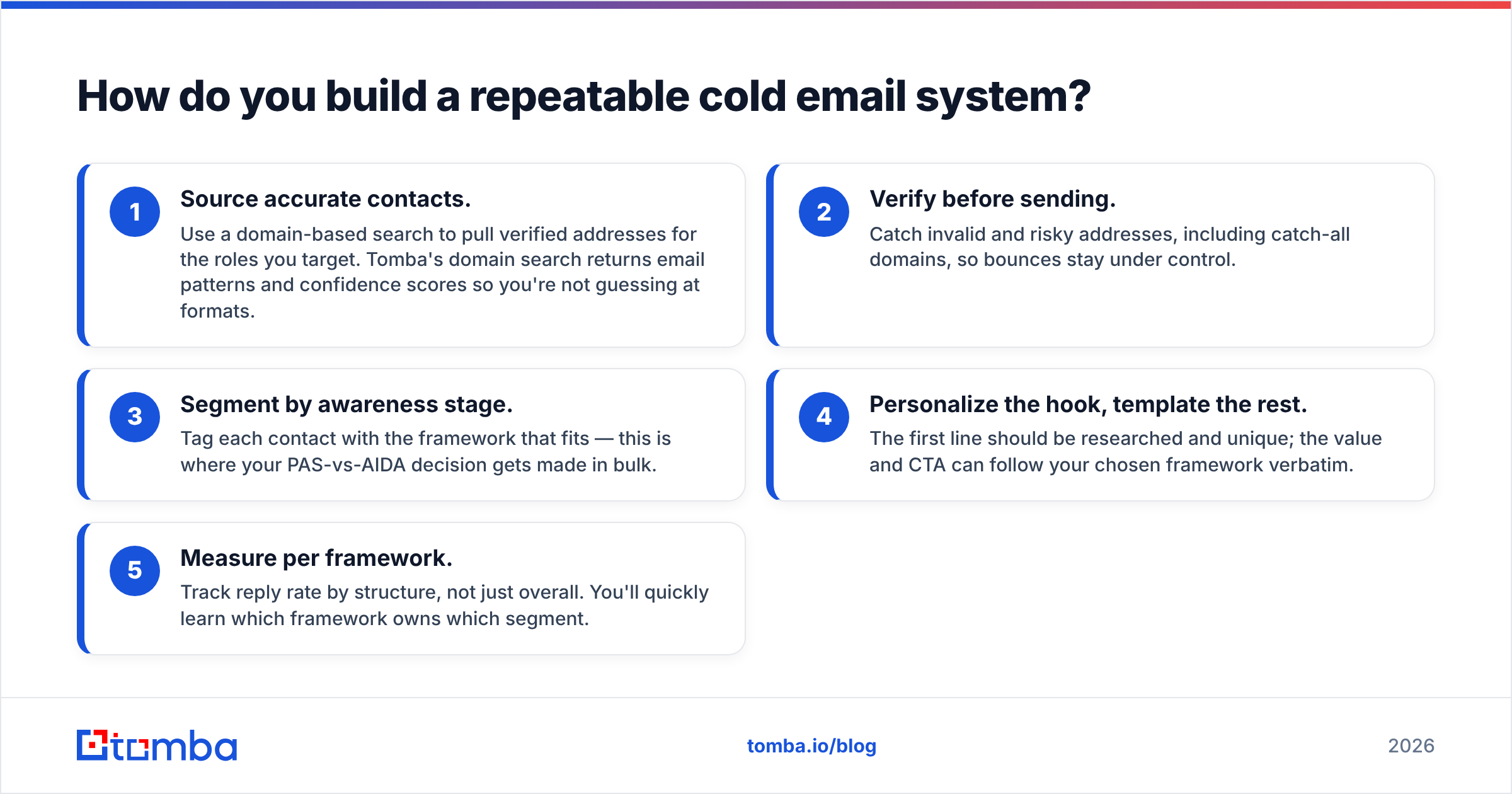
- Source accurate contacts. Use a domain-based search to pull verified addresses for the roles you target. Tomba's domain search returns email patterns and confidence scores so you're not guessing at formats.
- Verify before sending. Catch invalid and risky addresses, including catch-all domains, so bounces stay under control.
- Segment by awareness stage. Tag each contact with the framework that fits — this is where your PAS-vs-AIDA decision gets made in bulk.
- Personalize the hook, template the rest. The first line should be researched and unique; the value and CTA can follow your chosen framework verbatim.
- Measure per framework. Track reply rate by structure, not just overall. You'll quickly learn which framework owns which segment.
If you want to benchmark your setup against tooling options, compare vendors on independent directories like G2's sales intelligence category before committing budget — reviews there reflect real deliverability and data-accuracy experiences.
Cold email frameworks vs. no framework: does it actually move the numbers?#
Yes — structure consistently outperforms freestyle, and the gap widens at scale. Freestyle emails vary wildly: some reps write brilliant one-offs, most write rambling pitches. A framework raises the floor. When every email in a 1,000-send campaign follows PAS, your worst email is still coherent, and your best insights compound across the batch.
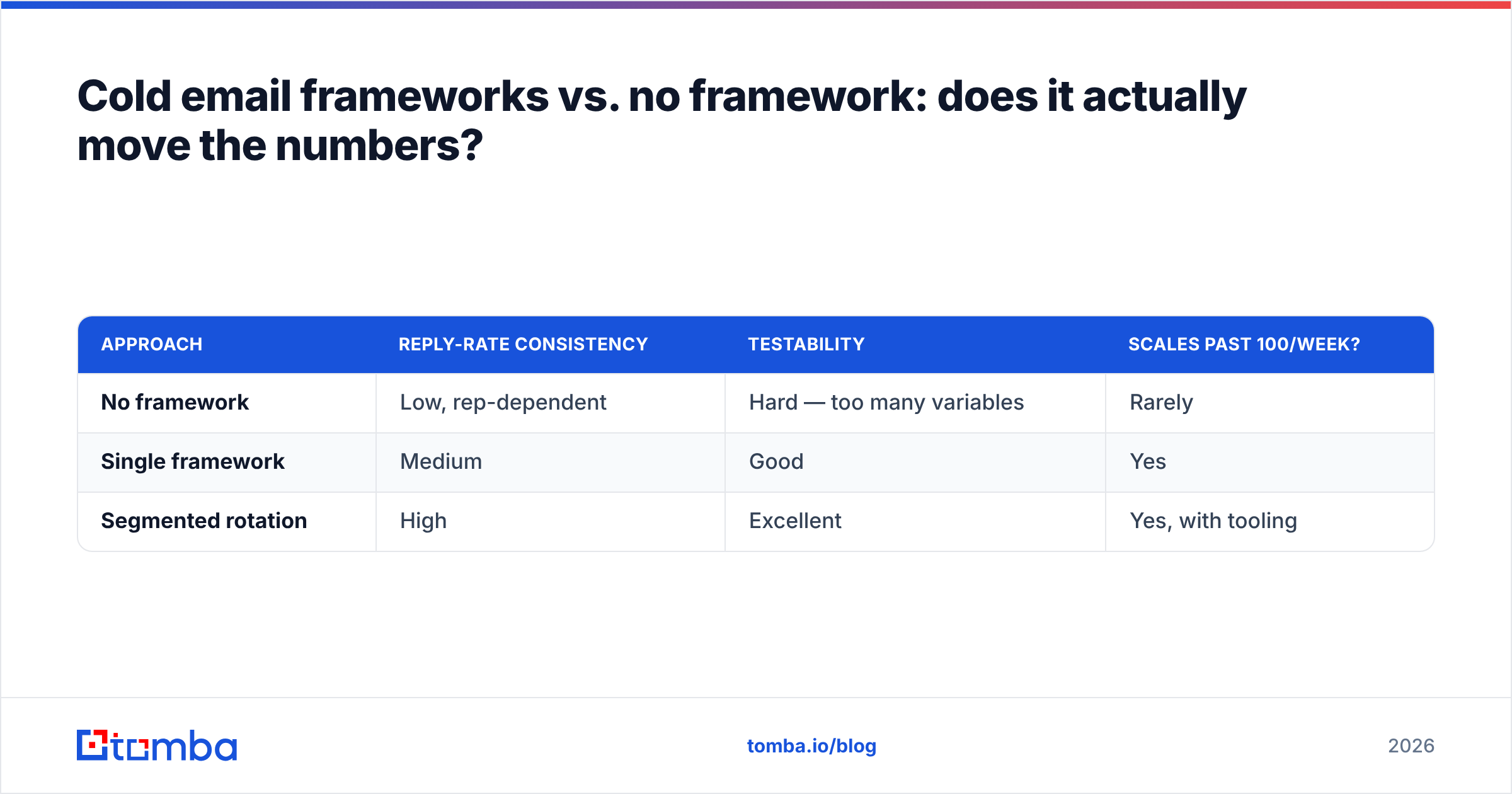
| Approach | Reply-rate consistency | Testability | Scales past 100/week? |
|---|---|---|---|
| No framework | Low, rep-dependent | Hard — too many variables | Rarely |
| Single framework | Medium | Good | Yes |
| Segmented rotation | High | Excellent | Yes, with tooling |
The move from "single framework" to "segmented rotation" is where advanced teams pull ahead — but it only pays off once your data and deliverability are solid. Otherwise you're just A/B testing which template dies fastest in the spam folder.
For the writing itself, keep a swipe file. Tomba's free cold email templates give you framework-ready starting points you can adapt per segment instead of drafting from scratch.
Which framework should you start with?#
If you're standing up outbound today, start with PAS for pain-driven offers and AIDA for everything else. Master those two, measure reply rate by segment for a month, then layer in BAB or the 3-B where the data tells you to. Don't collect frameworks for their own sake — each one you add is another thing to test and maintain.
And remember the hierarchy: the framework is the last 20% of the result. The first 80% is sending relevant, well-structured messages to real, verified people who actually have the problem you solve.
Start with a list worth writing to#
The best cold email framework in the world can't outrun a bad list. Before you agonize over AIDA versus PAS, make sure every address is real, deliverable, and attached to the right person. The Tomba Email Finder pulls verified professional emails by name, company, or domain — with confidence scores and sources — so your carefully-structured emails actually reach a human inbox. Pair it with the built-in email verification to keep bounces low, and check the Tomba pricing tiers: a free plan covers 25 searches a month, and the Starter plan runs $49/mo when you're ready to scale. Build the list right, then let the framework do its job.
Related guides#
Ready to find emails that actually work?
Join 150,000+ professionals who stopped guessing and started sending. Free credits on signup — no credit card required.
Get the Tomba newsletter
Practical outbound tactics and product updates — once every two weeks.
About the author