Cold Email Greeting: How to Open So People Actually Reply
Nine cold email greetings ranked by how they actually perform in B2B inboxes — plus the four openers that quietly kill your reply rate before line two.
TL;DR
- "Hi {FirstName}," beats every other cold email greeting in B2B on average — it's invisible, and invisible is the point.
- "Dear Sir or Madam," "Hey there," "I hope this email finds you well," and "To whom it may concern" are the four openers most likely to get you archived in under two seconds.
- Your greeting is worth roughly 1–3 percentage points of reply rate. Your first line after the greeting is worth 10–20. Spend your energy accordingly.
- Personalization tokens only work if the underlying data is clean. A greeting that renders "Hi ," or "Hi Dr. sarah," is worse than no greeting at all.
- Match the greeting to the channel and seniority: a VP of Engineering and a Chief Revenue Officer do not read the same opener the same way.
What is a cold email greeting, and why does it matter more than it should?#
A cold email greeting is the salutation line — the "Hi Sarah," or "Hey team," — that sits between the subject line and your first real sentence. On paper it carries almost no information. In practice it's the first thing a stranger reads inside your email, and it answers a question they're already asking: does this person actually know who I am?
Think of it like a knock on the door. The knock doesn't tell you anything about the visitor's business. But a confident, normal-sounding knock gets the door opened. A frantic hammering or a limp tap gets ignored. Your greeting is the knock.
Technically, salutations are one of the oldest conventions in written correspondence — the formal salutation traces back through centuries of letter-writing etiquette. Cold email inherited all of that formality and then spent fifteen years trying to shed it, because formality in an inbox reads as distance, and distance reads as mass send.
The stakes are smaller than the internet claims. Nobody replies to a cold email because the greeting was great. But plenty of people delete one because the greeting told them, in three words, that this was a bulk blast. The greeting is a filter, not a hook.
Which cold email greetings actually perform in B2B?#
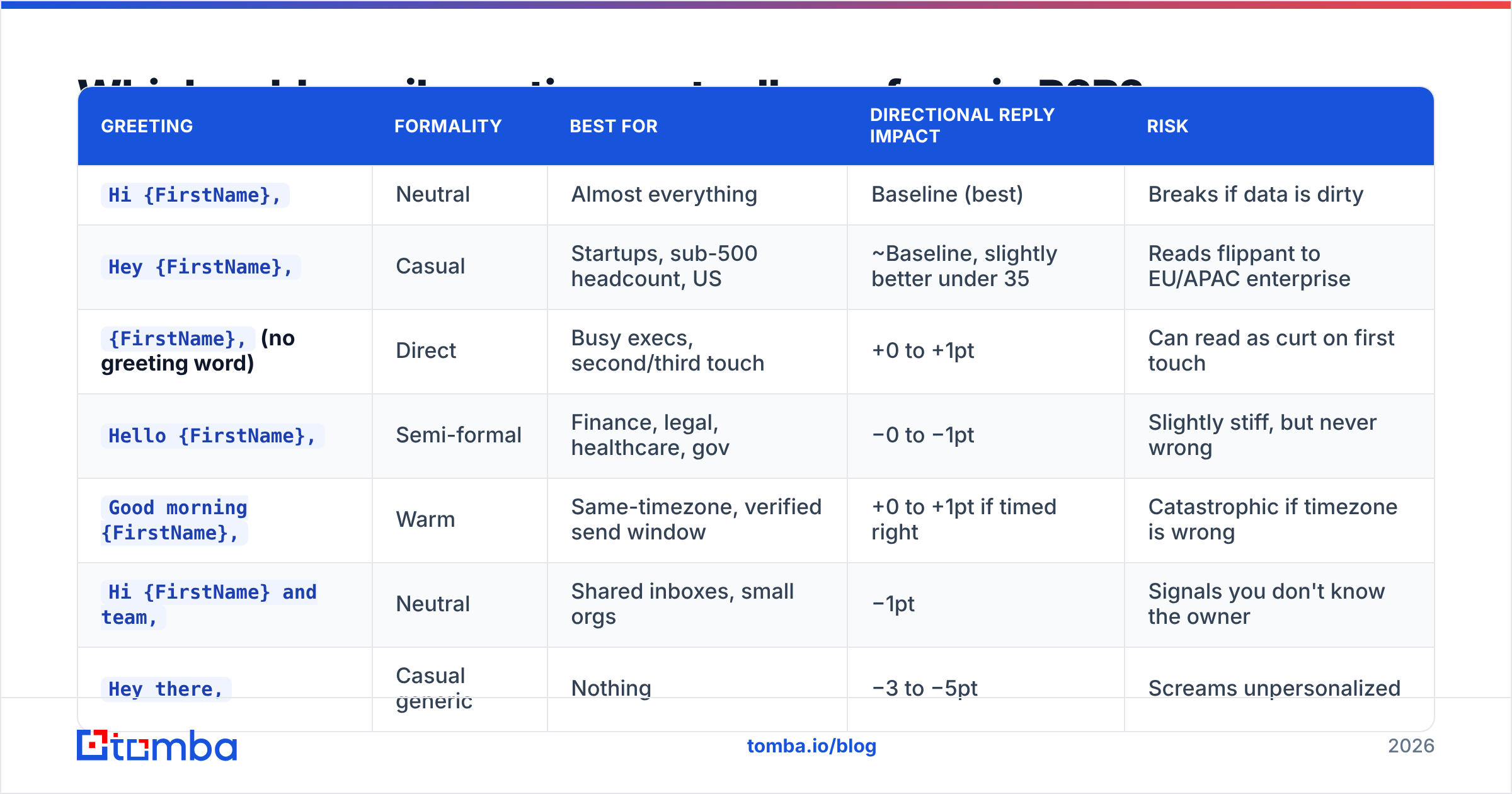
Here's the honest ranking. Reply-rate deltas below are directional — drawn from aggregated B2B outbound benchmarks and consistent across our own testing — not laboratory-precise. Treat them as ordering, not gospel.
| Greeting | Formality | Best for | Directional reply impact | Risk |
|---|---|---|---|---|
Hi {FirstName}, |
Neutral | Almost everything | Baseline (best) | Breaks if data is dirty |
Hey {FirstName}, |
Casual | Startups, sub-500 headcount, US | ~Baseline, slightly better under 35 | Reads flippant to EU/APAC enterprise |
{FirstName}, (no greeting word) |
Direct | Busy execs, second/third touch | +0 to +1pt | Can read as curt on first touch |
Hello {FirstName}, |
Semi-formal | Finance, legal, healthcare, gov | −0 to −1pt | Slightly stiff, but never wrong |
Good morning {FirstName}, |
Warm | Same-timezone, verified send window | +0 to +1pt if timed right | Catastrophic if timezone is wrong |
Hi {FirstName} and team, |
Neutral | Shared inboxes, small orgs | −1pt | Signals you don't know the owner |
Hey there, |
Casual generic | Nothing | −3 to −5pt | Screams unpersonalized |
Dear {FirstName}, |
Formal | Rare: academia, Japan, some legal | −2 to −4pt in US/UK tech | Dated |
Dear Sir or Madam, / To whom it may concern, |
Archaic | Nothing, ever | −5pt or worse | Admits you don't know the recipient |
Two observations from that table.
First, the top four are separated by rounding error. If you are agonizing between "Hi" and "Hello," you are optimizing the wrong variable. Pick "Hi," lock it, move on.
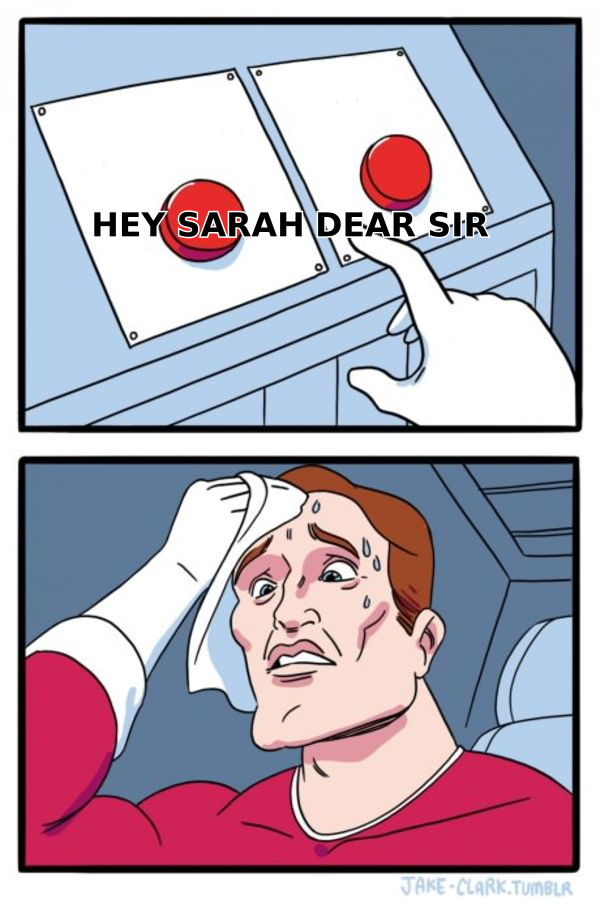
Second, the bottom of the table is where the money is. The gap between a good greeting and a great greeting is ~1 point. The gap between a good greeting and "To whom it may concern" is 5+ points, plus a measurable bump in spam complaints. Cold email greeting optimization is almost entirely a game of not being bad.
What makes a greeting fail?#
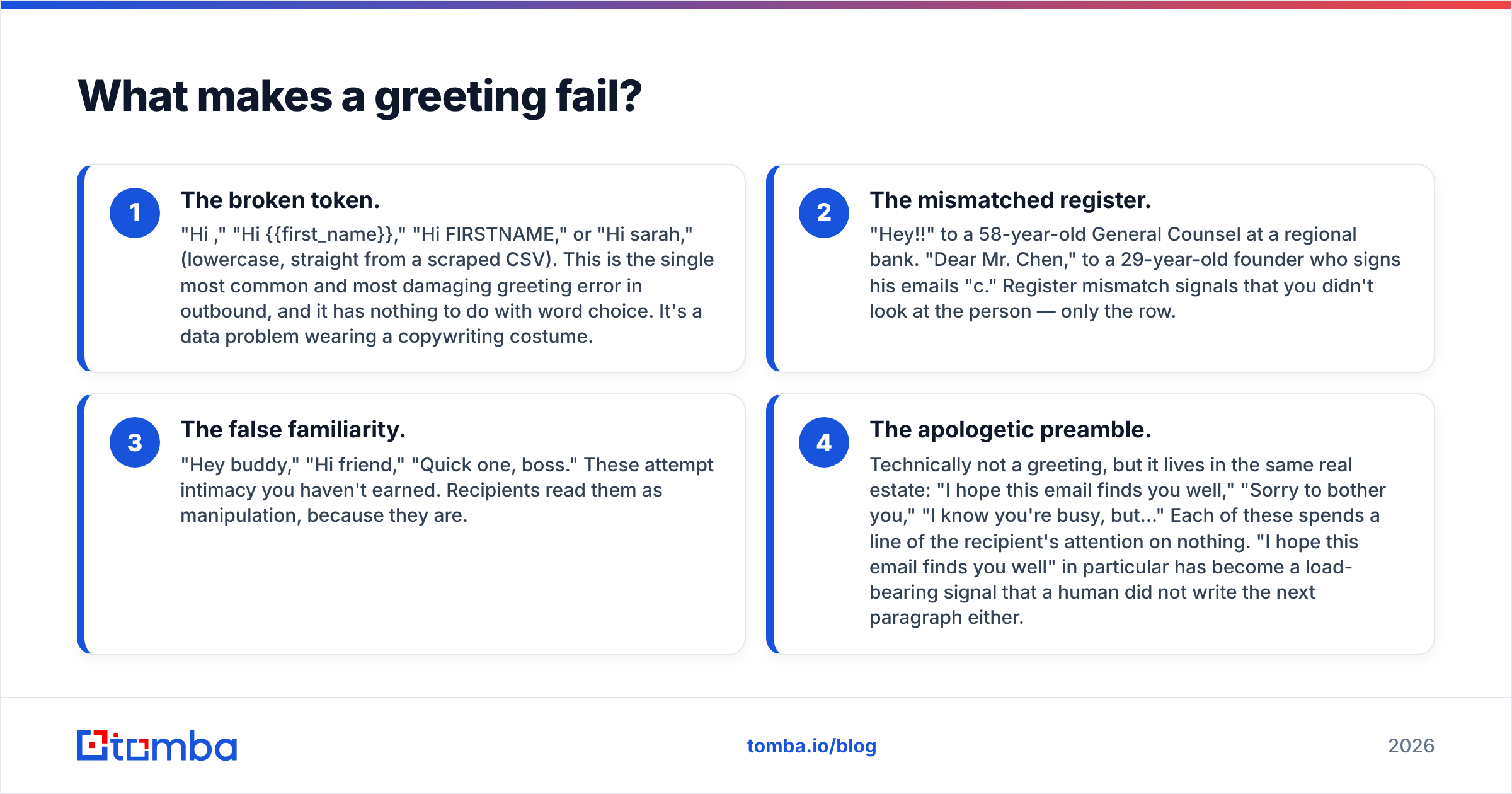
Four failure modes, in order of how often they show up in real sequences.
The broken token. "Hi ," "Hi {{first_name}}," "Hi FIRSTNAME," or "Hi sarah," (lowercase, straight from a scraped CSV). This is the single most common and most damaging greeting error in outbound, and it has nothing to do with word choice. It's a data problem wearing a copywriting costume.
The mismatched register. "Hey!!" to a 58-year-old General Counsel at a regional bank. "Dear Mr. Chen," to a 29-year-old founder who signs his emails "c." Register mismatch signals that you didn't look at the person — only the row.
The false familiarity. "Hey buddy," "Hi friend," "Quick one, boss." These attempt intimacy you haven't earned. Recipients read them as manipulation, because they are.
The apologetic preamble. Technically not a greeting, but it lives in the same real estate: "I hope this email finds you well," "Sorry to bother you," "I know you're busy, but…" Each of these spends a line of the recipient's attention on nothing. "I hope this email finds you well" in particular has become a load-bearing signal that a human did not write the next paragraph either.
The fix for #1 is not a better template. It's better data. If your list has 8% malformed first names — a normal rate for scraped or aged lists — then 8% of your greetings are broken regardless of what you wrote. Running contacts through an email verifier before a send catches invalid addresses; normalizing name casing and stripping honorifics catches the rest. Both belong in your pre-send checklist, not your copy doc.
Should you use the person's first name at all?#
Yes, with two exceptions.
Use the first name by default. It's the lowest-cost personalization signal in existence, and its absence is loud. "Hey there," on a one-to-one email is a confession.
Exception one: shared or role-based inboxes. If you're writing to sales@, hello@, or support@, there is no first name, and inventing one is worse than omitting it. Address the function: "Hi Acme team," or just open with the sentence. Role-based addresses also behave differently in deliverability terms — they're more likely to be spam-trap-adjacent and less likely to convert — which is one reason a good domain search that returns named contacts is worth more than a generic contact page scrape.
Exception two: the second or third touch in a thread. Once you're three emails deep in the same thread, re-greeting the person every time reads like a form letter. Drop it. Open with the sentence: "Following up on the pricing question —" is a better line four than "Hi Sarah," for the fourth time.
There's also a middle path worth testing: the bare-name greeting, Sarah,. It's what colleagues actually write to each other in Slack-adjacent email culture. It reads as direct and slightly senior. It also reads as slightly cold to someone who's never heard of you, which is why it tends to perform better on touch two than touch one.
How does the greeting change by seniority and region?#
Register is contextual. Here's a working map.
- Individual contributors and managers (US/UK tech): "Hi" or "Hey." Casual is safe. Formality creates suspicion — nobody writes "Dear" to a colleague, so "Dear" flags outsider.
- Directors and VPs: "Hi." Skip "Hey." They receive 40+ cold emails a week and read them with a triage mindset; friendliness doesn't buy you anything, brevity does.
- C-suite: "Hi {FirstName}," or the bare
{FirstName},. Then immediately a sentence that justifies the interruption. A CRO will forgive a slightly cold greeting. They will not forgive a wasted second line. - Finance, legal, healthcare, government, defense: "Hello" or "Hi." Never "Hey." These are compliance-adjacent cultures where informality reads as unseriousness.
- Germany, Japan, France, much of APAC enterprise: formality expectations rise sharply. "Dear Mr./Ms. {LastName}," is not dated there — it's expected. Localize or don't send.
- LinkedIn-originated conversations that move to email: carry the register over. If you've been "Hey Sarah" in DMs, "Dear Ms. Chen" in email is jarring.
The general rule: match the register of the person's own outbound writing. If you can see how they write on LinkedIn, in their blog byline, or in a public changelog, mirror it. This is the one piece of greeting personalization with real signal, and it costs you thirty seconds.
What should come immediately after the greeting?#
This is where the actual reply rate lives, and it's why the greeting debate is mostly theater.
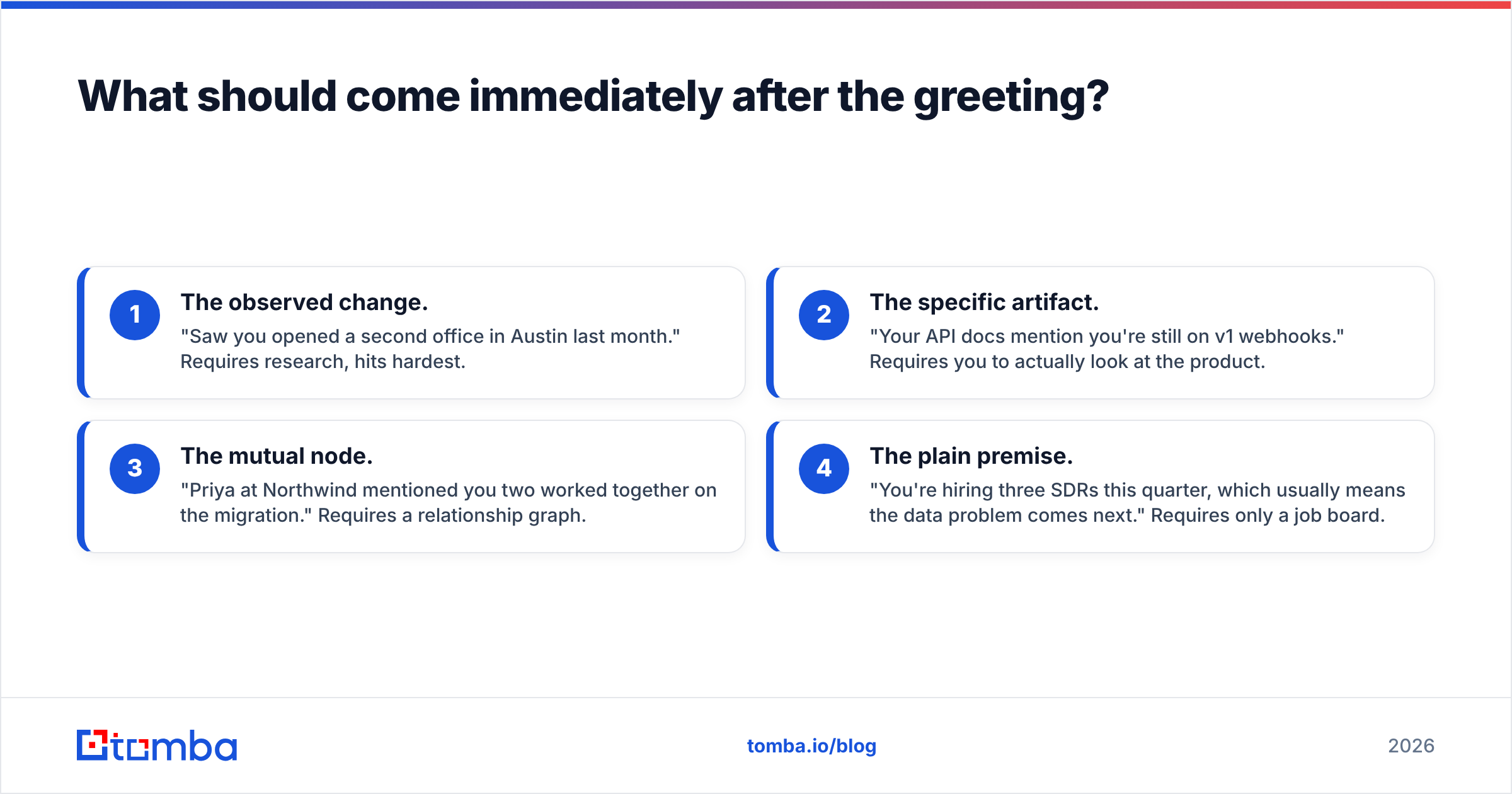
Your first sentence has one job: prove, in under fifteen words, that this email was written for this person. Not "we help companies like yours." Not "I came across your website." Something falsifiable.
Four patterns that work, in rough order of difficulty:
- The observed change. "Saw you opened a second office in Austin last month." Requires research, hits hardest.
- The specific artifact. "Your API docs mention you're still on v1 webhooks." Requires you to actually look at the product.
- The mutual node. "Priya at Northwind mentioned you two worked together on the migration." Requires a relationship graph.
- The plain premise. "You're hiring three SDRs this quarter, which usually means the data problem comes next." Requires only a job board.
Notice that none of these are greetings. The greeting bought you the right to write sentence one. Sentence one buys you sentence two.
If you're testing anything in your cold email, test this line — not "Hi" versus "Hello." Pair it with subject line testing and you're optimizing the two variables that actually move opens and replies.

Which greeting formulas can you copy right now?#
Copy-paste starting points. Replace the bracketed parts or you'll get exactly what you deserve.
Cold, first touch, US tech, IC to VP:
Hi Sarah,

[Specific observation about their company, ≤15 words.]

[One sentence on why that creates the problem you solve.]

Worth a 15-minute call Thursday?
Cold, first touch, enterprise / regulated:
Hello Sarah,

[Specific observation, ≤15 words.]

[One sentence on the problem, framed as risk or compliance cost.]

Would it make sense to connect briefly next week?
Second touch, same thread:
Sarah — following up on [specific thing].

[One new piece of information, not a repeat.]

Still worth 15 minutes?
Shared inbox:
Hi Acme team,

[Observation.] Hoping you can point me to whoever owns [function].
Referral / warm intro:
Hi Sarah,

Priya at Northwind suggested I reach out.

[One sentence on why, referencing what Priya said.]
More full-sequence structures live in our cold email templates library, which handles the parts after the greeting — the ask, the proof, the close.
Does the greeting affect deliverability?#
Indirectly, and less than you'd hope. Mailbox providers do not have a "Dear Sir or Madam" rule. What they do have is engagement modeling: if a specific pattern in your mail generates deletes-without-reads and spam complaints, your sender reputation degrades. A greeting that reliably triggers "this is bulk" will, over thousands of sends, hurt you.
Two things matter far more:
- List hygiene. Bounces from invalid addresses damage sender reputation directly and immediately. Nothing in your copy compensates for a 12% bounce rate.
- Volume and ramp. Sending 500 cold emails from a two-week-old domain will land you in spam regardless of how charming "Hi Sarah," is.
Google's bulk sender guidelines and the equivalent Microsoft policies are explicit about authentication, complaint rates, and unsubscribe handling. None of them mention salutations. Fix authentication and list quality first; greetings are a copy problem, not a deliverability problem.
Where the two intersect: a broken merge token ("Hi ,") often correlates with a broken record — one where the email itself was guessed, not verified. Those records bounce. Clean data fixes both symptoms at once.
What's the actual verdict?#
Use "Hi {FirstName},". Verify the token renders. Move to the next line and spend your real effort there.
The reason so much has been written about the cold email greeting is that it's the easiest part of the email to have an opinion about. It's three words. Everyone can argue. Meanwhile the reason your sequence underperforms is almost certainly one of: you're emailing the wrong people, your addresses bounce, your first line is generic, or your ask is too big.
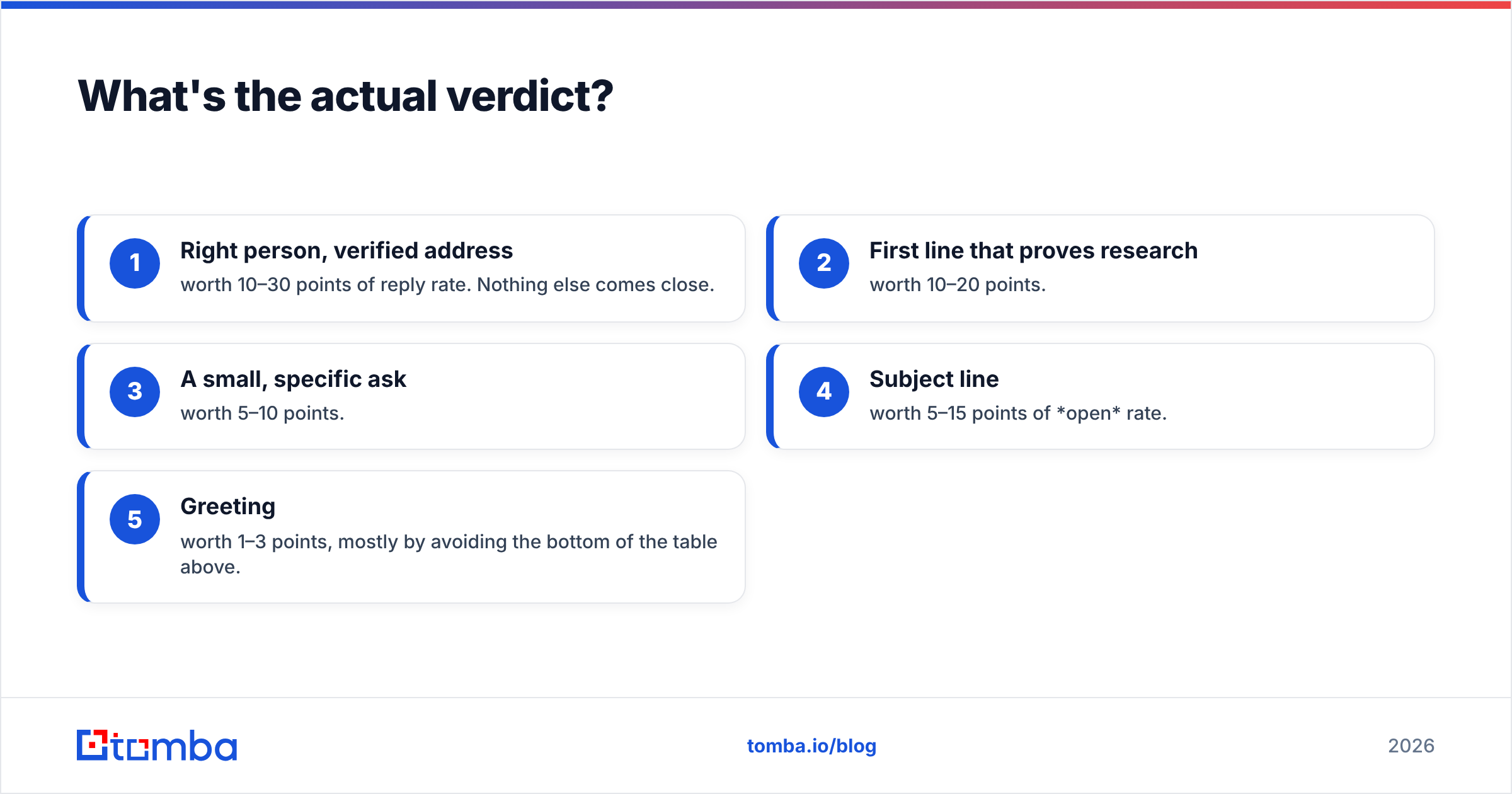
Rank your fixes by leverage:
- Right person, verified address — worth 10–30 points of reply rate. Nothing else comes close.
- First line that proves research — worth 10–20 points.
- A small, specific ask — worth 5–10 points.
- Subject line — worth 5–15 points of open rate.
- Greeting — worth 1–3 points, mostly by avoiding the bottom of the table above.
Marketing content is inverted relative to that list. Greetings get the blog posts; data quality gets the budget line nobody wants to defend. Guess which one shows up in the pipeline number.
Everything above assumes one thing: that Sarah is real, that she works where you think she works, and that sarah@acme.com is her actual address rather than a permutation you generated and hoped for. That's the assumption that quietly breaks most outbound programs — and the one that costs the most to get wrong, because a bounced email has a reply rate of exactly zero no matter how elegant the salutation.
Get the name right before you agonize over what to put in front of it. Tomba's Email Finder returns verified, correctly-cased professional email addresses by name and domain, with a confidence score attached to each one — so "Hi Sarah," renders as "Hi Sarah," every time, and lands in a mailbox that exists. Start on the free tier (25 searches a month) and see how many rows in your current list survive contact with reality. See Tomba pricing when you're ready to scale past that.
Related guides#
// get started
Find, verify and enrich your first contacts today
Start on the free plan with 25 searches a month, then scale when your team is ready.
Free plan · No credit card required · GDPR & CCPA
// about the author