Cold Email Icebreakers That Actually Get Replies in 2026
Most cold email openers are recycled flattery. Here's the data-backed breakdown of which cold email icebreakers earn replies, which ones burn the prospect's attention, and how to research them without spending an hour per lead.
TL;DR
- An icebreaker is the first 1–2 sentences of a cold email. Its only job is to prove a human made a decision to write to this person, then hand off to the value line.
- Compliments, "I saw you're hiring," and "congrats on the funding" are dead. They're what everyone automates, so prospects pattern-match them as spam in under a second.
- The icebreakers that still work reference something the prospect did, decided, or published — and connect it to a specific consequence for their business.
- Length matters more than cleverness: 12–22 words. Anything longer eats the preview pane before your ask lands.
- You can research a good icebreaker in 90 seconds if you know the four sources to check. Everything else is theater.
What is a cold email icebreaker?#
An icebreaker is the opening line of a cold email — the sentence that runs before your pitch, your ask, or your credibility statement. It sits in the mobile preview pane next to the subject line, which means it is doing roughly half the work of getting your email opened at all.
Think of it like the first three seconds of a phone call from an unknown number. You are not making your case in those three seconds. You are answering one question the other person is already asking: is this a person, or is this a machine? Everything after that is downstream of the answer.
Technically, the icebreaker performs three functions at once:
- It buys attention. It has to be interesting enough that the prospect keeps reading past line one.
- It proves research. It signals that the sender spent non-zero effort on this specific recipient, which triggers reciprocity — the same principle behind the foot-in-the-door technique.
- It sets up the pivot. A good icebreaker makes the next sentence feel inevitable rather than bolted on.
Most cold emails fail at #3. The rep finds a genuinely interesting fact about the prospect, opens with it, and then writes "Anyway, we help companies like yours…" The word anyway is the sound of an icebreaker that was never connected to anything.
Why do most cold email icebreakers fail?#
Because they're not personalization. They're personalization-shaped.
Here's the test: if you can swap the company name into the sentence and send it to 400 other people without editing anything else, it isn't an icebreaker. It's a mail merge with extra steps. "I noticed Acme is hiring three SDRs" is technically true and technically about Acme, but the prospect has received that exact sentence eleven times this quarter from eleven different vendors who all scraped the same job board.
The second failure mode is what I'd call the compliment tax. Praising someone's LinkedIn post costs the reader something: they now have to decide whether you're sincere. That's cognitive work you've assigned to them before delivering any value. Gong's research on cold outreach has consistently found that opener flattery correlates with lower reply rates, not higher — the sincerity check is expensive and the payoff is nothing.
The third is temporal drift. "Congrats on the Series B" sent seven months after the Series B tells the prospect exactly one thing: you bought a list.

Which cold email icebreaker types actually get replies?#
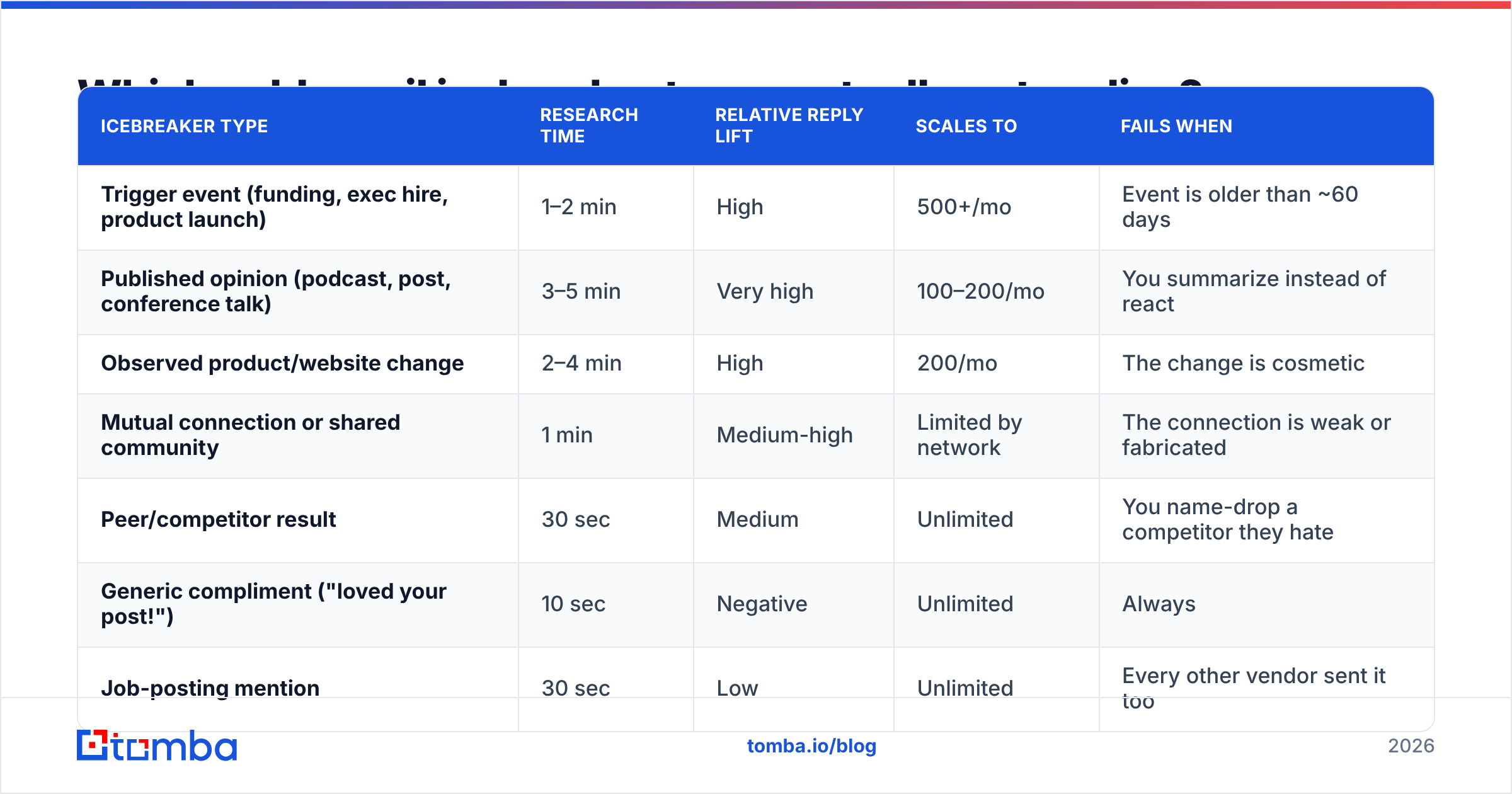
Not all research is equally expensive, and not all of it converts. Here's how the common categories stack up when you weigh reply lift against the minutes it costs you per prospect.
| Icebreaker type | Research time | Relative reply lift | Scales to | Fails when |
|---|---|---|---|---|
| Trigger event (funding, exec hire, product launch) | 1–2 min | High | 500+/mo | Event is older than ~60 days |
| Published opinion (podcast, post, conference talk) | 3–5 min | Very high | 100–200/mo | You summarize instead of react |
| Observed product/website change | 2–4 min | High | 200/mo | The change is cosmetic |
| Mutual connection or shared community | 1 min | Medium-high | Limited by network | The connection is weak or fabricated |
| Peer/competitor result | 30 sec | Medium | Unlimited | You name-drop a competitor they hate |
| Generic compliment ("loved your post!") | 10 sec | Negative | Unlimited | Always |
| Job-posting mention | 30 sec | Low | Unlimited | Every other vendor sent it too |
| Weather, sports, "hope you're well" | 0 sec | Negative | Unlimited | Always |
The pattern is not "more research equals more replies." It's that reply lift tracks with specificity of consequence. A funding round is a fact. A funding round plus the specific hiring bottleneck it creates in month three is an observation only someone paying attention would make.
What does a strong icebreaker actually look like?#
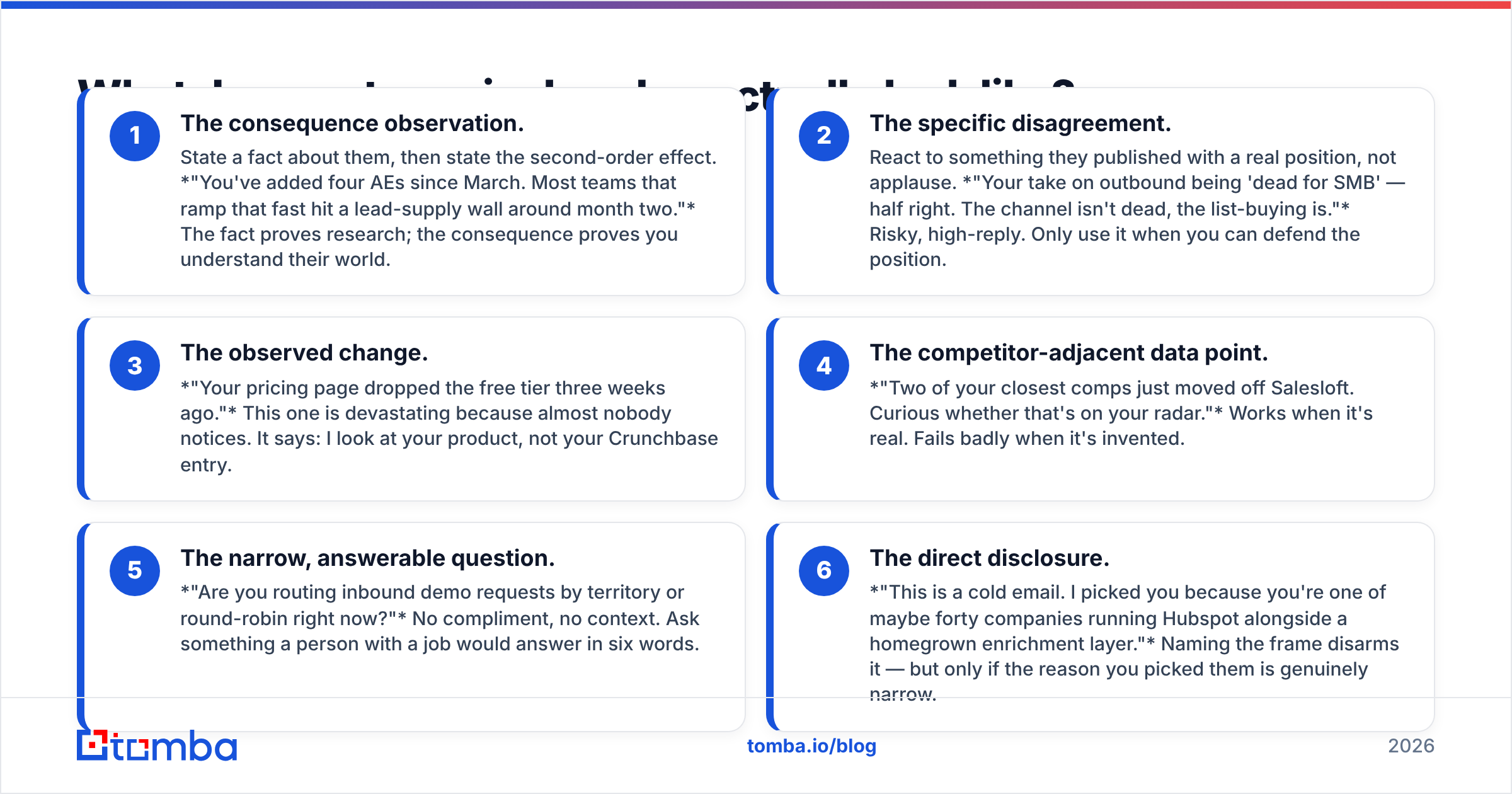
Here are the six structural patterns that survive contact with a real inbox. Each one is built to hand off cleanly to a value line.
The consequence observation. State a fact about them, then state the second-order effect. "You've added four AEs since March. Most teams that ramp that fast hit a lead-supply wall around month two." The fact proves research; the consequence proves you understand their world.
The specific disagreement. React to something they published with a real position, not applause. "Your take on outbound being 'dead for SMB' — half right. The channel isn't dead, the list-buying is." Risky, high-reply. Only use it when you can defend the position.
The observed change. "Your pricing page dropped the free tier three weeks ago." This one is devastating because almost nobody notices. It says: I look at your product, not your Crunchbase entry.
The competitor-adjacent data point. "Two of your closest comps just moved off Salesloft. Curious whether that's on your radar." Works when it's real. Fails badly when it's invented.
The narrow, answerable question. "Are you routing inbound demo requests by territory or round-robin right now?" No compliment, no context. Ask something a person with a job would answer in six words.
The direct disclosure. "This is a cold email. I picked you because you're one of maybe forty companies running Hubspot alongside a homegrown enrichment layer." Naming the frame disarms it — but only if the reason you picked them is genuinely narrow.
Notice what none of these do: none of them open with "I." The subject of the first sentence should almost always be the prospect, their company, or their decision. You get to exist starting in sentence two.
How long should a cold email icebreaker be?#
Twelve to twenty-two words. One sentence, maybe two if the second is short.
The constraint is not aesthetic. Mobile clients render roughly 35–90 characters of preview text depending on device, and a majority of B2B cold email is first opened on a phone. If your icebreaker runs three lines, the prospect sees the setup and none of the payoff, which is the worst possible position: you've spent their attention and delivered nothing.
There's a secondary effect. Long icebreakers force you into an obvious pivot ("Anyway…", "The reason I'm reaching out…"). Short ones don't leave room for the seam to show. If you're struggling to compress, the problem usually isn't the writing — it's that your observation wasn't sharp enough to state in one clause. Vague research produces long sentences.
A practical drill: write the icebreaker, then delete every word that isn't a noun, verb, number, or proper noun. If the sentence still means something, you had an observation. If it collapses, you had filler.
Where do you find icebreaker material fast?#
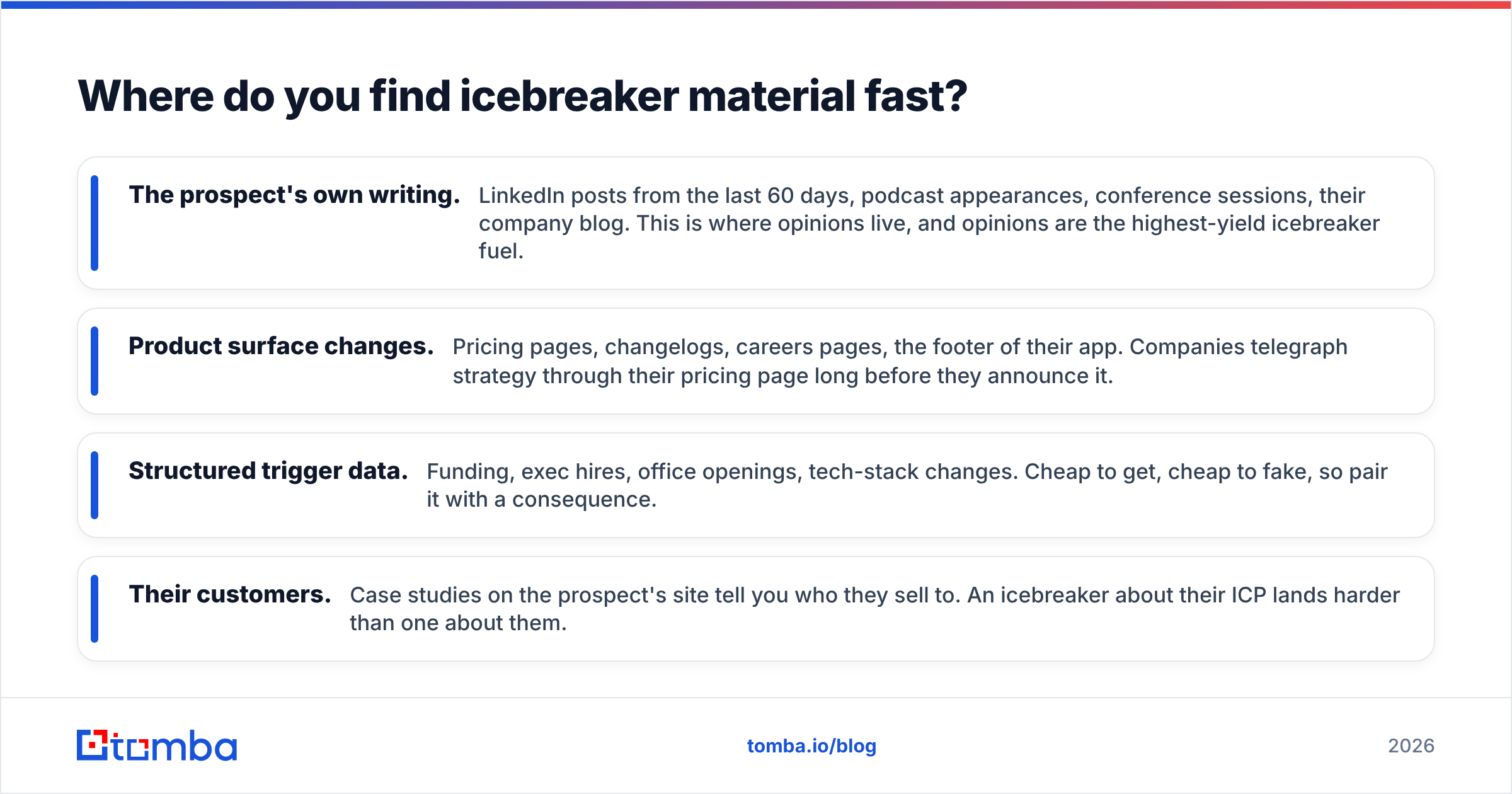
Four sources cover about 90% of cases, in rough order of yield per minute:
- The prospect's own writing. LinkedIn posts from the last 60 days, podcast appearances, conference sessions, their company blog. This is where opinions live, and opinions are the highest-yield icebreaker fuel.
- Product surface changes. Pricing pages, changelogs, careers pages, the footer of their app. Companies telegraph strategy through their pricing page long before they announce it.
- Structured trigger data. Funding, exec hires, office openings, tech-stack changes. Cheap to get, cheap to fake, so pair it with a consequence.
- Their customers. Case studies on the prospect's site tell you who they sell to. An icebreaker about their ICP lands harder than one about them.
You'll notice none of these is "an AI wrote a compliment about their headshot." Automated compliment generators produce text that reads like a compliment and carries zero information. Prospects have learned the tell.
What should be automated is everything upstream of the writing: finding the person, confirming the address is real, and enriching the row so you know their title and company before you invest research minutes. Spending four minutes crafting a sharp opener for a bounced address is the most expensive mistake in outbound. Run your list through an email verifier before anyone writes a word.
Can you personalize icebreakers at scale?#
Partially, and honesty about the tradeoff matters more than the tooling.

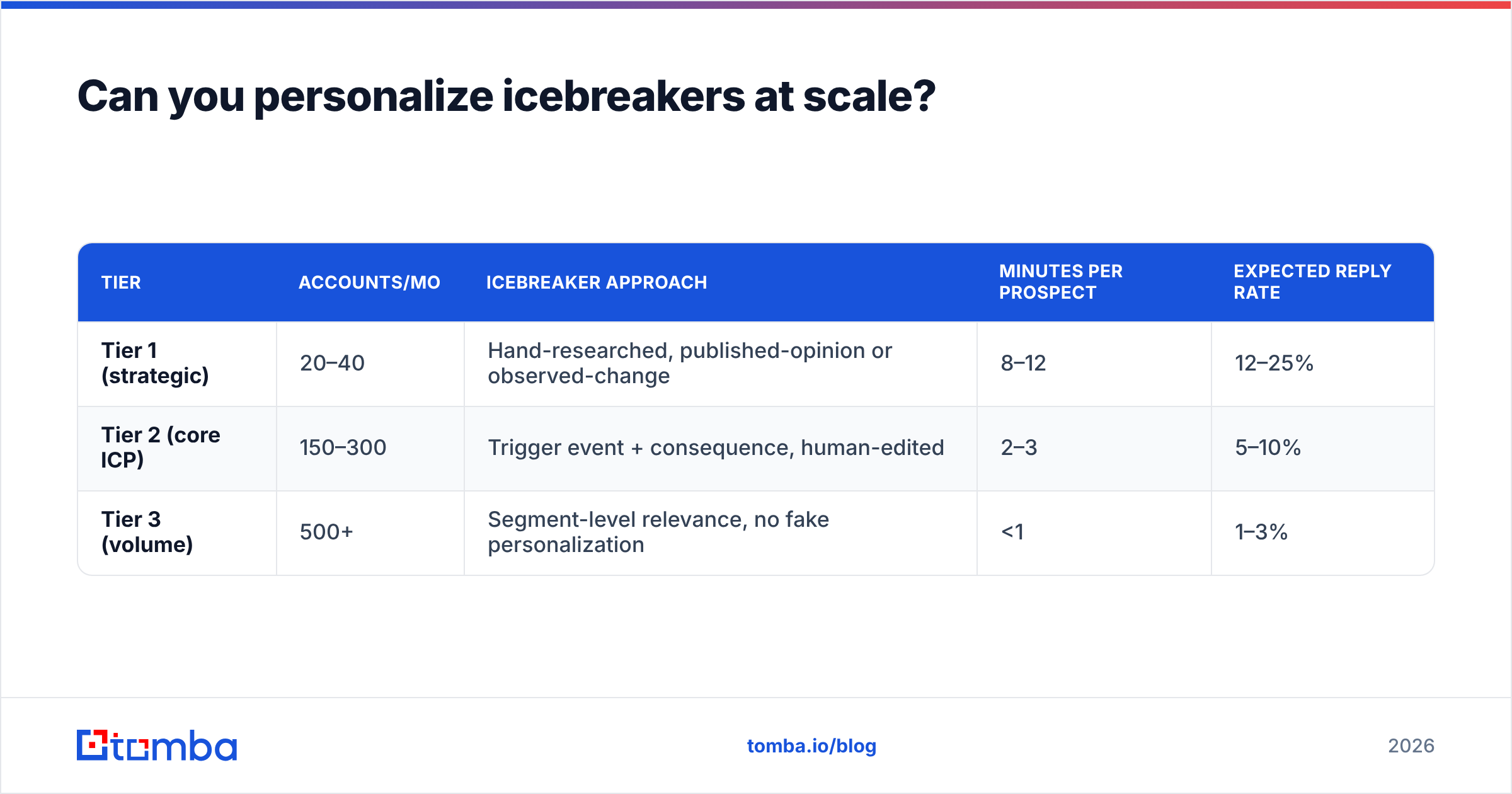
The realistic model is tiered. Split your list by account value and spend research time proportionally:
| Tier | Accounts/mo | Icebreaker approach | Minutes per prospect | Expected reply rate |
|---|---|---|---|---|
| Tier 1 (strategic) | 20–40 | Hand-researched, published-opinion or observed-change | 8–12 | 12–25% |
| Tier 2 (core ICP) | 150–300 | Trigger event + consequence, human-edited | 2–3 | 5–10% |
| Tier 3 (volume) | 500+ | Segment-level relevance, no fake personalization | <1 | 1–3% |
Tier 3 is the one people get wrong. When you can't personalize, don't fake it — write to the segment instead. "You're one of about 200 Series A fintechs running compliance reviews manually" is honest, relevant, and doesn't pretend to know the individual. It beats a hollow compliment every time.
For Tier 2, AI is genuinely useful as a drafting step on top of real research, not as a research substitute. Feed it the fact you found and let it compress; don't ask it to invent the fact. A cold email AI assist works when the input is a real observation. It produces slop when the input is a company name.
And if the opener is strong but the subject line is generic, you never get read at all. Run a few variants through a subject line generator and pick the one that doesn't sound like it was written by a marketer.
Which icebreakers should you retire in 2026?#
Four, immediately:
"Hope you're doing well." It is a load-bearing nothing. Delete it and the email improves. There is no counterargument.
"I came across your profile." Everyone came across everyone's profile. This sentence contains no information and burns your first line, which is the most expensive real estate you own.
"Congrats on the [funding/award/promotion]." Not because congratulations are bad, but because the automation is universal. If a fact is available through an API, assume every competitor in your category has already sent the prospect a congratulations email about it. Use the fact — just don't lead with the congratulations.
"I noticed you're hiring." Same problem, worse execution. Job boards are the most-scraped trigger source in B2B. HubSpot's sales team has written repeatedly about how quickly a personalization tactic decays once it becomes a default field in every sequencing tool. Hiring mentions decayed in 2021.
The general rule: any icebreaker that a tool can generate from a company domain alone is no longer personalization. It's a signature. Prospects filter on it.
How do you test which icebreakers work?#
Don't A/B test icebreakers in isolation. The icebreaker interacts with the subject line, the ask, and the sender identity, so a clean single-variable test needs more volume than most teams have.
Instead, test at the pattern level. Run 150–200 sends per pattern (consequence observation vs. narrow question vs. specific disagreement) with everything else held roughly constant, and measure at two points:
- Reply rate, obviously. But also —
- Positive reply rate. A sharp disagreement opener can triple total replies while producing worse pipeline, because half those replies are arguments. Track your response rate with sentiment split, not as a single number.
Give each pattern three weeks minimum. Cold email reply timing is long-tailed; two-thirds of replies to a Tuesday send arrive after Thursday. Calling a winner on day four is how teams end up cycling through openers forever.
One more thing worth measuring: how many of your icebreakers reference something more than 45 days old. If the number is above 20%, your data source is stale and no amount of copywriting will fix it.
The part nobody wants to hear#
The best icebreaker in the world sent to a wrong or unverified address is worth exactly zero. Before you spend a quarter optimizing openers, look at your bounce rate. Teams routinely find they're burning 15–25% of their sends on addresses that were never going to land, which silently degrades sender reputation and pushes the good sends to spam. At that point your icebreaker isn't underperforming. It's being read by a filter.
Fix the list first. Then fix the sentence.
Start with clean data. Icebreakers only pay off when the email actually arrives. Tomba's Email Finder finds professional addresses by domain, name, or company, with verification built into the same call — so the openers you spend eight minutes writing land in a real inbox instead of a bounce log. The free tier gives you 25 searches a month to test it against your current list; paid plans start at $49/mo. Check Tomba pricing if you're running volume.
Related guides#
// get started
Find, verify and enrich your first contacts today
Start on the free plan with 25 searches a month, then scale when your team is ready.
Free plan · No credit card required · GDPR & CCPA
// about the author