Cold Email Intro: 9 Opening Lines That Actually Get Replies
Your first sentence decides whether the other 120 words get read. Here are nine cold email intro patterns, ranked by effort and risk, plus the openers that quietly kill your reply rate.
TL;DR
- Your cold email intro has one job: earn the second sentence. It is not the place for your name, your title, or your company's mission.
- The highest-performing intros are observational (something specific and recent about the prospect) or problem-first (a pain they've already admitted publicly). "Hope you're well" is filler that costs you the preview pane.
- Nine intro patterns are compared below across effort, risk, and where they belong in a sequence — because the intro that works for a 50-account ABM list will sink a 5,000-contact send.
- Personalization only works if the data underneath it is real. A perfectly written intro sent to
jsmith@company.comwhen the actual address isjohn.smith@company.comnever gets read. - Test one variable at a time. Intro line, subject line, and CTA all move reply rate, and changing all three at once teaches you nothing.
What is a cold email intro, exactly?#
The cold email intro is the first one or two sentences of the body — everything the recipient sees in the Gmail or Outlook preview line after the subject. That's roughly 90 to 120 characters on desktop, less on mobile.
It is not the greeting. "Hi Sarah," is a salutation. The intro is what comes immediately after, and it functions as a gate: if it fails, the rest of your email — the value prop, the case study, the calendar link — is never read. Reply-rate data across most outbound tooling vendors puts the drop-off here, not at the CTA.
Think of it like the first ten seconds of a cold call. You are not selling. You are buying permission to keep talking.
The most common mistake is treating the intro as an introduction — a place to say who you are. Your prospect does not care who you are yet. They care whether this email is about them.
Why does "I hope this email finds you well" hurt you?#
Three reasons, and none of them are about politeness.
- It burns the preview pane. The average B2B decision-maker triages email from a list view. If your first 90 characters contain zero information, you have spent your only free impression on nothing.
- It signals template. Every recipient of cold email has seen that exact sentence a hundred times. It's a fingerprint. The moment it registers as templated, the reader's default shifts from "read" to "archive."
- It correlates with the rest being generic. Readers have learned this. An intro with no specificity predicts a body with no specificity, and they're usually right.
The same applies to its cousins: "I wanted to reach out," "My name is [X] and I'm the [title] at [company]," "I'll keep this brief," and "Quick question." That last one has been so heavily abused as a subject line and opener that it now reads as a tell rather than a courtesy.

Delete the throat-clearing. Start where the email actually starts.
What are the nine cold email intro patterns that work?#
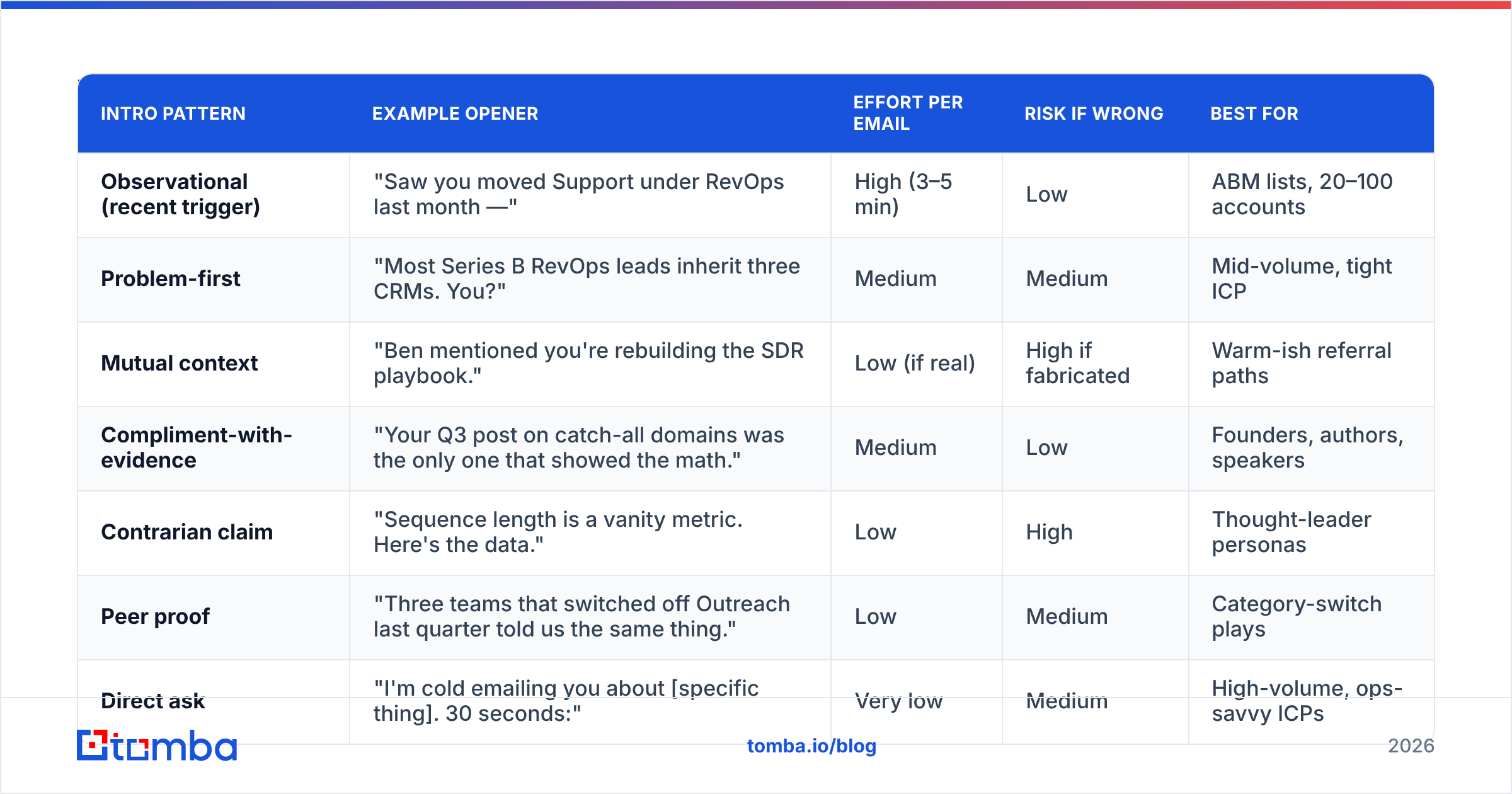
Here they are ranked, with the trade-offs that matter when you're deciding what to run at what volume.
| Intro pattern | Example opener | Effort per email | Risk if wrong | Best for |
|---|---|---|---|---|
| Observational (recent trigger) | "Saw you moved Support under RevOps last month —" | High (3–5 min) | Low | ABM lists, 20–100 accounts |
| Problem-first | "Most Series B RevOps leads inherit three CRMs. You?" | Medium | Medium | Mid-volume, tight ICP |
| Mutual context | "Ben mentioned you're rebuilding the SDR playbook." | Low (if real) | High if fabricated | Warm-ish referral paths |
| Compliment-with-evidence | "Your Q3 post on catch-all domains was the only one that showed the math." | Medium | Low | Founders, authors, speakers |
| Contrarian claim | "Sequence length is a vanity metric. Here's the data." | Low | High | Thought-leader personas |
| Peer proof | "Three teams that switched off Outreach last quarter told us the same thing." | Low | Medium | Category-switch plays |
| Direct ask | "I'm cold emailing you about [specific thing]. 30 seconds:" | Very low | Medium | High-volume, ops-savvy ICPs |
| Question about their stack | "Are you still routing inbound demos through Chili Piper?" | Medium | Low | Tech-stack-triggered plays |
| Numbers-in-their-world | "You're hiring 6 AEs. That's ~$1.4M in quota to cover." | Medium | Low | Hiring-signal outbound |
A few notes on reading that table.
Effort scales inversely with volume, not with quality. The observational intro is the best-performing pattern almost everywhere, and it is also the one you cannot run at 5,000 sends a day. If you have 60 target accounts, write 60 intros by hand. If you have 6,000, pick a pattern from the low-effort rows and accept a lower reply rate on higher volume.
Risk means "what happens when the personalization is wrong." A fabricated mutual connection ("Ben mentioned...") when there is no Ben is not a low reply rate. It's a burned domain and a screenshot on LinkedIn. Only claim context you actually have.
The direct ask is underrated. For technical buyers — RevOps, engineering, security — an opener that says "this is a cold email, here is exactly what I want" outperforms fake warmth. It respects their time and their pattern recognition.
How do you write an observational intro without spending 20 minutes?#
The observational intro is high-effort because most people research the wrong things. They read the About page. Nobody replies to an email about their About page.
What actually generates a usable observation, in rough order of value:
- A change in the last 90 days. New role, new funding round, new office, a reorg, a product launch, a pricing page rewrite. Change creates a problem, and problems create budget.
- Something the person wrote or said. A LinkedIn post, a podcast appearance, a conference talk, a G2 review they left, a comment thread. The author finder approach — matching a byline to a real inbox — exists precisely because published content is the richest signal you can act on.
- A hiring signal. Job posts are the most honest document a company publishes. "Must have experience consolidating overlapping data vendors" tells you the exact pain, in their own words.
- A stack change. New tag in the page source, a new integration listed on their site, a tool removed. A website tech stack checker surfaces this in seconds.
- A public number. Headcount growth, funding amount, ARR disclosed in a press release, review volume on a marketplace. Numbers make an intro concrete without you claiming to know anything private.
- A competitor's move. "Your two closest competitors both shipped AI summaries this quarter" is an observation about their market, not about them, and it lands.
Pick one. Write one sentence. Do not write two — the second sentence is where people start explaining and lose the reader.
The failure mode looks like this:
"Congratulations on the Series B! Growth like that must be exciting. As you scale, data quality becomes a real challenge..."
That's not an observation. That's a press-release paraphrase with a pivot bolted on. The reader can feel the seam.
Better:
"Series B usually means the SDR team doubles before the data vendor contract gets renegotiated. Which one are you on now?"
Same trigger, but the observation carries an implicit claim about their situation and ends with a question that's cheap to answer.
Is personalization worth it, or is volume better?#
Both camps are half right, and the honest answer depends on your average contract value.
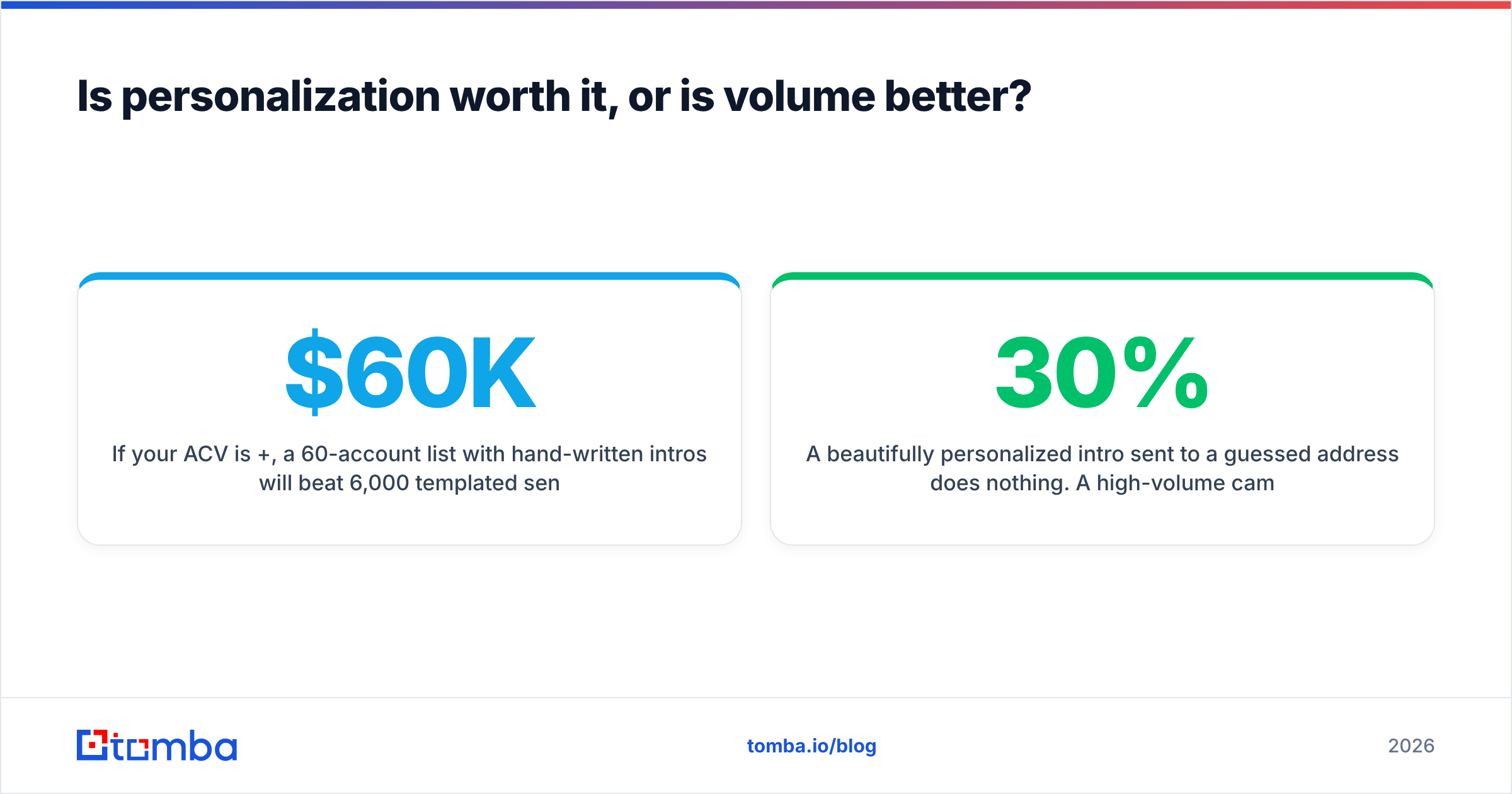
If your ACV is $60K+, a 60-account list with hand-written intros will beat 6,000 templated sends on pipeline generated, every time. The math is not close. If your ACV is $3K and you sell to a horizontal market, deep personalization is a rounding error on outcomes and a real cost on rep hours.
But there's a third variable most teams ignore: data quality sits underneath both strategies, and it fails silently.
A beautifully personalized intro sent to a guessed address does nothing. A high-volume campaign sent to a list with a 30% bounce rate does worse than nothing — it damages your sender reputation and pushes even your valid recipients toward spam. HubSpot's own cold email guidance makes the same point from the other direction: deliverability problems get misdiagnosed as copy problems constantly.
This is where the sequencing matters. Verify first, personalize second, send third. Running an email verifier across your list before you write a single intro line means every minute of research goes to an inbox that exists. Skipping it means you're doing your best writing for a bounce log.
What does a full cold email look like with a strong intro?#
Here's a complete example. Note how little of it is the intro, and how much the intro carries.
Subject: your Q3 catch-all post
Hi Dana,
Your Q3 post on catch-all domains was the only breakdown I've read that showed the actual SMTP behavior instead of hand-waving it.
The reason I'm writing: you mentioned your team still routes catch-alls to a manual review queue. We built a verification layer that resolves about 70% of those automatically, and the remaining 30% gets flagged with a confidence score instead of a shrug.
If that's still a queue you'd rather not staff, worth 15 minutes?
— Sam
Break it down:
- Sentence 1 (intro): specific, verifiable, and it demonstrates the sender read the thing. No compliment inflation ("amazing post!"), just evidence.
- Sentence 2: the pivot, and it names the transition explicitly ("the reason I'm writing"). Readers appreciate being told where they are.
- Sentence 3: the claim, with a number, including the part that doesn't work perfectly. Admitting the 30% makes the 70% credible.
- Sentence 4: a CTA that references their pain, not your calendar.
Total: 78 words. The intro is 24 of them.
Compare that to what most teams send, which opens with two sentences about the sender's company, spends the middle third on a feature list, and ends with "Let me know if you'd like to hop on a quick call to discuss synergies."
Which intro mistakes kill reply rate fastest?#
Ranked by how much damage they do:
- Fake familiarity. "Following up on our conversation" when there was no conversation. This isn't a copy mistake; it's a trust one, and it's the single fastest way to get reported as spam. Getting flagged by recipients feeds directly into the filtering signals that CAN-SPAM codified and that mailbox providers now enforce far more aggressively than the law does.
- The merge-tag tell.
Hi {{first_name}},rendering literally, or "I loved your recent post about [TOPIC]." One broken tag invalidates every other personalized element in the email, because now the reader knows the whole thing was assembled. - Compliment with no evidence. "Big fan of what you're building at Acme" reads identically whether you've used the product or found the domain in a scraped list. Add one specific detail or delete the sentence.
- Opening with your company. "At Acme, we help B2B teams..." The reader has no reason to care about Acme in sentence one. Move it to sentence three, or cut it.
- The double question. Opening with a question is fine. Opening with two questions makes the reader feel interrogated and defers the actual point.
- Length. If your intro runs past two sentences, it isn't an intro — it's a paragraph, and it's being skimmed.
Vendors like Gong have published call and email analysis for years showing the same directional pattern: specificity early beats polish throughout. Reviews on G2 for outbound tools echo it in the negative — the most common complaint about sequencing platforms isn't the software, it's teams shipping templated intros at scale and blaming the tool for the reply rate.
How do you test cold email intros properly?#
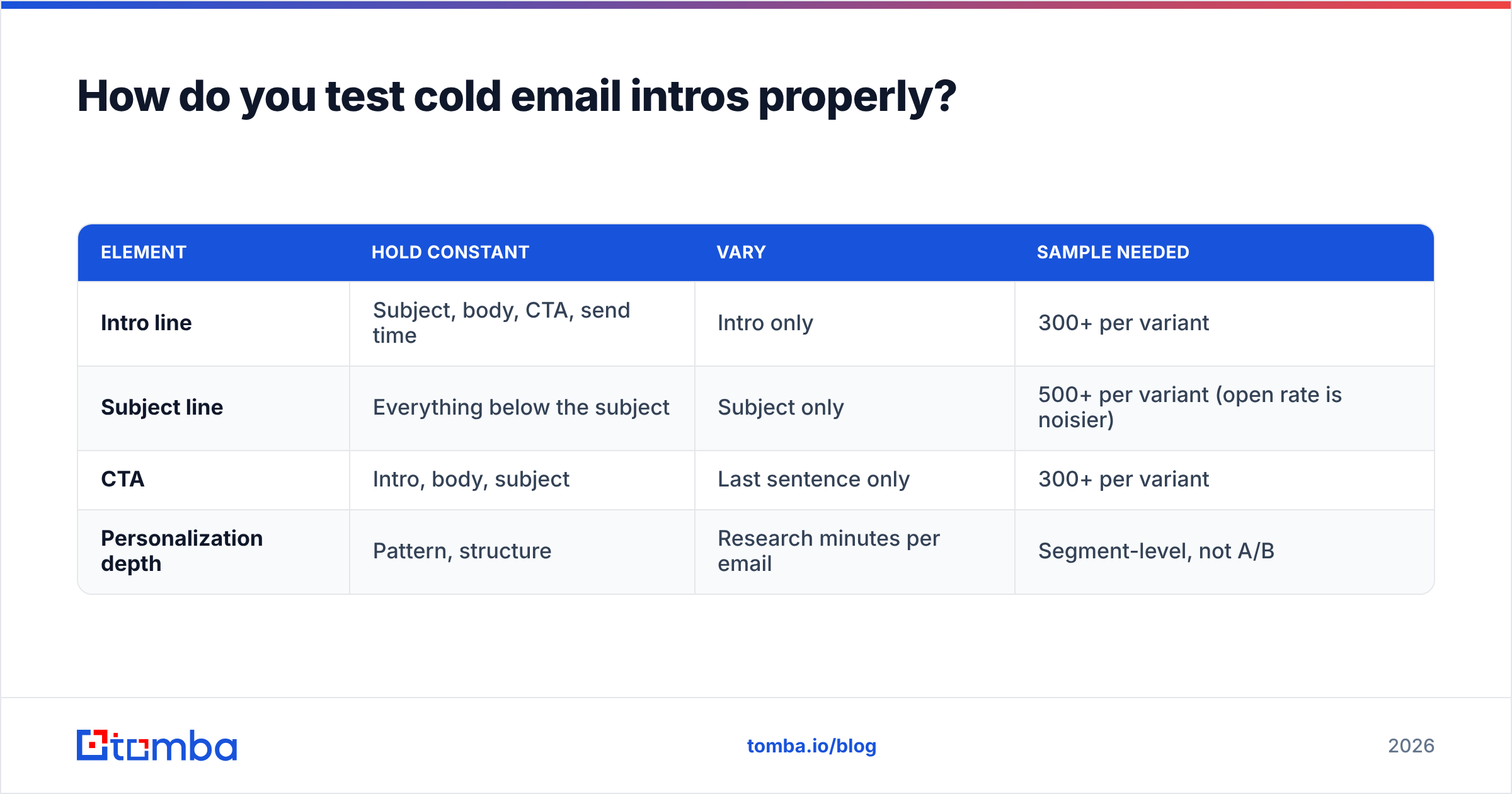
Most "A/B tests" in outbound are not tests. They're two campaigns with four differences each, and whichever one wins teaches nothing transferable.
Do it this way:
| Element | Hold constant | Vary | Sample needed |
|---|---|---|---|
| Intro line | Subject, body, CTA, send time | Intro only | 300+ per variant |
| Subject line | Everything below the subject | Subject only | 500+ per variant (open rate is noisier) |
| CTA | Intro, body, subject | Last sentence only | 300+ per variant |
| Personalization depth | Pattern, structure | Research minutes per email | Segment-level, not A/B |
Measure reply rate, not open rate. Open rate has been unreliable since privacy-protection image loading became the default across major mailbox providers, and it was never the metric you cared about anyway. A 60% open rate with a 0.4% reply rate is a subject line writing checks the intro can't cash.
Run each test until you have at least 300 sends per variant. Below that, the difference between a 2.1% and a 3.4% reply rate is noise wearing a suit.
And segment before you conclude. An intro that wins on Heads of RevOps at 200-person companies may lose badly on VPs of Sales at 2,000-person companies. The response-rate lift you found is a fact about a segment, not about a sentence.
What should you do before writing a single intro line?#
Get the list right. That's the unglamorous prerequisite.
The order of operations that consistently works:
- Define the ICP narrowly enough that one intro pattern fits the whole segment.
- Build the account list from real signals — hiring, funding, stack changes, published content.
- Find the right person and the right address. Guessing the format wastes every downstream step. Domain search surfaces the actual pattern a company uses, which is usually not the one you'd guess.
- Verify. Bounces are not a rounding error; they're the thing that determines whether the next campaign lands.
- Then research and write the intro.
Teams reverse steps 3–5 constantly. They write forty gorgeous, specific, well-researched opening lines and then discover half the addresses were permutations that never existed.
Where should you go from here?#
Write intros that earn the second sentence. Cut every word that describes you before you've described them. Pick one pattern from the table above that matches your list size and your ACV, run it against 300 contacts, and read the reply rate — not the open rate.
But do the boring part first. The best cold email intro in the world is worth exactly zero if it lands in a bounce log.
If you're building the list that all of this sits on top of, start with the Tomba Email Finder. It resolves professional addresses by name and domain, tells you the confidence level rather than pretending certainty, and hands off cleanly to verification before you send. Free tier gives you 25 searches a month to test the accuracy on accounts you already know the answer for — which is exactly how you should evaluate any data vendor. Paid plans start at $49/mo; the full breakdown is on the Tomba pricing page.
Get the address right. Then write the sentence that makes them read the next one.
Related guides#
Ready to find emails that actually work?
Join 150,000+ professionals who stopped guessing and started sending. Free credits on signup — no credit card required.
Get the Tomba newsletter
Practical outbound tactics and product updates — once every two weeks.
About the author