Cold Email Networking: A 2026 Guide to Real Connections
Cold email networking fails when it smells like a pitch. Here's the research, structure, timing, and follow-up cadence that turn a stranger's inbox into a real professional relationship.
TL;DR
- Cold email networking is not cold sales email with softer verbs. The goal is a relationship with option value, not a booked demo — which changes the ask, the length, and the follow-up cadence.
- The single biggest predictor of a reply is whether the first two sentences prove you did specific research on the recipient. Everything else is downstream of that.
- Ask for something that costs the recipient under five minutes. "Can I ask one question over email?" outperforms "Do you have 30 minutes for a call?" by a wide margin in practice.
- Send volume should be low: 5–15 genuinely researched emails a week beats 200 templated ones, because networking compounds through referrals and templated mail never earns one.
- Bad email addresses kill more networking outreach than bad copy. Verify before you send — a bounce on a personal outreach email is unrecoverable.
What is cold email networking, exactly?#
Cold email networking is reaching out to someone you have no prior relationship with, by email, to start a professional connection rather than close a transaction. You want their perspective, an introduction, a job lead, a collaboration, feedback on something you built, or simply to be a known name in their orbit six months from now.
The distinction matters because the mechanics diverge immediately. A cold sales email has a defined conversion event — a meeting, a trial, a reply that indicates buying intent. You can A/B test toward it. Cold email networking has no conversion event. Its output is a person who now knows who you are and doesn't resent you for it.
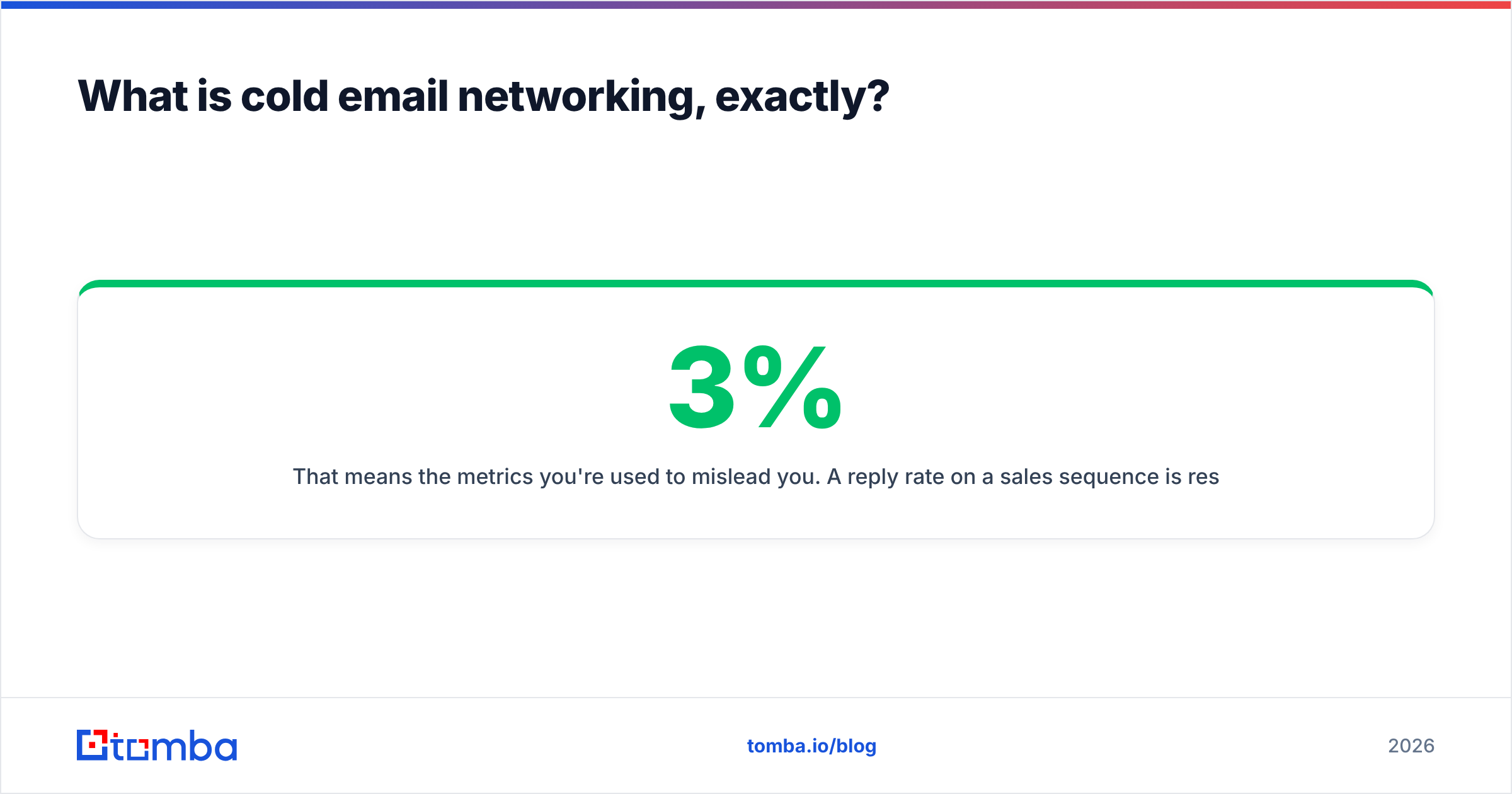
That means the metrics you're used to mislead you. A 3% reply rate on a sales sequence is respectable. A 3% reply rate on networking outreach means you sent 97 emails that made you slightly less credible to 97 people. The correct comparison isn't sales email — it's the response rate you'd expect from a warm introduction, and the honest answer is you should be aiming for 30–50% on a small, well-researched list.
The sociological backing here isn't new. Mark Granovetter's strength of weak ties research found that people get jobs, information, and opportunities disproportionately through acquaintances rather than close friends — because acquaintances live in different information networks. Cold email is a mechanism for manufacturing weak ties at scale. It works precisely as well as it feels non-manufactured.
How is networking email different from cold sales email?#
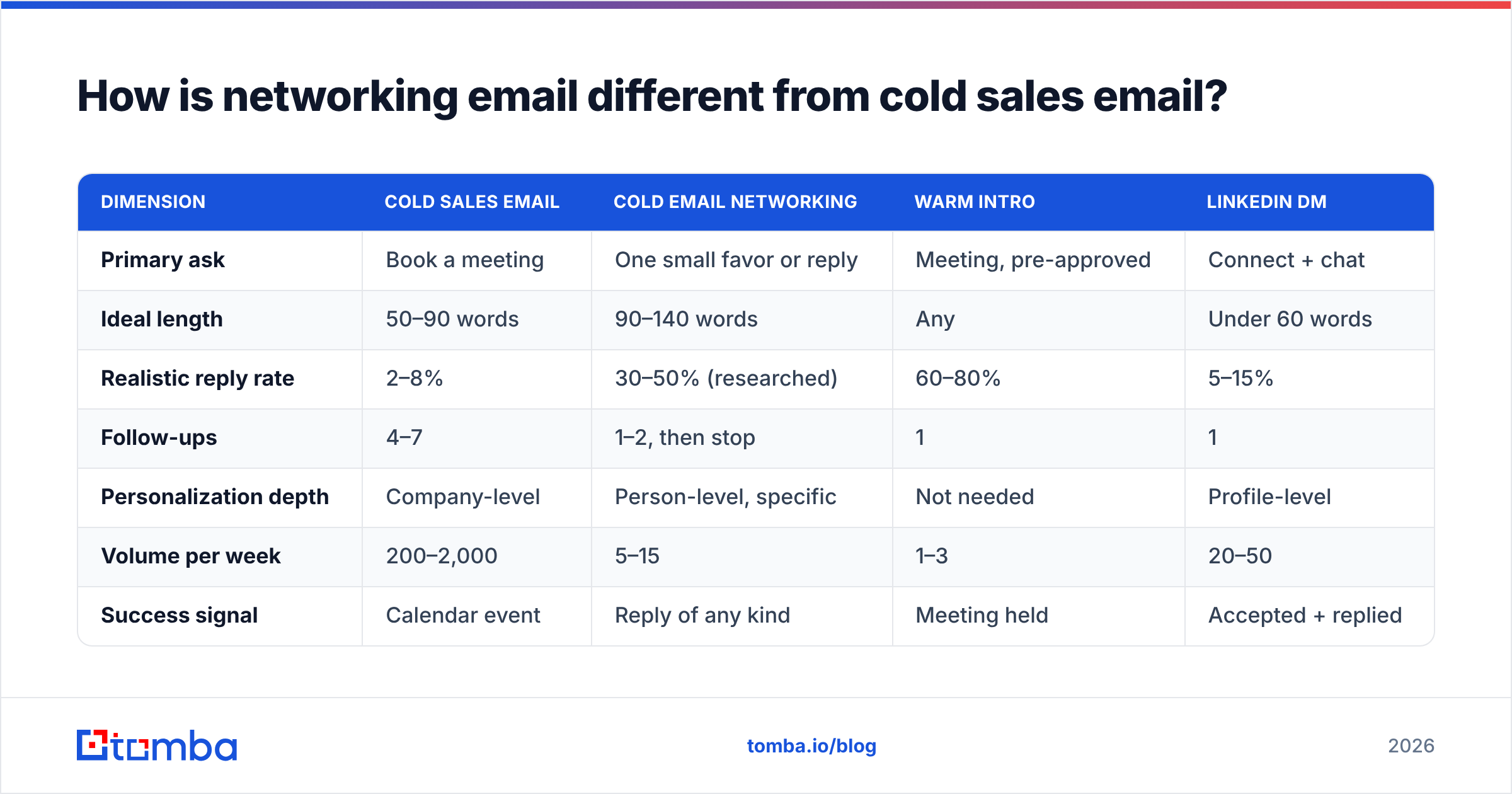
Most people writing networking emails have only ever seen sales templates, so they write sales templates with the word "sales" removed. Recipients spot this instantly. Here's what actually differs:
| Dimension | Cold sales email | Cold email networking | Warm intro | LinkedIn DM |
|---|---|---|---|---|
| Primary ask | Book a meeting | One small favor or reply | Meeting, pre-approved | Connect + chat |
| Ideal length | 50–90 words | 90–140 words | Any | Under 60 words |
| Realistic reply rate | 2–8% | 30–50% (researched) | 60–80% | 5–15% |
| Follow-ups | 4–7 | 1–2, then stop | 1 | 1 |
| Personalization depth | Company-level | Person-level, specific | Not needed | Profile-level |
| Volume per week | 200–2,000 | 5–15 | 1–3 | 20–50 |
| Success signal | Calendar event | Reply of any kind | Meeting held | Accepted + replied |
| What kills it | Weak offer | Generic flattery | Bad referrer | Sales pitch in DM |
Look at the volume row. That's the row that decides everything else. If you're sending 10 emails a week instead of 500, you can afford to read someone's last three posts, listen to twenty minutes of a podcast they were on, or actually use the product they shipped. That research is the entire product you're selling — the email is just the delivery mechanism.
The follow-up row is the other one people get wrong. Sales sequences follow up seven times because persistence converts. Networking follow-ups follow up once, maybe twice, because a third nudge converts a neutral non-response into an active negative impression. You are not chasing a deal. You are auditioning to be a low-maintenance person.
What does a cold networking email actually look like?#
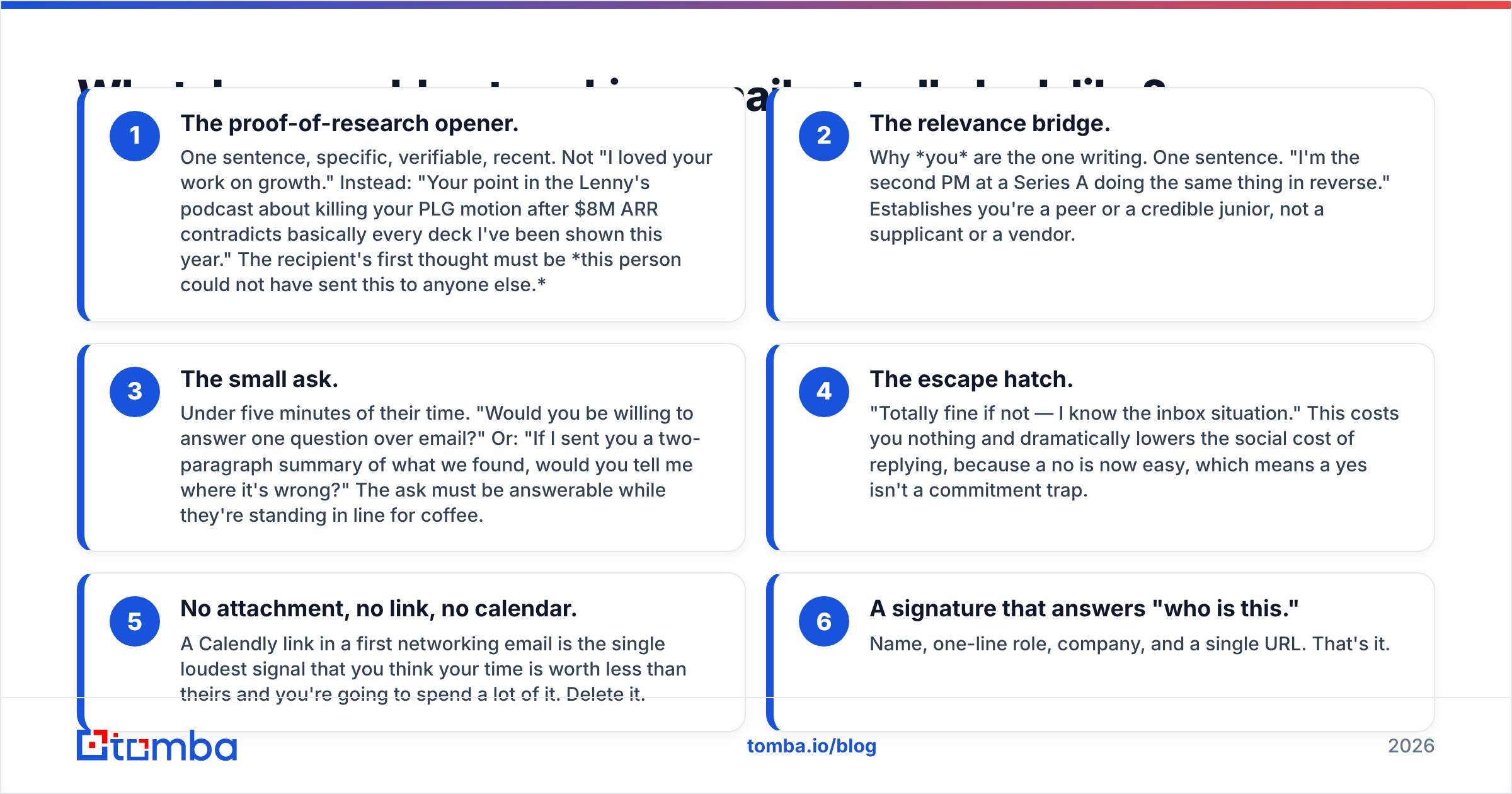
The structure is boringly consistent across every version that works. Six components, in order:
The proof-of-research opener. One sentence, specific, verifiable, recent. Not "I loved your work on growth." Instead: "Your point in the Lenny's podcast about killing your PLG motion after $8M ARR contradicts basically every deck I've been shown this year." The recipient's first thought must be this person could not have sent this to anyone else.
The relevance bridge. Why you are the one writing. One sentence. "I'm the second PM at a Series A doing the same thing in reverse." Establishes you're a peer or a credible junior, not a supplicant or a vendor.
The small ask. Under five minutes of their time. "Would you be willing to answer one question over email?" Or: "If I sent you a two-paragraph summary of what we found, would you tell me where it's wrong?" The ask must be answerable while they're standing in line for coffee.
The escape hatch. "Totally fine if not — I know the inbox situation." This costs you nothing and dramatically lowers the social cost of replying, because a no is now easy, which means a yes isn't a commitment trap.
No attachment, no link, no calendar. A Calendly link in a first networking email is the single loudest signal that you think your time is worth less than theirs and you're going to spend a lot of it. Delete it.
A signature that answers "who is this." Name, one-line role, company, and a single URL. That's it.
Total: 90–140 words. If you're at 200, you wrote a pitch and dressed it as curiosity.
Do not open with "I hope this email finds you well," and do not open with a compliment that could apply to anyone with a LinkedIn profile. HubSpot's ongoing sales statistics research consistently shows personalization is the lever, and generic praise reads as anti-personalization — it signals you had nothing specific to say and filled the space anyway.
Does subject line strategy matter for networking emails?#
Yes, but differently than for sales. A sales subject line is competing for attention against other vendors. A networking subject line is competing against the recipient's assumption that you're a vendor.
Which means the job of the subject line is to not look like marketing. Lowercase, short, specific, no brackets, no emoji, no numbers-as-hooks:
- Good:
your comment on PLG churn - Good:
question about the Rippling migration - Good:
one question, from a fellow ops person - Bad:
Quick question 🚀 - Bad:
[Free Guide] Growth Insights for You - Bad:
Following up on my previous email(in a first send — yes, people do this)
Six to eight words, phrased the way a colleague would phrase it. If you want to sanity-check tone before sending, run drafts through a subject line tester — but treat the score as a spam-signal check, not a persuasion score. High-converting sales subject lines are exactly the ones that make networking emails fail.
Send timing is worth less than people claim. Tuesday-through-Thursday, 7–9am recipient local time is a reasonable default and the difference between that and Friday 4pm is smaller than the difference between researched and unresearched. Don't optimize timing until you've optimized relevance.
How do you find the right person's email address?#
This is where networking outreach quietly falls apart. You spend forty minutes researching someone, write a genuinely good email, and send it to firstname@company.com because you guessed the pattern. It bounces. You have now burned the research and, if your domain is new, a little sender reputation.
Two rules:
Find the actual address, don't permute one. Guessing generates plausible-looking addresses that fail silently at catch-all domains — the mail server accepts everything and drops what doesn't exist, so you never even see a bounce. You just sit there wondering why a person you researched for an hour ignored you. Use a real email finder that pulls from verified sources rather than a permutator that generates fifteen candidates and hopes.
Verify before every single send. Networking lists are tiny, so verification costs you almost nothing and protects the one thing you can't rebuild: the impression that you're competent. An email verifier run on 12 addresses takes seconds and typically flags one or two.
If you're reaching out to someone because of something they wrote — an article, a research paper, a technical blog post — an author finder resolves the byline to a real address directly, which is both faster and more accurate than working backwards from the company domain.
A practical note on catch-all domains: a large share of mid-market companies run them, and standard verification returns "accept-all" rather than valid or invalid. That's not a failure of the tool, it's the mail server refusing to answer. For networking outreach at low volume, an accept-all result is usually worth sending to anyway — the downside is one silent non-delivery, not a deliverability problem. At scale, treat it differently.

What should you do after they reply?#
Most of the value in cold email networking is created in the ninety seconds after the reply lands, and most people waste it by immediately escalating the ask.
Someone answered your one question. Do not respond with "Amazing — do you have 30 minutes next week?" You have converted a low-cost interaction into a high-cost one and taught them that small asks from you become large ones. The relationship is now priced accordingly.
Instead:
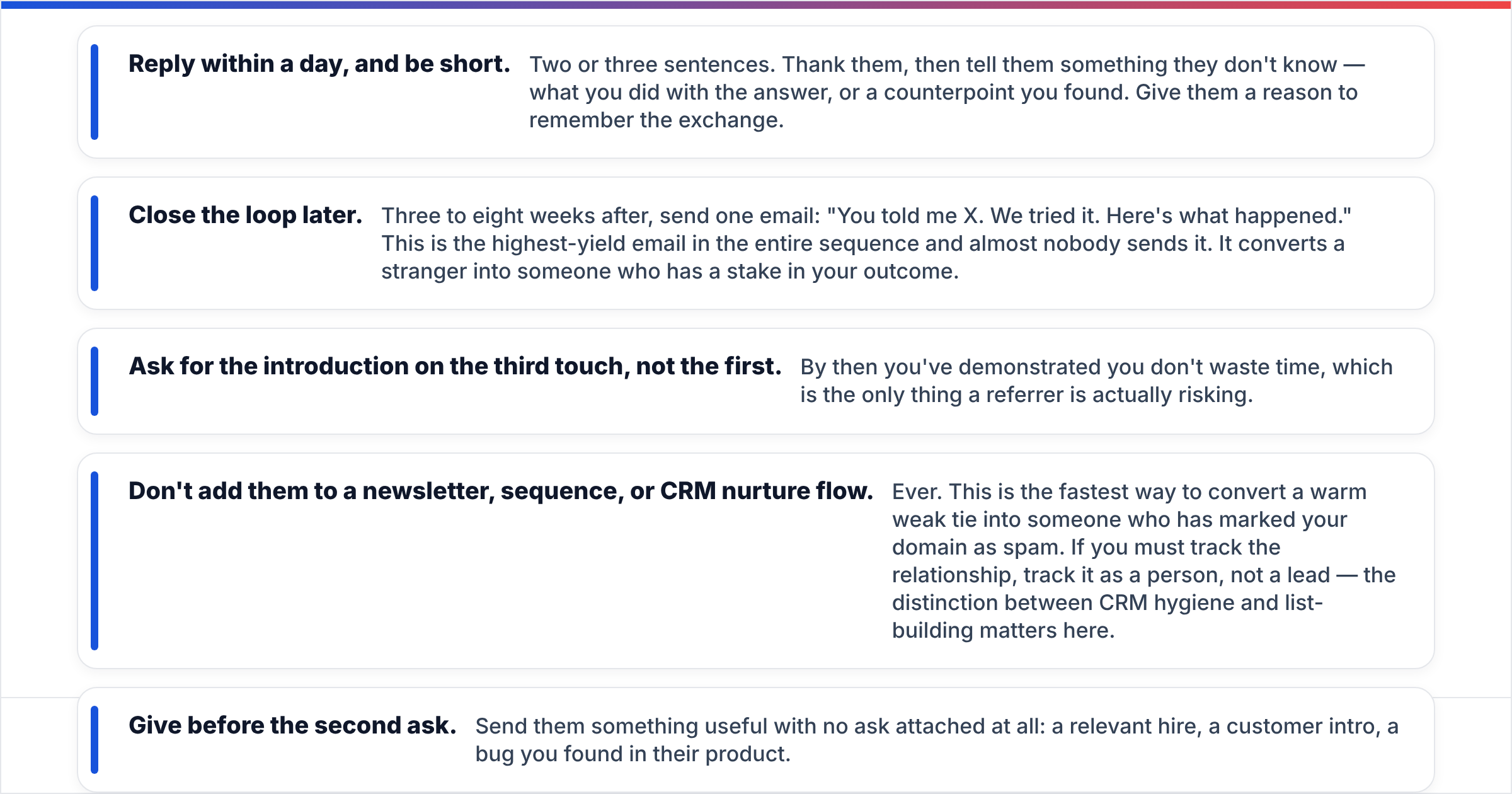
- Reply within a day, and be short. Two or three sentences. Thank them, then tell them something they don't know — what you did with the answer, or a counterpoint you found. Give them a reason to remember the exchange.
- Close the loop later. Three to eight weeks after, send one email: "You told me X. We tried it. Here's what happened." This is the highest-yield email in the entire sequence and almost nobody sends it. It converts a stranger into someone who has a stake in your outcome.
- Ask for the introduction on the third touch, not the first. By then you've demonstrated you don't waste time, which is the only thing a referrer is actually risking.
- Don't add them to a newsletter, sequence, or CRM nurture flow. Ever. This is the fastest way to convert a warm weak tie into someone who has marked your domain as spam. If you must track the relationship, track it as a person, not a lead — the distinction between CRM hygiene and list-building matters here.
- Give before the second ask. Send them something useful with no ask attached at all: a relevant hire, a customer intro, a bug you found in their product.
Analyst coverage of buyer behavior from firms like Gartner has consistently pointed the same direction for a decade — buyers and, by extension, professionals in general, are increasingly hostile to interactions that feel instrumented. The networking email that works is the one that isn't part of a machine.
How do you scale this without ruining it?#
You mostly don't, and that's the point. But there are three places where tooling helps without contaminating the personal layer:
Sourcing. Building a list of the 60 right people takes hours manually. A domain search across target companies, filtered to the two or three roles you actually want to talk to, compresses that to minutes. The research still happens per-person, by hand. The finding doesn't have to.
Verification. Batch-verify the whole list once, before you write anything. Deliverability isn't your differentiator here, but a bounce rate above a few percent will drag your domain reputation down and start landing your personal email in spam folders — which is a much worse outcome than a failed networking attempt.
Enrichment for context, not for mail-merge. Knowing someone's tenure, previous company, and current team size makes your research faster. It does not entitle you to write {{first_name}}, I saw you spent {{tenure}} years at {{prev_company}}. Merge fields in networking email are detectable in under a second, and once detected, everything before and after them is discounted too. Use data enrichment to inform what you write, never to populate it.
The honest ceiling on cold email networking is somewhere around 15 quality emails a week per person. Beyond that, either the research thins out or the emails start rhyming with each other. Fifteen a week is 750 a year. If a third reply and a tenth become real relationships, that's 75 new weak ties annually — which is, by Granovetter's math, an absurd return.
Reviews across G2 and similar directories mostly evaluate these tools on volume metrics — credits, throughput, bulk export. For networking, ignore that column entirely. Optimize for accuracy on the individual lookup, because you're going to run twelve of them, not twelve thousand, and one wrong address costs you the whole email.
Where should you start?#
Pick eight people. Not eighty. People whose work you can genuinely engage with — you've read the thing, used the product, disagreed with the argument. Write eight emails, each of which would be embarrassing to send to anyone other than its recipient. Verify all eight addresses. Send them Tuesday morning. Then wait, and follow up exactly once, seven days later, with three sentences.
Three or four will reply. That's the whole game.
The bottleneck won't be your writing — it'll be getting a correct address for the eight people worth writing to. Tomba's Email Finder resolves a name and company domain to a verified professional address, with confidence scoring so you know whether you're sending into a real inbox or a void. The free tier covers 25 searches a month, which is more than a serious networking practice needs in a month, and the Starter plan at $49/mo covers you if you're also prospecting. Spend the saved time on the research. That's where the reply comes from.
Related guides#
// get started
Find, verify and enrich your first contacts today
Start on the free plan with 25 searches a month, then scale when your team is ready.
Free plan · No credit card required · GDPR & CCPA
// about the author