Cold Email Objection Handling: 9 Replies That Book Meetings
Most reps treat a "not interested" as the end of the conversation. It usually isn't. Here are the nine objections that show up in cold email replies, the exact responses that keep the thread alive, and the ones you should let die.
TL;DR
- A cold email objection is a reply. A reply is a win. Roughly 90% of your sends produce nothing at all, so the person who wrote "not interested" is already in your top decile of engagement.
- Nine objections cover almost everything you'll see: no budget, no time, already have a vendor, send info, wrong person, bad timing, how'd you get my email, we tried this, and plain "no."
- The single highest-leverage move is to acknowledge in one sentence and ask one question. Not rebut. Not pitch. Ask.
- Two of the nine ("remove me," "how did you get my email") are not objections. They're compliance events. Handle them differently or you'll pay for it in deliverability.
- Half of what looks like objection handling is actually a data problem. If your reply says "I don't handle that," you didn't get objected to — you emailed the wrong human.
What counts as a cold email objection?#
An objection is any reply that declines your ask without ending the relationship. That distinction matters, because reps burn enormous energy trying to "overcome" messages that were never objections in the first place.
Sort every negative reply into three buckets:
- Dismissals — "Not interested," "we're all set," "no thanks." Low information. The prospect spent four seconds on you. There's almost nothing to work with, which is exactly why a single well-aimed question works better than a paragraph.
- Conditions — "No budget until Q3," "we just signed with a competitor," "I'm not the right person." These contain a fact. Facts are workable. A condition tells you what has to change, or who you should be talking to instead.
- Compliance signals — "Remove me," "unsubscribe," "how did you get this address," "this is spam." Not objections. Full stop the sequence, suppress the contact, and move on. Arguing here costs you domain reputation, and reputation is the only asset in cold email you can't buy back.
Most objection-handling advice fails because it applies condition-handling tactics to dismissals, or dismissal tactics to compliance signals. The tactics don't transfer.
Why do cold email objections happen at all?#
Three causes, in descending order of frequency.
Relevance failure. You sent a sales-enablement pitch to a controller. Nothing you write in reply fixes that. This is a targeting and data problem masquerading as a sales-skill problem, and it's the reason a clean list beats a clever script. If more than a quarter of your negative replies are "wrong person," stop editing your copy and go fix your source data.
Trust deficit. The prospect believes you but doesn't believe you. They've been burned by three vendors in the category. Their objection is a proxy for "prove you're not the fourth."
Genuine constraint. Budget is actually frozen. They actually signed a two-year contract last month. Nothing you say changes physics. Your only move is to set a calendar reminder and be first in line when the constraint lifts.
Guess wrong about which cause you're facing and your reply will feel off. A trust-deficit prospect who gets a "let me set a reminder for Q3" response reads it as indifference. A genuinely budget-constrained prospect who gets a value-reframe reads it as not listening.
What are the nine objections and what do you actually say?#
Here's the structured version. Each script assumes you've already sent something relevant — objection handling can't rescue a bad first touch.
"No budget." Don't discount. Ask what would need to be true. "Makes sense. Out of curiosity — is budget frozen across the board, or is it that this specific problem hasn't cleared the bar yet? Different answers, different follow-ups from me." You're separating a timing condition from a value condition. Only one of them is worth working.
"No time / too busy." They're not busy. They're unconvinced. But you can't say that. "Understood. I'll make this a yes/no: is [specific outcome] on your list for this half? If no, I'll close the loop and stop emailing." The offer to leave is the entire mechanic. It costs them nothing to say no, which is why they often say something else.
"We already use [Competitor]." Never attack the incumbent. Ask what they wish it did. "Good tool. Most of the teams we talk to who run [Competitor] keep a second source for [narrow use case] — is that true for you, or has that gotten better?" You're looking for a wedge, not a rip-and-replace.
"Send me some info." Usually a polite brush-off. Sometimes real. Test it with a cost: "Happy to. So I don't send a 12-page PDF you'll never open — are you more concerned with [problem A] or [problem B]?" If they answer, it was real. If they ghost, you saved yourself a deck.
"I'm not the right person." This is a gift. "No problem — who owns [specific outcome]? Happy to reach out directly, or you can forward this. Either works." Get the name. Then, and this is the part people skip, verify the new address before you send. A forwarded intro that bounces is worse than no intro.
"Bad timing / circle back in six months." Take it literally and make it cheap to honor. "Booked for [specific month]. One thing so I'm useful when I do: what has to be in place internally before something like this gets evaluated?" Now you have a re-entry trigger instead of a date.
"We tried something like this and it didn't work." The most valuable objection you'll receive. "That's the most useful thing anyone's told me this week. What broke — the tool, the rollout, or the data underneath it?" Nine times out of ten it was the data underneath it.
"How did you get my email?" Answer honestly and briefly. "Your work address is listed publicly on [source]. If you'd rather not hear from me, say the word and I'll suppress you permanently." Vagueness here reads as guilt. If you can't answer the question cleanly, your data sourcing has a problem worth fixing before your scripts do.
"No." / "Not interested." One attempt, then out. "Fair enough. Last question and then I'm gone: is it not-interested-in-this, or not-interested-in-anything-from-a-cold-email? Both are useful for me to know." Surprisingly high answer rate. Zero further attempts if they don't bite.
The pattern under all nine: one sentence of acknowledgment, one question, zero pitch. The moment you re-pitch, you've told them the first email wasn't a conversation.
Which objections are worth working, and which aren't?#
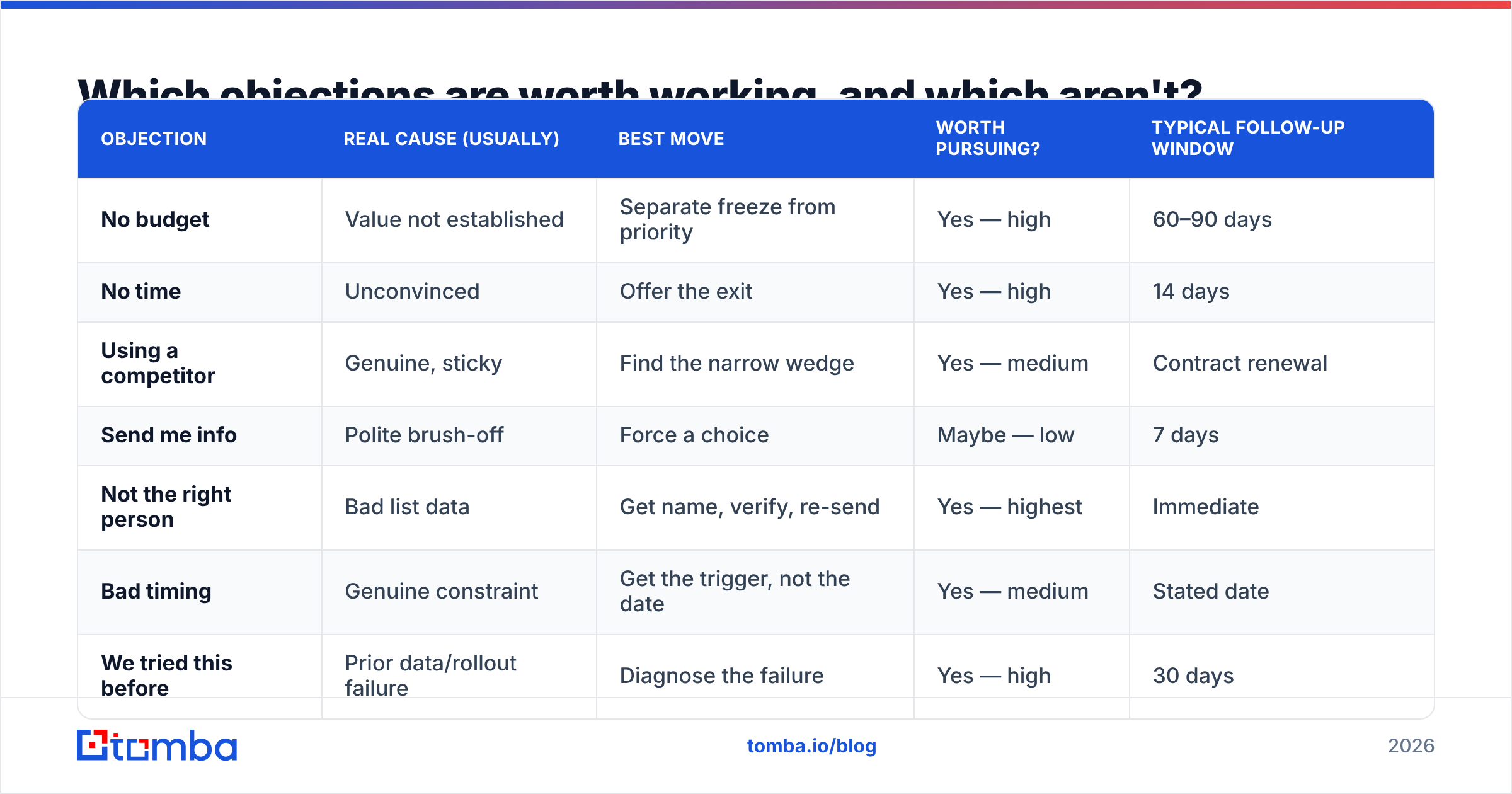
Not every reply deserves your calendar. Here's how the nine sort out on effort versus expected return.
| Objection | Real cause (usually) | Best move | Worth pursuing? | Typical follow-up window |
|---|---|---|---|---|
| No budget | Value not established | Separate freeze from priority | Yes — high | 60–90 days |
| No time | Unconvinced | Offer the exit | Yes — high | 14 days |
| Using a competitor | Genuine, sticky | Find the narrow wedge | Yes — medium | Contract renewal |
| Send me info | Polite brush-off | Force a choice | Maybe — low | 7 days |
| Not the right person | Bad list data | Get name, verify, re-send | Yes — highest | Immediate |
| Bad timing | Genuine constraint | Get the trigger, not the date | Yes — medium | Stated date |
| We tried this before | Prior data/rollout failure | Diagnose the failure | Yes — high | 30 days |
| How'd you get my email | Sourcing opacity | Answer plainly, offer opt-out | Compliance only | None |
| Remove me / spam | Done | Suppress permanently | No | Never |
Two lines in that table pay for the rest. "Not the right person" is the highest-return objection in cold email because it converts a dead thread into a warm referral at nearly zero cost. And "we tried this before" is the highest-information objection, because the answer almost always names a failure mode you can design around.
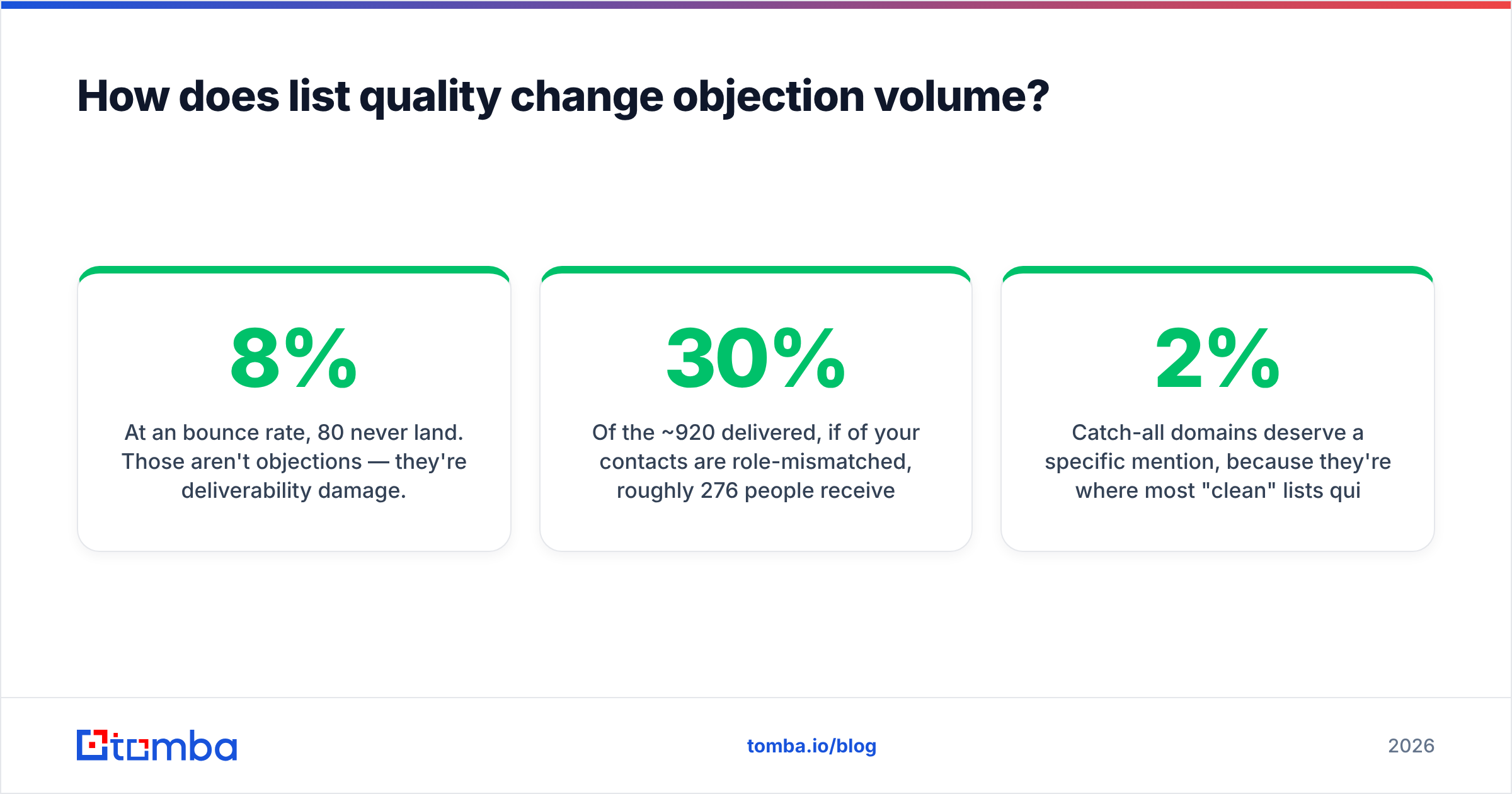
How does list quality change objection volume?#
Here's the uncomfortable arithmetic. Suppose you send 1,000 emails a month.
- At an 8% bounce rate, 80 never land. Those aren't objections — they're deliverability damage. Sender reputation degrades, and your good emails start landing in Promotions.
- Of the ~920 delivered, if 30% of your contacts are role-mismatched, roughly 276 people receive a message about a problem they don't own. Their most likely reply is "not the right person" — if they reply at all.
- The remaining 644 are the only sends where objection handling is even the relevant skill.
So the single biggest lever on your objection mix isn't your scripts. It's whether the person on the other end has the job you think they have, at the address you think they have. Running your list through an email verifier before send collapses the bounce line. Using domain search to pull the actual role-holder at a company — rather than whoever a scraped list handed you — collapses the wrong-person line.
Catch-all domains deserve a specific mention, because they're where most "clean" lists quietly rot. A catch-all server accepts everything, so a standard verification returns "valid" for addresses that lead nowhere. If a meaningful slice of your target accounts run catch-all MX records, a dedicated catch-all verifier is the difference between a 2% bounce rate and a 9% one.
What does the escalation from bad to good objection handling look like?#
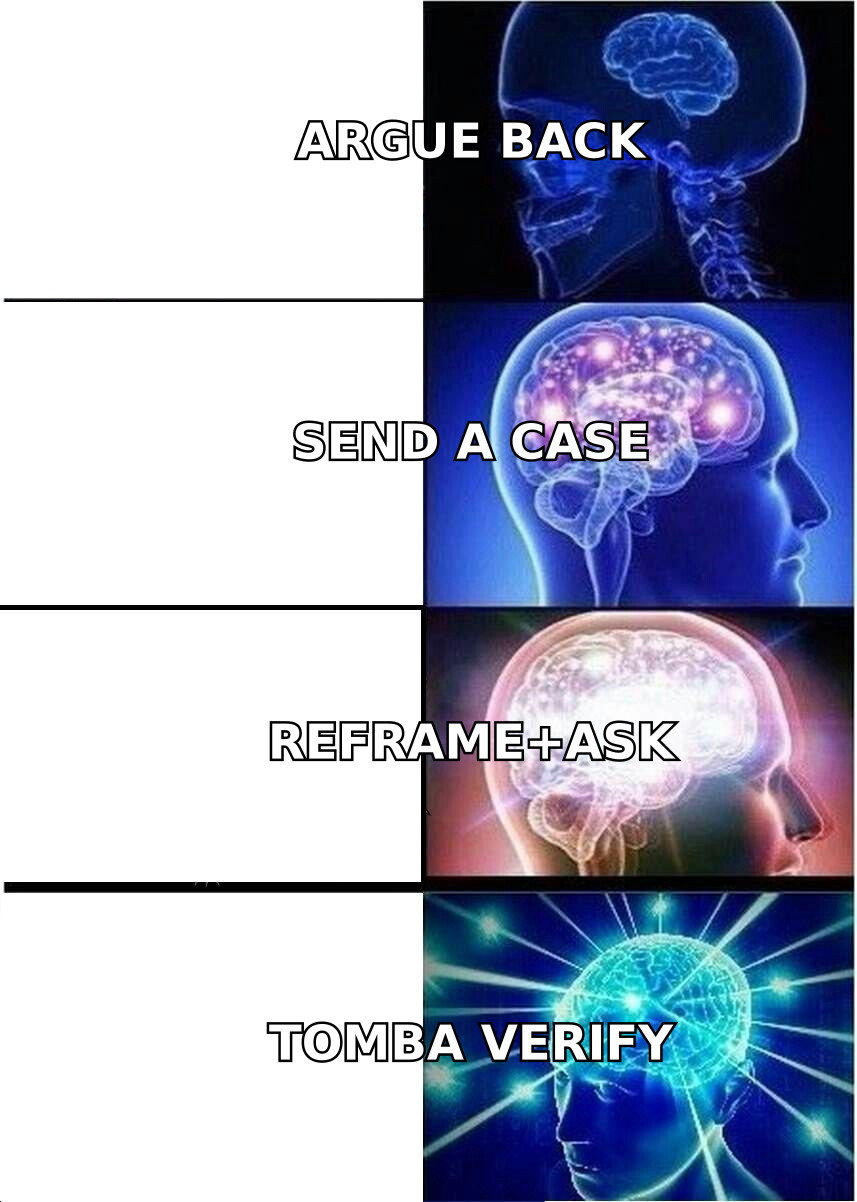
Reps move through four stages, and most stall at stage two.
Stage 1 — Rebut. You explain why the objection is wrong. "Actually, our ROI is 4x, so budget shouldn't be a concern." This is the natural instinct and it converts almost nothing, because you've just told a stranger they're mistaken about their own company's finances.
Stage 2 — Evidence-dump. You send a case study. Better than stage one, still weak: the prospect never asked for proof of a claim they hadn't accepted. Research on B2B buying behavior consistently shows buyers arrive with most of their evaluation already done — Gartner's research on the B2B buying journey puts direct supplier interaction at roughly 17% of the total buying process. A case study lands in that thin sliver only if they've already decided to look.
Stage 3 — Reframe and ask. You acknowledge, then ask a question that reclassifies their objection into a condition. This is where reply rates start moving, because you've handed control back to the prospect and lowered the cost of continuing the conversation.
Stage 4 — Fix the input. You notice that four of your last ten objections were "not the right person," and instead of writing a better referral script, you rebuild the list. Your objection volume drops. The objections you do get are richer, because they come from people who actually own the problem.
Stage four is where teams stop treating cold email as a persuasion exercise and start treating it as a data exercise with a persuasion layer on top. HubSpot's sales research has made a version of this point for years: the mechanics of outreach matter far less than whether the outreach was targeted at all.
How should you sequence follow-ups after an objection?#
Three rules, and none of them involve the word "bump."
Rule one: an objection resets the sequence, it doesn't continue it. If someone replied "no budget," they should never receive your pre-written step-four email. Pull them out. Anyone who replies gets a human thread or nothing.
Rule two: one question, then silence. Ask your reframe question. If they don't answer within five business days, close the loop with a single line — "Sounds like a no for now. I'll stop here." — and stop. That message has a higher reply rate than anything else in the sequence, which tells you something about how much people want out of your funnel.
Rule three: re-entry needs a trigger, not a timer. "Circle back in six months" produces an email in six months that reads exactly like the first one. Instead, capture the condition: new funding, a headcount change, a competitor renewal, a job change. When it fires, your opening line writes itself. Your response rate on triggered re-entry will beat calendar-based follow-up by a wide margin, because the email now has a reason to exist.
One practical note on job changes: when your champion moves companies, the objection you got at the old account frequently evaporates at the new one. Watching for that — and re-finding their new work address — is one of the cheapest sources of pipeline most teams ignore entirely.
What should you do this week?#
Pull your last 100 negative replies. Tag each one against the nine categories above. Then look at the mix.
If "not the right person" and hard bounces together account for more than a third, your problem is upstream of your scripts. Fix the list, and half your objections disappear without a single word of copy being rewritten.
If your mix is dominated by "no budget" and "we already use X," your data is fine and your positioning is the constraint. Rewrite the first email, not the rebuttal.
And if you're getting almost no replies at all — positive or negative — you don't have an objection-handling problem. You have a deliverability problem, and no script survives the spam folder.
Fix the input first. Most cold email objections are symptoms of a list that was never accurate to begin with. Tomba's Email Finder pulls verified work addresses for the specific role-holder at a company — so the person reading your email is the person who owns the problem you're solving. Start free with 25 searches a month, or move to Starter at $49/mo when volume picks up. Full Tomba pricing is public, no sales call required. Compare your current stack against real vendor data on G2 before you commit to anything, including us.
Related guides#
// get started
Find, verify and enrich your first contacts today
Start on the free plan with 25 searches a month, then scale when your team is ready.
Free plan · No credit card required · GDPR & CCPA
// about the author