Cold Email Outreach Sequence: The 2026 Playbook That Books Meetings
Most cold email sequences fail at step one: the list. Here's the exact 5-touch sequence, send timing, and copy structure that still books meetings in 2026, plus the reply-rate math behind each step.
TL;DR
- A cold email outreach sequence is 4–6 timed touches to the same prospect over 10–21 days, not one email and a prayer.
- Roughly 40–55% of positive replies land on touches 2 through 4. If you stop after one send, you throw away half your pipeline.
- List quality beats copy quality. A 3% bounce rate protects your domain; an 8% bounce rate ends the sequence for every prospect on it.
- The highest-performing structure in 2026: short first touch (under 90 words), value bump on day 3, angle change on day 6, social proof on day 10, breakup on day 14.
- Sequence length has diminishing returns. Touch 7 typically adds under 1% incremental reply rate while doubling unsubscribe risk.
What is a cold email outreach sequence?#
A cold email outreach sequence is a pre-planned series of emails sent to a prospect who has never spoken to you, spaced across days, where each email has a distinct job. Think of it like knocking on a door: the first knock announces you exist, the second confirms you meant it, the third gives them a reason to open, and the fourth tells them you're about to leave.
Technically, a sequence is a state machine. Each prospect sits in a step, a timer fires, the next email sends, and any reply, bounce, or unsubscribe pulls them out. Every serious sending tool — Instantly, Smartlead, Salesloft, Outreach — implements this same loop. The differences are in deliverability plumbing, not concept.
What separates a sequence from spam is not the number of emails. It is whether each touch carries new information. Four emails that say "just bumping this" are worse than one good email. Four emails that each approach the problem from a different angle earn a reply.
Why do single-touch cold emails fail?#
Because attention is a lottery, and one ticket loses.
Your first email arrives on a Tuesday at 9:14 a.m. into an inbox that received 41 other messages overnight. The prospect triages by sender recognition. You are not recognized. The email is archived unread, or read and mentally shelved for "later," which does not exist.
The second email arrives while the first is still faintly in memory. Recognition rises. The third email arrives after the prospect has had a bad week with the exact problem you named. That timing is not skill. It is exposure. Sequences buy exposure.
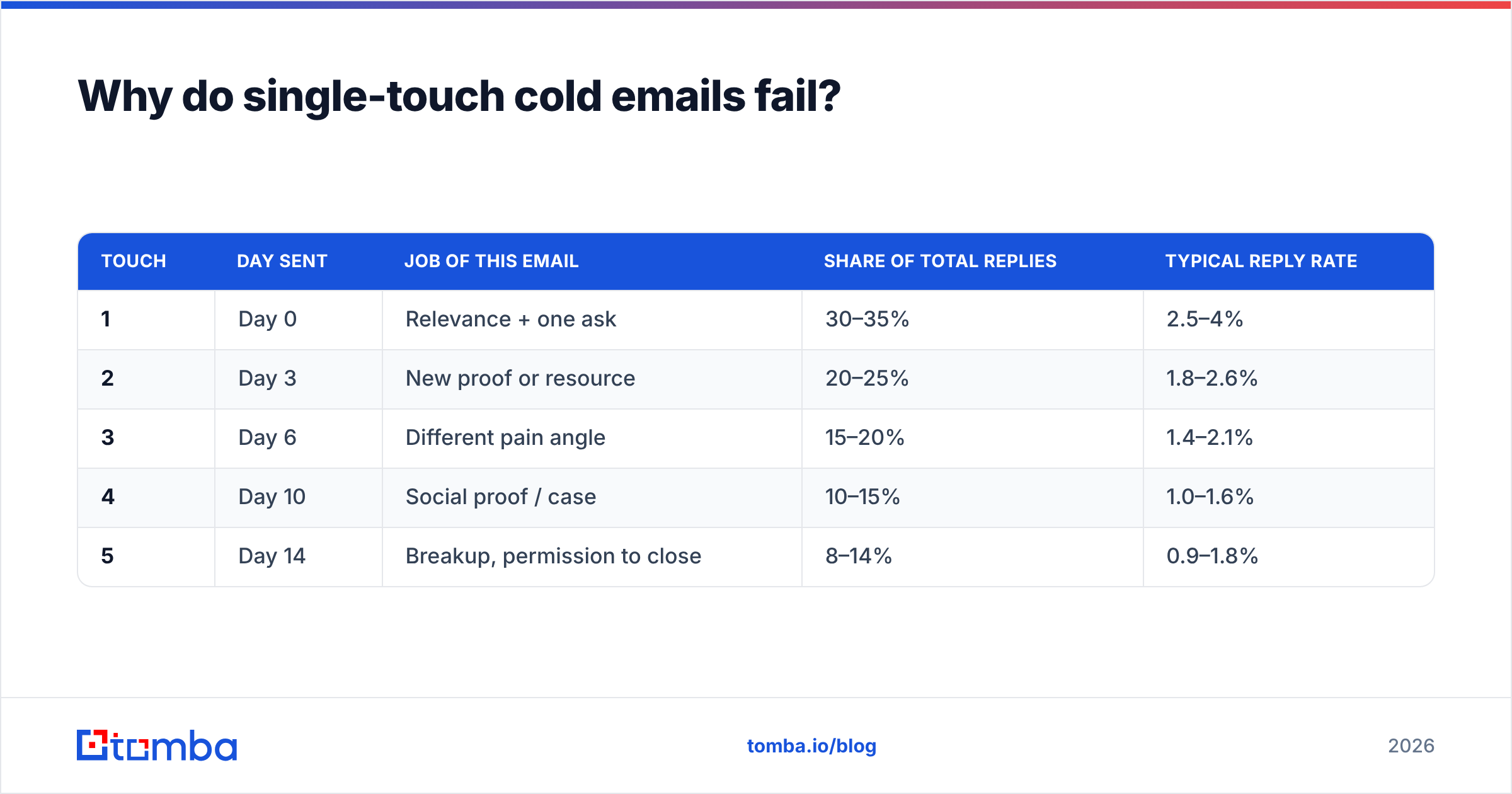
Here is roughly how replies distribute across a well-built five-touch sequence, based on aggregate patterns reported across outbound teams and vendor benchmark studies:
| Touch | Day sent | Job of this email | Share of total replies | Typical reply rate |
|---|---|---|---|---|
| 1 | Day 0 | Relevance + one ask | 30–35% | 2.5–4% |
| 2 | Day 3 | New proof or resource | 20–25% | 1.8–2.6% |
| 3 | Day 6 | Different pain angle | 15–20% | 1.4–2.1% |
| 4 | Day 10 | Social proof / case | 10–15% | 1.0–1.6% |
| 5 | Day 14 | Breakup, permission to close | 8–14% | 0.9–1.8% |
Two things jump out. First, the breakup email punches above its weight — loss aversion is real. Second, cumulative reply rate across five touches lands around 7–11% for a well-targeted list, versus 2.5–4% for a single send. That is not a marginal gain. That is the difference between a channel that works and a channel you kill in Q3.
What does a high-performing cold email outreach sequence look like?#
The structure below is deliberately boring. Boring works. The creativity belongs inside each email, not in the scaffolding.
Touch 1 — Day 0. The trigger email. Under 90 words. Open with something only true of them: a job posting, a funding round, a tech stack change, a podcast quote. Then one sentence on the problem that trigger implies. Then one soft ask. No attachments, no links, no calendar embed. Single-purpose.
Touch 2 — Day 3. The value bump. Reply in-thread so the original email rides along. Add something they can use whether or not they buy: a two-line benchmark, a teardown of one page on their site, a competitor's approach. This is where you prove you did homework rather than merged a variable.
Touch 3 — Day 6. The angle change. New thread, new subject line. If touch 1 sold time savings, touch 3 sells risk reduction. If touch 1 targeted the VP, touch 3 might name the pain their SDR team feels. You are testing which of two hypotheses about their problem is correct.
Touch 4 — Day 10. The proof email. One customer, one number, one sentence of context. "A 40-person team at [comparable company] cut list-building time from 6 hours to 40 minutes." Not a case study PDF. Not a deck. One number, then the ask.
Touch 5 — Day 14. The breakup. "I'll stop here — should I close the file or check back in Q4?" This gives permission to say no, which is the second-best outcome and the one most sequences never collect.
Notice what is absent: no "just following up," no "did you see my last email," no guilt. Those phrases signal that your email exists to serve your quota, not their problem.
How long should the gaps between emails be?#
Three days minimum, five days maximum, with the gap widening as the sequence progresses. Days 0, 3, 6, 10, 14 works. Days 0, 1, 2, 3, 4 gets you marked as spam.
The mechanical reason is throttling. Mailbox providers score sending patterns. Five emails to a non-engaging recipient inside a week produces a burst signature that Google's spam filters treat as bulk behavior, regardless of content. Widening gaps mimics human follow-up cadence.
The behavioral reason is memory decay. Recognition of an unfamiliar sender persists for roughly 72 hours. Follow up on day 2 and you are annoying. Follow up on day 8 and you are a stranger again. Day 3 to day 6 is the window where you are familiar but not intrusive.
Time of day matters less than practitioners claim. Send-time optimization moves reply rate by fractions of a percent. List quality moves it by multiples. Spend your energy accordingly.
What actually kills sequences: copy or the list?#
The list. It is not close.
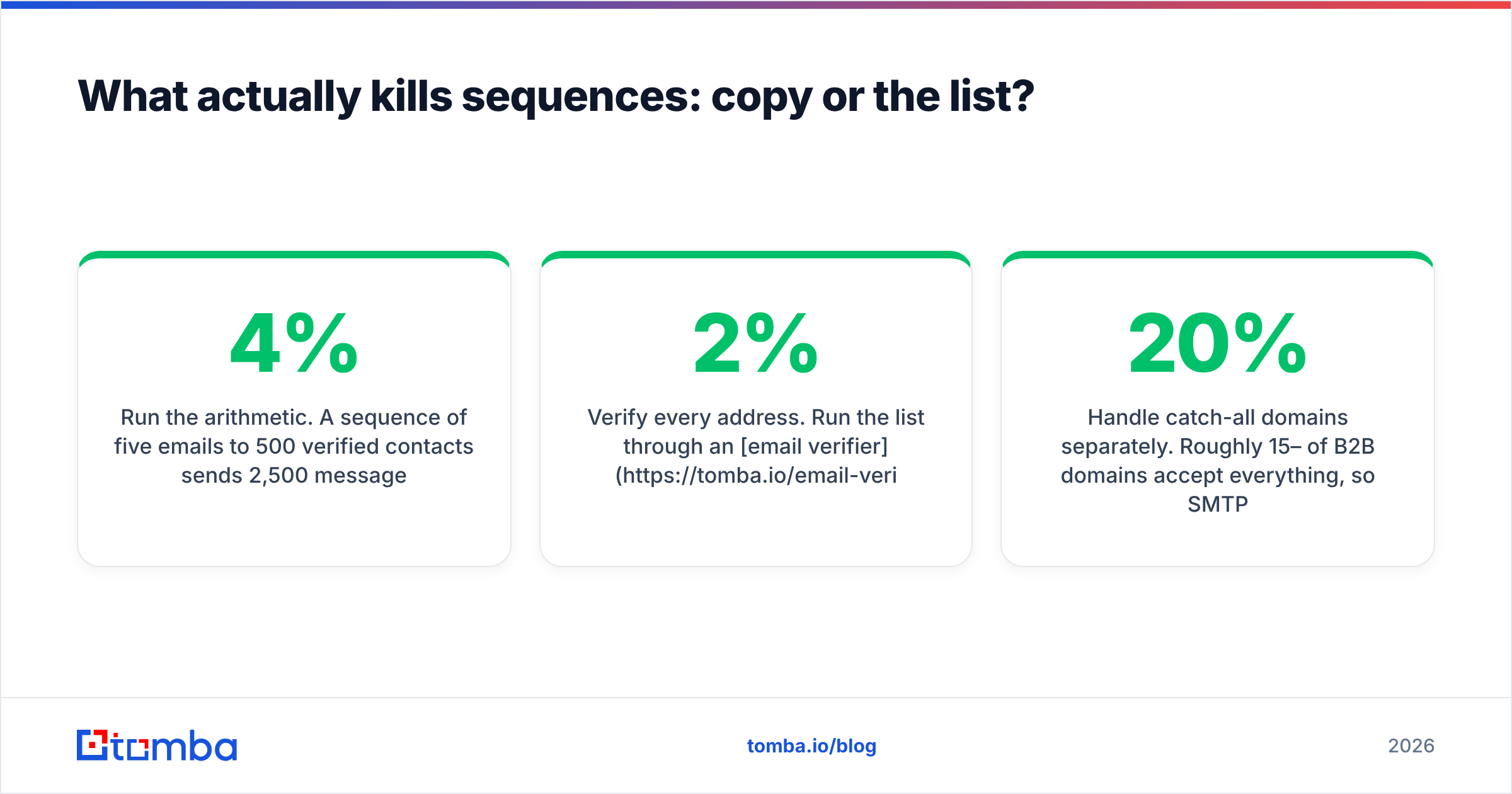
Run the arithmetic. A sequence of five emails to 500 verified contacts sends 2,500 messages. If 4% of those addresses are dead, you generate 20 bounces on the first touch alone. Cross 5% bounce rate on a warmed domain and Google begins throttling. Cross 8% and Microsoft starts routing you to junk wholesale. Your beautifully written touch 3 never renders in a human's eyes.
This is why the first step of building a cold email outreach sequence happens before you write a word of copy. You need addresses that resolve, roles that match, and companies that plausibly have the problem.
A practical pre-flight checklist:
- Verify every address. Run the list through an email verifier and drop anything not marked deliverable. Target under 2% bounce.
- Handle catch-all domains separately. Roughly 15–20% of B2B domains accept everything, so SMTP checks return "unknown." Use a catch-all verifier or route those contacts into a lower-volume, higher-scrutiny segment rather than blending them into your main send.
- Deduplicate across sequences. Nothing torches a deal like the same prospect receiving two different reps' sequences in the same week.
- Check the pattern before guessing. If you cannot confirm the company's email format, a domain search will surface known addresses and the dominant pattern rather than leaving you to permutate blindly.
- Cap daily volume per mailbox. 30–50 sends per mailbox per day on a warmed domain. More mailboxes, not more volume per mailbox.
How do sequence tools compare for cold outreach?#
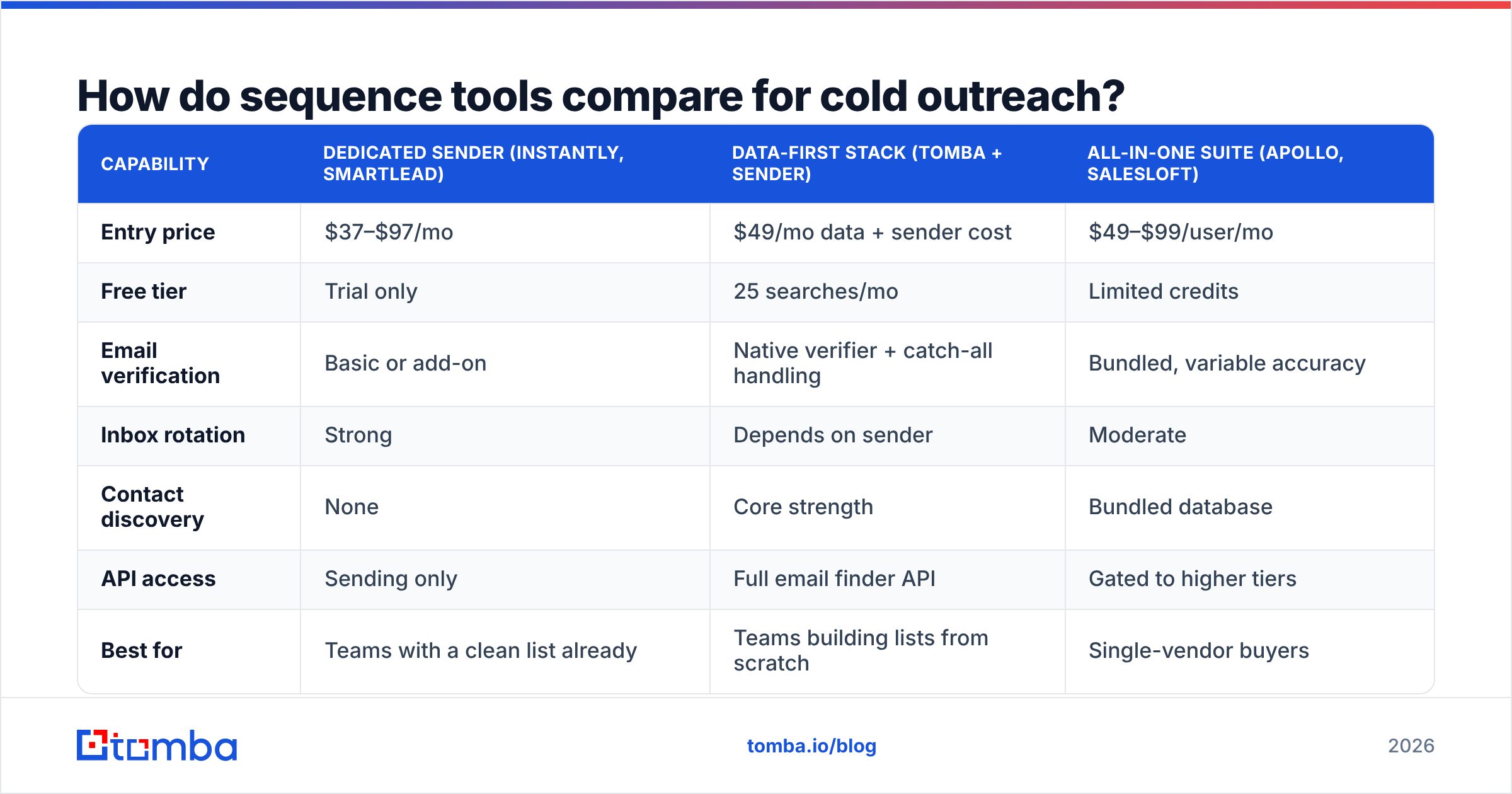
The market splits into three layers, and teams routinely overpay by buying a layer they do not need. Sending platforms move mail. Data platforms find contacts. All-in-one suites do both, usually with one half noticeably weaker.
| Capability | Dedicated sender (Instantly, Smartlead) | Data-first stack (Tomba + sender) | All-in-one suite (Apollo, Salesloft) |
|---|---|---|---|
| Entry price | $37–$97/mo | $49/mo data + sender cost | $49–$99/user/mo |
| Free tier | Trial only | 25 searches/mo | Limited credits |
| Email verification | Basic or add-on | Native verifier + catch-all handling | Bundled, variable accuracy |
| Inbox rotation | Strong | Depends on sender | Moderate |
| Contact discovery | None | Core strength | Bundled database |
| API access | Sending only | Full email finder API | Gated to higher tiers |
| Best for | Teams with a clean list already | Teams building lists from scratch | Single-vendor buyers |
A few honest observations. Apollo's bundled database is genuinely convenient and its sequencing is competent, but per-seat pricing scales badly past five reps. Instantly and Smartlead are excellent at the sending layer and openly tell you to bring your own data. Purpose-built B2B data vendors like BookYourData sell verified lists outright, which suits teams that would rather buy a static list than run discovery in-house — a legitimate trade-off when your ICP is stable and narrow.
Tomba sits in the data layer. Tomba pricing starts free with 25 searches per month, then $49/mo Starter, $99/mo Growth, and $249/mo Pro. Pair it with whichever sender your team already tolerates. The point is not vendor loyalty. The point is that spending $99 on data and $37 on sending usually beats spending $136 on a suite that is mediocre at both.
Cross-check any of this against G2's outbound category reviews before you commit budget. Vendor benchmark blogs, including this one, have obvious incentives.
What should each email in the sequence actually say?#
Four structural rules survive every A/B test I have seen.
Lead with them, not you. The first eight words of email one determine whether the next forty get read. "Saw you're hiring three SDRs in Austin" earns a read. "I'm reaching out because Tomba helps companies like yours" does not. The prospect's name in the subject line is not personalization. Their situation in the first sentence is.
One ask, one link, zero attachments. Every additional call to action halves the odds of any single one being taken. Every attachment raises spam score. If you must link, link once, and never to a calendar in touch one — asking a stranger for thirty minutes before establishing relevance is the outbound equivalent of proposing on a first date.
Write at a sixth-grade reading level. Not because prospects are unsophisticated, but because they are skimming on a phone between meetings. Short sentences. Concrete nouns. No "leverage," no "solutions," no "synergies." HubSpot's own sales email research consistently finds shorter emails outperform longer ones, and the effect is strongest in the first touch.
Make the ask small and specific. "Worth a look?" beats "Do you have 30 minutes Thursday?" A yes to the small ask creates a thread. Threads convert. Calendar links from strangers do not.
Subject lines deserve one paragraph. Four to seven words. Lowercase is fine. No brackets, no "RE:" fakery on a first touch — it works once and burns trust permanently. The best-performing subject lines describe the email's contents, not its importance. "question about your SDR ramp" outperforms "quick question" because it is falsifiable.
Do you need to worry about compliance?#
Yes, and the rules are simpler than the anxiety around them suggests.
In the United States, the CAN-SPAM Act requires accurate header information, a non-deceptive subject line, a physical postal address, and a functioning opt-out honored within ten business days. It does not require prior consent for B2B email. Cold email is legal.
In the EU and UK, GDPR and PECR are stricter. B2B cold email to corporate addresses generally rests on legitimate interest, which requires you to document a balancing test and offer opt-out from the first message. Individual sole traders and personal-format addresses get consumer-level protection. When in doubt, exclude them.
Practically: include a plain-text opt-out line in every email of the sequence, include your company address in the footer, honor unsubscribes within 24 hours rather than the legal ten days, and never scrape addresses you cannot explain the provenance of. If your data vendor cannot tell you where its data comes from, that is the answer to whether you should use it.
How do you measure whether the sequence is working?#
Track four numbers, and ignore the rest until these are healthy.
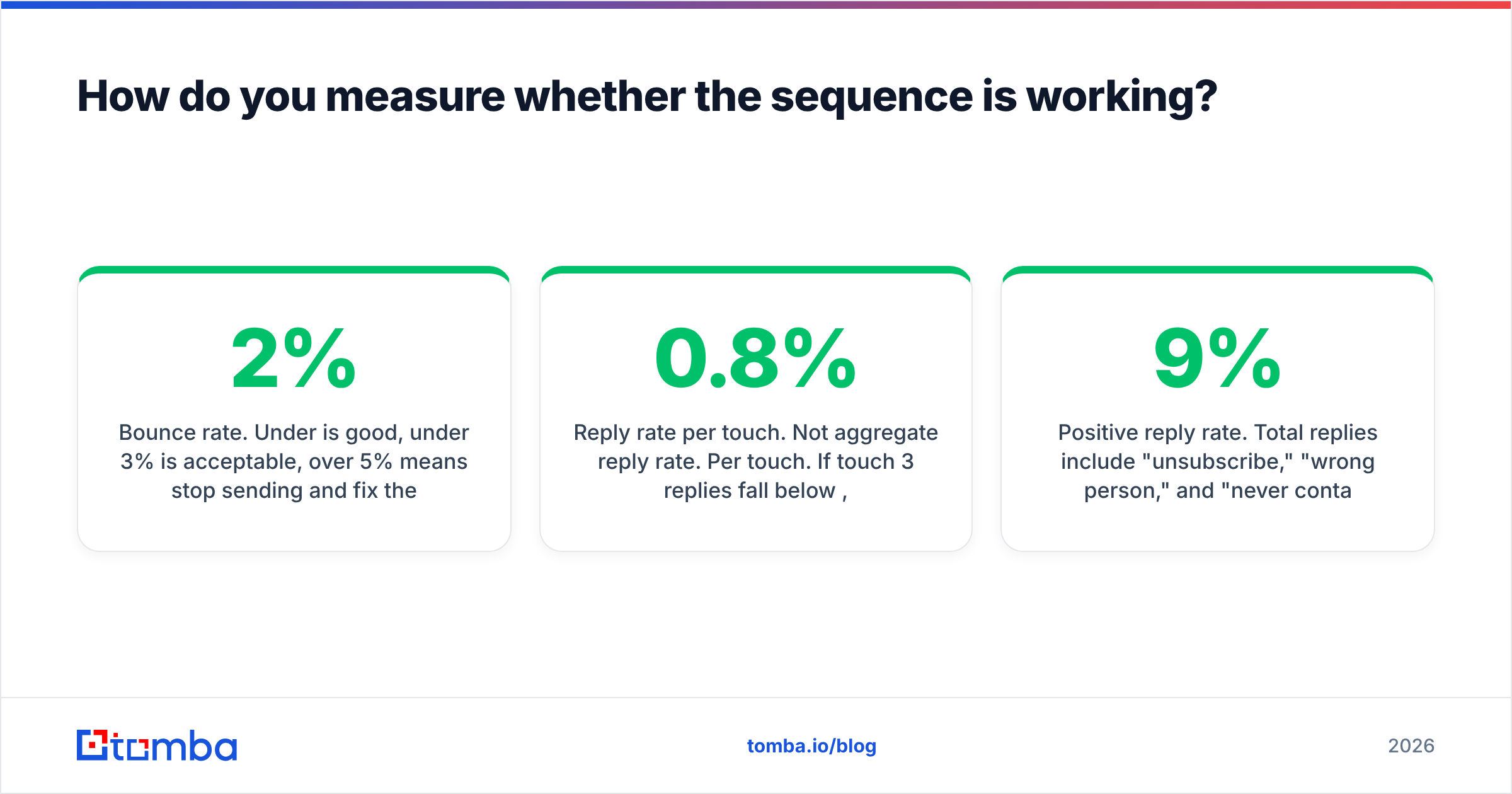
Bounce rate. Under 2% is good, under 3% is acceptable, over 5% means stop sending and fix the list. This is the only metric that can destroy the channel permanently.
Reply rate per touch. Not aggregate reply rate. Per touch. If touch 3 replies fall below 0.8%, that angle is wrong and should be rewritten, not deleted. If touch 5 outperforms touch 1, your first email is failing to establish relevance.
Positive reply rate. Total replies include "unsubscribe," "wrong person," and "never contact me again." Positive replies — interest, questions, referrals to the right person — are the only ones that produce revenue. A 9% reply rate with 1% positive is a worse sequence than a 5% reply rate with 3% positive.
Meetings booked per 1,000 sends. The only number a CRO cares about. Healthy outbound in most B2B categories lands between 3 and 12. Below 3, your targeting is wrong. Above 15, either your list is warm or you are counting demos that never happened.
Run each sequence for at least 400 sends before judging it. Reply rates on 50-contact tests are noise dressed as signal.
Where should you start?#
Start with the list, not the copy. Pick 200 companies that plausibly have the problem you solve. Find the two people at each who own that problem. Verify every address. Then write five emails that each say something new.
Most teams do this backwards. They spend three weeks workshopping subject lines, then blast them at a list they bought from a marketplace, watch the bounce rate cross 9%, and conclude cold email is dead. Cold email is not dead. Their domain is.
If you are building that list from scratch, the Tomba Email Finder surfaces verified professional addresses by name, domain, or company, with catch-all handling built in rather than bolted on. Free tier gives you 25 searches a month — enough to validate your ICP before you spend anything. Get the list right, and the sequence has a chance. Get it wrong, and no amount of copywriting will save it.
Related guides#
// get started
Find, verify and enrich your first contacts today
Start on the free plan with 25 searches a month, then scale when your team is ready.
Free plan · No credit card required · GDPR & CCPA
// about the author