Cold Email Proposal: How to Write One That Gets Replies
Most cold email proposals lose the deal in the first 40 words by pitching before earning attention. Here's the structure, word counts, and follow-up cadence that actually book calls in 2026.
TL;DR
- A cold email proposal is not a proposal document. It is a 90–150 word email whose only job is to earn a reply, not to close a deal.
- The single biggest failure mode is pitching in paragraph one. Lead with a specific observation about the prospect's business, then earn the ask.
- Attach nothing. Price nothing. Link to one thing at most. Full scope, deliverables, and pricing belong in the second conversation.
- Verify the address before you send. A cold email proposal that lands in a spam folder or bounces off a dead mailbox has a 0% close rate regardless of copy quality.
- Expect 3–8% reply rates on a well-targeted list, and treat anything above 12% as a signal you found a segment worth doubling down on.
What is a cold email proposal, exactly?#
A cold email proposal is an unsolicited email sent to a prospect who has never spoken with you, in which you propose a specific piece of work, a specific outcome, or a specific next step.
The word "proposal" is what trips people up. In agency and consulting circles, a proposal is a 12-page PDF with scope, timeline, three pricing tiers, and a signature block. That document exists. It is just not what you send to someone who has never heard your name.
What you send cold is a proposal of a conversation, dressed in enough specificity that the prospect believes you have already thought about their business. The real proposal comes later — after they reply, after a call, after you understand what they actually need.
Confuse the two and you get the most common cold email failure in B2B: a 700-word email with a PDF attachment, sent to a VP who has never heard of you, that gets deleted in under two seconds. Attachments from unknown senders also trigger spam filters, so the email frequently never reaches the inbox at all.
Here is the distinction, concretely:
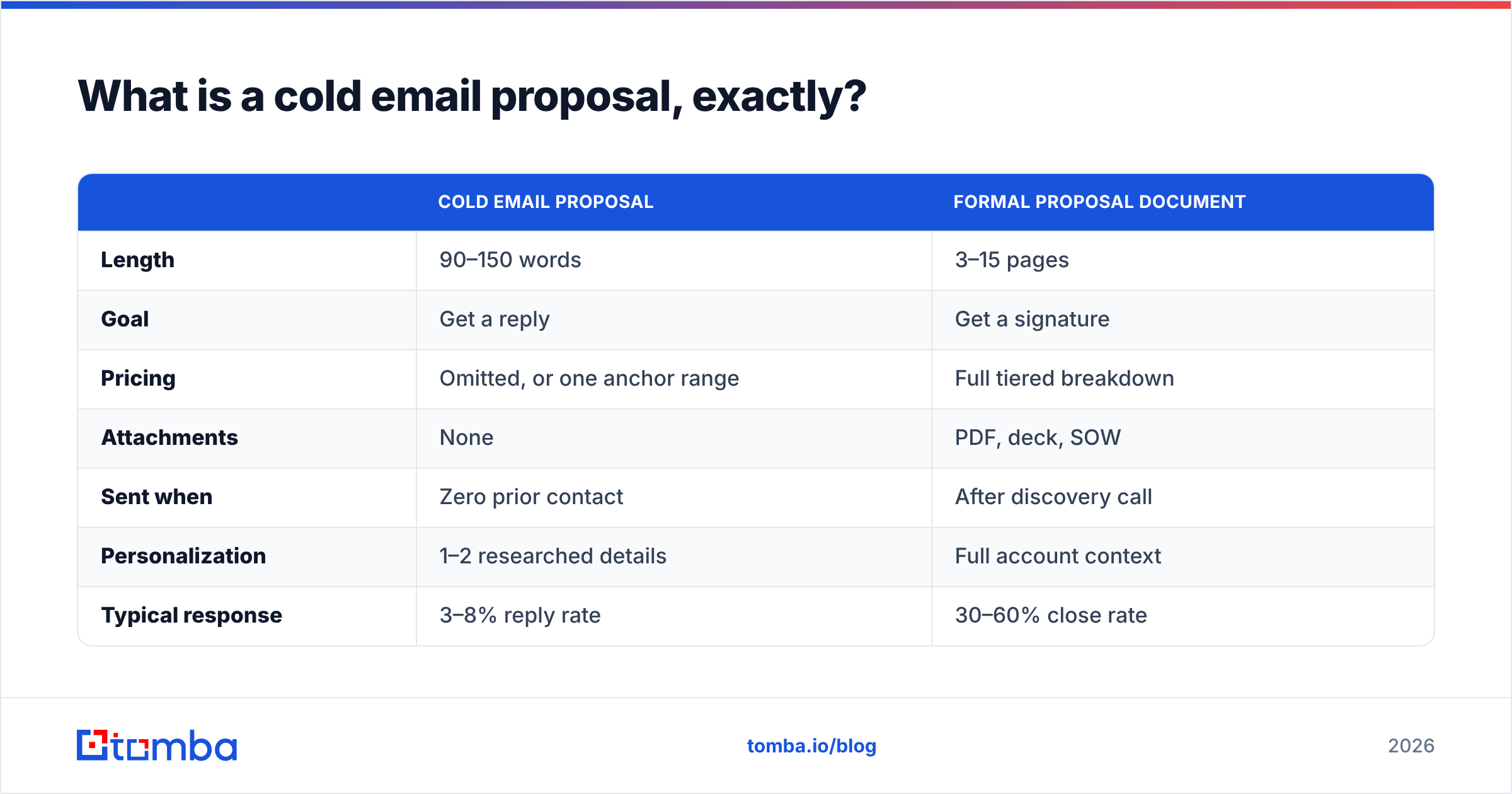
| Cold email proposal | Formal proposal document | |
|---|---|---|
| Length | 90–150 words | 3–15 pages |
| Goal | Get a reply | Get a signature |
| Pricing | Omitted, or one anchor range | Full tiered breakdown |
| Attachments | None | PDF, deck, SOW |
| Sent when | Zero prior contact | After discovery call |
| Personalization | 1–2 researched details | Full account context |
| Typical response | 3–8% reply rate | 30–60% close rate |
If you take one thing from this post: the cold email's only job is to move the prospect from column one to column two.

Why do most cold email proposals get ignored?#
Because they are written from the sender's calendar, not the recipient's problem.
The average B2B decision-maker gets somewhere north of 100 emails a day, and a meaningful share of those are cold. Your email is not competing against silence — it is competing against 14 other vendors who also want 15 minutes. HubSpot's sales research has documented for years that specificity and brevity outperform polish. The same conclusion shows up in Gartner's B2B buying research: buyers spend a small fraction of the purchase cycle with any single vendor, so the cost of an irrelevant email is not neutral — it actively burns your one shot.
Four failure modes account for nearly all ignored cold email proposals:
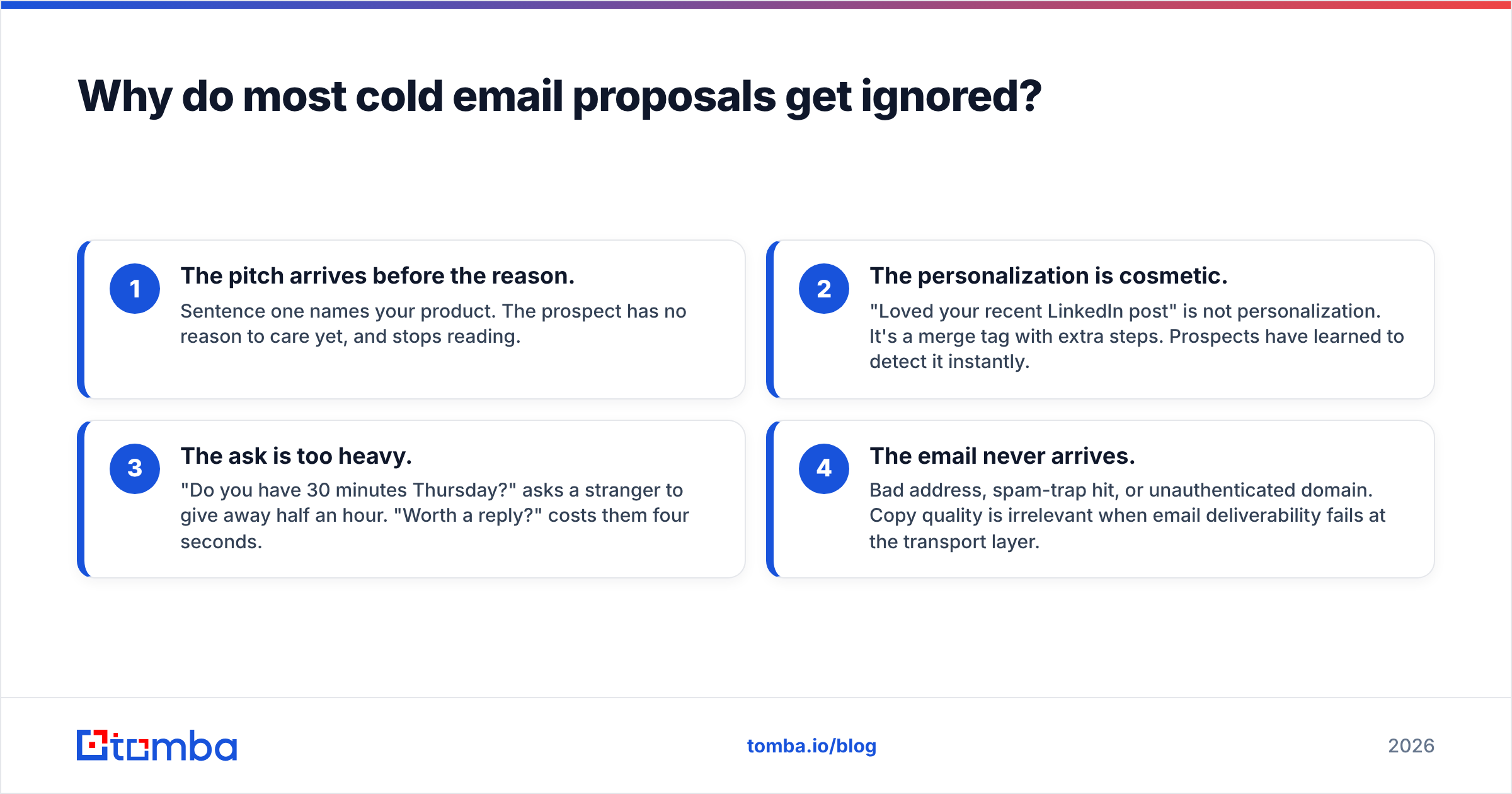
- The pitch arrives before the reason. Sentence one names your product. The prospect has no reason to care yet, and stops reading.
- The personalization is cosmetic. "Loved your recent LinkedIn post" is not personalization. It's a merge tag with extra steps. Prospects have learned to detect it instantly.
- The ask is too heavy. "Do you have 30 minutes Thursday?" asks a stranger to give away half an hour. "Worth a reply?" costs them four seconds.
- The email never arrives. Bad address, spam-trap hit, or unauthenticated domain. Copy quality is irrelevant when email deliverability fails at the transport layer.
The fourth one is the quiet killer, because it looks exactly like a copy problem. You rewrite the subject line six times while the actual issue is that 22% of your list bounced and your sender reputation cratered on day three.
What structure should a cold email proposal follow?#
Five parts, in this order, and no more than 150 words total.
- The observation (1 sentence). Something specific and verifiable about their business. A hire they made. A page they shipped. A market they entered. Not a compliment — an observation.
- The implication (1 sentence). Why that observation creates a problem, cost, or opportunity that you happen to handle. This is where credibility is won or lost.
- The proof (1 sentence). One number, one comparable client, one result. Not three. Not a case-study link plus a deck plus a testimonial.
- The proposal (1–2 sentences). What you would actually do. Concrete enough that they can picture it. Vague enough that it doesn't sound like you skipped discovery.
- The ask (1 sentence). The smallest possible next step. A reply-yes, an interest check, a single question.
Applied:
Subject: your Q3 SDR hires
Noticed you added four SDRs in Boston last quarter but the careers page still lists no sales-ops role.
Usually that means the new reps are building their own lists — which costs each of them roughly six selling hours a week.
We handled the same gap for [comparable company]; their reps got back about a day a week within the first month.
The proposal: we build and verify the target account list for one territory, you keep it either way, and we talk only if it holds up.
Worth a reply?
That's 94 words. Nothing is attached. Nothing is priced. The ask costs the reader almost nothing to accept.
Compare it against what most people send: three paragraphs of company boilerplate, a Calendly link, and a PDF named Proposal_v3_FINAL.pdf.
How long should a cold email proposal be, and when do you send pricing?#
Short, and later. But "short" needs a number, so here is the working range most outbound teams converge on:
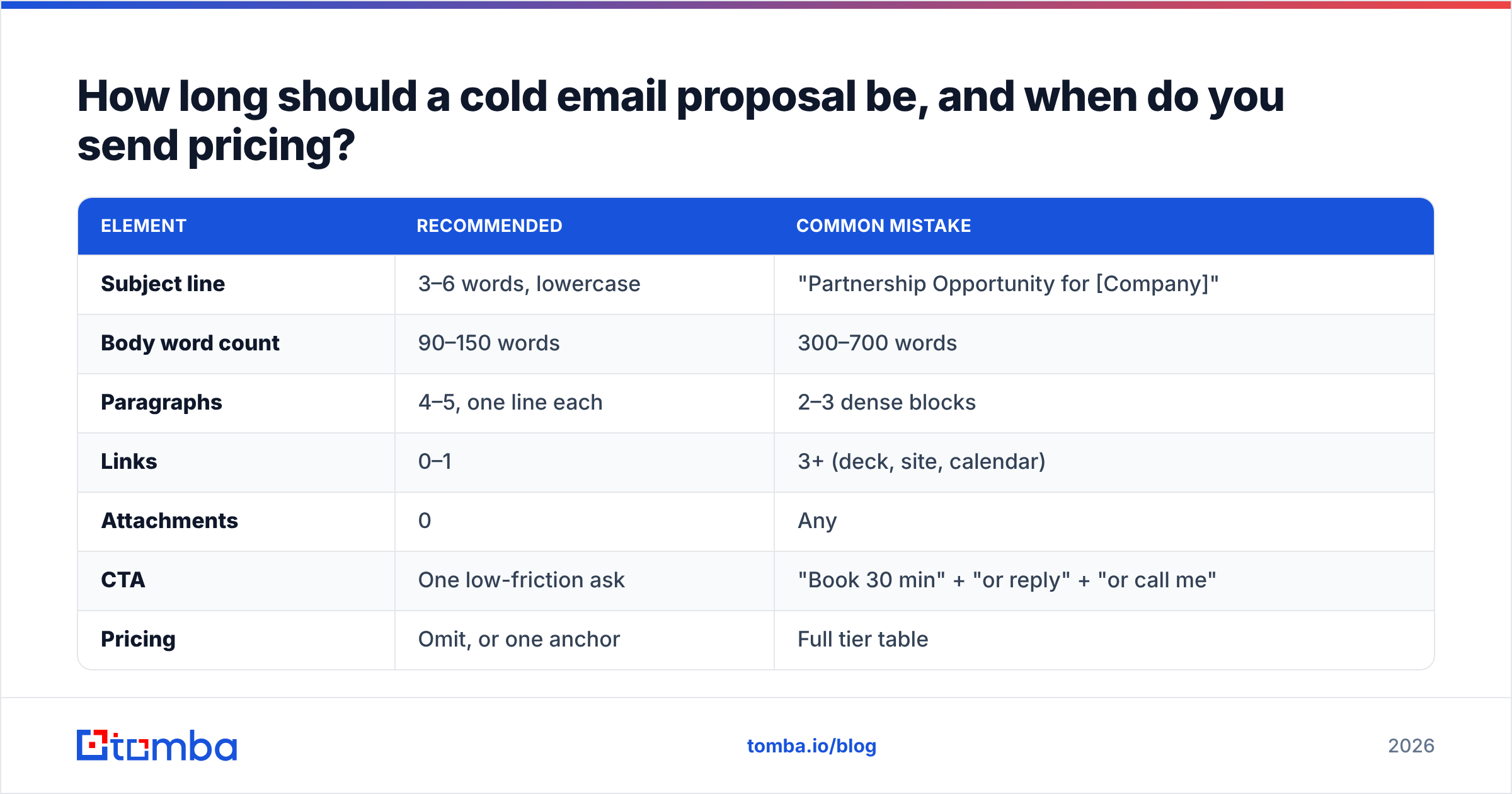
| Element | Recommended | Common mistake |
|---|---|---|
| Subject line | 3–6 words, lowercase | "Partnership Opportunity for [Company]" |
| Body word count | 90–150 words | 300–700 words |
| Paragraphs | 4–5, one line each | 2–3 dense blocks |
| Links | 0–1 | 3+ (deck, site, calendar) |
| Attachments | 0 | Any |
| CTA | One low-friction ask | "Book 30 min" + "or reply" + "or call me" |
| Pricing | Omit, or one anchor | Full tier table |
On pricing specifically, there are two defensible positions.
Omit it entirely. This is right when your pricing is scoped per engagement, when the range is wide, or when the number would scare a prospect who hasn't yet understood the value. Most consulting, agency, and enterprise SaaS proposals sit here.
Anchor it in one clause. "Engagements like this typically run $8–12K." This works when your price is a feature — when you are meaningfully cheaper than the incumbent, or when you want to disqualify tire-kickers before a call. It also saves you from the prospect who takes the call, hears the number, and vanishes.
What never works: a full pricing table in a cold email. It reads as a quote for work nobody asked for, and it invites comparison shopping against vendors the prospect already trusts. Browse the sales-engagement reviews on G2 and you'll find the same complaint from buyers repeatedly — cold quotes get filed, not answered.
How do you make sure the proposal actually reaches a human?#
Copy is downstream of delivery. Before you write a single word, three things must be true.
One: the address exists. Guessed patterns like firstname@company.com are right maybe half the time depending on the industry. Every bounce is a small deposit into a reputation account you cannot easily refill. Run the list through an email verifier before the first send, not after the first bad campaign.
Two: the address belongs to the right person. Sending a proposal to info@ or a departed employee is worse than not sending at all, because it consumes your one legitimate touch on that domain. Sourcing named contacts by role — via domain search, a data provider like BookYourData, or your own research — is what separates a 6% reply rate from a 0.4% one.
Three: your domain is authenticated. SPF, DKIM, and DMARC configured. A warmed sending domain that is not your primary. Volume ramped, not dumped. And a compliance floor: identify yourself, honor opt-outs, and follow the CAN-SPAM Act in the US or GDPR's legitimate-interest tests in the EU.

Teams that skip step one usually discover the problem in week three, when their response rate collapses and they blame the copy. It was almost never the copy.
What follow-up cadence works for a cold email proposal?#
Two to four follow-ups, spaced 3–5 business days apart, each adding something rather than asking again.
The follow-up that says "just bumping this to the top of your inbox" is a tax on the recipient's attention. It adds no information and signals that you have nothing else to say. The follow-up that says "one more data point — [comparable company] saw the same pattern after their Series B" gives the prospect a new reason to reply.
A cadence that holds up:
- Day 0 — The proposal. 94 words. One ask.
- Day 4 — A new angle. Different problem, same solution. Do not restate the original email.
- Day 9 — A single piece of proof. A number, a screenshot, a one-line result. No ask beyond "does this map to your situation?"
- Day 16 — The close-out. "Assuming this isn't a priority this quarter — should I check back in Q4, or take you off the list?" This email reliably outperforms every other follow-up in the sequence, because it gives the prospect an easy, dignified out. Many of them will instead reply with a reason.
Then stop. A fifth, sixth, and seventh follow-up damages your domain reputation and your brand for a rounding error in incremental replies.
If you need pre-built starting points rather than a blank page, the cold email templates library is a reasonable place to steal structure from — then rewrite the observation line yourself, because that line is the only part that cannot be templated.
What separates a 3% reply rate from a 12% one?#
Not the copy. The list.
This is the least satisfying conclusion in outbound, and the most consistently true one. Two teams sending the identical cold email proposal to different lists will see reply rates diverge by 4x. The team that wins is the one whose 200 prospects all share a specific, observable trigger — a funding round, a hire, a tech-stack change, a competitor's price increase — and whose email speaks to exactly that trigger.
Practically, that means:
- Segment before you write. One email per segment, not one email for the whole list. Fifty prospects with a real observation beats 5,000 with a merge tag.
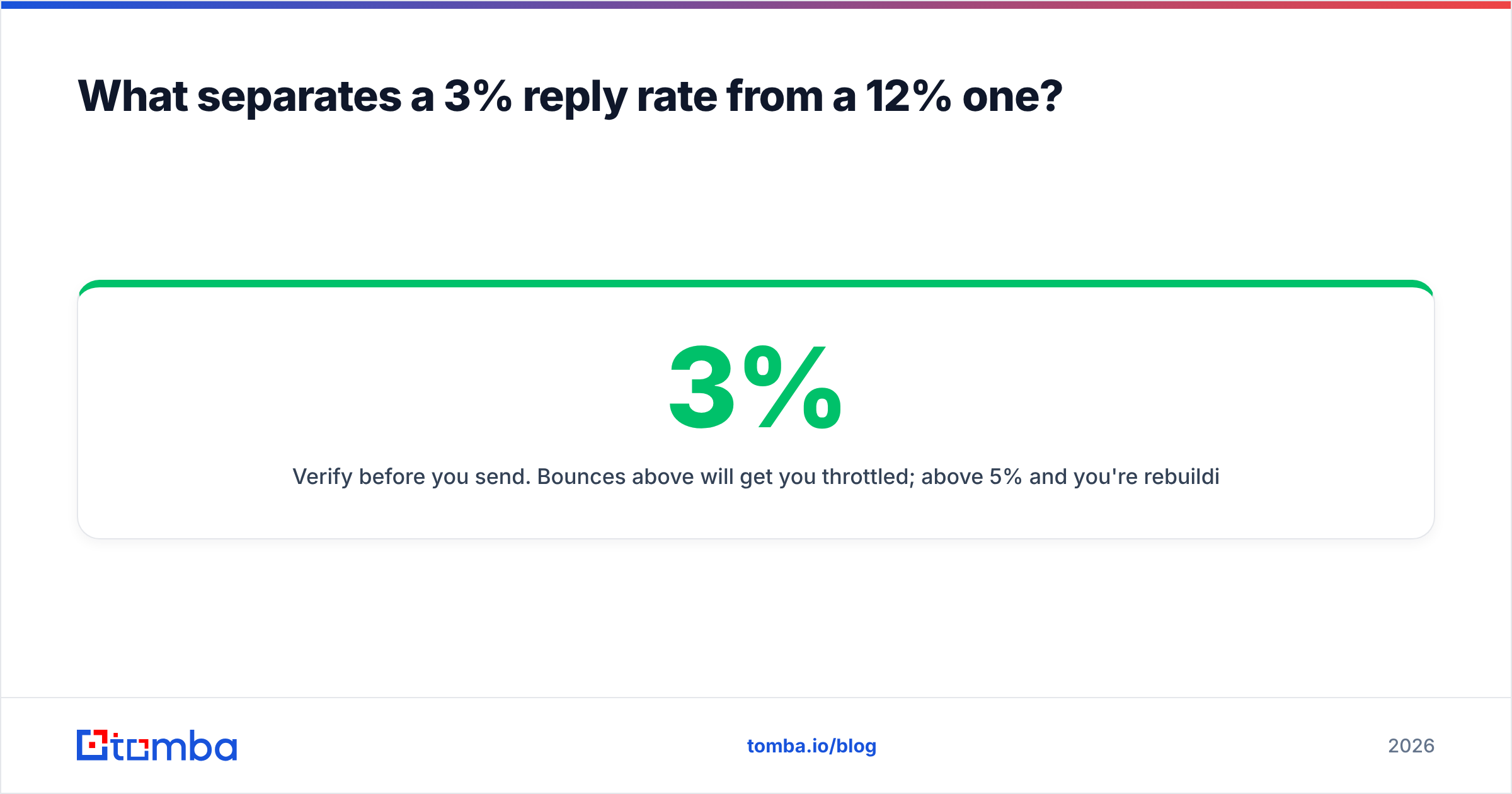
- Verify before you send. Bounces above 3% will get you throttled; above 5% and you're rebuilding a domain.
- Measure replies, not opens. Open tracking has been unreliable since Apple's Mail Privacy Protection shipped. Replies and booked calls are the only honest metrics left.
- Kill segments fast. If 100 sends produce zero replies, the segment is wrong. Do not send 400 more to be sure.
The list is upstream of everything. A good cold email proposal to the wrong 500 people loses to a mediocre one sent to the right 50.
Where should you start?#
Start with the list, because that's where the leverage is.
Pick one segment — a job title, a company size, and one observable trigger. Find the named decision-maker at each account rather than a generic inbox. Verify every address before the first send. Then write 94 words that prove you looked at their business for more than ten seconds.
Tomba's Email Finder gives you the named-contact layer of that workflow: search by domain, name, or company and get a verified professional address with a confidence score, so your cold email proposal reaches a real person on the first attempt instead of a bounce log. The free tier covers 25 searches a month if you want to test a segment before committing, and paid plans start at $49/mo — see full Tomba pricing if you're scaling past a single territory.
Write fewer emails. Send them to people who exist. That's the whole game.
Related guides#
// get started
Find, verify and enrich your first contacts today
Start on the free plan with 25 searches a month, then scale when your team is ready.
Free plan · No credit card required · GDPR & CCPA
// about the author