Cold Email Referral: How to Use Mutual Connections in 2026
A referral line can double your reply rate — or torch your credibility in one sentence. Here's how the cold email referral actually works, what to write, and how to verify the connection before you hit send.
TL;DR
- A cold email referral is any cold outreach that opens with a named third party — a mutual connection, a customer, a person who told you to reach out, or someone whose work the prospect already trusts.
- Referral-framed cold emails typically land 2x to 4x the reply rate of an unreferenced cold email, but the lift collapses the moment the prospect suspects you invented the connection.
- The three variants — true referral, mutual-connection mention, and social-proof name-drop — carry very different risk profiles. Most reps blur them, and that's where the credibility damage happens.
- The mechanics matter more than the copy: get the referrer's permission, verify the recipient's address, name the connection in the first sentence, and never bury it below the fold.
- Bad data kills a good referral. If you name the right person and email the wrong address, the whole play is wasted — verify before you send.
What is a cold email referral?#
A cold email referral is a first-touch email that borrows credibility from a person the recipient already knows or respects. You are still cold — you have no prior relationship with the prospect — but you are not anonymous. Somebody in the message is a known quantity.
Think of it like showing up to a dinner party. Walking in unannounced makes people uneasy. Walking in and saying "Sarah invited me" changes nothing about who you are, but it changes everything about how the room reads you. The host stops running threat assessment and starts running hospitality.
That's the entire mechanism. A referral does not make your product better. It moves the recipient from "who is this and why are they in my inbox" to "okay, this person is inside the trust perimeter, I'll read the next sentence." Everything after that is still your job.
The trouble is that "referral" gets used to describe four different things, and the four are not interchangeable.
What are the four types of referral cold email?#
Here's the taxonomy that actually predicts outcomes. Sort your emails into one of these before you write a word.
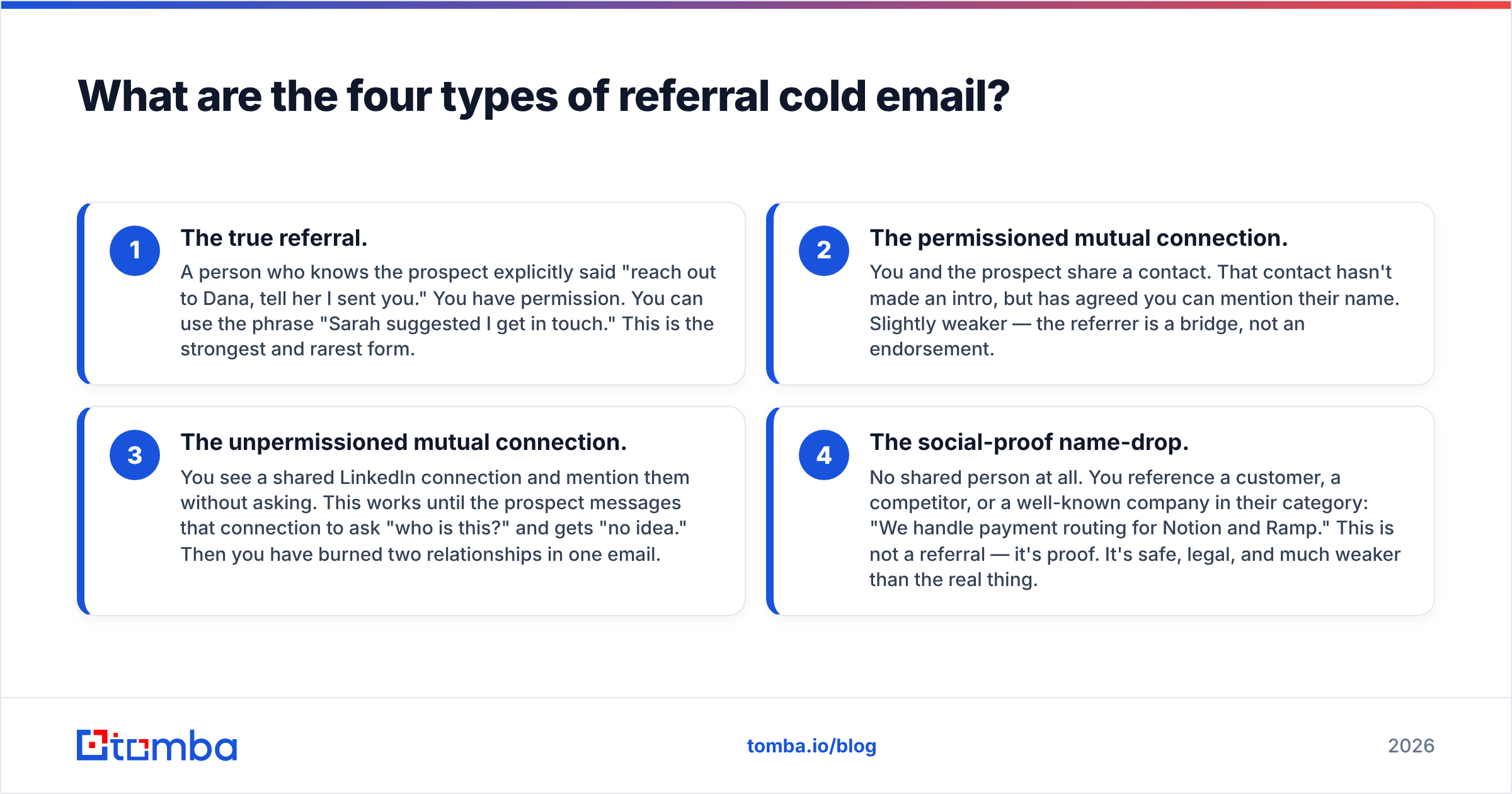
- The true referral. A person who knows the prospect explicitly said "reach out to Dana, tell her I sent you." You have permission. You can use the phrase "Sarah suggested I get in touch." This is the strongest and rarest form.
- The permissioned mutual connection. You and the prospect share a contact. That contact hasn't made an intro, but has agreed you can mention their name. Slightly weaker — the referrer is a bridge, not an endorsement.
- The unpermissioned mutual connection. You see a shared LinkedIn connection and mention them without asking. This works until the prospect messages that connection to ask "who is this?" and gets "no idea." Then you have burned two relationships in one email.
- The social-proof name-drop. No shared person at all. You reference a customer, a competitor, or a well-known company in their category: "We handle payment routing for Notion and Ramp." This is not a referral — it's proof. It's safe, legal, and much weaker than the real thing.
Most reps write type 4, call it type 1, and wonder why it doesn't perform. The gap between "I work with companies like yours" and "Sarah Chen told me to email you" is not a copy problem. It's a sourcing problem.
Does a cold email referral actually increase reply rates?#
Yes, and the effect size is large enough that it changes how you should allocate prospecting hours. But the number you've seen quoted in a LinkedIn post is probably inflated.
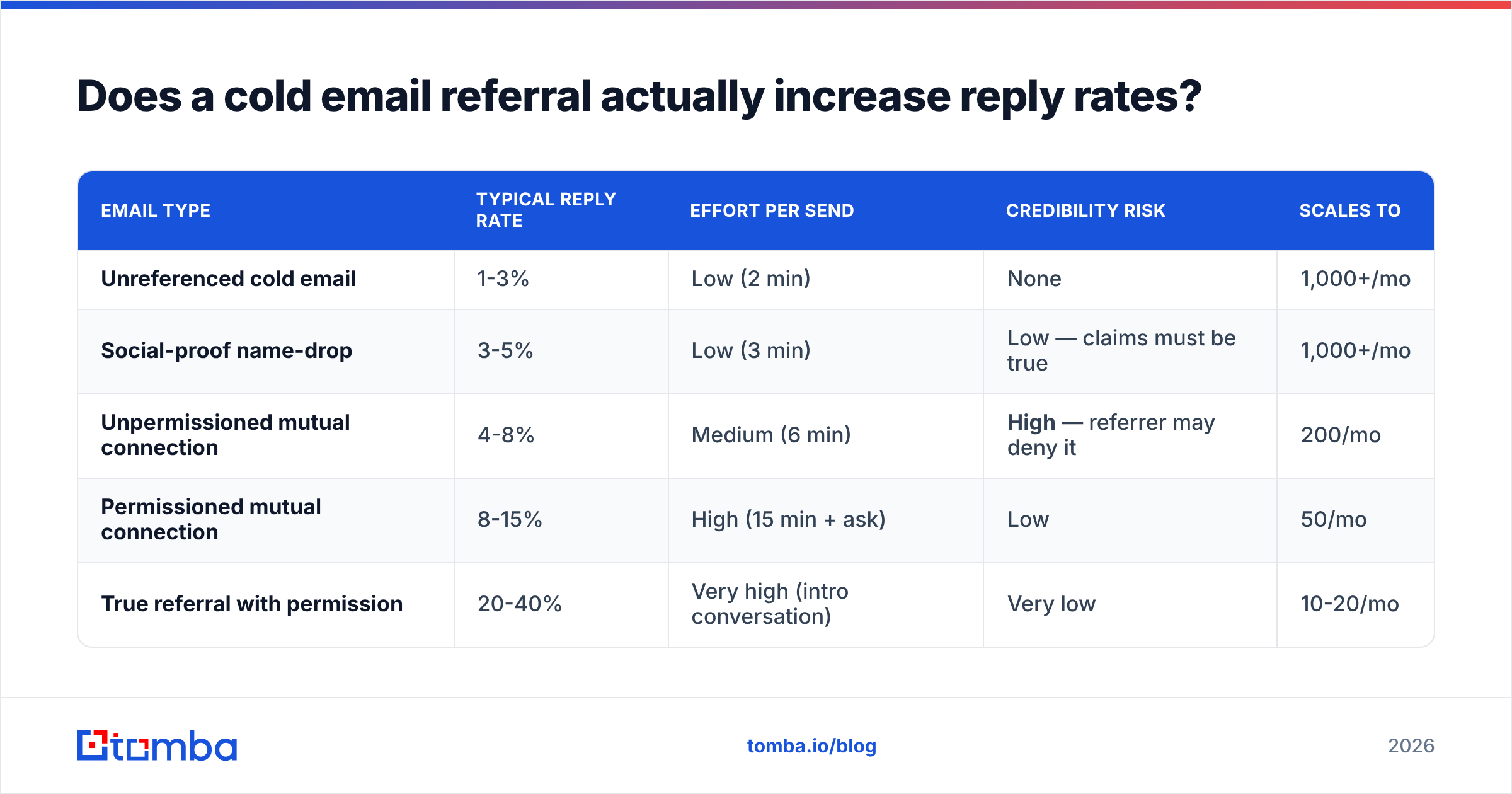
Here's the honest picture, based on what a well-run outbound team should expect across a 500-send segment:
| Email type | Typical reply rate | Effort per send | Credibility risk | Scales to |
|---|---|---|---|---|
| Unreferenced cold email | 1-3% | Low (2 min) | None | 1,000+/mo |
| Social-proof name-drop | 3-5% | Low (3 min) | Low — claims must be true | 1,000+/mo |
| Unpermissioned mutual connection | 4-8% | Medium (6 min) | High — referrer may deny it | 200/mo |
| Permissioned mutual connection | 8-15% | High (15 min + ask) | Low | 50/mo |
| True referral with permission | 20-40% | Very high (intro conversation) | Very low | 10-20/mo |
Two things jump out.
First, the reply rate roughly scales with the amount of relationship work you did before writing the email. There's no shortcut. The 30% reply rate on a true referral is bought with a conversation you had with the referrer, not with a clever subject line.
Second, volume moves inversely. You cannot run 800 true referrals a month. Nobody has 800 people willing to vouch for them. This means referral outreach is a top-of-list tactic, not a channel replacement. Reserve it for your 40 highest-value accounts and run standard cold sequences on the rest.
The classic research on why this works is social proof — people infer correct behavior from the behavior of others they trust. A referral is social proof delivered by a single high-weight node instead of a crowd.
How do you find a mutual connection worth mentioning?#
Sourcing is 80% of the work. The email is 20%.
Start with your own network graph. LinkedIn's "shared connections" panel on any profile is the fastest source. Filter for connections you've actually spoken with in the last 12 months — a dormant 2015 connection is a liability, not an asset. If the shared connection can't pick you out of a lineup, don't use their name.
Mine your customer list against their org chart. If you sell to RevOps leaders and one of your customers used to work at the prospect's company, you have a referral path even without a LinkedIn overlap. Former colleagues are underrated referrers because the relationship is durable and the endorsement is specific.
Check who publishes in their space. If a prospect has shared or commented on an article, the author of that article is a soft referral node. An author finder lookup turns a byline into a reachable contact, and a warm note from a writer they follow travels further than a rep's pitch.
Use investor, board, and advisor overlap. Two portfolio companies of the same fund share a connection whether anyone acknowledges it or not. This is why the "our mutual investor at Sequoia suggested I reach out" line works — when it's true.
Once you've picked the person, you need the prospect's actual address. This is where most referral campaigns quietly die: the copy is perfect, the connection is real, and the email bounces into a defunct alias. Run the domain through a domain search to get the company's real pattern, then confirm the specific address with an email verifier before you spend a referral on it. You get one shot per referrer. Don't burn it on a typo.
What should a cold email referral actually say?#
Four rules, then four templates.
Rule 1: The name goes in the first eight words. Not the second paragraph. Not after your intro. If Sarah's name is below the preview pane, you have written a cold email with a decoration attached.
Rule 2: Explain the connection, don't just assert it. "Sarah Chen suggested I reach out" is fine. "Sarah Chen and I worked together on the Acme migration last spring — she mentioned you're rebuilding your data stack" is dramatically better, because it proves the relationship is real and explains why the prospect specifically is being contacted.
Rule 3: One ask, and make it small. The referral bought you attention, not commitment. Ask for a 15-minute call or a yes/no answer, never a demo, never a document review.
Rule 4: Never fake it, never fudge it. "I saw we're both connected to Sarah" is a mutual connection, not a referral. Say the true thing. The moment a prospect forwards your email to the referrer with "do you know this person?", your entire pipeline for that account is decided.
Template 1 — True referral#
Subject: Sarah Chen suggested I reach out
Dana,
Sarah Chen mentioned you're consolidating three CDPs into one and said I should introduce myself.
We did the same migration for her team at Acme last quarter — the piece that surprised her was how much of the identity-resolution work was already solved in the source system.
Worth 15 minutes to compare notes? Happy to send what we learned either way.
— Marc
Template 2 — Permissioned mutual connection#
Subject: Sarah Chen said you'd have opinions on this
Dana,
Sarah Chen and I have been trading notes on CDP consolidation for a year. She said you've probably run into the same identity-resolution wall she did.
I wrote up how three teams solved it. Want me to send it over?
— Marc
Template 3 — Social-proof name-drop (no shared person)#
Subject: How Ramp cut CDP spend 40%
Dana,
Ramp and Notion both consolidated onto a single CDP last year. Both cut spend around 40%, and both hit the same identity-resolution problem in month two.
You're running three CDPs, per your job posting for a data engineer. Same road.
15 minutes to walk through how they handled month two?
— Marc
Template 4 — The referral request (to the referrer, not the prospect)#
Subject: Quick ask — Dana at Globex
Sarah,
I'm trying to reach Dana Ruiz at Globex about CDP consolidation. She'd know the same headaches you had.
Would you be comfortable with me mentioning your name? No intro needed — just want to make sure you're okay with it.
— Marc
Template 4 is the one nobody sends, and it's the one that turns a type-3 email into a type-2 email. It takes ninety seconds and it eliminates the entire credibility risk column of the table above. If you write more cold email templates, start there.
When does a cold email referral backfire?#
Four failure modes, in order of how often they show up.
The referrer doesn't remember you. You met at a conference, connected, never spoke. You use their name. The prospect asks. The referrer says "who?" You've now damaged your standing with both. Filter mercilessly: if you couldn't call this person and have them pick up, they're not a referrer.
The referrer and the prospect don't like each other. A shared LinkedIn connection is not a friendship. Sometimes it's a former manager the prospect left because of. Sometimes it's a vendor who overcharged them. LinkedIn shows you the edge; it doesn't show you the sign on the edge. When the relationship history is unknown, ask the referrer first.
The name is doing all the work. If your email is a name plus a generic pitch, the prospect reads it as manipulation — because it is. The referral opens the door; a specific, researched reason for contacting them is what gets you through it.
The email never arrives. You did everything right and the message hit a catch-all that silently swallowed it, or the address was a guessed pattern that bounced. Referral emails deserve better data than blast emails, because the cost of a wasted send is a wasted relationship. Pull the address properly with an email finder, confirm deliverability, and only then spend the name.
Worth reading alongside this: HubSpot's sales blog has solid data on referral-sourced pipeline conversion, and Salesforce publishes benchmarks on how referred opportunities close faster than self-sourced ones. Both confirm the pattern — referred deals convert at higher rates and shorter cycles, which is why the low volume is acceptable.
How do you build a repeatable referral motion?#
Stop treating referrals as a thing that happens to you.
Audit your existing graph quarterly. Export your closed-won contacts, your investors, your advisors, and your top 200 LinkedIn connections. Cross-reference against your target account list. The overlap is your referral inventory. Most teams discover 30-60 viable paths they didn't know they had.
Ask at the moment of value. The best time to request a referral is immediately after a customer says something positive — after a good QBR, after a support win, after they renew. Not in a quarterly "do you know anyone?" email, which is the referral equivalent of a mass BCC.
Make the ask specific. "Do you know anyone who might need us?" gets nothing. "Would you be comfortable if I mentioned your name to Dana Ruiz at Globex?" gets a yes or a no, and both are useful.
Track referral emails separately. Blending them into your main sequence metrics hides the signal. A 25% referral reply rate averaged with a 2% cold reply rate produces a number that tells you nothing. Segment them, and watch what a lifted response rate does to your pipeline math.
Close the loop with the referrer. Tell them what happened. Whether the deal closed or the prospect ghosted, the person who lent you their name deserves the ending. It costs one email and it's the entire reason they'll say yes the second time.
Get the address right before you spend the name#
A referral is the most expensive asset in outbound. You can send a thousand cold emails and lose nothing but time. You can send one referral email to a bad address and lose the referrer's goodwill, the account, and the second chance.
So do the boring part first. Confirm the company's real email pattern, resolve the individual, and verify the address is live before that name leaves your drafts folder.
Tomba Email Finder does exactly that — find a professional address by name, domain, or company, then verify it before send. The free tier gives you 25 searches a month, which is roughly the number of true referrals a good rep can generate anyway. Paid plans start at $49/mo for Starter and $99/mo for Growth; see Tomba pricing for the full breakdown.
Find the person. Verify the address. Then, and only then, use the name.
Related guides#
// get started
Find, verify and enrich your first contacts today
Start on the free plan with 25 searches a month, then scale when your team is ready.
Free plan · No credit card required · GDPR & CCPA
// about the author