Cold Email Sequence: The 2026 Guide to Getting Replies
Most cold email sequences die on send one — not because the copy is bad, but because the list is. Here's the 5-step structure, timing, and templates that hold up in 2026.
TL;DR
- A cold email sequence is 4–6 spaced emails to the same prospect, each carrying a new reason to reply — not a nag about the last one.
- Reply rates collapse at the list, not the copy. A 20% bounce rate poisons your domain before anyone reads email two.
- The best-performing structure in 2026: hypothesis → proof → resource → objection → breakup, spread over 14–21 days.
- Follow-ups do the heavy lifting. Roughly half of positive replies land on emails 2–4, not the opener.
- Stop sending on a schedule. Stop when they reply, click twice, or hit the breakup — whichever comes first.
What is a cold email sequence?#
A cold email sequence is a planned series of emails sent to a prospect who has never heard of you, spaced over days or weeks, where each message stands on its own.
Think of it like knocking on a neighbor's door. The first knock is polite. The second, thirty seconds later, is annoying. But coming back on Thursday with the package that got delivered to your house by mistake? That's a different visit entirely. Every email in a good sequence is a different visit with a different reason — not the same knock, louder.
Technically: a sequence is a state machine. Each prospect sits in a step, waits a delay, receives a message, and exits on a trigger (reply, meeting booked, unsubscribe, bounce, or sequence end). The thing most teams get wrong is treating it as a broadcast schedule instead of a conversation with pauses.
Three properties separate a sequence from a drip blast:
- Each email is independently valuable. Delete email one and email three still makes sense to a stranger.
- Exit conditions are aggressive. A reply — even "not interested" — pulls the prospect out immediately.
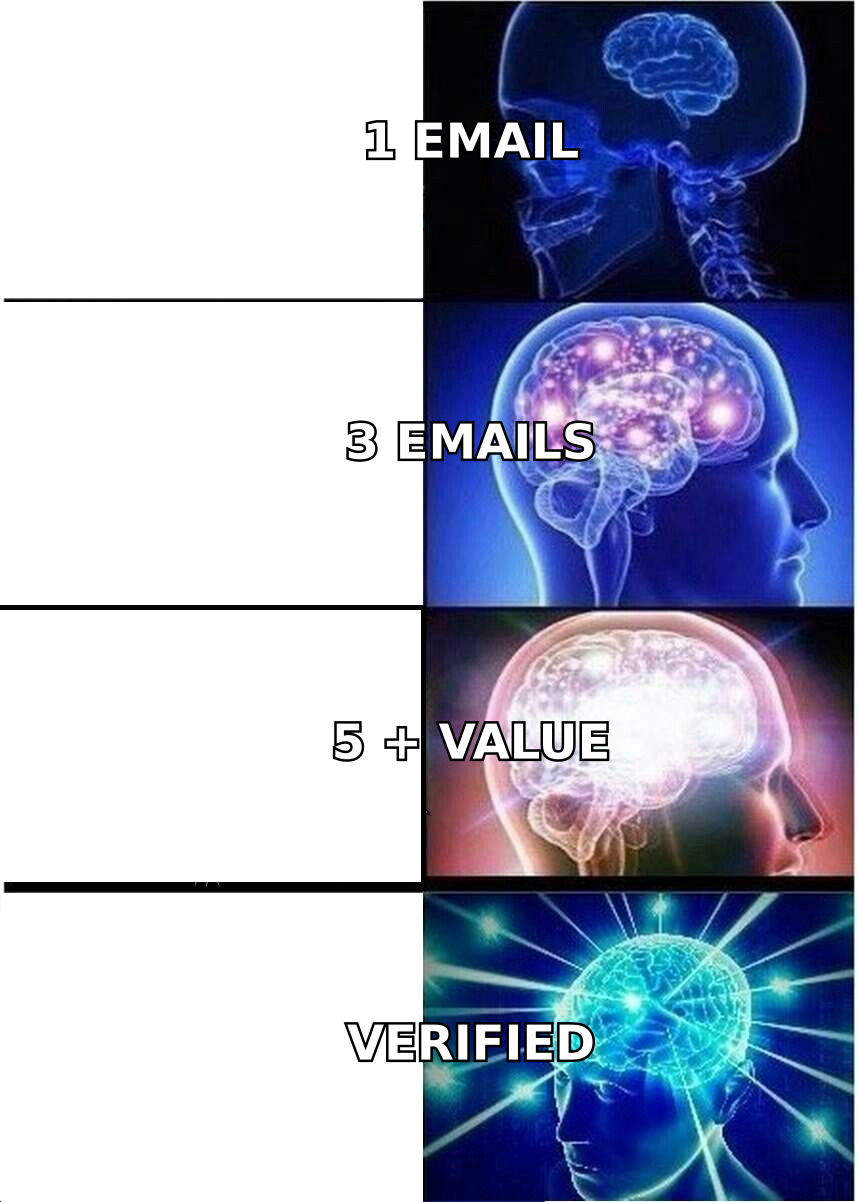
- The data is verified before send one. Everything downstream depends on this.
Why do most cold email sequences fail?#
Because the sender optimizes the part they can see. Copy is visible. Deliverability isn't.
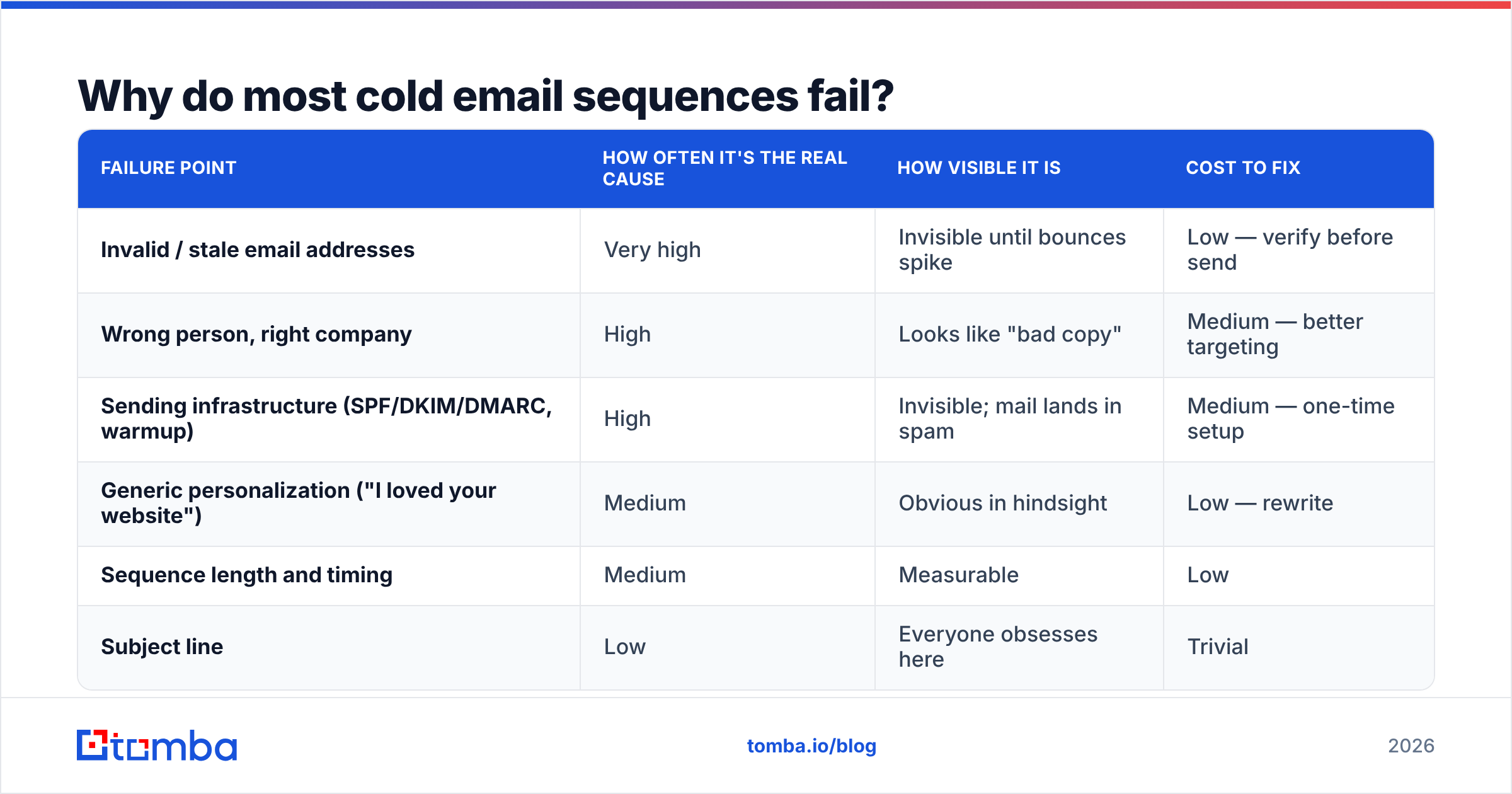
Here is the actual order of impact, from a teardown of what breaks first:
| Failure point | How often it's the real cause | How visible it is | Cost to fix |
|---|---|---|---|
| Invalid / stale email addresses | Very high | Invisible until bounces spike | Low — verify before send |
| Wrong person, right company | High | Looks like "bad copy" | Medium — better targeting |
| Sending infrastructure (SPF/DKIM/DMARC, warmup) | High | Invisible; mail lands in spam | Medium — one-time setup |
| Generic personalization ("I loved your website") | Medium | Obvious in hindsight | Low — rewrite |
| Sequence length and timing | Medium | Measurable | Low |
| Subject line | Low | Everyone obsesses here | Trivial |
Notice the inversion: the things teams spend the most time on sit at the bottom. A/B testing subject lines on a list with a 22% bounce rate is rearranging deck chairs. Google and Yahoo both tightened bulk-sender requirements in 2024, and the practical effect since then is that a spam-complaint rate above 0.3% moves your entire domain, not just one campaign, into the junk folder. Check the Gmail bulk sender guidelines directly rather than trusting a vendor's summary of them.
Verify your list before it becomes a reputation problem. A quick pass through an email verifier removes the catch-alls, role accounts, and dead mailboxes that would otherwise become bounces. If a chunk of your list is on catch-all domains — common in enterprise — a catch-all verifier tells you which are actually deliverable rather than guessing.
What is the ideal cold email sequence structure?#
Five emails over 14–21 days. Each with a distinct job.
1. The hypothesis (Day 0). You state a specific, falsifiable guess about their business and ask if it's true. Not "we help companies like yours." Something like: "You've got 14 SDRs on LinkedIn but no listed sales ops hire — guessing routing is manual?" Under 90 words. One question. No attachment, no calendar link, no signature image.
2. The proof (Day 3). Same thread, new information. A specific result from a company that looks like theirs, with a number and a timeframe. Not a case-study PDF. Two sentences of context, one number, one question.
3. The resource (Day 7). Give something away with no ask. A teardown of their competitor's pricing page. A three-line SQL query for the problem you named in email one. This is the email that most often gets a reply from people who ignored the first two, because it's the first one that costs you something and them nothing.
4. The objection (Day 12). Name the reason they haven't replied and answer it. "Most people in your seat tell me they already have this in Salesforce. They usually do — the gap is that it doesn't fire until after the demo." This works because it demonstrates you've had the conversation before.
5. The breakup (Day 18). Short, unbitter, and genuinely closing the loop. "Closing this out — if timing changes, this thread is here." No guilt, no "I'll assume you're not interested." The breakup email produces a surprising share of replies precisely because it removes the pressure.
Then stop. A sixth, seventh, and eighth email produce complaints, not meetings.
How long should a cold email sequence be?#
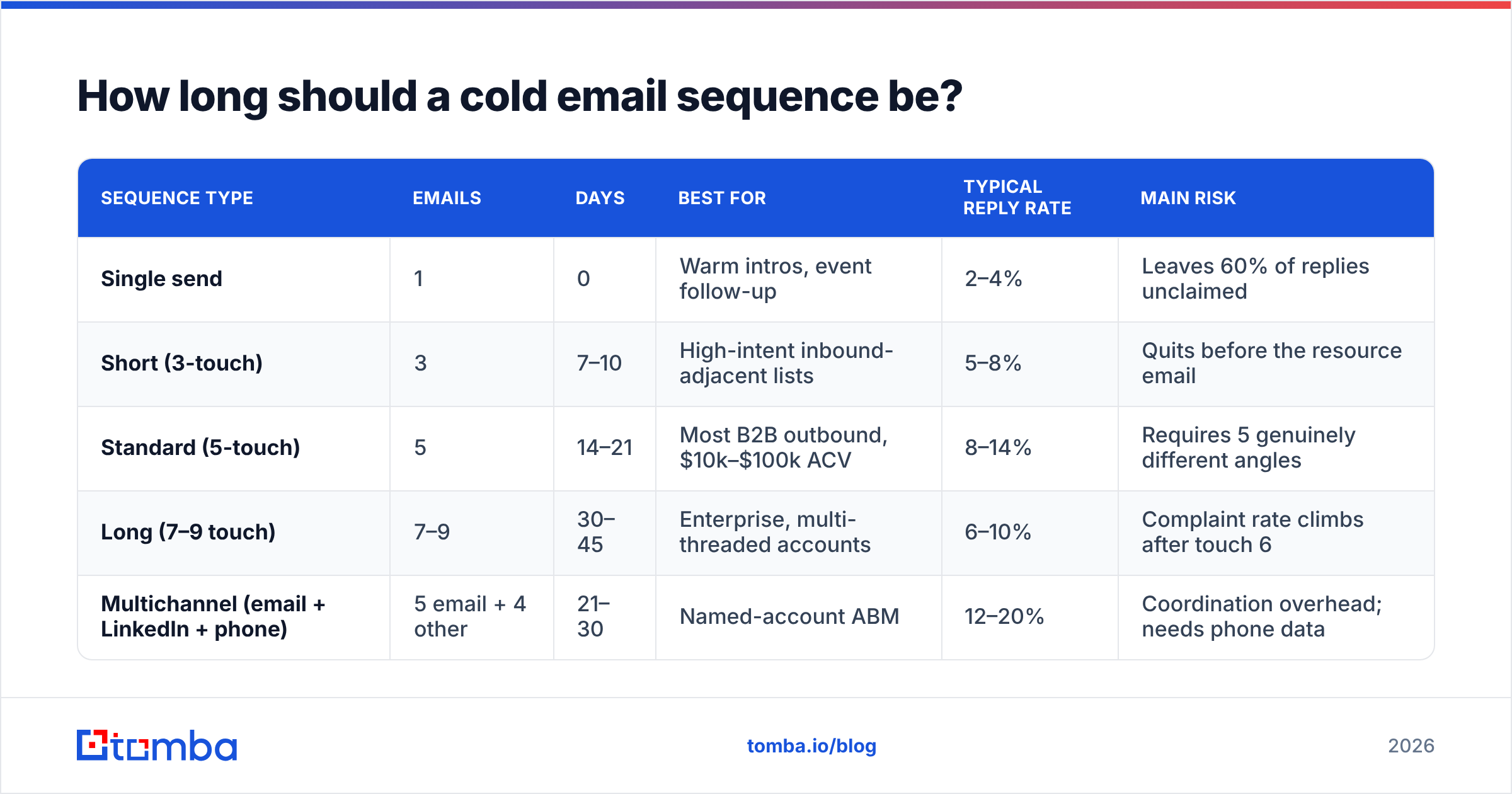
Depends on deal size and how hard the persona is to reach. Here's how the shapes compare:
| Sequence type | Emails | Days | Best for | Typical reply rate | Main risk |
|---|---|---|---|---|---|
| Single send | 1 | 0 | Warm intros, event follow-up | 2–4% | Leaves 60% of replies unclaimed |
| Short (3-touch) | 3 | 7–10 | High-intent inbound-adjacent lists | 5–8% | Quits before the resource email |
| Standard (5-touch) | 5 | 14–21 | Most B2B outbound, $10k–$100k ACV | 8–14% | Requires 5 genuinely different angles |
| Long (7–9 touch) | 7–9 | 30–45 | Enterprise, multi-threaded accounts | 6–10% | Complaint rate climbs after touch 6 |
| Multichannel (email + LinkedIn + phone) | 5 email + 4 other | 21–30 | Named-account ABM | 12–20% | Coordination overhead; needs phone data |
The multichannel row is where the numbers actually move, and it's also where most teams stall — because they have email addresses and nothing else. Layering a call between emails three and four roughly doubles connect rates in most teams' data, but only if you have direct dials rather than switchboards. A phone finder closes that gap without you buying a second full-stack platform.
One caution on benchmarks: the reply rates above are directional, not promises. Reply rate is a function of list quality, offer strength, and market saturation, and the same sequence that returns 14% into a niche vertical returns 3% into a market where every competitor is already running the same play. G2's sales engagement category is a decent place to see how crowded a given tool's user base is before you assume your prospects haven't seen your template before.
How do you write each email in the sequence?#
Four rules, in priority order.
Lead with the observation, not the introduction. Nobody opens a cold email hoping to learn your company name. The first sentence should be something only someone who looked at their business could write. Delete "My name is" and "I hope this email finds you well" — they consume the preview text, which is the only real estate you get in a crowded inbox.
One ask, and make it cheap. "Worth a look?" beats "Do you have 30 minutes Tuesday at 2pm ET?" every time in a cold context. You're not asking for a meeting. You're asking for a reply. The meeting comes from the reply.
Write at a seventh-grade reading level. Not because your buyer is dumb, but because they're reading on a phone between meetings. Short sentences. Concrete nouns. HubSpot's own outbound research consistently shows shorter emails outperforming long ones, and the effect is strongest on mobile.
Personalize the variable that matters. Company name is not personalization — everyone merges that. A recent hire, a shipped feature, a job posting that reveals a priority: that's personalization. If you can only personalize one field at scale, make it the reason you're emailing them specifically, and hard-code the rest.
The practical bottleneck is data, not writing. You can generate five variants of an email in thirty seconds. You cannot invent the fact that this prospect just posted a job for a demand-gen lead. Pulling firmographic and role context via data enrichment before the sequence starts is what makes rule four survivable at 200 prospects a week.
What should you measure in a cold email sequence?#
Not open rate. Apple Mail Privacy Protection has inflated opens since 2021, and by 2026 open rate is close to noise — a metric that tells you how many prospects use a mail client with image proxying.
Track these instead:
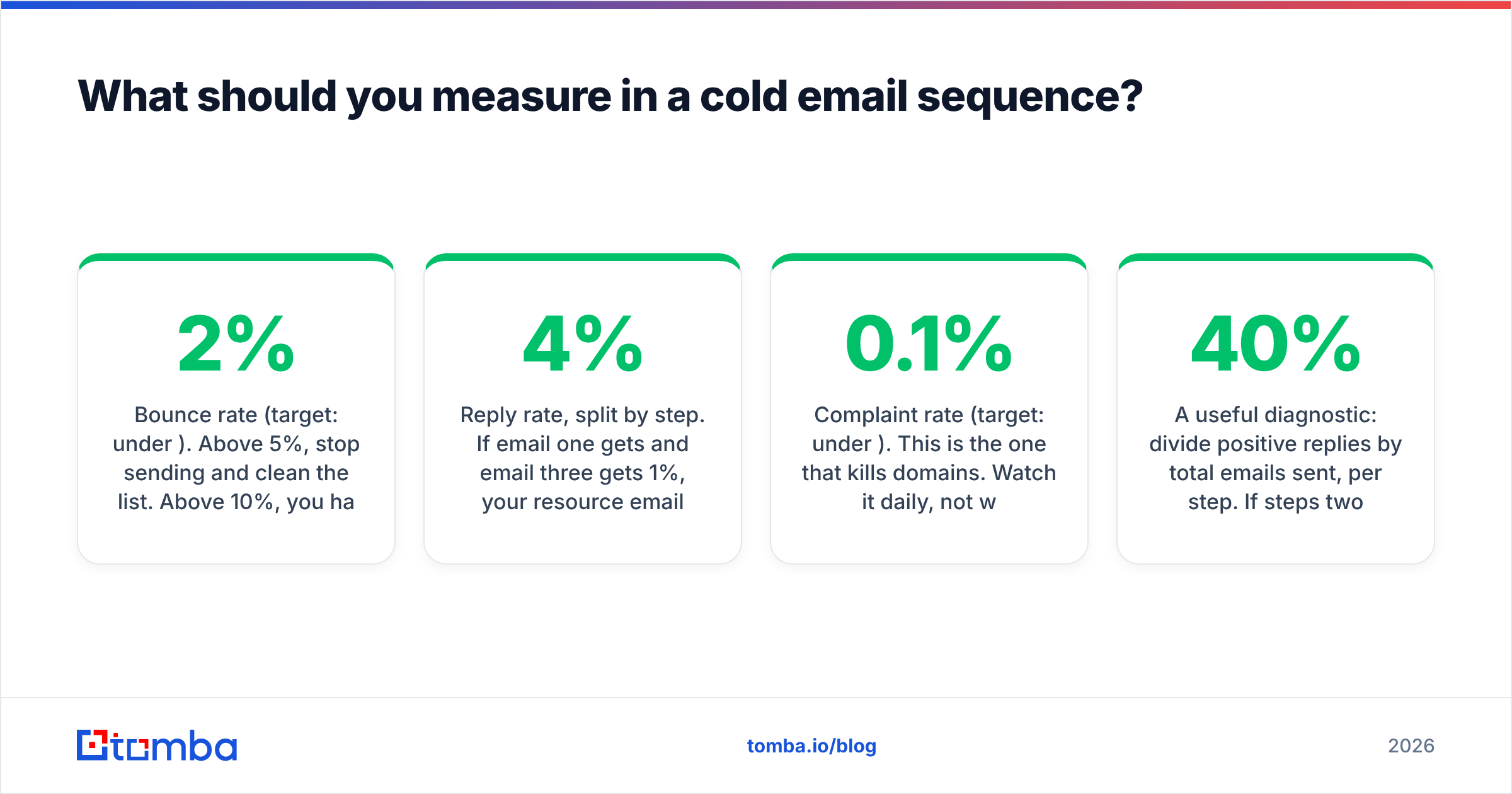
- Bounce rate (target: under 2%). Above 5%, stop sending and clean the list. Above 10%, you have a reputation problem that will take weeks to unwind.
- Reply rate, split by step. If email one gets 4% and email three gets 1%, your resource email isn't a resource.
- Positive reply rate. Total replies include "unsubscribe" and "wrong person." Only positive replies predict pipeline.
- Reply-to-meeting conversion. If people reply and don't book, the problem is your offer, not your sequence.
- Complaint rate (target: under 0.1%). This is the one that kills domains. Watch it daily, not weekly.
A useful diagnostic: divide positive replies by total emails sent, per step. If steps two through four contribute less than 40% of positive replies combined, your follow-ups are nags rather than new visits. Rewrite them before you touch the opener.
How do sequence tools compare?#
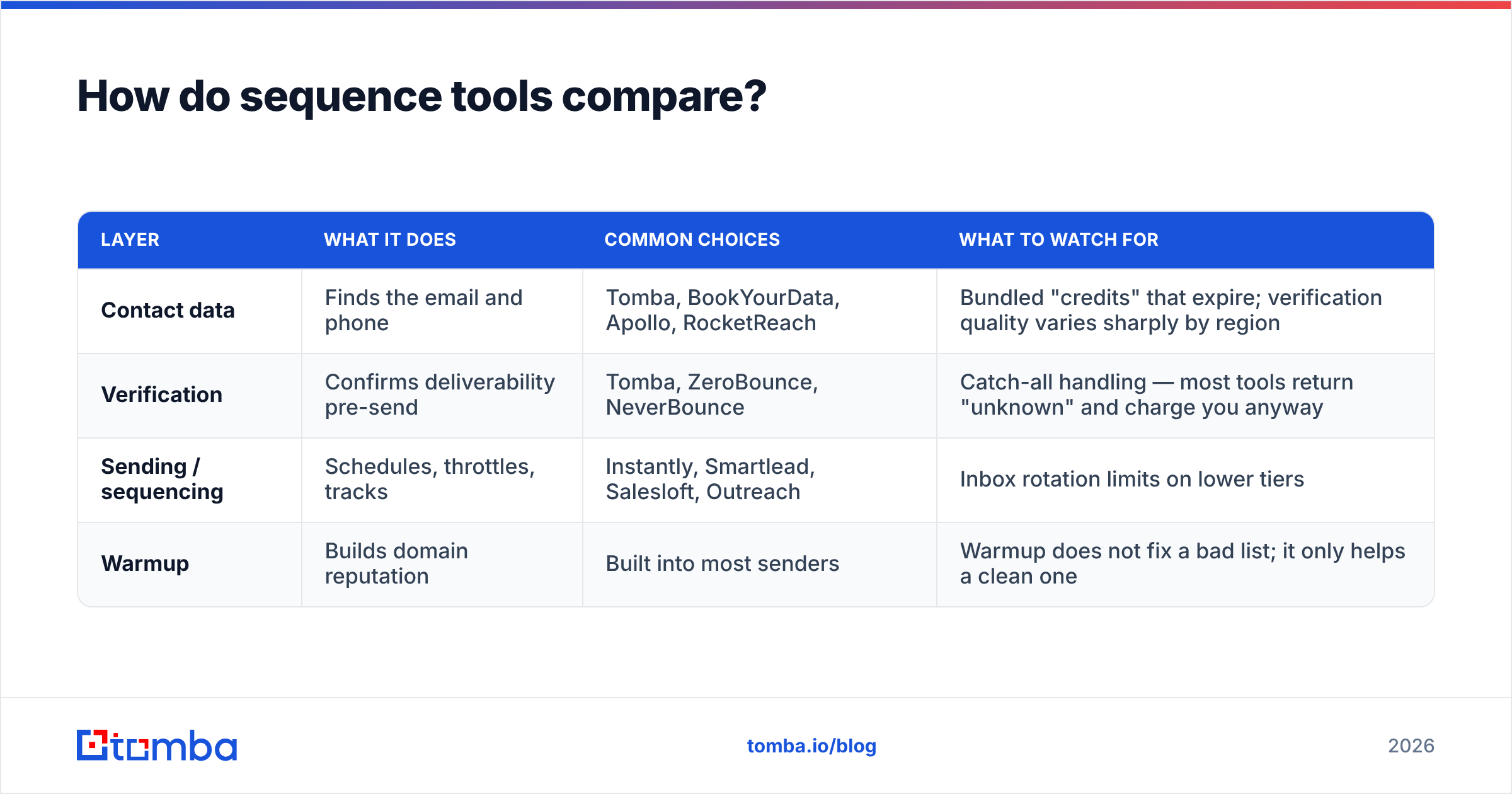
Most teams end up running three layers: a data source, a sending tool, and a verification pass. Some vendors claim all three. The honest tradeoff:
| Layer | What it does | Common choices | What to watch for |
|---|---|---|---|
| Contact data | Finds the email and phone | Tomba, BookYourData, Apollo, RocketReach | Bundled "credits" that expire; verification quality varies sharply by region |
| Verification | Confirms deliverability pre-send | Tomba, ZeroBounce, NeverBounce | Catch-all handling — most tools return "unknown" and charge you anyway |
| Sending / sequencing | Schedules, throttles, tracks | Instantly, Smartlead, Salesloft, Outreach | Inbox rotation limits on lower tiers |
| Warmup | Builds domain reputation | Built into most senders | Warmup does not fix a bad list; it only helps a clean one |
Two notes on this table. First, BookYourData is a solid pick when you want a pre-verified list handed to you rather than building it — a genuinely different workflow from live lookup, and better if your ICP is stable. Second, bundling data and sending in one vendor is convenient until you want to change one of them; the teams with the most durable outbound motions keep the layers separate on purpose.
For the data layer specifically, Tomba pricing starts with a free tier at 25 searches/month, then Starter at $49/mo, Growth at $99/mo, and Pro at $249/mo. The free tier is enough to test whether the coverage for your specific ICP holds up before you commit — which is the only test that matters, since aggregate accuracy claims mean little if the vendor is weak in your vertical or geography.
What's a sequence you can copy today?#
Assume you sell a routing tool to RevOps leaders at 200–800 person SaaS companies.
Email 1 (Day 0), subject: lead routing at {{company}}
Saw you're hiring two AEs in EMEA. Guessing inbound routing to the new region is manual right now — that's usually where the first hour of speed-to-lead goes.
Is that the case, or did you already solve it?
Email 2 (Day 3), same thread:
Quick data point: a Series B team with your headcount cut first-touch time from 4h to 11m by routing on territory before enrichment finished, not after.
Worth 10 minutes to see if the same order applies to you?
Email 3 (Day 7):
Not selling anything here — put together the routing logic for the EMEA split, based on how three similar teams handle it. Five-step flowchart, no gate. Want it?
Email 4 (Day 12):
Most RevOps leads tell me they'd rather build this in Salesforce Flow. Fair — and it works until you need round-robin with capacity caps. That's where it usually breaks.
Is that the objection, or is it timing?
Email 5 (Day 18):
Closing this out. If routing comes back up next quarter, this thread's here.
That's it. No emoji, no calendar link before email four, no "just bumping this to the top of your inbox."
Where should you start?#
Fix the list first. Everything in this post is downstream of whether your emails reach a human.
Run your target accounts through the Tomba Email Finder to get verified, deliverable addresses tied to real people at real companies — then verify, then sequence. The free tier gives you 25 searches to check coverage against your own ICP before you pay anyone, including us. If the addresses hold up, the five-email structure above will do its job. If they don't, no subject line in the world is going to save the campaign.
Related guides#
Ready to find emails that actually work?
Join 150,000+ professionals who stopped guessing and started sending. Free credits on signup — no credit card required.
Get the Tomba newsletter
Practical outbound tactics and product updates — once every two weeks.
About the author