Cold Email Subject Line Examples: 27 Tested Lines for 2026
27 cold email subject line examples pulled from real outbound campaigns, sorted by pattern, with the open-rate math and the spam triggers that quietly kill your reply rate.
TL;DR
- Short beats clever. Subject lines of 1–5 words consistently outperform 8+ word lines in cold outbound, because they look like internal mail, not marketing.
- Personalization tokens only work when the token is specific (a competitor name, a job posting, a podcast episode) —
{{first_name}}alone is noise now. - The single biggest lever on open rate isn't the subject line at all: it's whether the email lands in the inbox. Bad list hygiene sinks great copy.
- Six repeatable patterns cover almost every high-performing cold email subject line: Question, Referral, Observation, Number, Curiosity Gap, and Plain Utility.
- Avoid: exclamation marks, ALL CAPS, "Re:" fakery, discount language, and anything over 60 characters (it truncates on mobile).
What Actually Makes a Cold Email Subject Line Work?#
A cold email subject line has exactly one job: earn a click, not a sale. Everything else — the pitch, the proof, the CTA — lives in the body. The moment you try to compress a value proposition into 40 characters, you write something that reads like an ad, and ads get archived.
Three mechanics determine whether your line gets opened:
- Deliverability. If the message lands in Promotions or Spam, subject copy is irrelevant. Sender authentication, domain age, and list quality decide this before the recipient ever sees a word.
- Pattern match. Recipients scan their inbox for mail that looks like it came from a colleague. Sentence case, no punctuation flourishes, short. A subject that looks like a newsletter gets sorted like a newsletter.
- Specificity. "Quick question" works when the sender is credible and the preview text is specific. It fails when it's the 40th "quick question" that week.
The uncomfortable truth is that most subject-line advice tests copy while holding everything else constant — which is exactly the variable that isn't constant in real outbound. A 34% open rate on a warmed domain with a verified list and a 12% open rate on a scraped list can come from the same subject line.
Before you A/B test copy, run the list through an email verifier and check your sending domain with an SPF checker. Otherwise you're optimizing the paint job on a car with no engine.
What Are the Six Patterns Behind Every Good Subject Line?#
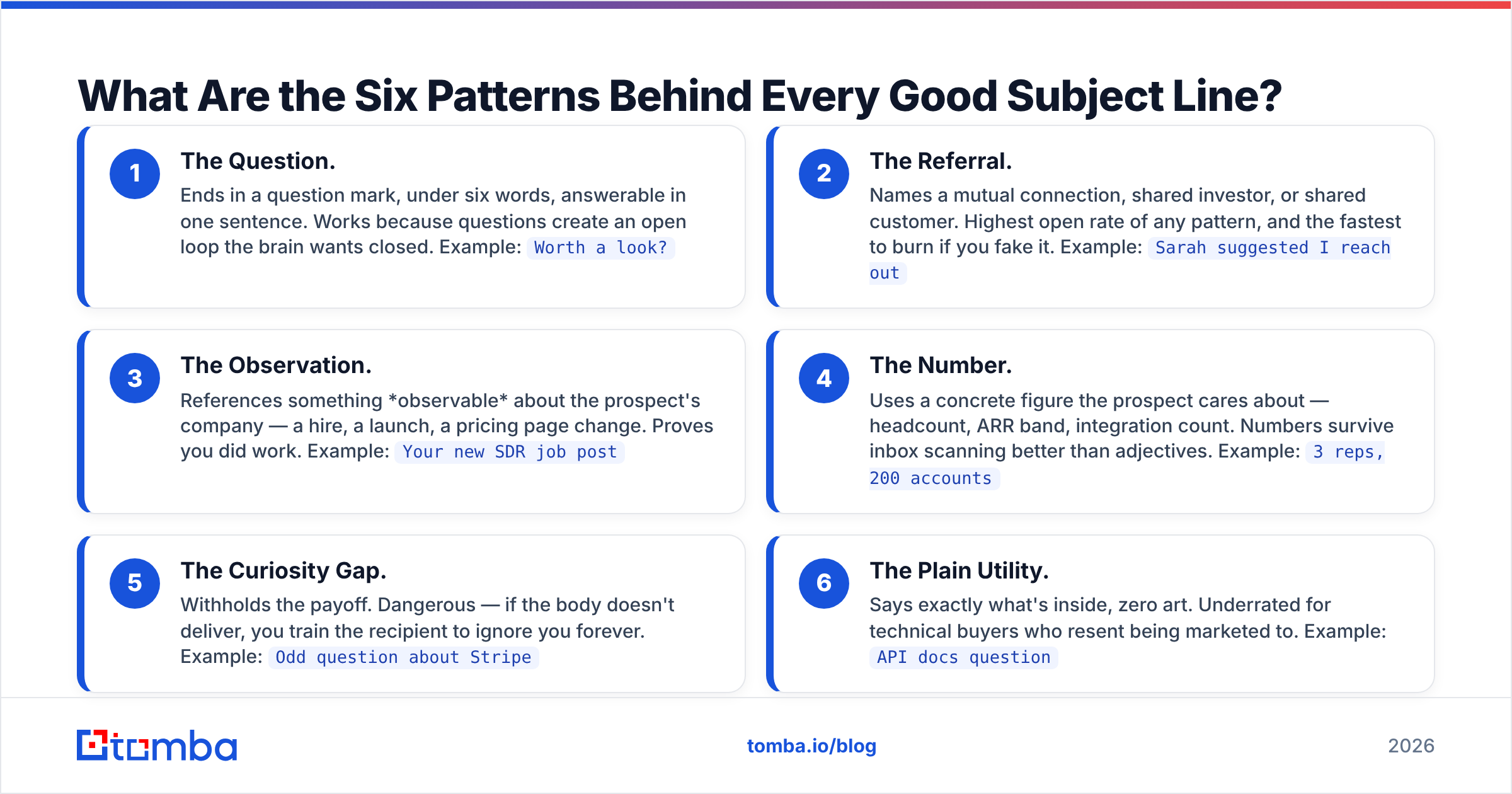
Nearly every cold email subject line that performs falls into one of six structures. Learn the structure, not the line — copied lines decay fast once thousands of reps send them.
- The Question. Ends in a question mark, under six words, answerable in one sentence. Works because questions create an open loop the brain wants closed. Example:
Worth a look? - The Referral. Names a mutual connection, shared investor, or shared customer. Highest open rate of any pattern, and the fastest to burn if you fake it. Example:
Sarah suggested I reach out - The Observation. References something observable about the prospect's company — a hire, a launch, a pricing page change. Proves you did work. Example:
Your new SDR job post - The Number. Uses a concrete figure the prospect cares about — headcount, ARR band, integration count. Numbers survive inbox scanning better than adjectives. Example:
3 reps, 200 accounts - The Curiosity Gap. Withholds the payoff. Dangerous — if the body doesn't deliver, you train the recipient to ignore you forever. Example:
Odd question about Stripe - The Plain Utility. Says exactly what's inside, zero art. Underrated for technical buyers who resent being marketed to. Example:
API docs question
Notice what's absent: no exclamation marks, no emoji, no "unlock," "revolutionize," or "supercharge." Sales teams at HubSpot and Gong have published broadly similar findings — clarity outperforms cleverness once you control for list quality.
What Are 27 Cold Email Subject Line Examples That Actually Get Opened?#
Here they are, grouped by pattern. Swap the bracketed variables for real research. Do not send any of these unedited to 5,000 people — the value is in the structure.
Question (1–5 words)
Worth a look?Are you the right person?Open to this?Still hiring SDRs?Question about [Company]
Referral
[Mutual Name] said to email youIntro from [Investor]Following [Mutual Name]'s note[Peer Company] sent me here
Observation
Your [Product] launchSaw the [Job Title] openingNoticed [Company] moved to [Tool]Your post on [Topic][Company] + [Competitor]
Number
12 reps, 1 CRM[Company]'s 3 open roles2 minutes on [Metric]40% of your traffic
Curiosity Gap
Odd question about [Tool]Probably a bad ideaThis might be nothingDon't reply to this one
Plain Utility
Cold email, 30 secondsPricing question[Category] vendor comparisonData on [Prospect's Industry][Your Company] <> [Their Company]
Line 22 ("Don't reply to this one") is the kind of line that spikes in Q1 and collapses by Q3. Curiosity-gap subject lines have a half-life. Utility lines don't. If you're building a program you'll run for two years, weight toward patterns 1, 3, and 6.
Which Subject Line Style Wins for Your Use Case?#
Different motions want different lines. A founder emailing 30 hand-picked accounts should never use the same subject structure as an SDR running 1,200 sends a month.
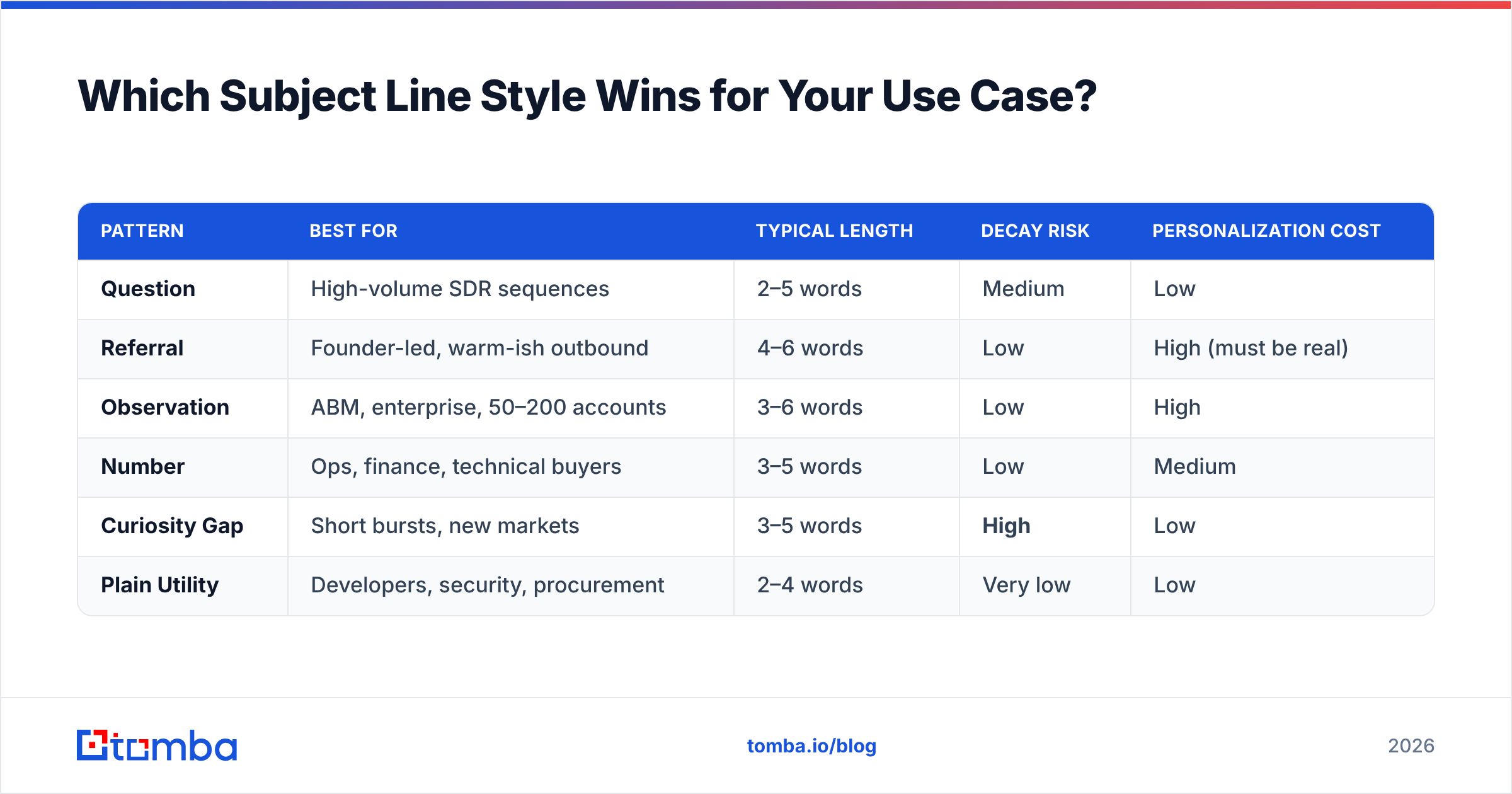
| Pattern | Best for | Typical length | Decay risk | Personalization cost |
|---|---|---|---|---|
| Question | High-volume SDR sequences | 2–5 words | Medium | Low |
| Referral | Founder-led, warm-ish outbound | 4–6 words | Low | High (must be real) |
| Observation | ABM, enterprise, 50–200 accounts | 3–6 words | Low | High |
| Number | Ops, finance, technical buyers | 3–5 words | Low | Medium |
| Curiosity Gap | Short bursts, new markets | 3–5 words | High | Low |
| Plain Utility | Developers, security, procurement | 2–4 words | Very low | Low |
The column that matters most is decay risk. Curiosity-gap lines convert well the first time a prospect sees them and worse every time after. Observation lines never decay because they're unique per prospect — but they cost real research minutes. Pick based on how many accounts you can afford to actually study.
How Long Should a Cold Email Subject Line Be?#
Under 60 characters, and ideally under 30.
Gmail on mobile truncates at roughly 35–40 characters depending on device width. Outlook desktop shows more. If your line's meaning depends on word 9, mobile readers never see it. A safe rule: the first four words must carry the entire meaning.
Length also signals intent. Long subject lines read as marketing because marketing emails have long subject lines. Compare:
Discover how [Company] can 3x your outbound pipeline in Q3— 57 characters. Reads as an ad. Archived.Outbound pipeline— 17 characters. Reads as a colleague. Opened.
The second one is worse copy by any creative-writing standard and better copy by every commercial standard.
If you want a fast sanity check, run drafts through a subject line tester before you load them into a sequence, and use a subject line generator when you're stuck at zero.
Which Cold Email Subject Lines Should You Never Send?#
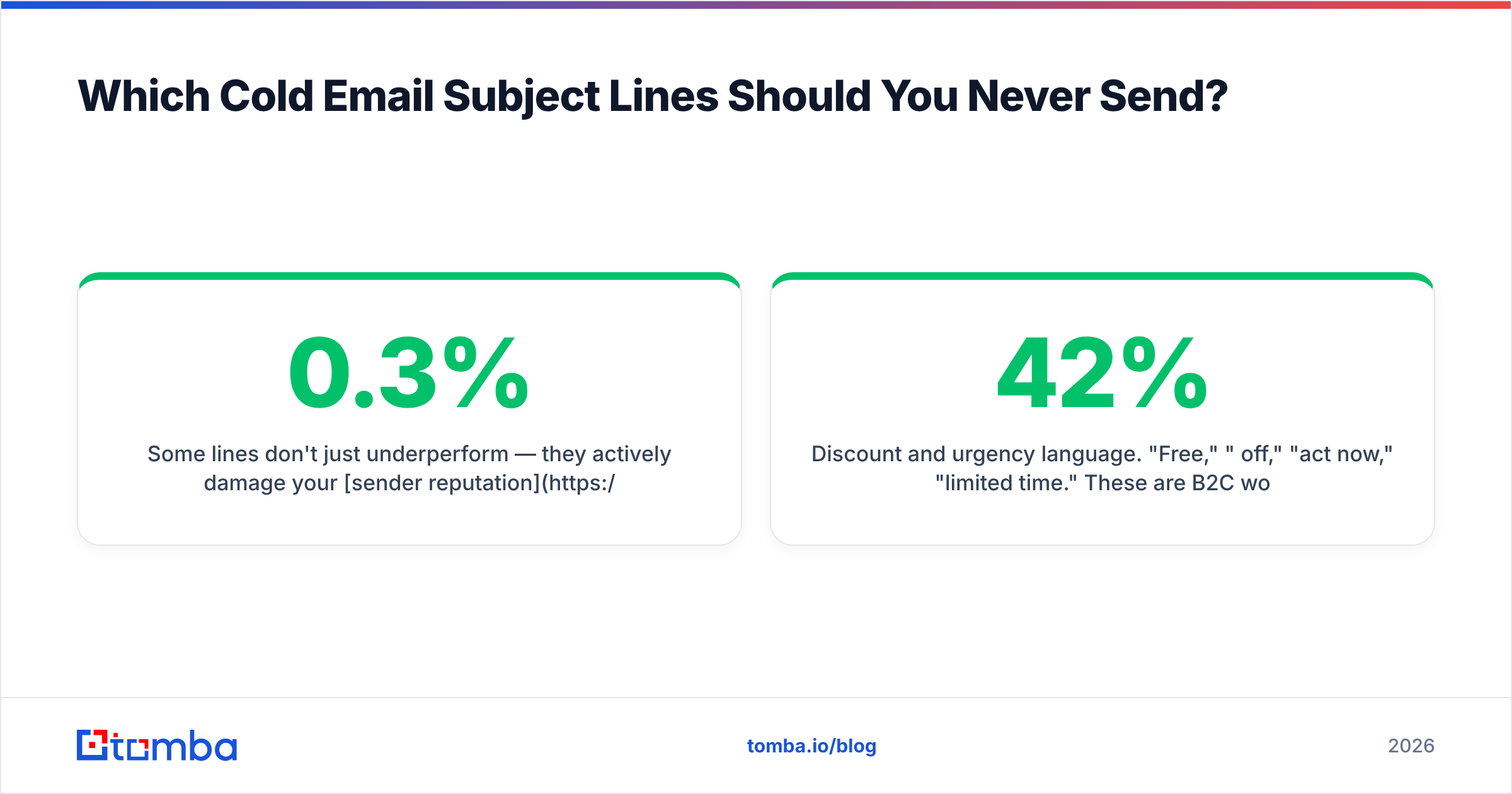
Some lines don't just underperform — they actively damage your sender reputation by driving spam complaints. Complaint rates above 0.3% get you throttled by Gmail and Microsoft regardless of what you're sending.
The banned list:
- Fake "Re:" and "Fwd:" prefixes.
Re: our conversationwhen there was no conversation. It gets opens. It also gets marked as spam at 4–6x the baseline rate, and in several jurisdictions it's a deceptive-header violation. - Exclamation marks and ALL CAPS.
LAST CHANCE!!!triggers content filters and reads as a scam. - Discount and urgency language. "Free," "42% off," "act now," "limited time." These are B2C words in a B2B inbox.
- Emoji. Fine for newsletters. In cold B2B mail they're a filter signal and a credibility tax.
- Their name alone.
Johnas a subject line is a manipulation tactic. Sophisticated buyers recognize it instantly. - Anything you'd be embarrassed to have quoted back to you. That's the whole test.
Run your full email — subject plus body — through a spam checker before launch. The subject line is only one of about 30 signals filters evaluate, and a clean subject can still be dragged down by a body stuffed with tracking pixels and link shorteners.
Does Personalization in the Subject Line Still Work?#
Yes, but only specific personalization.
{{first_name}}, quick question was novel in 2016. By 2026, every prospect in a B2B ICP has received several thousand of them. The token no longer signals effort because inserting it requires none.
What still works is personalization that could only have come from research:
Your Series B— requires knowing they raisedSaw the Postgres migration— requires reading their engineering blogRe: your G2 review of [Tool]— requires actually reading G2 reviews
Each of those takes 60–180 seconds of research per prospect. That's the trade: personalization that works costs time, and personalization that's free doesn't work. There's no third option, and any vendor promising one is selling you {{first_name}} with extra steps.
The volume math is unforgiving. If observation-style subject lines double your reply rate but cut your daily send capacity by 70%, they lose on raw pipeline unless your ACV is high. Enterprise reps should personalize. High-velocity SMB reps should use Question and Plain Utility patterns and put their effort into list quality instead.
How Do You Actually Test Subject Lines?#
Most "A/B tests" in cold email are statistically meaningless. Two hundred sends per variant will not detect a 3-point open-rate difference. You need roughly 1,000+ sends per variant to detect a 5-point difference with any confidence — and open-rate tracking itself is increasingly unreliable thanks to Apple Mail Privacy Protection inflating opens.
A more honest testing protocol:
- Test patterns, not words. Compare Question vs. Observation across 2,000 sends each. Don't compare "Worth a look?" against "Worth a chat?" — that difference is noise.
- Measure reply rate, not open rate. Opens are corrupted by privacy proxies. Replies are the only metric that survives.
- Hold the list constant. Randomize across the same segment. Testing subject lines on two different verticals tests the verticals, not the copy.
- Run for at least two weeks. Day-of-week effects are larger than most subject-line effects.
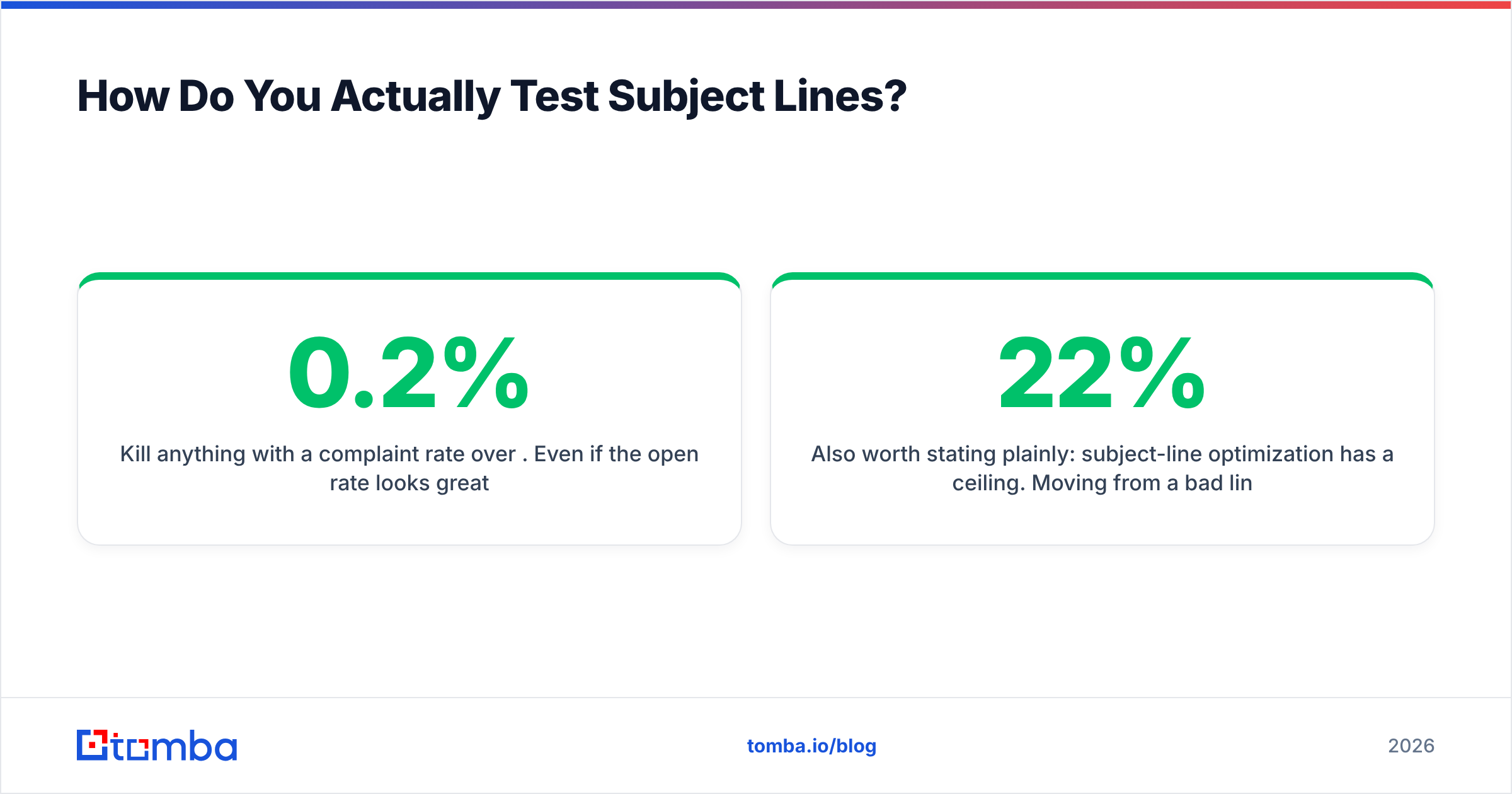
- Kill anything with a complaint rate over 0.2%. Even if the open rate looks great.
Also worth stating plainly: subject-line optimization has a ceiling. Moving from a bad line to a good line might take you from 22% to 38% opens. Moving from an unverified list to a verified one can take you from 40% deliverability to 95%. The second lever is roughly four times bigger and takes an afternoon.
Where Should You Spend Your Next Hour?#
If your reply rate is under 2%, don't rewrite your subject line. Check, in this order:
- Bounce rate. Over 3% means your list is the problem, not your copy.
- SPF, DKIM, DMARC. Missing records mean filtered mail regardless of content.
- Targeting. Are you emailing people who plausibly have the problem?
- Body copy. Does the first line reference them or you? (If it starts with "I'm reaching out because we help…" that's your leak.)
- Subject line. Now, and only now, optimize this.
Great cold email templates sent to bad addresses produce nothing. Mediocre templates sent to verified decision-makers produce a pipeline. The order of operations matters more than the craft.
Start With the Right Addresses#
The best subject line in this article can't rescue an email sent to john.smith@ at a company where the pattern is jsmith@. Bounces damage your domain reputation, and damaged domains get filtered before any human reads your carefully chosen five words.
Build the list first. Tomba Email Finder finds and verifies professional email addresses by name, domain, or company, so your subject lines get tested against real inboxes instead of dead ones. The free tier gives you 25 searches a month to check whether your ICP is even reachable; paid plans start at $49/mo on Starter, with Growth at $99/mo — see full Tomba pricing for the breakdown.
Write the short subject line. Send it to a verified address. Then measure replies, not opens.
Related guides#
// get started
Find, verify and enrich your first contacts today
Start on the free plan with 25 searches a month, then scale when your team is ready.
Free plan · No credit card required · GDPR & CCPA
// about the author