Cold Email Subject Lines That Get Opened in 2026: 27 Examples
Open rates lie, personalization is overrated, and most "proven" subject line swipe files are noise. Here's what actually gets cold emails opened in 2026 — with 27 examples, real ranges, and the formats that quietly kill deliverability.
TL;DR
- Subject lines are a tiebreaker, not a lever. If your domain reputation or your list is bad, no wording saves you.
- Short, specific, and boring beats clever. Four to seven words, lowercase-ish, no promises the body can't cash.
- Since Apple Mail Privacy Protection, reported open rates are inflated by roughly 20-40% for consumer-heavy lists. Optimize for reply rate, not opens.
- Personalization works when it's observable ("your Series B", "the pricing page rebuild"), not when it's a mail-merge token.
- Most "my open rate dropped" problems trace back to unverified addresses, not copy.
What actually makes cold email subject lines that get opened?#
Three things, in order of weight: who you are to the recipient (sender reputation, domain age, whether they've heard of you), whether the email lands in the primary tab, and only then what the subject line says.
That ordering matters because most subject line advice assumes the first two are solved. They usually aren't. A perfect subject line in the Promotions tab is a perfect subject line nobody sees.
Once you're actually in the inbox, a subject line has one job: make opening the email feel like the lowest-effort next action. Not the most exciting. The lowest-effort. The recipient is scanning 60 unread lines on a phone at 8:40 a.m. and deciding, in about 300 milliseconds per line, whether this is work or noise.
Subject lines that read like work get opened. Subject lines that read like marketing get archived.
The practical implications:
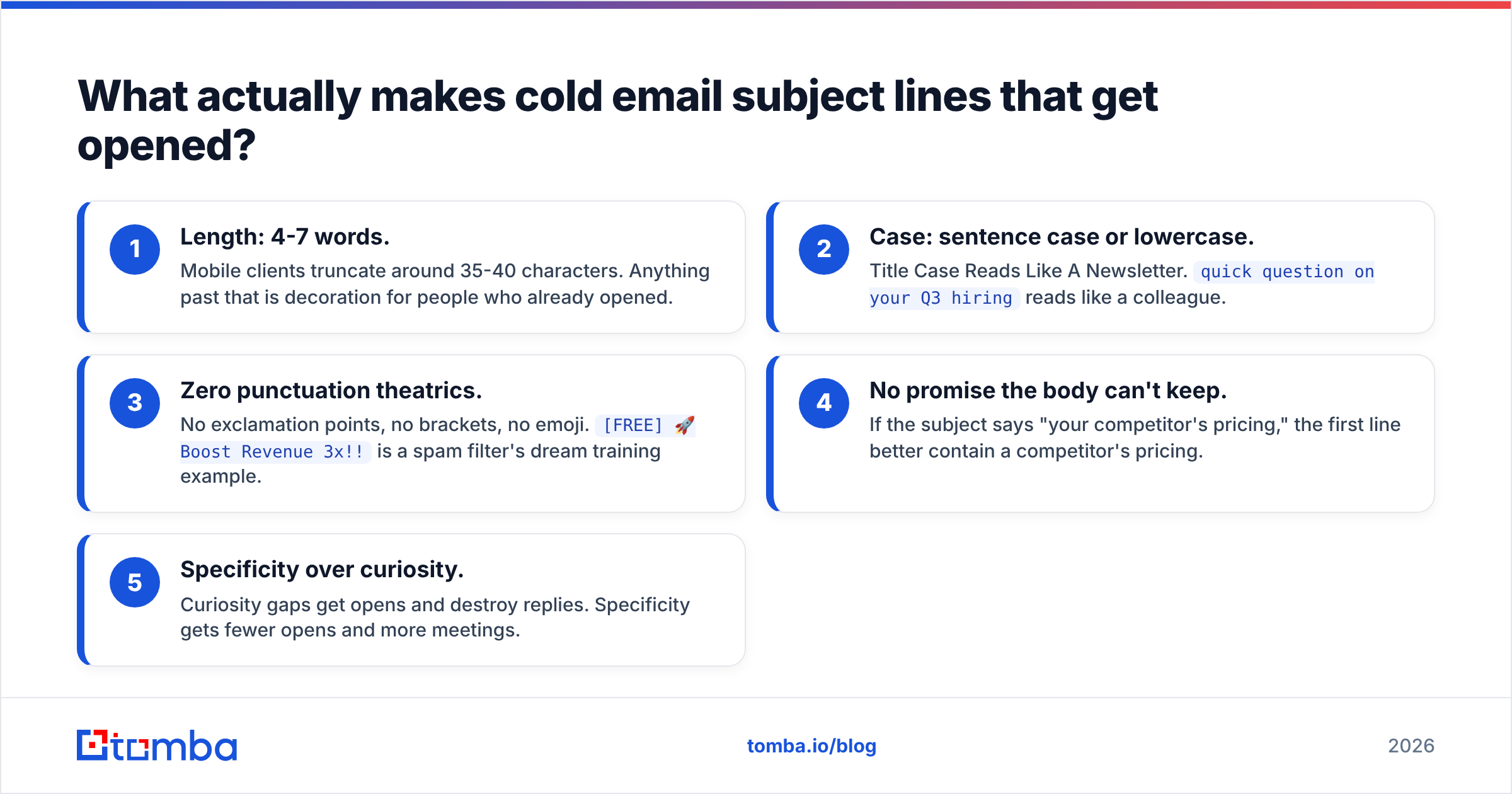
- Length: 4-7 words. Mobile clients truncate around 35-40 characters. Anything past that is decoration for people who already opened.
- Case: sentence case or lowercase. Title Case Reads Like A Newsletter.
quick question on your Q3 hiringreads like a colleague. - Zero punctuation theatrics. No exclamation points, no brackets, no emoji.
[FREE] 🚀 Boost Revenue 3x!!is a spam filter's dream training example. - No promise the body can't keep. If the subject says "your competitor's pricing," the first line better contain a competitor's pricing.
- Specificity over curiosity. Curiosity gaps get opens and destroy replies. Specificity gets fewer opens and more meetings.
That last one is the trade every SDR gets wrong for the first six months.

Are open rates even real anymore?#
Partially. Apple's Mail Privacy Protection, rolled out in iOS 15 and now the default for most Apple Mail users, pre-fetches tracking pixels whether or not the human opened anything. Gmail's image proxy has done something similar for longer. The net effect: your reported open rate contains a meaningful block of phantom opens.
For B2B lists skewed toward corporate Outlook and Gmail, the inflation is smaller than consumer lists — call it 15-25%. For anything touching founders, agencies, or creative industries (heavy Apple Mail usage), it can exceed 40%.
So what do you do with subject lines if you can't trust the metric they're supposed to move?
You measure reply rate per sent, and you use open rate only as a directional signal within a single, tightly controlled A/B test where the audience composition is identical on both arms. Open rate is a thermometer with a bent needle: still useful for spotting a fever, useless for reporting your exact temperature.
Google's own sender guidelines are explicit that engagement — replies, stars, moving out of spam — carries more weight than opens in filtering decisions. Optimize for the signal the filter actually counts.
Which cold email subject line formats work in 2026?#
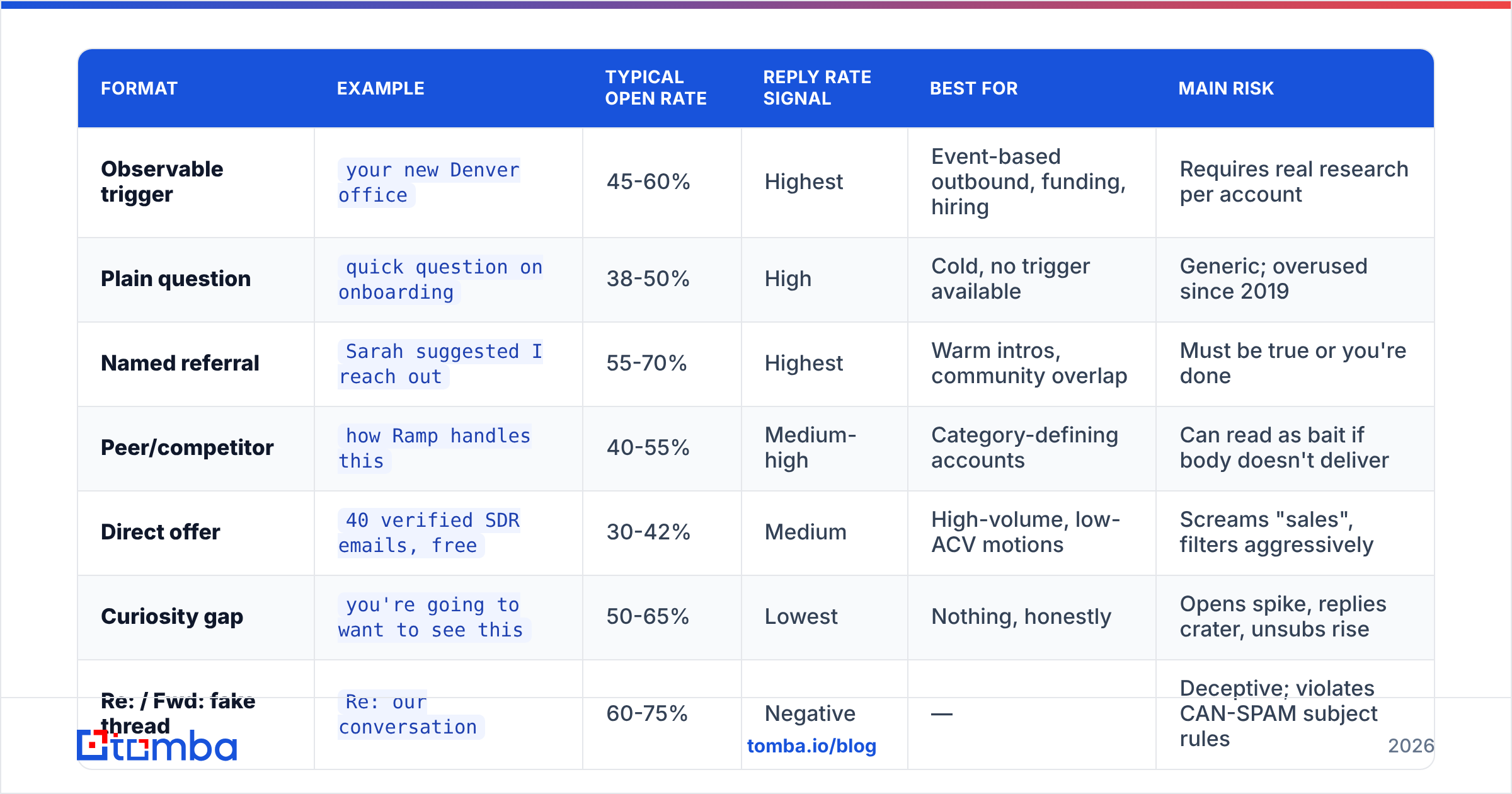
Here's the honest comparison. Ranges below reflect what B2B teams commonly report on verified, warmed lists of 500-5,000 contacts — not what a swipe file promises.
| Format | Example | Typical open rate | Reply rate signal | Best for | Main risk |
|---|---|---|---|---|---|
| Observable trigger | your new Denver office |
45-60% | Highest | Event-based outbound, funding, hiring | Requires real research per account |
| Plain question | quick question on onboarding |
38-50% | High | Cold, no trigger available | Generic; overused since 2019 |
| Named referral | Sarah suggested I reach out |
55-70% | Highest | Warm intros, community overlap | Must be true or you're done |
| Peer/competitor | how Ramp handles this |
40-55% | Medium-high | Category-defining accounts | Can read as bait if body doesn't deliver |
| Direct offer | 40 verified SDR emails, free |
30-42% | Medium | High-volume, low-ACV motions | Screams "sales", filters aggressively |
| Curiosity gap | you're going to want to see this |
50-65% | Lowest | Nothing, honestly | Opens spike, replies crater, unsubs rise |
| Re: / Fwd: fake thread | Re: our conversation |
60-75% | Negative | — | Deceptive; violates CAN-SPAM subject rules |
Two rows in that table deserve extra attention.
The curiosity gap is the single most seductive trap. It genuinely does raise opens. It also trains the recipient that opening your email was a waste of eight seconds, which is exactly the behavioral signal — open, no engagement, delete — that mailbox providers use to demote future sends from your domain.
The fake Re: prefix isn't a gray area. The CAN-SPAM Act prohibits deceptive subject lines outright, and Gmail's filters have pattern-matched fake reply threads for years. It works until it doesn't, and when it doesn't, it takes the domain with it.
What are 27 cold email subject lines that get opened?#
Grouped by the situation you're actually in. Steal the structure, not the words — the words stop working the moment a thousand people copy them.
When you have a real trigger (best-performing tier):
your Series B— works because it's undeniably about themsaw the SDR job postyour new Denver officethe pricing page rebuildcongrats on the Acme dealquestion about the API changelogre: your G2 review of Outreach
When you have research but no event:
quick question on onboardinghow you handle inbound after hoursyour team's 3-tool stack12 SDRs, one CRM?two ideas for Q4 pipelineis this you?(only if you're forwarding something genuinely theirs)noticed something on your careers page
When you have a name to drop:
Sarah suggested I reach outwe both know Dan Chenfrom the RevOps Slackfollow-up from SaaStr
When you have nothing (true cold, no research):
worth a look?bad timing?you or Marcus?one question10 seconds
Follow-ups (thread continuation — never restart the subject):
re: quick question on onboarding(genuine reply to your own thread)closing the loopshould I stop?last one from me
Note what's absent: numbers-in-brackets, ALL CAPS words, the word "free," the word "opportunity," and any construction containing "revolutionize." Also absent: the recipient's first name in the subject line. John, quick question tested worse than quick question in every internal split I've seen since about 2022 — the token telegraphs automation.
If you want to pressure-test your own lines before sending, run them through a subject line tester and a spam checker. Neither is oracle-grade, but both catch the obvious own-goals.
Is personalization in the subject line worth it?#
Yes — if the personalization is observable. No — if it's a merge field.
There's a useful distinction here that most teams collapse. Merge-field personalization inserts a variable: company name, first name, job title. It costs nothing and signals nothing, because the recipient knows a database produced it. Observable personalization references something the sender could only know by looking: a changelog entry, a job posting, a specific line in a G2 review, a talk they gave.
Merge fields lift opens by a rounding error. Observable references lift replies substantially — HubSpot's research on email personalization has consistently found the effect concentrated in relevance, not in name insertion.
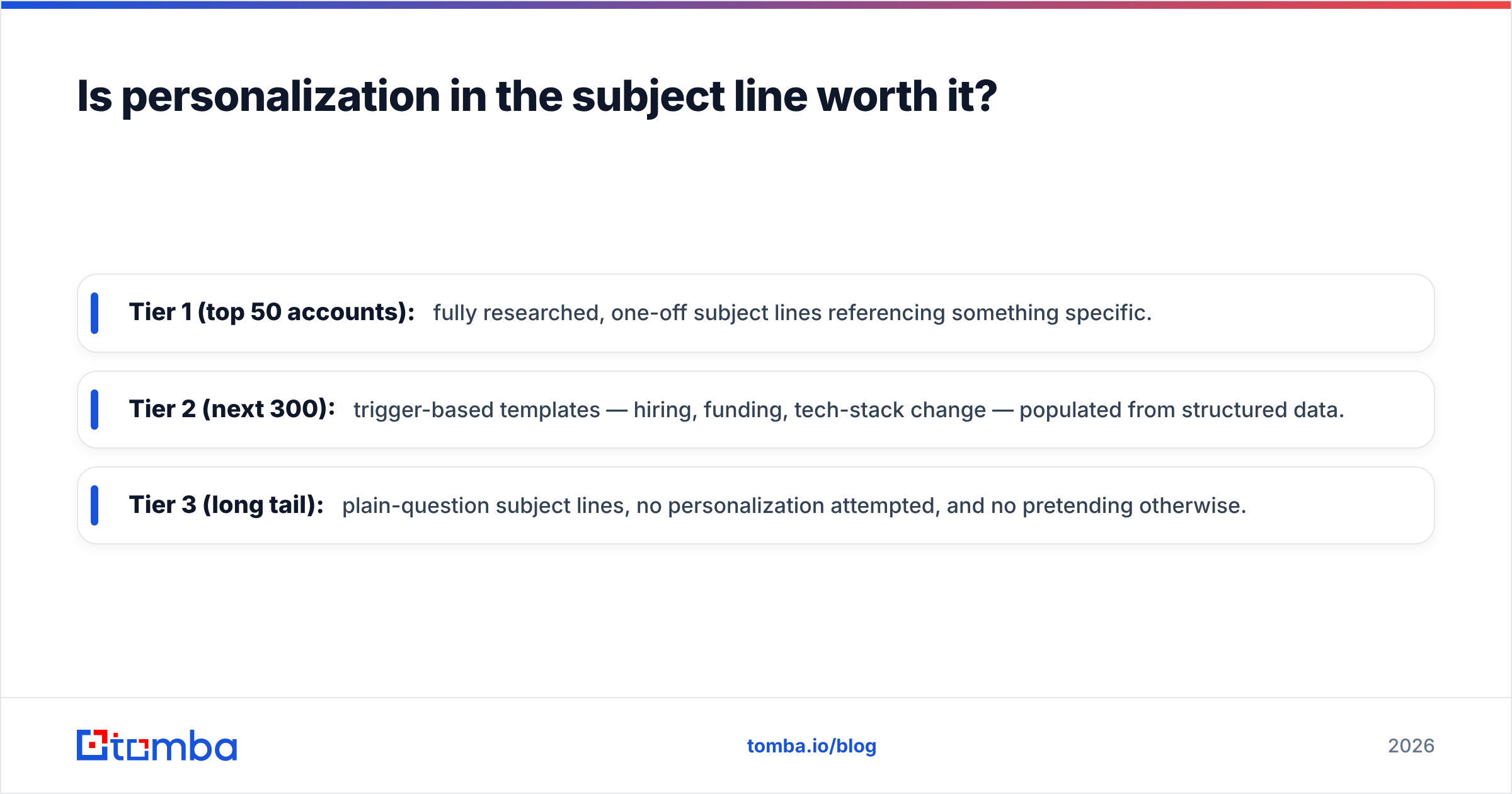
The operational problem is that observable personalization doesn't scale linearly. Researching 500 accounts by hand is a full-time job. The realistic compromise most good outbound teams land on:
- Tier 1 (top 50 accounts): fully researched, one-off subject lines referencing something specific.
- Tier 2 (next 300): trigger-based templates — hiring, funding, tech-stack change — populated from structured data.
- Tier 3 (long tail): plain-question subject lines, no personalization attempted, and no pretending otherwise.
Pretending Tier 3 is Tier 1 is how you get Hi {FirstName}, I loved your recent post! sent to someone who has never posted.
Why does a good subject line still get a 12% open rate?#
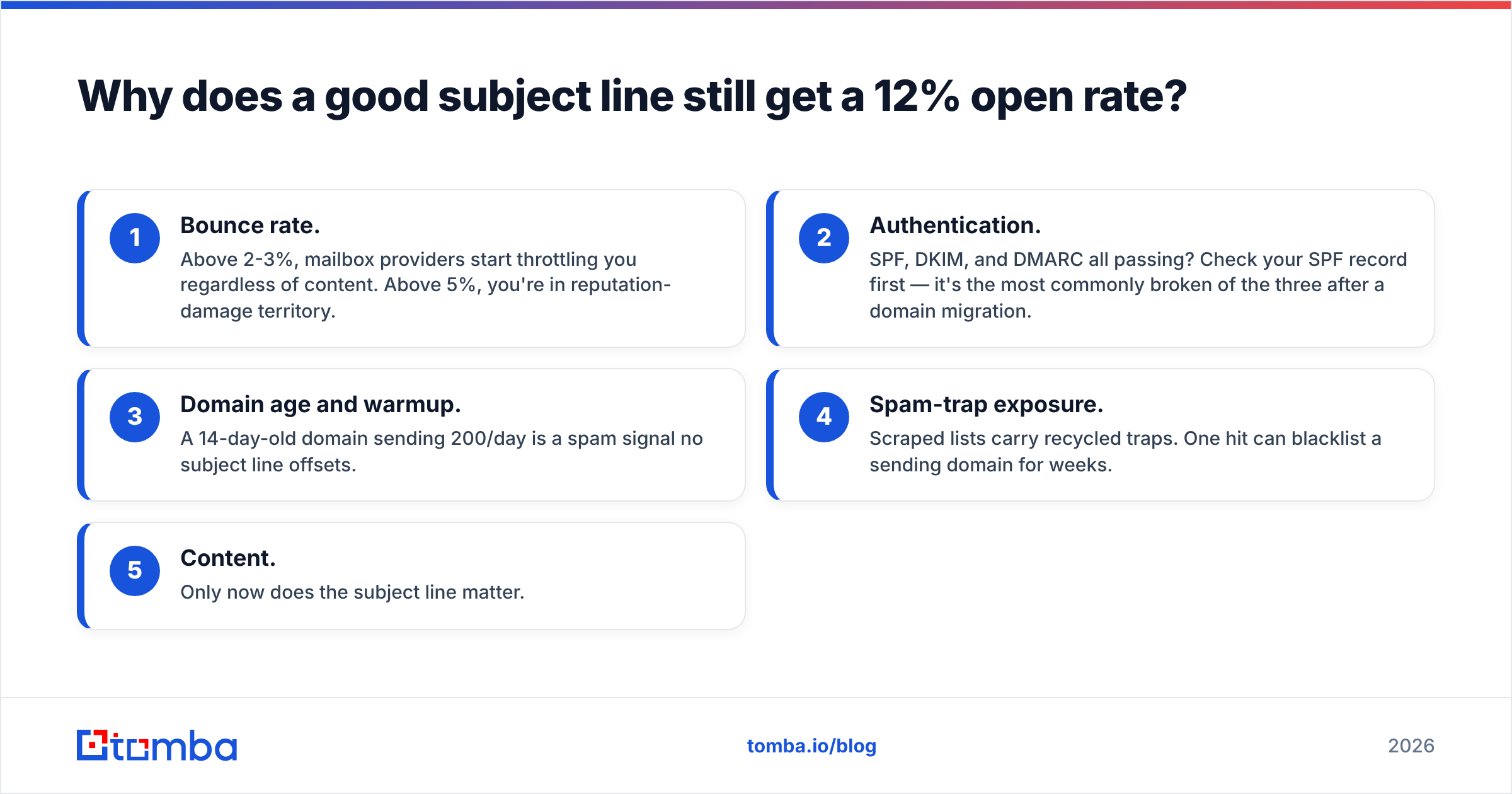
Because subject lines are downstream of deliverability, and deliverability is downstream of list quality.
Run the diagnostic in this order before you touch copy:
- Bounce rate. Above 2-3%, mailbox providers start throttling you regardless of content. Above 5%, you're in reputation-damage territory.
- Authentication. SPF, DKIM, and DMARC all passing? Check your SPF record first — it's the most commonly broken of the three after a domain migration.
- Domain age and warmup. A 14-day-old domain sending 200/day is a spam signal no subject line offsets.
- Spam-trap exposure. Scraped lists carry recycled traps. One hit can blacklist a sending domain for weeks.
- Content. Only now does the subject line matter.
Steps 1 and 4 are the same root cause: you're emailing addresses that shouldn't be on the list. Running the list through an email verifier before a send removes invalid, role-based, and disposable addresses, and flags catch-all domains for separate handling. It is the least glamorous and highest-ROI thing in cold email.
The uncomfortable arithmetic: a subject line rewrite might move opens by 4-8 percentage points on a clean list. Cleaning a dirty list moves them by 20-30, because the emails start arriving. Teams spend weeks on the first and skip the second.
How do you test subject lines without wasting your list?#
Volume is the constraint. Most cold outbound programs never reach statistical significance on a subject line test, and then act on the result anyway.
Rough guidance: to detect a 5-percentage-point difference in open rate at 95% confidence, you need on the order of 1,200-1,500 recipients per arm. Most SDRs are testing on 80. At that size, a 12-point observed difference is well within noise.
What to do instead:
- Test categories, not wording. "Trigger-based vs. plain question" is a question you can answer across a quarter of sends. "Blue button vs. teal button" is not.
- Hold the audience constant. Never compare a subject line sent to founders against one sent to VPs of Sales and call it a copy result.
- Use reply rate as the tiebreaker. Two subject lines with identical opens and a 2x reply gap are not equivalent, and open rate will never tell you that.
- Track by segment, not aggregate. A subject line that wins on a 50-person company and loses on a 5,000-person company is two findings, not one.
- Recycle winners slowly. A format that works for six months becomes a spam signature once enough teams copy it.
quick questionwas elite in 2018. It's wallpaper now.
Keep a running log. Which formats, which segments, which quarters. That log is worth more than any swipe file, including this one, because it's about your audience.
What should you never put in a cold email subject line?#
- Fake reply or forward prefixes (
Re:,Fwd:) on a thread that doesn't exist. - Urgency you don't have. "Last chance" to a stranger is a lie they can see.
- The word "free," "guaranteed," "no obligation," or "act now." Legacy spam triggers, still weighted.
- Emoji. In B2B, they read as consumer marketing and hit Promotions.
- Their company name plus a superlative.
Acme's growth is incredible!— nobody believes you looked. - Anything over 60 characters. It gets cut, and what survives is usually the least interesting half.
- A question you'll answer in the first line. If the subject asks and the body immediately tells, the subject was filler.
If you want more structured starting points for the body copy that follows, the cold email templates library covers the standard sequences — trigger, value, breakup — that these subject lines sit on top of.
Where do you go from here?#
Fix the list, then fix the copy. In that order, every time.
Start with a subject line format that matches the intelligence you actually have about the account — trigger if you have one, plain question if you don't, and never a curiosity gap you can't pay off. Cap it at seven words. Send it to a verified address on an authenticated, warmed domain. Then measure the reply, not the open.
The part most teams skip is the address itself. If you're building prospect lists from company domains, LinkedIn profiles, or article bylines, the Tomba Email Finder returns verified professional addresses with a confidence score attached, so the emails you spent an hour writing subject lines for actually arrive. The free tier covers 25 searches a month; paid plans start at $49/mo on Starter, with Growth at $99/mo — full Tomba pricing is public.
A great subject line to a bounced address is still a bounce. Get the address right, and then the seven words start earning their keep.
Related guides#
Ready to find emails that actually work?
Join 150,000+ professionals who stopped guessing and started sending. Free credits on signup — no credit card required.
Get the Tomba newsletter
Practical outbound tactics and product updates — once every two weeks.
About the author