Cold Email Template for Research: 7 Proven Examples for 2026
Research outreach fails for boring reasons: the ask is too big, the email is stale, and the address bounced. Here are 7 cold email templates for research — plus the reply-rate math behind each one.
TL;DR
- A cold email template for research is not a sales email with softer verbs. The currency is credibility plus a tiny ask, not urgency.
- The single biggest driver of reply rate is not the copy — it's whether the message reached a monitored inbox. Verify before you send.
- Five research contexts need five different templates: expert interviews, academic lab inquiries, user-research recruiting, survey participation, and co-authorship or data-sharing requests.
- Reply rates for well-targeted research outreach land between 15% and 40% — far above the 1–5% you see in commercial cold email, because you're asking for opinion, not budget.
- Two follow-ups is the sweet spot. The third one costs you goodwill you'll need later.
What is a cold email template for research?#
A cold email template for research is a reusable message structure used to contact someone you've never met, where the ask is information rather than a purchase. That covers a PhD applicant emailing a lab director, a product manager recruiting 12 users for discovery interviews, a market analyst asking an industry expert for 25 minutes, and a journalist requesting comment.
The mechanics differ from sales outreach in one structural way. In a sales email, you're asking someone to spend money, so you spend the whole email building the case that the money is well spent. In a research email, you're asking someone to spend attention — a scarcer, less tradeable resource — so you spend the email proving you've already done work and that their marginal effort is small.
Get that inversion wrong and everything downstream fails. The most common failure isn't a bad subject line. It's a first paragraph about you.
Why do most research cold emails get ignored?#
Four reasons, in descending order of frequency.
- The email never arrived. Academic and analyst inboxes churn constantly — people move labs, change firms, get new domains. A 2024 address for a researcher who moved institutions is dead weight. It bounces, it hurts your sending domain, and you never learn why nobody wrote back.
- The ask is unbounded. "Would love to pick your brain" has no cost ceiling. The recipient cannot estimate what they're agreeing to, so they default to no.
- You didn't prove you read the work. Citing a paper title is not proof. Citing a specific claim in the paper and stating what you did with it is proof.
- No mechanism. The email ends with "let me know if interested," which pushes the scheduling burden onto the busiest person in the exchange.
Fix one and you get a bump. Fix all four and reply rates roughly triple in most outreach programs I've seen instrumented.

What structure does a high-reply research email use?#
Every template below is a variation on the same six-part skeleton. Learn the skeleton, not the words.
- Subject line — factual, not clever. "Question about your 2025 attrition paper" outperforms "Quick question!" Curiosity gaps read as manipulation to people who get pitched daily.
- First sentence — credible proof of reading. Name the specific finding, method, or dataset. One sentence. No flattery adjectives.
- Second sentence — who you are, compressed. Institution, role, or company, and why that makes the question relevant. Twelve words is plenty.
- The ask — quantified and capped. "20 minutes," "three questions by email," "one paragraph." Give the cost up front.
- The mechanism — you carry the load. A calendar link, a "reply with a time and I'll adapt," or the three questions inline so they can answer without a call.
- The exit — permission to decline. "If this isn't a fit, no need to reply." It costs a line and raises replies, because it removes the social debt of saying no.
Total: 90 to 130 words. Anything longer signals that you'll be an expensive correspondent.
Which template matches which research scenario?#
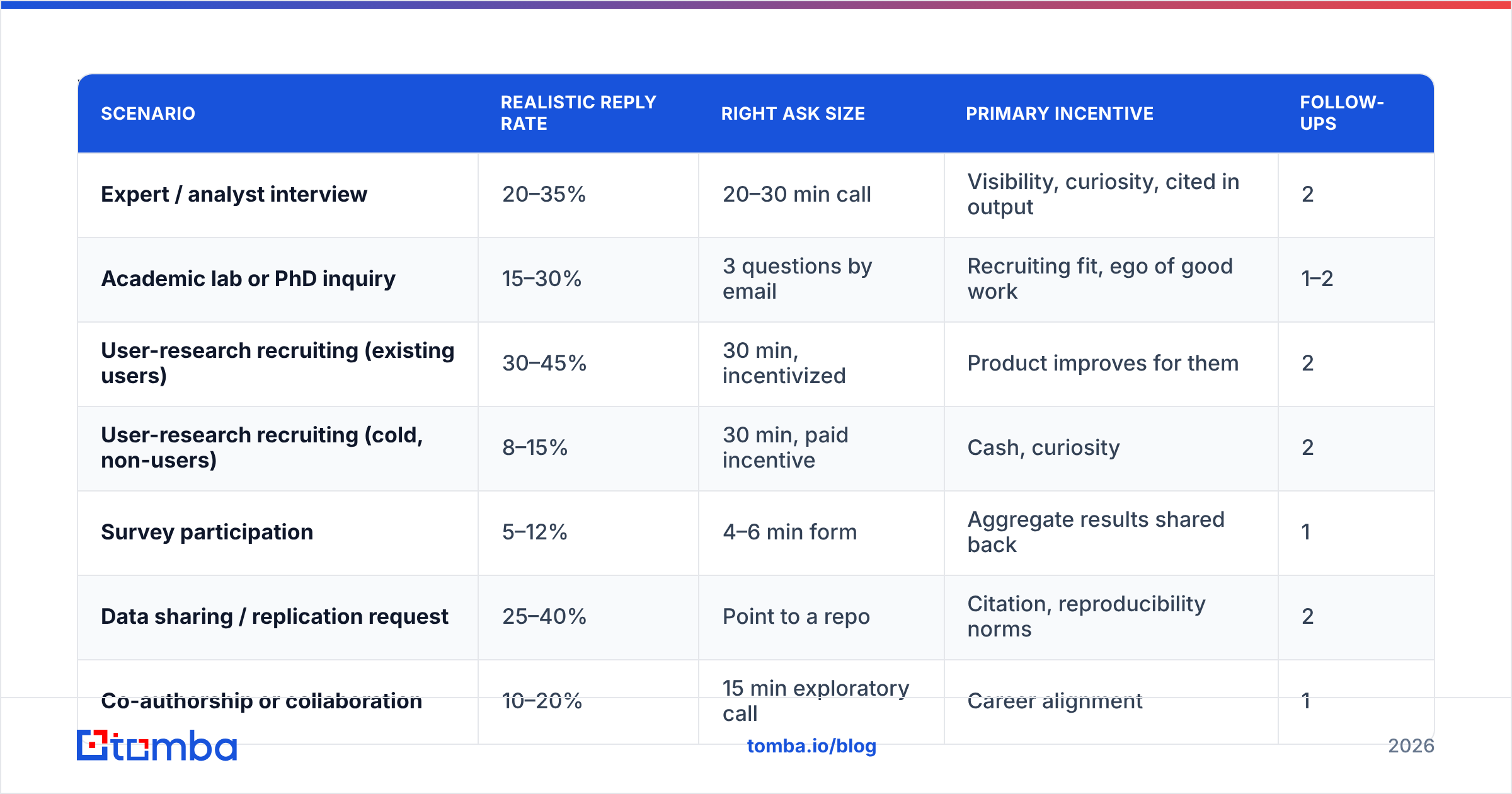
The scenarios diverge on who has power, what the incentive is, and how long the ask takes. Pick by the row that matches your situation.
| Scenario | Realistic reply rate | Right ask size | Primary incentive | Follow-ups |
|---|---|---|---|---|
| Expert / analyst interview | 20–35% | 20–30 min call | Visibility, curiosity, cited in output | 2 |
| Academic lab or PhD inquiry | 15–30% | 3 questions by email | Recruiting fit, ego of good work | 1–2 |
| User-research recruiting (existing users) | 30–45% | 30 min, incentivized | Product improves for them | 2 |
| User-research recruiting (cold, non-users) | 8–15% | 30 min, paid incentive | Cash, curiosity | 2 |
| Survey participation | 5–12% | 4–6 min form | Aggregate results shared back | 1 |
| Data sharing / replication request | 25–40% | Point to a repo | Citation, reproducibility norms | 2 |
| Co-authorship or collaboration | 10–20% | 15 min exploratory call | Career alignment | 1 |
Two things stand out. Cold user-research recruiting is the hardest row — those are strangers with no relationship to your product and no professional norm pushing them to answer. And data-sharing requests are the easiest, because academic reciprocity norms do the persuasion work for you.
What are the seven templates?#
1. Expert interview request (industry analyst, practitioner)#
Subject: Question re: your take on [specific claim]
Hi [First name],
Your [post/talk/report] argued that [specific claim, stated accurately]. We ran the same analysis across [N] accounts and got the opposite result on [narrow dimension], which I can't explain.
I'm [role] at [company], researching [one-line scope]. Would you have 20 minutes in the next two weeks to tell me where our method is wrong?
Happy to send the three questions in advance, and I'll share the anonymized dataset either way.
If the timing doesn't work, no need to reply.
[Name]
Why it works: you disagree with them on evidence, then offer them the evidence. Experts answer disagreement far more reliably than they answer praise.
2. Academic inquiry (prospective student to PI)#
Subject: [Your name] — question about [method] in [paper, short title]
Dear Dr. [Last name],
In [Paper, Year] you used [specific method] to handle [specific problem]. I replicated the [figure/table] on [different dataset] and the effect held at [rough magnitude], though [one honest caveat].
I'm finishing [degree] at [institution] and applying for [cycle]. Three short questions, answerable by email:
- Are you taking students for [term]?
- Is [research direction] still active in the lab?
- Does the lab prefer applicants with [skill A] or [skill B]?
Nothing needed beyond a one-line answer. CV attached if useful.
[Name]
The replication line is the whole email. It converts you from "applicant #180" into "person who ran my code."
3. User-research recruiting (existing users)#
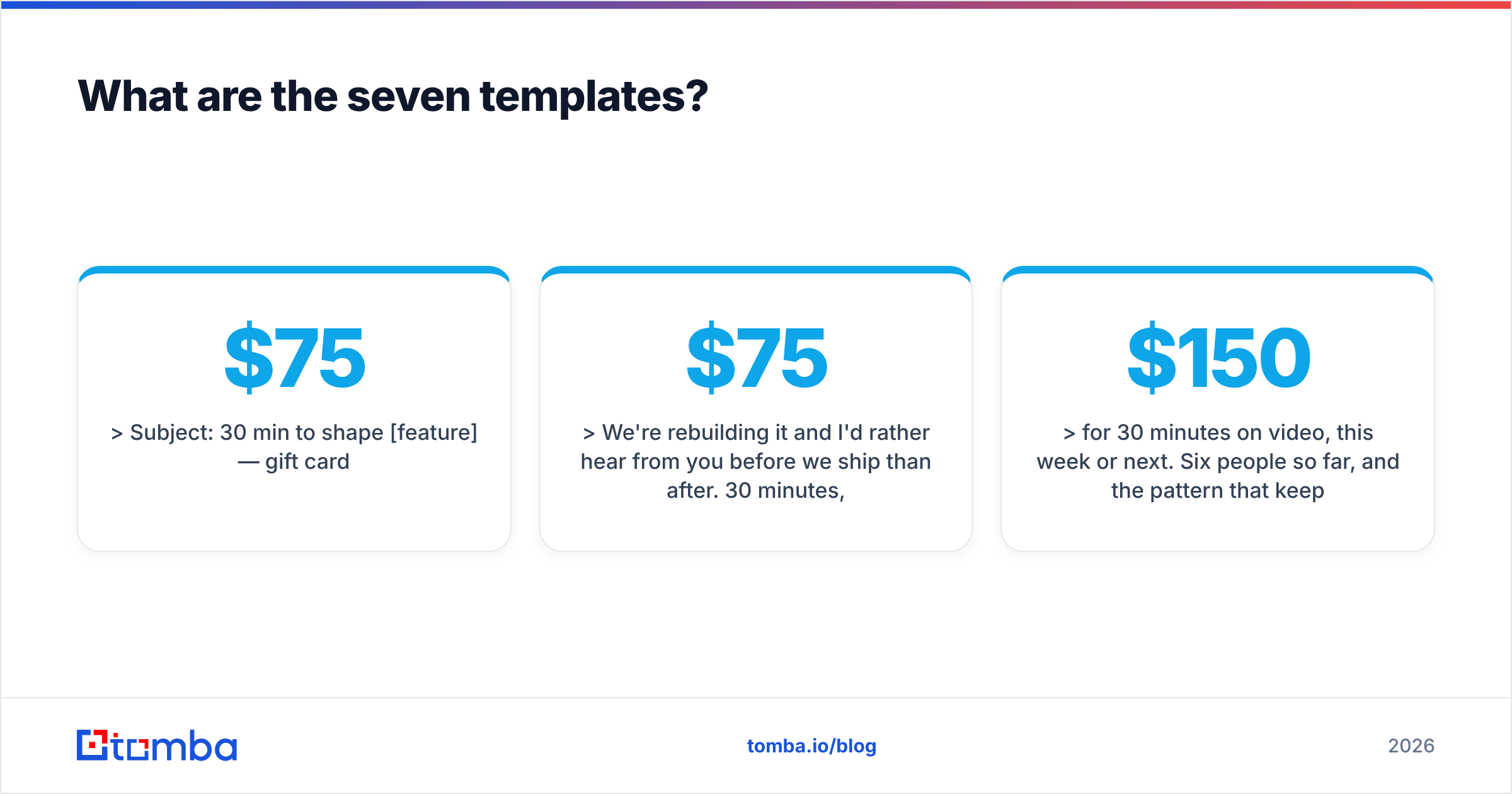
Subject: 30 min to shape [feature] — $75 gift card
Hi [First name],
You've used [feature] [N] times in the last month, which puts you in the top few percent of our users.
We're rebuilding it and I'd rather hear from you before we ship than after. 30 minutes, video call, $75 gift card. I'll ask about workflow, not opinions on mockups.
[Calendar link] — grab any slot. If none work, reply with a window and I'll match it.
[Name], [role]
Nielsen Norman Group's research on usability test participant recruiting is blunt about this: behavioral qualification ("you used the feature") beats demographic qualification every time.
4. Cold user-research recruiting (non-users)#
Subject: Paid 30 min — how [role] handles [workflow]
Hi [First name],
I'm researching how [job title]s at [company size/industry] handle [narrow workflow]. Not selling anything, and I won't ask about your vendors.
$150 for 30 minutes on video, this week or next. Six people so far, and the pattern that keeps showing up is [genuinely interesting finding] — I want to know whether it holds at [their company type].
[Calendar link]
If you'd rather not, ignore this and I won't follow up twice.
[Name]
Sharing an in-progress finding is the unlock. It makes the recipient a peer in an ongoing investigation rather than a specimen.
5. Survey participation#
Subject: 5 minutes: [year] [industry] [topic] survey
Hi [First name],
We're running the [year] [topic] survey across [N] [industry] teams. It's 14 questions, median completion time 4 minutes 40 seconds.
[Survey link]
Everyone who completes it gets the full anonymized dataset before it goes public, including the cross-tabs we won't publish.
[Name]
Publish the median completion time, not "just a few minutes." Precision is a proxy for honesty and it measurably lifts starts.
6. Data-sharing or replication request#
Subject: Replication of [Paper, Year] — data availability
Dear Dr. [Last name],
I'm replicating [Paper, Year] as part of [project/course/preprint]. The [supplementary/repo] link in the paper points to [specific issue: 404, missing variable, aggregated only].
Would you be able to share [precisely what you need]? I'll cite the paper, credit the data in the acknowledgements, and send you the replication notebook before anything goes public.
Happy to sign a data-use agreement if your institution requires one.
[Name], [affiliation]
Name the exact file or variable. Vague requests get vague non-answers.
7. Collaboration / co-authorship feeler#
Subject: [Their method] + [your dataset]?
Hi [First name],
You built [method]; we sit on [dataset description, with scale]. Nobody has run the first against the second, as far as I can tell from [search you actually did].
Worth 15 minutes to see whether there's a paper in it? If it turns out there isn't, that's a useful 15 minutes too.
[Calendar link]
[Name]
Short because the pitch is structural, not rhetorical. Either the combination is interesting or it isn't.
How do you find the right address for a research contact?#
The template is maybe 30% of the outcome. Delivery is the rest — and research targets are unusually hard to reach because they live behind institutional aliases, moved-on lab pages, and generic info@ catch-alls.
A workable sequence:
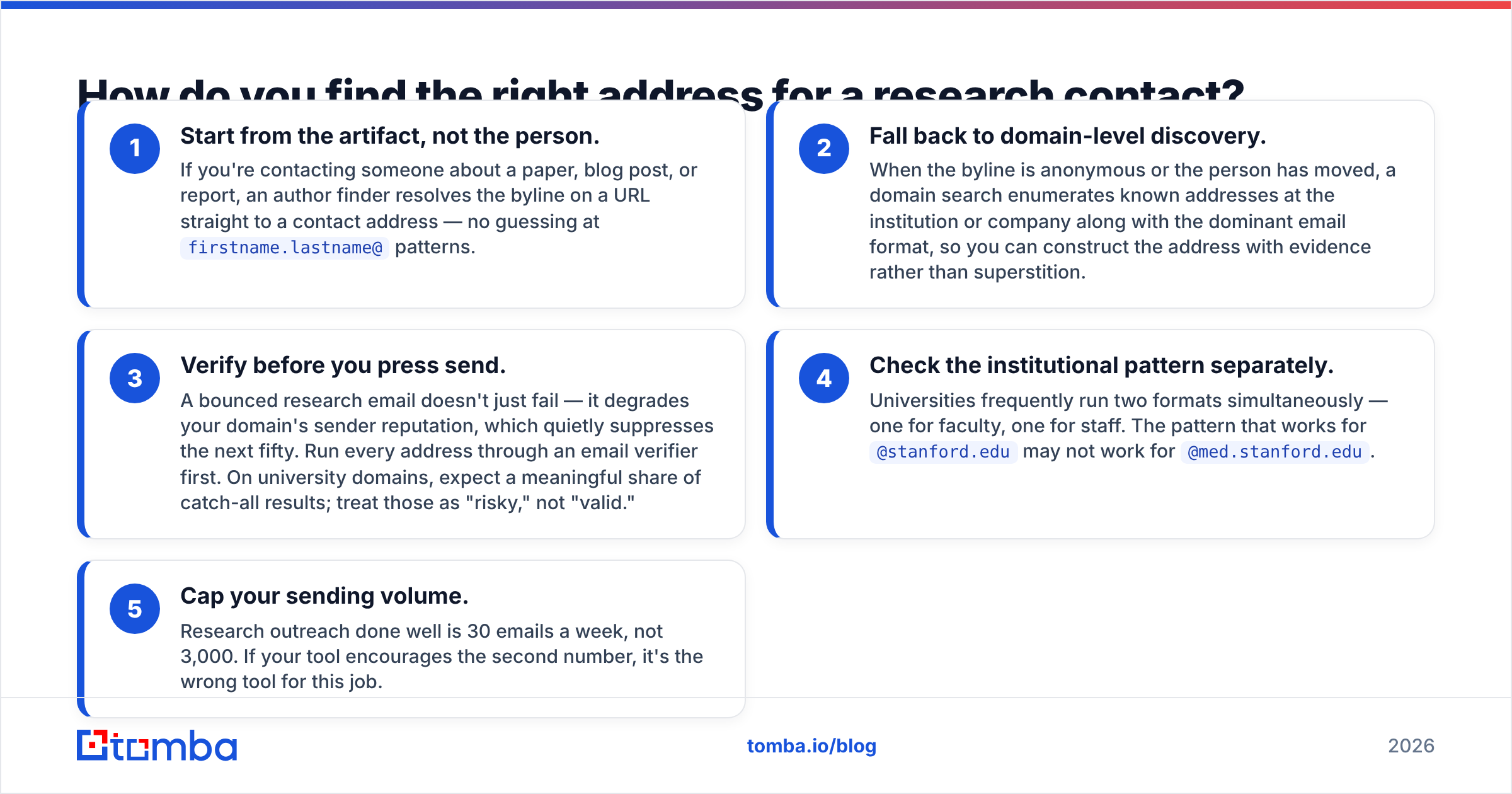
- Start from the artifact, not the person. If you're contacting someone about a paper, blog post, or report, an author finder resolves the byline on a URL straight to a contact address — no guessing at
firstname.lastname@patterns. - Fall back to domain-level discovery. When the byline is anonymous or the person has moved, a domain search enumerates known addresses at the institution or company along with the dominant email format, so you can construct the address with evidence rather than superstition.
- Verify before you press send. A bounced research email doesn't just fail — it degrades your domain's sender reputation, which quietly suppresses the next fifty. Run every address through an email verifier first. On university domains, expect a meaningful share of catch-all results; treat those as "risky," not "valid."
- Check the institutional pattern separately. Universities frequently run two formats simultaneously — one for faculty, one for staff. The pattern that works for
@stanford.edumay not work for@med.stanford.edu. - Cap your sending volume. Research outreach done well is 30 emails a week, not 3,000. If your tool encourages the second number, it's the wrong tool for this job.
The economics here are unintuitive. On a 40-person expert-interview list, a 12% bounce rate doesn't cost you five emails — it costs you five specific experts you selected precisely because they were hard to replace.
Should research emails follow up, and how many times?#
Yes, twice, then stop.
- Follow-up 1 (day 4–5): reply in the same thread, three sentences, restate the ask with a smaller version. "If a call is too much, would you answer question 2 by email?"
- Follow-up 2 (day 11–14): add a new piece of information — a preliminary finding, a relevant paper that came out since, a change in your scope. Never "just bumping this."
- Follow-up 3: don't. In research communities, people talk. The person who pings four times is remembered as the person who pings four times.
HubSpot's sales email research shows persistence paying off in commercial pipelines well past three touches, but that math doesn't transfer. Commercial prospects are anonymous to each other. Researchers in a subfield are not — you're building a reputation with every send, and it compounds in both directions.

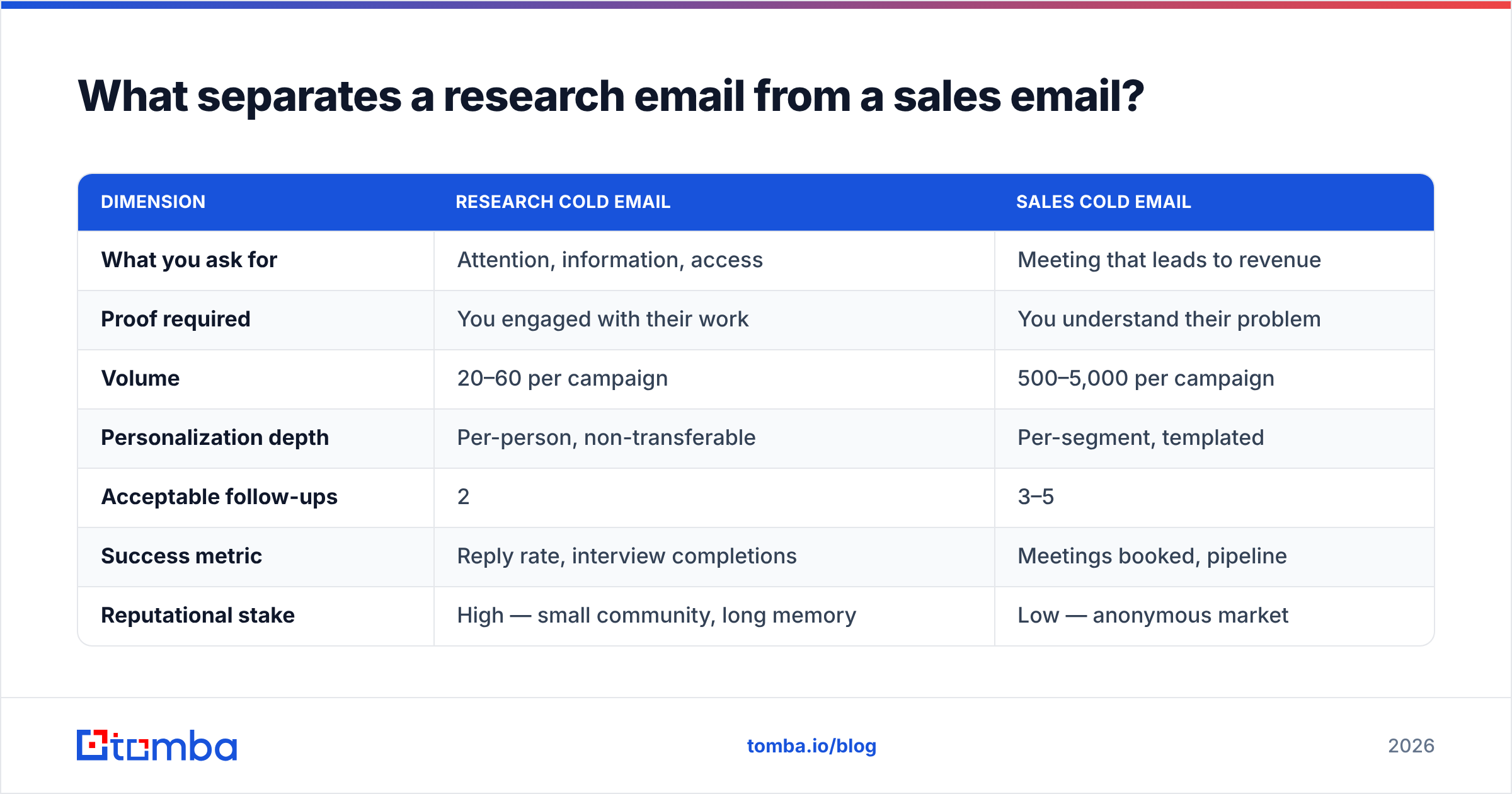
What separates a research email from a sales email?#
Worth being precise, because the two get conflated and the conflation is what makes research outreach feel spammy.
| Dimension | Research cold email | Sales cold email |
|---|---|---|
| What you ask for | Attention, information, access | Meeting that leads to revenue |
| Proof required | You engaged with their work | You understand their problem |
| Volume | 20–60 per campaign | 500–5,000 per campaign |
| Personalization depth | Per-person, non-transferable | Per-segment, templated |
| Acceptable follow-ups | 2 | 3–5 |
| Success metric | Reply rate, interview completions | Meetings booked, pipeline |
| Reputational stake | High — small community, long memory | Low — anonymous market |
The dimension that catches people out is the last one. A cold email sent into a commercial market is disposable. A cold email sent into an academic subfield or an analyst community is a permanent artifact in a small, gossipy graph. Write accordingly.
What should you measure?#
Four numbers, tracked per campaign:
- Deliverability rate — bounces plus spam placement. Should be above 97%. If it isn't, your list is the problem, not your copy.
- Reply rate — all replies, including declines. Declines are signal; they mean the message was read and understood.
- Positive reply rate — the ones that convert to a call, an answer, or a dataset. Compare against the table above by scenario.
- Time-to-first-reply — a median under 48 hours means your subject lines are working. Over a week means you're being triaged into "later," which is functionally "never."
If you want a starting library of structures to adapt rather than draft from scratch, our cold email templates collection is a reasonable place to strip-mine phrasing, though every one of them needs the research inversion applied before you send it.
Getting the address right before you get the words right#
Every template on this page assumes an email that lands in a monitored inbox. That assumption is doing more work than the copy is.
Before you spend an hour perfecting a first sentence for a lab director, spend two minutes resolving and verifying her actual address. The Tomba Email Finder resolves professional addresses by name and domain, flags the ones that look risky, and does it against verified sources rather than pattern-guessing. The free tier gives you 25 searches a month — enough to build a research outreach list of the size that actually works — and paid plans start at $49/mo if you're running this continuously. See Tomba pricing for the full breakdown.
Great research outreach is a small number of very good emails, sent to addresses that exist. Do the second part first.
Related guides#
Ready to find emails that actually work?
Join 150,000+ professionals who stopped guessing and started sending. Free credits on signup — no credit card required.
Get the Tomba newsletter
Practical outbound tactics and product updates — once every two weeks.
About the author