Cold Email to Potential Client Sample: 7 Templates for 2026
Seven cold email samples you can send to a potential client this week, plus the structural rules behind each one, benchmark reply rates, and the deliverability checks that decide whether any of them land.
TL;DR
- A cold email to a potential client works when it proves you researched them, names one specific problem, and asks for a decision that costs under 10 seconds. Everything else is decoration.
- Length matters less than specificity, but the data still favors short: 50–125 word emails consistently outperform 200+ word emails on reply rate.
- The seven samples below cover the realistic situations you actually face — trigger event, referral, competitor switch, content hook, post-demo revival, breakup, and the plain-value opener.
- Templates fail for boring reasons. Roughly a third of "low reply rate" problems are actually bounce and spam-placement problems caused by unverified addresses.
- Personalize the first line and the CTA. Leave the middle alone. That's where the leverage is.
What makes a cold email to a potential client actually work?#
Most cold email advice tells you to "add value." That's useless because it doesn't tell you what to type. Here is what to type.
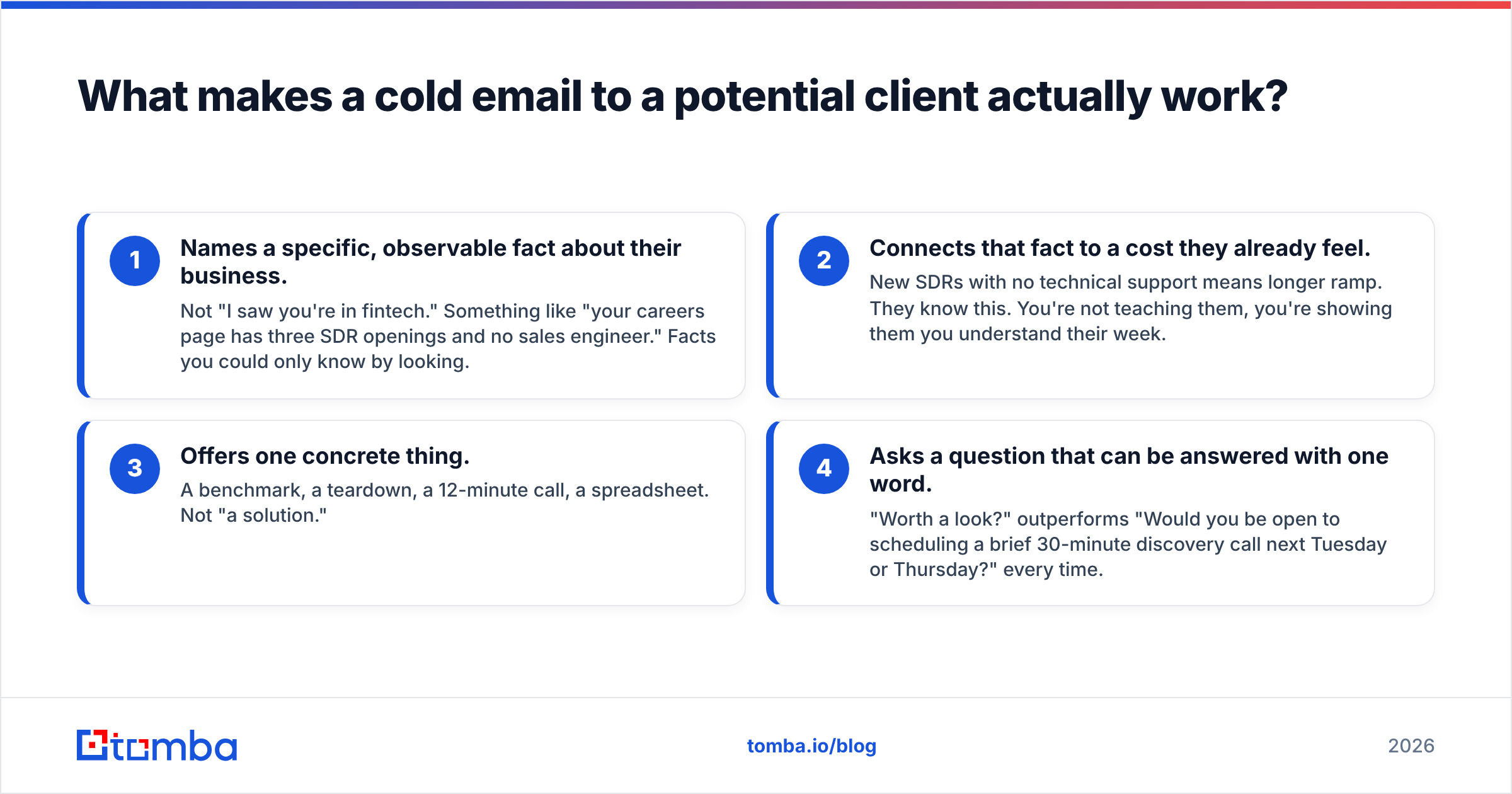
A cold email that gets a reply from a potential client does four things, in this order:
- Names a specific, observable fact about their business. Not "I saw you're in fintech." Something like "your careers page has three SDR openings and no sales engineer." Facts you could only know by looking.
- Connects that fact to a cost they already feel. New SDRs with no technical support means longer ramp. They know this. You're not teaching them, you're showing them you understand their week.
- Offers one concrete thing. A benchmark, a teardown, a 12-minute call, a spreadsheet. Not "a solution."
- Asks a question that can be answered with one word. "Worth a look?" outperforms "Would you be open to scheduling a brief 30-minute discovery call next Tuesday or Thursday?" every time.
Everything else — the pleasantries, the company boilerplate, the three-paragraph explanation of your methodology — subtracts. Your prospect is reading this on a phone, between meetings, with 41 other unread messages. You are competing for eleven seconds.

Wait — that's the wrong image reference. Use the placeholder:
Which cold email sample should you use for which situation?#
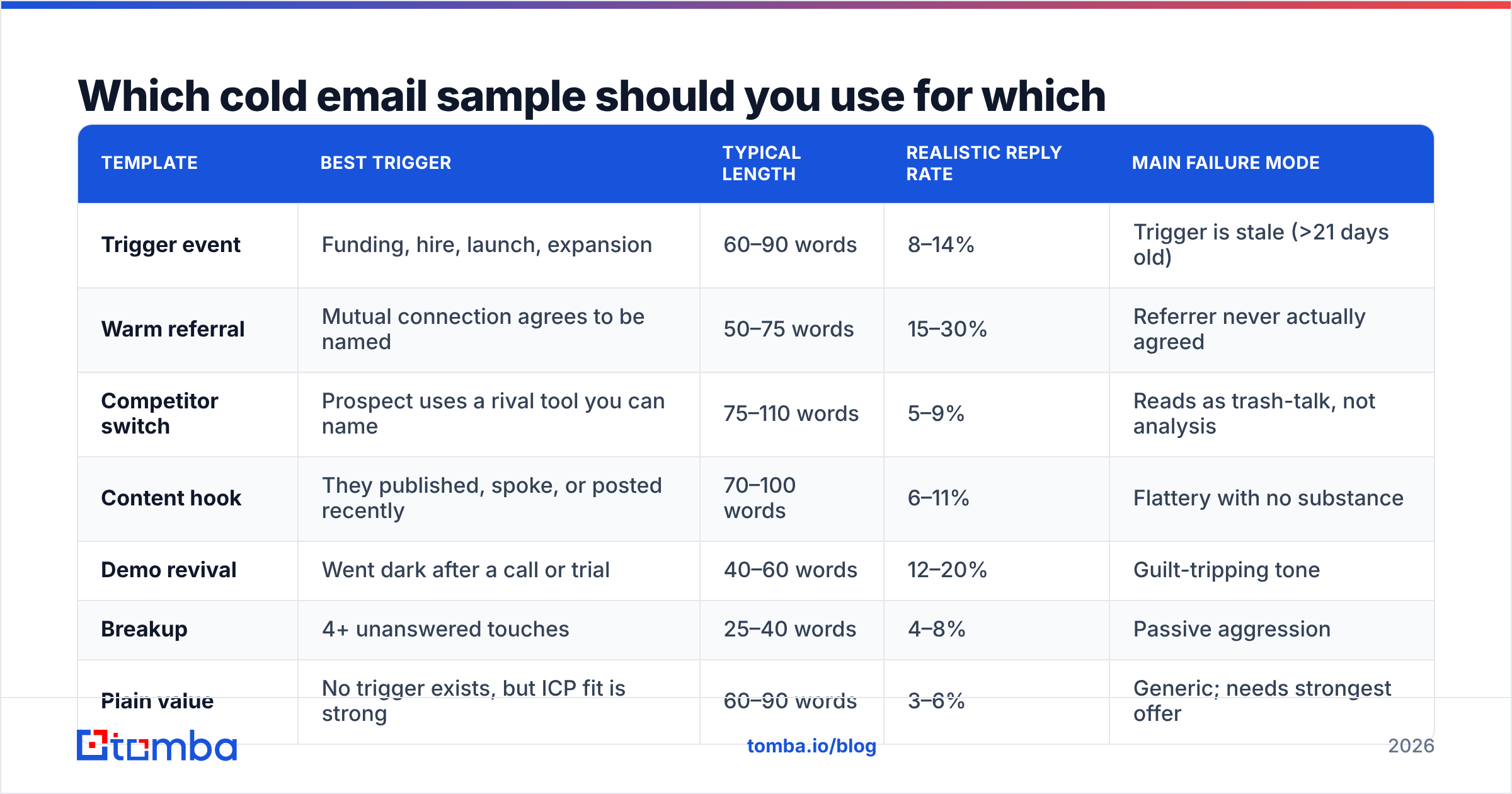
There is no universal cold email to potential client sample. There is a right sample for a specific trigger. Pick by trigger, not by taste.
| Template | Best trigger | Typical length | Realistic reply rate | Main failure mode |
|---|---|---|---|---|
| Trigger event | Funding, hire, launch, expansion | 60–90 words | 8–14% | Trigger is stale (>21 days old) |
| Warm referral | Mutual connection agrees to be named | 50–75 words | 15–30% | Referrer never actually agreed |
| Competitor switch | Prospect uses a rival tool you can name | 75–110 words | 5–9% | Reads as trash-talk, not analysis |
| Content hook | They published, spoke, or posted recently | 70–100 words | 6–11% | Flattery with no substance |
| Demo revival | Went dark after a call or trial | 40–60 words | 12–20% | Guilt-tripping tone |
| Breakup | 4+ unanswered touches | 25–40 words | 4–8% | Passive aggression |
| Plain value | No trigger exists, but ICP fit is strong | 60–90 words | 3–6% | Generic; needs strongest offer |
Reply rates above are directional ranges observed across B2B outbound programs, not guarantees. Your list quality moves these numbers more than your copy does. A perfect email to a wrong-fit contact still gets nothing.
What are the 7 cold email samples?#
Copy these. Then replace every bracket with something only you could write.
1. The trigger-event email#
Subject: the 3 SDR reqs
Hi [First name],
Saw [Company] posted three SDR roles this month and no sales engineer alongside them. Usually that means reps end up fielding technical questions themselves, and ramp stretches from 90 days to 150.
We helped [Similar company] cut ramp to 74 days by giving reps a pre-built technical objection library. Happy to send the library itself — no call required.
Want it?
[Your name]
Why it works: the observation is checkable, the cost is specific, the offer is a file rather than a meeting, and the ask is two words.
2. The warm referral email#
Subject: [Referrer name] said to reach out
Hi [First name],
[Referrer], who runs RevOps at [Their company], mentioned you're rebuilding the outbound stack this quarter and suggested I write.
We built the enrichment layer she uses — the part that stops reps from emailing addresses that bounce. She'd probably tell you more than I would.
Worth 15 minutes, or should I just send what we built for her?
[Your name]
Only use this if the referrer genuinely said yes. Using a name without permission ends two relationships at once.
3. The competitor-switch email#
Subject: your [Competitor] renewal
Hi [First name],
[Company] shows up as a [Competitor] customer in your tech stack. Good product — genuinely. The complaint we hear most from teams switching is per-seat pricing at 20+ reps, and no credit rollover.
If neither of those bother you, ignore this. If they do, I can send a side-by-side of what the same volume costs on our model.
Fair?
[Your name]
Note the concession. Attacking the incumbent makes you look desperate; acknowledging it makes the specific complaint credible.
4. The content-hook email#
Subject: your point about intent data
Hi [First name],
Your LinkedIn post last Tuesday argued that intent data mostly surfaces buyers who already found you. Agreed, and I'd add that it also inflates pipeline forecasts because it double-counts inbound.
We ran a study across 340 outbound teams that puts numbers on exactly that. Two charts, no gate.
Send it over?
[Your name]
Reference something they said within the last 14 days and add a thought, don't just applaud. Applause is not personalization.
5. The demo-revival email#
Subject: closing your file
Hi [First name],
We talked on the 12th, you liked the enrichment coverage, and then quarter-end happened. Completely normal.
Should I keep the sandbox open another two weeks, or shut it down?
[Your name]
Forty words. Two options. No guilt. The "shut it down" option is what makes people answer.
6. The breakup email#
Subject: last one from me
Hi [First name],
I've sent four emails about SDR ramp time. Either it's not a problem, or it's not a problem this quarter.
Which one?
[Your name]
The breakup only works if it is actually the last one. If you follow up after it, you've taught the prospect your emails mean nothing.
7. The plain-value email#
Subject: bounce rates at [Company]
Hi [First name],
No trigger here — I just think [Company] is exactly the profile that gets hurt by list decay. Teams your size typically lose 22–30% of their contact database annually to job changes.
I pulled the current validity rate on a sample of 200 contacts in your ICP. It's 61%. Want the file?
[Your name]
This is the hardest template because you have no excuse to be in their inbox. Compensate with an offer that has real work behind it. The sample file has to exist.
Why do good cold email samples still get no replies?#
Because the email never arrived, or it arrived in a folder nobody opens.
Before you rewrite a single line of copy, rule out the mechanical failures:
- Bounces. A bounce rate above 3% degrades your sender reputation and drags every subsequent send toward spam. Run the list through an email verifier before it touches your sequencer. This is not optional at any volume.
- Guessed addresses. Pattern-generated emails (
first.last@) look plausible and bounce hard. Use a real email finder with source attribution instead of a permutator, and reserve the email permutator for the handful of contacts where nothing else works. - Authentication. No SPF, DKIM, or DMARC means bulk senders get filtered before content is even evaluated. Google and Yahoo both enforce this now — their bulk sender guidelines spell out the thresholds.
- Volume from a cold domain. A new domain sending 300 emails on day one is a spam signal regardless of what the emails say.
- Spam-trigger structure. Multiple links, tracking pixels, image-heavy HTML, and 400-word blocks all correlate with filtering. Plain text with one link performs better.
Once those are clean, and only then, does copy become the variable worth testing. Teams that skip this order spend six weeks A/B testing subject lines on emails that never reached an inbox. If you're unsure where you stand, email deliverability is the concept to understand before you scale anything.
How much should you personalize a cold email to a potential client?#
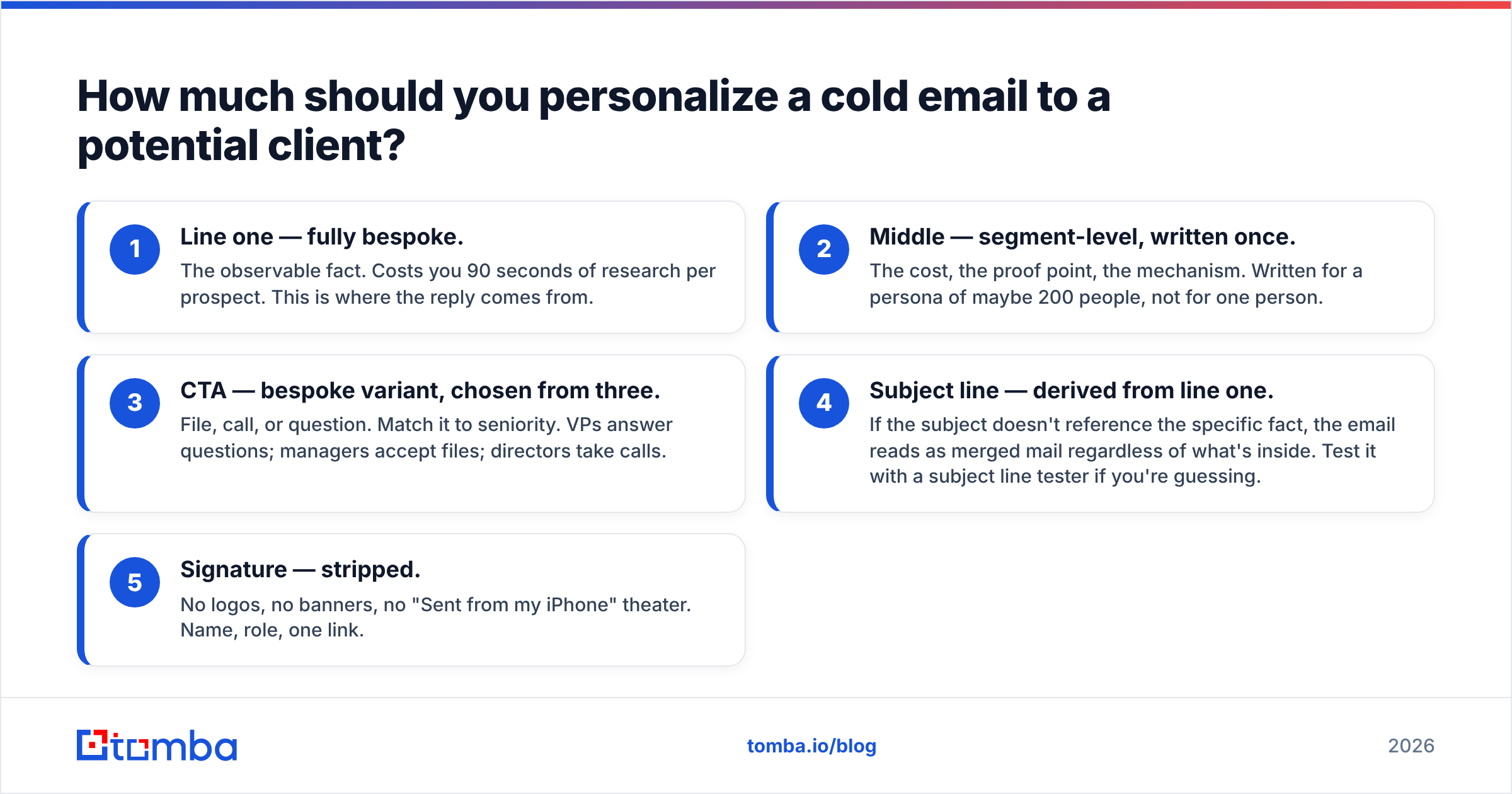
Personalize the first sentence and the call to action. Leave the middle paragraph identical across the segment.
This is the practical compromise between the two failure modes. Full personalization gives you 12 emails a day and a rep who quits. Zero personalization gives you 3,000 emails a day and a burned domain.
Here's the split that works at scale:
- Line one — fully bespoke. The observable fact. Costs you 90 seconds of research per prospect. This is where the reply comes from.
- Middle — segment-level, written once. The cost, the proof point, the mechanism. Written for a persona of maybe 200 people, not for one person.
- CTA — bespoke variant, chosen from three. File, call, or question. Match it to seniority. VPs answer questions; managers accept files; directors take calls.
- Subject line — derived from line one. If the subject doesn't reference the specific fact, the email reads as merged mail regardless of what's inside. Test it with a subject line tester if you're guessing.
- Signature — stripped. No logos, no banners, no "Sent from my iPhone" theater. Name, role, one link.
Research from HubSpot's sales blog and independent outbound benchmarks converges on the same conclusion: relevance beats volume up to a point, then volume beats relevance, and the crossover happens around 60–80 well-researched emails per rep per day. Below that you're leaving pipeline on the table. Above it, quality collapses and reply rate falls faster than send volume rises.
Is cold emailing potential clients legal?#
Yes, in most jurisdictions, with conditions — and the conditions differ by region.
In the United States, the CAN-SPAM Act permits unsolicited commercial email to business contacts provided you include a valid physical postal address, don't use deceptive headers or subject lines, honor opt-outs within 10 business days, and identify the message as commercial where required. There is no opt-in requirement.
In the EU and UK, GDPR and PECR apply. Business-to-business email to a corporate role address is generally permissible under legitimate interest, but you must document that assessment, name your data source on request, and offer opt-out in every message. Emailing a personal address (jane.doe@gmail.com) without consent is a different and much riskier proposition.
Canada's CASL is the strictest of the three: it requires consent, express or implied, with implied consent expiring after a defined window following a business relationship. If you're prospecting into Canada, get counsel rather than a blog post.
Two operational rules follow from all of this: keep a record of where every contact came from, and make unsubscribing trivial. Both are also good deliverability practice, which is convenient.
What's the realistic benchmark for a cold email campaign?#
Set expectations before you send, or you'll kill a working campaign at day nine.
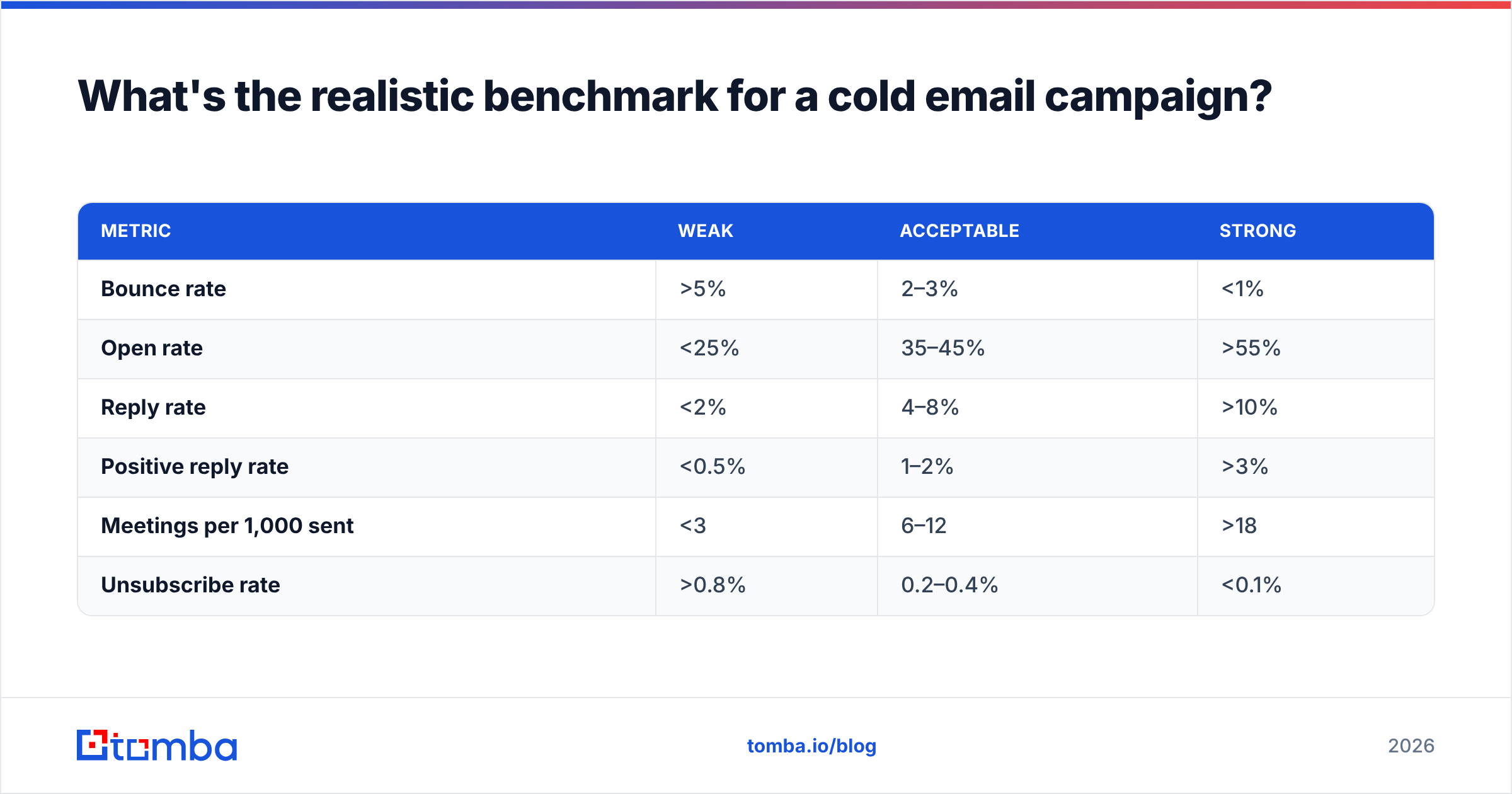
| Metric | Weak | Acceptable | Strong |
|---|---|---|---|
| Bounce rate | >5% | 2–3% | <1% |
| Open rate | <25% | 35–45% | >55% |
| Reply rate | <2% | 4–8% | >10% |
| Positive reply rate | <0.5% | 1–2% | >3% |
| Meetings per 1,000 sent | <3 | 6–12 | >18 |
| Unsubscribe rate | >0.8% | 0.2–0.4% | <0.1% |
Two caveats. Open rate is increasingly unreliable because of Apple Mail Privacy Protection and similar prefetching — treat it as directional only. And a 10% reply rate on a 200-contact list of perfectly-fit prospects is worth more than a 4% reply rate on 5,000 randoms, because the replies come from people who can sign.
Track positive replies and meetings booked. Those are the only two numbers that survive contact with a board meeting.
How do you build the list these samples are sent to?#
The list is the product. The email is the packaging.
Start with a definition of the account, not the person: employee count, tech stack, funding stage, geography, and one disqualifier that removes 30% of the market. Then find the two or three roles at each account who feel the pain you solve.
From there, domain search gets you the email pattern and the named contacts at each target company in one pass, and bulk verify confirms which of those addresses will actually accept mail before you queue a single send. Enrich what survives with the firmographic and technographic fields your first line depends on — you cannot write "your careers page has three SDR openings" without data telling you which pages to read.
If you want to see how vendors differ on sourcing and freshness, G2's email-finder category has enough unfiltered practitioner reviews to be useful, though read the one-star reviews first; they're where the coverage gaps show up.
Start with a list that doesn't bounce#
Every template in this post assumes the email arrives. That assumption fails more often than most teams realize — job changes alone rot 2–3% of a B2B contact list every month, and the addresses that go stale first tend to be the senior ones you most want to reach.
Tomba's Email Finder returns verified professional addresses by name and domain, with the source attribution that tells you why the address is believed correct rather than just asserting a confidence score. The free tier covers 25 searches a month if you want to test it against a list you already have — run 25 contacts you believe are good and see how many come back flagged. Paid plans start at $49/mo, with full Tomba pricing covering higher-volume needs.
Write the first line yourself. Let the tooling handle the part where the email actually lands.
Related guides#
Ready to find emails that actually work?
Join 150,000+ professionals who stopped guessing and started sending. Free credits on signup — no credit card required.
Get the Tomba newsletter
Practical outbound tactics and product updates — once every two weeks.
About the author