Cold Introduction Email: Templates, Structure, and Reply Data
Most cold introduction emails fail in the first two lines — not because the offer is bad, but because the opener is about you. Here's the structure, the data, and the templates that actually earn a reply in 2026.
TL;DR
- A cold introduction email is a first-contact message to someone who has never heard of you. Its only job is to earn a reply — not to close, not to explain your company.
- The first two lines decide everything. If line one is about you ("I'm the founder of..."), you've already lost most readers.
- Median cold reply rates sit in the 1–5% range across most B2B lists. Tightly targeted lists with verified addresses and a specific, researched opener land in the 8–15% range.
- Structure beats cleverness: relevance hook → observation → one-sentence value claim → single low-friction ask. Under 120 words.
- Deliverability is a prerequisite, not an afterthought. An unverified list quietly kills every good email you send after it.
What is a cold introduction email?#
A cold introduction email is your first written contact with a person who has no prior relationship with you, your company, or anyone who vouched for you. No demo request. No webinar signup. No mutual connection making the handoff. Just you, an inbox, and roughly eight seconds of attention.
Think of it like knocking on a stranger's door at dinner time. You can absolutely have a good reason to be there — but you have to establish that reason before they decide whether to keep listening. The reason cannot be "I would like to tell you about myself."
That is the entire discipline. Everything else in this guide is mechanics.
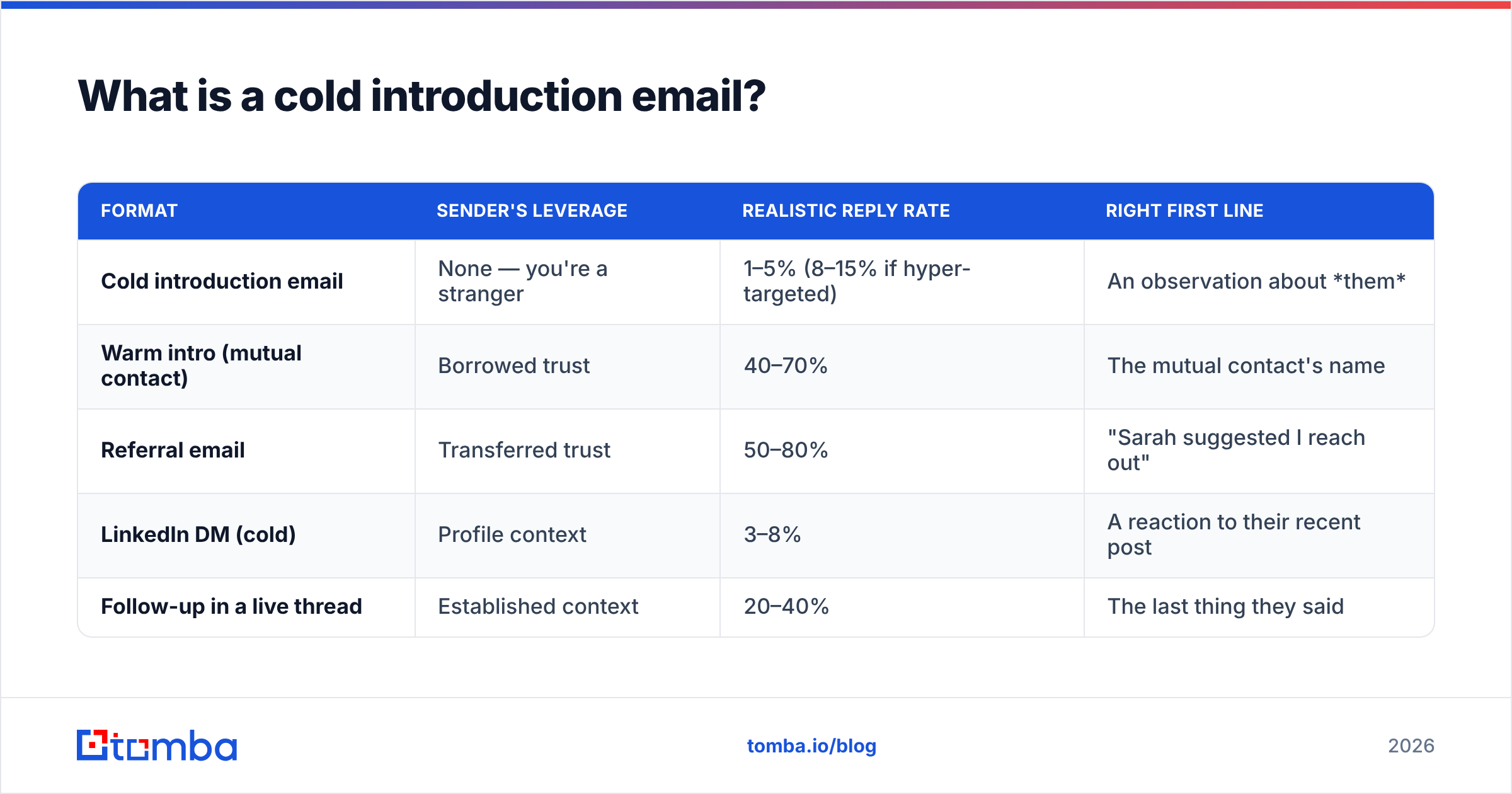
Cold introduction emails get confused with three adjacent formats, and the confusion causes most of the damage. Here's how they differ in practice:
| Format | Sender's leverage | Realistic reply rate | Right first line |
|---|---|---|---|
| Cold introduction email | None — you're a stranger | 1–5% (8–15% if hyper-targeted) | An observation about them |
| Warm intro (mutual contact) | Borrowed trust | 40–70% | The mutual contact's name |
| Referral email | Transferred trust | 50–80% | "Sarah suggested I reach out" |
| LinkedIn DM (cold) | Profile context | 3–8% | A reaction to their recent post |
| Follow-up in a live thread | Established context | 20–40% | The last thing they said |
The gap between row one and row two is the whole problem. You have no leverage, so you have to manufacture it — with research, specificity, and restraint.
Why do most cold introduction emails fail?#
They fail for four reasons, in descending order of how often I see them.
- The email never arrives. Bounced, filtered, or routed to spam. If 12% of your list bounces, your sender reputation degrades and even your good addresses stop landing in the primary tab. Verification is not optional infrastructure.
- The opener is autobiographical. "I'm Ben, founder of X, and we help companies like yours..." The reader's brain classifies this as an ad in under a second. Every subsequent sentence, however good, is read through that filter.
- The ask is too heavy. "Do you have 30 minutes Thursday?" is a big commitment from someone who does not yet know why you exist. You are asking for a meeting before you've earned a reply.
- The email is too long. Over 150 words and you're competing with actual work. The person skims, sees a paragraph block, and archives.
None of these are creativity problems. All four are process problems, which is good news — process is fixable.

What does a cold introduction email that works look like?#
It has four moving parts and nothing else.
- The relevance hook (line 1). Something you observed about their company, role, market, or recent action. Not flattery. Evidence that you looked.
- The bridge (line 2). Why that observation makes you relevant. One sentence. This is where you're allowed to exist.
- The value claim (line 3). What outcome you produce, stated in their terms, ideally with a number or a named peer.
- The ask (line 4). One question. Low friction. Answerable with a word.
Here is that skeleton with meat on it:
Subject: the 40-person SDR question
Noticed you added six SDRs in Q1 and are still running Outreach sequences off list imports.
That combination usually means reps are spending 3–5 hours a week hand-verifying addresses before they can send anything.
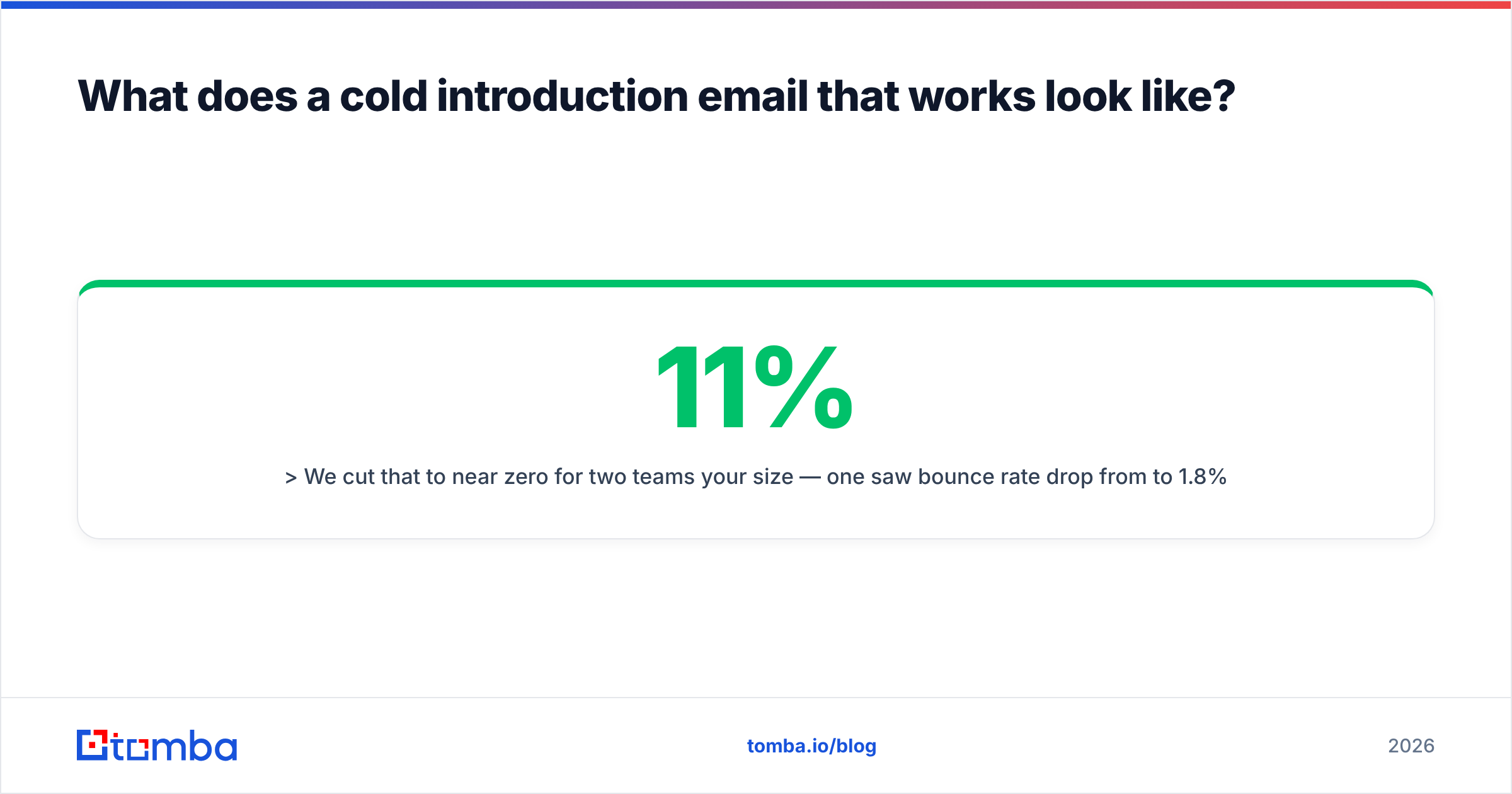
We cut that to near zero for two teams your size — one saw bounce rate drop from 11% to 1.8% in six weeks.
Is manual list cleanup actually eating your reps' time, or have you already solved that?
Ninety-four words. The last line is a genuine question with a real "no" available. That optionality is what makes people answer — you've given them a way out, so replying doesn't feel like a trap.
Compare it to the version most people send:
Subject: Quick question
Hi Sarah,
Hope this email finds you well! My name is Ben and I'm the co-founder of DataThing, a leading platform for sales teams. We help companies streamline their outbound motion and drive pipeline efficiency at scale.
Our clients typically see a 3x improvement in productivity. I'd love to hop on a quick 15-minute call to show you how we could do the same for you. Are you free Tuesday or Wednesday?
Everything in the second email is about the sender. "Hope this finds you well" is the universal signal of a template. "Leading platform" is unfalsifiable. And "Tuesday or Wednesday" presumes a meeting the reader has not agreed to want.
How do you write the subject line?#
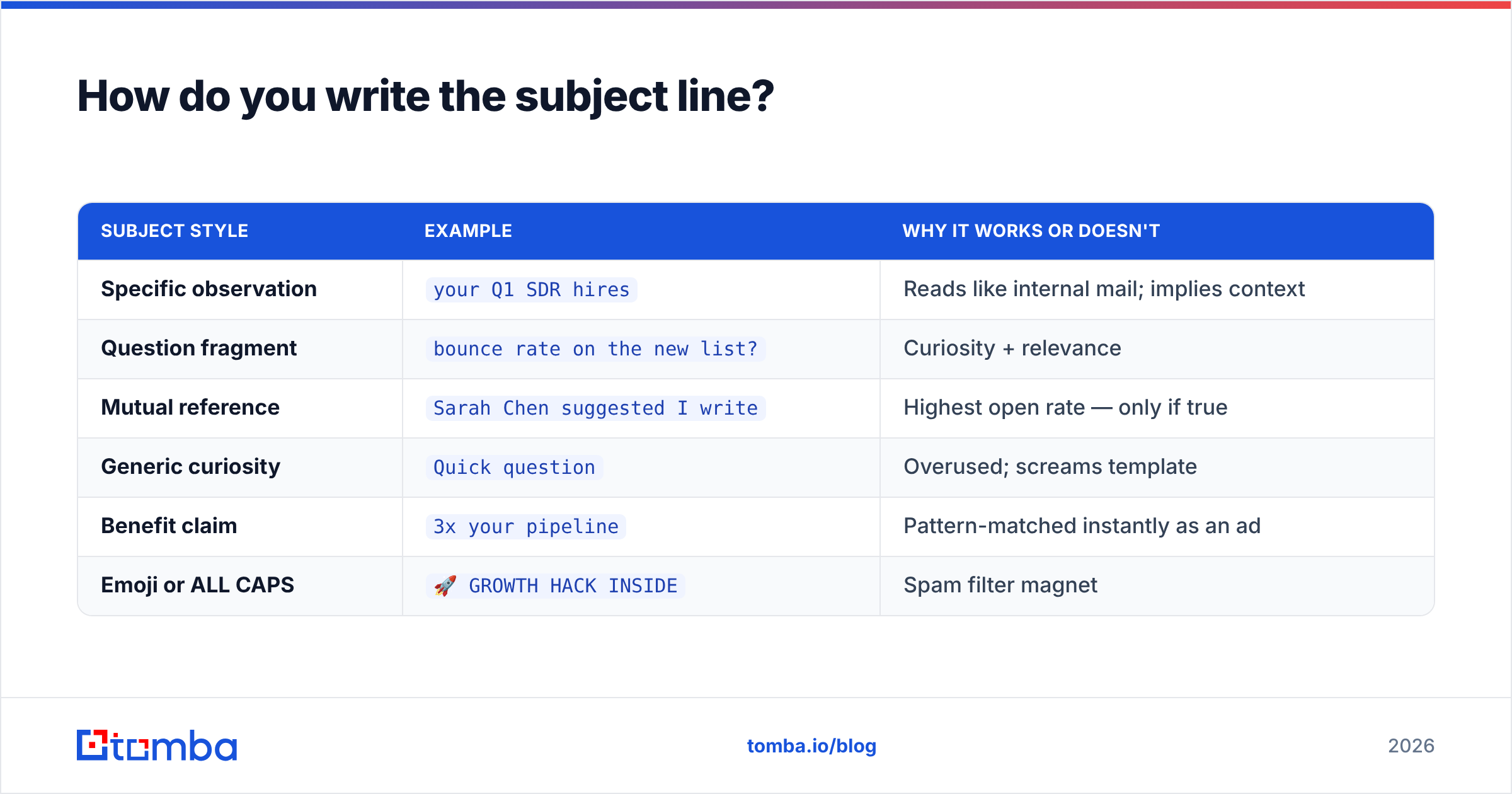
Short, lowercase, and specific. Treat it as a preview of the first line, not a headline for the whole email.
| Subject style | Example | Why it works or doesn't |
|---|---|---|
| Specific observation | your Q1 SDR hires |
Reads like internal mail; implies context |
| Question fragment | bounce rate on the new list? |
Curiosity + relevance |
| Mutual reference | Sarah Chen suggested I write |
Highest open rate — only if true |
| Generic curiosity | Quick question |
Overused; screams template |
| Benefit claim | 3x your pipeline |
Pattern-matched instantly as an ad |
| Emoji or ALL CAPS | 🚀 GROWTH HACK INSIDE |
Spam filter magnet |
Two rules that hold up across every dataset I've seen: keep it under six words, and never make a claim in the subject that the body can't immediately substantiate. If you're unsure whether a line reads as human or as marketing, run it through a subject line tester before you commit 500 sends to it.
Lowercase is not a gimmick. It signals that a person typed it, not a sequencer. It's also easy to overdo — if your whole sequence is lowercase, the effect dies.
Does personalization actually move the needle?#
Yes, but not the kind most people mean by "personalization."
Merge-tag personalization — {{first_name}}, {{company}}, {{recent_funding_round}} — is table stakes. It gets you past the "is this a robot" check and nothing more. Its marginal effect on reply rate is close to zero once everyone does it, and everyone does it.
What moves the needle is research personalization: one sentence that could only have been written about this specific company, by someone who spent three minutes looking. A job posting. A shipped feature. A tech-stack change. A comment in a podcast. The specific mechanism at work is that the reader thinks "this person did work before emailing me," and reciprocity does the rest.
The tradeoff is obvious and real:
- Fully manual research — 8–12 minutes per prospect, 15%+ reply rates, roughly 30 emails a day per rep. Correct for a 100-account target list.
- Templated with a research variable — 90 seconds per prospect, 6–10% reply rates, 150 emails a day. Correct for a 1,000-account list.
- Pure template with merge tags — 5 seconds per prospect, 1–3% reply rates. Correct for almost nothing, but it's what most teams run.
- AI-generated "personalization" — fast, and increasingly detectable. When the observation is generic ("I see you're growing fast!"), it lands worse than no personalization at all, because it fakes the signal without the substance.
The honest answer for most teams: build a 200-account list where research is affordable, rather than a 5,000-account list where it isn't. A smaller list of verified emails with real research will out-produce the big one every quarter.
How do you find the right person to email in the first place?#
Before structure matters, targeting matters. You can write the best cold introduction email in the world and send it to a director who has no budget and no pain.
Work backwards from the problem you solve. Who feels it weekly? That's your primary. Who signs for the fix? That's your economic buyer. Sometimes they're the same person; usually they're not, and the intro email should go to whoever feels the pain — they'll pull the buyer in for you.
Once you know the title, you need the address. Three practical routes:
- Domain-first. You know the company, you need the people. A domain search returns the addresses and roles attached to a domain, plus the pattern that company uses (
first.last@,flast@, and so on). - Name-first. You know the person from LinkedIn or a conference list. An email finder resolves name + company to a deliverable address and returns a confidence score.
- Database-first. You want a filtered list to start from. Providers like BookYourData and Tomba's own contact database both do this well; the differentiator is how recently the record was verified, not how many million records the vendor advertises.
Whichever route you take, verify before you send. A list that looks fine on a spreadsheet can carry 10–15% dead addresses, and every one of them is a small deposit into the wrong side of your sender reputation ledger. Google's own sender guidelines are explicit that spam complaint and bounce signals gate inbox placement for bulk senders — this is not folklore.
What should you do after you hit send?#
Most replies to cold introduction emails don't come from the first email. They come from the second or third touch — and the follow-up is where nearly everyone gets lazy.
A follow-up that says "just bumping this to the top of your inbox" adds zero information. It asks the reader to do work with no new reason. Instead, each follow-up should carry one new asset: a relevant customer story, a specific number, a link to something genuinely useful, or a narrower version of the original question.
A sequence that holds up:
- Day 0 — Introduction. The four-part email above. One ask.
- Day 3 — New angle. Same problem, different evidence. A peer's result, a data point, a screenshot.
- Day 7 — Narrower ask. "Is this even on your roadmap this half? A yes/no is fine."
- Day 14 — Value-only. Send something useful with no ask attached. A teardown, a benchmark, a relevant post.
- Day 21 — Close the loop. "I'll stop here — happy to circle back next quarter if the timing's wrong."
Five touches, then stop. The permanent-nurture sequence that never ends is how you get marked as spam, and one spam complaint costs more than the eleven emails that generated it. Reasonable benchmarks for what "working" looks like: a 40%+ open rate, sub-2% bounce, and a response rate above 5% across the full sequence.
Track replies, not opens. Open-rate tracking has been unreliable since Apple's Mail Privacy Protection began pre-fetching images, and most serious teams have quietly stopped optimizing against it. HubSpot's sales research and buyer surveys from Gartner both point the same direction: reply and meeting-booked are the only metrics that survive contact with reality.
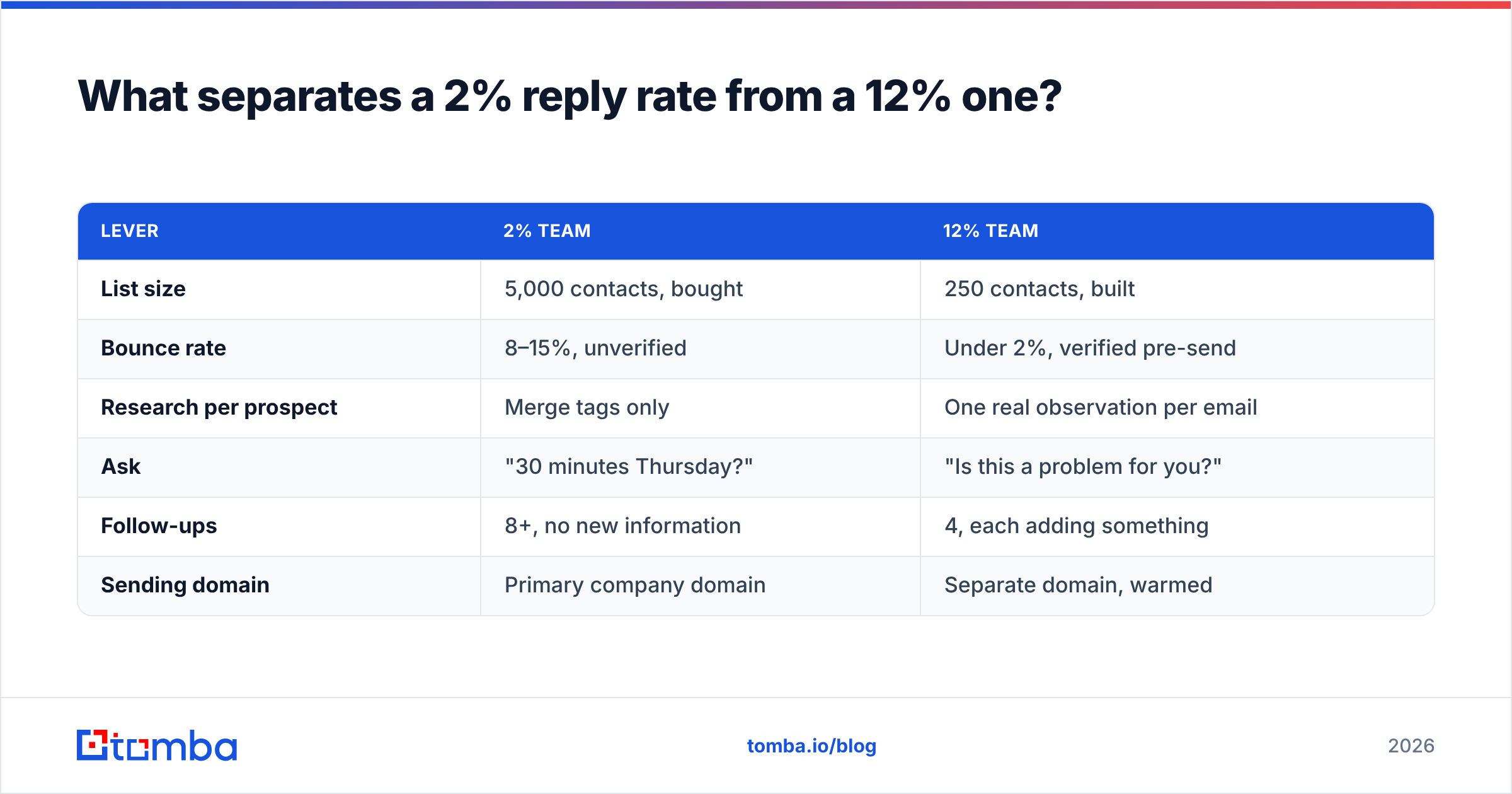
What separates a 2% reply rate from a 12% one?#
Almost never the copy. It's the four things underneath the copy.
| Lever | 2% team | 12% team |
|---|---|---|
| List size | 5,000 contacts, bought | 250 contacts, built |
| Bounce rate | 8–15%, unverified | Under 2%, verified pre-send |
| Research per prospect | Merge tags only | One real observation per email |
| Ask | "30 minutes Thursday?" | "Is this a problem for you?" |
| Follow-ups | 8+, no new information | 4, each adding something |
| Sending domain | Primary company domain | Separate domain, warmed |
Read that table as a diagnostic. If your cold introduction emails aren't landing, find your row before you rewrite a single sentence. The copy is usually the last thing wrong.
One more note on the sending setup, because it's invisible until it isn't: send cold outreach from a secondary domain, warm it for at least three weeks, cap daily volume per mailbox, and authenticate properly with SPF, DKIM, and DMARC. If your primary domain gets burned, your invoices and support replies stop landing too. That's a bad week.
Where should you start?#
Pick 50 accounts where you can articulate — in one sentence, without hedging — why they'd care. Find the person who feels the pain. Verify the address. Write four lines. Send.
Fifty of those beat five thousand of the other thing, every time.
The one piece you shouldn't do by hand is the address. Guessing formats, permutating names, and finding out on send day that half your list bounced is the fastest way to poison the domain you'll be using for the next three years. Run your names through the Tomba Email Finder first — the free tier covers 25 searches a month, which is enough to test the approach on a real account list before you commit. Paid plans start at $49/mo, and every result comes back with a confidence score and source attribution, so you know what you're sending into.
Get the address right. Then get the first line right. The rest is arithmetic.
Related guides#
Ready to find emails that actually work?
Join 150,000+ professionals who stopped guessing and started sending. Free credits on signup — no credit card required.
Get the Tomba newsletter
Practical outbound tactics and product updates — once every two weeks.
About the author