Cold Lead Re-Engagement Emails: The 2026 Playbook That Works
Most re-engagement emails are apologies wearing a subject line. Here's the data, the angles, and the sequences that actually pull dead leads back into pipeline — plus when to stop trying.
TL;DR
- Cold lead re-engagement emails work when they carry new information, not new guilt. "Just bumping this up" is the single most common reason these campaigns flatline.
- Before you send anything, re-verify the list. A 6-month-old cold list decays roughly 2–2.5% per month; re-mailing it unverified is how you turn a re-engagement play into a deliverability incident.
- The highest-reply angles are trigger-based (job change, funding, tech-stack change) and teardown-based (you did work before you asked). Both beat "checking in" by a wide margin.
- Three touches over 10–14 days is the sweet spot. Beyond touch four, incremental replies fall off a cliff while spam complaints don't.
- Not every dead lead deserves a resurrection. Segment by why they went cold — no-reply, disqualified, went-dark-after-demo — and only two of those three are worth an email.
What actually counts as a "cold lead" worth re-engaging?#
A cold lead is not a bad lead. It's a lead where the conversation stopped, and the reason it stopped is usually one of three things — and the three are not equally revivable.
The three cold-lead types, ranked by how much they're worth to you:
- Went dark mid-cycle. They replied, took a call, maybe sat through a demo, then vanished. Highest intent, highest revival rate. Something changed on their side — budget freeze, priority shift, internal champion left. These are the ones you write for.
- Never replied, right profile. They matched ICP, opened three times, never answered. Medium value. The problem was almost always relevance or timing, not fit. Worth one new angle, not five follow-ups.
- Never replied, wrong profile. Wrong company size, wrong role, wrong geography, wrong problem. Zero value. Re-engaging these is how you generate spam complaints and convince yourself outbound is dead.
- Explicitly disqualified. They told you no, or you told you no. Leave them alone unless a genuine trigger fires — a new role, a new employer, a new funding round.
- Bounced or unverifiable. Not a lead. A liability. Suppress them before the next send, not after.
The mistake almost everyone makes: treating all five as one bucket called "the old list" and blasting it. That's not a re-engagement campaign. That's a reputation experiment.
Why do most cold lead re-engagement emails fail?#
Because they're about the sender.
Read the standard re-engagement email out loud: "Hi Sarah, I wanted to circle back on my note from March. Are you still the right person for this? Would love to reconnect." Every clause in that message describes the seller's calendar, the seller's uncertainty, and the seller's need for closure. It gives Sarah nothing she didn't have in March.
Four specific failure modes show up over and over:
1. The apology open. "Sorry to bother you again" primes the reader to treat your email as a bother. You've done their filtering for them.
2. Zero new information. If the only thing that changed between email #3 and this one is the date on the calendar, there's no reason for the outcome to change either. A re-engagement email must contain something that did not exist the last time you wrote — a trigger, a result, a teardown, a piece of research, a competitor's move.
3. The permission question. "Are you still the right person?" and "Is this still a priority?" are yes/no questions that cost the reader nothing to ignore and everything to answer honestly. Both answers are bad for you.
4. Sending to a list that decayed. Contact data rots. People change jobs, companies get acquired, mailboxes get deprovisioned. According to widely-cited B2B data-quality research summarized by analysts at Gartner, poor contact data is one of the top drags on sales productivity — and a re-engagement campaign is uniquely exposed to it, because by definition you're mailing records that have been sitting still.
That last one is the quiet killer. If 18% of a 12-month-old list is now invalid, and you send to all of it, your bounce rate lands somewhere north of 15%. Mailbox providers read that as list-buying behavior. Your good emails start landing in spam. The campaign didn't just fail — it taxed everything you send for the next month.
Run the list through an email verifier before the first send, not after the first bounce report. It's a ten-minute step that protects your sender reputation for the whole quarter.
Which re-engagement angle should you pick?#
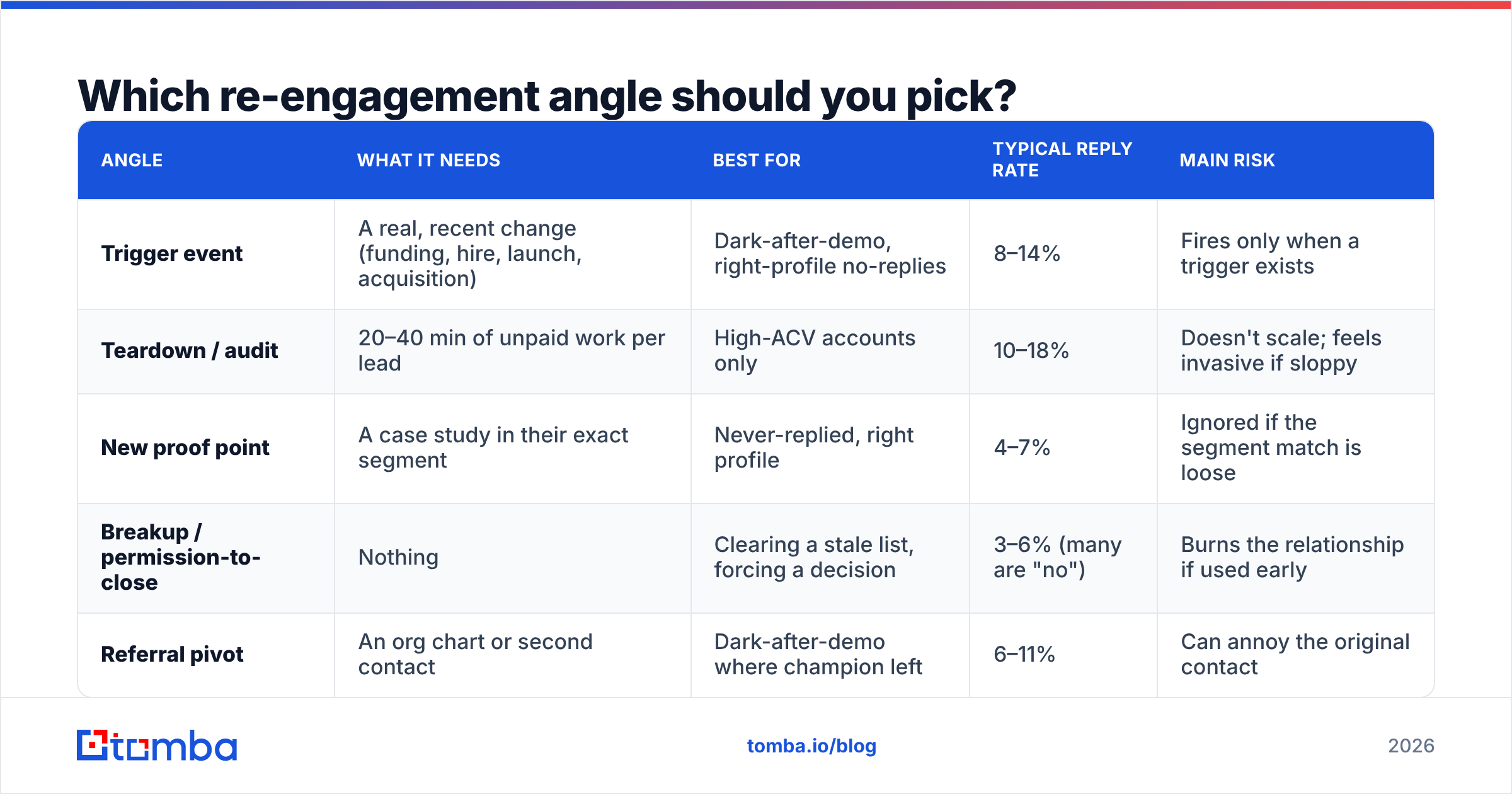
There are five angles that reliably work, and they are not interchangeable. Pick based on what you actually know about the lead.
| Angle | What it needs | Best for | Typical reply rate | Main risk |
|---|---|---|---|---|
| Trigger event | A real, recent change (funding, hire, launch, acquisition) | Dark-after-demo, right-profile no-replies | 8–14% | Fires only when a trigger exists |
| Teardown / audit | 20–40 min of unpaid work per lead | High-ACV accounts only | 10–18% | Doesn't scale; feels invasive if sloppy |
| New proof point | A case study in their exact segment | Never-replied, right profile | 4–7% | Ignored if the segment match is loose |
| Breakup / permission-to-close | Nothing | Clearing a stale list, forcing a decision | 3–6% (many are "no") | Burns the relationship if used early |
| Referral pivot | An org chart or second contact | Dark-after-demo where champion left | 6–11% | Can annoy the original contact |
Two notes on reading that table. First, "reply rate" here means any reply, including "no thanks" — which is a genuinely useful outcome for a stale list, because it lets you suppress the record and stop paying for it. Second, the teardown angle's numbers look spectacular until you divide by the hours it costs. At a $6k ACV, a 35-minute teardown per lead is negative margin. At $60k, it's the highest-ROI email you will send all year.
The breakup email deserves a specific warning. It works — but it works once, and it works as a closing device, not an opening one. Sending a breakup email as your first re-engagement touch tells the reader you were never really paying attention. Sending your fourth breakup email to the same person tells them the first three were theater.
What should you do before you write a single line?#
Five prep steps. Skip any of them and the copy quality stops mattering.
- Segment by cold reason, not by cold date. Pull the CRM field that says why the deal stalled. If that field doesn't exist, create it — this is a revenue operations problem before it's a copy problem.
- Re-verify every address. Non-negotiable. Catch-all domains need their own treatment; a plain SMTP check returns "accept-all" and tells you nothing.
- Re-enrich the records. Roughly a fifth of your dark leads have changed jobs since you last emailed. Some of them changed into better-fit companies. Running the list through data enrichment turns a stale record into two live opportunities: the person at their new company, and their replacement at the old one.
- Check for a trigger. Funding rounds, new leadership, product launches, hiring sprees, technology changes. No trigger means you're back to the "new proof point" angle, which is fine — but you should know that before you start writing.
- Warm the sending domain. If the mailbox has been idle, don't go from zero to 400 sends in one morning. Ramp over 7–10 days.
Step 3 is the one most teams skip, and it's the one that pays. A lead who ignored you as a Director at a 40-person startup and is now a VP at a 900-person company is not a cold lead. It's a warm lead with a new email address and a much bigger budget.
What does a working sequence actually look like?#
Three touches. Ten to fourteen days. Each touch carries a different reason to exist.
Touch 1 — Day 0: The trigger or the teardown. Lead with the new information. No apology, no reference to your previous emails. Two to four sentences. One specific observation about their business, one sentence on what it implies, one soft question.
Subject: your new pricing page
Noticed you moved to usage-based pricing last month. The three companies I've watched make that switch all hit the same wall in month two — self-serve customers churn before finance notices. Curious whether you're seeing it yet, or whether you sized the tiers to avoid it.
Nothing in there says "following up." Nothing asks for a meeting. It reads like a note from someone who actually looked.
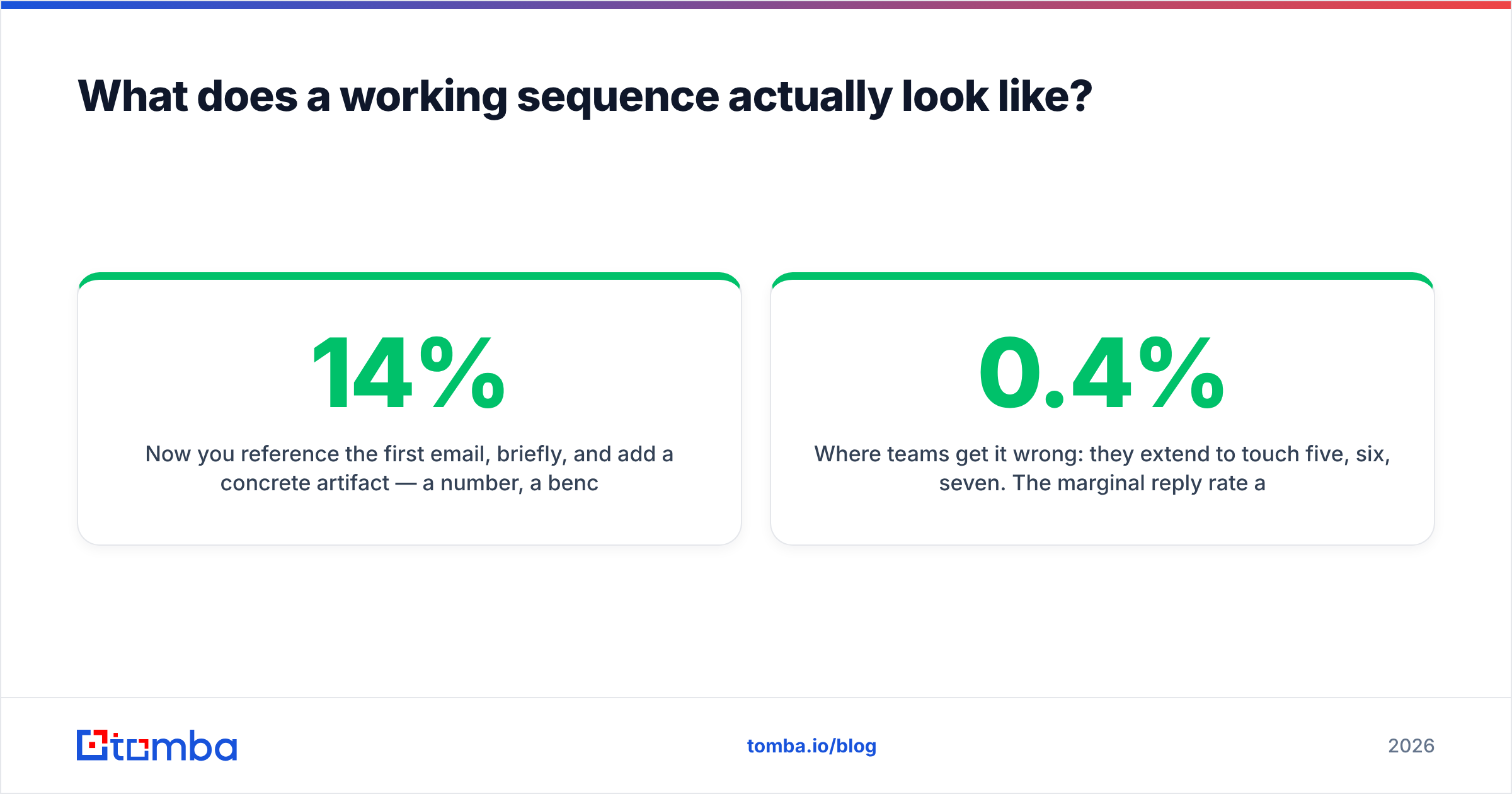
Touch 2 — Day 4: The proof. Now you reference the first email, briefly, and add a concrete artifact — a number, a benchmark, a one-paragraph case. This is where a specific metric earns its keep. "We cut their bounce rate from 14% to 2.1%" beats "we improved deliverability" every time.
Touch 3 — Day 11: The exit. The permission-to-close. Short, unbothered, genuinely final.
Subject: closing the loop
Haven't heard back, which usually means one of three things: not a priority, not your call, or not a real problem. Any of the three is a fine answer — reply with the number and I'll stop.
That last one gets replies. Not because it's clever, but because it's the first email in the sequence that costs the reader one keystroke to resolve.
Where teams get it wrong: they extend to touch five, six, seven. The marginal reply rate after touch four is somewhere around 0.4%, while the marginal complaint rate is not meaningfully lower than it was at touch two. You are trading pipeline for deliverability at a terrible exchange rate. HubSpot's own sales research has been making this point for years and sellers keep not believing it.
Should you re-engage the old list or just build a new one?#
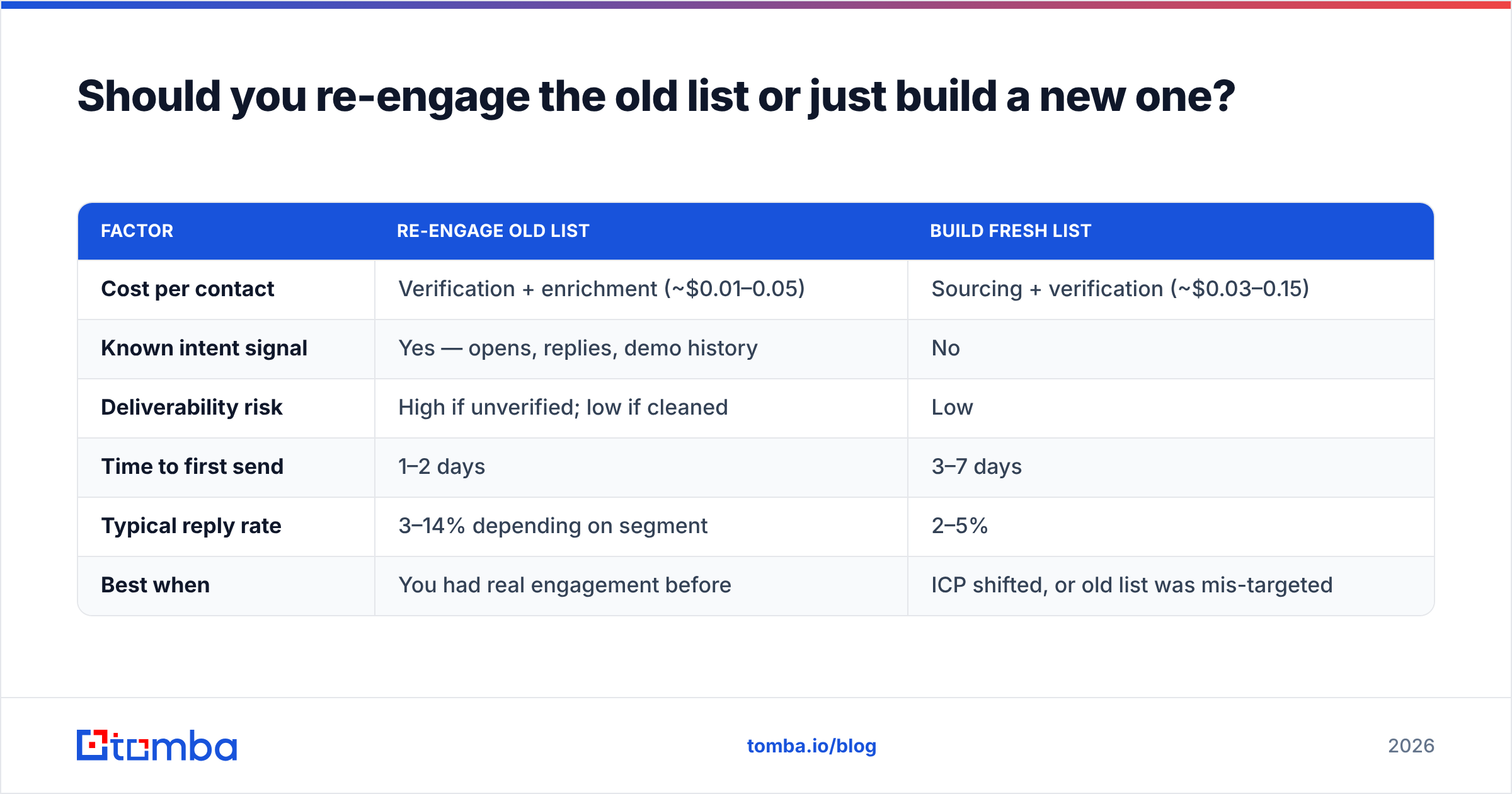
Honest answer: it depends on the cost of a fresh contact versus the decayed value of an old one. Here's the comparison most teams never actually run.
| Factor | Re-engage old list | Build fresh list |
|---|---|---|
| Cost per contact | Verification + enrichment (~$0.01–0.05) | Sourcing + verification (~$0.03–0.15) |
| Known intent signal | Yes — opens, replies, demo history | No |
| Deliverability risk | High if unverified; low if cleaned | Low |
| Time to first send | 1–2 days | 3–7 days |
| Typical reply rate | 3–14% depending on segment | 2–5% |
| Best when | You had real engagement before | ICP shifted, or old list was mis-targeted |
The takeaway: if your old list had any engagement history — opens, clicks, a demo, a "not right now" — re-engagement is cheaper and higher-yield than net-new prospecting. If the old list never engaged and never matched your ICP, re-engaging it is nostalgia, not strategy. Build new.
Most teams do both, and the honest sequencing is: clean the old list first (it's faster and cheaper to reach first reply), then spend the fresh-sourcing budget on the segment the old list proved was working. Buying supplemental contact data from a reputable provider — BookYourData and similar verified-contact vendors are reasonable options here — is a fine complement, provided you still verify on ingest rather than trusting anyone's freshness claim, including your own.
How do you know if it's working?#
Four metrics, in this order of importance:
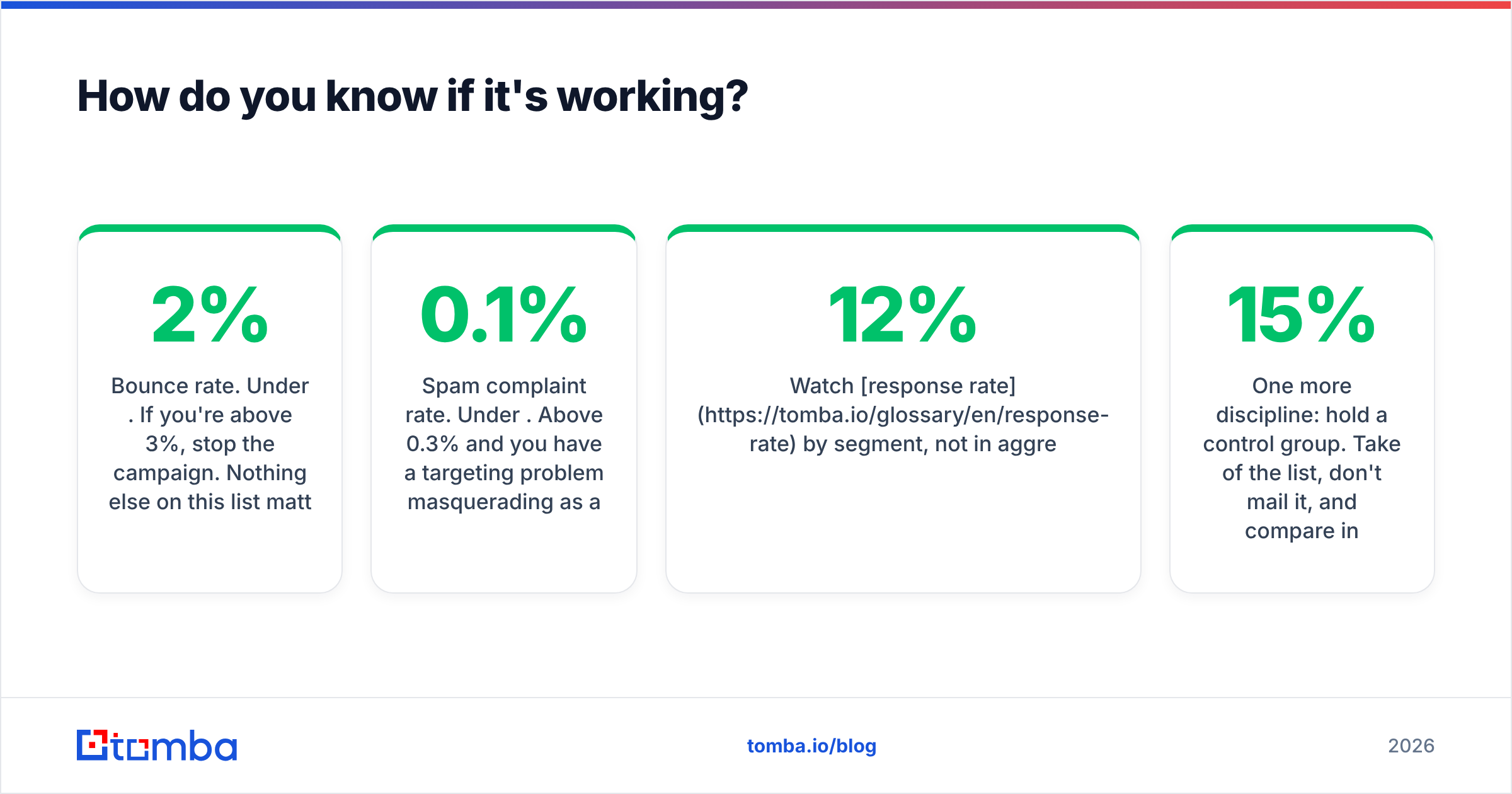
- Bounce rate. Under 2%. If you're above 3%, stop the campaign. Nothing else on this list matters until this is fixed.
- Reply rate, including negatives. A "no" is a win. It's a suppression, a data-quality correction, and sometimes a referral. Track total replies, then split them.
- Meetings booked per 100 sent. The only number your CRO cares about. Anything above 2 on a re-engagement list is strong.
- Spam complaint rate. Under 0.1%. Above 0.3% and you have a targeting problem masquerading as a copy problem.
Watch response rate by segment, not in aggregate. Aggregate numbers hide the thing you most need to see: that your dark-after-demo segment is replying at 12% while your never-replied segment is replying at 1.8% and dragging the average into a number that tells you nothing. Kill the second segment, double the first.
One more discipline: hold a control group. Take 15% of the list, don't mail it, and compare inbound-inquiry rates 60 days later. Some percentage of "re-engaged" leads were going to come back on their own. You want to know how big that percentage is before you build next year's plan on top of it. You can sanity-check the tooling side of this on G2 — vendor-reported lift numbers and practitioner reviews rarely agree, and the gap is instructive.
What's the one-line version?#
Re-engagement is not a copywriting problem. It's a data problem that happens to end in an email.
Verify the list. Segment by why it went cold. Find a trigger or do the work. Three touches, then stop. Measure replies, not opens. And accept that a meaningful share of your old list is not cold — it's dead, and the kindest thing you can do for your domain is let it go.
Start with the data layer. Every play in this post assumes the address in your CRM still reaches a human. Use the Tomba Email Finder to re-locate contacts who've moved companies, catch the ones whose formats changed after a rebrand, and confirm the rest before your first send. The free tier covers 25 searches a month, and paid plans start at $49/mo — see Tomba pricing for the full breakdown. Clean the list, then write the email. In that order.
Related guides#
// get started
Find, verify and enrich your first contacts today
Start on the free plan with 25 searches a month, then scale when your team is ready.
Free plan · No credit card required · GDPR & CCPA
Get the Tomba newsletter
Product and data updates
// about the author