B2B Cold Sales Email Templates That Get Replies in 2026
Nine field-tested B2B cold sales email templates, plus the structure, personalization, and deliverability rules that turn a cold send into a booked meeting.
Most cold emails fail before anyone reads the offer. The address bounces, the subject line reads like a template, or the ask is so heavy the prospect archives it in two seconds. A good cold sales email template B2B teams can reuse solves the structure problem — but only if you feed it clean data and a reason to reply.
This guide gives you nine templates you can paste and adapt today, the anatomy behind why they work, and the deliverability and personalization rules that decide whether they land in the inbox or the spam folder.
TL;DR#
- A high-performing B2B cold email is short (50–125 words), leads with the prospect's problem, and asks for one small commitment — not a 30-minute demo.
- Templates are a starting frame, not a copy-paste crutch. The first line must be genuinely specific to the recipient or the whole email reads as spam.
- Deliverability is upstream of copy: verify every address, warm the domain, and keep volume sane, or your best template never gets seen.
- The nine templates below cover pain-point, trigger-event, referral, competitor-switch, and break-up angles.
- Personalization at scale needs accurate contact data — use an email finder and an email verifier before you hit send.
What makes a B2B cold email actually work?#
The best cold emails feel like a one-to-one note a busy person wrote in 40 seconds, not a broadcast. Think of it like knocking on one specific door versus stapling flyers to every pole on the street — the flyer approach is faster, and that's exactly why nobody reads it.
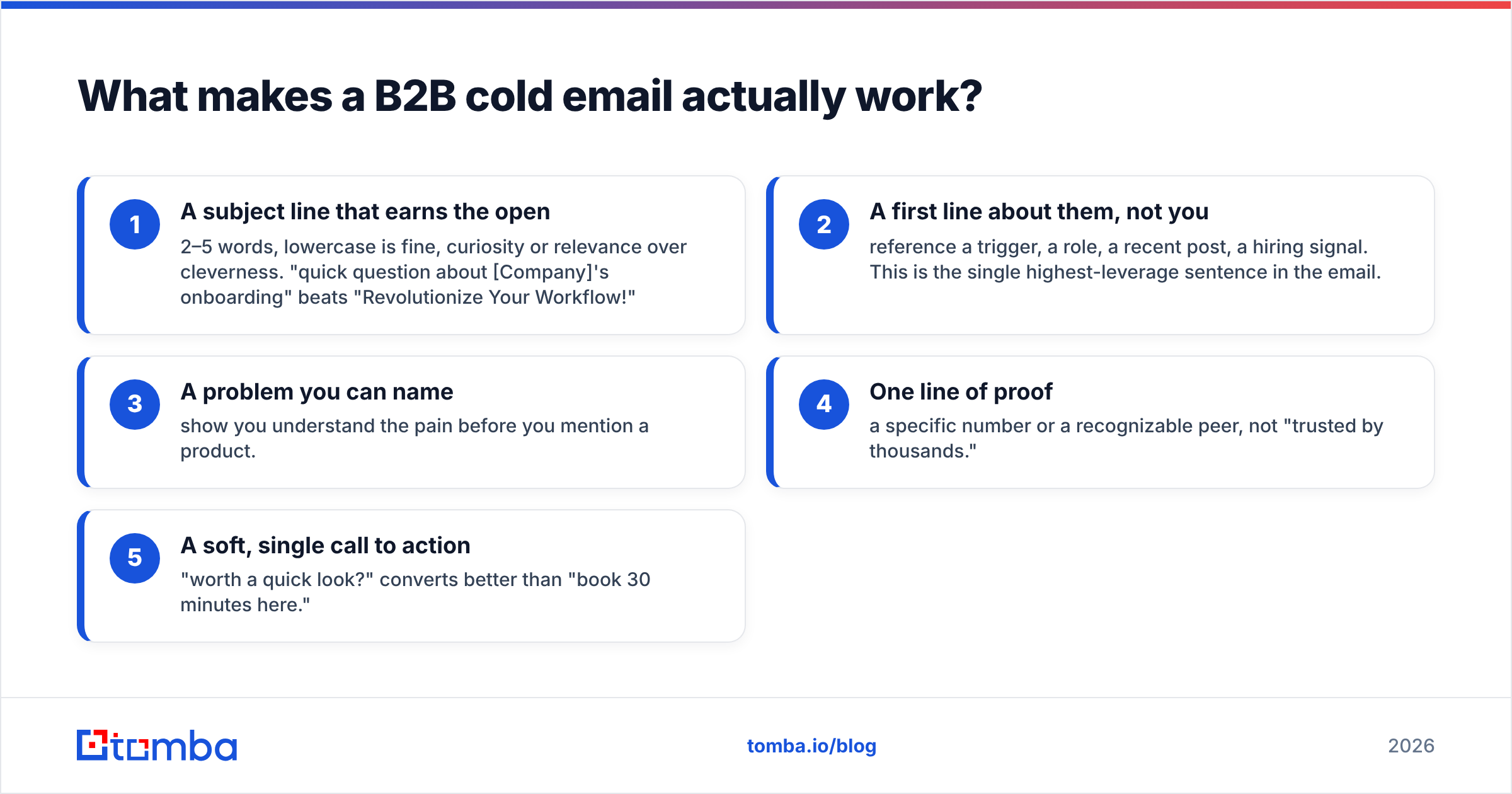
Every reply-worthy cold email shares five parts:
- A subject line that earns the open — 2–5 words, lowercase is fine, curiosity or relevance over cleverness. "quick question about [Company]'s onboarding" beats "Revolutionize Your Workflow!"
- A first line about them, not you — reference a trigger, a role, a recent post, a hiring signal. This is the single highest-leverage sentence in the email.
- A problem you can name — show you understand the pain before you mention a product.
- One line of proof — a specific number or a recognizable peer, not "trusted by thousands."
- A soft, single call to action — "worth a quick look?" converts better than "book 30 minutes here."
Miss any one of these and the template collapses. A perfect CTA cannot save an email that opens with "I hope this email finds you well."
The anatomy of a cold email that converts#
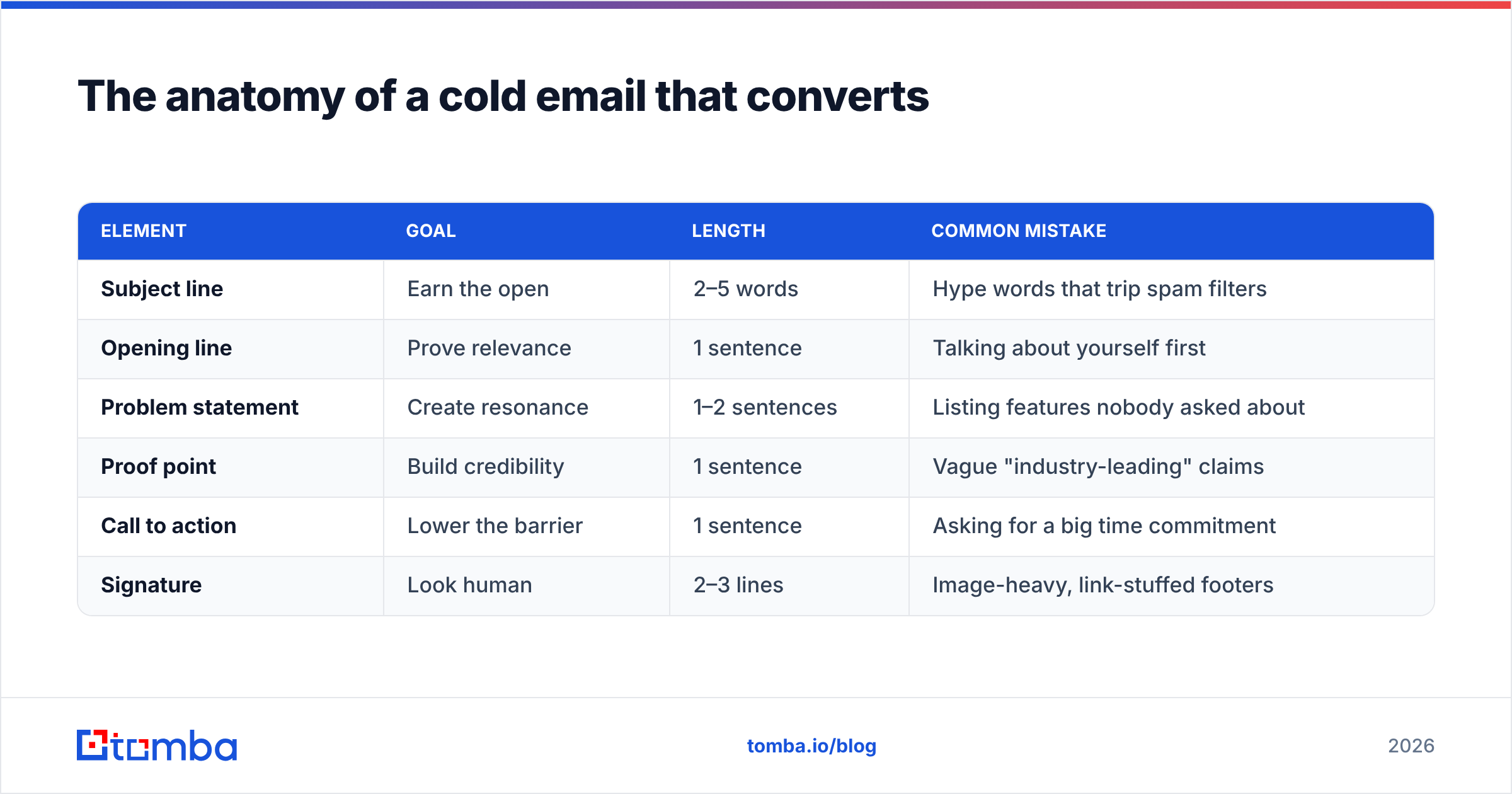
Here is the skeleton every template in this post follows. Keep it in front of you when you write your own.
| Element | Goal | Length | Common mistake |
|---|---|---|---|
| Subject line | Earn the open | 2–5 words | Hype words that trip spam filters |
| Opening line | Prove relevance | 1 sentence | Talking about yourself first |
| Problem statement | Create resonance | 1–2 sentences | Listing features nobody asked about |
| Proof point | Build credibility | 1 sentence | Vague "industry-leading" claims |
| Call to action | Lower the barrier | 1 sentence | Asking for a big time commitment |
| Signature | Look human | 2–3 lines | Image-heavy, link-stuffed footers |
Notice what's missing: paragraphs of company history, three CTAs, and a PDF attachment. Cut all of it. If a sentence doesn't move the reader toward replying, delete it.
9 B2B cold sales email templates you can steal#
Use these as frames. Replace every bracket, and rewrite the first line so it could only have been sent to that one person.
1. The pain-point opener#
Subject: [problem] at [Company]?
Hi [First name],
Teams like [Peer company] told us [specific pain — e.g., "reps were losing 6 hours a week rebuilding lead lists by hand"] before switching how they source contacts.
Is that something your team runs into too?
If so, I can share how they cut it to under an hour. Worth a look?
[Your name]
2. The trigger-event email#
Subject: congrats on the [round/launch/hire]
Hi [First name],
Saw [Company] just [raised Series B / opened a new region / hired 12 SDRs]. Usually that means outbound targets just doubled overnight.
We help teams at that stage keep their prospect data accurate so new reps aren't emailing dead addresses on day one.
Open to a two-line overview?
3. The referral / name-drop#
Subject: [Mutual contact] suggested I reach out
Hi [First name],
[Mutual contact] mentioned you own [function] at [Company] and might care about [outcome].
We recently helped [Peer] hit [specific result]. Happy to send the one-pager — should I?
4. The competitor-switch email#
Subject: switching from [Competitor]?
Hi [First name],
A few teams moved off [Competitor] this quarter because [specific limitation]. If that's on your radar, I can show you the side-by-side in two minutes.
Want me to send it over?
5. The question-only email#
Subject: quick one
Hi [First name],
Who owns [process] at [Company] these days? Trying to reach the right person, not spam your whole team.
Thanks!
6. The value-first email#
Subject: [teardown / idea] for [Company]
Hi [First name],
I put together a short teardown of how [Company]'s [signup flow / outbound / pricing page] could lift [metric]. No pitch — just useful.
Want me to send it?
7. The social-proof email#
Subject: how [Peer] hit [result]
Hi [First name],
[Peer], roughly your size, went from [before] to [after] in [timeframe].
I can share the exact playbook in a short note. Interested?
8. The one-line email#
Subject: [Company] + [your company]?
Hi [First name] — is improving [outcome] a priority this quarter, or should I circle back later?
9. The break-up email#
Subject: closing the loop
Hi [First name],
Haven't heard back, so I'll assume the timing's off. If [problem] becomes urgent, I'm one reply away.
Should I close the file for now?
The break-up email is the quiet workhorse — it regularly pulls the highest reply rate in a sequence because it removes pressure and triggers loss aversion. For more subject-line variations, run your ideas through a subject line generator before you commit.
How do you personalize templates at scale without sounding like a robot?#
Personalize the opening line and the problem statement; leave the rest templated. That is the entire trick.
You do not need to hand-write 500 unique emails. You need one strong first sentence per prospect that proves you did five seconds of homework. Tie that sentence to a variable you can pull at scale:
- Role-based: "As [Company]'s head of [function], you probably own [problem]…"
- Trigger-based: recent funding, a job posting, a product launch, a leadership change.
- Content-based: a LinkedIn post, a podcast appearance, a conference talk.
- Peer-based: name a competitor or look-alike company they'll recognize.
The failure mode is fake personalization — "I loved your recent post!" with no post named. Prospects spot it instantly, and it's worse than no personalization at all. According to HubSpot's sales research, relevance and timing beat volume for reply rates, which is why a smaller, better-researched list almost always outperforms a bigger cold one.
To pull role and company signals cleanly, enrich your list first. Tomba's data enrichment fills in titles, company data, and social profiles so your merge fields are accurate instead of guessed.
Why deliverability decides whether your template ever gets read#
Your copy is irrelevant if the email never reaches the inbox. Deliverability sits upstream of everything, and it's where most cold campaigns quietly die.
Three things sink cold campaigns before the reader ever judges your writing:
- Bounces. Sending to invalid addresses spikes your bounce rate, and mailbox providers read that as a spammer signal. Keep bounces under ~2%. Always verify emails before a send.
- Cold domain reputation. A brand-new sending domain blasting 300 emails on day one looks exactly like an attacker. Warm up gradually and authenticate with SPF, DKIM, and DMARC. Google and Yahoo's bulk sender requirements now enforce this.
- Spam-trigger content. Image-heavy emails, link shorteners, and "FREE!!!" style copy get filtered regardless of how good the offer is.
The sequence that works: build an accurate list, verify it, warm the domain, keep daily volume conservative, and monitor bounce and reply rates. Skip any step and even the nine templates above will underperform.
Cold email templates vs. fully personalized emails: which wins?#
Neither wins outright — the right answer depends on deal size and list size. Here's the honest trade-off.
| Factor | Template-driven | Fully custom |
|---|---|---|
| Time per email | ~1–2 min | 15–30 min |
| Best for | High-volume SMB outbound | Enterprise / ABM |
| Reply rate | Solid with good data | Highest, but slow |
| Scalability | High | Low |
| Risk | Sounds generic if lazy | Doesn't scale past a small list |
Most teams should run a hybrid: templated structure plus a genuinely custom first line and problem statement. That captures ~80% of the reply-rate benefit of full personalization at a fraction of the time cost. Reserve fully bespoke emails for your top 20 named accounts.
You can pressure-test any of these frameworks against peer reviews on G2's sales engagement category to see which structures your buyers actually respond to.
Common cold email mistakes that kill reply rates#
Even a great template underperforms when you make these unforced errors:
- Leading with your company. Nobody cares who you are until they know you understand their problem.
- Multiple CTAs. One ask per email. Two asks means zero replies.
- Sending unverified lists. Bounces wreck your sender reputation and torpedo future campaigns.
- Walls of text. If it looks like work to read, it gets archived.
- No follow-up. Most replies come from emails 2–4, not email 1. A three-to-five-touch sequence spaced over two to three weeks is standard.
- Ignoring the data layer. The cleanest copy in the world can't fix a list full of wrong names and dead addresses.
Fix the data problem first. It's the highest-ROI change you can make, and it's the one most teams skip.
Frequently asked questions#
How long should a B2B cold email be? Between 50 and 125 words. Short enough to read on a phone in one glance, long enough to name the problem and make one ask.
How many follow-ups should I send? Three to five touches over two to three weeks. Vary the angle each time — don't just "bump" the same message.
What's a good cold email reply rate? A well-targeted, verified campaign with strong personalization typically lands in the 5–15% reply range. Below 3% usually means a data or targeting problem, not a copy problem.
Do I need to verify emails if I use a good finder? Yes. Even accurate finders return the occasional stale address. A quick verification pass keeps your bounce rate low and protects your domain reputation.
Start with the data, not the draft#
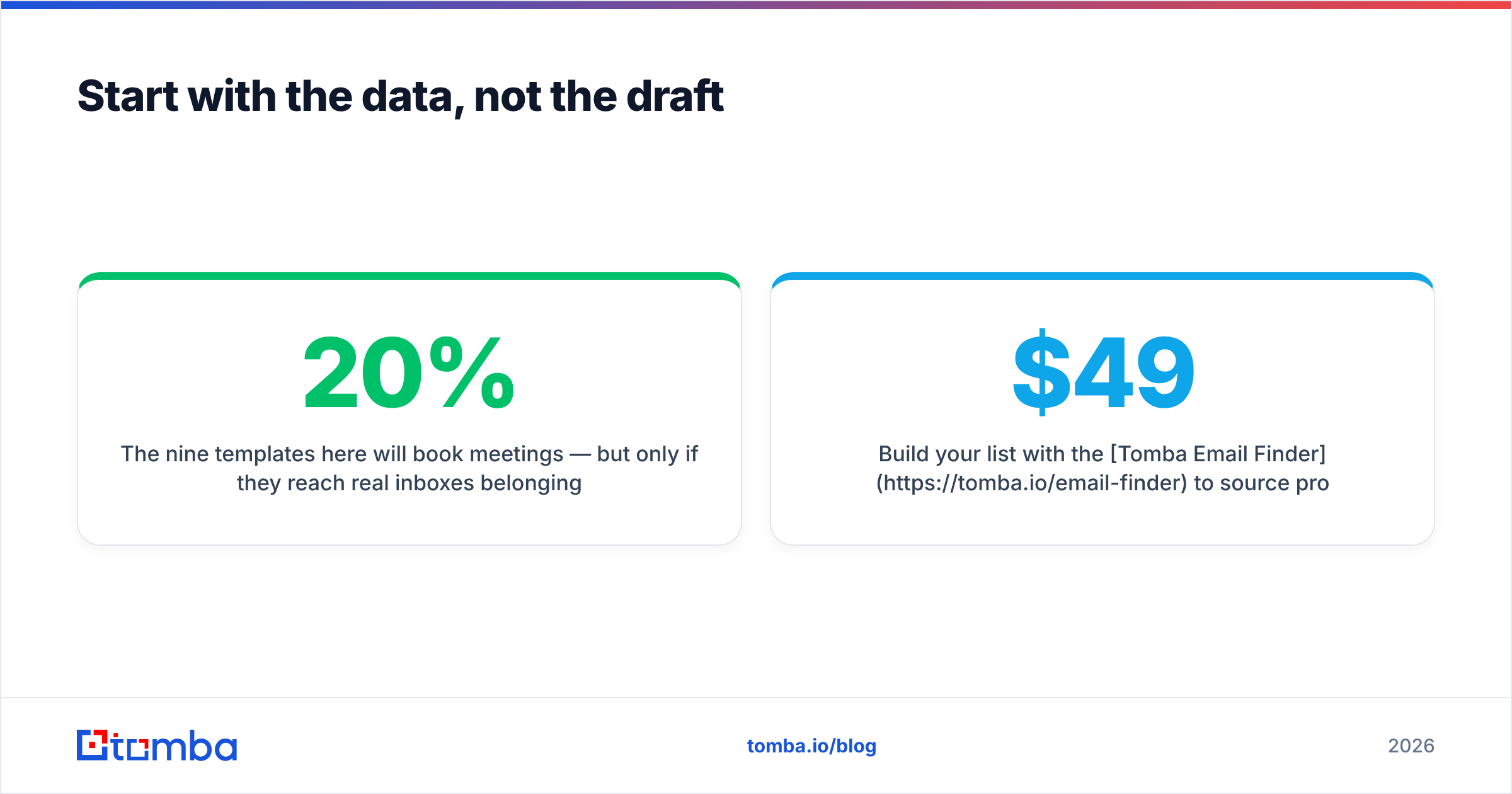
The nine templates here will book meetings — but only if they reach real inboxes belonging to the right people. Copy is the last 20% of cold email; accurate, verified contact data is the first 80%.
Build your list with the Tomba Email Finder to source professional addresses by name, company, or domain, then run them through the verifier before you send. Start on the free tier (25 searches/month), and if outbound becomes a core motion, the Starter plan at $49/mo and Growth at $99/mo scale with your volume — full Tomba pricing is transparent and usage-based. Get the data right, paste in a template, personalize the first line, and let the replies come in.
Related guides#
Ready to find emails that actually work?
Join 150,000+ professionals who stopped guessing and started sending. Free credits on signup — no credit card required.
Get the Tomba newsletter
Practical outbound tactics and product updates — once every two weeks.
About the author