Coldlytics Pricing 2026: Reviews, Pros, Cons, and Costs
A neutral breakdown of Coldlytics pricing in 2026 — how the credit model really works, what a researched lead actually costs you, what reviewers praise and complain about, and when a self-serve email finder is the cheaper call.
TL;DR
- Coldlytics is not a database you search — it's a done-for-you research service. You submit a brief, a human-plus-tooling workflow builds the list, and you get contacts back in hours or days.
- Coldlytics pricing is credit-based and subscription-gated. The headline number on the plan matters far less than your effective cost per usable, verified contact after bounces and bad-fit rows.
- Reviewers consistently praise list quality and niche-targeting ability. The recurring complaints are turnaround time, credit rollover rules, and cost at volume.
- It's a strong fit for hyper-specific, hard-to-scrape ICPs (roofers with 5+ trucks in three counties). It's a poor fit for high-volume, standard-firmographic prospecting where an API returns the same contact in 400ms.
- If your bottleneck is "I have the company list, I need the emails," a self-serve email finder at $49/mo does that job for a fraction of managed-research pricing.
What is Coldlytics and who is it actually for?#
Coldlytics sits in a different category than most tools you compare it against. It is a managed prospecting service, not a searchable contact database. You don't type filters into a UI and export 5,000 rows. You describe your ideal customer profile in a request form — industry, geography, headcount, tech stack, weird qualifiers only a human would catch — and their team assembles the list using a mix of scraping, manual research, and verification.
That distinction is the whole story when you evaluate Coldlytics pricing. You are not paying for data access. You are paying for research labor plus data, and labor does not get cheaper as you scale the way a database subscription does.
Who it fits:
- Agencies with messy, bespoke ICPs. "Dental practices that opened a second location in the last 18 months" is not a filter in any database. It is a research brief.
- Founders who don't want to learn a data stack. You write a brief, you get a CSV. Zero tooling overhead.
- Teams targeting local or trade businesses. SMB, home services, and regional operators are chronically under-covered in the big B2B databases.
- Anyone whose current list source produces 30% bounce rates and who would rather pay someone else to fix it than debug it.
Who it doesn't fit:
- High-volume outbound teams. If you're sending 10,000 emails a month, per-lead research pricing becomes the largest line item in your GTM budget.
- Anyone who already has the target accounts. If you have 800 company domains and need contacts at each, you need domain search and verification — not a research team.
Wait — that renders wrong. Here it is properly:

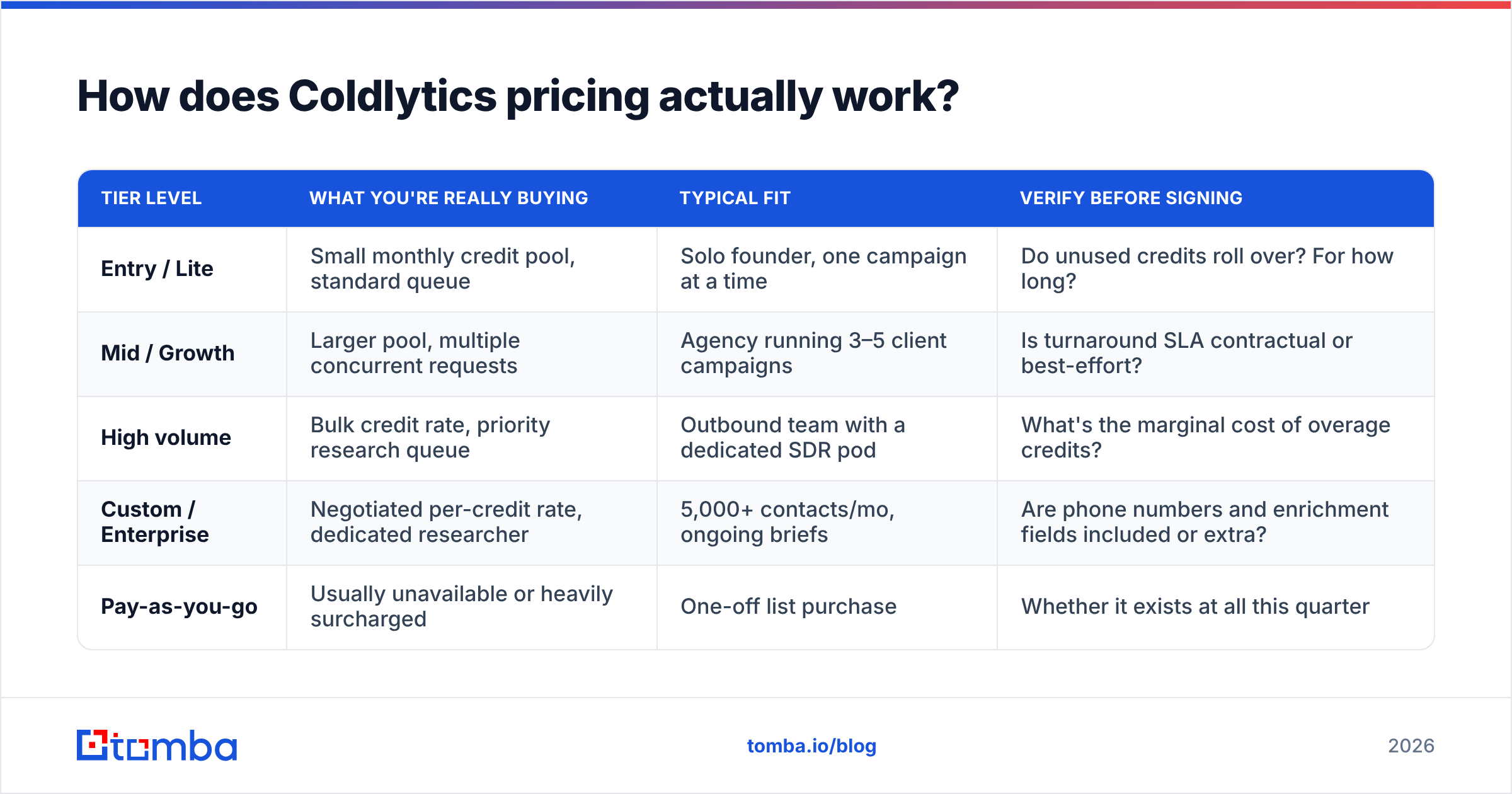
How does Coldlytics pricing actually work?#
Coldlytics prices on a credit model wrapped in a monthly subscription. One credit maps roughly to one researched, verified contact record. Plans differ by monthly credit allotment, request throughput (how many list requests you can have running at once), and turnaround priority.
Because published tiers change and are sometimes quoted per-region or per-contract, treat any number you read in a blog post — including this one — as a starting point to verify against coldlytics.com before you sign. What doesn't change is the structure. Here is what you're actually buying at each level:
| Tier level | What you're really buying | Typical fit | Verify before signing |
|---|---|---|---|
| Entry / Lite | Small monthly credit pool, standard queue | Solo founder, one campaign at a time | Do unused credits roll over? For how long? |
| Mid / Growth | Larger pool, multiple concurrent requests | Agency running 3–5 client campaigns | Is turnaround SLA contractual or best-effort? |
| High volume | Bulk credit rate, priority research queue | Outbound team with a dedicated SDR pod | What's the marginal cost of overage credits? |
| Custom / Enterprise | Negotiated per-credit rate, dedicated researcher | 5,000+ contacts/mo, ongoing briefs | Are phone numbers and enrichment fields included or extra? |
| Pay-as-you-go | Usually unavailable or heavily surcharged | One-off list purchase | Whether it exists at all this quarter |
The three clauses that quietly determine your real spend:
- Credit rollover. If credits expire monthly, your effective price per lead is your subscription cost divided by the credits you actually used, not the credits you bought. Teams routinely use 60–70% of an allotment in a slow month. That's a 40%+ silent price increase.
- What counts as a credit. A returned row with a company name and no email should not cost the same as a fully verified, deliverable contact. Ask explicitly how partial records are billed.
- Enrichment add-ons. Phone numbers, LinkedIn URLs, and firmographic fields are sometimes bundled, sometimes surcharged. A "cheap" per-credit rate with paid add-ons can end up above a bundled competitor.
What does a Coldlytics lead really cost per contact?#
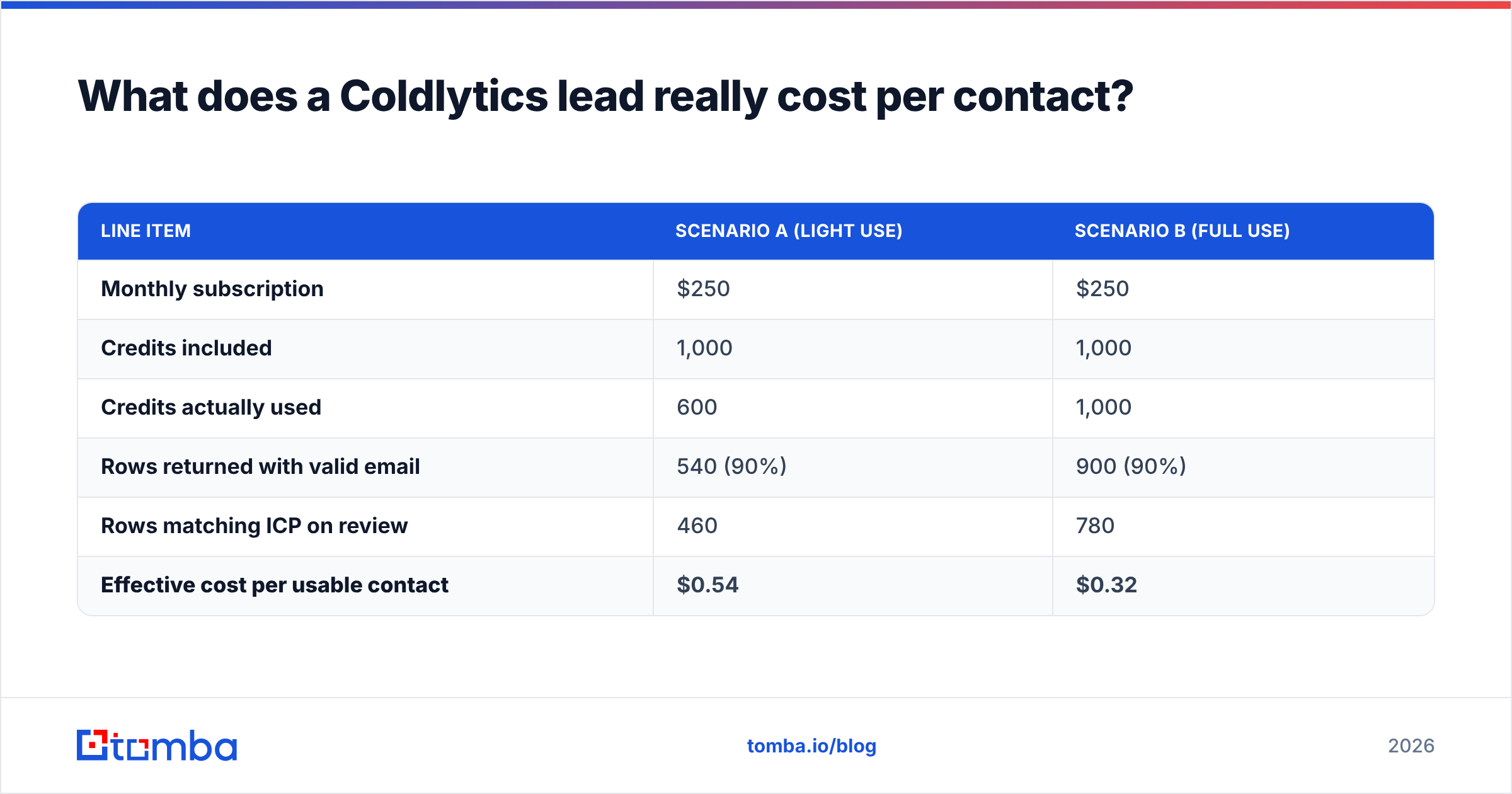
Here's the math nobody runs before they subscribe. The following is illustrative — plug in the quote you're actually given.
| Line item | Scenario A (light use) | Scenario B (full use) |
|---|---|---|
| Monthly subscription | $250 | $250 |
| Credits included | 1,000 | 1,000 |
| Credits actually used | 600 | 1,000 |
| Rows returned with valid email | 540 (90%) | 900 (90%) |
| Rows matching ICP on review | 460 | 780 |
| Effective cost per usable contact | $0.54 | $0.32 |
Two things fall out of that table. First, underuse is the single biggest price multiplier in any credit subscription — Coldlytics included. Second, even at full utilization you're in the $0.30+ per-contact range, which is roughly 10–30x what a self-serve API costs per lookup.
That premium can be entirely justified. If a researcher hand-qualifies "roofing companies with 5+ trucks in Travis County," and your average deal is $8,000, thirty cents a lead is a rounding error. If you're spraying a generic SaaS list, you have just paid a research premium for data a machine could have returned instantly.
For reference on the other end of the spectrum: Tomba pricing starts free at 25 searches/month, then $49/mo (Starter), $99/mo (Growth), and $249/mo (Pro). At the Growth tier the per-lookup cost lands in fractions of a cent, because you're paying for pattern-matched data retrieval — not for a person to read a county business registry.
What do Coldlytics reviews actually say?#
Aggregate the reviews on G2 and Capterra and a clear, consistent picture emerges. The praise and the complaints are both remarkably stable across years.
What reviewers consistently praise:
- List quality on hard ICPs. This is the dominant positive theme. Users who tried to build the same list themselves report meaningfully lower bounce rates and better fit.
- Low bounce rates. Verification is done before delivery, not left to you.
- Support responsiveness. Human service businesses live and die on this, and Coldlytics generally scores well.
- No wasted time on scraping tooling. For non-technical founders this is the entire value proposition.
What reviewers consistently complain about:
- Turnaround time. Lists take hours to days, not seconds. Reviewers who expected database speed describe this as the biggest adjustment. Rush requests can stack up during busy periods.
- Cost at volume. The model that feels cheap at 500 leads/month feels expensive at 5,000.
- Credit expiry. Losing unused credits at month-end is a repeated frustration and directly inflates effective cost per lead.
- Limited self-serve control. If the returned list is 80% right, you file a revision request rather than adjusting a filter yourself. That round trip costs a day.
- Coverage gaps outside core geos. North America and UK/EU coverage is strong; other regions are thinner.
None of this makes Coldlytics a bad product. It makes it a service, with service economics and service latency. The mistake teams make is benchmarking it against tools that solve a different problem.
What are the pros and cons of Coldlytics in 2026?#
| Dimension | Pro | Con |
|---|---|---|
| Data quality | Human-verified before delivery; low bounce rates | Quality depends on brief clarity — a vague brief returns a vague list |
| Speed | No setup time, no tooling to learn | Hours-to-days turnaround; no instant lookups |
| Cost | Predictable monthly subscription | High effective cost per contact; credits may expire |
| Flexibility | Handles ICPs no filter can express | No self-serve refinement; changes require a revision request |
| Scale | Fine to a few thousand contacts/month | Linear cost curve — research labor doesn't get cheaper |
| Integration | CSV delivery works everywhere | No real-time API to enrich records inside your CRM at the moment of need |
| Coverage | Excellent on SMB, trades, local, and niche verticals | Thinner outside core English-speaking markets |
The clean summary: Coldlytics converts money into research hours. That trade is excellent when research hours are the scarce resource and terrible when they aren't.
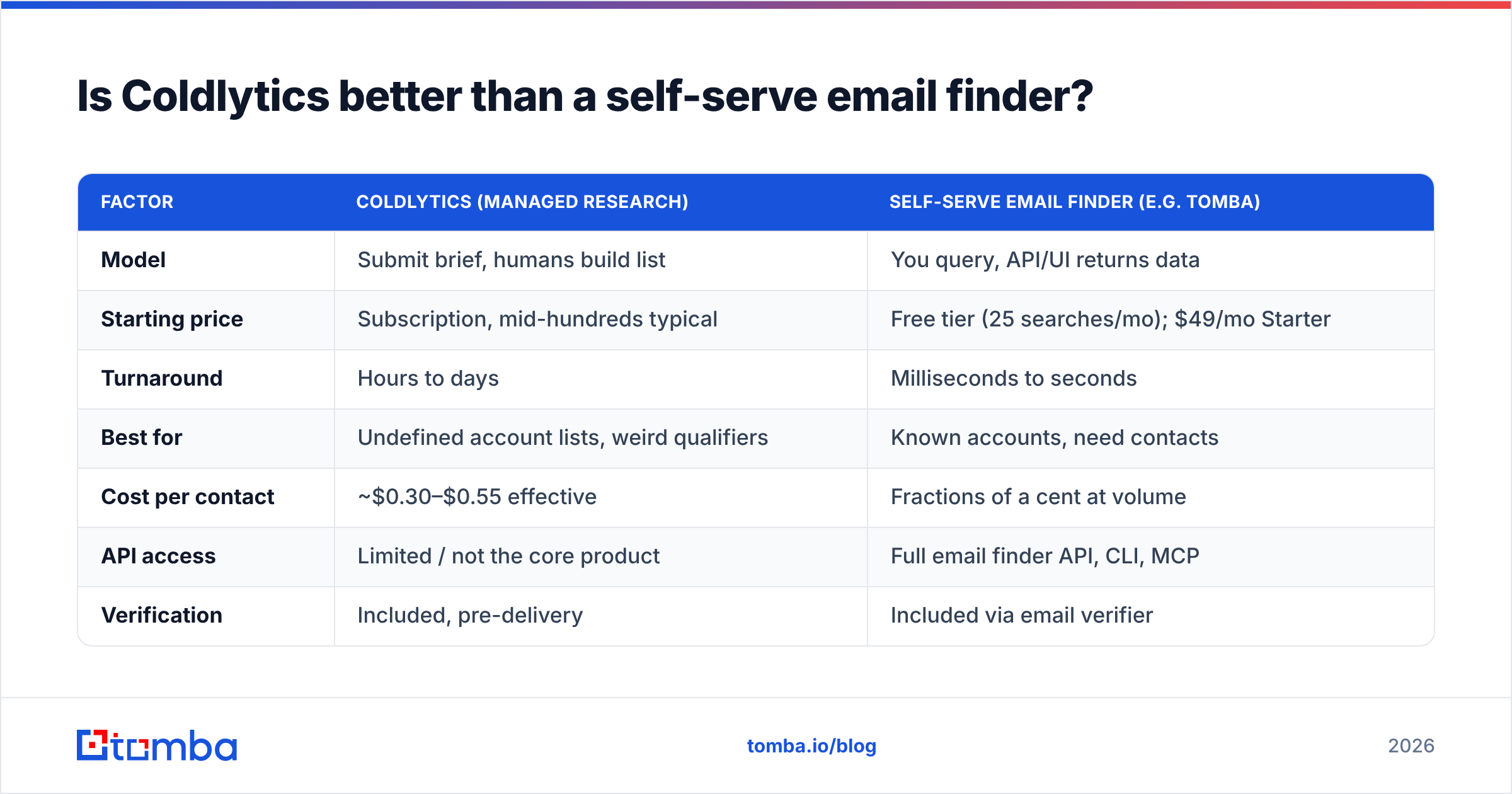
Is Coldlytics better than a self-serve email finder?#
They aren't competitors — they're two answers to different questions. But budgets are finite, so here's the honest side-by-side against the self-serve model.
| Factor | Coldlytics (managed research) | Self-serve email finder (e.g. Tomba) |
|---|---|---|
| Model | Submit brief, humans build list | You query, API/UI returns data |
| Starting price | Subscription, mid-hundreds typical | Free tier (25 searches/mo); $49/mo Starter |
| Turnaround | Hours to days | Milliseconds to seconds |
| Best for | Undefined account lists, weird qualifiers | Known accounts, need contacts |
| Cost per contact | ~$0.30–$0.55 effective | Fractions of a cent at volume |
| API access | Limited / not the core product | Full email finder API, CLI, MCP |
| Verification | Included, pre-delivery | Included via email verifier |
| Bulk workflow | Handled by their team | Bulk email finder — you run it |
| Control | Revision requests | Total, immediate |
| Learning curve | Effectively zero | An afternoon |
The decision rule is one question: do you know which companies you want to reach?
If yes, you don't need a research service. You need contacts at those domains, and a domain search plus verification pass gets you there today, at a cost that doesn't scale with headcount. If no — if defining the account list is the hard part — then a research service is buying you something a lookup API structurally cannot.
Plenty of teams run both. Coldlytics builds the account list for a new vertical experiment; the email finder API keeps the CRM enriched afterward as contacts churn and job-change.
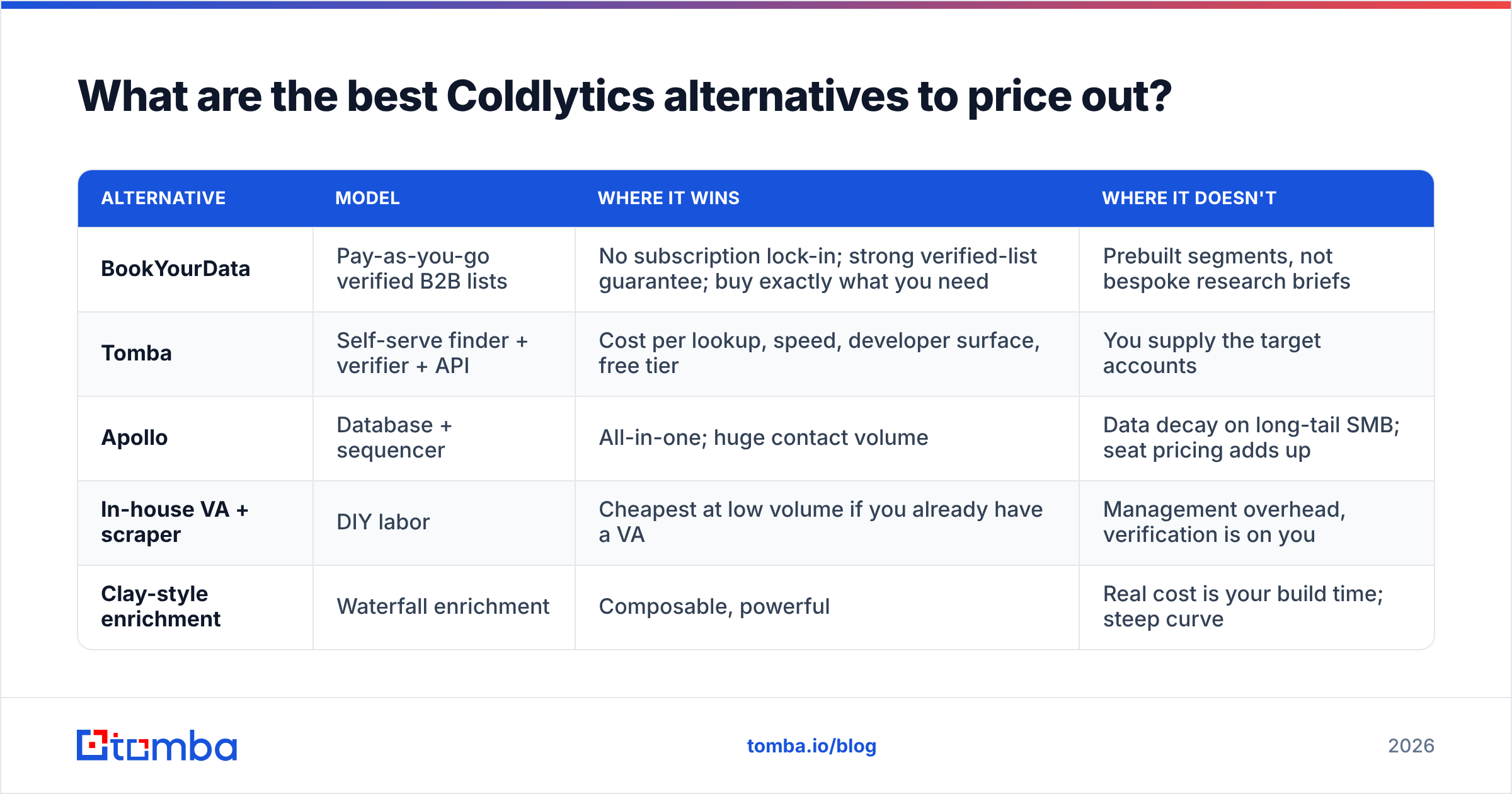
What are the best Coldlytics alternatives to price out?#
Before you commit to a subscription, get quotes from at least two of these. They span the full managed-to-self-serve spectrum.
| Alternative | Model | Where it wins | Where it doesn't |
|---|---|---|---|
| BookYourData | Pay-as-you-go verified B2B lists | No subscription lock-in; strong verified-list guarantee; buy exactly what you need | Prebuilt segments, not bespoke research briefs |
| Tomba | Self-serve finder + verifier + API | Cost per lookup, speed, developer surface, free tier | You supply the target accounts |
| Apollo | Database + sequencer | All-in-one; huge contact volume | Data decay on long-tail SMB; seat pricing adds up |
| In-house VA + scraper | DIY labor | Cheapest at low volume if you already have a VA | Management overhead, verification is on you |
| Clay-style enrichment | Waterfall enrichment | Composable, powerful | Real cost is your build time; steep curve |
BookYourData deserves a specific mention here because it solves the same underlying anxiety — "will this list bounce?" — with a different commercial model. Where Coldlytics sells research subscriptions, BookYourData sells verified contacts on a pay-as-you-go basis with an accuracy guarantee. If your objection to Coldlytics is the subscription commitment rather than the human-research premium, that's the first quote to get.
So is Coldlytics pricing worth it?#
Yes, if all three of these are true:
- Your ICP cannot be expressed as database filters.
- Your average contract value is high enough that $0.30–$0.55 per contact is noise.
- You genuinely will consume your monthly credits — every month.
No, if any of these are true:
- You already have the target account list. You're overpaying for research you don't need.
- You send more than a few thousand emails a month. The cost curve will hurt.
- You need contacts now, inside a workflow, at the moment a lead hits your CRM.
- You'll use 55% of your credits in a normal month. Your real price is nearly double the sticker.
The most common expensive mistake is teams buying a research subscription to solve a contact-discovery problem. They had 600 target domains. They needed emails. They paid research pricing for a lookup job. If that describes you, run one domain against a free tier before you sign anything — you'll know within ten minutes which category you're in.
Frequently asked questions#
Does Coldlytics offer a free trial? Coldlytics typically offers a sample list or paid trial rather than an open free tier. Ask for a sample built against your actual brief — a generic sample tells you nothing about how they'll handle your qualifiers.
Do Coldlytics credits roll over? Rollover rules vary by plan and have changed over time. Get it in writing. This single clause can swing your effective cost per lead by 40% or more.
Are phone numbers included in Coldlytics pricing? Phone data is often an add-on rather than a bundled field. If direct dials matter, price them explicitly — or handle them separately with a dedicated phone finder so you're not paying research rates for a lookup.
How accurate are Coldlytics lists? Reviewers report low bounce rates, which is the point of the human verification step. Accuracy on fit — whether the contact actually matches your ICP — depends almost entirely on how precisely you wrote the brief.
What's the cheapest way to get verified B2B emails? If you have the companies, a self-serve finder with built-in verification is the cheapest path by an order of magnitude. If you don't, budget for research — either yours, a VA's, or Coldlytics'.
Get the contacts without the research invoice#
If you've read this far and realized your problem was never "who should I target" but "how do I reach the people at these 800 companies," you don't need a research subscription. You need working email addresses, verified before you send.
Tomba Email Finder returns professional email addresses by domain, name, or company — with verification built in, an API for your CRM, and a free tier at 25 searches per month so you can test the accuracy on your own accounts before you spend a dollar. Starter is $49/mo. That's less than the credit expiry you'd write off in a slow month.
Run ten of your real target domains through it. Compare the output to the last list you bought. Then decide what your research budget is actually for.
Related guides#
Ready to find emails that actually work?
Join 150,000+ professionals who stopped guessing and started sending. Free credits on signup — no credit card required.
Get the Tomba newsletter
Practical outbound tactics and product updates — once every two weeks.
About the author