Coldlytics vs Apollo.io (2026): Which Lead Data Tool Wins?
One sells human-researched lists. The other sells access to a 275M-contact database. They are not the same product — and picking wrong costs you a quarter. Here's the honest breakdown.
TL;DR — what's the actual difference?#
- Coldlytics is a service. Apollo.io is a database. Coldlytics has humans build a list to your spec. Apollo gives you self-serve search across a massive pre-built contact index. Comparing them on "price per contact" alone will mislead you.
- Coldlytics wins on precision for weird ICPs. If your target is "dental practices in Ohio with 3+ locations and an in-house hygienist coordinator," no database has that field. A researcher does.
- Apollo wins on speed, volume, and workflow. Search, filter, export, sequence — all in one seat, in minutes, at a price most SDR teams already budget for.
- Both have a data-freshness tax. Apollo's crowd-sourced records decay; Coldlytics' hand-built lists are fresh on delivery day and stale by month three. Verification is not optional in either case.
- The third path: buy the search layer as an API (a dedicated email finder plus verification) and keep the list logic in your own stack. Cheaper than both once you're past ~2,000 contacts a month.
What is Coldlytics, exactly?#
Coldlytics is a done-for-you B2B list building service. You submit a request describing your ideal customer profile — industry, geography, headcount, job titles, and any qualifier a machine can't filter on — and a team of human researchers builds the list, sources contact details, and delivers it as a CSV or straight into your outreach tool.
The pitch is that a researcher can read a company's About page, notice they just hired a VP of RevOps, and decide the account qualifies. A boolean filter cannot. For niche B2B — manufacturing verticals, franchise groups, local services, anything where the SIC code lies — this matters more than most people expect.
The trade-offs are structural, not fixable:
- Turnaround is measured in days, not seconds. A typical list request takes several business days depending on size and complexity.
- It doesn't scale linearly. Ten thousand hand-verified contacts costs roughly ten times what a thousand costs. There is no marginal-cost cliff.
- You don't own the pipeline. When you need a fresh list, you file a new request. There's no API you can wire into your CRM to enrich a lead the moment it lands.
- Cost per contact runs high. Human research is the most expensive data-sourcing method that exists. That's the point — you're paying for judgment.
Coldlytics is best understood as outsourced SDR research, not as a data vendor. Check the current plans on the official Coldlytics site before you budget — their credit model and tier pricing have shifted more than once.
What is Apollo.io, exactly?#
Apollo.io is a sales intelligence and engagement platform. It combines a contact and company database (Apollo has publicly cited figures north of 270 million contacts and 70 million companies) with filters, a Chrome extension, sequencing, dialer, and light CRM functionality.
The core loop: filter the database → save a list → enrich → push into a sequence → send. You never leave the tab. For a team of five SDRs, this is genuinely efficient, and it's why Apollo shows up on nearly every B2B stack diagram drawn since 2021.
Where Apollo gets criticized — and you'll see this consistently across reviews on G2 — is data quality at the edges:
- Contributed data decays. A meaningful chunk of Apollo's contact graph comes from users syncing their own email and CRM data. That's a powerful moat and a freshness problem. Records reflect the moment someone's inbox was scanned, not today.
- "Verified" is a status, not a promise. Apollo labels emails with confidence tiers. Verified generally lands well. Guessed or unverified emails will torch your sender reputation if you send to them blind.
- Filters can't judge. You can filter on industry, headcount, tech stack, funding, and title keywords. You cannot filter on "sounds like they're in pain."
- Seat-based pricing bites. Credits are per user. A five-person team on a mid-tier plan is a real line item.
How do Coldlytics and Apollo.io compare head to head?#
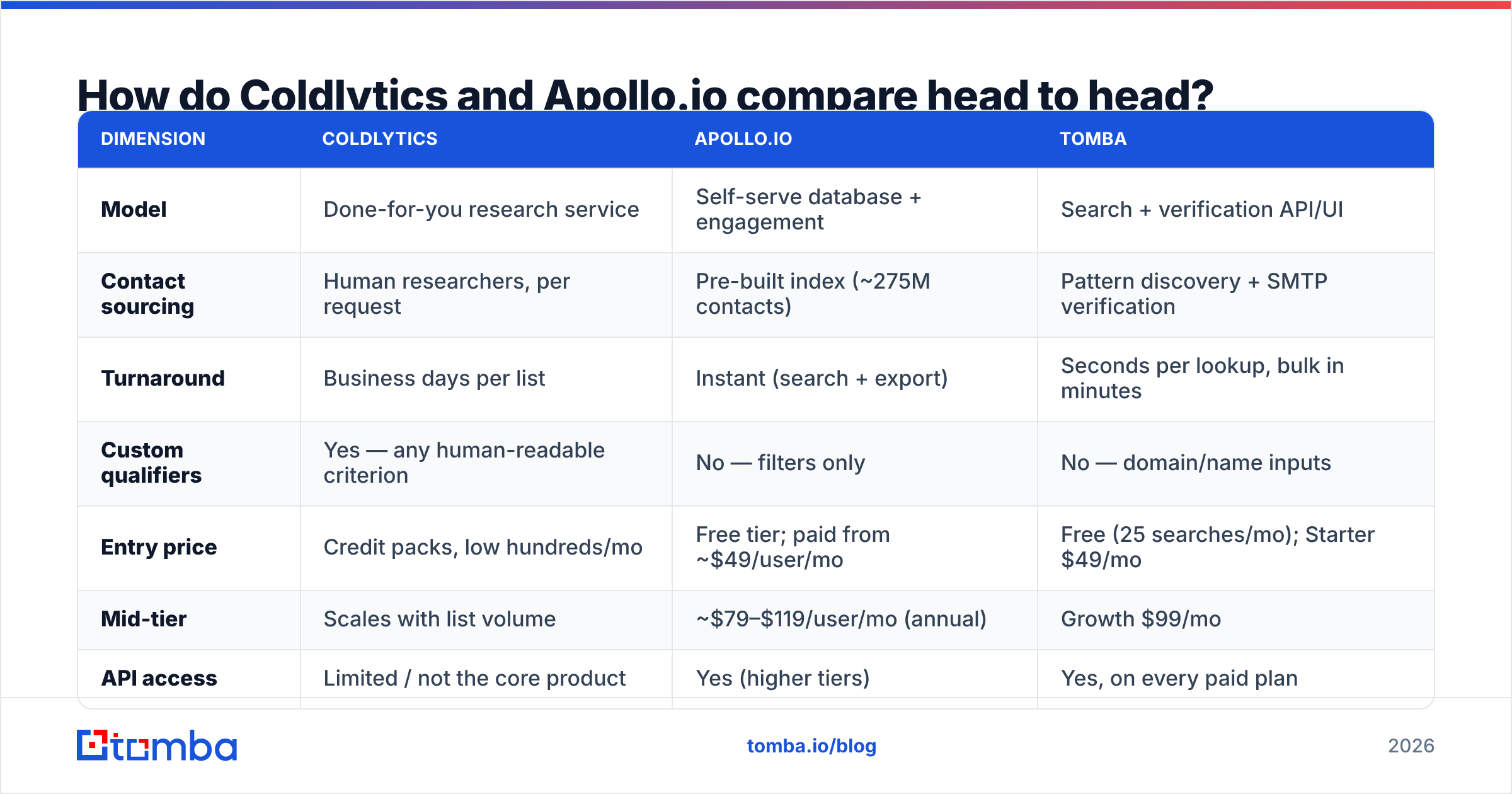
Here's the table people actually come here for. Pricing is list price at time of writing and moves — verify on the vendor sites before you commit budget.
| Dimension | Coldlytics | Apollo.io | Tomba |
|---|---|---|---|
| Model | Done-for-you research service | Self-serve database + engagement | Search + verification API/UI |
| Contact sourcing | Human researchers, per request | Pre-built index (~275M contacts) | Pattern discovery + SMTP verification |
| Turnaround | Business days per list | Instant (search + export) | Seconds per lookup, bulk in minutes |
| Custom qualifiers | Yes — any human-readable criterion | No — filters only | No — domain/name inputs |
| Entry price | Credit packs, low hundreds/mo | Free tier; paid from ~$49/user/mo | Free (25 searches/mo); Starter $49/mo |
| Mid-tier | Scales with list volume | ~$79–$119/user/mo (annual) | Growth $99/mo |
| API access | Limited / not the core product | Yes (higher tiers) | Yes, on every paid plan |
| Email sequencing | No (delivers into your tool) | Yes, built in | No — integrates instead |
| Best for | Niche ICPs, low-volume high-ACV | Volume outbound, generalist ICPs | Teams who own their list logic |
Read that table twice. The row that decides the purchase isn't price — it's custom qualifiers. If your ICP is expressible as filters, Apollo is faster and cheaper, full stop. If it isn't, no amount of Apollo credits will produce the list you need, and Coldlytics is worth every dollar.
Which one has better data accuracy?#
Neither, unconditionally. They fail differently.
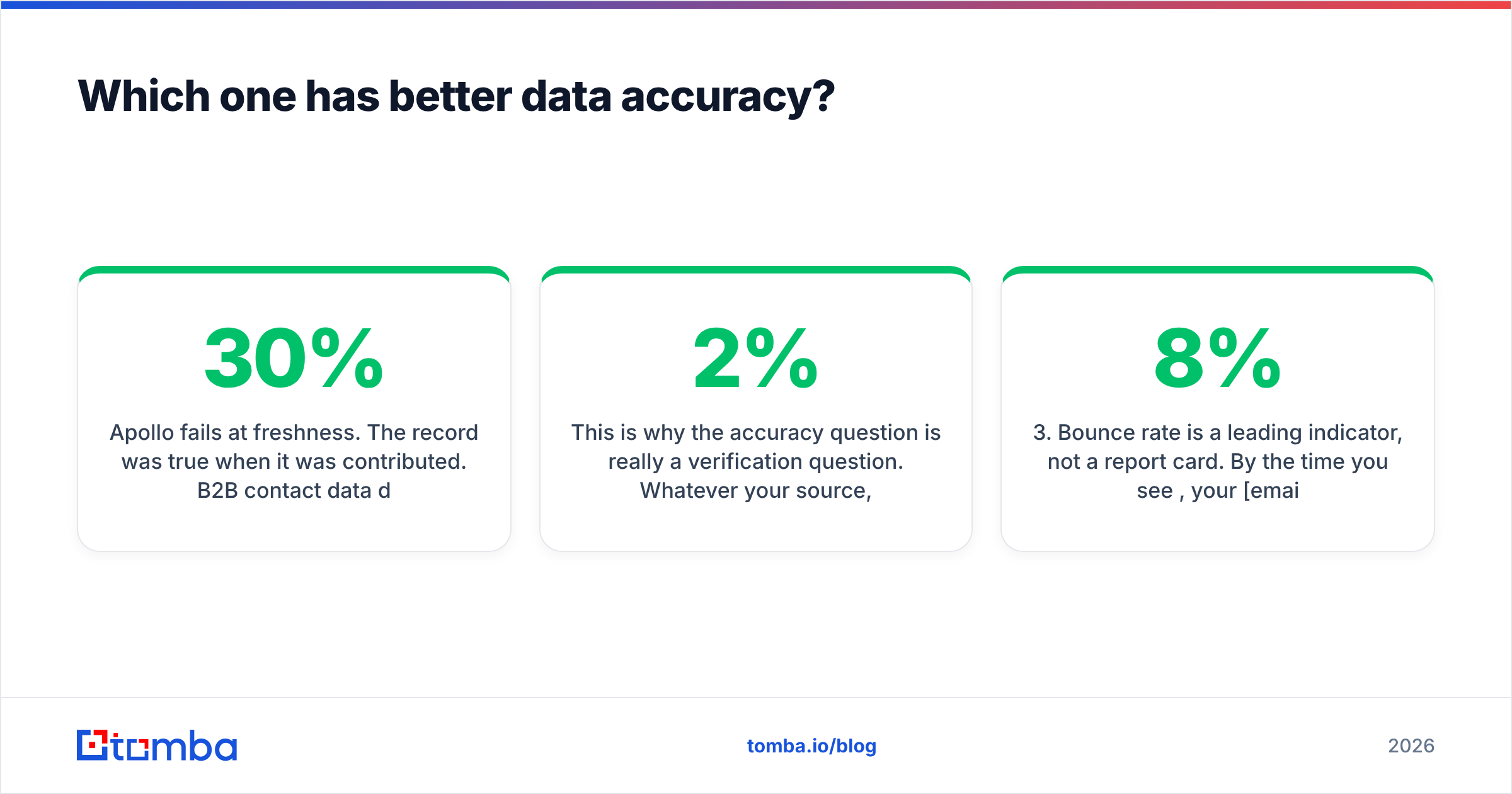
Apollo fails at freshness. The record was true when it was contributed. B2B contact data decays at roughly 25–30% annually — people change jobs, companies rebrand, mail servers get reconfigured. A record sitting in a 275M-row index that nobody has touched in fourteen months is a coin flip.
Coldlytics fails at scale and staleness-after-delivery. The list is accurate the day it lands in your inbox. Six weeks later, it's a normal B2B list with normal decay — except you paid a premium for it and there's no re-verification button.

This is why the accuracy question is really a verification question. Whatever your source, the last mile before you press send should be a real-time SMTP check against the destination server. That's what separates a 2% bounce rate from a 9% bounce rate, and 9% is where Google and Microsoft start throttling you.
Three rules that hold regardless of vendor:
- Never trust a status label older than 30 days. Re-verify at send time, not at export time. An email verifier run over a 5,000-row list costs less than one blocked domain.
- Treat catch-all domains as their own bucket. They pass basic verification and still bounce. Use a catch-all verifier or route them to LinkedIn instead of email.
- Bounce rate is a leading indicator, not a report card. By the time you see 8%, your email deliverability is already damaged and takes weeks to recover.
What does each one actually cost you?#
Sticker price is the least interesting number. Here's the total-cost picture for a realistic scenario: one SDR, 2,000 net-new contacts per month, cold email only.
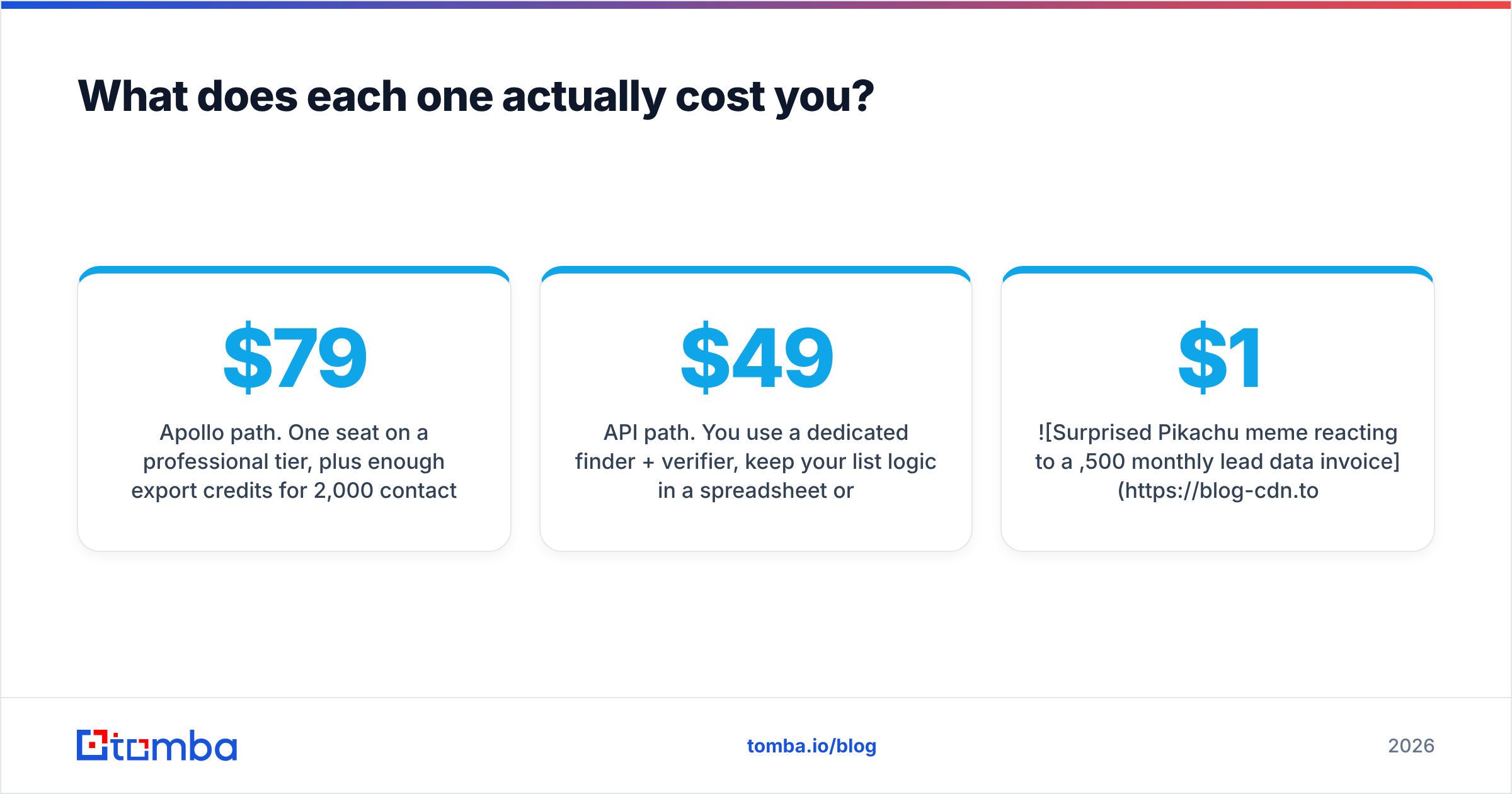
Coldlytics path. You file monthly list requests. At human-research rates, 2,000 contacts a month sits comfortably in four figures. You get high relevance, zero platform overhead, and a five-day lag between "we changed our ICP" and "we have a list." Verification is largely handled, but re-verification on old lists isn't.
Apollo path. One seat on a professional tier, plus enough export credits for 2,000 contacts. Call it $79–$119/user/month annualized, and watch the credit consumption — Apollo's export credits are the real meter, not the seat. You get sequencing bundled, which offsets a separate outreach tool. You pay for the whole platform even if you only wanted the data.
API path. You use a dedicated finder + verifier, keep your list logic in a spreadsheet or your CRM, and pipe results in via API. Tomba pricing puts Starter at $49/mo and Growth at $99/mo, with a free tier at 25 searches/mo to test the waters. You bring your own sequencer. Cheapest per contact, most assembly required.
The invoice shock in this category almost never comes from the base plan. It comes from credit overages, per-seat multiplication, and the second tool you had to buy anyway because the first one didn't do sequencing, or didn't do enrichment, or didn't do phone numbers.
When should you choose Coldlytics over Apollo.io?#
Choose Coldlytics when three things are true at once:
- Your ICP is not filterable. "Companies running Shopify Plus who mention sustainability on their About page and have no Head of Ops on LinkedIn" is a research brief, not a search query.
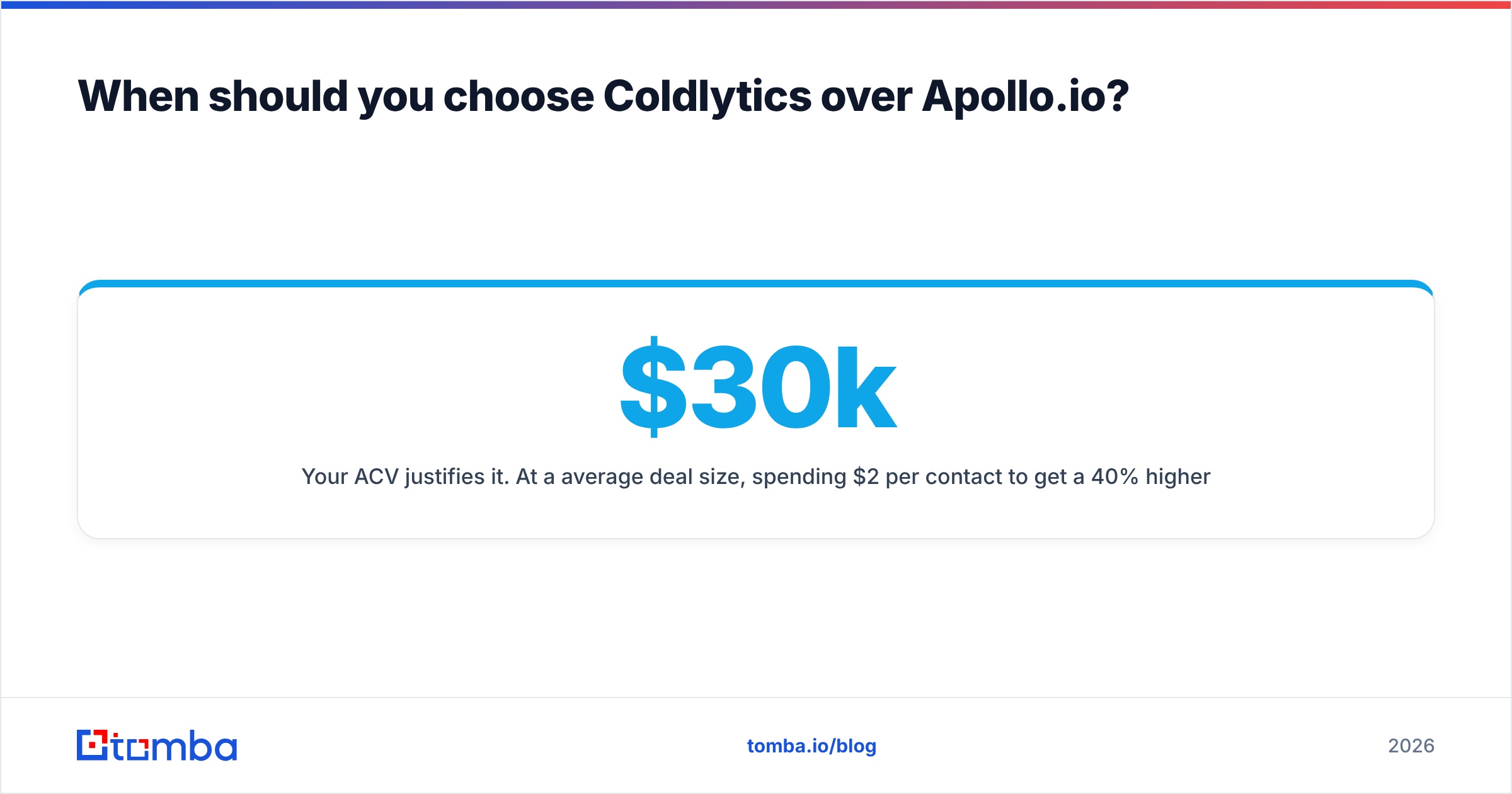
- Your ACV justifies it. At a $30k average deal size, spending $2 per contact to get a 40% higher reply rate is trivially correct math. At a $500 ACV, it's not.
- Your list volume is low and your list quality is everything. Two hundred perfect accounts beats twenty thousand plausible ones when your close rate depends on relevance.
Choose Apollo.io when:
- Your ICP maps cleanly to firmographic filters (industry, headcount, title, geography, funding stage).
- You need volume now and can absorb a bounce rate you'll clean up with verification.
- You want one platform — data plus sequencing plus dialer — and you're willing to accept "good enough" on each rather than best-in-class on any.
- You're evaluating consolidation. If Apollo replaces three tools, its seat cost stops looking expensive.
If neither of those descriptions fits, you're probably in the third bucket — and there are more of you than the vendor marketing admits.
Is there a middle path between a service and a suite?#
Yes, and it's the one most experienced RevOps teams end up on after their second renewal: unbundle the data layer.
The insight is that "list building" is actually three jobs stapled together, and you're usually only bad at one of them:
- Deciding who to target — your job. Nobody outsources this well long-term.
- Finding the contact details — a solved problem, available as an API.
- Sending and tracking — your sequencer's job.
Coldlytics sells you #1 and #2 as a bundle. Apollo sells you #2 and #3 as a bundle. If you already have opinions about #1 (and you should) and already own a sequencer for #3, you're paying twice for a bundle you don't need.

The unbundled stack looks like this:
- Account list — built in a spreadsheet, from your CRM, from a conference attendee list, from LinkedIn Sales Navigator, or from a researcher you hire directly for the hard 200.
- Contact discovery — domain search to pull every known address on a company, or a name+domain lookup for a specific person. Wire it through the Tomba API so enrichment happens the moment a record hits your CRM, not five days later.
- Verification — real-time SMTP check at send time, catch-all handling routed separately.
- Enrichment — job title, LinkedIn, phone, company data appended via data enrichment only for the records that survived verification. Don't pay to enrich bounced contacts.
- Send — whatever sequencer you already pay for.
This is more work to set up. It is meaningfully cheaper to run, and — the part that matters — you keep the ICP logic in-house, which is the only part of the stack that compounds.
So, Coldlytics vs Apollo.io — which wins?#
There is no winner, because they're answering different questions.
- If the question is "who should I talk to, and I can't express it as filters" → Coldlytics, and it's not close.
- If the question is "I know who to talk to, get me 5,000 of them by Thursday and let me sequence them" → Apollo.io.
- If the question is "I know who to talk to, I own my sequencer, and I want the contact data at API cost" → neither. Unbundle.
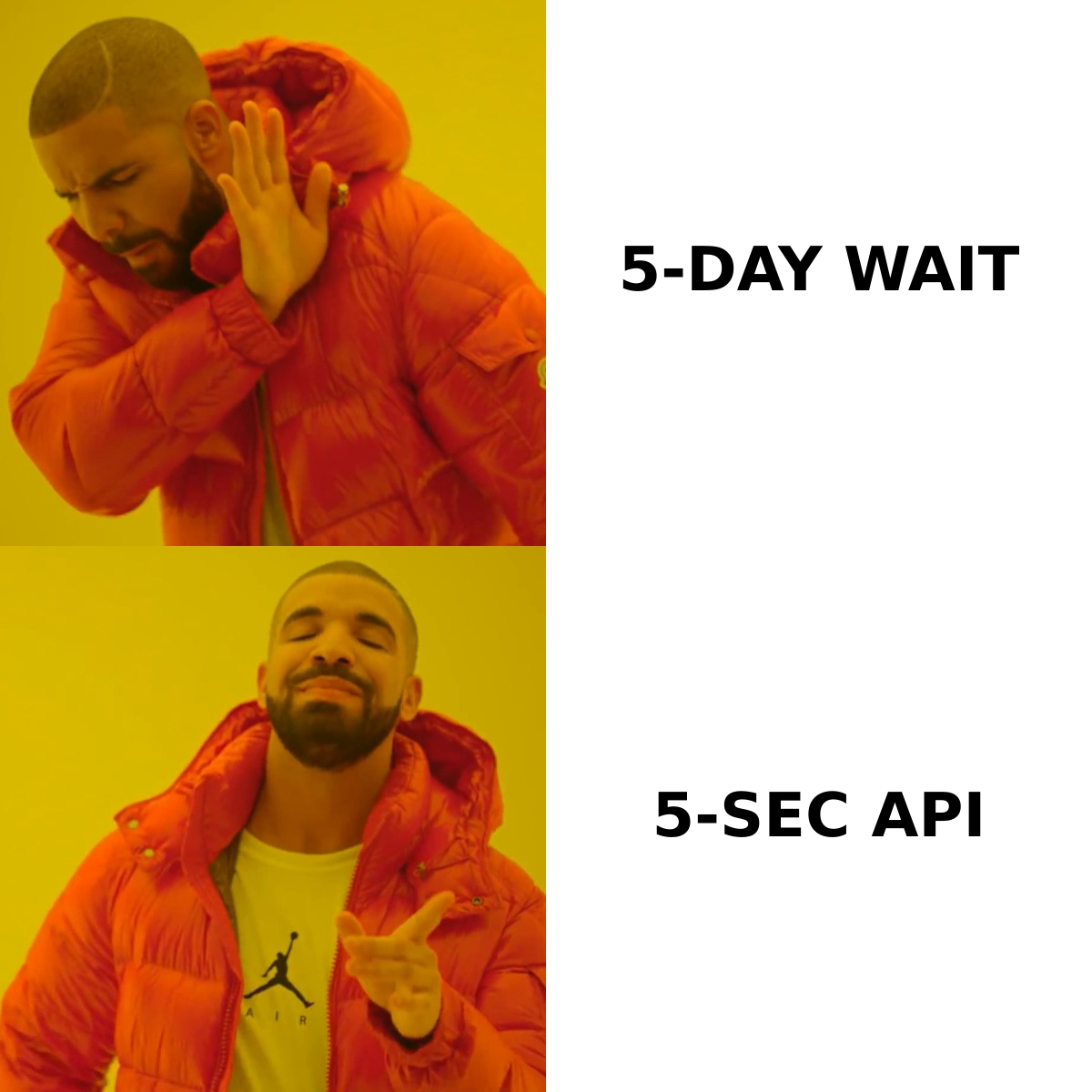
The mistake that costs quarters isn't picking the "wrong" tool. It's buying a done-for-you service when your ICP was filterable all along, or buying a 275M-record database when your entire addressable market is 900 companies and you needed a human to read their websites.
Audit your ICP first. Then buy the tool that matches its shape.
Get the data layer right before you buy the bundle#
If you've read this far and concluded that what you actually need is accurate contact data — not a research service, not a platform you'll use 30% of — start with the Tomba Email Finder. Free tier gives you 25 searches a month to test accuracy against a list you already know the answers to. Starter is $49/mo, Growth is $99/mo, and the API is included on every paid plan, so you can wire discovery and verification directly into your CRM instead of exporting CSVs forever.
Run it against ten contacts you can verify by hand. That test tells you more than any comparison table — including this one.
Related guides#
Ready to find emails that actually work?
Join 150,000+ professionals who stopped guessing and started sending. Free credits on signup — no credit card required.
Get the Tomba newsletter
Practical outbound tactics and product updates — once every two weeks.
About the author