Coldlytics vs Datanyze: Which B2B Data Tool Wins in 2026?
One sells human researchers, the other sells a browser extension built on technographics. Here's how Coldlytics and Datanyze actually compare on data, speed, cost per usable lead, and where a self-serve API beats both.
TL;DR
- Coldlytics is a done-for-you research service: you brief a target persona, human researchers plus automation build the list, and it lands in your inbox in a day or three. You are buying labor, not software.
- Datanyze is a lightweight Chrome extension owned by ZoomInfo. It surfaces contact details and technographic signals while you browse LinkedIn or a company site. You are buying a lookup tool, not a list.
- They barely compete. Coldlytics wins when your ICP is weird and un-filterable. Datanyze wins when you want to know what tech a company runs before you write the email.
- Both have the same structural weakness: neither is built to feed a programmatic outbound engine at volume. Coldlytics has turnaround latency; Datanyze has credit ceilings and a narrowing product roadmap.
- If your bottleneck is "I have 4,000 domains and need verified emails by Thursday," an email finder with an API and bulk endpoints solves that faster and cheaper than either.
What is Coldlytics?#
Coldlytics is a lead research platform that sits somewhere between a SaaS tool and an outsourced SDR research team. You submit a "task": describe the companies you want, the job titles you want inside them, and any qualifying criteria that a database filter cannot express — "agencies that mention HubSpot on their careers page," "clinics with fewer than three locations," "SaaS companies that just posted a RevOps role."
A combination of researchers and scraping infrastructure builds that list, verifies the emails, and delivers a CSV. Turnaround is typically measured in business days rather than seconds.
The pitch is straightforward: databases are stale and filter-limited, so pay humans to look. For genuinely awkward ICPs, that pitch holds up. For "VP of Sales at US SaaS companies with 50-200 employees," you are paying a premium for something a database query already does.
What is Datanyze?#
Datanyze started life as a technographics company — its original claim to fame was telling you which websites ran Shopify, Marketo, or Intercom. ZoomInfo acquired it in 2018, and today Datanyze is positioned as a low-cost Chrome extension for individual reps: hover a LinkedIn profile or company site, pull a business email and a direct dial, see the tech stack, push it into your workflow.
It is deliberately narrow. There is no sequencer, no CRM, no bulk enrichment pipeline of consequence. It is a per-seat, per-credit lookup tool, priced accordingly, and it lives inside a much larger ZoomInfo product family that gets the bulk of the roadmap attention.
How do Coldlytics and Datanyze actually differ?#
The comparison only makes sense once you accept that these are different categories of product. Here is the honest breakdown:
- Delivery model. Coldlytics is service-first — you brief, you wait, you receive a file. Datanyze is tool-first — you click, you get one record, you move on. One is asynchronous and batched. The other is synchronous and single-record.
- Where the data comes from. Coldlytics assembles data at request time from live sources, which is why it can satisfy criteria no database schema anticipated. Datanyze serves from a pre-built index plus ZoomInfo lineage, which is why it is instant but bounded by what has already been collected.
- Unit of purchase. Coldlytics sells credits that map to researched leads. Datanyze sells credits that map to contact reveals. Similar words, very different economics — a Coldlytics credit carries human time inside it.
- Technographics. This is Datanyze's one durable moat. Knowing that a prospect runs Klaviyo and Recharge is a real personalization hook. Coldlytics can research a tech stack if you ask, but it is not an indexed, filterable dataset you can slice.
- Scale behavior. Datanyze degrades gracefully but caps out — credits run dry, and the extension is a per-record interaction. Coldlytics scales by throwing more research hours at the task, which means cost and turnaround both climb roughly linearly. Neither scales the way an API does, where 5,000 lookups cost the same per unit as 50.
- Fit with automation. If you run outbound out of a CRM, a spreadsheet, or a script, Datanyze forces manual clicks and Coldlytics forces a file-import step. Neither slots cleanly into a workflow that wants contact data on demand.
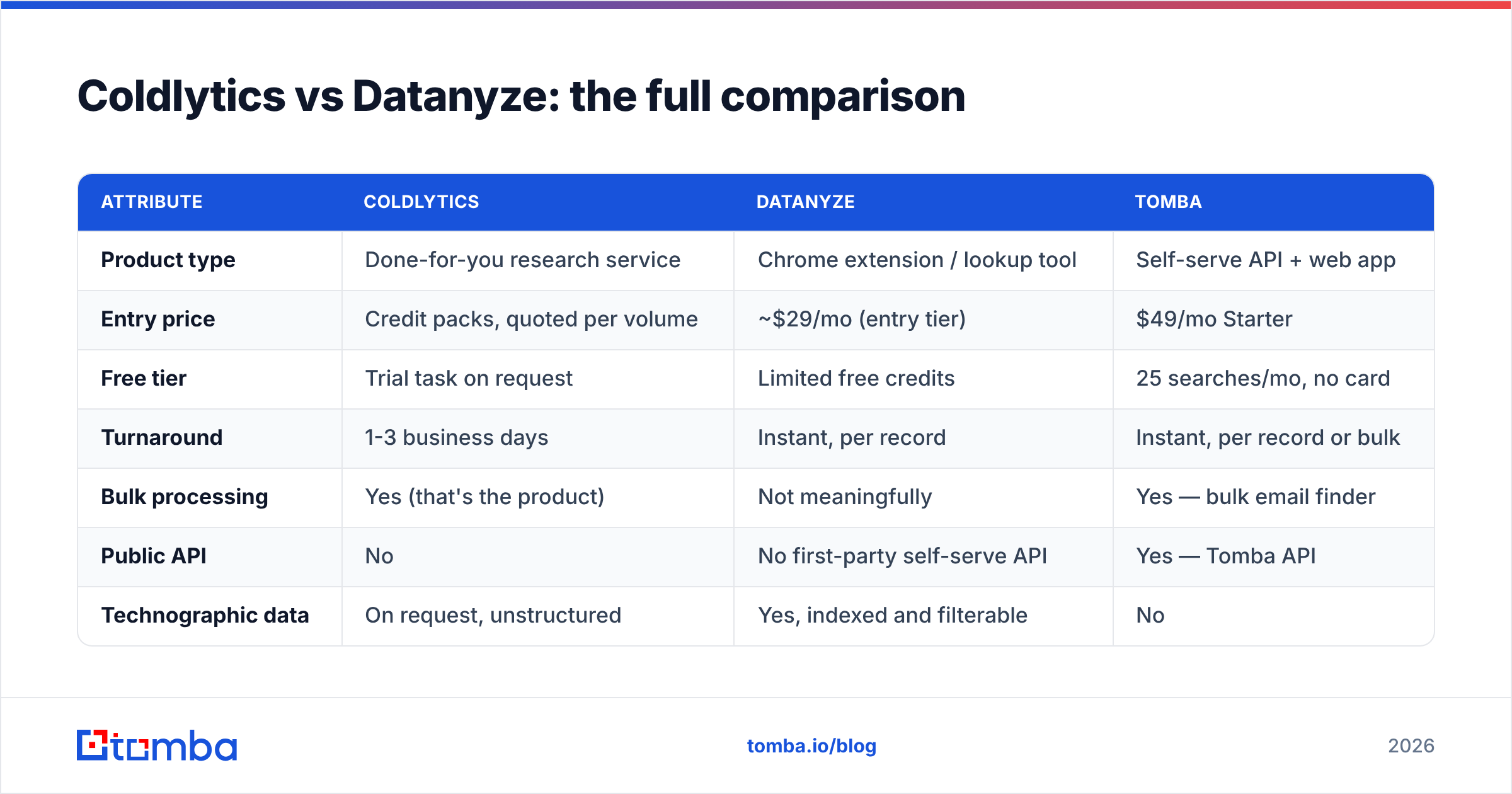
Coldlytics vs Datanyze: the full comparison#
Prices below reflect publicly listed figures at the time of writing. Both vendors have changed packaging more than once — confirm on their own pricing pages before you commit budget.
| Attribute | Coldlytics | Datanyze | Tomba |
|---|---|---|---|
| Product type | Done-for-you research service | Chrome extension / lookup tool | Self-serve API + web app |
| Entry price | Credit packs, quoted per volume | ~$29/mo (entry tier) | $49/mo Starter |
| Free tier | Trial task on request | Limited free credits | 25 searches/mo, no card |
| Turnaround | 1-3 business days | Instant, per record | Instant, per record or bulk |
| Bulk processing | Yes (that's the product) | Not meaningfully | Yes — bulk email finder |
| Public API | No | No first-party self-serve API | Yes — Tomba API |
| Technographic data | On request, unstructured | Yes, indexed and filterable | No |
| Email verification | Included in delivery | Basic validation | Dedicated email verifier + catch-all handling |
| Phone numbers | On request | Yes, direct dials | Yes |
| Best for | Un-filterable, niche ICPs | Solo reps prospecting on LinkedIn | Programmatic lookup at volume |
| Worst for | Time-sensitive, high-volume lists | Anything above ~500 contacts/mo | Technographic targeting |
Read that table left to right and the segmentation is obvious. Coldlytics is a research shop. Datanyze is a rep's sidearm. If you needed either, you probably already knew which.
Which has better data accuracy?#
Neither vendor publishes an independently audited accuracy figure, and you should be suspicious of any comparison post that claims otherwise — including the ones citing a number with no methodology attached. What you can reason about is mechanism.
Coldlytics is researched-on-demand. A human or a fresh scrape confirmed that person holds that title recently. Freshness is structurally good. The failure mode is inconsistency: the quality of a manually assembled list depends on who assembled it and how tight your brief was. A vague brief produces a vague list, and you find out three days later.
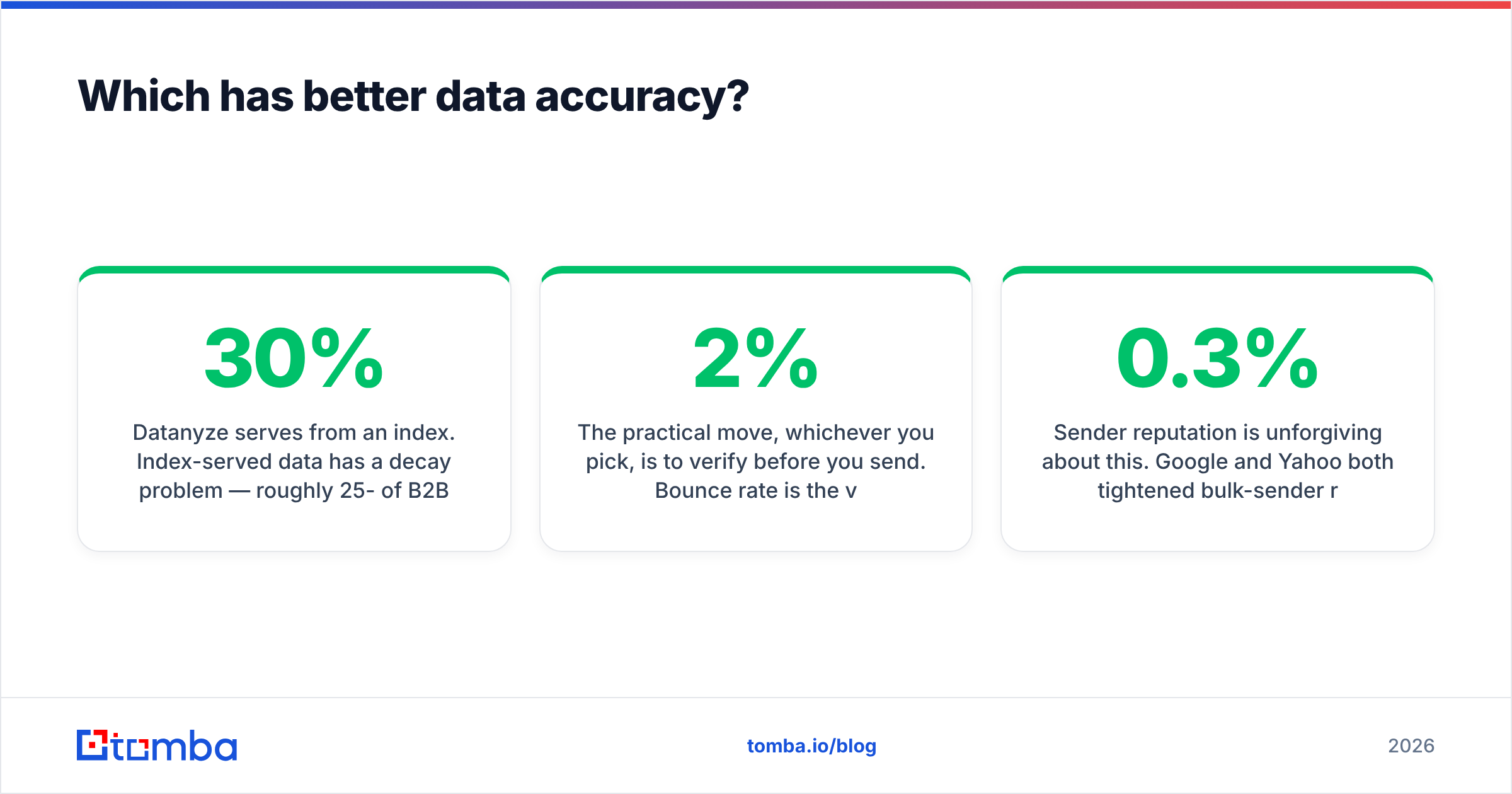
Datanyze serves from an index. Index-served data has a decay problem — roughly 25-30% of B2B contact records go stale every year as people change jobs, which is the same reason G2 reviews of extension-class tools cluster around "great when it hits, empty when it doesn't." Coverage on mid-market and enterprise US contacts is decent. Coverage on European SMBs, non-English markets, and anything below 50 employees thins out fast.
The practical move, whichever you pick, is to verify before you send. Bounce rate is the variable that actually determines whether your domain survives the quarter, and neither of these tools makes bounce management their core competence. If you are importing a list from anywhere — a service, an extension, a scraped export, a conference badge dump — run it through a dedicated verifier first, and pay attention to how the tool handles catch-all domains, which is where most "verified" lists quietly hide their bounces. A catch-all verifier is the difference between a 2% bounce rate and a 9% one on the exact same list.
Sender reputation is unforgiving about this. Google and Yahoo both tightened bulk-sender requirements, and the guidance on their own postmaster documentation is blunt about keeping spam complaint rates under 0.3%. A list that bounces is a list that costs you email deliverability you cannot buy back.
What does each one actually cost per usable lead?#
This is where the comparison gets uncomfortable, because the sticker price is the least interesting number.
Take a realistic scenario: you need 1,000 contacts at companies matching a moderately specific ICP.
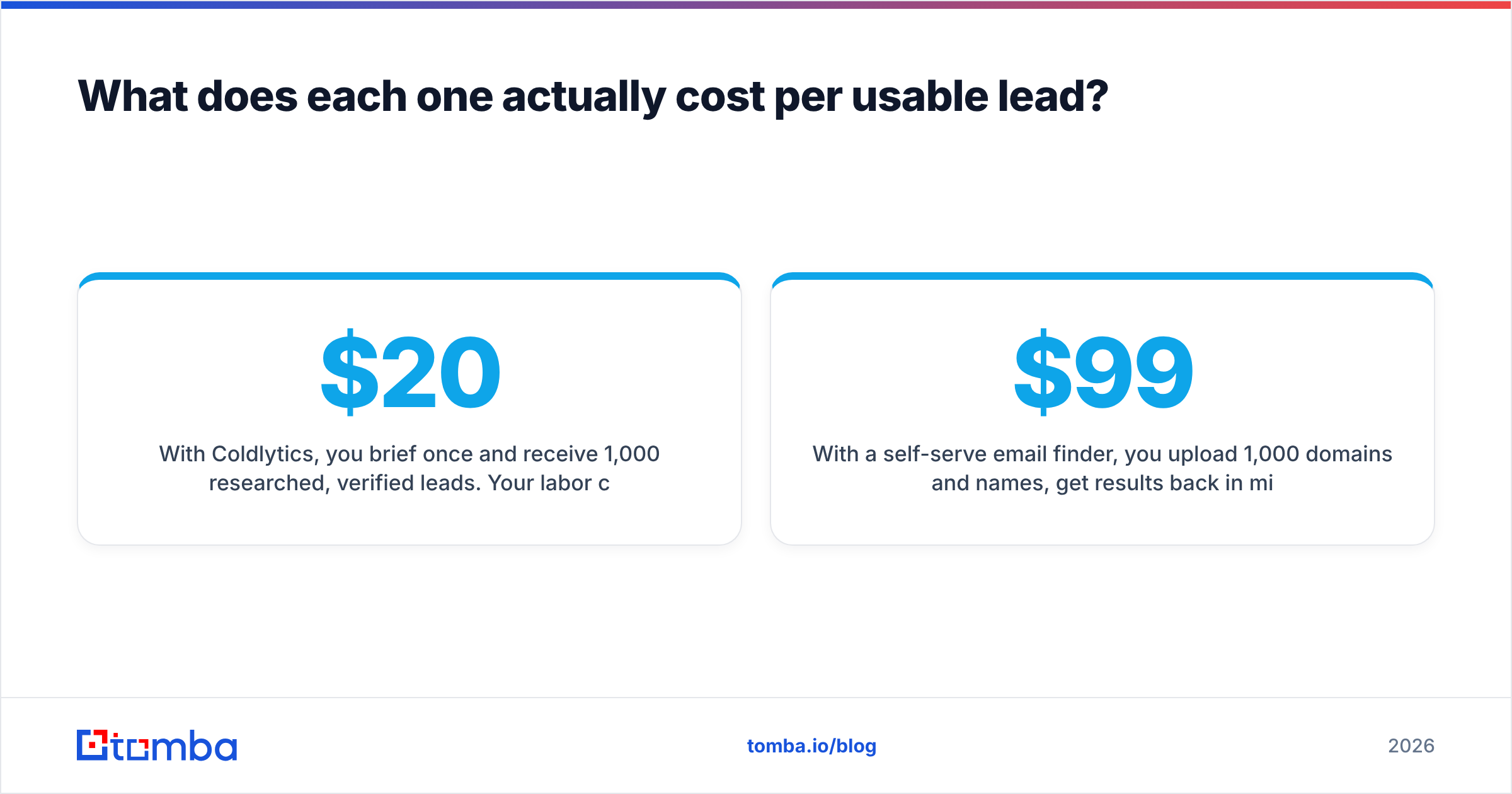
With Coldlytics, you brief once and receive 1,000 researched, verified leads. Your labor cost is roughly thirty minutes writing the brief. Your latency cost is two to three days. The per-lead price is the highest of the three options, but the usable rate is high because a human filtered it. If your ACV is $20,000, this arithmetic is fine. If you are selling a $49/mo product, it is not.
With Datanyze, 1,000 contacts means 1,000 credit reveals, which means either a large credit purchase or a rep clicking through LinkedIn for several days. The extension is not designed for this. You will hit the credit ceiling, upgrade, hit it again, and eventually conclude the tool was never meant to be a list-building engine — because it wasn't.
With a self-serve email finder, you upload 1,000 domains and names, get results back in minutes, and pay a flat credit rate. On the Growth plan at $99/mo the per-lead cost lands well under a cent, and the same credits work through the API, the Google Sheets add-on, or the Chrome extension depending on where you actually work.
The honest caveat: that third option does not replicate what Coldlytics does. If your criterion is "companies that mention a specific compliance framework on their careers page," no API in the world will filter for it. You need a human, and Coldlytics is a legitimate way to rent one. Likewise, if your entire outbound angle is "I noticed you're running Segment," Datanyze's technographic index is doing work no email finder does.

Who should choose Coldlytics?#
Pick Coldlytics when the list is the hard part and the emails are trivial.
Concretely, that means:
- Your ICP is defined by something no database has a field for — hiring signals, page content, physical location quirks, licensing status.
- You are running low-volume, high-ACV outbound where 200 exquisitely qualified accounts beat 5,000 mediocre ones.
- You do not have a research SDR and do not want to hire one.
- Two- to three-day turnaround is irrelevant to your sales cycle, because your sales cycle is four months.
Do not pick Coldlytics if you need lists weekly, if you need lists on demand from a script, or if you plan to enrich an existing CRM of 40,000 records. The economics collapse.
Who should choose Datanyze?#
Pick Datanyze when the technographic signal is your message.
Concretely:
- You are one rep, or a small team, prospecting manually inside LinkedIn.
- Your cold email opens with a tech-stack observation, and that observation is the reason the reply comes back.
- Your monthly contact volume is genuinely small — a few hundred reveals, not a few thousand.
- You want the cheapest legitimate way into ZoomInfo-lineage data without a ZoomInfo contract.
Do not pick Datanyze as your team's primary contact-data source. It is a supplementary lookup tool, and it has been positioned that way since the acquisition. Treat it as a signal layer sitting on top of a real data source, not as the data source. Reviewers on Capterra consistently describe the same arc: useful, cheap, and then you outgrow it.
Is there a third option that covers the overlap?#
Yes, and it is worth naming plainly because the overlap between these two tools is exactly where most outbound teams actually live: you know which companies you want, you know which titles you want, and you need verified emails for all of them right now.
That is not a research problem and it is not a browsing problem. It is a lookup problem, and lookup problems are solved by APIs.
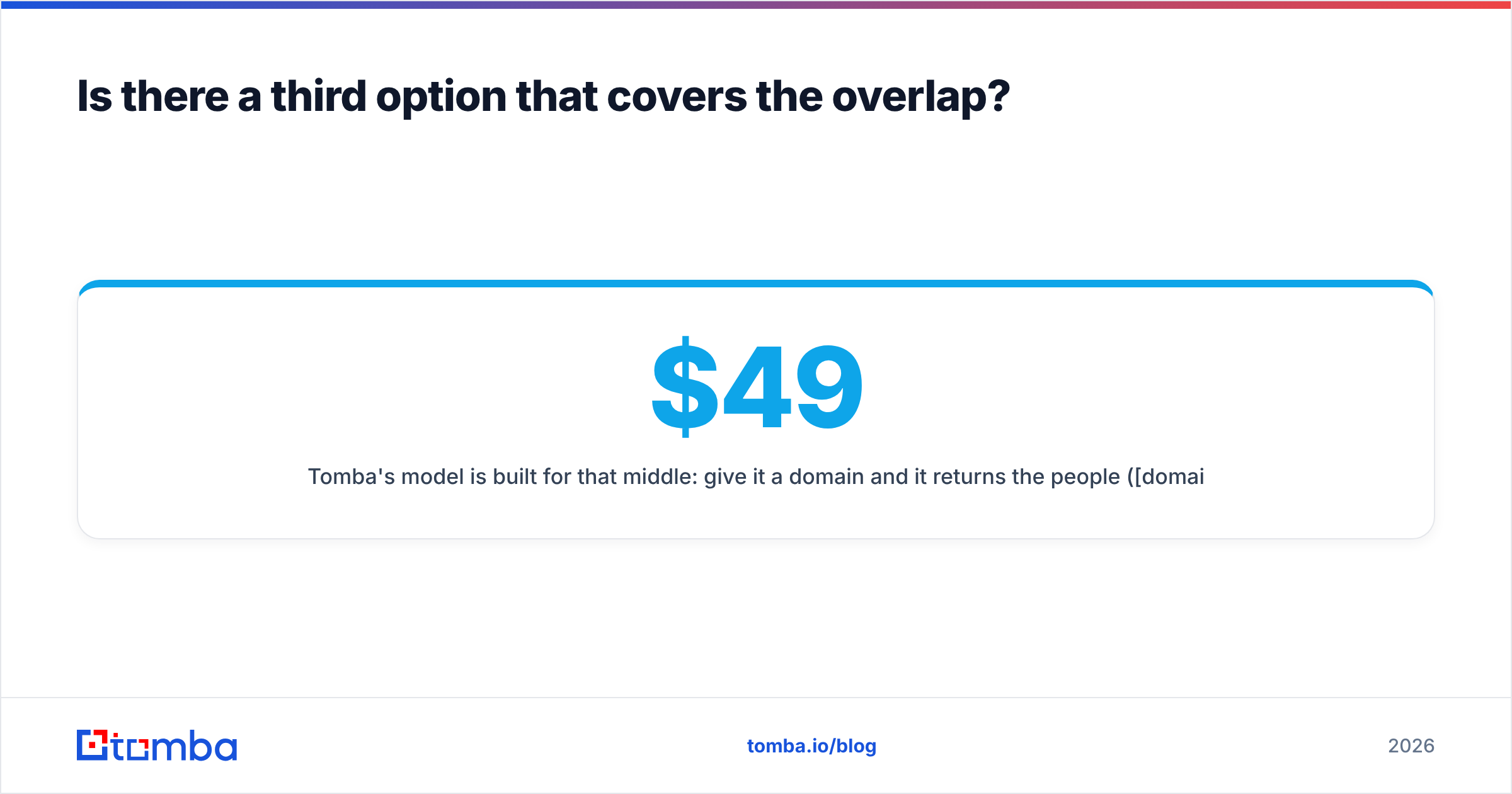
Tomba's model is built for that middle: give it a domain and it returns the people (domain search); give it a name and a domain and it returns the address; give it 4,000 rows and it returns 4,000 results. Free tier is 25 searches a month, Starter is $49/mo, Growth is $99/mo, Pro is $249/mo, and Enterprise is negotiated. Every plan exposes the same API, the same verification, and the same catch-all handling.
Where it does not compete: it will not read a careers page and infer intent, and it will not tell you the prospect runs Marketo. If those are your buying criteria, buy the tool that does them.
Coldlytics vs Datanyze: the verdict#
If someone forces a single answer, Coldlytics is the better product for building a list, and Datanyze is the better product for enriching a profile you are already looking at. They are not substitutes and any post that ranks one "above" the other on a single axis is selling you something.
The more useful conclusion is this: most teams evaluating Coldlytics vs Datanyze are actually solving a third problem neither one is shaped for — repeatable, high-volume, verified contact discovery that plugs into whatever tool the team already lives in. That job wants an API, bulk endpoints, honest catch-all handling, and a per-lead cost measured in fractions of a cent.
Run the test yourself. Take fifty domains from your last campaign. Send them through whichever of these three you are considering. Count the valid addresses, count the bounces, and divide the total cost by the number of contacts that actually reached a human inbox. That number ends the argument faster than any comparison table, including the one above.
Start with the Tomba Email Finder — 25 free searches a month, no card required, and the same API endpoint whether you're checking one prospect or ten thousand. If it doesn't beat your current cost per usable lead on those fifty domains, you'll know within an hour, and you'll have lost nothing but the hour.
Related guides#
// get started
Find, verify and enrich your first contacts today
Start on the free plan with 25 searches a month, then scale when your team is ready.
Free plan · No credit card required · GDPR & CCPA
// about the author