Coldlytics vs ZoomInfo: Which B2B Data Tool Wins in 2026?
Coldlytics sells hand-built prospect lists; ZoomInfo sells a massive self-serve database. We compare pricing, accuracy, and fit so you pick the right one — and show where a leaner API beats both.
Choosing between Coldlytics and ZoomInfo comes down to one question: do you want someone to hand-build a small, precise prospect list for you, or do you want self-serve access to a database of tens of millions of contacts? They are two very different products that happen to solve the same problem — filling your pipeline with contactable leads — and picking the wrong one wastes either your money or your reps' time.
This is a neutral breakdown. We'll compare data models, pricing, accuracy, and the workflows each tool actually fits, then show where a lean email-finding layer beats paying for either at full price.
TL;DR: Coldlytics vs ZoomInfo at a glance#
- Coldlytics is a done-for-you research service. You submit a request, a human team builds a targeted list to your spec, and you pay per lead or per credit. Best for niche ICPs where databases go stale or thin.
- ZoomInfo is a self-serve data platform with a huge contact and company database, intent signals, and workflow tooling. Best for large teams that need volume, filters, and CRM integration at scale.
- Pricing is the biggest divide: Coldlytics is affordable and pay-as-you-go; ZoomInfo is enterprise-tier with annual contracts often starting in the five figures.
- Accuracy is a wash on paper — both promise verified data — but the failure modes differ. Coldlytics fails on volume; ZoomInfo fails on long-tail and rapidly-changing roles.
- The smart middle path: use a pay-as-you-go email finder and email verifier to source and validate contacts on demand, so you only pay for the leads you actually work.
What is Coldlytics?#
Coldlytics is a managed prospecting service, not a database you log into. You define your ideal customer — job titles, industries, geographies, company size, even specific account lists — and a research team manually finds matching decision-makers, then verifies their email addresses before delivery. Think of it like ordering a custom suit instead of buying off the rack: slower, made-to-measure, and better fitting when your target is unusual.
That human-in-the-loop model is Coldlytics' whole pitch. Automated databases decay fast — people change jobs, companies rebrand, and titles shift — so a manually sourced list built this week is often fresher than a database record last touched months ago. For agencies and lead-gen shops running cold outreach into narrow verticals, that freshness matters more than raw volume.
The trade-off is throughput. Human research doesn't scale to 50,000 contacts overnight, and turnaround time is measured in days, not seconds. You're buying precision, not a firehose.
What is ZoomInfo?#
ZoomInfo is the opposite model: a massive, self-serve B2B data platform. It aggregates hundreds of millions of contact and company records, layers on firmographics, technographics, org charts, and buyer-intent signals, and wraps it all in filtering, list-building, and CRM-sync tooling. It's the off-the-rack option — instant, huge selection, and standardized.
ZoomInfo is built for scale and for teams that live inside a sales stack. Its intent data (surfacing accounts researching your category) and deep CRM/enrichment integrations are genuinely strong, and for a large SDR org that needs to build territories and enrich thousands of records at once, the platform earns its place.
The catch is cost and commitment. ZoomInfo sells annual contracts, typically negotiated, and pricing climbs quickly with seats and add-on modules. You're also trusting an automated database, which means long-tail roles, small companies, and recently-changed jobs are where you'll hit stale or missing records.

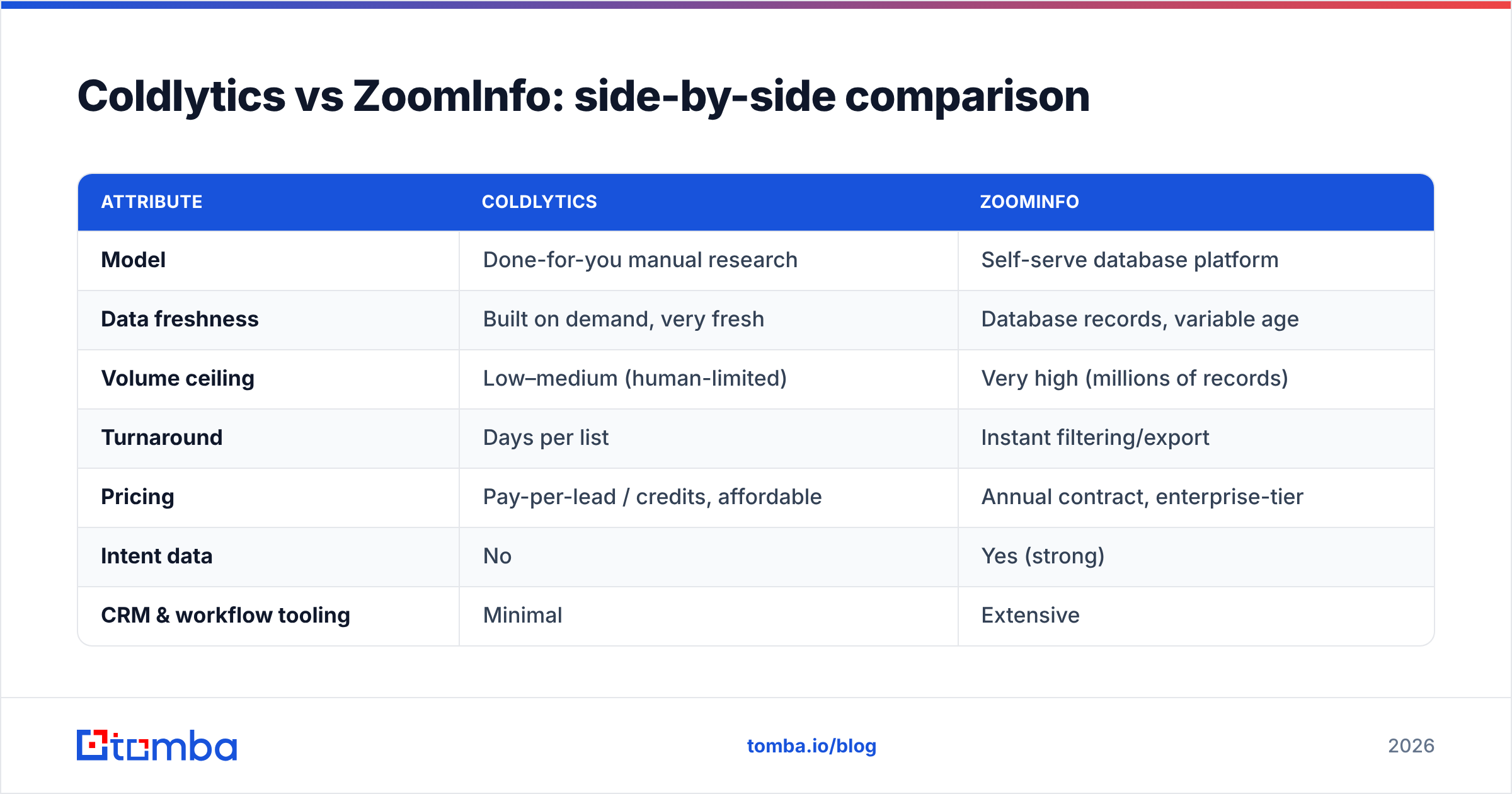
Coldlytics vs ZoomInfo: side-by-side comparison#
| Attribute | Coldlytics | ZoomInfo |
|---|---|---|
| Model | Done-for-you manual research | Self-serve database platform |
| Data freshness | Built on demand, very fresh | Database records, variable age |
| Volume ceiling | Low–medium (human-limited) | Very high (millions of records) |
| Turnaround | Days per list | Instant filtering/export |
| Pricing | Pay-per-lead / credits, affordable | Annual contract, enterprise-tier |
| Intent data | No | Yes (strong) |
| CRM & workflow tooling | Minimal | Extensive |
| Best for niche ICPs | Excellent | Hit or miss (long-tail gaps) |
| Best for high volume | Poor | Excellent |
| Commitment | Low, flexible | High, annual |
The pattern is clear: Coldlytics optimizes for precision at low volume with low commitment, while ZoomInfo optimizes for volume and workflow depth at high cost and high commitment. Neither is "better" in the abstract — they're tuned for different buyers.
Which one is more accurate?#
Both claim verified data, and in independent user reviews on sites like G2, both score respectably — but they fail differently, and that's what you should plan around.
Coldlytics' accuracy is highest exactly where databases struggle: obscure titles, small or newly-formed companies, and fast-moving org changes. Because a human sourced the record days ago, the email is likely still live. Its weakness is that you can't get that quality at 10,000-contact scale in an afternoon.
ZoomInfo's accuracy is strong on well-covered segments — mid-market and enterprise, common titles, established companies. Its weakness is decay and long-tail coverage. A record that was accurate when ingested may be months old by the time you export it, and no automated database catches every job change in real time. This is why serious teams verify before sending regardless of source. Running any list through an email verification pass before a campaign protects your sender reputation and bounce rate.

How does pricing compare?#
Here's where most buyers actually make the decision.
Coldlytics uses a pay-as-you-go, credit- or lead-based model. You buy what you need, there's no forced annual lock-in, and the entry cost is low enough for a solo founder or a small agency to test. You pay a premium per lead compared to bulk database pulls, but you only pay for leads that match your exact spec.
ZoomInfo is an enterprise sale. Pricing is quote-based and negotiated, contracts are annual, and real-world entry points commonly land in the low-to-mid five figures per year once you add seats and modules. For a large team that will use the volume and intent features daily, the per-record cost can be excellent. For a small team that needs a few hundred good contacts a month, it's massive overkill.
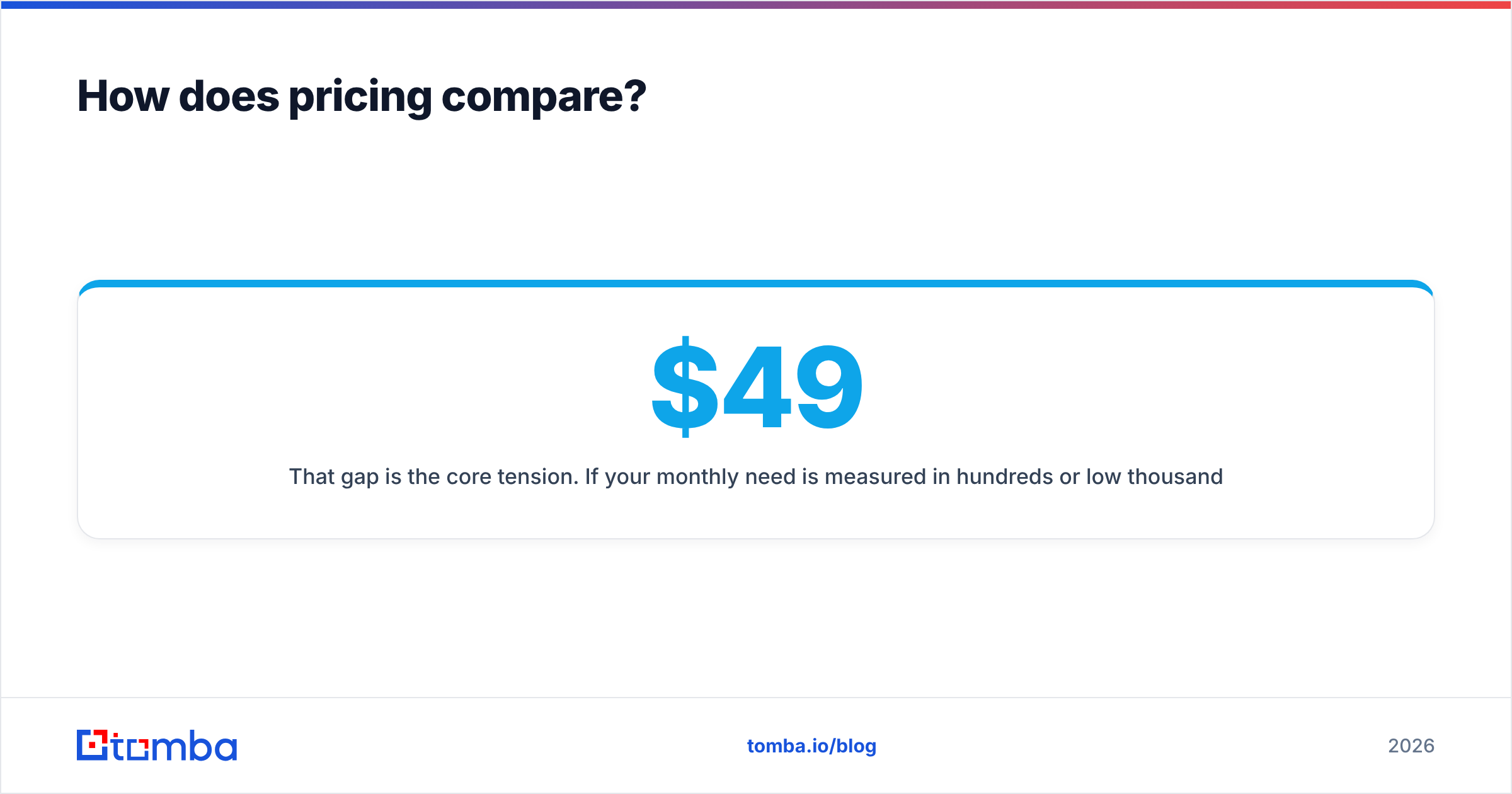
That gap is the core tension. If your monthly need is measured in hundreds or low thousands of contacts, an enterprise annual contract is the wrong shape entirely. A usage-based email finder like Tomba fills that gap: Tomba pricing starts with a free tier of 25 searches per month, then $49/mo (Starter), $99/mo (Growth), and $249/mo (Pro), with no annual lock-in required to get started.
When should you choose Coldlytics?#
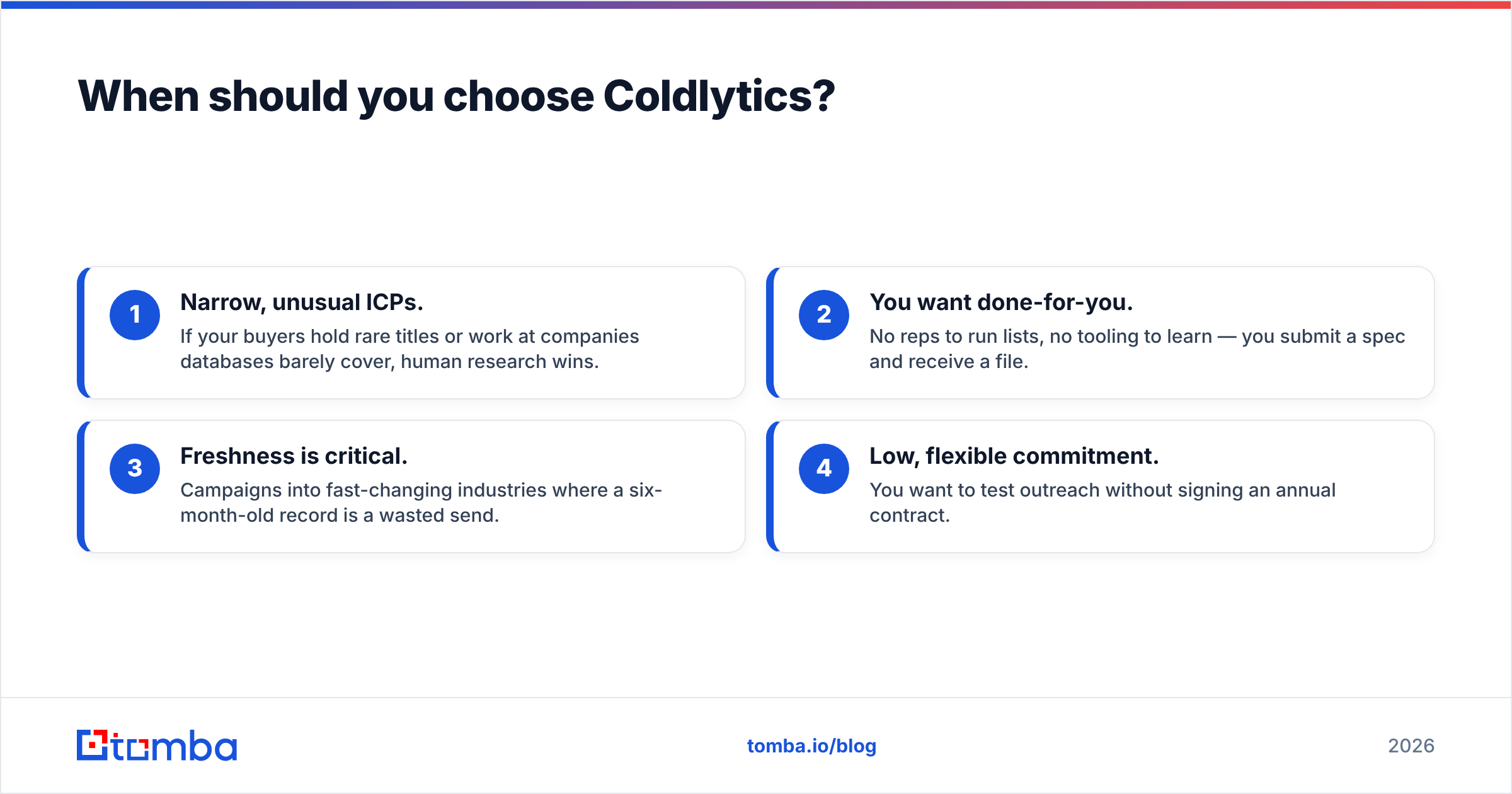
Pick Coldlytics when precision beats volume:
- Narrow, unusual ICPs. If your buyers hold rare titles or work at companies databases barely cover, human research wins.
- You want done-for-you. No reps to run lists, no tooling to learn — you submit a spec and receive a file.
- Freshness is critical. Campaigns into fast-changing industries where a six-month-old record is a wasted send.
- Low, flexible commitment. You want to test outreach without signing an annual contract.
Coldlytics is a poor fit if you need tens of thousands of contacts fast, want intent signals, or need deep CRM automation.
When should you choose ZoomInfo?#
Pick ZoomInfo when scale and workflow depth matter most:
- High volume. You're staffing SDRs who burn through thousands of contacts monthly.
- You want intent data. Surfacing in-market accounts is a genuine ZoomInfo strength.
- Deep stack integration. You need native enrichment and sync across CRM, MAP, and sales-engagement tools.
- Budget and buy-in exist. You can justify a five-figure annual spend and will actually use the platform.
ZoomInfo is a poor fit for small teams, tight budgets, or anyone whose targets live in the long tail.
Is there a smarter middle option?#
Yes — and for a lot of teams it's the right answer. Most buyers don't actually need a done-for-you research team or a five-figure database contract. They need to turn a name and company into a verified, contactable email, on demand, at a price that scales with usage.
That's the lane a focused email-finding platform occupies. Instead of paying for a full database you'll barely tap or a managed service you can't scale, you source contacts yourself and pay per result:
- Domain search pulls the reachable email addresses at any company in seconds — the self-serve speed of ZoomInfo without the contract.
- Email Finder turns a specific first name, last name, and domain into a verified address, one-off or in bulk.
- Data enrichment fills in the firmographic and contact gaps on records you already own.
- Built-in verification validates every address before it hits your sequencer, keeping bounce rates low.
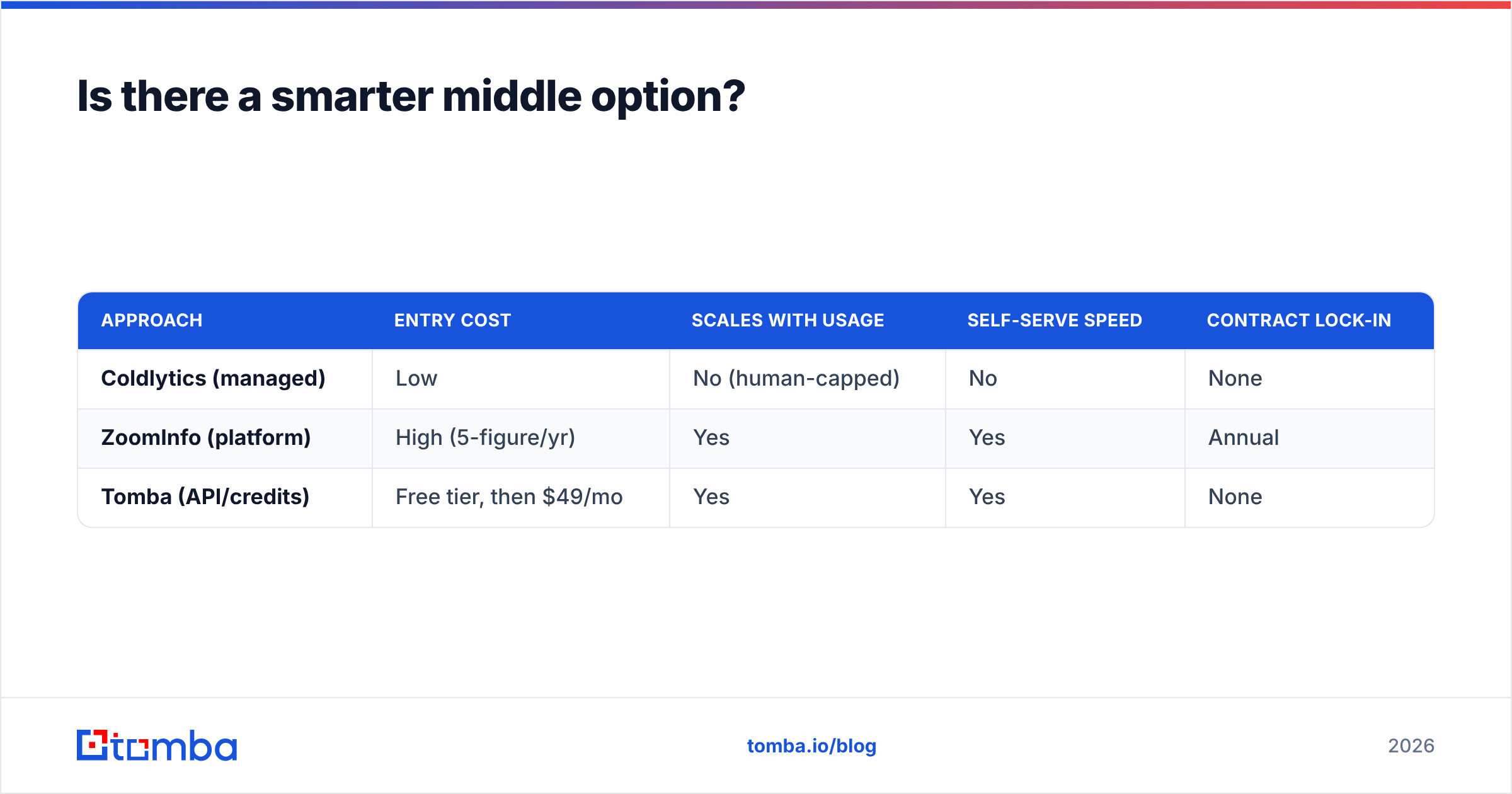
Here's how the three approaches stack up on the dimension most teams care about — cost to reach a usable contact at moderate volume:
| Approach | Entry cost | Scales with usage | Self-serve speed | Contract lock-in |
|---|---|---|---|---|
| Coldlytics (managed) | Low | No (human-capped) | No | None |
| ZoomInfo (platform) | High (5-figure/yr) | Yes | Yes | Annual |
| Tomba (API/credits) | Free tier, then $49/mo | Yes | Yes | None |
For a founder, a lean growth team, or an agency that wants ZoomInfo-style self-serve without ZoomInfo-style commitment, the usage-based model is simply the better shape. You can wire it into your workflow through the Tomba API or use it directly in your spreadsheet — and you never pay for records you don't touch.
The verdict#
There's no universal winner in Coldlytics vs ZoomInfo — there's only the right fit for your volume, budget, and ICP.
- Choose Coldlytics if you need precise, made-to-order lists for niche targets and you value freshness over scale.
- Choose ZoomInfo if you're a well-funded team that needs high volume, intent data, and deep integrations, and will use the platform enough to justify the annual spend.
- Choose a usage-based email finder if you want self-serve speed and verified contacts without either a managed-service ceiling or a five-figure contract — which describes most small and mid-sized teams honestly.
Match the tool to the job, verify before you send, and don't pay enterprise prices for startup-sized needs.
Get contactable leads without the enterprise contract#
If your real need is verified emails on demand — not a research queue and not an annual commitment — start with the Tomba Email Finder. Turn any name and company domain into a validated business email in seconds, search a whole company with domain search, and verify everything before it reaches your outreach tool. Try the free tier at 25 searches a month, then scale to a plan that grows with your pipeline instead of locking you in. It's the fastest way to test whether you ever needed a database that big in the first place.
Related guides#
Ready to find emails that actually work?
Join 150,000+ professionals who stopped guessing and started sending. Free credits on signup — no credit card required.
Get the Tomba newsletter
Practical outbound tactics and product updates — once every two weeks.
About the author