The Columbo Close: How 'Just One More Thing' Closes Deals
The Columbo close borrows a rumpled TV detective's trick: drop your biggest ask as a casual afterthought. Here's why the low-pressure move still lands deals in 2026 — and when it backfires.
TL;DR
- The Columbo close is a low-pressure closing technique named after the TV detective who saves his most important question for the doorway: "Just one more thing..."
- It works because the buyer's guard drops the moment they think the pitch is over — the casual afterthought lands without triggering sales resistance.
- Use it to surface a hidden objection, ask for the meeting, or reintroduce a decisive benefit right as the conversation "ends."
- It is not manipulation when the "one more thing" is genuinely useful to the buyer. It becomes a cheap trick when it isn't.
- Pair it with clean contact data and a tight follow-up cadence so the technique has something real to close on.
What is the Columbo close?#
The Columbo close is a soft-close technique where you deliver your most important ask after the buyer believes the pitch is over. You lower the stakes, signal you're wrapping up, and then — almost as an afterthought — drop the line that actually moves the deal forward.
It's named after Lieutenant Columbo, the deceptively sharp detective played by Peter Falk in the long-running TV series. Columbo would shuffle toward the door, appear to be leaving, then turn around with his trademark "Oh, just one more thing..." — and that final question was always the one that cracked the case.
In sales, the mechanics are the same. When a prospect thinks they've survived the pitch, their defenses drop. That's the exact moment a well-placed question or offer gets an honest answer instead of a reflexive "let me think about it."
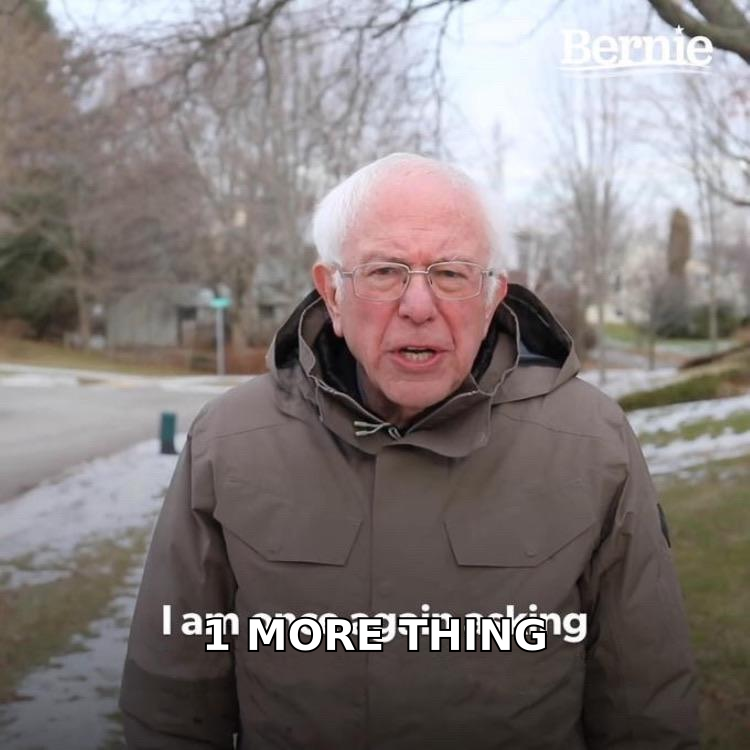
Why does the Columbo close actually work?#
The technique exploits a simple truth about buyer psychology: people brace for the close, not the afterthought. Once they mentally file the conversation under "done," they stop performing objections and start telling you what they really think.
Three forces are doing the work:
- Lowered resistance. The buyer relaxes because they believe the ask is over. A question framed as a casual add-on bypasses the "here comes the hard sell" reflex.
- Reciprocity of candor. When you sound relaxed and low-stakes, the buyer mirrors it. You get the real objection — budget, timing, a competing vendor — instead of a polite dodge.
- Recency. The last thing said in a conversation is the thing best remembered. Saving your strongest point for the "doorknob moment" makes it stick.
Research on sales conversations consistently shows that the best closers talk less and ask better questions late in the call. HubSpot's sales closing research points to low-pressure, question-led approaches outperforming aggressive tactics with modern buyers — and the Columbo close is question-led by design.
How do you use the Columbo close in a sales call?#
The move has three beats: signal the end, pause, then deliver the afterthought. Get the sequence right and it feels natural. Rush it and it feels like a gimmick.
- Signal you're wrapping up. "Alright, I think that covers everything — thanks for the time." The buyer exhales.
- Pause. Let the conversation actually feel finished. A half-second of real closure is what disarms them.
- Deliver the afterthought. "Oh — one more thing. If we could get the onboarding done before your Q3 push, would that change the timing on your end?"
- Shut up and listen. The answer you get here is usually the truth. Don't talk over it.
The "one more thing" can be an ask, a reframe, or a question that surfaces the real blocker. What it should never be is a second full pitch. The whole point is that it's small, casual, and singular.
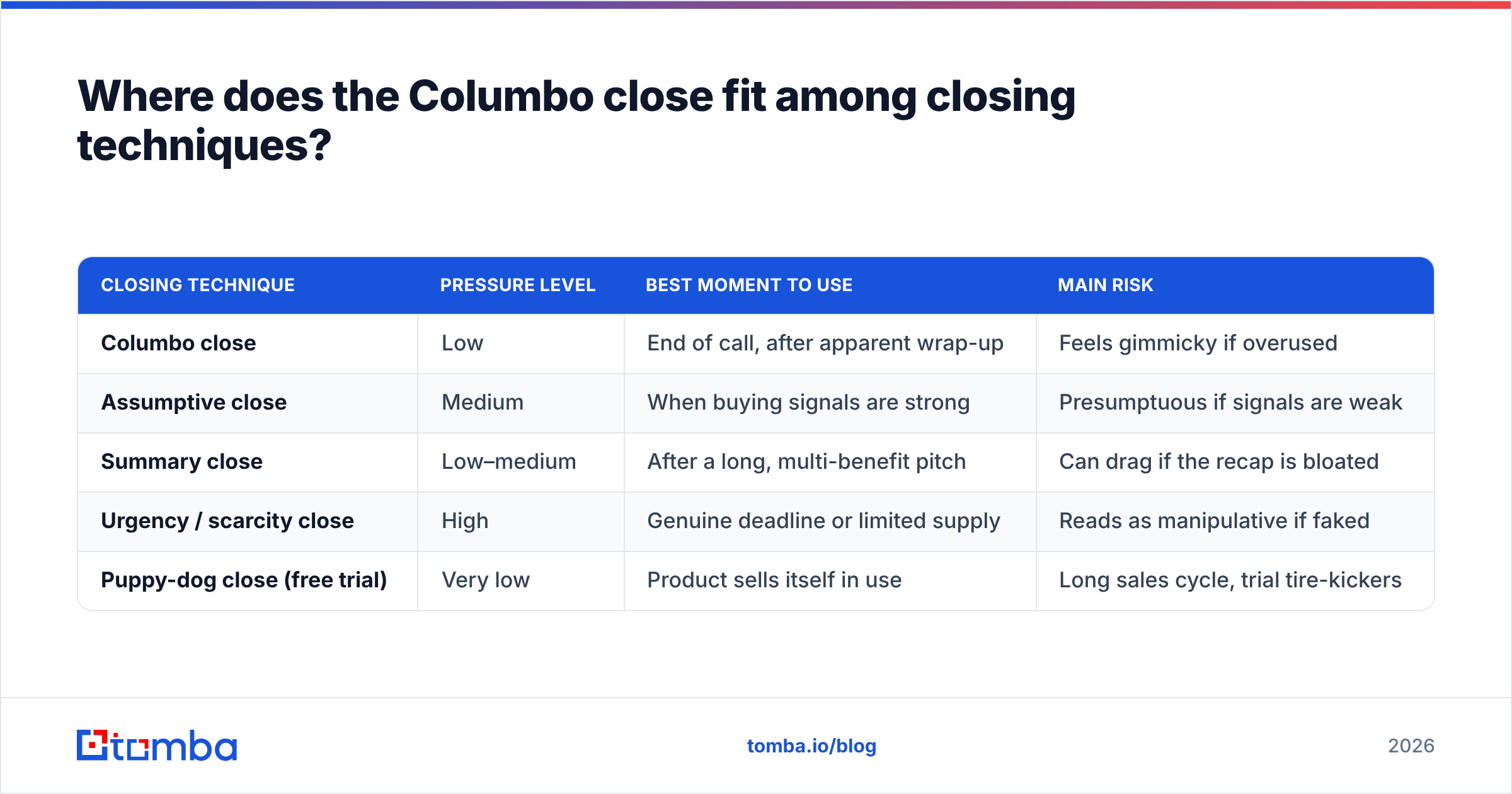
Where does the Columbo close fit among closing techniques?#
The Columbo close is a soft close — it belongs with the assumptive and summary closes, not the high-pressure "now or never" school. Here's how it stacks up against the closes most reps actually reach for.
| Closing technique | Pressure level | Best moment to use | Main risk |
|---|---|---|---|
| Columbo close | Low | End of call, after apparent wrap-up | Feels gimmicky if overused |
| Assumptive close | Medium | When buying signals are strong | Presumptuous if signals are weak |
| Summary close | Low–medium | After a long, multi-benefit pitch | Can drag if the recap is bloated |
| Urgency / scarcity close | High | Genuine deadline or limited supply | Reads as manipulative if faked |
| Puppy-dog close (free trial) | Very low | Product sells itself in use | Long sales cycle, trial tire-kickers |
The pattern is clear: the Columbo close wins on trust. It's the technique you use when the relationship matters more than squeezing a signature out of a single call — which, for most B2B deals in 2026, is exactly the situation you're in.
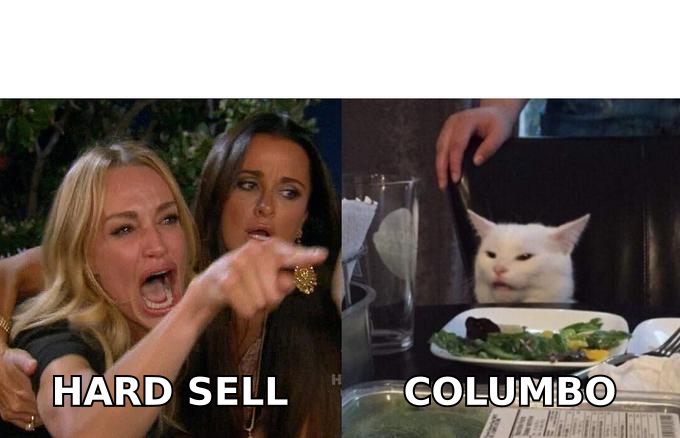
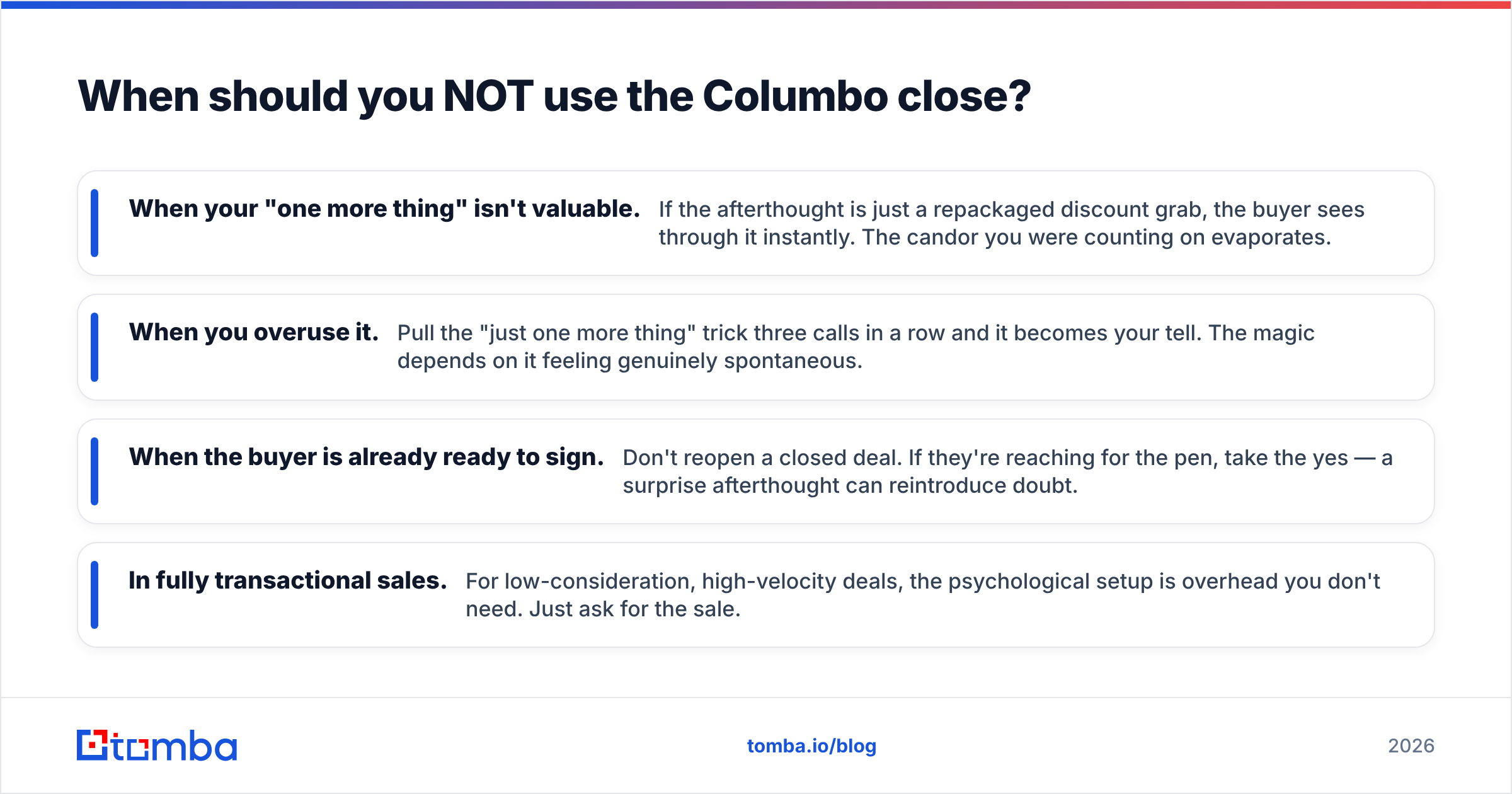
When should you NOT use the Columbo close?#
Every technique has a failure mode. The Columbo close breaks in a few predictable ways:
- When your "one more thing" isn't valuable. If the afterthought is just a repackaged discount grab, the buyer sees through it instantly. The candor you were counting on evaporates.
- When you overuse it. Pull the "just one more thing" trick three calls in a row and it becomes your tell. The magic depends on it feeling genuinely spontaneous.
- When the buyer is already ready to sign. Don't reopen a closed deal. If they're reaching for the pen, take the yes — a surprise afterthought can reintroduce doubt.
- In fully transactional sales. For low-consideration, high-velocity deals, the psychological setup is overhead you don't need. Just ask for the sale.
The line between disarming and manipulative is whether the buyer would thank you for the "one more thing" if they knew you'd planned it. Keep it on the right side of that line and the technique compounds trust instead of spending it.
What are real Columbo close examples you can steal?#
Here are field-ready lines. Notice that each one is a single, small, buyer-centered ask — never a second pitch.
To surface a hidden objection:
"I think we're good here. Oh — one more thing. Is there anything about this that, honestly, still doesn't quite sit right with you?"
To ask for the next meeting:
"Thanks again for the time. One more thing before I let you go — would it make sense to get your ops lead on a 15-minute call so they're not blindsided later?"
To reintroduce your strongest benefit:
"That's everything on my end. Actually — one thing I forgot to mention: the migration is fully done for you, so your team never touches it. Does that change anything about the timeline?"
On a cold email or follow-up:
"No worries if the timing's off. One quick thing — if I could show you the exact response rate lift in a two-line reply, would that be worth a look?"
That last one matters because the Columbo close isn't only a phone tactic. It translates cleanly into written outreach, where a low-key "P.S. — one more thing" often outperforms a formal call-to-action. If you want ready-made structures to drop it into, Tomba's cold email templates give you frames that leave room for the afterthought, and the subject line generator helps you get the open in the first place.
How does the Columbo close affect response and win rates?#
Used well, the Columbo close improves two numbers reps live and die by: response rate on written outreach and win rate on live deals. The reason is the same in both channels — you're extracting the real objection earlier, so you spend your effort on solvable deals instead of chasing polite maybes.
But a technique is only as good as the pipeline feeding it. A perfect doorknob question is worthless if you're aiming it at the wrong contact or a dead inbox. That's where process beats charisma:
- Reach the actual decision-maker. The Columbo close depends on talking to someone who can say yes. Use an accurate email finder to reach the right stakeholder instead of a shared info@ box.
- Have a phone fallback. Some afterthoughts land better by voice. A phone finder gives you a second channel when email stalls.
- Track the objection you surfaced. Log what the "one more thing" revealed in your CRM so the next touch is sharper.
The technique creates the honest moment. Your data and follow-up decide whether that honesty turns into revenue.
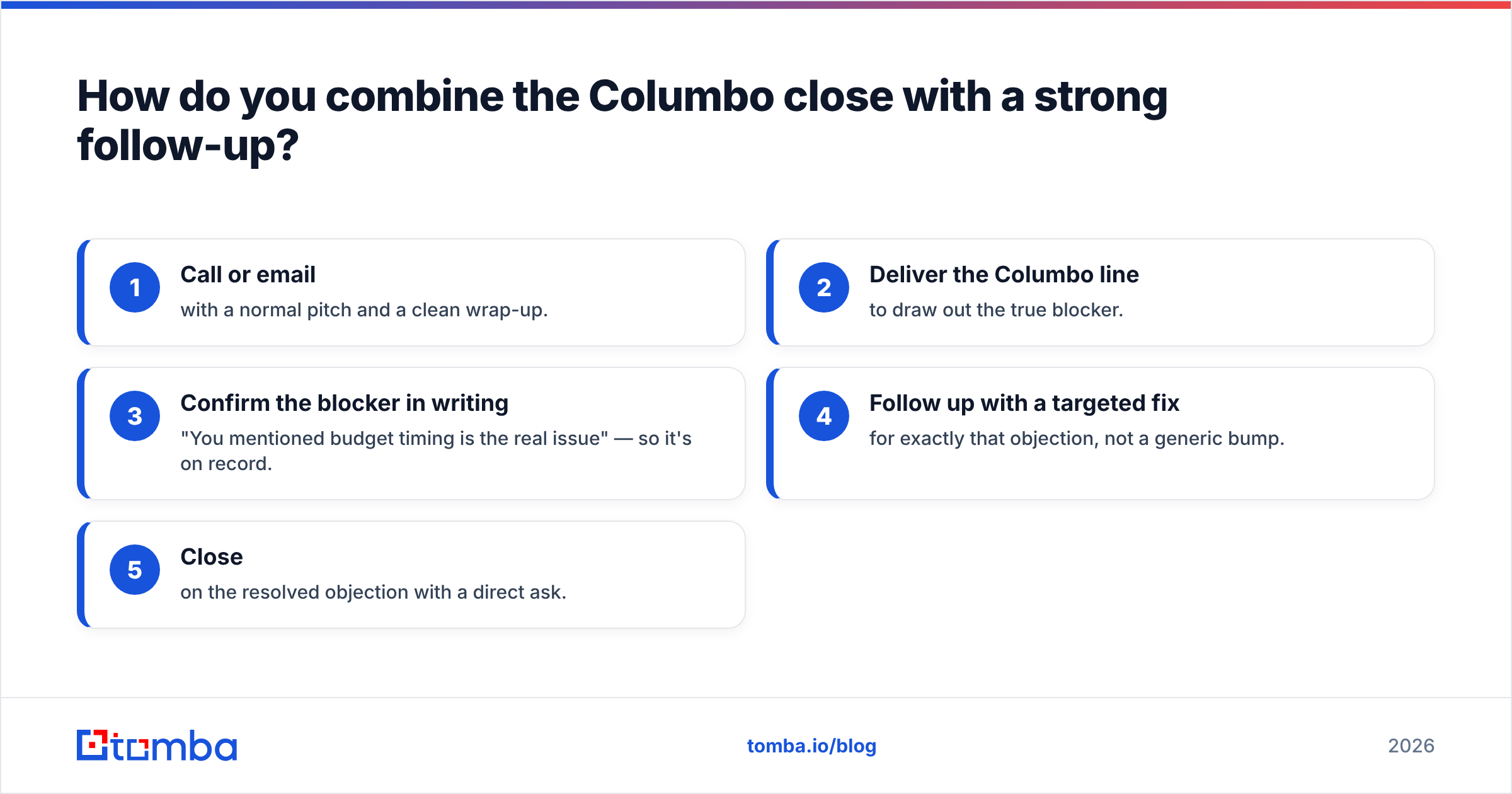
How do you combine the Columbo close with a strong follow-up?#
The single best pairing is the Columbo close plus a disciplined follow-up sequence. The afterthought surfaces the objection; the follow-up resolves it. Skip the second half and you've just collected a great insight you never acted on.
A simple loop that works:
- Call or email with a normal pitch and a clean wrap-up.
- Deliver the Columbo line to draw out the true blocker.
- Confirm the blocker in writing — "You mentioned budget timing is the real issue" — so it's on record.
- Follow up with a targeted fix for exactly that objection, not a generic bump.
- Close on the resolved objection with a direct ask.
Salesforce's guidance on modern selling reinforces the same idea: momentum comes from resolving the specific concern a buyer raised, not from re-pitching. The Columbo close is simply the cheapest way to get that concern out of them in the first place.
Is the Columbo close still relevant in 2026?#
Yes — arguably more than ever. Buyers are more guarded, more researched, and more allergic to pressure than they were a decade ago. A technique built on removing pressure fits that buyer perfectly, while hard-close tactics keep losing ground.
The one thing that has changed is the bar for the "one more thing." It has to be real. Today's buyer has seen every script, so a hollow afterthought gets pattern-matched and dismissed in seconds. The reps who win with the Columbo close in 2026 are the ones whose final question is genuinely the most useful thing they said all call.
The bottom line#
The Columbo close works because it trades pressure for candor. You let the buyer relax, then ask the one question that actually matters — and you finally get the truth. Keep the afterthought small, genuine, and buyer-centered, and it will out-close louder tactics every time.
But the smartest close in the world needs a real person on the other end of the line. Before you polish your "just one more thing," make sure you're aiming it at the right decision-maker with a verified, up-to-date email. Start free with the Tomba Email Finder — 25 searches a month at no cost, and paid plans from $49/mo when you're ready to scale — and give your Columbo close a target worth closing. Check the full Tomba pricing to match a plan to your outbound volume.
Related guides#
Ready to find emails that actually work?
Join 150,000+ professionals who stopped guessing and started sending. Free credits on signup — no credit card required.
Get the Tomba newsletter
Practical outbound tactics and product updates — once every two weeks.
About the author