The Best Common Room Alternatives for GTM Teams in 2026
Common Room is powerful, but it's not the only way to turn signals into pipeline. Here are 7 Common Room alternatives compared on price, data quality, and workflow fit.
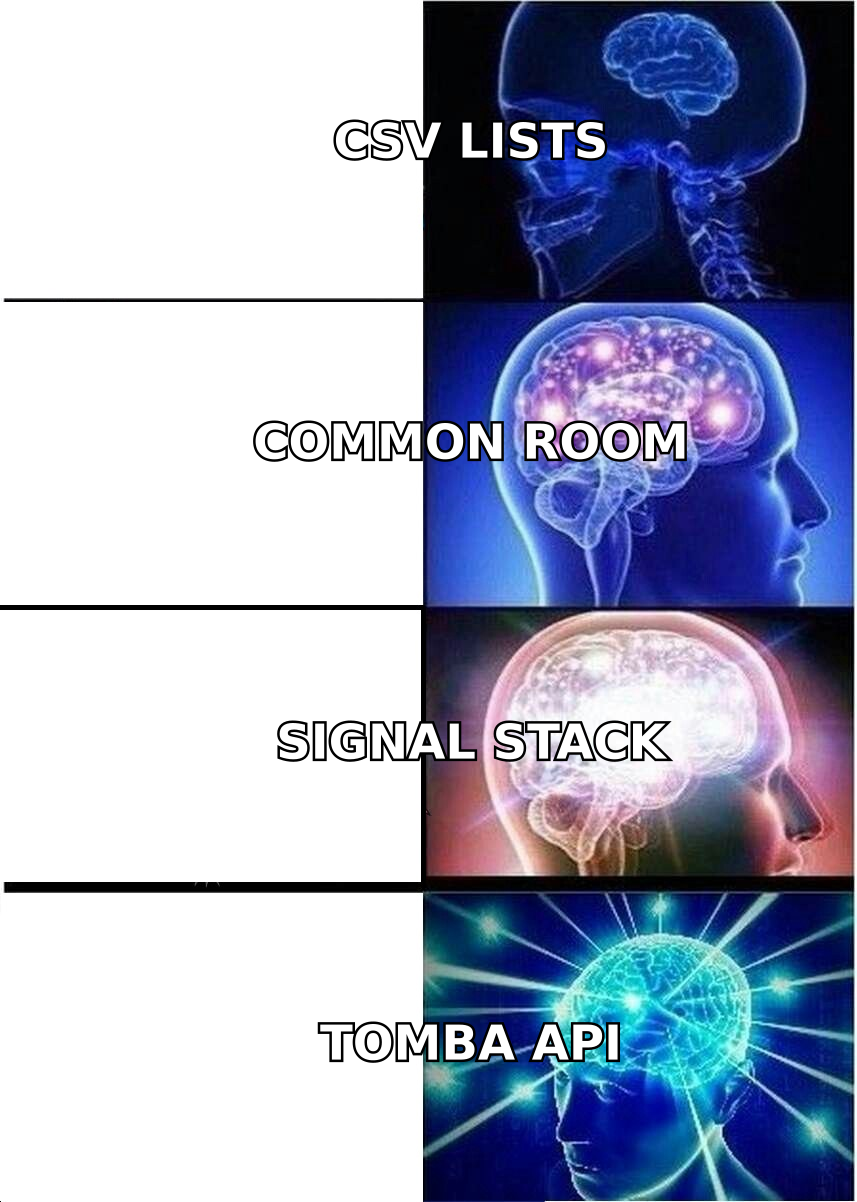
Common Room helped popularize a simple idea: your next customer is already raising their hand somewhere — in a community thread, a product signup, a GitHub star, or a job-change post — and your GTM team should catch that signal before a competitor does. It's a strong product. It's also expensive, opinionated about workflow, and overkill for a lot of teams who just need clean contact data and a few reliable triggers.
If you're evaluating Common Room alternatives in 2026, this guide compares seven options across price, data quality, signal coverage, and who each one actually fits. No fluff, no "it depends" cop-outs — just where each tool wins and where it doesn't.
TL;DR: The Shortlist#
- Best for data-first teams on a budget: Tomba — clean B2B emails, phone, and enrichment via API without a per-seat signal platform tax.
- Best full-stack signal + prospecting: Apollo.io — signals, contact data, and sequences in one place.
- Best for enterprise intent + ABM: 6sense — deep account-level intent scoring, priced for larger orgs.
- Best for revenue intelligence: Gong — conversation and deal signals, not community signals.
- Best for warm-inbound routing: Warmly and Koala — website de-anonymization and PLG signals.
- Reality check: most teams don't need Common Room's full surface area — they need reliable data plus 2–3 triggers wired into the CRM.
What Does Common Room Actually Do?#
Common Room is a customer intelligence / signal-based GTM platform. It ingests signals from communities (Slack, Discord, GitHub, forums), product usage, CRM, and social, then unifies them into person and account profiles so sales and marketing can act on "warm" activity. Think of it as a switchboard: dozens of noisy signal wires come in, and Common Room tries to route the right one to the right rep at the right moment.
That's genuinely useful if you run a large community-led or product-led motion. But three things push teams to look elsewhere:
- Price and packaging — meaningful features sit behind custom, quote-based Enterprise tiers, and per-seat costs add up fast.
- Overlap with existing tools — if you already own a CRM, an enrichment vendor, and a sequencer, you may be paying twice for stitching.
- Data depth — Common Room is strong at signals but you still need accurate emails and phone numbers to act, which often means a second data vendor anyway.
How Should You Evaluate a Common Room Alternative?#
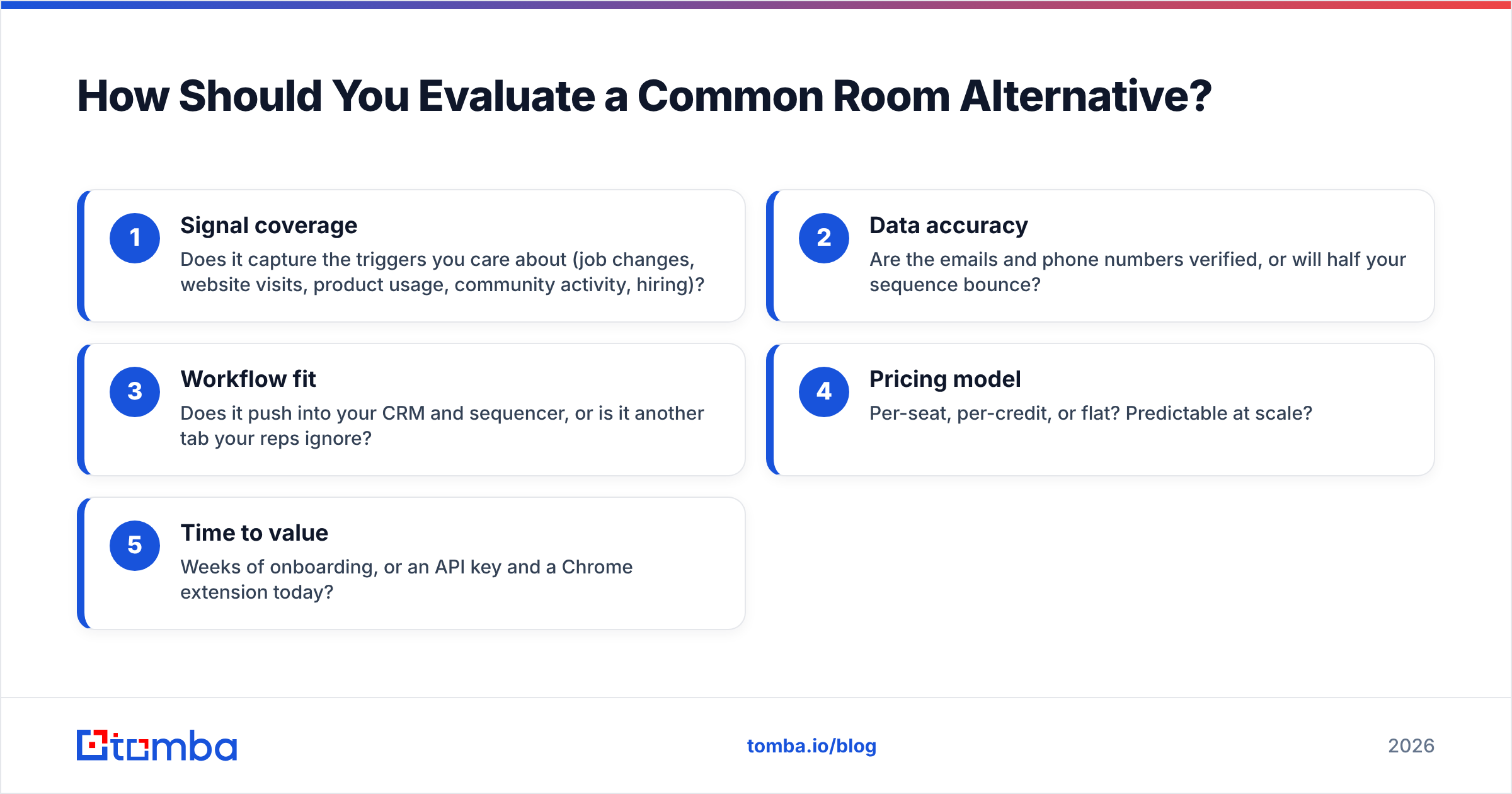
Before you demo anything, score each tool against the five things that actually move pipeline. Use this as a checklist:
- Signal coverage — Does it capture the triggers you care about (job changes, website visits, product usage, community activity, hiring)?
- Data accuracy — Are the emails and phone numbers verified, or will half your sequence bounce?
- Workflow fit — Does it push into your CRM and sequencer, or is it another tab your reps ignore?
- Pricing model — Per-seat, per-credit, or flat? Predictable at scale?
- Time to value — Weeks of onboarding, or an API key and a Chrome extension today?
A tool that nails signals but ships bad contact data just moves the bottleneck. That's why many teams pair a lightweight signal source with a dedicated data layer like Tomba's data enrichment rather than betting everything on one platform.
The 7 Best Common Room Alternatives in 2026#
1. Tomba — Best Data Layer for Signal-Based GTM#
Tomba isn't a community-signal platform, and that's the point. Most teams evaluating Common Room don't have a signal problem — they have a data problem. You can spot a warm account all day long, but without a verified email or direct dial, the signal dies.
Tomba is a B2B email-finder and enrichment stack: find email addresses by domain or name, verify them, pull direct phone numbers, and enrich records — all through a clean email finder API, Chrome extension, Sheets add-on, or bulk uploads. You wire it behind whatever surfaces your signals (website reveal, CRM, a scraped list) and it turns "we think this account is hot" into "here's the decision-maker's verified email."
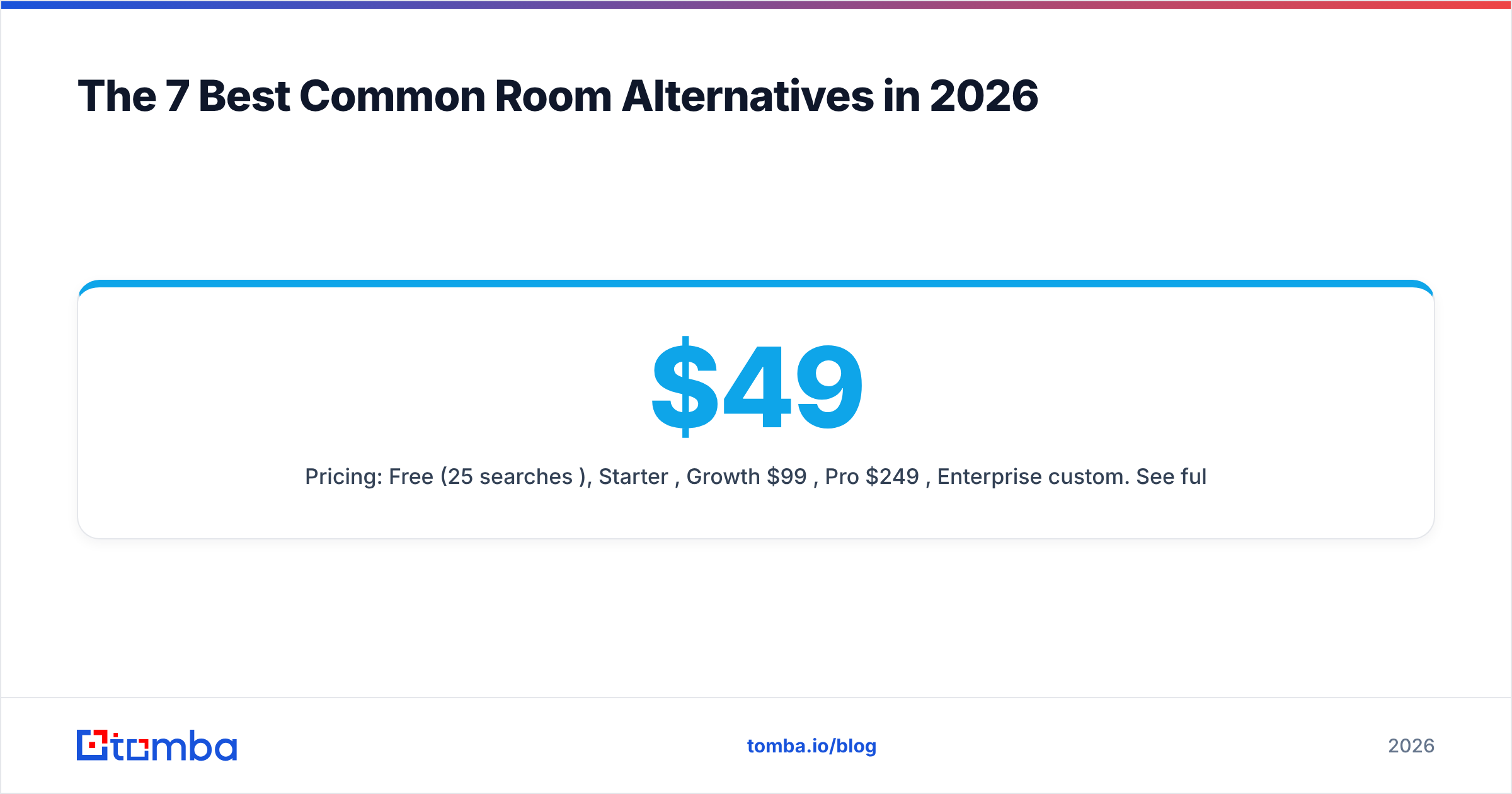
- Pricing: Free (25 searches/mo), Starter $49/mo, Growth $99/mo, Pro $249/mo, Enterprise custom. See full Tomba pricing.
- Best for: RevOps and outbound teams that want accurate data without a heavy per-seat platform.
- Watch-out: It's not a full ABM/intent suite — pair it with a signal source if you need one.
2. Apollo.io — Best All-in-One Prospecting#
Apollo bundles a contact database, buying-signal filters, enrichment, and email/call sequences into one tool. If you want signals and outreach without stitching four vendors together, it's the pragmatic pick. The trade-off: data accuracy is inconsistent on niche segments, and the cheaper tiers throttle exports. Teams frustrated by that often look at an Apollo alternative for the data layer specifically.
3. 6sense — Best Enterprise Intent & ABM#
6sense is the heavyweight for account-level intent and predictive scoring. It watches anonymous buying behavior across the web and tells you which accounts are in-market before they fill out a form. It's excellent — and priced like it. This is a platform for larger orgs with dedicated ops headcount, not a scrappy startup. If the six-figure commitment scares you, evaluate a leaner 6sense alternative before signing.
4. Gong — Best Revenue (Conversation) Intelligence#
Gong captures a different signal class entirely: what's actually said in your sales calls and emails. It surfaces deal risk, competitor mentions, and next-step gaps. It won't tell you a prospect starred your repo, but it will tell you why a deal is stalling. Complementary to Common Room rather than a direct swap — see how it compares as a Gong alternative.
5. Warmly — Best for Website De-anonymization#
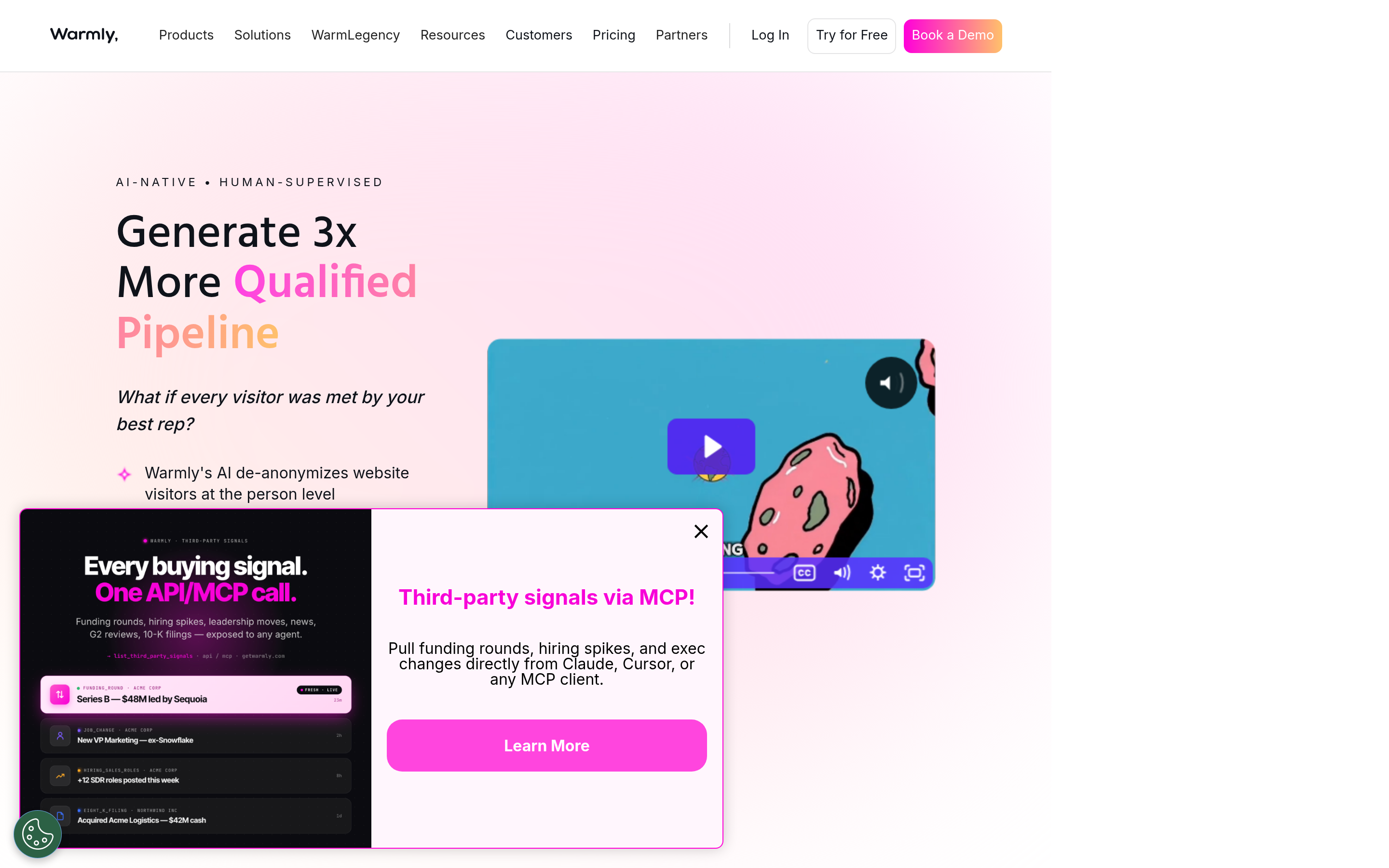
Warmly focuses on warm inbound: it identifies the companies (and sometimes people) visiting your site in real time and routes them to reps or automated plays. Tighter scope than Common Room, faster to value, friendlier pricing for mid-market. If your best signal is "they're on the pricing page right now," Warmly is purpose-built for it.
6. Koala — Best for PLG Product Signals#

Koala scores accounts based on product usage and website behavior, then pushes the hot ones to sales. It's a favorite of product-led teams who want a lightweight, developer-friendly layer instead of a full customer-intelligence suite. Narrow by design, which keeps it cheap and easy to adopt.
7. Clearbit / HubSpot Breeze — Best If You Live in HubSpot#
Now folded into HubSpot's Breeze intelligence, Clearbit-style enrichment auto-fills firmographic and contact data inside the CRM you already use. If you're a HubSpot shop, native enrichment beats bolting on a separate platform. If you're not, the value drops sharply — and a standalone Clearbit alternative may serve you better.

Common Room Alternatives Compared#
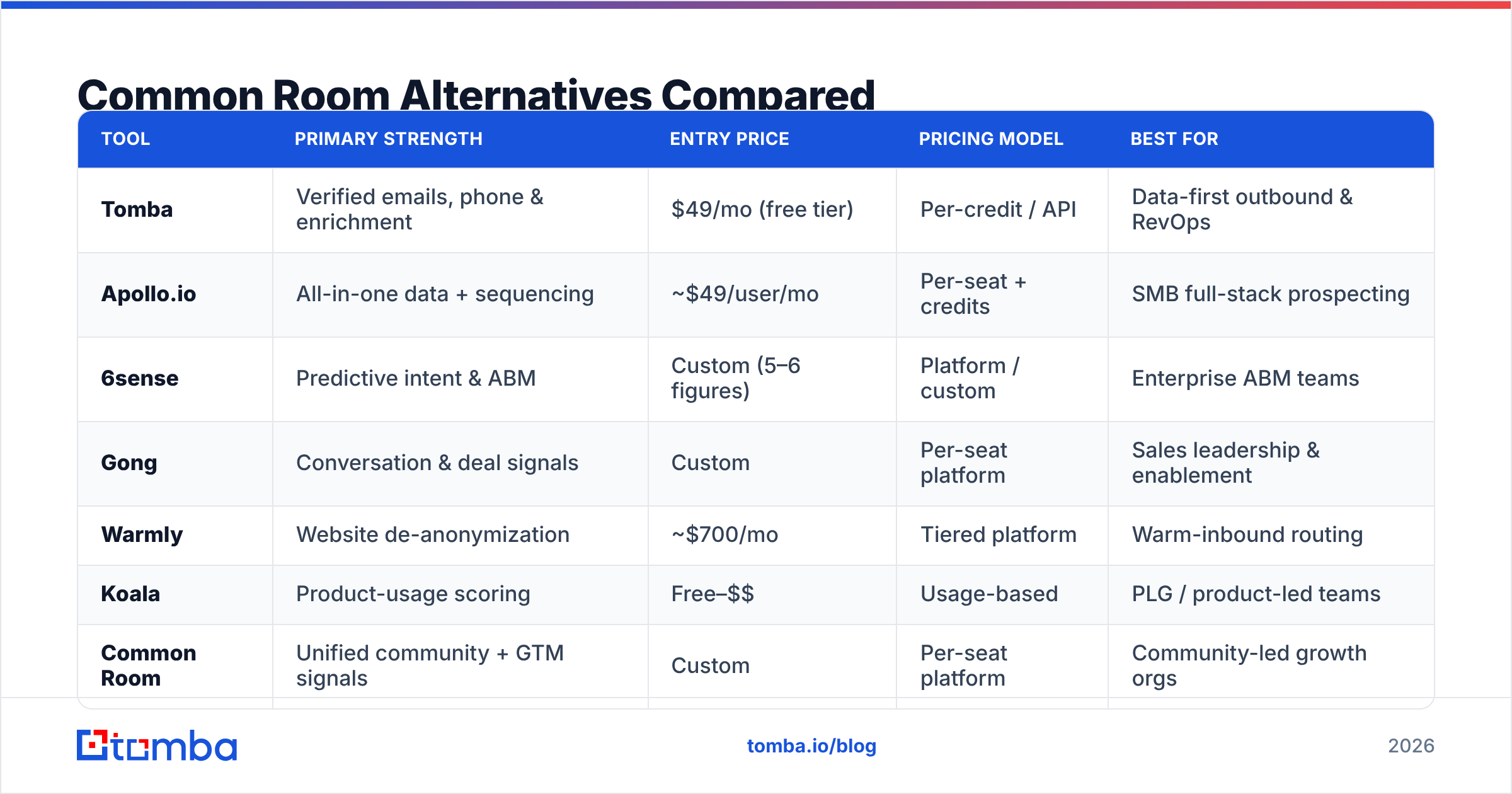
Here's the head-to-head. Pricing reflects publicly listed entry points as of 2026; enterprise tiers are quote-based across the board.
| Tool | Primary Strength | Entry Price | Pricing Model | Best For |
|---|---|---|---|---|
| Tomba | Verified emails, phone & enrichment | $49/mo (free tier) | Per-credit / API | Data-first outbound & RevOps |
| Apollo.io | All-in-one data + sequencing | ~$49/user/mo | Per-seat + credits | SMB full-stack prospecting |
| 6sense | Predictive intent & ABM | Custom (5–6 figures) | Platform / custom | Enterprise ABM teams |
| Gong | Conversation & deal signals | Custom | Per-seat platform | Sales leadership & enablement |
| Warmly | Website de-anonymization | ~$700/mo | Tiered platform | Warm-inbound routing |
| Koala | Product-usage scoring | Free–$$ | Usage-based | PLG / product-led teams |
| Common Room | Unified community + GTM signals | Custom | Per-seat platform | Community-led growth orgs |
Two takeaways from this table. First, there is no single "Common Room but cheaper" — the market has split into signal specialists (Warmly, Koala, 6sense) and data specialists (Tomba, Apollo, Clearbit). Second, the specialists usually cost less combined than one broad platform, and you keep the flexibility to swap either layer.
Is Common Room Worth It, or Should You Switch?#
Keep Common Room if you run a genuine community-led motion — a large Slack/Discord, an active open-source project, thousands of self-serve signups — and you have the ops maturity to act on unified signals. That's the exact scenario it was built for, and nothing else covers community signals as broadly.
Switch (or unbundle) if any of these are true:
- You're paying enterprise pricing to use a fraction of the features.
- Your real gap is accurate contact data, not more signals.
- Your signals already live in your CRM and you just need enrichment on top.
- You want predictable, credit-based pricing instead of per-seat platform fees.
For most mid-market outbound teams, the winning stack in 2026 is lean: one signal source you already trust (website reveal, CRM activity, or hiring triggers), plus a dependable data layer to turn those accounts into reachable people. You can build that with a B2B database and enrichment for a fraction of an all-in-one platform.
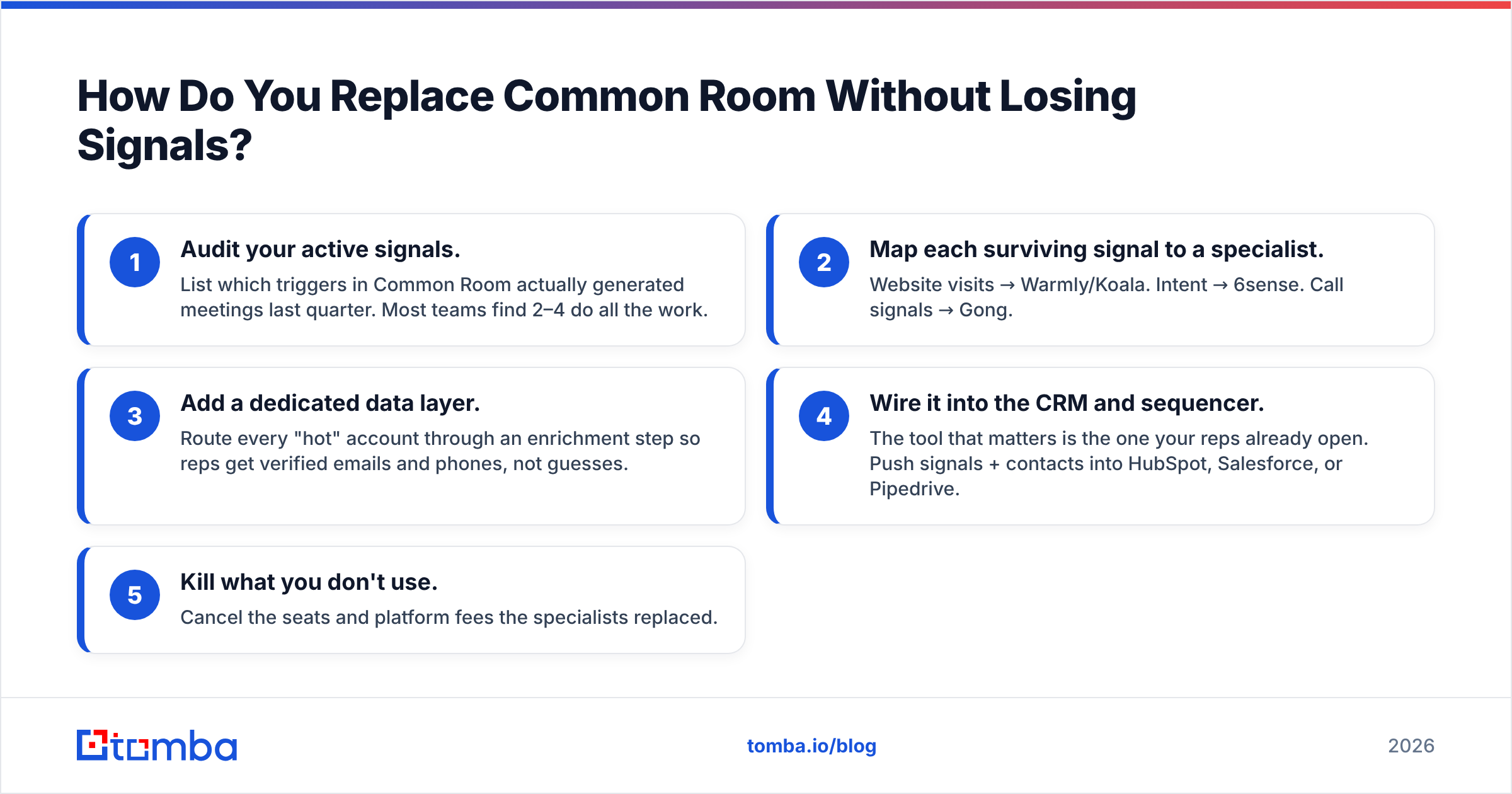
How Do You Replace Common Room Without Losing Signals?#
You don't have to rip and replace in one weekend. A staged migration keeps pipeline flowing:
- Audit your active signals. List which triggers in Common Room actually generated meetings last quarter. Most teams find 2–4 do all the work.
- Map each surviving signal to a specialist. Website visits → Warmly/Koala. Intent → 6sense. Call signals → Gong.
- Add a dedicated data layer. Route every "hot" account through an enrichment step so reps get verified emails and phones, not guesses.
- Wire it into the CRM and sequencer. The tool that matters is the one your reps already open. Push signals + contacts into HubSpot, Salesforce, or Pipedrive.
- Kill what you don't use. Cancel the seats and platform fees the specialists replaced.
Done right, you cut cost, sharpen data quality, and keep the signals that actually convert.
The Bottom Line#
Common Room is a strong platform for community-led and product-led orgs, but "strong platform" and "right for you" aren't the same thing. The best Common Room alternatives in 2026 fall into two camps — signal specialists and data specialists — and most teams win by combining a lightweight signal source with a reliable data layer instead of paying for one giant suite.
If your bottleneck is turning warm accounts into people you can actually reach, start with the data. Tomba's Email Finder gives you verified B2B emails, direct phone numbers, and enrichment through a simple API, Chrome extension, or bulk upload — free to start at 25 searches a month, and just $49/mo when you scale. Wire it behind whatever signals you keep, and stop letting good leads die at "we couldn't find their email."
Sources & further reading: Common Room, 6sense, G2 GTM software reviews.
Related guides#
Ready to find emails that actually work?
Join 150,000+ professionals who stopped guessing and started sending. Free credits on signup — no credit card required.
Get the Tomba newsletter
Practical outbound tactics and product updates — once every two weeks.
About the author