Company Growth Signals: How to Spot and Act on Them in 2026
Growth signals tell you which accounts are ready to buy right now. Here's how to find hiring, funding, and tech signals, and turn them into booked meetings.
Most reps still build lists the slow way: pick an industry, filter by headcount, and blast the whole thing. The problem is that a static list can't tell you which account is hiring five sales reps this week, which one just closed a Series B, and which one quietly swapped its CRM. Those events are company growth signals, and they are the difference between an email that lands in a warm inbox and one that dies in spam.
This guide breaks down what growth signals are, which ones actually predict a sale, and how to turn a raw signal into a booked meeting without drowning in data.
TL;DR#
- Company growth signals are observable events (hiring, funding, expansion, tech changes, leadership moves) that indicate an account is entering a buying window.
- The highest-value signals are timely and specific: a job posting from last week beats a headcount range that's six months stale.
- Signals only matter if you can act fast — pair each signal with fresh contact data so you reach the right person before the window closes.
- Build a simple scoring model (hot / warm / watch) instead of chasing every trigger.
- Tools like Tomba turn a company name into verified decision-maker emails, so a signal becomes outreach in minutes, not days.
What are company growth signals?#
A company growth signal is any public or semi-public event that suggests an organization is expanding, changing, or under pressure to buy. Think of it like weather forecasting for sales: you can't control the storm, but if you see the pressure drop, you bring an umbrella. A signal is that pressure drop — evidence that an account's needs are shifting right now.
Contrast this with firmographics, which describe what a company is (industry, size, location, revenue). Firmographics tell you who might buy eventually. Growth signals tell you who is likely to buy this quarter. A 200-person SaaS company is a firmographic. That same company posting 12 new engineering roles and opening a London office is a signal.

Signals are perishable. A funding announcement is red-hot for about 30–60 days while budget is being allocated, then it cools. That expiry date is exactly why speed matters more than volume.
Which company growth signals actually predict a sale?#
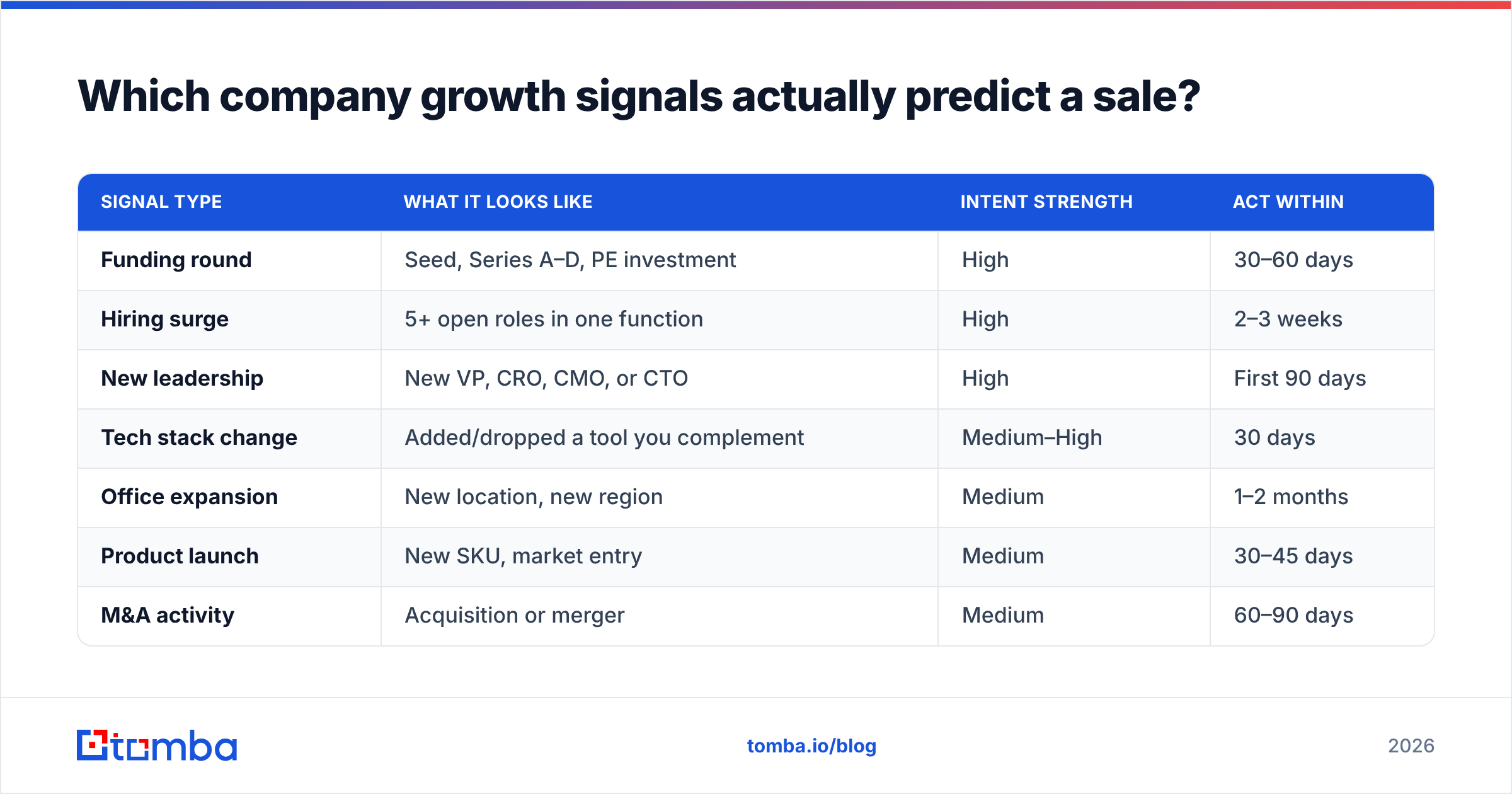
Not all signals carry the same weight. A rebrand is interesting; a doubling of the sales team is a buying trigger. Here's how the major categories stack up on intent strength and how quickly you need to move.
| Signal type | What it looks like | Intent strength | Act within |
|---|---|---|---|
| Funding round | Seed, Series A–D, PE investment | High | 30–60 days |
| Hiring surge | 5+ open roles in one function | High | 2–3 weeks |
| New leadership | New VP, CRO, CMO, or CTO | High | First 90 days |
| Tech stack change | Added/dropped a tool you complement | Medium–High | 30 days |
| Office expansion | New location, new region | Medium | 1–2 months |
| Product launch | New SKU, market entry | Medium | 30–45 days |
| M&A activity | Acquisition or merger | Medium | 60–90 days |
| Website/traffic spike | Anonymous visits to pricing pages | Medium | 1–7 days |
The pattern is clear: money moving and people moving are your strongest triggers. A new VP of Sales has budget, a mandate, and 90 days to prove they can change things — which usually means buying new tools. A funding round means an account has cash it is expected to deploy. Prioritize these over softer signals like a blog post cadence or a social-media redesign.
How do you find growth signals without buying five tools?#
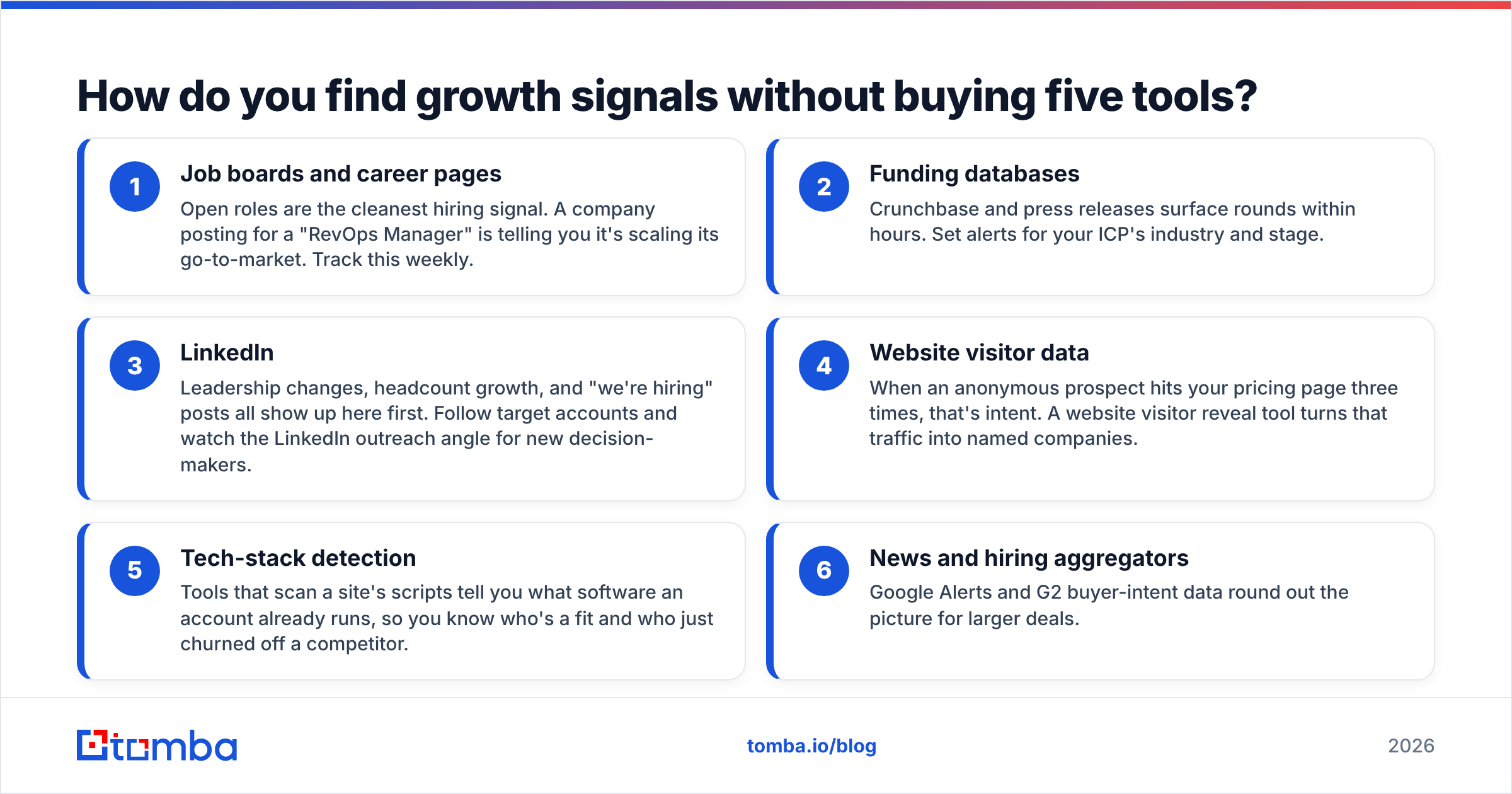
You don't need an enterprise intent platform to start. Most high-value signals are hiding in public sources. Here's a practical, low-cost stack you can assemble today.
- Job boards and career pages — Open roles are the cleanest hiring signal. A company posting for a "RevOps Manager" is telling you it's scaling its go-to-market. Track this weekly.
- Funding databases — Crunchbase and press releases surface rounds within hours. Set alerts for your ICP's industry and stage.
- LinkedIn — Leadership changes, headcount growth, and "we're hiring" posts all show up here first. Follow target accounts and watch the LinkedIn outreach angle for new decision-makers.
- Website visitor data — When an anonymous prospect hits your pricing page three times, that's intent. A website visitor reveal tool turns that traffic into named companies.
- Tech-stack detection — Tools that scan a site's scripts tell you what software an account already runs, so you know who's a fit and who just churned off a competitor.
- News and hiring aggregators — Google Alerts and G2 buyer-intent data round out the picture for larger deals.
The trick isn't collecting more signals. It's collecting the right signals for accounts that match your ideal customer profile, then wiring them into a workflow you'll actually check.
How do you turn a signal into a booked meeting?#
A signal is worthless until it becomes a conversation. This is where most teams break down — they spot a great trigger, then spend two days hunting for the right contact's email while the window closes. The workflow below keeps the gap between signal and send under an hour.
Step 1 — Qualify the signal against your ICP. A Series B is only relevant if the company fits your customer profile. Filter ruthlessly so your reps chase fit, not noise.
Step 2 — Identify the right person. A hiring surge in engineering points you to a VP of Engineering, not the CFO. Map each signal type to the persona who owns the pain it creates.
Step 3 — Get verified contact data fast. Once you know the company and the role, you need a working email. A domain search returns every known address at a company plus the org's email pattern, so you can reach a named decision-maker in seconds. For a specific person, an email finder takes a name plus a domain and returns a verified address. Layer in data enrichment to append job titles, seniority, and phone numbers before you write a word.
Step 4 — Reference the signal in your first line. "Saw you're hiring three AEs — usually that means onboarding is about to get painful" beats any generic opener. The signal is your personalization.
Step 5 — Move within the window. Send while the trigger is fresh. A funding email in week one gets read; the same email in week eight gets ignored.
What does a growth-signal scoring model look like?#
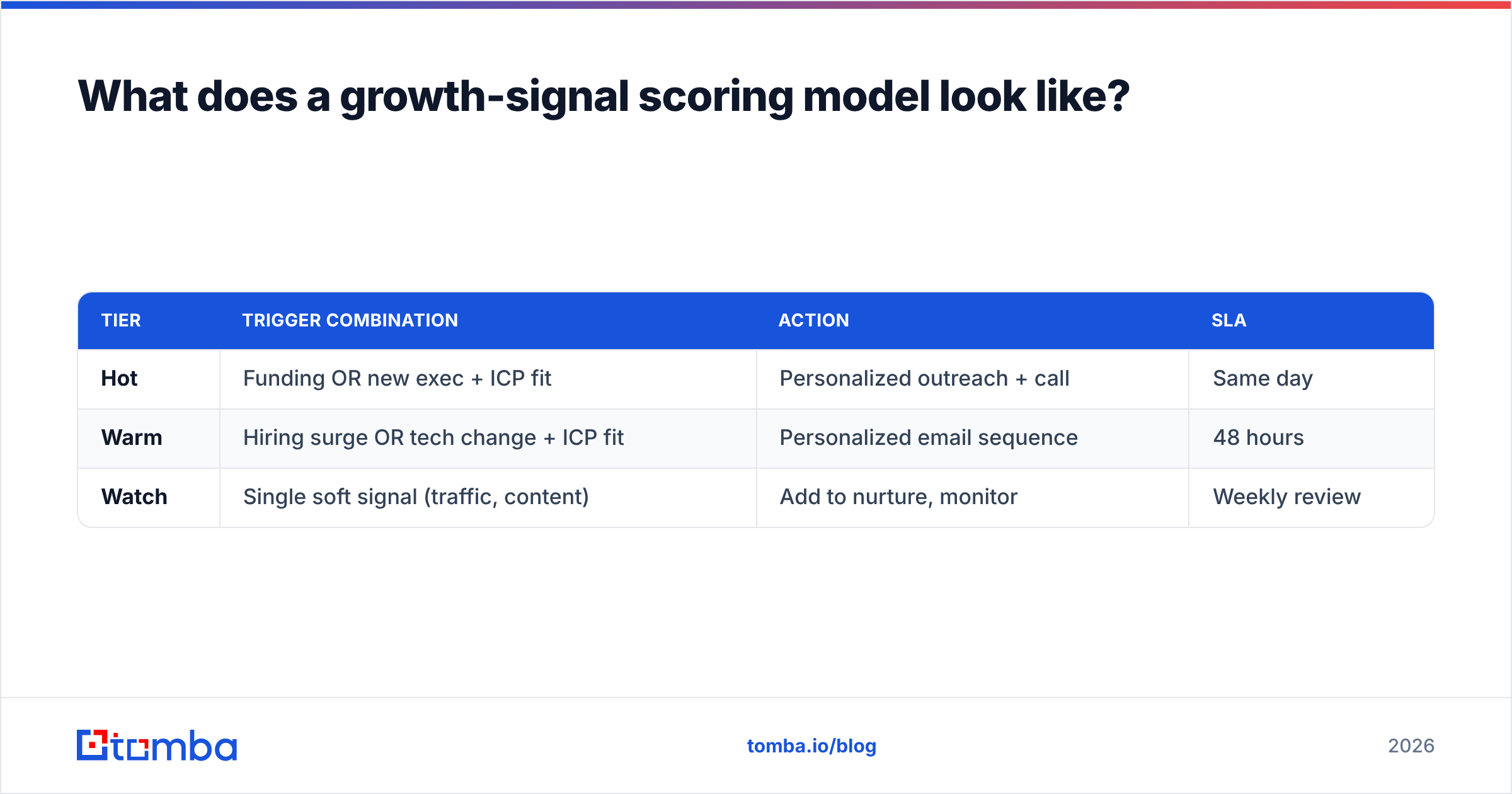
Chasing every trigger burns reps out. A lightweight scoring model keeps focus on accounts worth the effort. You don't need a data-science team — a three-tier system works.
| Tier | Trigger combination | Action | SLA |
|---|---|---|---|
| Hot | Funding OR new exec + ICP fit | Personalized outreach + call | Same day |
| Warm | Hiring surge OR tech change + ICP fit | Personalized email sequence | 48 hours |
| Watch | Single soft signal (traffic, content) | Add to nurture, monitor | Weekly review |
Assign points instead of hard tiers if you want more nuance: funding = 30, new VP = 25, hiring surge = 20, tech change = 15, traffic spike = 10. Anything over 40 is hot. The exact numbers matter less than the discipline of not treating a blog post like a budget approval.
Two rules keep the model honest. First, decay old signals — drop a trigger's score to zero after its window closes so your list stays fresh. Second, combine signals for confidence — a funding round plus a new CRO is a far stronger buy than either alone.
How is Tomba different from a full intent platform?#
Big intent platforms (6sense, Demandbase, ZoomInfo) bundle signal detection, scoring, and data into one expensive suite. They're powerful, but they're overkill and out of budget for many teams. The alternative is a modular stack: use free or cheap sources for signals, then plug in a focused data tool for the contact layer.
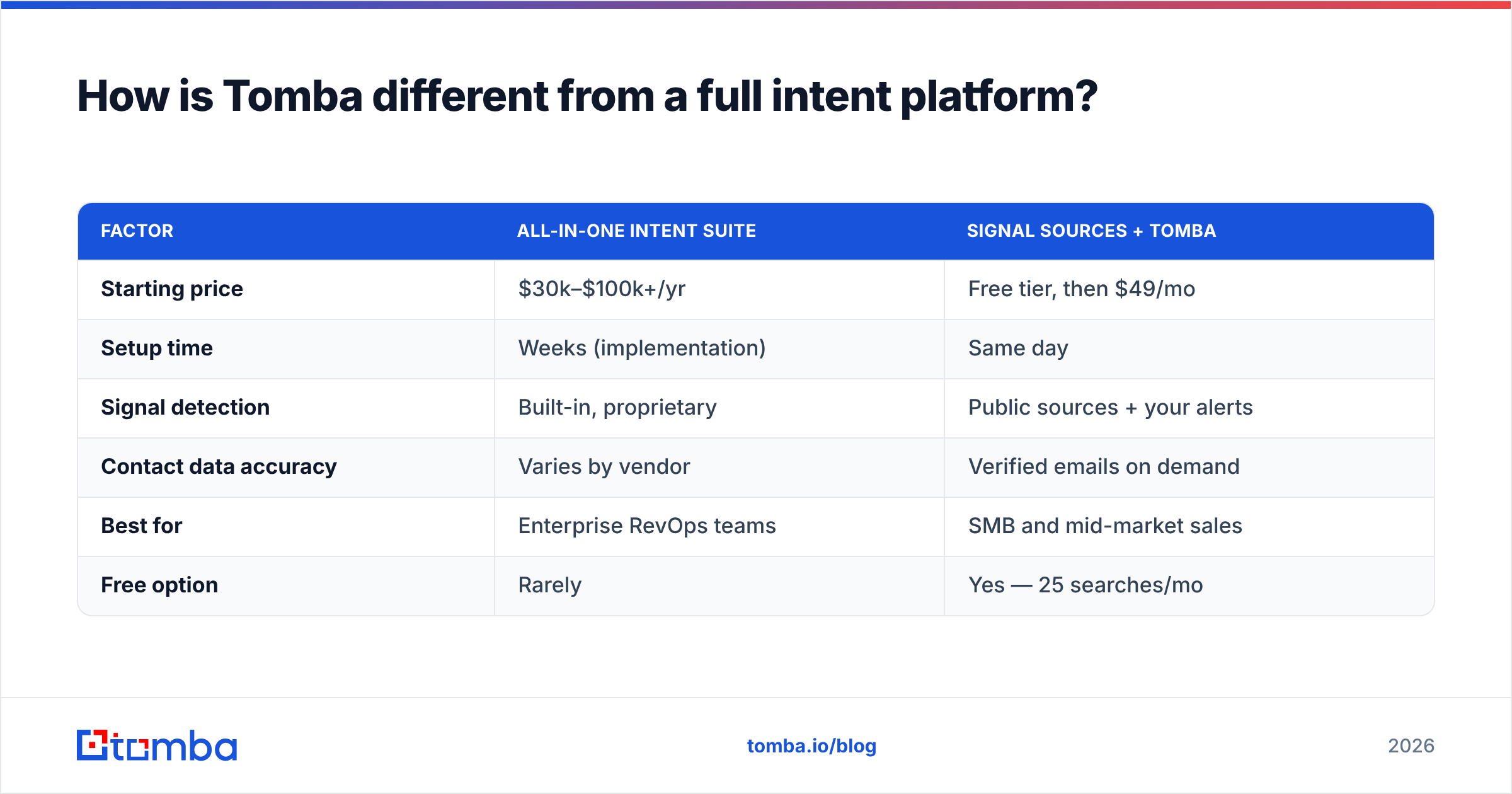
That's where Tomba fits. It doesn't try to replace your signal sources — it solves the expensive part of the workflow: turning a company name into verified, deliverable contact data the moment a signal fires. Here's how the two approaches compare.
| Factor | All-in-one intent suite | Signal sources + Tomba |
|---|---|---|
| Starting price | $30k–$100k+/yr | Free tier, then $49/mo |
| Setup time | Weeks (implementation) | Same day |
| Signal detection | Built-in, proprietary | Public sources + your alerts |
| Contact data accuracy | Varies by vendor | Verified emails on demand |
| Best for | Enterprise RevOps teams | SMB and mid-market sales |
| Free option | Rarely | Yes — 25 searches/mo |
For most B2B teams, the modular route wins on cost and speed. You keep control of which signals matter, and you pay only for the data you pull. Reputable B2B data providers like BookYourData can supply bulk lists for your ICP, while Tomba handles on-demand, real-time lookups the instant a trigger appears — the two complement each other rather than compete.
Curious about the numbers? The full Tomba pricing breaks down each tier, from the free plan (25 searches/mo) up to Growth at $99/mo for teams running signal-based outbound at volume.
What mistakes kill a signal-based strategy?#
Even good teams sabotage themselves. Watch for these four traps.
- Acting on stale signals. A "hiring" flag from a scraped database that's three months old is not a signal — it's a fossil. Verify recency before you send.
- Ignoring fit. A signal without ICP alignment is a distraction. A fast-growing company that will never buy your product is still a "no."
- Skipping the contact layer. The best-timed message to the wrong person, or to a bounced email, is a wasted signal. Verify every address before outreach to protect email deliverability.
- No follow-through system. Signals arrive daily; without a CRM workflow and clear SLAs, they pile up unactioned. Automate the routing.
Avoid these and your reply rate climbs, because every message you send is timely, relevant, and reaching a real inbox.
How do you get started this week?#
Start narrow. Pick one signal type — hiring surges are the easiest to track — and one source (a job board plus LinkedIn). Build a list of 25 accounts that fired that signal in the last two weeks and match your ICP. For each, find the decision-maker's verified email, reference the signal in your opener, and send. Measure reply rate against your usual cold list. You'll see the difference in a week.
Once the motion works, layer in a second signal (funding), then a third (tech change), and formalize the scoring model above. Growth signals compound: the more triggers you track, the more precisely you can time every touch.
The bottleneck is almost never finding signals — they're everywhere. It's converting a signal into a verified contact fast enough to matter. That's the gap Tomba's Email Finder closes: drop in a name and company from any signal source and get a verified, deliverable email in seconds, so you reach the right buyer while the window is still open. Start free with 25 searches a month, and turn your next growth signal into a booked meeting before your competitors even notice it fired.
Related guides#
Ready to find emails that actually work?
Join 150,000+ professionals who stopped guessing and started sending. Free credits on signup — no credit card required.
Get the Tomba newsletter
Practical outbound tactics and product updates — once every two weeks.
About the author