CompanyData.com, BoldData vs Apollo.io: B2B Data Compared
CompanyData.com, BoldData, and Apollo.io all sell B2B data—but they solve very different problems. Here's an honest breakdown of accuracy, pricing, coverage, and which one actually fits your outbound motion.
TL;DR
- CompanyData.com and BoldData are list vendors. You buy a static export of company and contact records, often as a one-time CSV. Coverage is great. Freshness is weak.
- Apollo.io is a living sales-intelligence platform. It gives you search, sequences, and a self-refreshing contact database. You pay per seat with credit limits.
- These three are not the same product. Pick the tool that matches your motion: bulk market mapping, daily prospecting, or verified outbound.
- Static B2B lists decay 25–30% each year. Verify whatever you buy before you send. A high bounce rate wrecks your sender reputation.
- Is your bottleneck finding and confirming decision-maker emails? A dedicated finder plus verifier (like Tomba) is cheaper and more accurate than a full platform seat you barely use.
Why compare CompanyData.com, BoldData vs Apollo.io at all?#
Buyers keep lumping these three together. They shouldn't. When you search "CompanyData.com, BoldData vs Apollo.io," you usually mean one thing: where do I get B2B contact data that won't bounce and won't blow my budget?
The honest answer is simple. These three sit in different categories. Two of them sell you a file. One sells you a workflow. Confuse the two, and you pay platform prices for list-vendor value. Or you buy a 100,000-row CSV that is 30% dead on arrival.
Let's define each one before we score it.
What is CompanyData.com?#
CompanyData.com is a B2B data provider. It focuses on company-level firmographic records: business names, addresses, industry codes, employee counts, revenue bands, and phone numbers. You get them as downloadable databases or via API. Its sweet spot is breadth of company coverage for market sizing, territory planning, and direct mail.
Where it is strong: total addressable market builds, ICP filtering by SIC/NAICS code, and offline channels. Where it is weaker: individual email deliverability. Company databases are great at "which firms exist." They are less reliable at "which inbox reaches the VP of Sales today."
What is BoldData?#
BoldData is an Amsterdam-based B2B database vendor. It sells targeted contact and company lists across 300M+ companies worldwide. It has a strong reputation for international and European coverage. You brief them on a segment—industry, country, job title—and they deliver a tailored file. It is often a one-time purchase, not a subscription.
BoldData is a solid option when you need country-specific or hard-to-reach international segments. US-centric platforms cover those poorly. The trade-off is the one every list vendor faces. The moment a CSV is delivered, it starts aging. People change jobs. Companies rebrand. Domains lapse.
What is Apollo.io?#
Apollo.io is a sales-intelligence and engagement platform. It combines a 275M+ contact database with search filters, email sequencing, a Chrome extension, and CRM sync. Unlike a list vendor, Apollo is subscription software. You pay per seat, get monthly credits, and work inside its UI to find, enrich, and email prospects.
Apollo's advantage is the all-in-one workflow. You prospect, enrich, and sequence without leaving the tab. Its limits are credit caps, data accuracy that varies by region and seniority, and per-seat costs that climb fast as your team grows. Independent reviews on G2 praise coverage. They also flag inconsistent email accuracy on senior and non-US contacts.
CompanyData.com, BoldData vs Apollo.io: the comparison table#
Here is the head-to-head on the attributes that change your outcomes.
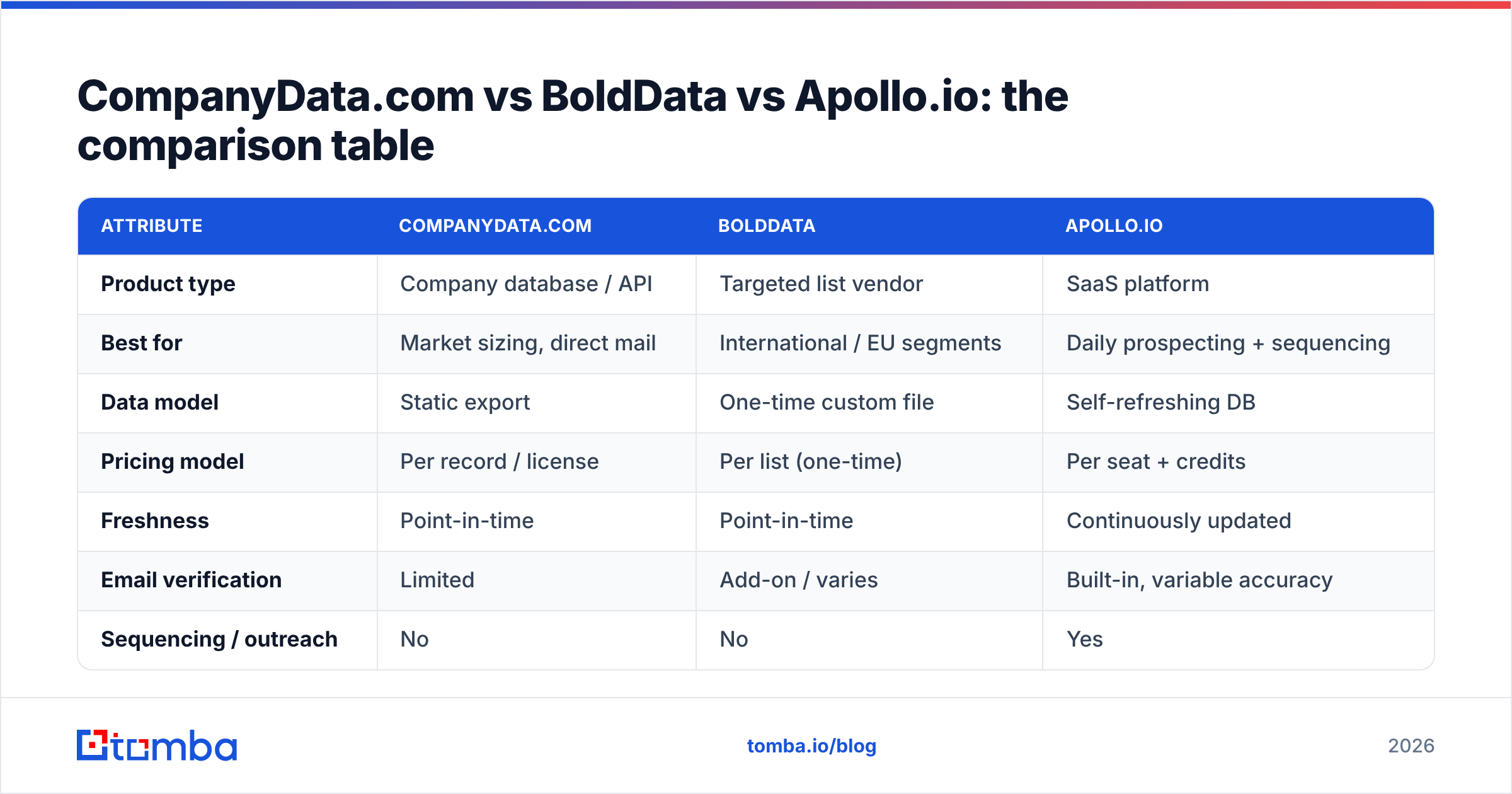
| Attribute | CompanyData.com | BoldData | Apollo.io |
|---|---|---|---|
| Product type | Company database / API | Targeted list vendor | SaaS platform |
| Best for | Market sizing, direct mail | International / EU segments | Daily prospecting + sequencing |
| Data model | Static export | One-time custom file | Self-refreshing DB |
| Pricing model | Per record / license | Per list (one-time) | Per seat + credits |
| Freshness | Point-in-time | Point-in-time | Continuously updated |
| Email verification | Limited | Add-on / varies | Built-in, variable accuracy |
| Sequencing / outreach | No | No | Yes |
| Free tier | No | No | Yes (limited credits) |
Read this table as a fork, not a leaderboard. Do you need a wall-to-wall list of every manufacturer in Germany? A list vendor wins. Do you need to email 40 new contacts today and log the replies? A platform wins. Neither is "better." They just answer different questions.
Which one is most accurate for email outreach?#
Trust none of them blind. Buyers underestimate this part: B2B data decays 25–30% per year. Static lists can't tell you which rows died since delivery. Apollo refreshes continuously, which helps. But its accuracy still swings by seniority and geography.
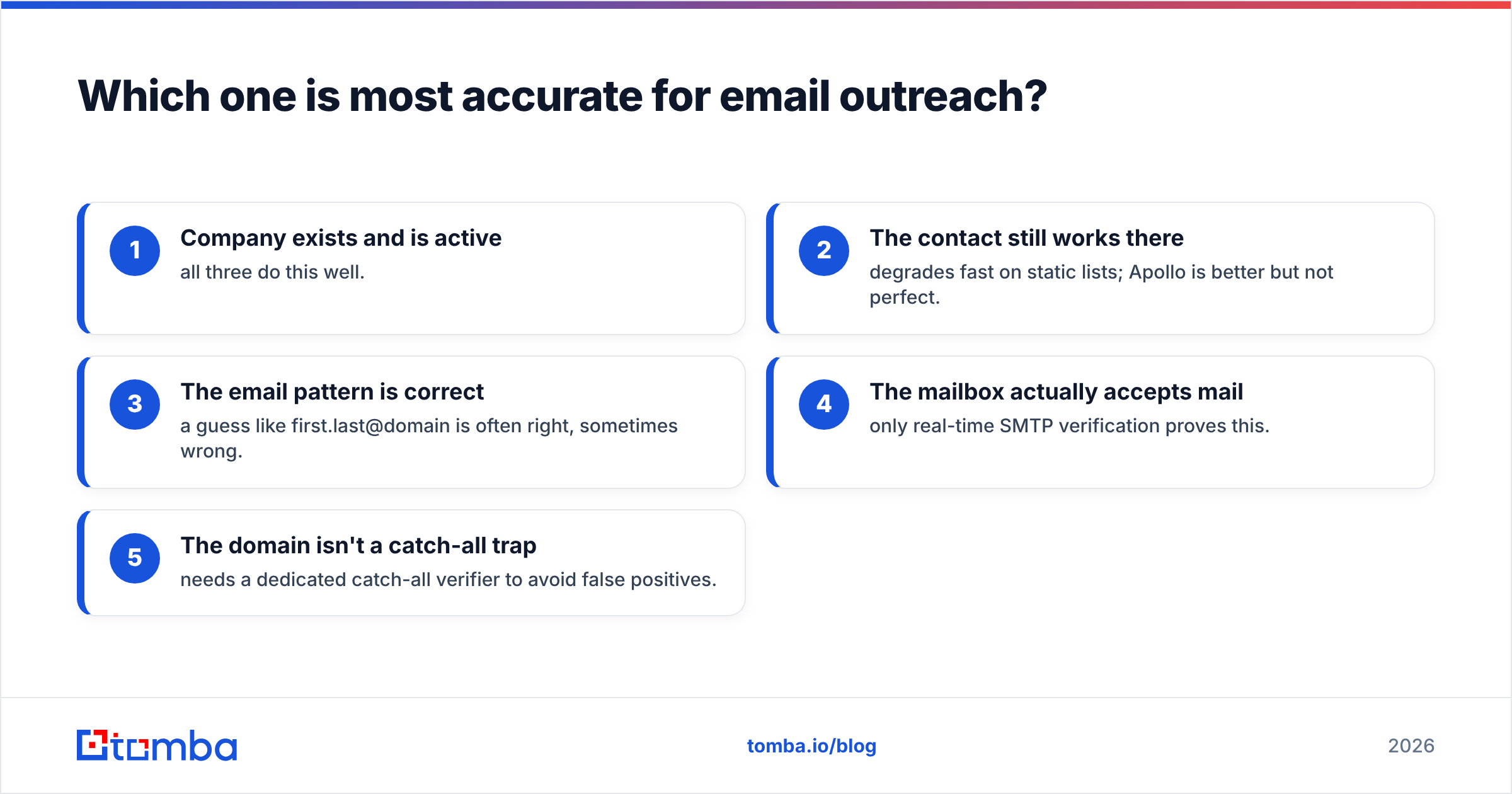
Here is the practical hierarchy of what "accurate" means for cold email:
- Company exists and is active — all three do this well.
- The contact still works there — this degrades fast on static lists. Apollo is better, but not perfect.
- The email pattern is correct — a guess like first.last@domain is often right. Sometimes it's wrong.
- The mailbox actually accepts mail — only real-time SMTP verification proves this.
- The domain isn't a catch-all trap — you need a dedicated catch-all verifier to avoid false positives.
Steps 4 and 5 decide deals and sender reputation. They are exactly where a downloaded CSV can't help. Whatever list you buy, run it through an email verifier before your first send. A 3% bounce rate is the line between the inbox and spam.

What does each one cost?#
Pricing philosophies differ as much as the products.
- CompanyData.com — licensing is usually volume-based, priced per record or per database license. That favors large one-time pulls. It gets expensive for continuous refreshes.
- BoldData — quote-based per list. You pay once for a delivered segment. Refreshing means buying again. It is cost-effective for a single, well-defined campaign. It is less so for ongoing prospecting.
- Apollo.io — freemium with paid per-seat tiers. Credits gate exports and enrichment. The monthly cost is predictable. But seat and credit ceilings mean a bigger team multiplies the bill.
The hidden cost across all three is waste. You pay for records you never contact. Or you re-buy data you already had because it went stale. A usage-based finder-plus-verifier stack avoids that. It charges you for lookups you actually run.
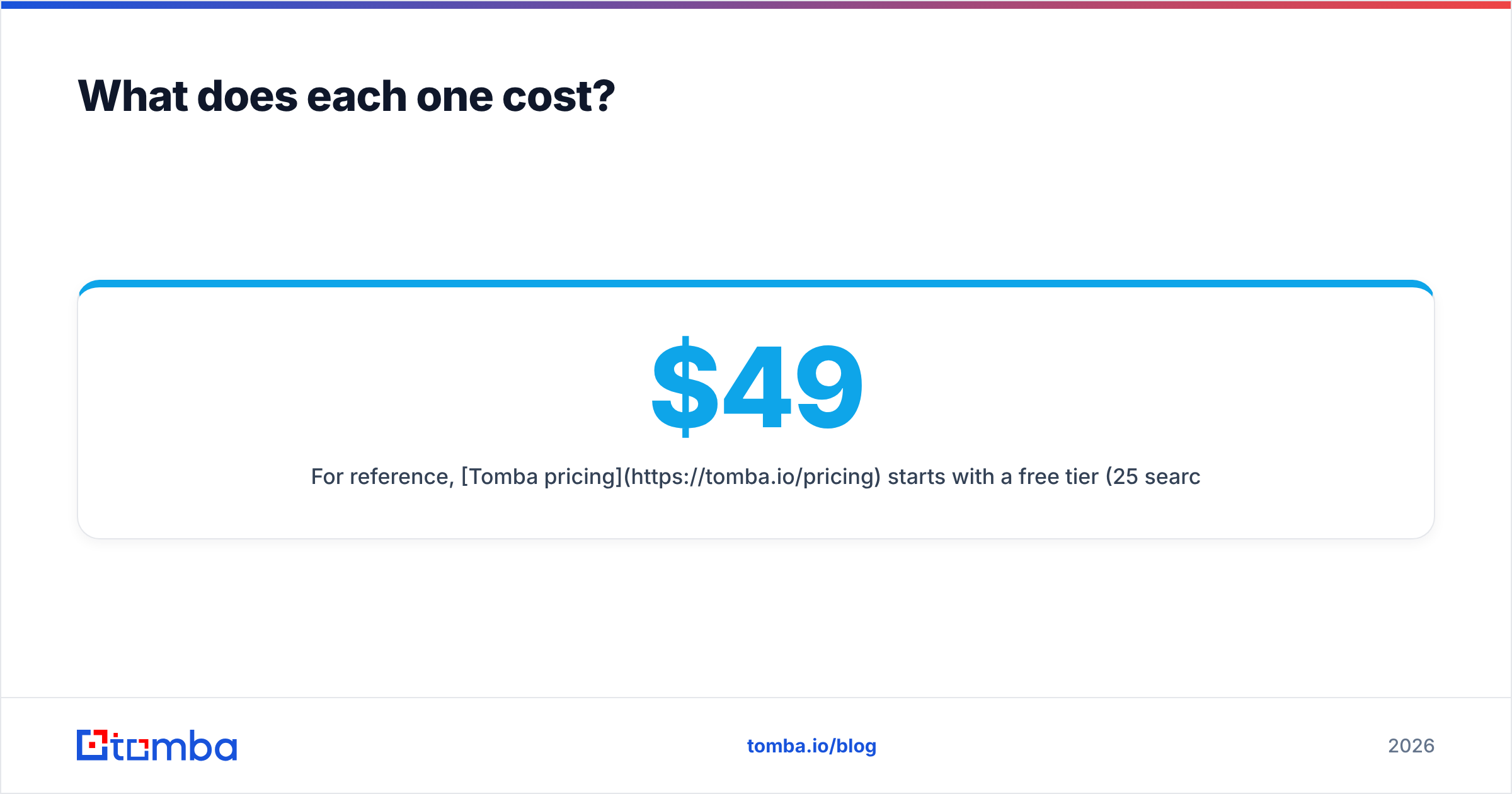
For reference, Tomba pricing starts with a free tier (25 searches/month). Then Starter is $49/mo, Growth is $99/mo, and Pro is $249/mo. It is credit-based, so you pay for what you find. There is no per-seat license or one-time bulk file you can't refresh.
When should you pick a list vendor over a platform?#
Pick CompanyData.com or BoldData when:
- You need maximum firmographic breadth for market sizing or territory design.
- Your channel is direct mail, telemarketing, or offline, where email deliverability matters less.
- You want a specific international segment (BoldData's EU/global strength) that US-centric tools miss.
- You're comfortable verifying and refreshing the file yourself before outreach.
Pick Apollo.io when:
- You want prospecting, enrichment, and sequencing in one tab.
- Your team lives inside a single tool and values workflow over raw list size.
- You're fine working within credit and seat limits.
Pick a dedicated finder + verifier (Tomba) when:
- Your real bottleneck is finding and confirming decision-maker emails, not managing a platform.
- You want usage-based pricing without per-seat lock-in.
- You need clean data piped into your CRM or sequencer via data enrichment and integrations.
How does Tomba fit into this comparison?#
Tomba isn't an all-in-one engagement suite or a bulk list broker. It's a focused email finder and verifier. It sits upstream of whatever you already use—Apollo, a CRM, a cold-email tool, or a raw list from BoldData.
Here is the workflow most teams land on:
- Build your target company list from any source, including a list vendor.
- Use domain search or the Tomba Email Finder to pull decision-maker emails by domain, name, or role.
- Verify every address, including catch-all domains, so your bounce rate stays under 3%.
- Push clean, enriched contacts into your sequencer or CRM.
That keeps your data fresh at the moment of send. A static CSV can never promise that. It also means you're not paying platform seat prices to do the one job—reliable email discovery—that actually gates your pipeline.
The honest verdict#
There's no universal winner, only a best fit:
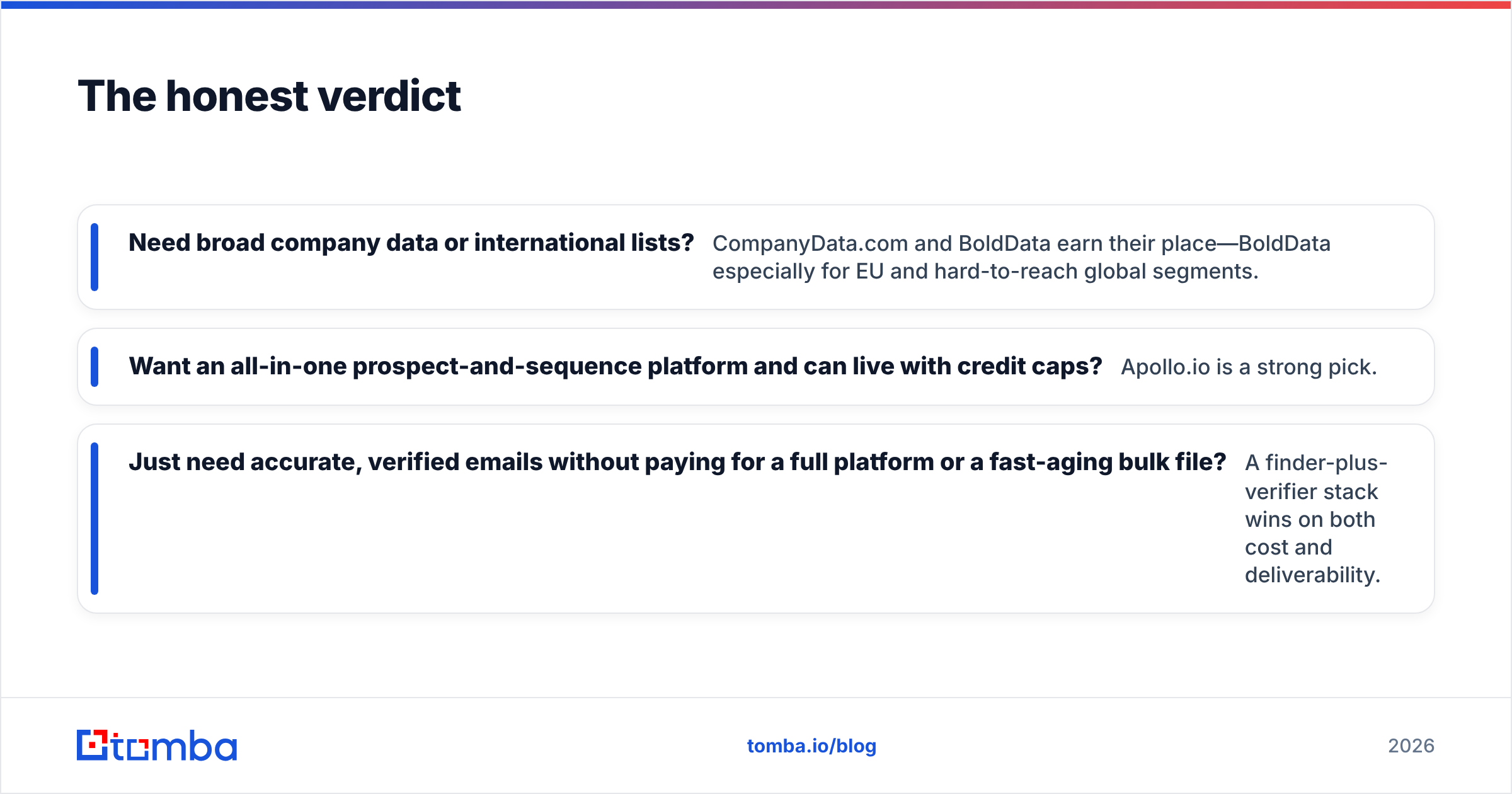
- Need broad company data or international lists? CompanyData.com and BoldData earn their place. BoldData is especially strong for EU and hard-to-reach global segments.
- Want an all-in-one prospect-and-sequence platform and can live with credit caps? Apollo.io is a strong pick.
- Just need accurate, verified emails without a full platform or a fast-aging bulk file? A finder-plus-verifier stack wins on cost and deliverability.
Most teams end up combining them. They use a list vendor or Apollo for discovery. Then they add a verifier layer to make sure what they send actually arrives.
Start with data you can trust#
Before you commit to a seat license or a five-figure list, fix the part that decides everything: deliverability. Run your prospects through the Tomba Email Finder to pull and verify decision-maker emails on demand. A free tier lets you test accuracy on your own target accounts. Find the right inbox, confirm it's live, and keep your sender reputation clean. Then let CompanyData.com, BoldData, or Apollo handle whatever they do best.
Related guides#
Ready to find emails that actually work?
Join 150,000+ professionals who stopped guessing and started sending. Free credits on signup — no credit card required.
Get the Tomba newsletter
Practical outbound tactics and product updates — once every two weeks.
About the author