Companydatacom BoldData vs Datanyze: B2B Data Compared
Companydatacom, BoldData, and Datanyze all sell B2B company data — but they solve very different problems. Here's an honest breakdown of accuracy, pricing, coverage, and which one fits your workflow in 2026.
Weighing Companydatacom BoldData vs Datanyze for B2B data? Here's the short version first, then the full breakdown of accuracy, pricing, and coverage.
TL;DR
- Companydata.com is a bulk firmographic list vendor. It's strong for buying broad company records by industry, geography, or SIC code. It's weaker on verified, contact-level email data.
- BoldData is a Netherlands-based, human-curated list broker. It has deep global coverage and GDPR-conscious sourcing, so it's great for targeted international mailing lists. The trade-off is that it's slower and less self-serve.
- Datanyze (owned by ZoomInfo) is a lightweight technographic and contact tool built for reps browsing LinkedIn. It's cheap, but coverage and freshness lag the bigger platforms.
- None of the three is primarily an email finder. If your real bottleneck is turning a company name into a verified inbox, a dedicated tool like Tomba Email Finder plus data enrichment fills the gap they leave.
- Pick by job-to-be-done: bulk lists → Companydata.com or BoldData; rep-level prospecting → Datanyze; deliverable contact data → an email-first stack.
Why compare Companydatacom, BoldData, and Datanyze at all?#
Because they get lumped together in "B2B data provider" searches, and they shouldn't be. All three sell information about companies. But they sit at different points of the funnel. Companydata.com and BoldData are list vendors: you tell them a segment, they hand you a file. Datanyze is a rep-facing lookup tool: you're on a prospect's site or LinkedIn profile and want quick context.
Think of it like buying produce. Companydata.com and BoldData are the wholesale market. You order a pallet of one crop and it arrives in bulk. Datanyze is the corner grocer: convenient and per-item, but limited stock. Confuse the two and you pay for a pallet when you needed a handful. Or you scrape one profile at a time when you needed 10,000 records.
This post breaks down where each wins and where each disappoints. It also shows where a modern email-first workflow beats all three at the one task that matters: reaching a real human.
What is Companydata.com best at?#
Companydata.com positions itself as a bulk business-data marketplace. It sells firmographics, company counts by segment, and downloadable lists. You filter by industry code, revenue band, employee size, and location. The pitch is volume and self-serve list building.
Where it shines:
- Breadth of firmographic filters. SIC/NAICS codes, headcount tiers, and geography are first-class. That's handy for TAM sizing and territory planning.
- Transactional pricing. You can often buy a one-off list without a long annual contract. That's attractive for a single campaign.
- Speed to a raw file. Need "5,000 manufacturing companies in Texas with 50–200 employees"? You get a CSV quickly.
Where it disappoints:
- Contact-level depth is thin. You often get company records and generic info@ addresses. You rarely get named, role-specific, verified contacts.
- Freshness is a question mark. Static lists decay fast. People change jobs at roughly 2–3% per month, so a file ages the day you download it.
- Verification is on you. Run the emails through an email verifier before you send, or you'll torch your sender reputation.
What is BoldData known for?#
BoldData is an Amsterdam-based data broker. It takes a curated, human-assisted approach to global company data, claiming 300M+ companies across 200+ countries. It's a favorite for international direct-mail and account targeting where local coverage matters.
Where it shines:
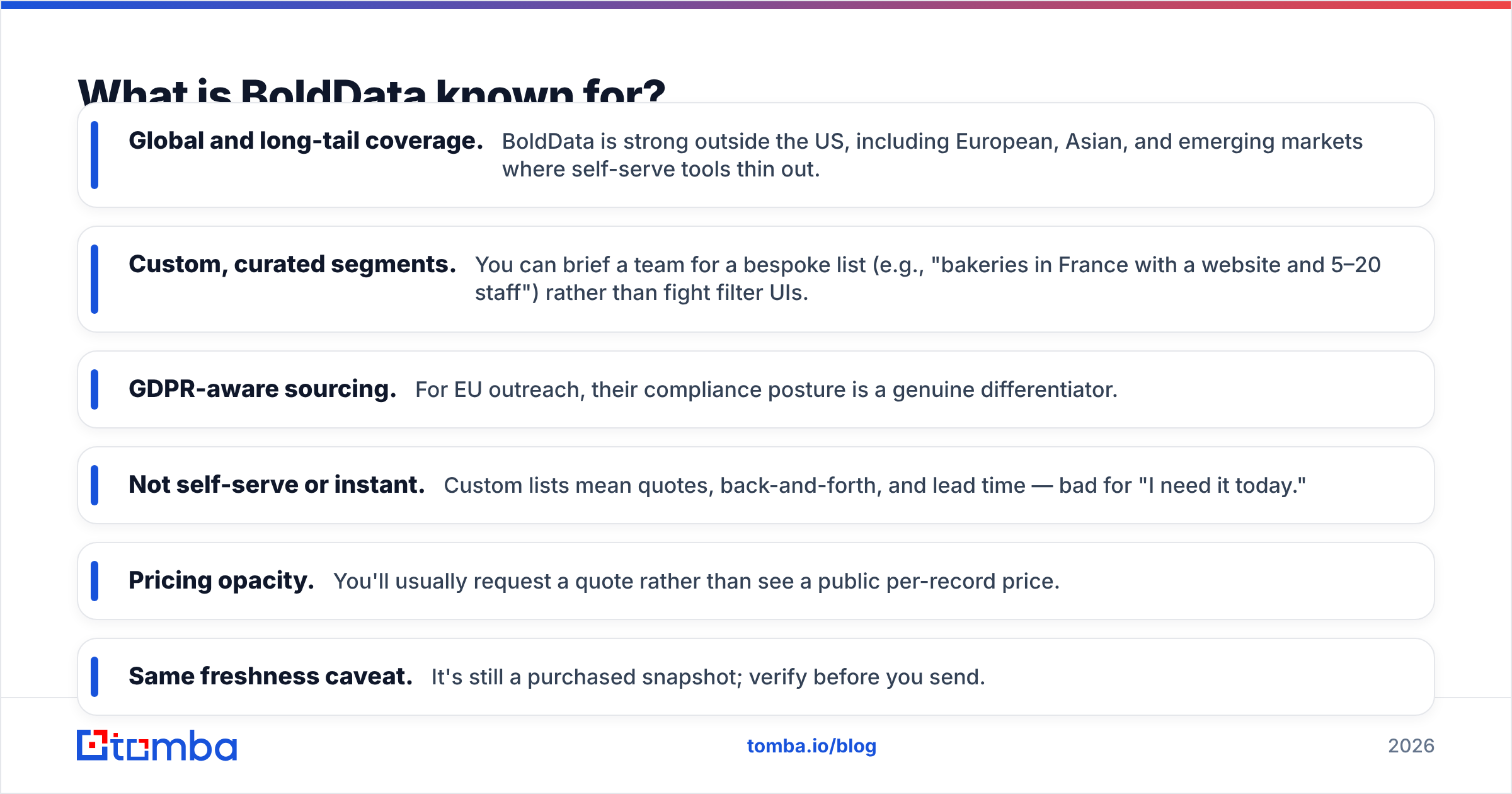
- Global and long-tail coverage. BoldData is strong outside the US. That includes European, Asian, and emerging markets where self-serve tools thin out.
- Custom, curated segments. You brief a team for a bespoke list, like "bakeries in France with a website and 5–20 staff." You don't fight filter UIs.
- GDPR-aware sourcing. For EU outreach, their compliance posture is a genuine differentiator.
Where it disappoints:
- Not self-serve or instant. Custom lists mean quotes, back-and-forth, and lead time. That's bad for "I need it today."
- Pricing opacity. You'll usually request a quote rather than see a public per-record price.
- Same freshness caveat. It's still a purchased snapshot. Verify before you send.
Note: BoldData is a respected data house. For genuinely international bulk lists it may beat both of the others. It's the least "tool-like" of the three.
What is Datanyze and who is it for?#
Datanyze, now part of ZoomInfo, is a Chrome-extension-first tool. It surfaces company firmographics and technographics (the software a company runs) as you browse. It's aimed at individual SDRs doing manual, one-at-a-time prospecting.
Where it shines:
- Cheap entry point. Low monthly cost and a free trial make it approachable for solo reps.
- In-context lookups. See revenue, employee count, and tech stack without leaving LinkedIn or a company site.
- Technographics. Filtering by "companies using Shopify, HubSpot, or Salesforce" is a real signal for some sellers.
Where it disappoints:
- Coverage and freshness lag. It's the lightweight sibling of ZoomInfo, so its data breadth and update cadence trail the flagship. Independent reviews on G2 often flag stale or missing contacts.
- Credit limits. Contact reveals are metered, so heavy prospecting hits a wall fast.
- Not built for bulk. It's a per-profile tool, not a list-export engine.
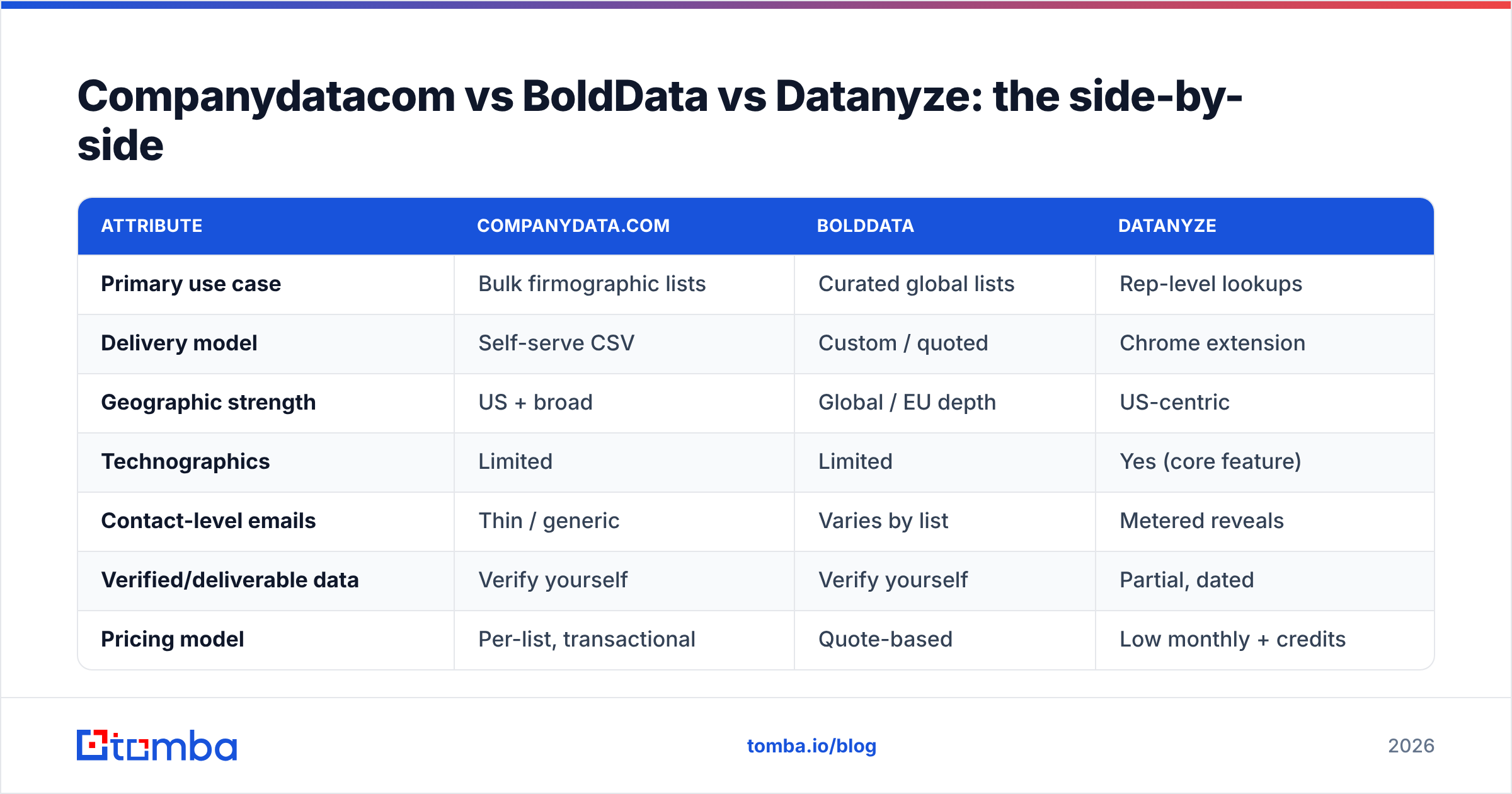
Companydatacom BoldData vs Datanyze: the side-by-side#
Here's the honest head-to-head. Read it against your actual job, not the marketing.
| Attribute | Companydata.com | BoldData | Datanyze |
|---|---|---|---|
| Primary use case | Bulk firmographic lists | Curated global lists | Rep-level lookups |
| Delivery model | Self-serve CSV | Custom / quoted | Chrome extension |
| Geographic strength | US + broad | Global / EU depth | US-centric |
| Technographics | Limited | Limited | Yes (core feature) |
| Contact-level emails | Thin / generic | Varies by list | Metered reveals |
| Verified/deliverable data | Verify yourself | Verify yourself | Partial, dated |
| Pricing model | Per-list, transactional | Quote-based | Low monthly + credits |
| Best for | TAM lists, one-off blasts | International targeting | Solo SDR prospecting |
| Weakest at | Freshness, contacts | Speed, transparency | Bulk, coverage depth |
The pattern is clear. You get two list vendors and one browser tool, and none of them guarantees a deliverable inbox. That last column is where most outbound actually breaks.
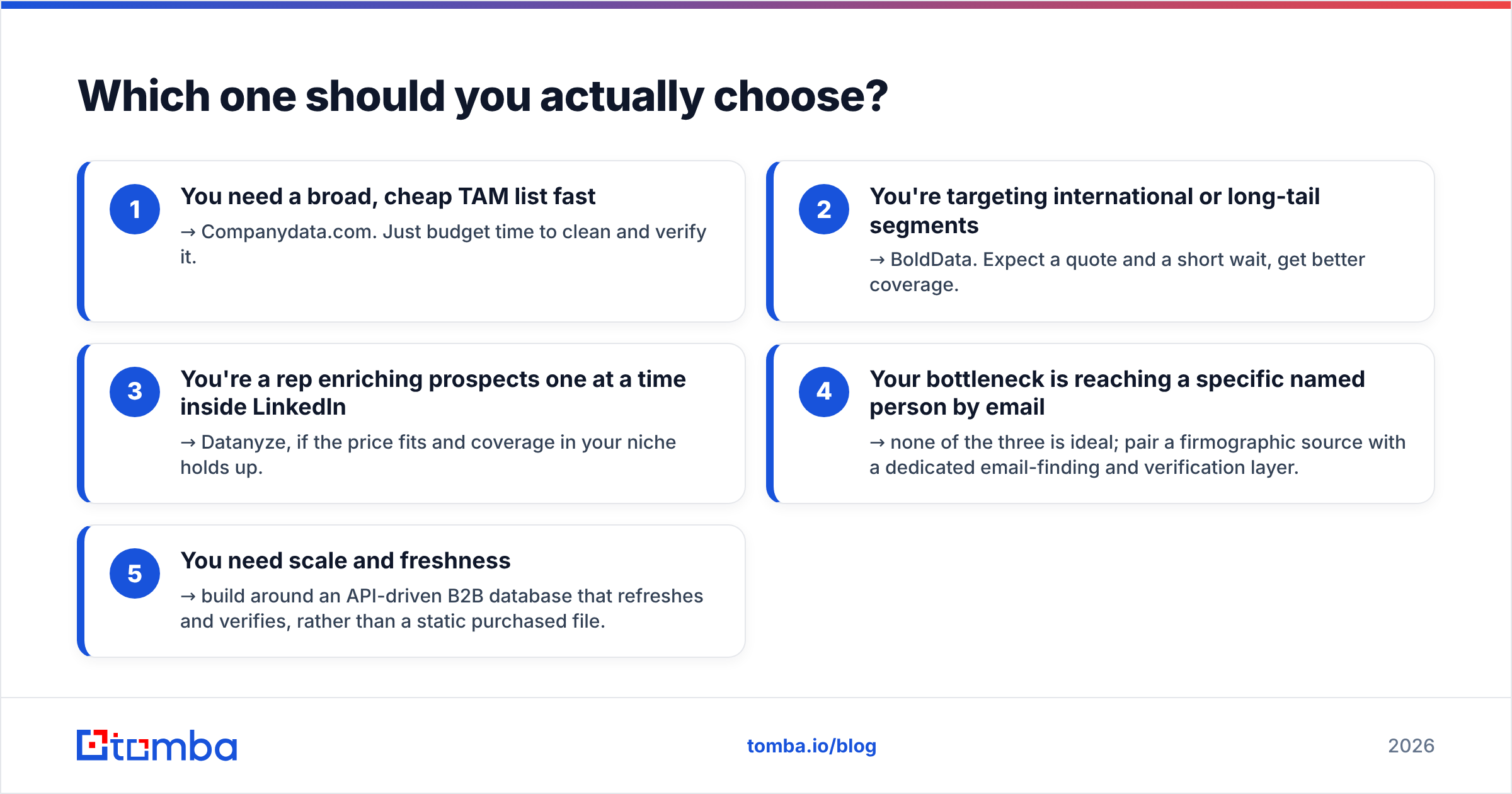
Which one should you actually choose?#
Match the tool to the task instead of asking which is "best":
- You need a broad, cheap TAM list fast → Companydata.com. Just budget time to clean and verify it.
- You're targeting international or long-tail segments → BoldData. Expect a quote and a short wait, and get better coverage.
- You're a rep enriching prospects one at a time inside LinkedIn → Datanyze, if the price fits and coverage in your niche holds up.
- Your bottleneck is reaching a specific named person by email → none of the three is ideal. Pair a firmographic source with a dedicated email-finding and verification layer.
- You need scale and freshness → build around an API-driven B2B database that refreshes and verifies, rather than a static purchased file.
That fourth point is the one teams underestimate. A list of companies is not a list of reachable people. You still have to resolve a name and role into a working address. And you have to do it without guessing your way into spam traps.

Where does an email-first workflow beat all three?#
For the job of "turn a company into a deliverable contact," a purpose-built email finder plus verifier beats a generic list dump. Here's the practical difference:
- You start from the company you already have. Feed a domain into domain search and pull the real email pattern and named contacts on demand. No waiting on a quote or hoping a static file is current.
- Every address is verified at the point of use. You don't trust a months-old snapshot. You validate deliverability before the send, which protects your sender reputation.
- It scales without list-buying. A bulk email finder runs thousands of rows through the same verified pipeline, so freshness isn't a one-time gamble.
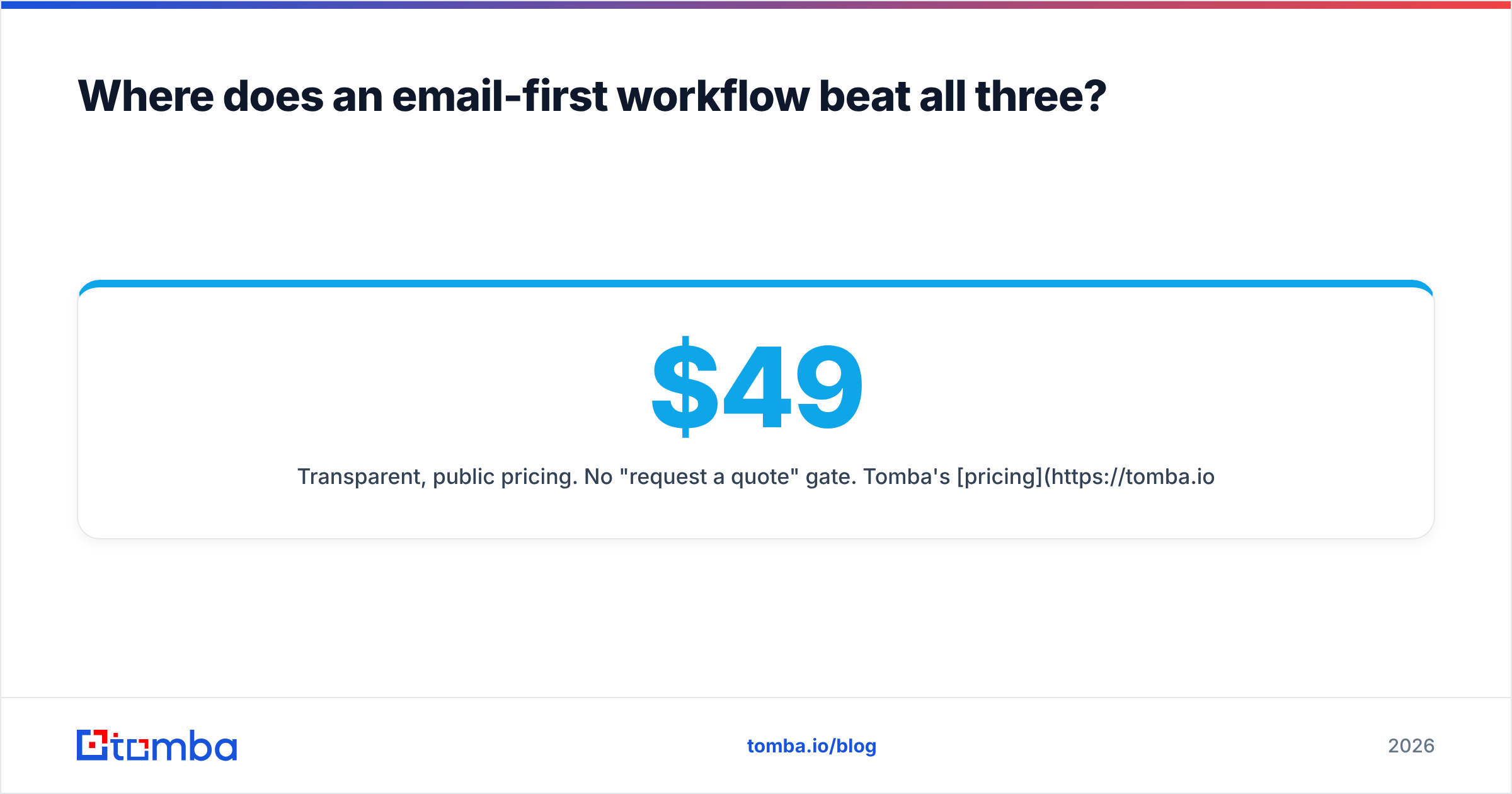
- Transparent, public pricing. There's no "request a quote" gate. Tomba's pricing is a free tier (25 searches/mo), Starter $49/mo, Growth $99/mo, Pro $249/mo, and custom Enterprise. You know the cost before you commit.
This isn't an argument that firmographic vendors are useless. Companydata.com and BoldData are genuinely good at sizing and segmenting markets, and Datanyze is fine for casual in-browser context. The point is simpler. They leave the last mile — the verified, deliverable email — unsolved. And that's usually the part that decides whether your campaign lands.
How do the three compare on freshness and deliverability?#
Freshness is the quiet killer. A firmographic record ("Acme Corp, 120 employees, SaaS, Austin") stays roughly true for a long time. A contact record ("Jane Doe, VP Marketing, jane@acme.com") rots fast. Role changes, departures, and rebrands break it within months.
- Companydata.com and BoldData sell you a snapshot. It's accurate on the download date and degrades from there. For contact fields especially, always re-verify.
- Datanyze updates more often but with narrower coverage. So you trade freshness against completeness, and you'll still hit missing or bounced contacts.
- A verify-at-send workflow flips the model. You resolve and validate the address in the moment you need it, so decay never piles up in a stale file.
If you take one thing from this comparison, take this. Buy firmographics as a snapshot, but never treat a purchased email column as trustworthy. Run it through verification first, or use a finder that verifies natively. Your bounce rate and your domain reputation depend on it.
The verdict#
There's no single winner, because these tools answer different questions. Companydata.com wins on cheap, fast, self-serve US bulk lists. BoldData wins on curated international coverage and EU compliance. Datanyze wins on low-cost, in-browser technographic lookups for individual reps. All three lose on the same thing. None hands you verified, deliverable, person-level email you can send to today.
That's the gap worth closing on purpose. Use a firmographic vendor to define who you want. Then use a dedicated finder to reach them.
Get deliverable contacts, not just company lists#
If your goal is to actually reach the people behind those company records, start with Tomba Email Finder. Feed it a domain or a name-plus-company. Get back the verified professional email, and validate deliverability before you hit send. That way the list you built with Companydata.com, BoldData, or Datanyze turns into replies instead of bounces. Try the free tier (25 searches/mo) and see how a verify-first workflow changes your outbound numbers. Pair it with contact enrichment to fill in the fields your list vendor left blank, and you've got a stack that covers the whole path from segment to inbox.
Related guides#
Ready to find emails that actually work?
Join 150,000+ professionals who stopped guessing and started sending. Free credits on signup — no credit card required.
Get the Tomba newsletter
Practical outbound tactics and product updates — once every two weeks.
About the author