CompanyData.com vs BoldData vs DealSignal (2026 Comparison)
CompanyData.com, BoldData, and DealSignal all sell B2B company data — but they win on different things. Here's an honest breakdown of accuracy, pricing, and coverage so you buy the right one.
Choosing a B2B data vendor is a bet on two things: how fresh the records are, and how much you pay to keep them fresh. This CompanyData.com BoldData vs DealSignal comparison cuts through the marketing pages. All three sell clean company and contact data. But each one is built for a different buyer. This guide shows you where each one actually fits.
TL;DR — Which B2B data provider should you pick?#
- CompanyData.com is best if you want raw, bulk company firmographics (registration data, industry codes, addresses) delivered as files or via API — think list-building and market sizing.
- BoldData is a Netherlands-based custom-list vendor with deep international company coverage. You brief them, and they build a targeted list. It's strong for one-off regional campaigns, less so for always-on prospecting.
- DealSignal is a subscription platform focused on verified, on-demand contact and account data with intent signals — priced for sales teams, not one-time buyers.
- None of the three is a live email-finder. If your real need is verified work emails on demand, a dedicated tool like the Tomba Email Finder will beat a static list every time.
- Match the tool to the job: bulk firmographics → CompanyData.com, bespoke international lists → BoldData, verified contacts + intent → DealSignal, real-time email discovery → Tomba.
CompanyData.com BoldData vs DealSignal: what does each one do?#
These three brands get lumped together because they all sell "B2B data." But they operate on very different models.
- CompanyData.com — bulk firmographic files. It aggregates company-level records (legal name, address, industry classification, size, registration IDs). It sells them as downloadable datasets or through an API. The unit of value is the company record, not the individual contact.
- BoldData — custom-built targeted lists. BoldData is a data agency more than a self-serve platform. You describe your ideal segment (industry, country, company size), and their team returns a tailored list. Their edge is breadth of international registries — 300M+ companies across 200+ countries by their own claims.
- DealSignal — a subscription data platform. DealSignal leans toward sales and marketing teams. It offers verified contacts, account hierarchies, technographics, and buyer-intent signals refreshed on demand. It competes more with the Apollo/ZoomInfo tier than with a file vendor.
The practical difference is simple: two of these sell you a snapshot, and one sells you a subscription. Snapshots decay. Industry benchmarks put B2B data decay at roughly 22.5% to 30% per year as people change jobs. So a list that's accurate today is measurably wrong in six months. That decay curve is the whole game. It's why data enrichment as an ongoing process usually beats a one-time buy.
How do they compare on price, coverage, and data type?#
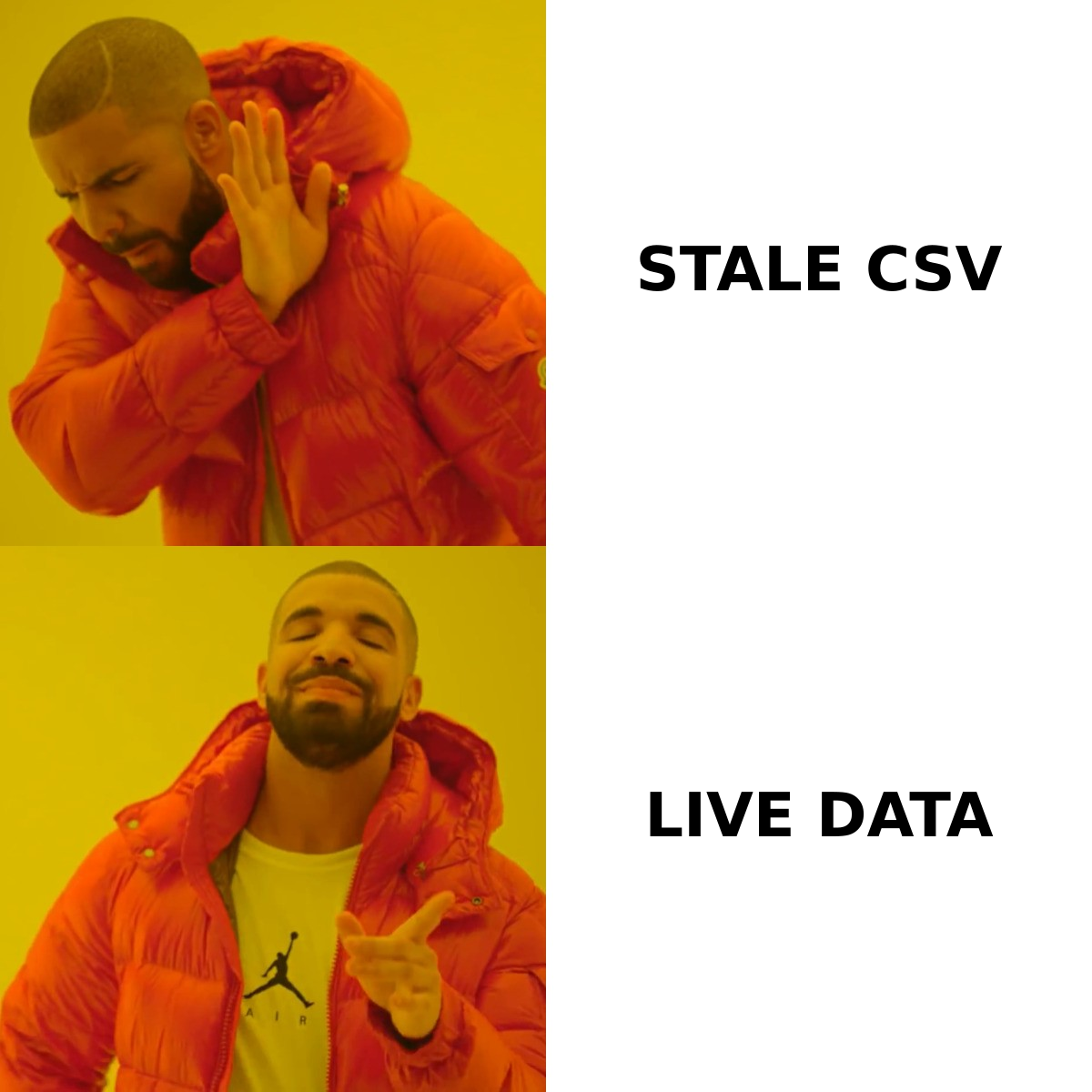
Here's the honest side-by-side. Pricing for all three is quote-driven at the higher tiers. So treat published figures as starting points and confirm directly.
| Attribute | CompanyData.com | BoldData | DealSignal |
|---|---|---|---|
| Core model | Bulk files + API | Custom-built lists | SaaS subscription |
| Primary unit | Company record | Targeted list | Verified contact/account |
| Contact emails | Limited | Add-on / regional | Yes, verified |
| Buyer intent data | No | No | Yes |
| International coverage | Broad | Very broad (200+ countries) | Strong (US-centric core) |
| Starting price | Per-record / dataset | Per-list quote | Subscription (custom) |
| Best for | Market sizing, TAM | One-off regional campaigns | Always-on sales prospecting |
| Data freshness | Snapshot | Snapshot at delivery | On-demand re-verification |
A few things stand out. If you need verified contact emails and intent signals, DealSignal is the only one built around that. If you need maximum geographic reach for a single campaign, BoldData's registry coverage is hard to beat. And if you're doing market research or TAM modeling, CompanyData.com's file model is the most cost-efficient way to get thousands of company rows.
What none of them does well is the moment-of-need lookup. You have a name and a company, and you need that person's email right now. That's a different tool category — closer to a domain search or email finder than a list vendor.
Which one is most accurate?#
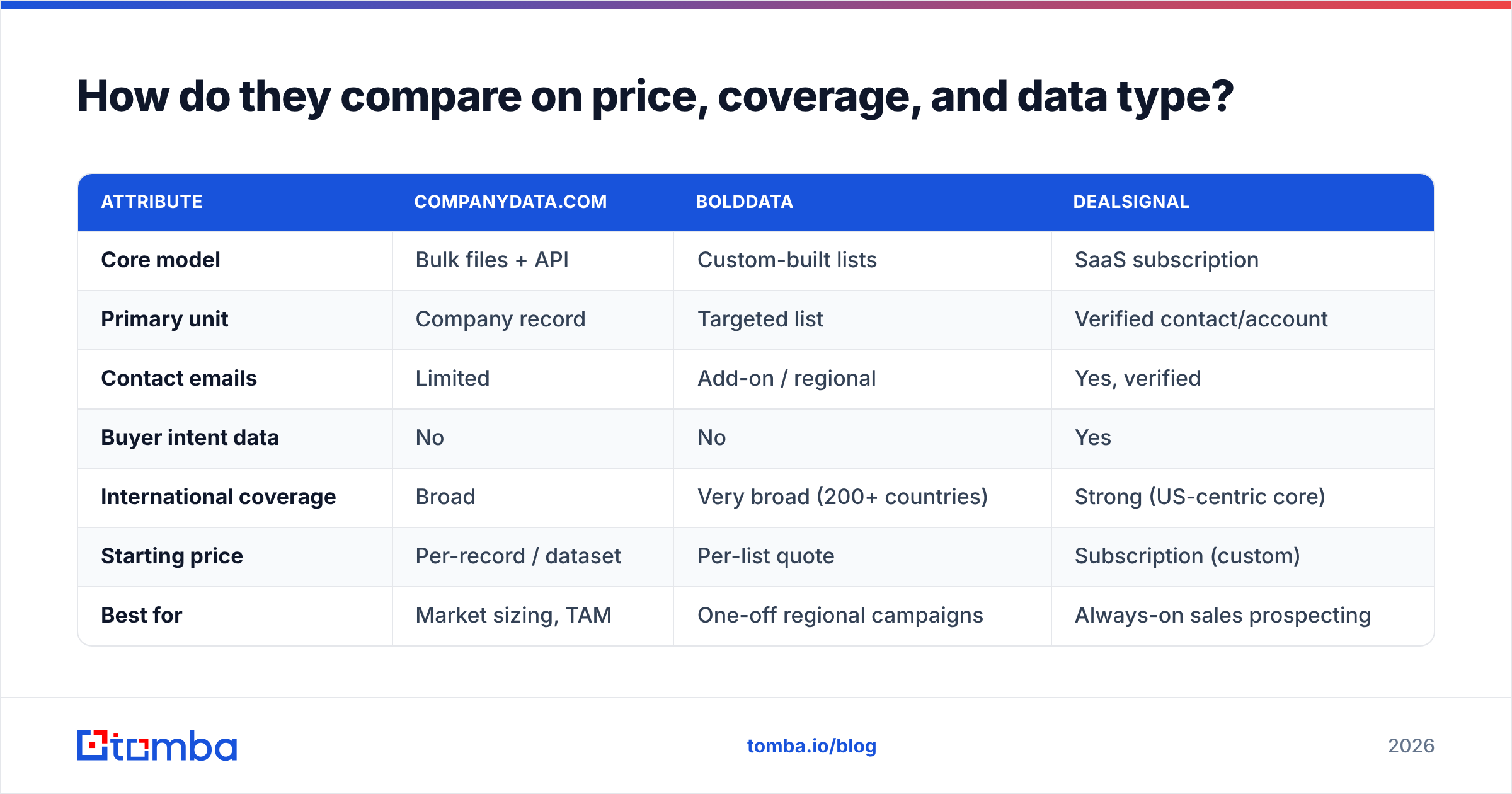
Accuracy depends on what you're measuring. The three vendors optimize for different metrics.
- CompanyData.com is accurate at the company level. Registry data (addresses, legal entities, industry codes) changes slowly. It's weaker on contact-level detail, which isn't its focus.
- BoldData delivers accuracy at the moment of build. Lists are compiled per request, so a fresh brief gets you fresh data. But once delivered, it starts decaying like any snapshot. There's no re-verification loop.
- DealSignal invests most heavily in accuracy as an ongoing process, with multi-source verification and re-checking. That's the trade-off you pay a subscription for.
The uncomfortable truth for all list-based buying is this: verification is not a one-time event. A record marked "valid" in January can bounce in July. That's why serious outbound teams pair any data source with a standalone email verifier and re-check lists before each send. Research compiled by vendors like ZoomInfo shows bounce rates above 3–5% start hurting sender reputation. So accuracy at send time matters more than accuracy at purchase time.
If your workflow depends on catch-all domains (common in enterprise), you'll also want a catch-all verifier. Most bulk vendors simply flag catch-alls as "unknown" and move on.
When should you use a list vendor vs. an email finder?#
This is the decision most buyers get wrong. They buy a 50,000-row list. Three months later, two-thirds of it bounces or goes to someone who left the company.
Use a list vendor (CompanyData.com, BoldData, DealSignal) when:
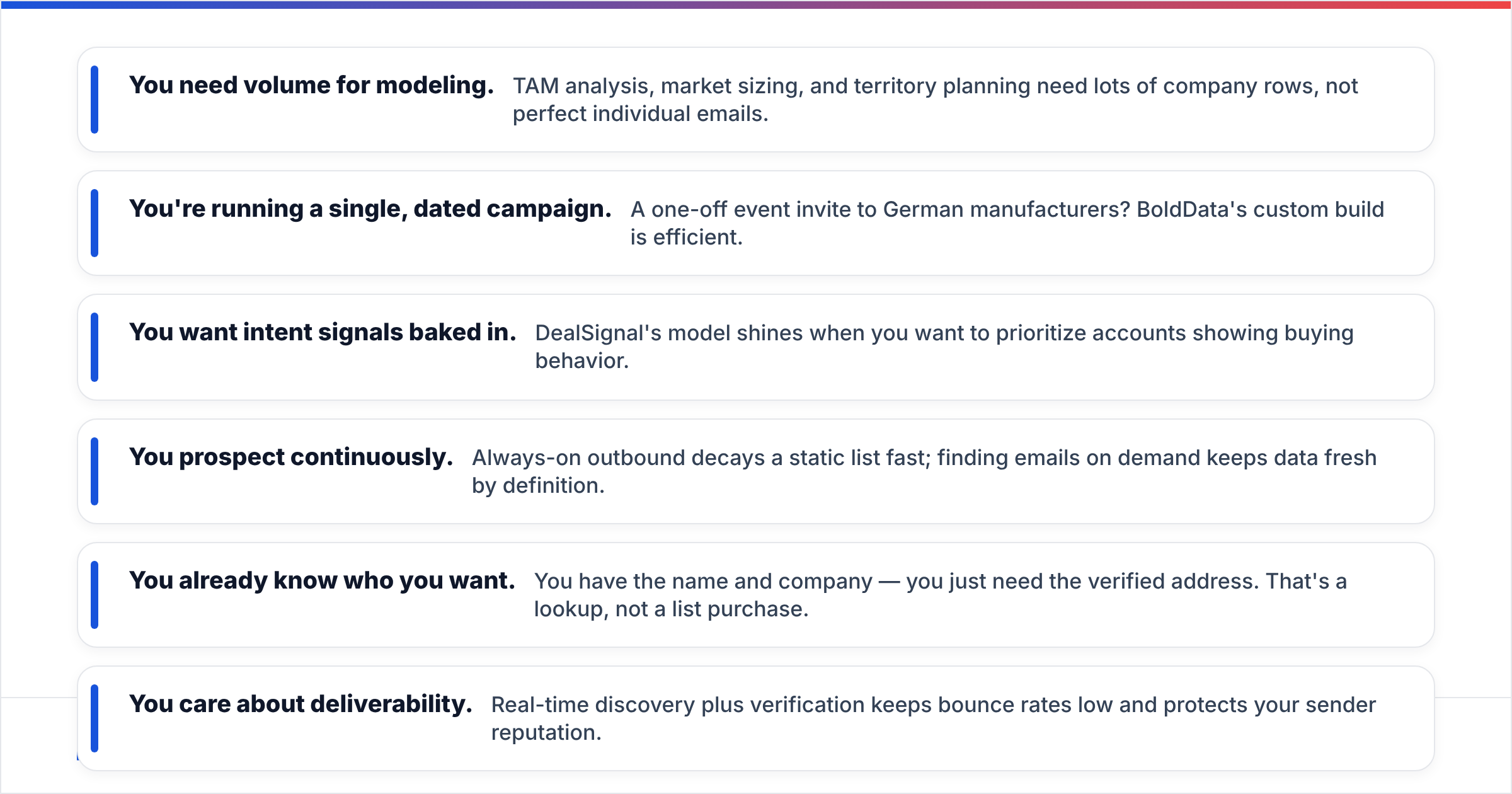
- You need volume for modeling. TAM analysis, market sizing, and territory planning need lots of company rows, not perfect individual emails.
- You're running a single, dated campaign. A one-off event invite to German manufacturers? BoldData's custom build is efficient.
- You want intent signals baked in. DealSignal's model shines when you want to prioritize accounts showing buying behavior.
Use an email finder when:
- You prospect continuously. Always-on outbound decays a static list fast. Finding emails on demand keeps data fresh by definition.
- You already know who you want. You have the name and company, and you just need the verified address. That's a lookup, not a list purchase.
- You care about deliverability. Real-time discovery plus verification keeps bounce rates low and protects your sender reputation.
The two approaches aren't mutually exclusive. A common, effective stack is simple: buy company-level firmographics from a bulk vendor for targeting. Then use an email finder and verifier to build the actual contact list you'll email. You get the reach of the list and the freshness of on-demand lookup.
How does Tomba fit into this comparison?#
Tomba isn't a bulk-list broker, so it's not a like-for-like swap for BoldData's custom builds or CompanyData.com's datasets. It solves the other half of the problem. It turns a target company or a name into a verified, sendable email, right when you need it.
Here's where Tomba's model differs from the three above:
- On-demand, not snapshot. You search a domain or a name and get current results. You're not emailing a record that was accurate two quarters ago.
- Verification built in. Every found email can run through verification, including catch-all handling, before it enters your sequence.
- Transparent, self-serve pricing. No quote-only wall to get started.
- Developer-first. A documented email finder API, CLI, and native integrations for HubSpot, Salesforce, and Google Sheets.
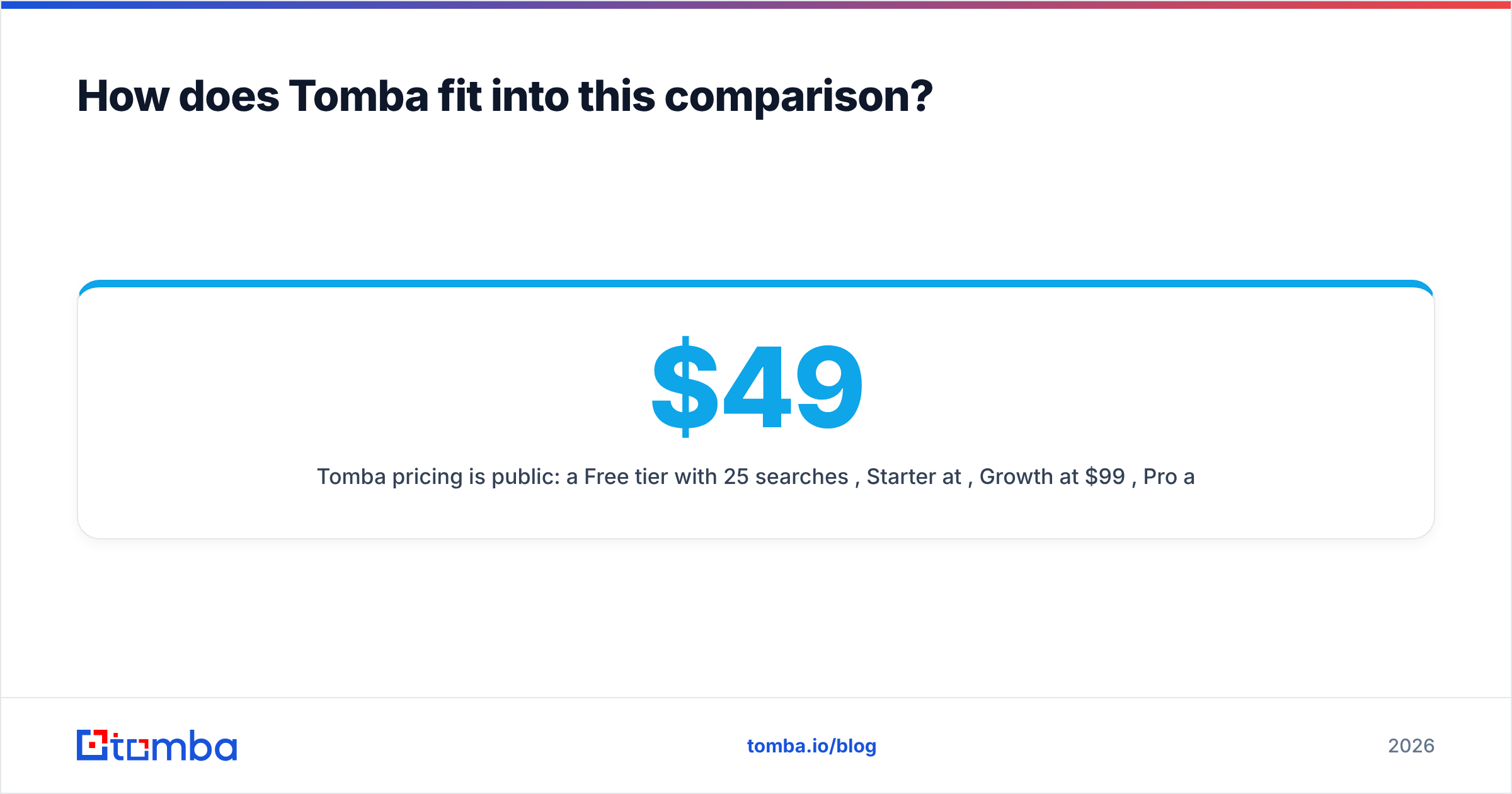
Tomba pricing is public: a Free tier with 25 searches per month, Starter at $49/mo, Growth at $99/mo, Pro at $249/mo, and custom Enterprise. You can see the full Tomba pricing breakdown without booking a call — a contrast to the quote-driven models of all three vendors here.
| Need | Best pick |
|---|---|
| Bulk company firmographics | CompanyData.com |
| Custom international campaign list | BoldData |
| Verified contacts + buyer intent | DealSignal |
| On-demand verified email + finder | Tomba |
| Ongoing prospecting freshness | Tomba |
For teams that both buy lists and prospect continuously, the pragmatic answer is "and," not "or." Use a list vendor for reach, and use Tomba to keep the contact layer accurate at send time. You can compare vendor tiers and reviews on independent sites like G2 before committing to any annual contract.
Frequently asked questions#
Is CompanyData.com the same as a CRM database? No. CompanyData.com sells firmographic company records; it isn't a CRM. You'd import its data into your CRM or use its API to enrich existing records. For that enrichment step, a dedicated contact enrichment tool often adds the person-level detail bulk files lack.
Does BoldData provide verified email addresses? BoldData can include contact details in a custom build. But because lists are snapshots delivered at a point in time, you should re-verify emails before sending. Pair any delivered list with an email verification pass.
Is DealSignal worth it over a cheaper file vendor? If you need verified contacts refreshed on demand plus intent signals, DealSignal's subscription can justify itself for an active sales team. If you only need occasional company data, a file vendor is cheaper. Match the model to how often you actually buy.
Which is cheapest for a startup? For low-volume, always-on prospecting, a self-serve email finder with a free tier is usually the cheapest entry point. You're not committing to a bulk purchase or an annual subscription. All three list vendors here are quote-driven, which raises the floor.
Can I combine these tools? Yes, and most effective teams do. Use a list vendor for firmographic reach and targeting. Then layer an email finder and verifier on top to build the fresh, sendable contact list. The list gives you scale; the finder keeps it accurate.
The verdict#
In this CompanyData.com BoldData vs DealSignal comparison, there's no single winner — there's a right tool for each job. CompanyData.com wins on cheap bulk firmographics. BoldData wins on bespoke international coverage for one-off campaigns. DealSignal wins on verified contacts with intent for always-on sales teams. Each is a respected option in its lane.
But if your core problem is "I need this person's verified email, and I need it to still be valid when I hit send," a static list is the wrong shape of tool. It doesn't matter how good it is on day one. That's a real-time job.
Start free with the Tomba Email Finder: search by domain, name, or company, verify every result before it enters a sequence, and keep your outbound data fresh by design instead of buying a snapshot that starts decaying the moment it lands. Twenty-five searches a month, no credit card, and public pricing when you're ready to scale.
Related guides#
Ready to find emails that actually work?
Join 150,000+ professionals who stopped guessing and started sending. Free credits on signup — no credit card required.
Get the Tomba newsletter
Practical outbound tactics and product updates — once every two weeks.
About the author