Companydata.com BoldData vs Hunter: Which Wins in 2026?
Companydata.com and BoldData sell bulk B2B lists; Hunter finds emails live from domains. We compare accuracy, pricing, and workflow fit so you know which one actually belongs in your stack in 2026.
This Companydata.com BoldData vs Hunter comparison sorts out three tools that all promise "B2B contacts." But they solve different problems. Two of them sell you lists. One finds emails on demand. Buy the wrong model, and you either overpay for records you never touch or run dry when your niche gets specific.
This guide breaks down what each tool does, how fresh the data is, what you pay, and which workflow it fits. No vendor spin — just the trade-offs you need to pick right the first time.
TL;DR: Companydata.com BoldData vs Hunter#
- Companydata.com and BoldData are bulk data providers. You buy a filtered list (by industry, geography, company size) and receive a file of companies and contacts. Best for one-time campaigns and market sizing.
- Hunter is a live email finder. You give it a domain or a name, and it returns verified professional emails in real time. Best for targeted, ongoing prospecting.
- Bulk lists go stale fast. B2B data decays roughly 22–30% per year, so a purchased list is only as good as the day it was pulled.
- Live finders stay fresh because they resolve emails the moment you search. But they cover one prospect (or domain) at a time unless you run bulk jobs.
- Best overall value for most outbound teams: a live finder like Hunter or Tomba Email Finder, which pairs real-time accuracy with bulk mode when you need volume.
What does each tool actually do?#
The biggest mistake buyers make is treating these three as interchangeable. They are not.
Companydata.com is a global company database. You filter by firmographics — country, SIC/NAICS code, revenue band, employee count. Then you download a structured list of companies, often with generic contact details and some decision-maker names. Think of it like buying a phone book for one neighborhood: coverage is broad, but you get everyone at once, and freshness depends on the last print run.
BoldData works much the same way. It's a Netherlands-based provider (bolddata.nl). It sells targeted B2B mailing lists and company data across 300+ million companies worldwide. Its edge is custom lists and GDPR compliance. You tell them your target segment, and they deliver a tailored file. It's a respected vendor, especially for European and international coverage where many US-centric tools thin out.
Hunter (hunter.io) is a different animal. It's an email finder and verifier. Enter a company domain, and it returns the emails it knows for that company, plus a confidence score and sources. Enter a name and a domain, and it predicts the exact address. It's built for reps who already know who they want to reach and just need a reliable way in.
Here's the analogy that makes it click. Companydata.com and BoldData sell you a stocked pond. Hunter hands you a fishing rod. Want fish today for a known recipe? The rod wins. Want to survey the whole pond for a market study? Buy the pond.
Which has the most accurate, current data?#
Accuracy is where the model difference bites hardest. It's also where most disappointment starts.
Bulk lists are a snapshot. The moment Companydata.com or BoldData exports your file, the clock starts. People change jobs — the average B2B pro switches roles every ~2.5 years. Companies rebrand, domains migrate, and email formats change after acquisitions. Benchmarks put B2B data decay at 22–30% a year. So a list bought in January can be a quarter wrong by December. Good providers refresh often, but you still get a static file frozen at export time.
Live finders resolve emails at query time. So they reflect the current state of the web the second you search. That's a real edge for accuracy. The trade-off is coverage. The tool has to find and verify that exact person right now. Obscure or gated targets can come back empty, where a purchased list would hold some record — even a stale one.

For accuracy that stays honest over time, verification matters as much as finding. Whatever tool you pick, run new addresses through an email verifier before you send. A good verifier catches invalid, role-based, and risky addresses that inflate bounce rates and hurt your sender reputation. A live finder plus verification beats a stale list plus hope almost every time.
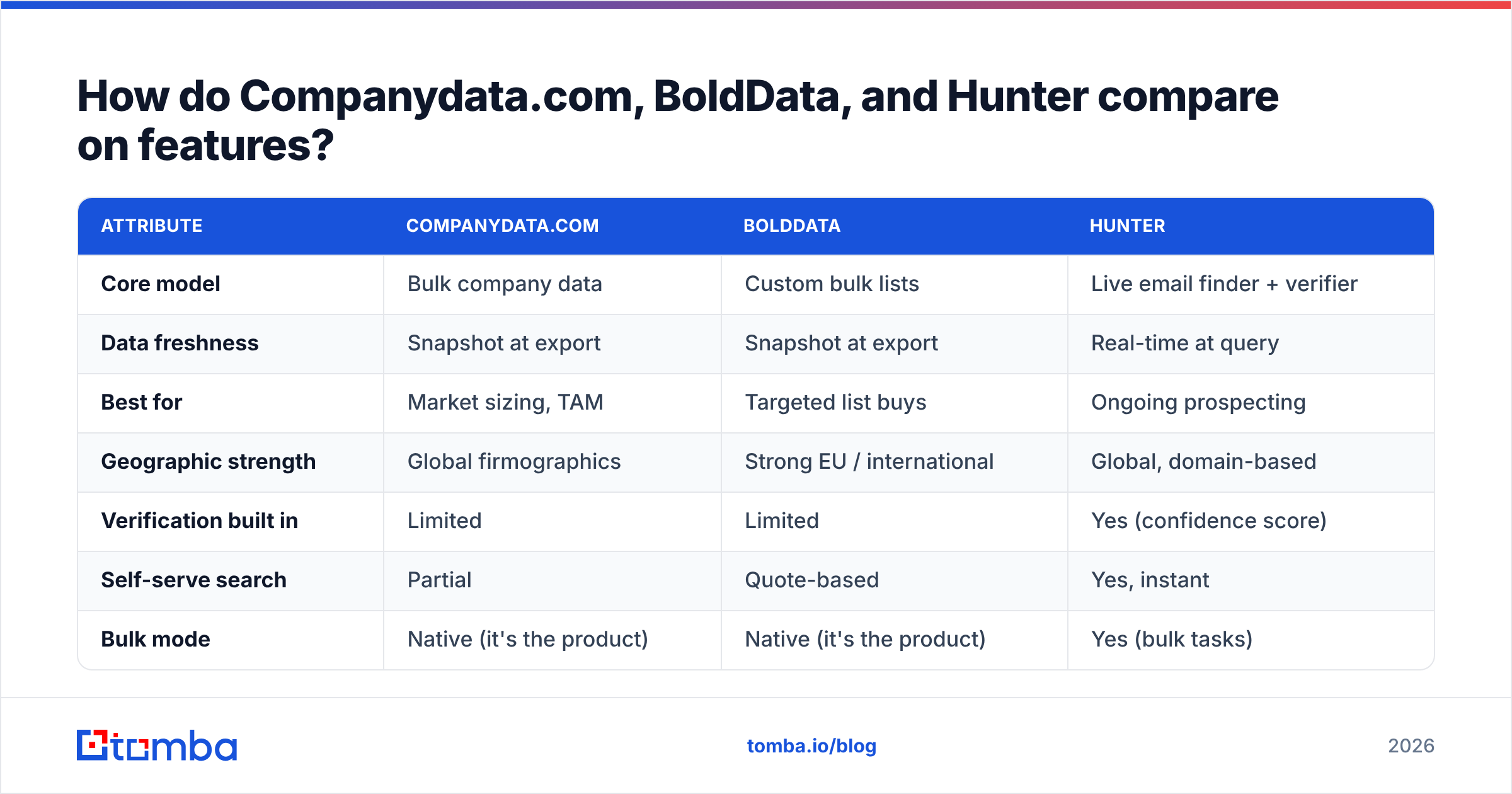
How do Companydata.com, BoldData, and Hunter compare on features?#
| Attribute | Companydata.com | BoldData | Hunter |
|---|---|---|---|
| Core model | Bulk company data | Custom bulk lists | Live email finder + verifier |
| Data freshness | Snapshot at export | Snapshot at export | Real-time at query |
| Best for | Market sizing, TAM | Targeted list buys | Ongoing prospecting |
| Geographic strength | Global firmographics | Strong EU / international | Global, domain-based |
| Verification built in | Limited | Limited | Yes (confidence score) |
| Self-serve search | Partial | Quote-based | Yes, instant |
| Bulk mode | Native (it's the product) | Native (it's the product) | Yes (bulk tasks) |
| API access | Varies | Varies | Yes |
| Typical pricing model | Per-record / per-list | Per-list quote | Monthly subscription |
The pattern is clear. The two data vendors win on breadth and one-shot volume, especially internationally. Hunter wins on freshness, verification, and self-serve speed. Neither model is simply "better." Each is tuned for a different job.
What about pricing — which is cheaper?#
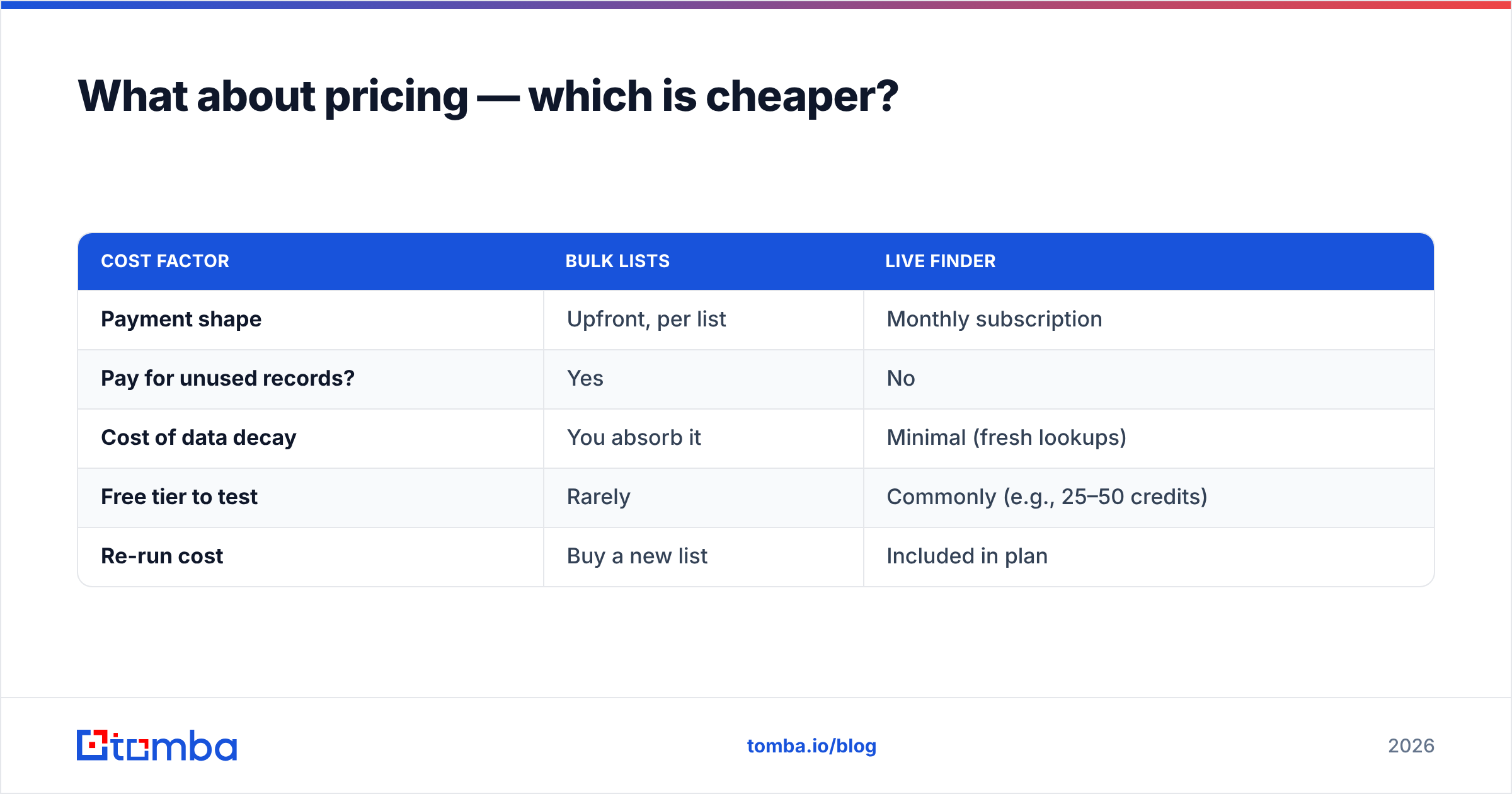
Pricing here is apples-to-oranges. Read it by intent, not by sticker price.
Bulk providers (Companydata.com, BoldData) usually price per record or per custom list, often by quote. At volume, that can look cheap per contact — fractions of a cent to a few cents each. But you pay upfront for the whole list. That includes records you never contact and ones that decay before you reach them. The real cost per usable, current contact is higher than the headline.
Live finders price by subscription, with monthly search or credit limits. You pay for what you look up, and every lookup is fresh. Hunter's plans scale from a free tier into paid monthly tiers. For a like-for-like point, Tomba's pricing runs a free tier (25 searches/month), Starter at $49/month, Growth at $99/month, and Pro at $249/month — with the same live-verification model.
| Cost factor | Bulk lists | Live finder |
|---|---|---|
| Payment shape | Upfront, per list | Monthly subscription |
| Pay for unused records? | Yes | No |
| Cost of data decay | You absorb it | Minimal (fresh lookups) |
| Free tier to test | Rarely | Commonly (e.g., 25–50 credits) |
| Re-run cost | Buy a new list | Included in plan |
Rule of thumb: if you'll contact most of a segment once, the bulk math can favor the list. If you prospect all the time and value freshness, the subscription wins per successful touch — because you never pay for rot.

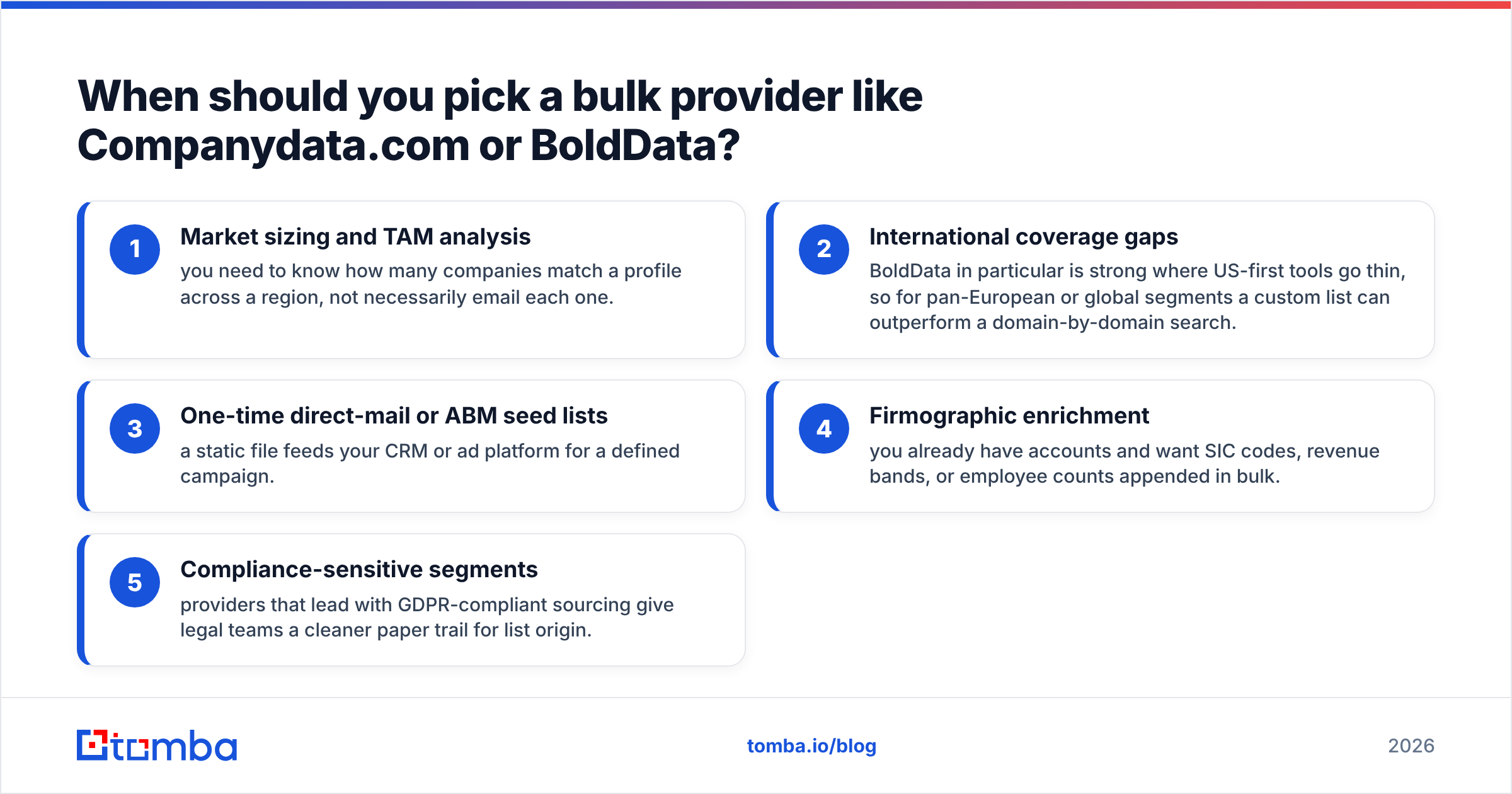
When should you pick a bulk provider like Companydata.com or BoldData?#
Buy a list when your job is breadth, not depth:
- Market sizing and TAM analysis — you need to know how many companies match a profile across a region, not necessarily email each one.
- International coverage gaps — BoldData is strong where US-first tools go thin, so a custom list can beat a domain-by-domain search for pan-European or global segments.
- One-time direct-mail or ABM seed lists — a static file feeds your CRM or ad platform for a defined campaign.
- Firmographic enrichment — you already have accounts and want SIC codes, revenue bands, or employee counts appended in bulk.
- Compliance-sensitive segments — providers that lead with GDPR-compliant sourcing give legal teams a cleaner paper trail for list origin.
If that's your use case, a purchased list is the right tool — just budget for decay and re-verify before you send.
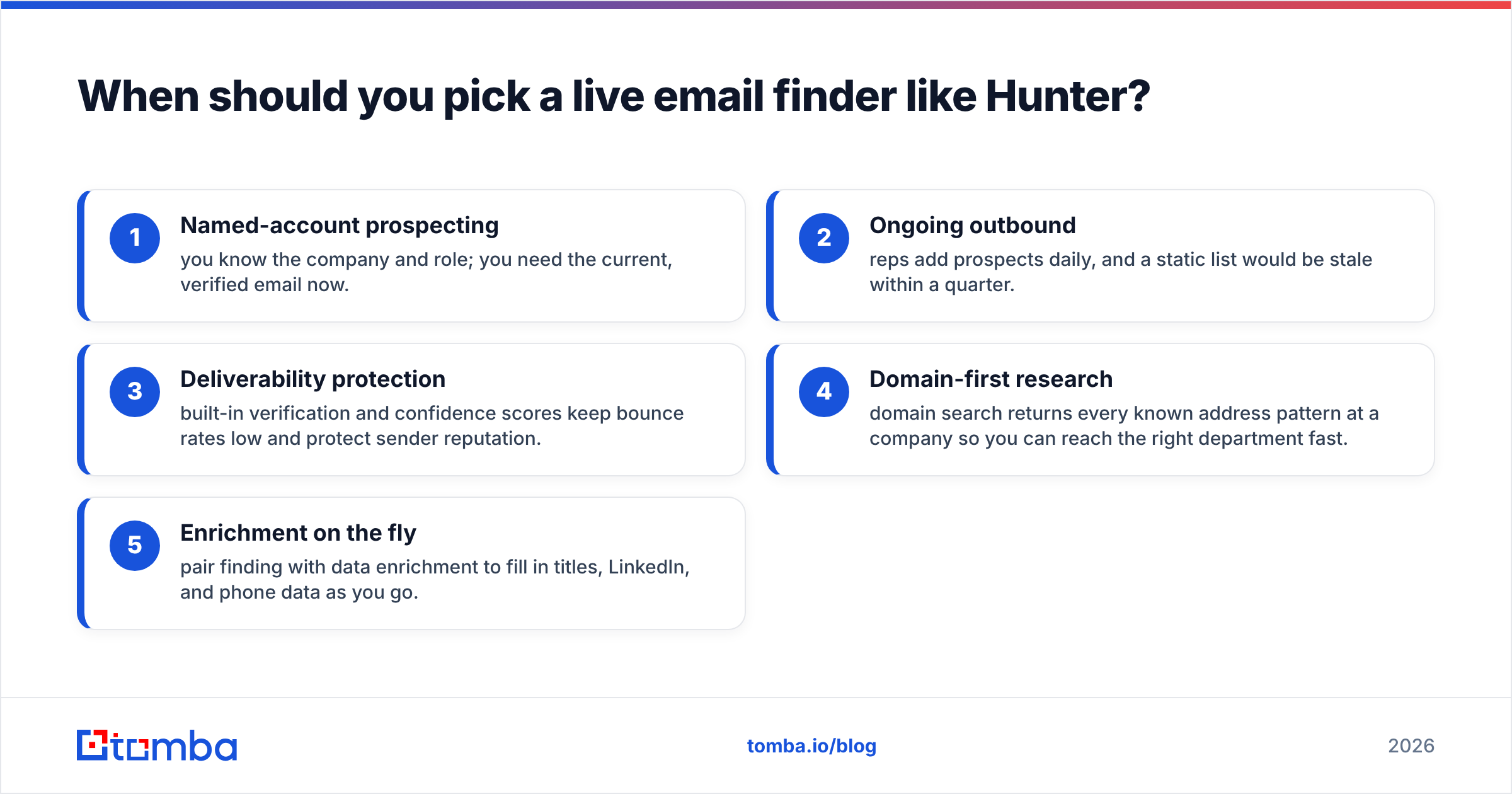
When should you pick a live email finder like Hunter?#
Choose a live finder when your job is precision and repetition:
- Named-account prospecting — you know the company and role; you need the current, verified email now.
- Ongoing outbound — reps add prospects daily, and a static list would be stale within a quarter.
- Deliverability protection — built-in verification and confidence scores keep bounce rates low and protect sender reputation.
- Domain-first research — domain search returns every known address pattern at a company so you can reach the right department fast.
- Enrichment on the fly — pair finding with data enrichment to fill in titles, LinkedIn, and phone data as you go.
This is where Hunter earns its reputation, and where alternatives like Tomba compete directly on the same real-time model. If most of your work is "I have a name and a company, get me the inbox," a finder is simply the correct architecture.

Can you use both models together?#
Yes — and the strongest teams do exactly that. The two approaches are complementary, not exclusive.
A common winning stack looks like this:
- Source the universe with bulk data. Use Companydata.com or BoldData to pull every company that matches your ICP in a region — your addressable market.
- Prioritize accounts with intent signals or firmographic fit.
- Resolve contacts live with a finder when a rep works the account, so every email you send is current and verified.
- Verify before send regardless of source, so bulk-list rot never reaches your sequencer.
This hybrid gives you the breadth of a database and the freshness of a finder, without paying the full accuracy tax of either alone. You can check any provider's reputation and user reviews on G2 before committing budget. Real buyer feedback surfaces the freshness and support issues that spec sheets hide.
Which one is right for you?#
Here's the decision in one line each:
- Pick Companydata.com or BoldData if you need a broad, international, one-time list for market sizing, ABM seeding, or firmographic enrichment — and you'll re-verify before outreach. BoldData especially shines for custom European and global segments.
- Pick Hunter if your work is continuous, named-account prospecting where fresh, verified emails matter more than owning a giant static file.
- Pick a hybrid if you run outbound at scale: buy the map from a data vendor, then find and verify contacts live as you work each account.
The mistake to avoid is buying a bulk list because it looks cheaper per record, then watching a third of it bounce because it aged out before your reps got to it. Cost-per-record is a vanity metric. Cost-per-delivered, replied contact is the number that funds your pipeline.
The bottom line#
Companydata.com and BoldData answer "who exists in my market?" Hunter answers "how do I reach this specific person right now?" Most teams need both answers. But the daily, revenue-driving work — actually emailing prospects — lives in the second question. That's where a live, verification-first finder pays for itself. In any Companydata.com BoldData vs Hunter decision, match the tool to the job, not the sticker price.
If you want the freshness and built-in verification of a live finder with self-serve pricing that starts free, try Tomba Email Finder. Search by domain, name, or company; get a confidence score on every result; verify in the same workflow; and scale into bulk email finder jobs when a campaign needs volume — without buying a list that's already decaying the day it lands in your inbox. Start on the free tier, test it against your own accounts, and let the reply rate decide.
Related guides#
Ready to find emails that actually work?
Join 150,000+ professionals who stopped guessing and started sending. Free credits on signup — no credit card required.
Get the Tomba newsletter
Practical outbound tactics and product updates — once every two weeks.
About the author