CompanyData.com, BoldData vs Tomba: B2B Data Compared
Bulk B2B lists or real-time email finding? A neutral breakdown of CompanyData.com, BoldData, and Tomba across data freshness, accuracy, pricing, and compliance — so you buy the right model, not just the loudest pitch.
CompanyData.com, BoldData vs Tomba is usually framed the wrong way. People ask "which has the best data?" The real question is simpler. Do you want a static list handed to you once? Or a live lookup engine you query when you need a contact? Those are two different products. They just happen to overlap on the word "data."
This is a neutral breakdown. All three are legitimate. But they solve different problems, price differently, and decay at very different rates. Here's how to tell which model fits your motion.
TL;DR: CompanyData.com, BoldData vs Tomba#
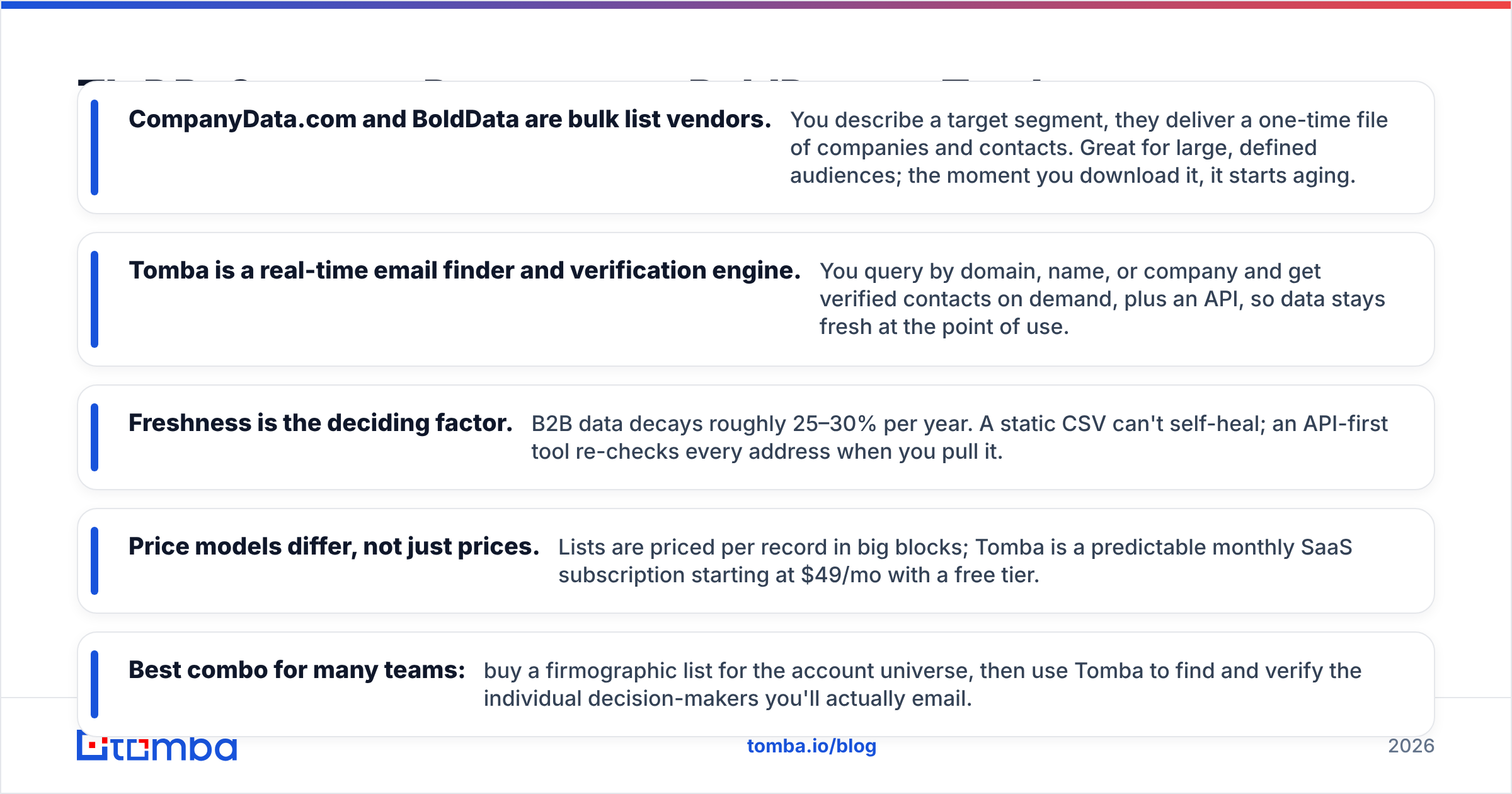
- CompanyData.com and BoldData are bulk list vendors. You describe a target segment, and they deliver a one-time file of companies and contacts. That's great for large, defined audiences. But the moment you download it, it starts aging.
- Tomba is a real-time email finder and verification engine. You query by domain, name, or company. You get verified contacts on demand, plus an API. So data stays fresh at the point of use.
- Freshness is the deciding factor. B2B data decays roughly 25–30% per year. A static CSV can't self-heal. An API-first tool re-checks every address when you pull it.
- Price models differ, not just prices. Lists are priced per record in big blocks. Tomba is a predictable monthly SaaS subscription, starting at $49/mo with a free tier.
- Best combo for many teams: buy a firmographic list for the account universe. Then use Tomba to find and verify the individual decision-makers you'll actually email.
What do CompanyData.com and BoldData actually sell?#
Both are database-and-list providers. You tell them the shape of your audience — industry codes, company size, geography, job function. They compile a file matching that segment. BoldData markets global company data pulled from chambers of commerce and official registries, and sells targeted email lists and full-company databases by segment. CompanyData.com plays a similar role: firmographic company records and contact data delivered in bulk.
The mental model is a phone book you buy by the neighborhood. You get everyone in the selected area at once, which is powerful for coverage. The catch is the same as a printed phone book. It's accurate the day it's printed and drifts every day after. People change jobs, companies rebrand, and domains get retired. Your file has no idea any of that happened.
That's not a knock. Bulk data is the right tool for market sizing, total-addressable-market modeling, direct mail, or seeding a CRM with an account universe. It's just a snapshot, and you should treat it like one.
What does Tomba do differently?#
Tomba is built around querying, not downloading. Instead of receiving a frozen file, you look up contacts the moment you need them. Each address is checked before it reaches you. The core is the email finder, backed by an email verifier, domain search, and catch-all detection. A Tomba API brings the same freshness inside your own tooling.
The analogy: bulk lists are a warehouse of canned goods. Tomba is the produce aisle you visit before dinner. One optimizes for stockpiling, the other for freshness at the point of use. If you're sending cold email this week, freshness beats stockpile size. Bounced sends punish your sender reputation and drag down email deliverability for every future campaign.

How do they compare feature by feature?#
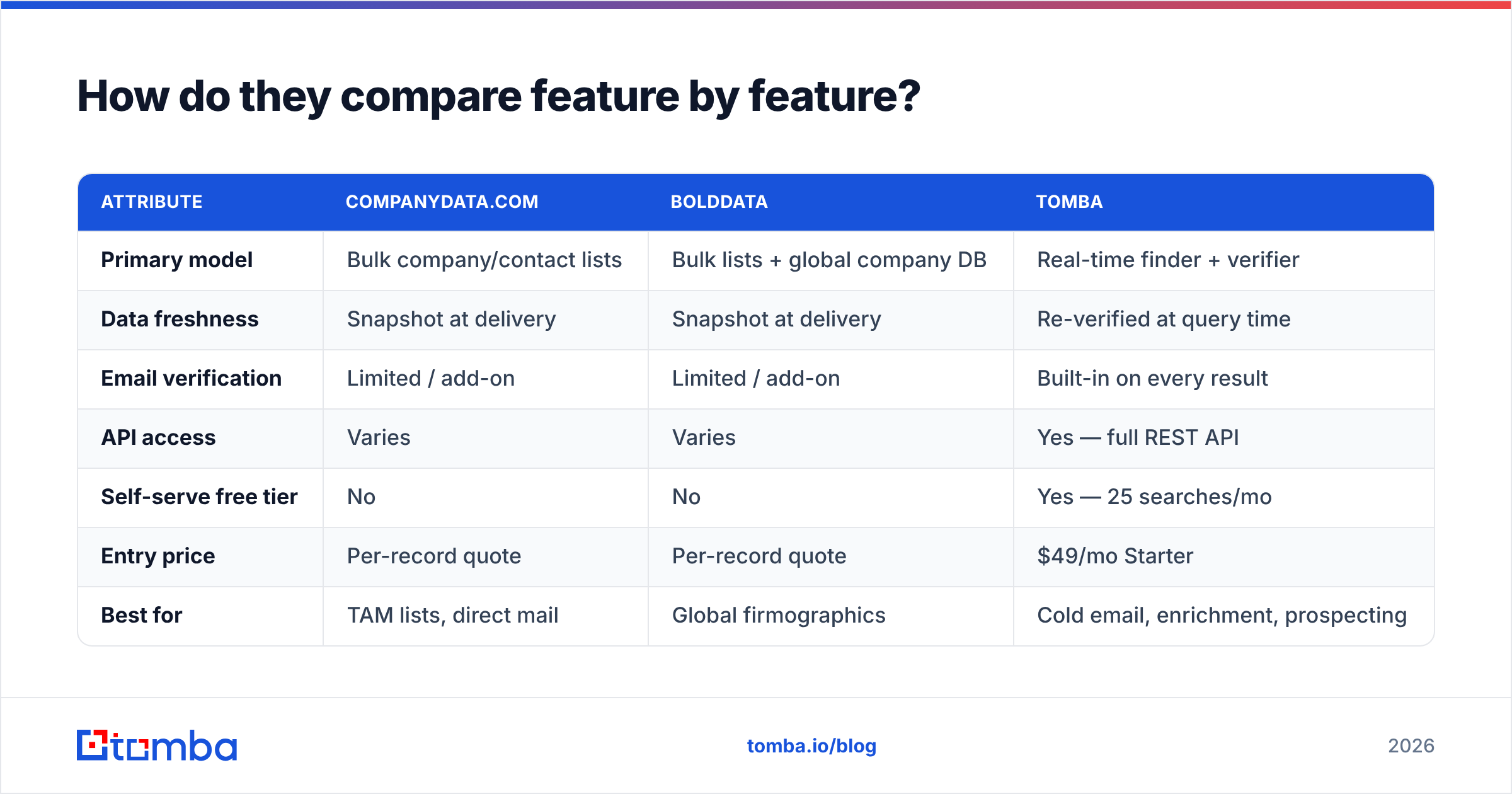
Here's the honest side-by-side. Capabilities for the two list vendors reflect the bulk-list model they operate on. Tomba reflects the query-and-verify model.
| Attribute | CompanyData.com | BoldData | Tomba |
|---|---|---|---|
| Primary model | Bulk company/contact lists | Bulk lists + global company DB | Real-time finder + verifier |
| Data freshness | Snapshot at delivery | Snapshot at delivery | Re-verified at query time |
| Email verification | Limited / add-on | Limited / add-on | Built-in on every result |
| API access | Varies | Varies | Yes — full REST API |
| Self-serve free tier | No | No | Yes — 25 searches/mo |
| Entry price | Per-record quote | Per-record quote | $49/mo Starter |
| Best for | TAM lists, direct mail | Global firmographics | Cold email, enrichment, prospecting |
| Catch-all handling | Not a focus | Not a focus | Dedicated catch-all verifier |
The pattern is clear. The list vendors win on breadth of a defined segment delivered at once. Tomba wins on freshness, verification, and programmatic access. Neither column is "better" in the abstract. It depends on whether your bottleneck is coverage or accuracy.
Which one has more accurate data?#
Accuracy is really two questions. How good is the data at creation? And how fast does it rot?
At creation, all three can be strong. Registry-sourced firmographics (BoldData's strength) are reliable for company-level facts like legal name, address, and industry. The problem is person-level contact data. Job titles and email addresses are the fastest-decaying data in B2B. Industry analysts consistently peg B2B contact decay at 25–30% per year, and some segments move faster.
A static list has no defense against that decay. A tool that verifies at query time does. When you pull a contact from Tomba, the address is checked against live signals right then. Catch-all domains get routed through a dedicated catch-all verifier instead of being blindly trusted. You can also confirm data provenance on Tomba's data sources page, which matters for compliance reviews.
So the fair answer: for company-level facts on a fresh file, the list vendors are competitive. For email accuracy at the moment you send, a real-time verifier structurally wins. It re-checks instead of assuming.
How does pricing compare?#
This is where the models diverge most, and where buyers get surprised.
Bulk list pricing is typically per record, quoted in blocks. A segment of 20,000 contacts is one price. A bigger or more niche segment is another. You often pay again for a refreshed file later, because the first one aged. Verification, enrichment, or appended fields can be add-ons. The sticker can look cheap per record until you factor in re-buying for freshness.
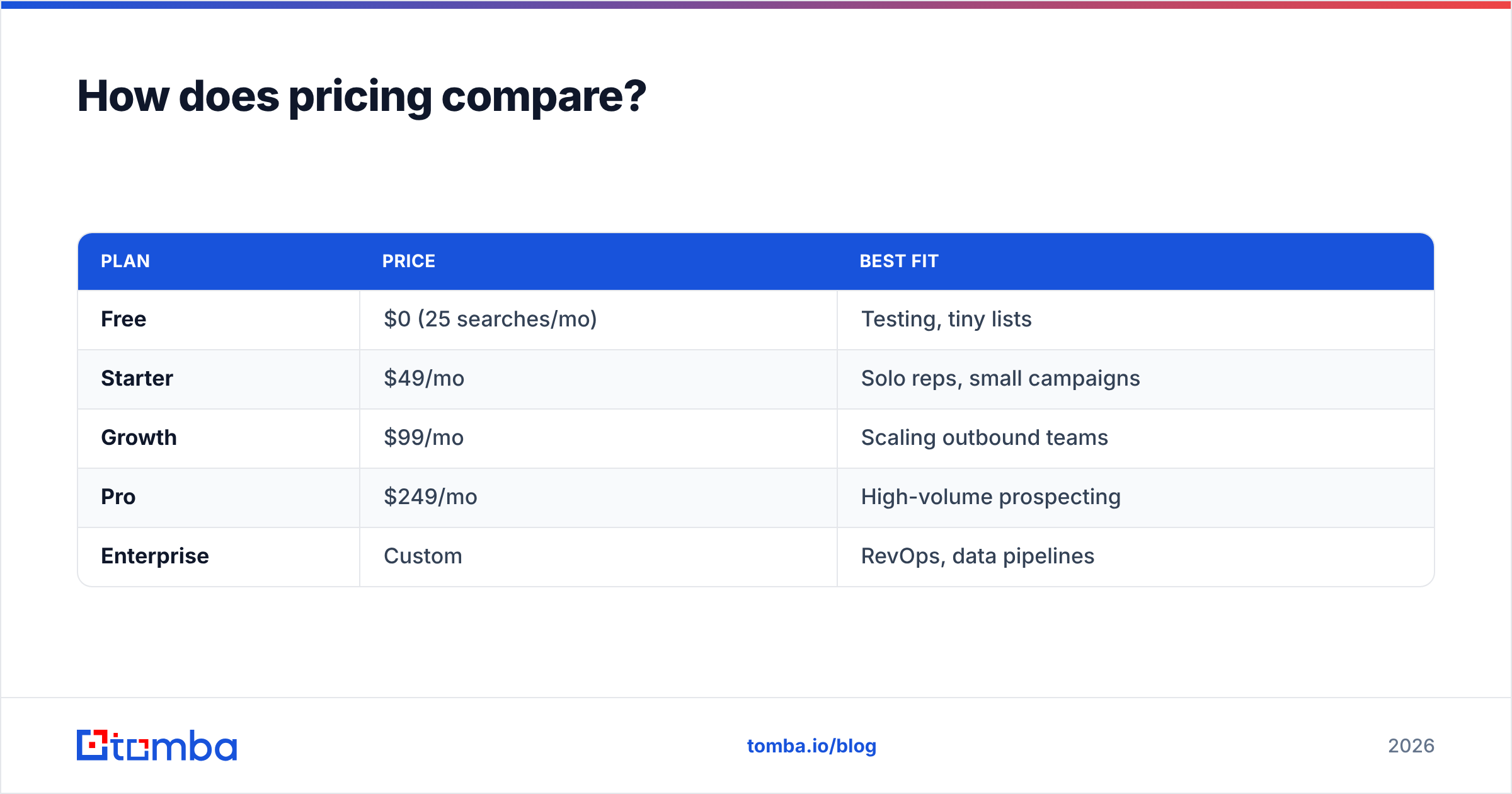
Tomba uses straightforward SaaS Tomba pricing:
| Plan | Price | Best fit |
|---|---|---|
| Free | $0 (25 searches/mo) | Testing, tiny lists |
| Starter | $49/mo | Solo reps, small campaigns |
| Growth | $99/mo | Scaling outbound teams |
| Pro | $249/mo | High-volume prospecting |
| Enterprise | Custom | RevOps, data pipelines |
The difference isn't just the number. It's predictability. With a subscription you pull fresh, verified contacts continuously, without re-purchasing a decaying asset. With bulk lists you're buying a depreciating snapshot. So the true cost includes the refresh cadence you'll inevitably need.
A blunt rule of thumb: if you need a huge one-time audience for a single campaign or a mail drop, per-record lists can be economical. If you prospect continuously, a subscription that keeps data current usually costs less over a year than repeatedly re-buying lists.
When should you pick a bulk list provider?#
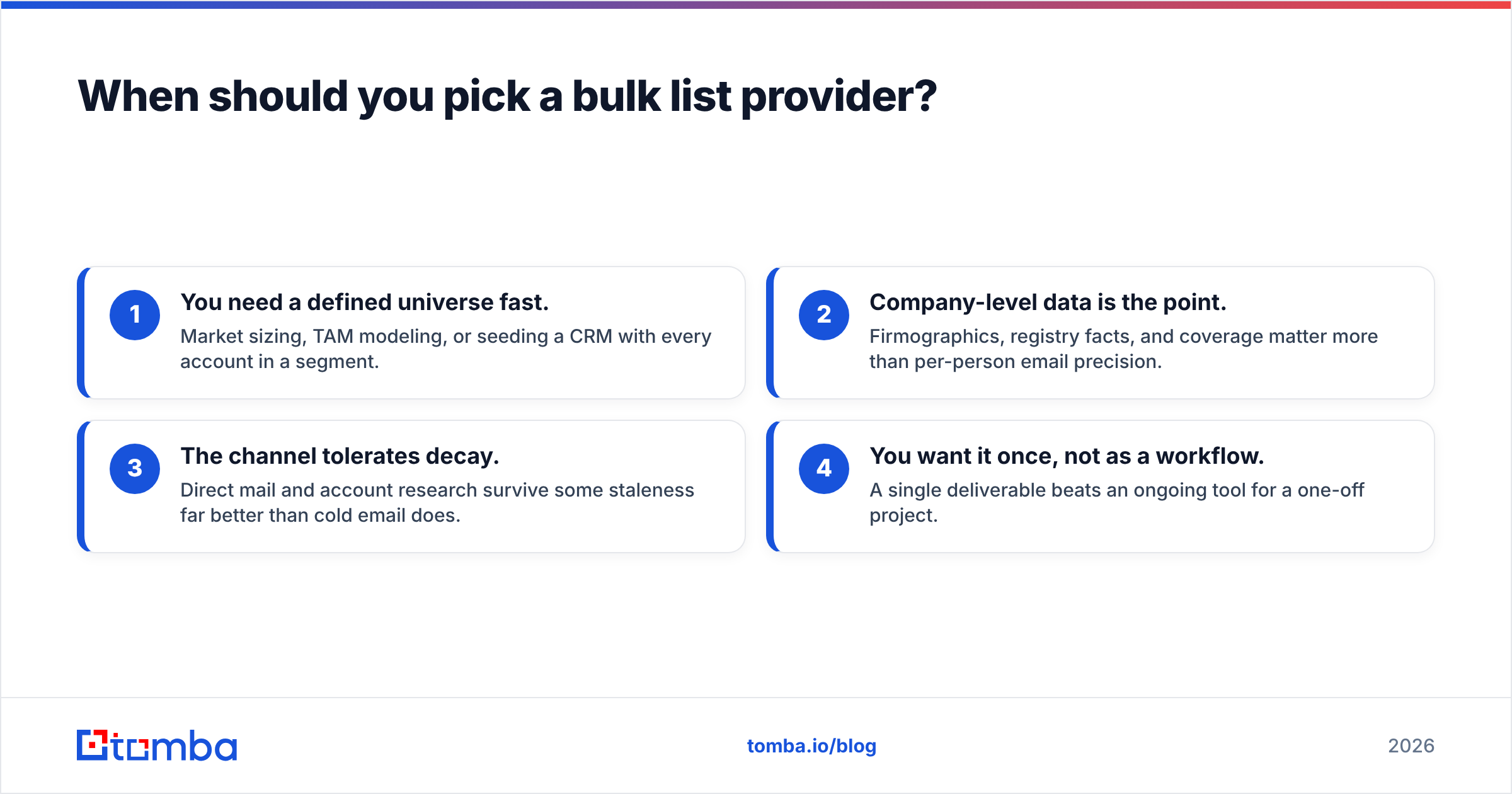
Choose CompanyData.com or BoldData when:
- You need a defined universe fast. Market sizing, TAM modeling, or seeding a CRM with every account in a segment.
- Company-level data is the point. Firmographics, registry facts, and coverage matter more than per-person email precision.
- The channel tolerates decay. Direct mail and account research survive some staleness far better than cold email does.
- You want it once, not as a workflow. A single deliverable beats an ongoing tool for a one-off project.
These are real, common needs. If that's you, a reputable list vendor is a sound buy. Just budget for a refresh, and run the emails through verification before you send.
When should you pick Tomba?#
Choose Tomba when:
- You send cold email or run sequences. Every bounce hurts deliverability, so verification at send time is non-negotiable. Pair it with a free email checker for quick spot checks.
- You want an API. Enrich records inside your CRM, product, or scripts using the email finder API rather than importing CSVs.
- You prospect continuously. A subscription that stays fresh beats re-buying lists that keep aging.
- You need per-contact precision. Finding the specific decision-maker's verified address at a target account is exactly the finder's job.
- You want to start free. The free tier lets you validate quality before paying anything.

Can you use both together?#
Yes. And for a lot of teams, that's the smartest play. The models are complementary, not mutually exclusive.
A clean workflow:
- Buy the account universe from a bulk provider — every company that fits your ICP, with firmographics.
- Enrich and find people with Tomba — for each priority account, use domain search and the finder to pull the current, verified decision-makers.
- Verify before every send with the email verifier so campaigns stay clean and your domain reputation stays healthy.
You get the coverage of a list and the freshness of a real-time engine. Verification is the safety net between "we have a record" and "we're about to email a human." That layering is why "vs" is often the wrong framing. The list answers who exists, and Tomba answers how to reach them today.
If you're weighing broader data platforms too, it's worth reading how Tomba stacks up as an Apollo alternative or a Clearbit alternative. Those blend firmographics and contact data in one subscription.
The verdict: CompanyData.com, BoldData vs Tomba#
There's no single winner. There's a right tool per job. CompanyData.com and BoldData are strong when you need a broad, defined segment delivered in bulk and can live with snapshot freshness. Tomba is strong when you need verified, current contacts on demand, an API, predictable pricing, and clean deliverability.
If your work is continuous outbound, prospecting, or enrichment, freshness and verification decide it. That favors a query-and-verify model. If your work is a one-time audience build, a list vendor earns its place.
Want to see the difference before spending a cent? Start with Tomba's free tier — 25 searches a month, no card. Run the Tomba Email Finder against a few of your target accounts. Compare what comes back to the last list you bought. If the verified, current results win, you'll know exactly which model your pipeline actually needs.
You can also cross-check any provider's claims against neutral review data on G2 before you commit budget.
Related guides#
Ready to find emails that actually work?
Join 150,000+ professionals who stopped guessing and started sending. Free credits on signup — no credit card required.
Get the Tomba newsletter
Practical outbound tactics and product updates — once every two weeks.
About the author