Compelling Event in Sales: How to Find, Create, and Close on One
A compelling event is the deadline that turns "interested" into "signed." Here's how to identify one, manufacture it when it's missing, and use it to pull deals across the line in 2026.
Most stalled deals don't die because of price, product, or a bad demo. They die because nothing forced the buyer to act now. That "act now" pressure has a name in sales: the compelling event.
TL;DR#
- A compelling event in sales is a specific, time-bound reason the buyer must make a decision by a certain date — miss it, and they suffer real consequences.
- Without one, deals slip quarter after quarter. "Great call, let's reconnect next month" is the sound of a missing compelling event.
- Compelling events come in two flavors: naturally occurring (contract renewal, compliance deadline, funding round) and manufactured (pilot expiry, price change, onboarding window).
- You find them by asking better discovery questions and by enriching account data so you spot triggers before the rep even dials.
- The best reps don't wait for urgency — they surface it, quantify the cost of inaction, and tie the close date to the buyer's own calendar.
What is a compelling event in sales?#
A compelling event is the answer to the buyer's quietest, most dangerous question: "Why should I do this now instead of never?"
Think of it like a flight departure. You might want to visit a city for years, but you only book, pack, and show up when there's a departure time on the ticket. The date creates the action. In sales, the compelling event is that departure time — a concrete deadline attached to a real consequence.
It is not the same as pain. Pain is "our current tool is slow." A compelling event is "our contract with that slow tool auto-renews on March 31, and legal won't let us re-sign it." Pain explains why they'd buy. The compelling event explains why they'd buy by a date. Deals need both, but only one of them moves a close date.
A useful compelling event has three parts:
- An event — a dated, external happening (renewal, audit, launch, board meeting, fiscal year-end).
- A consequence — what breaks or costs money if nothing changes by that date.
- A decision owner — the person who feels that consequence and can sign.
Miss any one of the three and you have a "nice to have," not a forcing function.
Why do deals stall without a compelling event?#
Because "no decision" is the easiest decision a buyer can make. Doing nothing feels free. It isn't — but it feels that way until someone quantifies the cost.
Gartner's research on B2B buying has repeatedly shown that a huge share of qualified pipeline ends in no decision at all, not a loss to a competitor. The buyer simply runs out of urgency before they run out of interest. Your champion gets pulled onto another project, budget gets reallocated, and the deal you forecast at 80% quietly rots to closed-lost.
A missing compelling event shows up as predictable symptoms:
- Deals that push from Q1 to Q2 to "sometime next half."
- Champions who love you but "just need to align internally" — indefinitely.
- Forecasts that look full but never convert on the dates you promised your VP.
- Discovery calls that surface pain but never a deadline.
If your pipeline review keeps sliding the same logos forward, you don't have a pipeline problem. You have a compelling-event problem. And it directly drags down your sales win rate because the deals aren't unqualified — they're un-triggered.
Naturally occurring vs. manufactured compelling events#
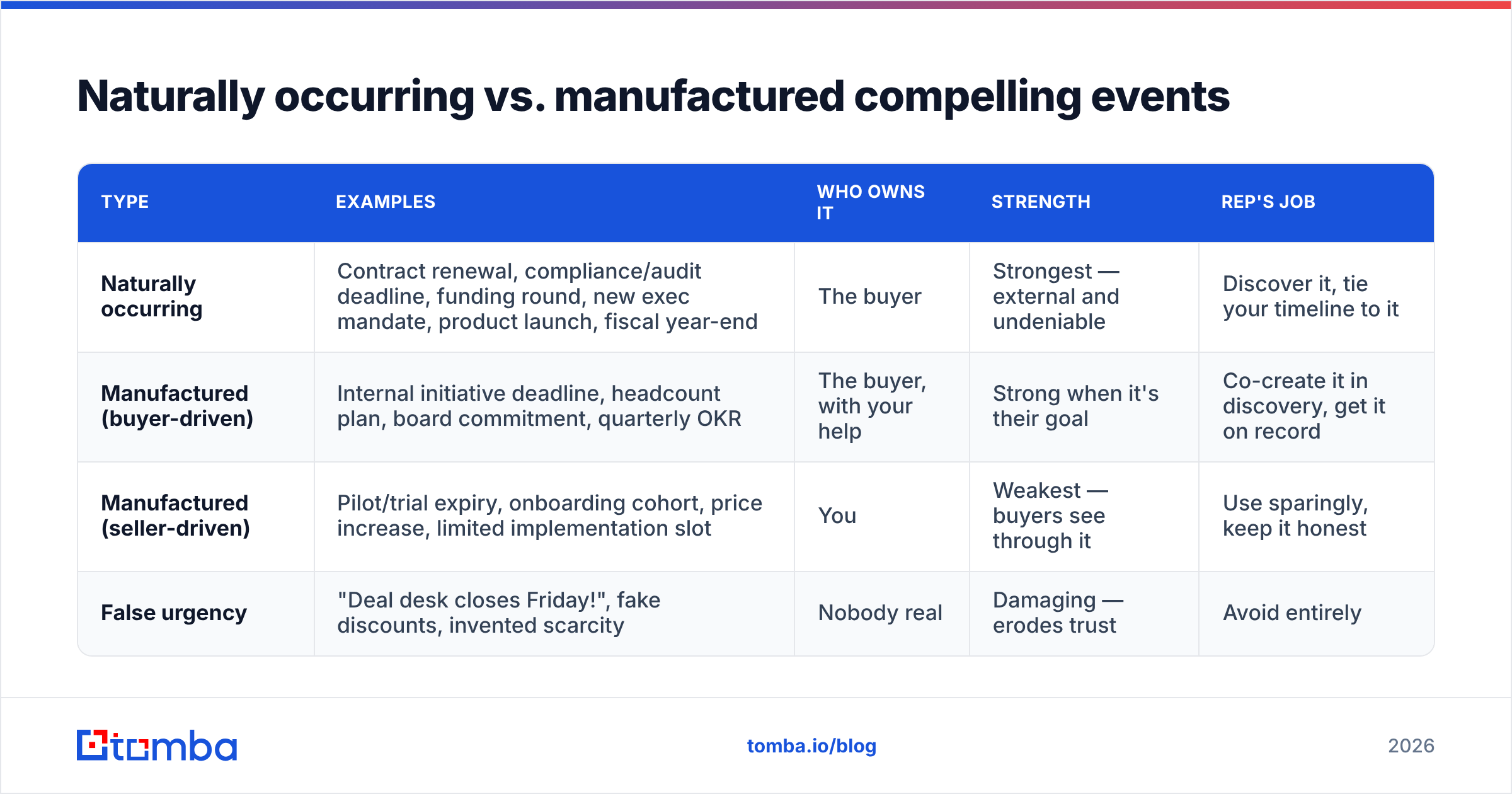
Reps love the idea of a compelling event handed to them on a plate. Sometimes it happens. More often, you have to find a real one that's already there but unspoken, or help the buyer build one.
| Type | Examples | Who owns it | Strength | Rep's job |
|---|---|---|---|---|
| Naturally occurring | Contract renewal, compliance/audit deadline, funding round, new exec mandate, product launch, fiscal year-end | The buyer | Strongest — external and undeniable | Discover it, tie your timeline to it |
| Manufactured (buyer-driven) | Internal initiative deadline, headcount plan, board commitment, quarterly OKR | The buyer, with your help | Strong when it's their goal | Co-create it in discovery, get it on record |
| Manufactured (seller-driven) | Pilot/trial expiry, onboarding cohort, price increase, limited implementation slot | You | Weakest — buyers see through it | Use sparingly, keep it honest |
| False urgency | "Deal desk closes Friday!", fake discounts, invented scarcity | Nobody real | Damaging — erodes trust | Avoid entirely |
The mistake most reps make is jumping straight to the bottom of that table. They lead with an expiring discount because it's the only lever they know. Buyers have seen that movie a thousand times, and it makes you look like you need the deal more than they do.
Start at the top. The strongest compelling events already live inside the account — you just have to find them.
How do you find a compelling event during discovery?#
You ask questions that surface dates and consequences, not just problems. Most reps interrogate pain and forget to interrogate timing. Flip the ratio.
Here are the questions that actually uncover a compelling event:
- "What happens on the business side if this isn't solved by end of quarter?" — surfaces the consequence.
- "Is there a specific date this needs to be live by, and what's driving that date?" — surfaces the event.
- "Who feels this problem most, and what are they accountable for this year?" — surfaces the decision owner.
- "You mentioned a contract with your current vendor — when does that come up for renewal?" — surfaces a naturally occurring event.
- "What else is competing for this budget, and when do those decisions get made?" — surfaces the real timeline.
Notice that none of these are "what's your pain." They assume pain and dig for the clock attached to it.
The other half of finding compelling events happens before the call. A rep who walks into discovery already knowing the account just raised a Series B, hired a new VP of RevOps, or posted 30 open roles has a head start on urgency. That intelligence comes from good data enrichment — layering firmographic and trigger data onto your target accounts so you spot the event before you dial. When you can connect "you just closed funding and are hiring 20 SDRs" to "here's the deadline that creates," discovery gets a lot shorter.
How do you create a compelling event without faking urgency?#
You don't invent a deadline. You make an existing consequence visible and put a date on it that the buyer agrees is real.
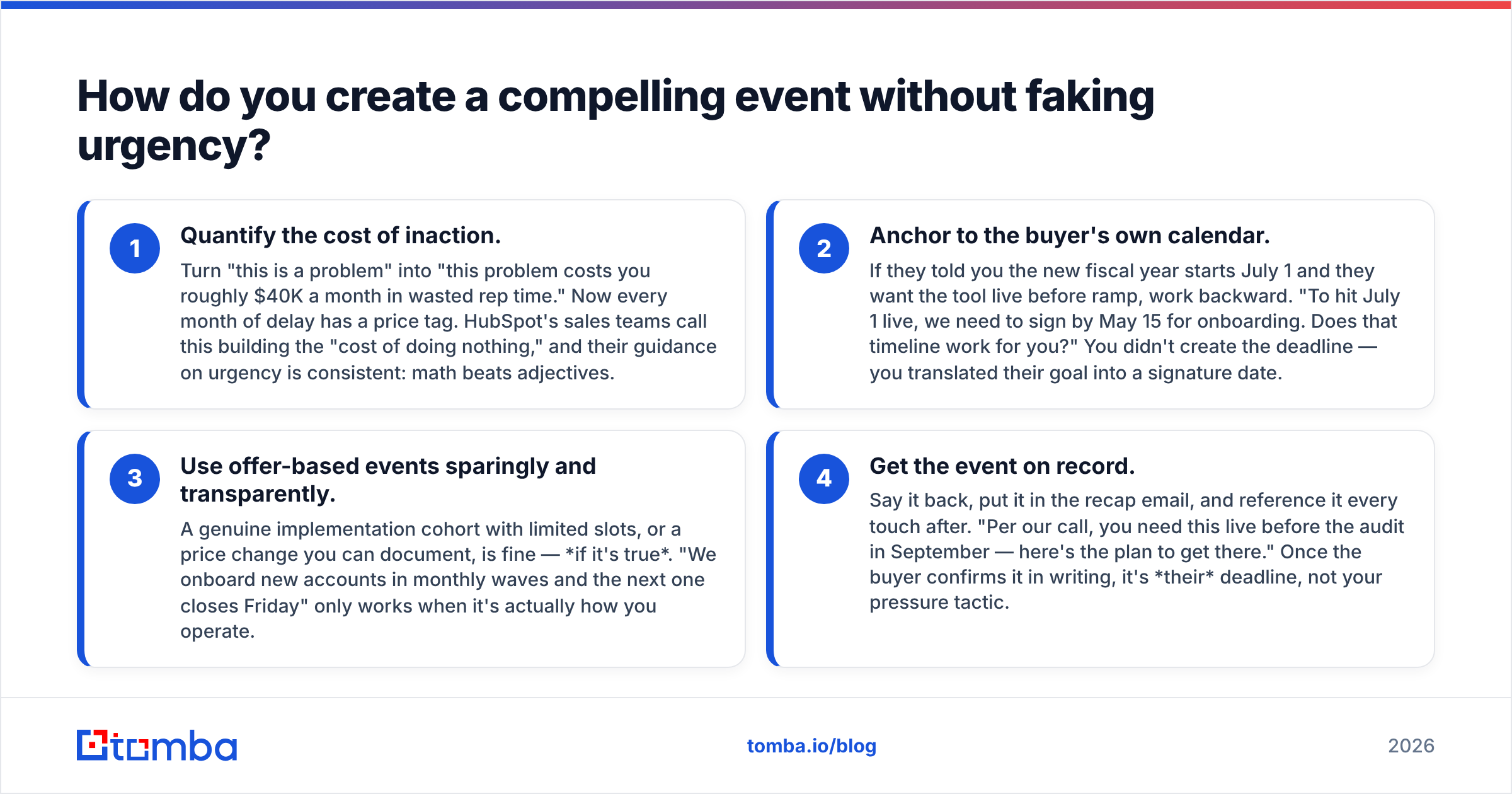
The honest way to manufacture urgency has four moves:
Quantify the cost of inaction. Turn "this is a problem" into "this problem costs you roughly $40K a month in wasted rep time." Now every month of delay has a price tag. HubSpot's sales teams call this building the "cost of doing nothing," and their guidance on urgency is consistent: math beats adjectives.
Anchor to the buyer's own calendar. If they told you the new fiscal year starts July 1 and they want the tool live before ramp, work backward. "To hit July 1 live, we need to sign by May 15 for onboarding. Does that timeline work for you?" You didn't create the deadline — you translated their goal into a signature date.
Use offer-based events sparingly and transparently. A genuine implementation cohort with limited slots, or a price change you can document, is fine — if it's true. "We onboard new accounts in monthly waves and the next one closes Friday" only works when it's actually how you operate.
Get the event on record. Say it back, put it in the recap email, and reference it every touch after. "Per our call, you need this live before the audit in September — here's the plan to get there." Once the buyer confirms it in writing, it's their deadline, not your pressure tactic.
The difference between compelling and coercive is honesty. A real compelling event survives the buyer asking "wait, why does that date matter?" A fake one collapses the moment they push on it — and takes your credibility with it.
What does a compelling event look like across the sales cycle?#
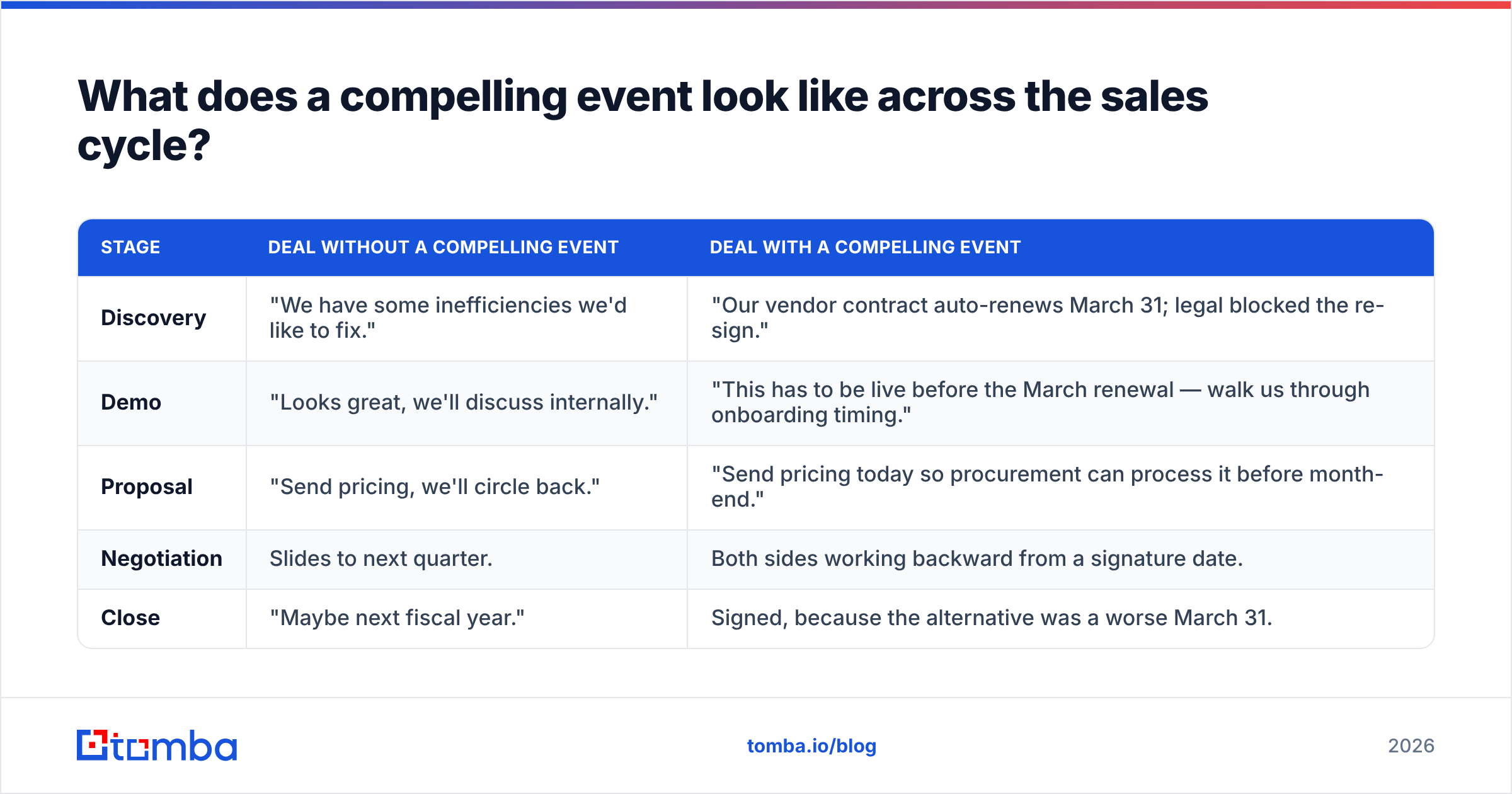
It should show up at every stage, getting sharper as the deal progresses. Here's how the same deal reads with and without one.
| Stage | Deal WITHOUT a compelling event | Deal WITH a compelling event |
|---|---|---|
| Discovery | "We have some inefficiencies we'd like to fix." | "Our vendor contract auto-renews March 31; legal blocked the re-sign." |
| Demo | "Looks great, we'll discuss internally." | "This has to be live before the March renewal — walk us through onboarding timing." |
| Proposal | "Send pricing, we'll circle back." | "Send pricing today so procurement can process it before month-end." |
| Negotiation | Slides to next quarter. | Both sides working backward from a signature date. |
| Close | "Maybe next fiscal year." | Signed, because the alternative was a worse March 31. |
The left column is a deal you'll forecast three times and lose once. The right column is a deal with a spine.
This is also why your email response rate climbs when your outreach references a real trigger. "Saw you're hiring 15 reps — here's how teams your size onboard before ramp" lands because it carries an implied deadline. Generic "circling back" emails carry none.
How does prospecting data create more compelling events?#
The earlier you spot a trigger, the more compelling events you get to work with — and the fewer deals stall for lack of urgency.
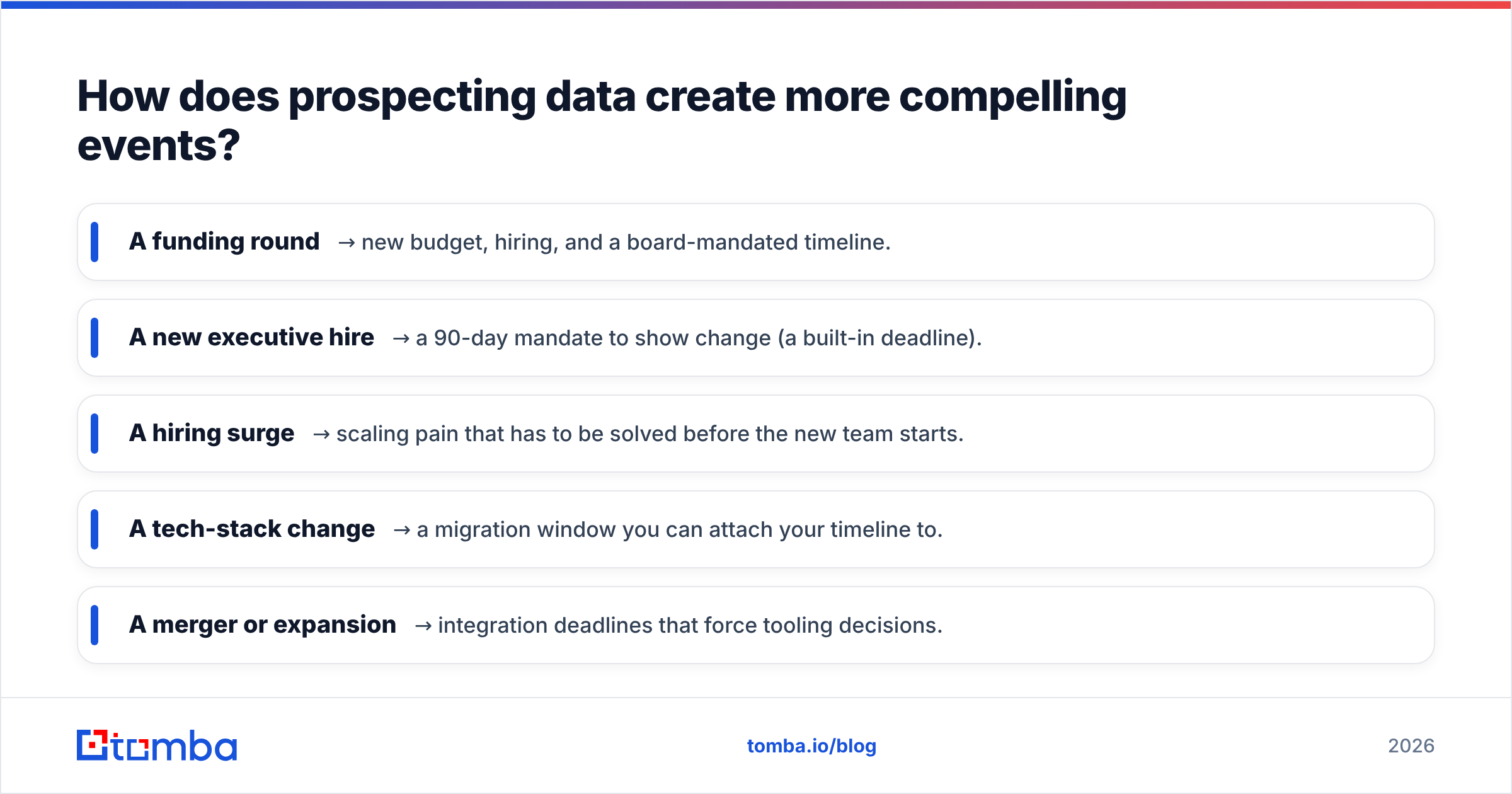
Triggers that create or reveal compelling events are almost always visible in data before a rep hears about them on a call:
- A funding round → new budget, hiring, and a board-mandated timeline.
- A new executive hire → a 90-day mandate to show change (a built-in deadline).
- A hiring surge → scaling pain that has to be solved before the new team starts.
- A tech-stack change → a migration window you can attach your timeline to.
- A merger or expansion → integration deadlines that force tooling decisions.
The reps who consistently work deals with compelling events aren't luckier — they're better fed. They start from a list of accounts already showing a trigger, then use accurate contact data to reach the decision owner while the window is open. That's where tools like the Tomba Email Finder and a reliable phone finder earn their keep: a compelling event is worthless if you can't reach the one person who feels the consequence before the deadline passes. You can compare capabilities and plans on the Tomba pricing page, and vendor-neutral reviews on G2 are a good sanity check on any tool in your stack.
Speed matters here. The half-life of a trigger is short — a funding announcement is worth ten times more in week one than in week eight. If your prospecting motion takes three weeks to turn a signal into a conversation, the compelling event has cooled by the time you dial.
Common mistakes that kill a compelling event#
- Confusing pain with a deadline. You can have a champion in agony and still lose to "next year." Always find the clock.
- Manufacturing fake urgency. Buyers can smell an invented discount deadline. It trains them to wait for the next one.
- Never writing it down. If the compelling event isn't in your recap emails and CRM, it isn't real — it's a thing one rep remembers.
- Assuming the event owner can sign. The person who feels the pain isn't always the one who signs. Map both early.
- Working the event too late. Surface it in discovery, not in negotiation. A deadline discovered in week eight can't reshape a timeline set in week one.
- Letting the clock run without a plan. A deadline with no mutual action plan is just anxiety. Pair the event with a step-by-step path to hit it.
Putting it into practice#
The next time a deal stalls, don't reach for a discount. Reach for the calendar. Ask what happens to the buyer's business if nothing changes by a specific date — and if there's no answer, you've found your problem. Either there's a compelling event you haven't surfaced yet, or there genuinely isn't one and the deal shouldn't be in your commit.
Great sellers treat the compelling event as a discovery output, not a closing trick. They build it into every stage, quantify the cost of inaction in the buyer's own numbers, and reach the right person while the window is still open.
That last part — reaching the right person, fast, before the trigger cools — is a data problem as much as a selling one. If your reps are burning the best hours of a compelling event hunting for a verified email or a direct dial, you're leaving pipeline on the table. Start free and put accurate contact data behind every trigger you spot with the Tomba Email Finder — so when you find the deadline, you're already talking to the one person who can beat it.
Related guides#
Ready to find emails that actually work?
Join 150,000+ professionals who stopped guessing and started sending. Free credits on signup — no credit card required.
Get the Tomba newsletter
Practical outbound tactics and product updates — once every two weeks.
About the author