Competitive Insights in 2026: The Complete B2B Playbook
Competitive insights only pay off when they change a decision. Here's how to collect, structure, and act on competitor data without drowning your team in dashboards.
Competitive insights sound strategic until someone asks what you actually did with them. Most teams collect competitor screenshots, pricing pages, and win/loss notes into a folder nobody opens. This guide is about the other kind: insight that changes a decision this quarter.
TL;DR#
- Competitive insights are structured, decision-ready facts about your rivals' pricing, positioning, product, and go-to-market motion — not a scrapbook of screenshots.
- The value is in the action: a repricing, a battlecard, a re-targeted campaign, a killed feature. If nothing changes, it wasn't an insight.
- Good programs combine four data streams: public signals, buyer/win-loss feedback, product telemetry, and enriched contact/firmographic data.
- Tooling matters less than cadence. A weekly 30-minute review beats a $40k platform nobody logs into.
- Clean contact and company data is the unglamorous foundation — you can't act on a competitor's customer base you can't identify or reach.
What are competitive insights, exactly?#
Competitive insights are the processed, decision-ready layer that sits on top of raw competitive intelligence. Think of it like cooking: intelligence is the pile of groceries, insight is the meal you can actually serve. Raw intelligence is "Competitor X changed their pricing page." The insight is "Competitor X moved their entry tier from usage-based to seat-based, which means they're chasing bigger accounts and leaving SMB exposed — we should push our SMB offer harder this quarter."
The distinction matters because most teams stop at intelligence. They accumulate. A competitive insight has three properties intelligence lacks:
- It's interpreted — someone assigned meaning, not just a data point.
- It's tied to a decision — pricing, messaging, roadmap, or targeting.
- It has an owner and a deadline — otherwise it decays into trivia.
According to Gartner, the highest-performing revenue teams treat competitor knowledge as an operational input, not a quarterly slide. That operational framing is the whole game.

Why do most competitive insights programs fail?#
They fail for boring, predictable reasons — which is good news, because boring problems are fixable.
- No owner. "Everyone" watches the competition, so no one does. Assign a single accountable person per competitor.
- Collection over synthesis. Teams optimize for gathering (more alerts, more feeds) instead of deciding. More inputs make the problem worse, not better.
- Stale battlecards. A battlecard written 18 months ago is worse than none — reps trust it and get burned on a live call.
- No feedback loop. Sales hears objections about a competitor daily but has nowhere to log them, so the intel never reaches product or marketing.
- Data you can't act on. You learn a rival won a logo, but you can't identify the buying committee or reach them, so the insight dies.
That last point is where data quality quietly sinks the whole effort. If your competitive picture is built on a B2B database full of stale titles and bounced emails, every downstream decision inherits that rot.
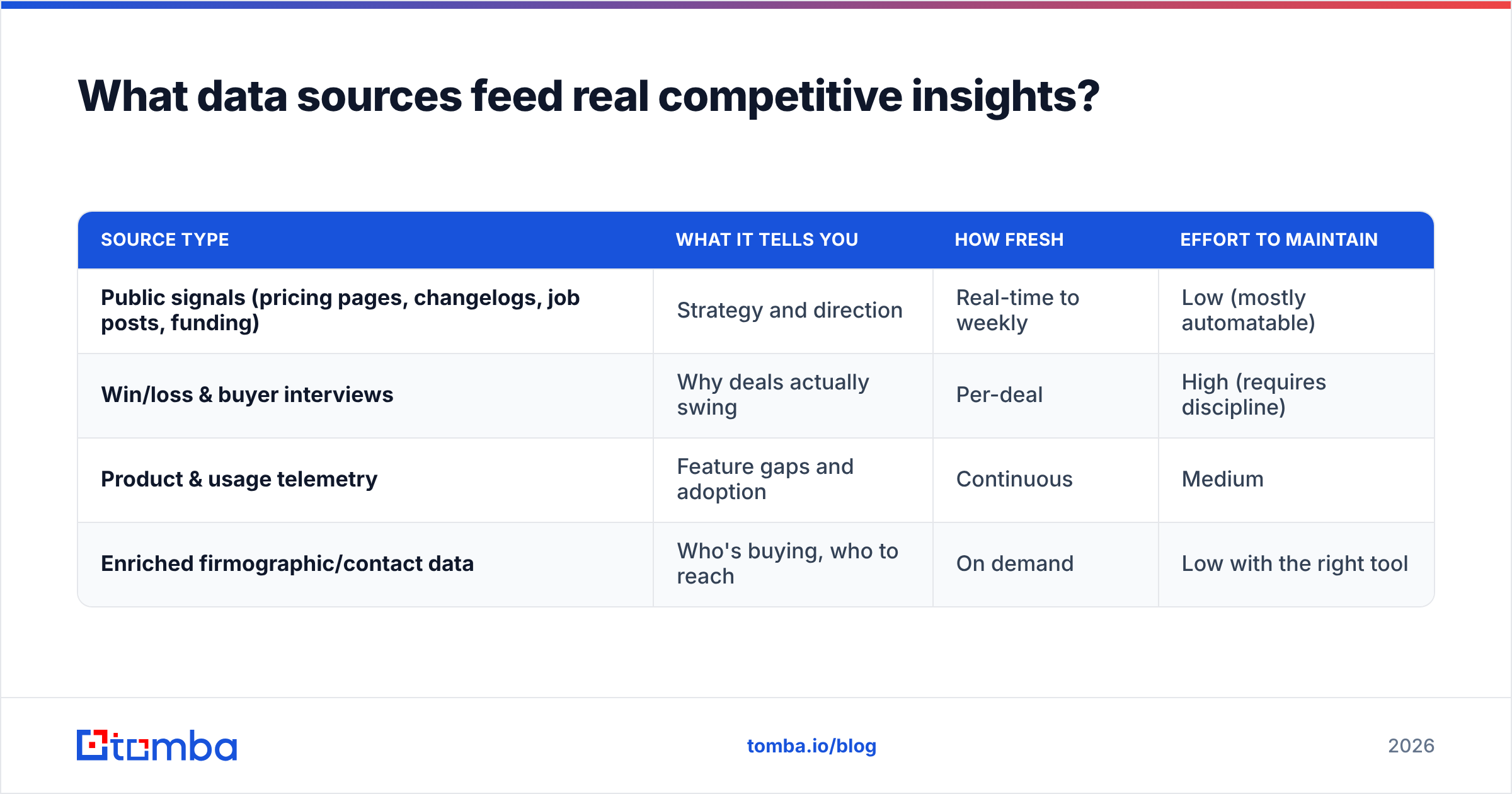
What data sources feed real competitive insights?#
Strong programs blend four streams. Any one alone gives you a distorted picture — public signals tell you what competitors say, buyer feedback tells you what's true.
| Source type | What it tells you | How fresh | Effort to maintain |
|---|---|---|---|
| Public signals (pricing pages, changelogs, job posts, funding) | Strategy and direction | Real-time to weekly | Low (mostly automatable) |
| Win/loss & buyer interviews | Why deals actually swing | Per-deal | High (requires discipline) |
| Product & usage telemetry | Feature gaps and adoption | Continuous | Medium |
| Enriched firmographic/contact data | Who's buying, who to reach | On demand | Low with the right tool |
A few notes on each:
Public signals are the cheapest and most abused. Hiring 10 enterprise AEs is a louder signal than any press release. A quietly deleted feature page tells you what a competitor is sunsetting. Monitor these, but never mistake them for truth — pricing pages lie by omission constantly.
Win/loss is the highest-value and lowest-adopted source. Buyers who chose the competitor will tell you exactly why if you ask within a week of the decision. HubSpot's research consistently shows that structured loss reviews surface objections your reps rationalize away in the moment.
Product telemetry — if you can see which competitor integrations customers request, or which features drive churn to a rival, you have insight nobody else has.
Enriched data turns a name into a reachable, scored account. When you spot that a competitor's customer is hiring for a role your product replaces, data enrichment lets you go from "interesting" to "here's the VP of Ops and her verified email" in one step.
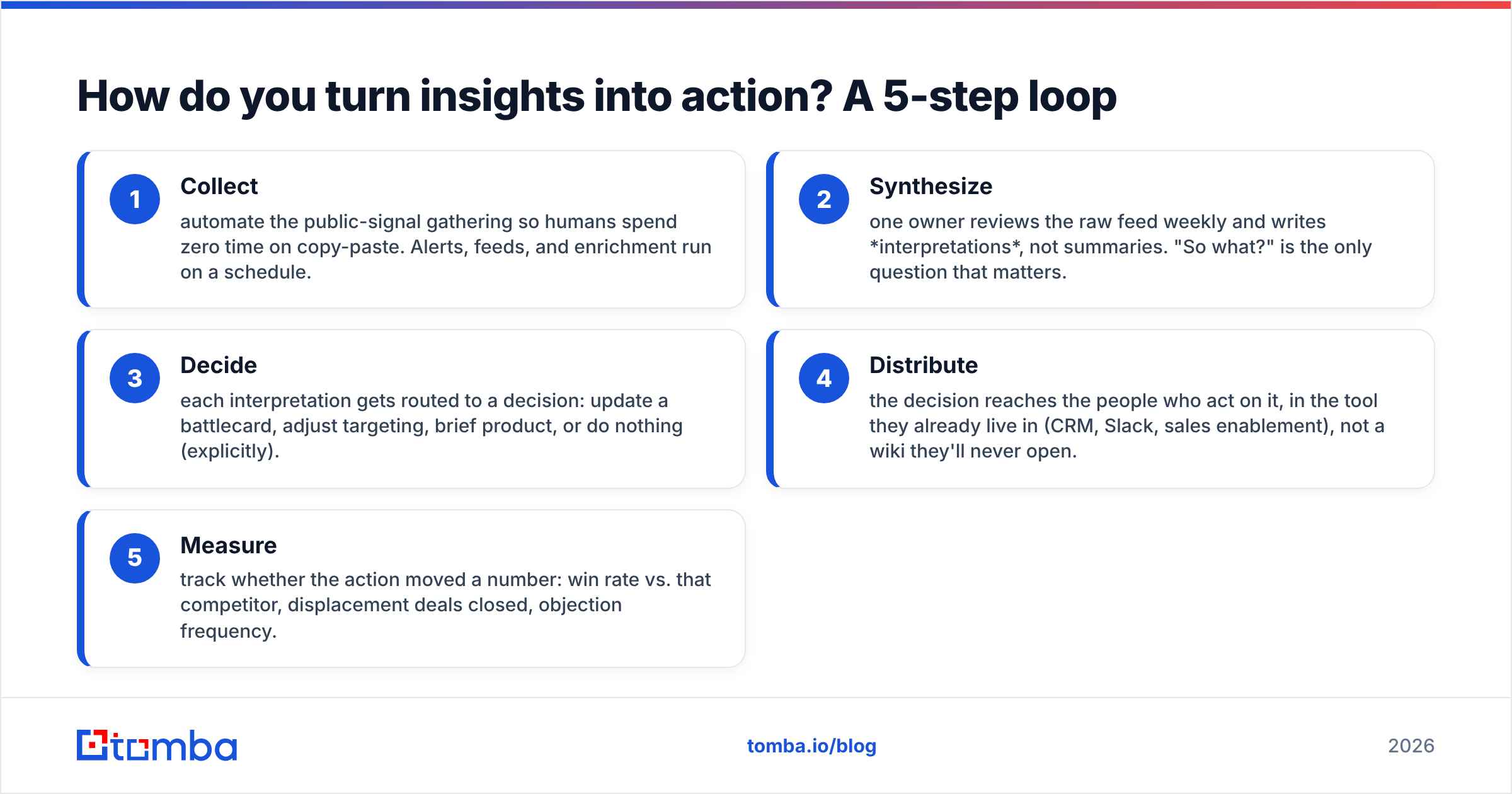
How do you turn insights into action? A 5-step loop#
Insight without a loop is a hobby. Here's the operational cadence that separates programs that move revenue from programs that fill Notion pages.
- Collect — automate the public-signal gathering so humans spend zero time on copy-paste. Alerts, feeds, and enrichment run on a schedule.
- Synthesize — one owner reviews the raw feed weekly and writes interpretations, not summaries. "So what?" is the only question that matters.
- Decide — each interpretation gets routed to a decision: update a battlecard, adjust targeting, brief product, or do nothing (explicitly).
- Distribute — the decision reaches the people who act on it, in the tool they already live in (CRM, Slack, sales enablement), not a wiki they'll never open.
- Measure — track whether the action moved a number: win rate vs. that competitor, displacement deals closed, objection frequency.
The loop is deliberately short. A weekly rhythm keeps insights fresh and forces synthesis before the pile grows unmanageable. Teams that run this loop religiously beat teams with fancier tooling and no cadence, every time.
Which competitive insights tools should you consider?#
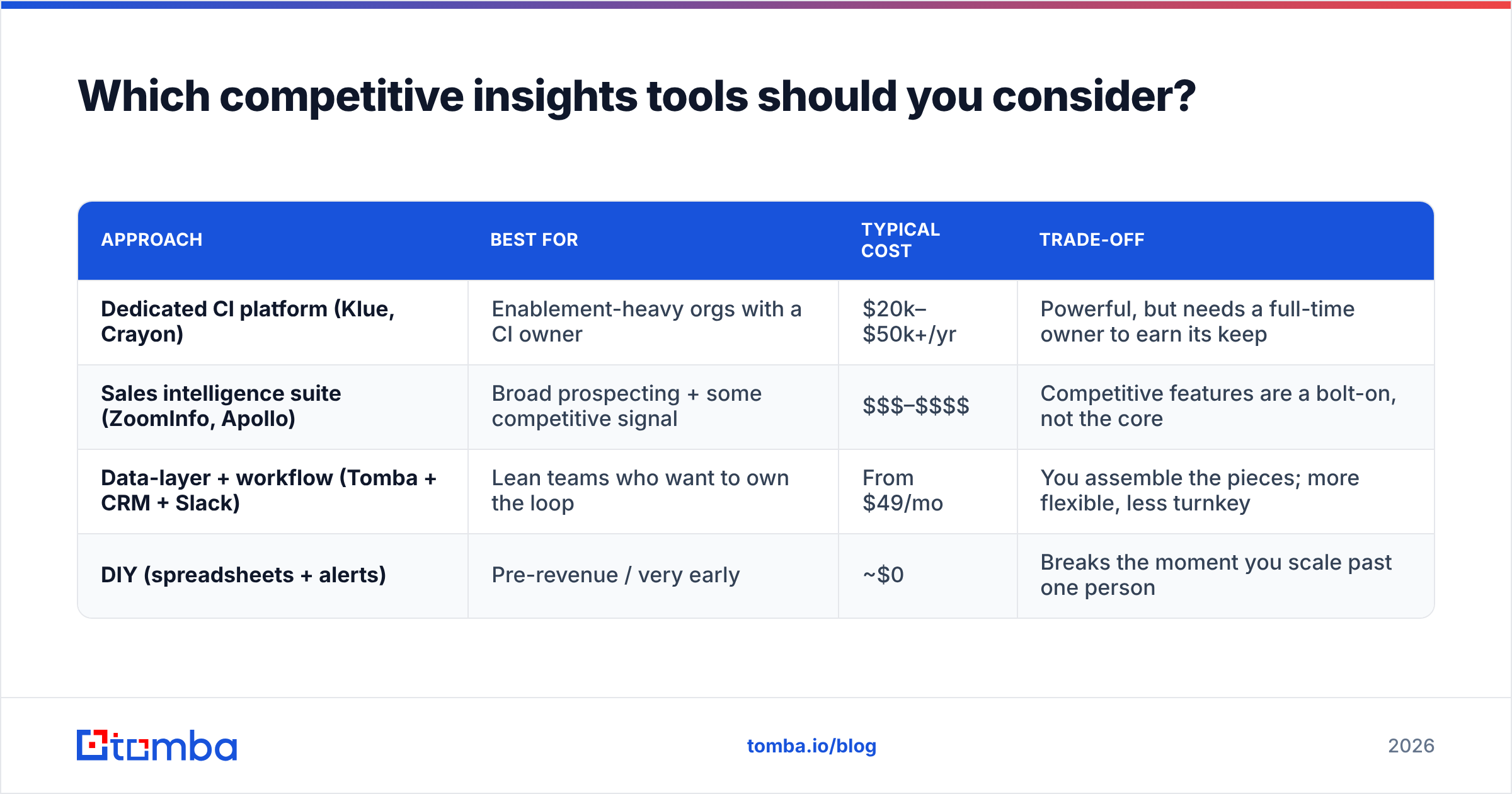
The market splits into dedicated competitive intelligence platforms, all-in-one sales intelligence suites, and lightweight data layers you assemble yourself. There's no universal winner — it depends on how much of the loop you want to buy versus build.
| Approach | Best for | Typical cost | Trade-off |
|---|---|---|---|
| Dedicated CI platform (Klue, Crayon) | Enablement-heavy orgs with a CI owner | $20k–$50k+/yr | Powerful, but needs a full-time owner to earn its keep |
| Sales intelligence suite (ZoomInfo, Apollo) | Broad prospecting + some competitive signal | $$$–$$$$ | Competitive features are a bolt-on, not the core |
| Data-layer + workflow (Tomba + CRM + Slack) | Lean teams who want to own the loop | From $49/mo | You assemble the pieces; more flexible, less turnkey |
| DIY (spreadsheets + alerts) | Pre-revenue / very early | ~$0 | Breaks the moment you scale past one person |
If you're a lean team, the honest recommendation is to not start with a $40k platform. Start with a clean data foundation and a weekly loop, prove the ROI, then buy the heavy platform when you have a dedicated owner to run it. You can compare category leaders on G2 before committing to any tier.
For the data layer specifically, being able to identify a competitor's customers and reach the buying committee is what makes competitive insight actionable. Tools like website visitor reveal surface which companies are researching you (and often comparing you to a named rival), while a reliable email finder turns those company names into verified contacts you can actually engage.
How is AI changing competitive insights in 2026?#
AI has genuinely shifted the collect-and-synthesize half of the loop — with a catch. Large models are excellent at summarizing a competitor's changelog, clustering win/loss themes, and drafting a first-pass battlecard. They are terrible at knowing whether the underlying facts are current or true.
This creates a subtle trap. AI-generated competitive summaries read as confident and authoritative regardless of whether the source data was six days or six years old. The teams getting real value in 2026 use AI for synthesis speed but keep two things human-owned:
- Source freshness — a person verifies that pricing, positioning, and contact data are current before AI reasons over them.
- The decision — AI can propose "here's what this signal means," but a human owns "here's what we'll do about it."
The pattern that works: feed AI clean, fresh, structured inputs and let it accelerate synthesis. Feed it stale scraped junk and you get fluent, fast, wrong. As the old data adage goes, garbage in, garbage out — and AI makes the garbage come out faster and more persuasively.
What are the most common competitive insights mistakes?#
Even well-funded programs step on the same rakes. Watch for these:
- Confirmation-bias battlecards — cards that only list where you win. Reps get ambushed on the two things the competitor genuinely does better. List those too, with a rebuttal.
- Watching the wrong competitor — obsessing over the market leader while a scrappy upstart quietly takes your SMB base. Track by deal overlap, not by brand fame.
- Insight hoarding — a CI team that produces beautiful reports nobody reads. Distribution is the job, not production.
- Ignoring "do nothing" — treating every signal as an emergency. Explicitly deciding not to react is a valid, underused output.
- Building on dirty data — the quiet killer. Every mis-targeted campaign, every bounced outreach to a competitor's customer, traces back to unverified contact and company data.
How do you measure whether competitive insights are working?#
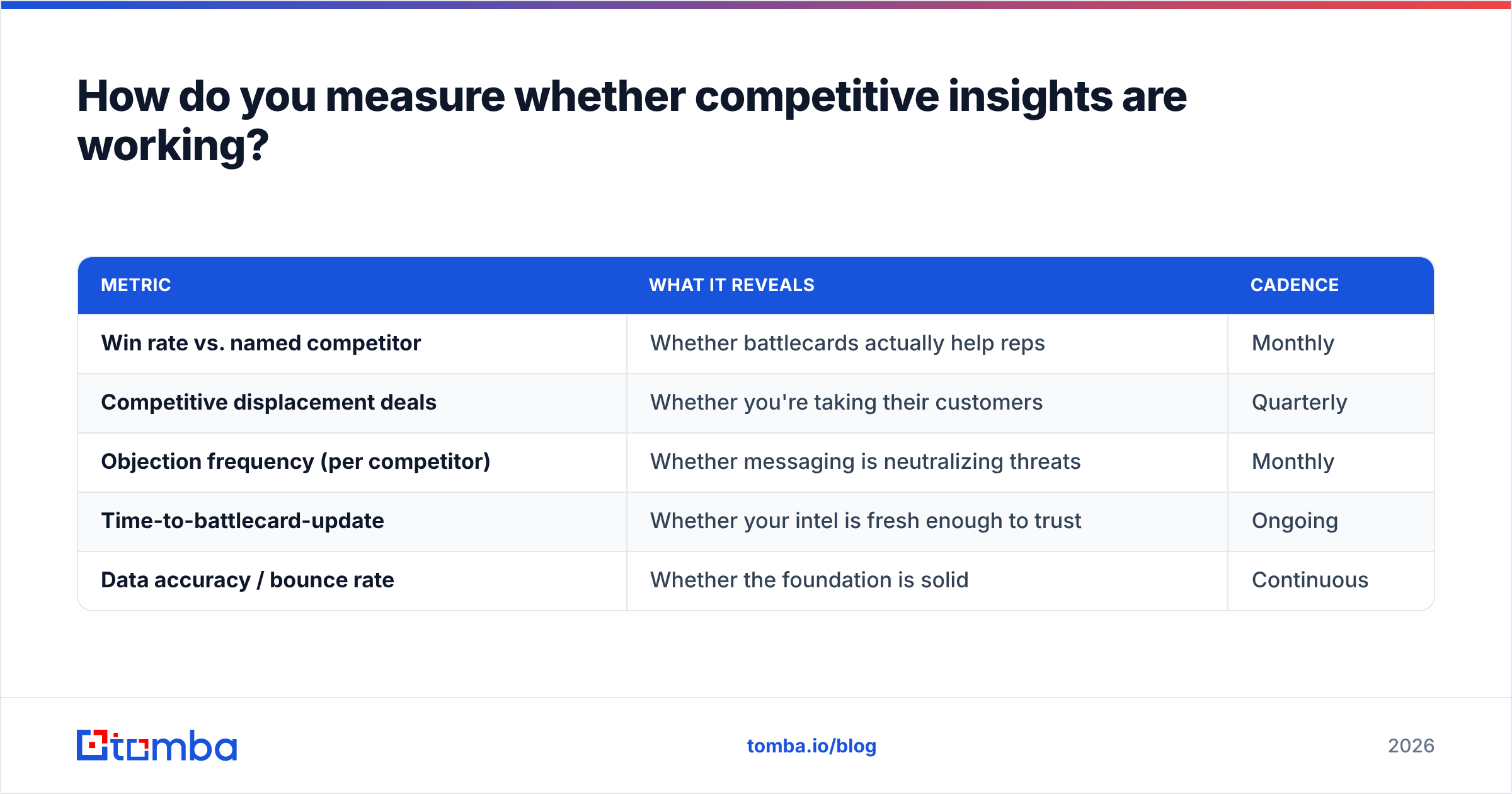
You measure the decision, not the collection. Vanity metrics (alerts processed, reports published) tell you nothing. Tie your program to outcomes:
| Metric | What it reveals | Cadence |
|---|---|---|
| Win rate vs. named competitor | Whether battlecards actually help reps | Monthly |
| Competitive displacement deals | Whether you're taking their customers | Quarterly |
| Objection frequency (per competitor) | Whether messaging is neutralizing threats | Monthly |
| Time-to-battlecard-update | Whether your intel is fresh enough to trust | Ongoing |
| Data accuracy / bounce rate | Whether the foundation is solid | Continuous |
If win rate against a specific rival ticks up after you ship a new battlecard, you have proof. If nothing moves after three months, kill the effort or fix the loop — don't let it limp along consuming budget and attention.
Where does contact data fit into all this?#
It's the layer that makes every other layer actionable. You can have flawless competitive intelligence — you know a rival just lost a major account, you know exactly who's frustrated — and it's worthless if you can't identify and reach the human who signs the renewal.
That's the practical bridge between "insight" and "revenue." When your competitive picture surfaces an opportunity, you need to move immediately: find the decision-maker, verify the email, and reach out while the window is open. Weak, stale, or unverifiable data adds friction at exactly the moment speed matters most. Reliable data sources and verified contacts are what convert a good insight into a booked meeting.
Start with the foundation, not the dashboard#
Competitive insights are only as good as the action they trigger — and action requires reaching real people at real accounts. Before you invest in an expensive intelligence platform, make sure the data underneath it is clean, fresh, and reachable. When you spot a competitor's vulnerable account, the Tomba Email Finder turns that company name into verified, deliverable contacts for the whole buying committee — so your insight becomes a conversation instead of a note in a doc. Start on the free tier (25 searches/month), and scale to a paid plan when the loop is proving its worth. Check the full Tomba pricing to match a plan to your motion.
Collect less, decide more, and act while the window is open. That's the whole discipline.
Related guides#
Ready to find emails that actually work?
Join 150,000+ professionals who stopped guessing and started sending. Free credits on signup — no credit card required.
Get the Tomba newsletter
Practical outbound tactics and product updates — once every two weeks.
About the author