Competitive Intelligence Database: The 2026 Build Guide
A competitive intelligence database turns scattered notes into a living asset your whole GTM team can query. Here's how to build one that stays accurate.
Most teams "do competitive intelligence" the way people "do" their taxes in April: a frantic, once-a-year scramble to assemble battlecards nobody trusts. A competitive intelligence database fixes that by turning one-off research into a structured, queryable asset your whole go-to-market team can pull from on any given Tuesday.
This guide walks through what a competitive intelligence database actually is, what belongs inside it, how to keep it from rotting, and how to decide between a spreadsheet, a dedicated tool, and a custom build.
TL;DR#
- A competitive intelligence database is a structured, continuously updated store of everything you know about rival companies — pricing, positioning, org changes, wins, and losses — that any team can query.
- The value isn't the data you collect once; it's the freshness and structure that let sales pull a current battlecard in seconds.
- The core schema is simpler than vendors want you to believe: competitors, signals, sources, and outcomes.
- Enrichment and contact data (who works there, who just left, who they hired) is the layer most teams skip and the one that drives the most pipeline.
- Start with a spreadsheet, graduate to a dedicated tool or custom build when you hit 5+ competitors and 3+ consuming teams.
What is a competitive intelligence database?#
A competitive intelligence database is the single source of truth for what your company knows about its competitors. Think of it like a CRM, but instead of tracking your prospects, it tracks the companies fighting you for those prospects.
The everyday analogy: it's the difference between a shoebox of receipts and an accounting system. Both technically "contain" your financial data. Only one lets you answer "how much did we spend on travel last quarter?" in five seconds. A competitive intelligence database is the accounting system — the same raw intel, but structured so questions have fast answers.
Technically, it's a normalized data store (spreadsheet, Airtable base, Notion, or a real SQL database) where each competitor is a record, each observation is a timestamped signal, and every signal traces back to a source. That last part — provenance — is what separates a database from a rumor mill.
Unlike a static battlecard, a live database is queryable ("show me every competitor that raised prices in the last 90 days") and compounding (every observation makes the next query smarter).
What data belongs in a competitive intelligence database?#
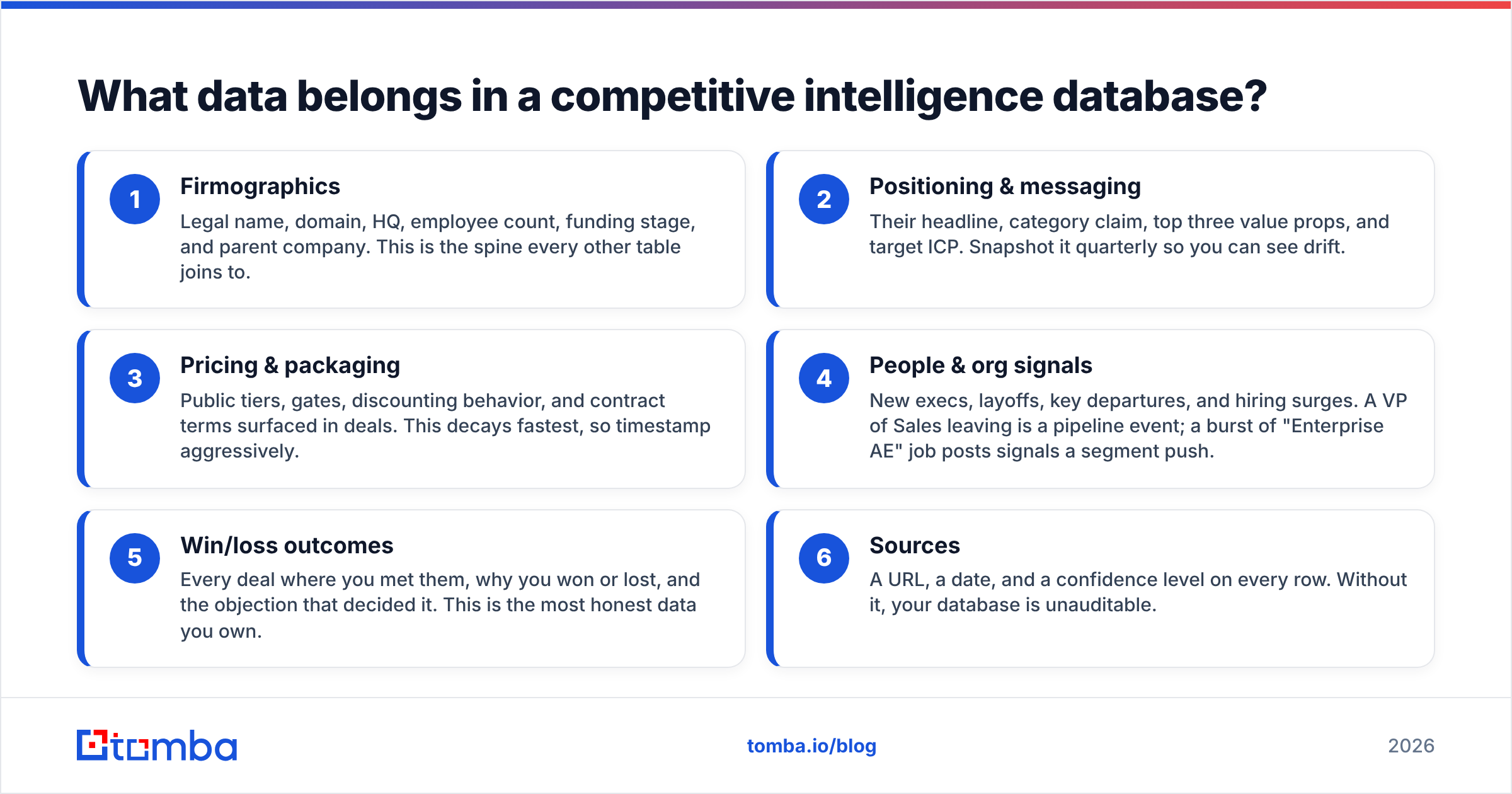
The instinct is to hoard everything. Resist it. A database stuffed with screenshots nobody labeled is just a slower shoebox. Store signals that change a decision. Here's the core structure most winning teams converge on:
- Firmographics — Legal name, domain, HQ, employee count, funding stage, and parent company. This is the spine every other table joins to.
- Positioning & messaging — Their headline, category claim, top three value props, and target ICP. Snapshot it quarterly so you can see drift.
- Pricing & packaging — Public tiers, gates, discounting behavior, and contract terms surfaced in deals. This decays fastest, so timestamp aggressively.
- People & org signals — New execs, layoffs, key departures, and hiring surges. A VP of Sales leaving is a pipeline event; a burst of "Enterprise AE" job posts signals a segment push.
- Win/loss outcomes — Every deal where you met them, why you won or lost, and the objection that decided it. This is the most honest data you own.
- Sources — A URL, a date, and a confidence level on every row. Without it, your database is unauditable.
The people layer is where most databases stay thin, and it's the highest-leverage one. Knowing a competitor just lost their head of product tells your reps when to reach into that competitor's accounts. Pairing org signals with real contact data — verified emails and direct dials for the decision-makers at accounts your rival is bleeding — turns passive intel into an outbound trigger. That's where data enrichment and a reliable B2B database do the heavy lifting.
How is a competitive intelligence database different from a battlecard?#
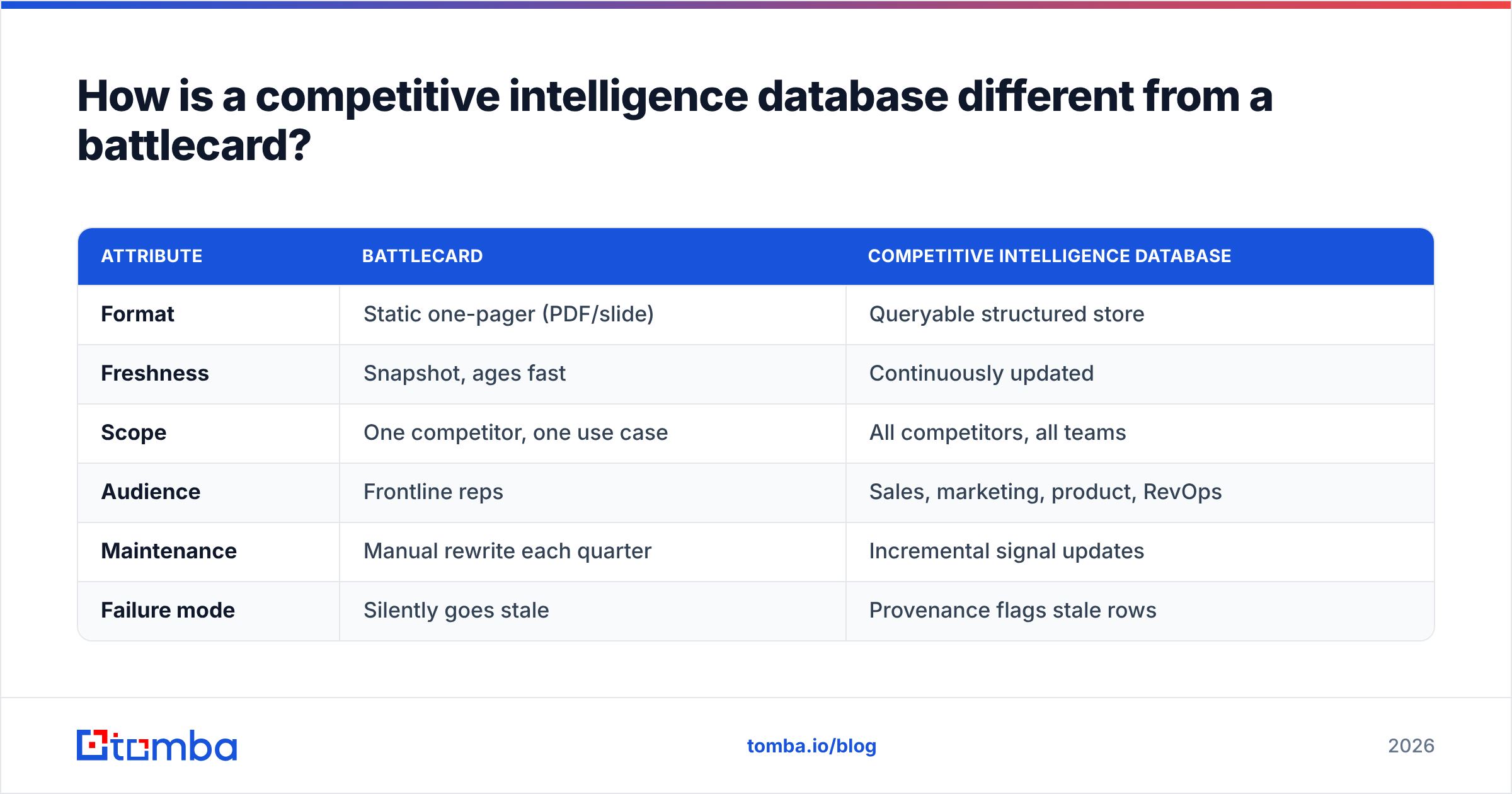
They're related but not interchangeable. A battlecard is the output; the database is the engine.
| Attribute | Battlecard | Competitive Intelligence Database |
|---|---|---|
| Format | Static one-pager (PDF/slide) | Queryable structured store |
| Freshness | Snapshot, ages fast | Continuously updated |
| Scope | One competitor, one use case | All competitors, all teams |
| Audience | Frontline reps | Sales, marketing, product, RevOps |
| Maintenance | Manual rewrite each quarter | Incremental signal updates |
| Failure mode | Silently goes stale | Provenance flags stale rows |
The right mental model: your database generates battlecards on demand, the way a CRM generates a pipeline report. If you're hand-editing battlecards, you don't have a database yet — you have a document.
Should you build, buy, or use a spreadsheet?#
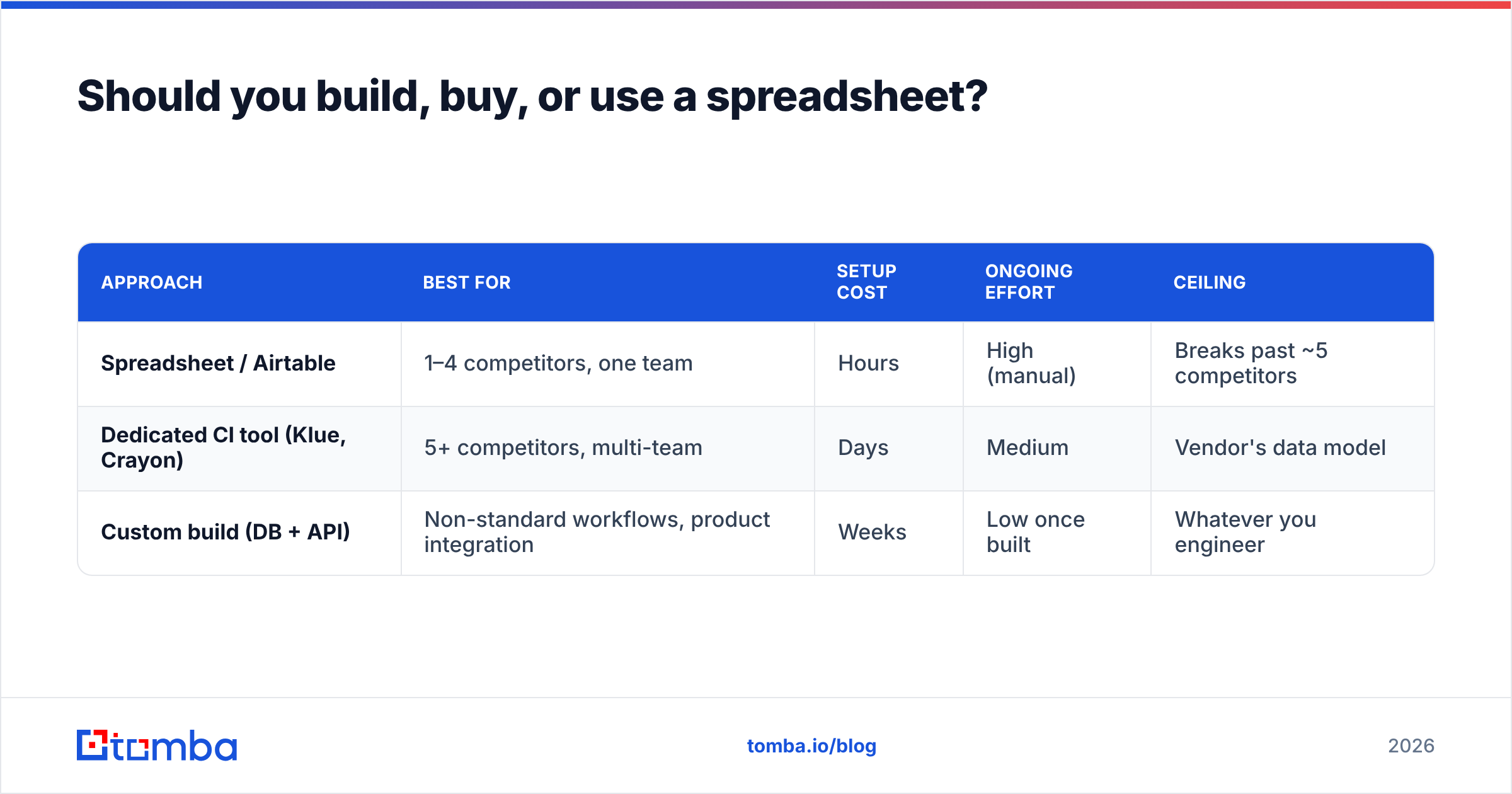
Conclusion first: start in a spreadsheet, buy a tool when coordination cost exceeds tool cost, and build custom only when your workflow is genuinely non-standard. Here's how the three stack up.
| Approach | Best for | Setup cost | Ongoing effort | Ceiling |
|---|---|---|---|---|
| Spreadsheet / Airtable | 1–4 competitors, one team | Hours | High (manual) | Breaks past ~5 competitors |
| Dedicated CI tool (Klue, Crayon) | 5+ competitors, multi-team | Days | Medium | Vendor's data model |
| Custom build (DB + API) | Non-standard workflows, product integration | Weeks | Low once built | Whatever you engineer |
A dedicated platform like Klue or Crayon is the default answer for most mid-market GTM orgs — you get change alerts, battlecard hosting, and Slack delivery out of the box. Check current user sentiment on G2 before committing; the category moves fast.
Go custom only when you need something the tools won't give you: your own enrichment pipeline, tight integration with your product analytics, or programmatic access so the database feeds other systems. If you're building, an email finder API and enrichment endpoints let you populate the people-and-org layer automatically instead of copy-pasting from LinkedIn.
How do you keep a competitive intelligence database accurate?#
A competitive intelligence database has exactly one enemy: decay. Pricing pages change, execs leave, positioning shifts, and a database that silently ages is worse than no database because people trust it. Four practices keep it honest.
1. Timestamp and source everything. Every row gets a last_verified date and a source URL. When a rep pulls a battlecard, they see "pricing verified 4 days ago" versus "verified 8 months ago" and calibrate accordingly. Trust comes from visible provenance, not from claimed completeness.
2. Assign decay windows per field type. Not all data ages equally. Firmographics can go 90 days between checks; pricing and org changes need weekly-to-monthly monitoring. Flag any row past its window as stale automatically.
3. Close the win/loss loop. The richest, cheapest intel already lives in your CRM and your reps' heads. Pipe every competitive deal outcome back into the database. This is the one data source competitors can't see and you can't buy.
4. Automate the mechanical parts. Contact verification, new-hire detection, and firmographic refreshes shouldn't be human work. Route the people layer through data enrichment and an email verifier so the emails and titles in your database stay valid instead of bouncing when a rep finally reaches out. Where a competitor's data comes from matters too — understanding your data sources is what lets you defend a claim in a deal review.
Set a recurring 30-minute weekly review to triage stale flags. Databases don't die from one bad update; they die from a hundred skipped ones.
What does a competitive intelligence workflow look like end to end?#
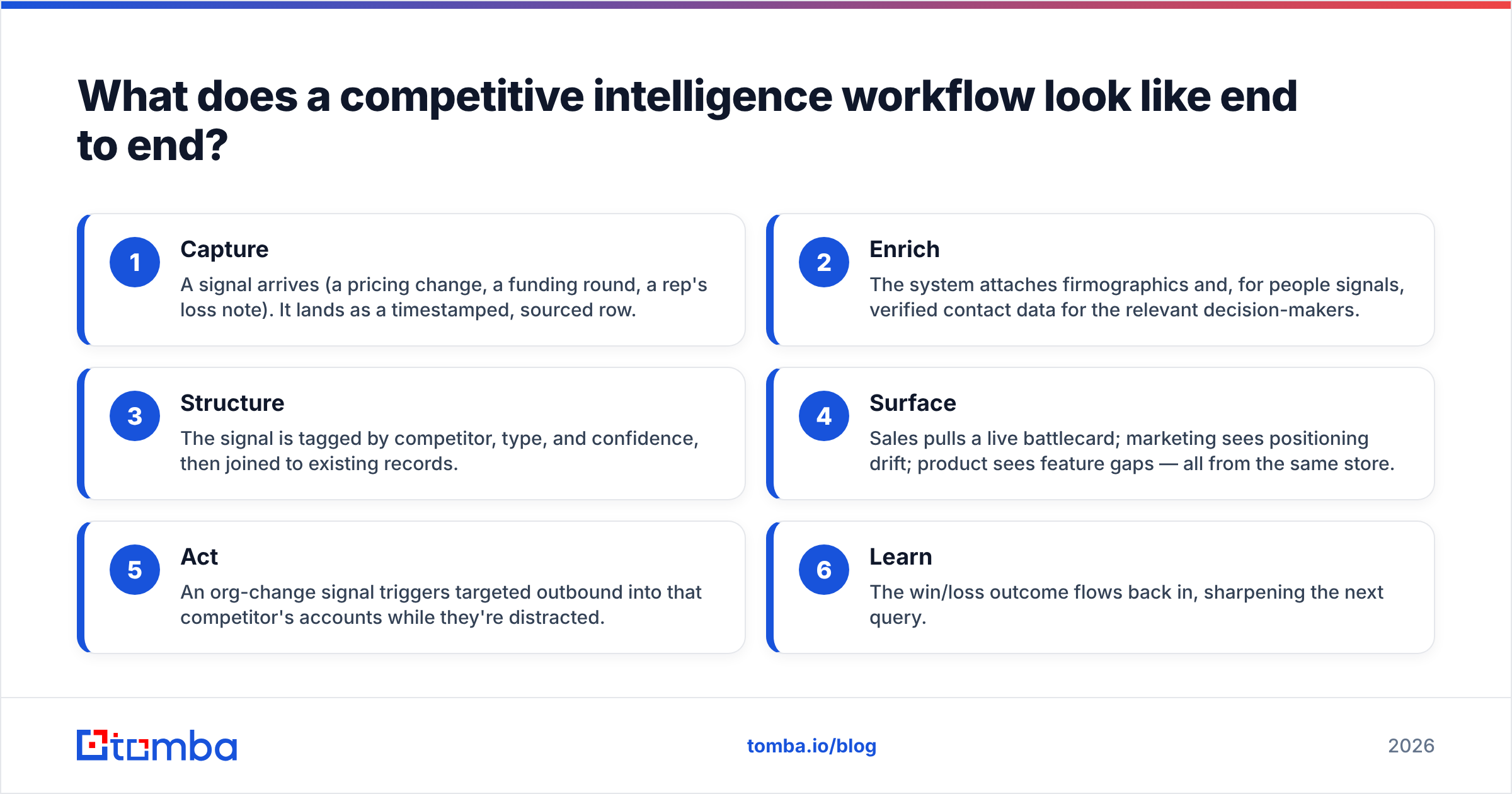
Here's the loop a well-run competitive intelligence database supports, from raw signal to closed deal:
- Capture — A signal arrives (a pricing change, a funding round, a rep's loss note). It lands as a timestamped, sourced row.
- Enrich — The system attaches firmographics and, for people signals, verified contact data for the relevant decision-makers.
- Structure — The signal is tagged by competitor, type, and confidence, then joined to existing records.
- Surface — Sales pulls a live battlecard; marketing sees positioning drift; product sees feature gaps — all from the same store.
- Act — An org-change signal triggers targeted outbound into that competitor's accounts while they're distracted.
- Learn — The win/loss outcome flows back in, sharpening the next query.
Each pass compounds. The team that runs this loop tightly doesn't just "know their competitors" — they get to opportunities earlier, because a structured database surfaces the trigger before a human would have noticed it.
What are the common mistakes to avoid?#
- Collecting without a decision in mind. If a field never changes a rep's behavior, don't store it. Volume is not value.
- No provenance. Unsourced rows are rumors. One wrong claim in a deal review torches the whole database's credibility.
- Ignoring the people layer. Firmographics are table stakes; verified contacts and org changes are what drive action.
- Treating it as a marketing project. A competitive intelligence database that only produces battlecards, and never feeds outbound or product, is running at a fraction of its value.
- Manual everything. If a human is copy-pasting emails and re-checking headcounts, the database will decay the first busy week. Automate the mechanical layers.
Frequently asked questions#
How often should a competitive intelligence database be updated? Per field type. Pricing and org signals: weekly to monthly. Positioning: quarterly. Firmographics: every 90 days. The database should flag stale rows automatically so review time goes to what actually changed.
Is a competitive intelligence database the same as market intelligence? No. Market intelligence covers the whole landscape — trends, TAM, buyer behavior. A competitive intelligence database is narrower and deeper: specific rival companies and how you beat them in specific deals.
Do small teams need one? If you have more than three real competitors and more than one team that references them, yes. Below that, a well-maintained spreadsheet is genuinely fine — don't over-tool.
What's the fastest way to populate the people layer? Automate it. Use enrichment and an email-finding API to pull verified decision-maker contacts by domain instead of manual LinkedIn scraping, then keep them valid with verification on a schedule.
Build the contact layer your database is missing#
A competitive intelligence database lives or dies on the people layer — who works at your rivals, who just left, and how to reach the decision-makers in the accounts they're serving. That's exactly the data most teams leave empty. Tomba Email Finder fills it: find verified professional emails by company domain, enrich them with titles and firmographics, and pipe the results straight into your database through the API or bulk finder. The Free tier gives you 25 searches a month to test the fit; paid plans start at $49/mo — see full Tomba pricing for the tiers. Turn your competitive intel from a static document into an outbound engine.
Related guides#
Ready to find emails that actually work?
Join 150,000+ professionals who stopped guessing and started sending. Free credits on signup — no credit card required.
Get the Tomba newsletter
Practical outbound tactics and product updates — once every two weeks.
About the author