9 Best Competitors App Alternatives for B2B Prospecting in 2026
A neutral look at 9 Competitors app alternatives for finding, verifying, and enriching B2B contact data — with real pricing, accuracy notes, and which tool fits which team.
If you've been leaning on a single "Competitors" app to track rivals and pull contact data, you've probably hit the same wall most teams do: the tracking is fine, but the lead data underneath it is thin, stale, or locked behind a plan that costs more every renewal. This guide breaks down the strongest Competitors app alternatives for 2026 — what each one is actually good at, what it costs, and where the accuracy holds up.
TL;DR — The Short Version#
- No single app wins everything. Competitive tracking, email finding, and enrichment are three different jobs, and the best stack usually splits them.
- For contact accuracy at a fair price, dedicated email-finder tools like Tomba and its peers beat all-in-one suites that treat data as an afterthought.
- Watch the renewal math. Several popular apps look cheap at the entry tier, then gate exports, credits, or API access behind steep upgrades.
- Verification matters more than volume. A smaller list of verified emails outperforms a huge list of guesses on both reply rate and sender reputation.
- Best overall value pick: a verify-first email finder with transparent Tomba pricing and an open API, so you're not re-buying the same contacts every quarter.
Why Look for a Competitors App Alternative at All?#
Most "competitors" apps are built to answer one question: what are my rivals doing? They track ad spend, keywords, pricing pages, and hiring signals. That's genuinely useful for positioning — but it's a different problem from how do I reach the buyers those signals point to?
Think of it like a security camera versus a phone book. The camera (competitive tracking) shows you activity. The phone book (contact data) lets you actually make the call. When one app tries to be both, one half is usually mediocre — and it's almost always the contact-data half, because accurate B2B email and phone data is expensive to maintain.
The three most common reasons teams switch:
- Data decay. Contact records go stale at roughly 22–30% per year as people change jobs. An app that refreshes its competitive index daily but its contact index yearly leaves you emailing ghosts.
- Credit anxiety. All-in-one suites meter everything. You burn credits on tracking, enrichment, and exports from the same bucket, so real prospecting gets rationed.
- Export and API limits. You can see the data but can't easily get it into your CRM or sequencing tool without an enterprise upgrade.

If your primary pain is the contact-data half, you don't need to rip out competitive tracking — you need a purpose-built alternative for the sourcing layer. That's where the tools below earn their keep.
What Are the Best Competitors App Alternatives in 2026?#
Here's the shortlist, grouped by the job they do best. Prices are entry-to-mid tier and reflect publicly listed plans as of 2026 — always confirm on the vendor's own page before you buy.
1. Tomba — Best for accurate email finding and verification#
Tomba is a focused email-finder and lead-enrichment platform rather than a do-everything suite. You give it a domain, a name, or a company, and it returns professional email addresses with a confidence score, then lets you verify emails before you send. The domain search pulls every discoverable address at a company in one pass, and the bulk email finder handles list-scale work.
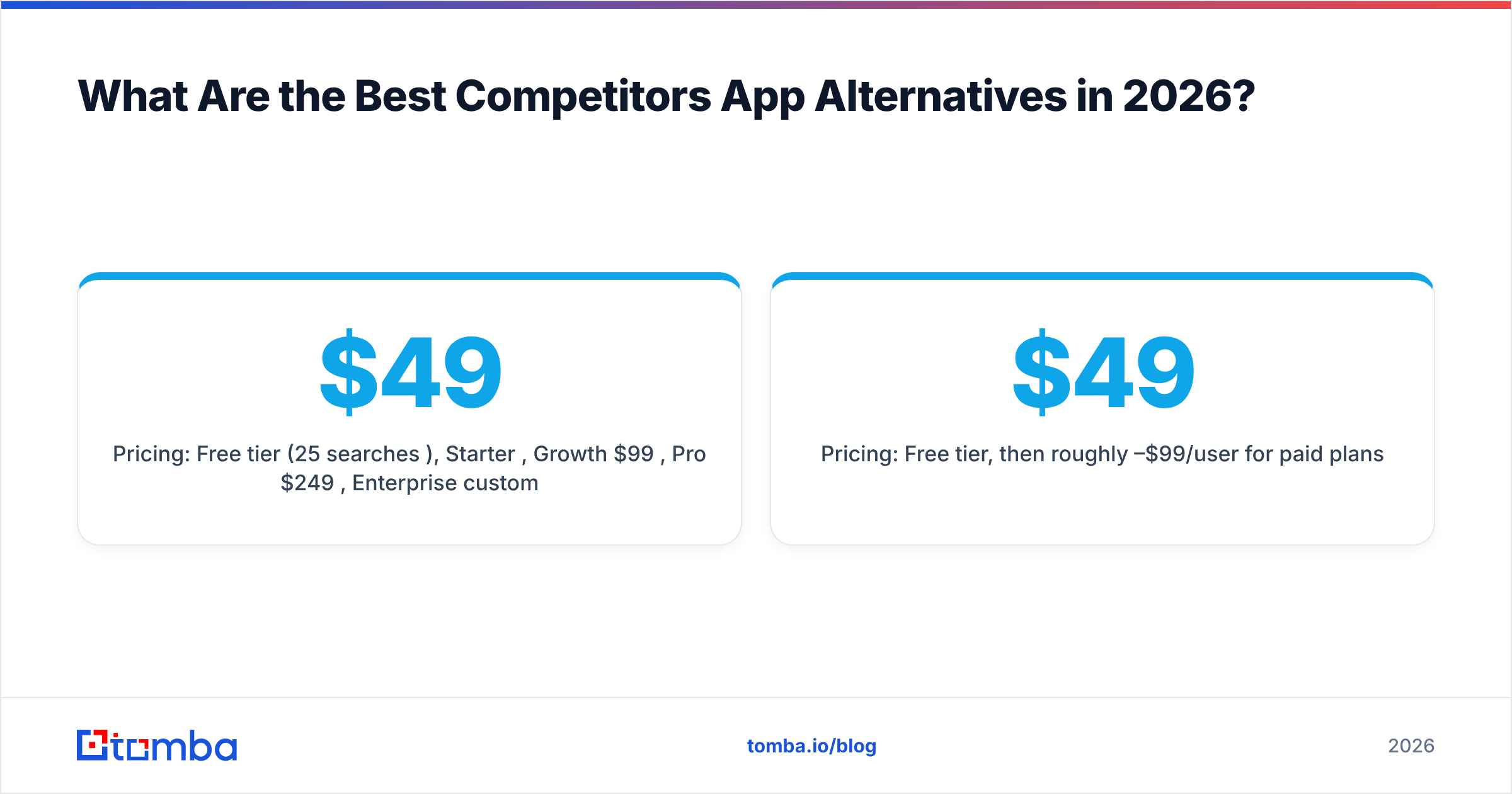
- Pricing: Free tier (25 searches/mo), Starter $49/mo, Growth $99/mo, Pro $249/mo, Enterprise custom.
- Best for: Teams that want verified contacts and a clean API without paying suite prices.
- Watch-outs: It's not a competitive-tracking or ad-intelligence tool — pair it with one if that's your other need.
2. Apollo — Best all-in-one for teams that want a database + sequencing#
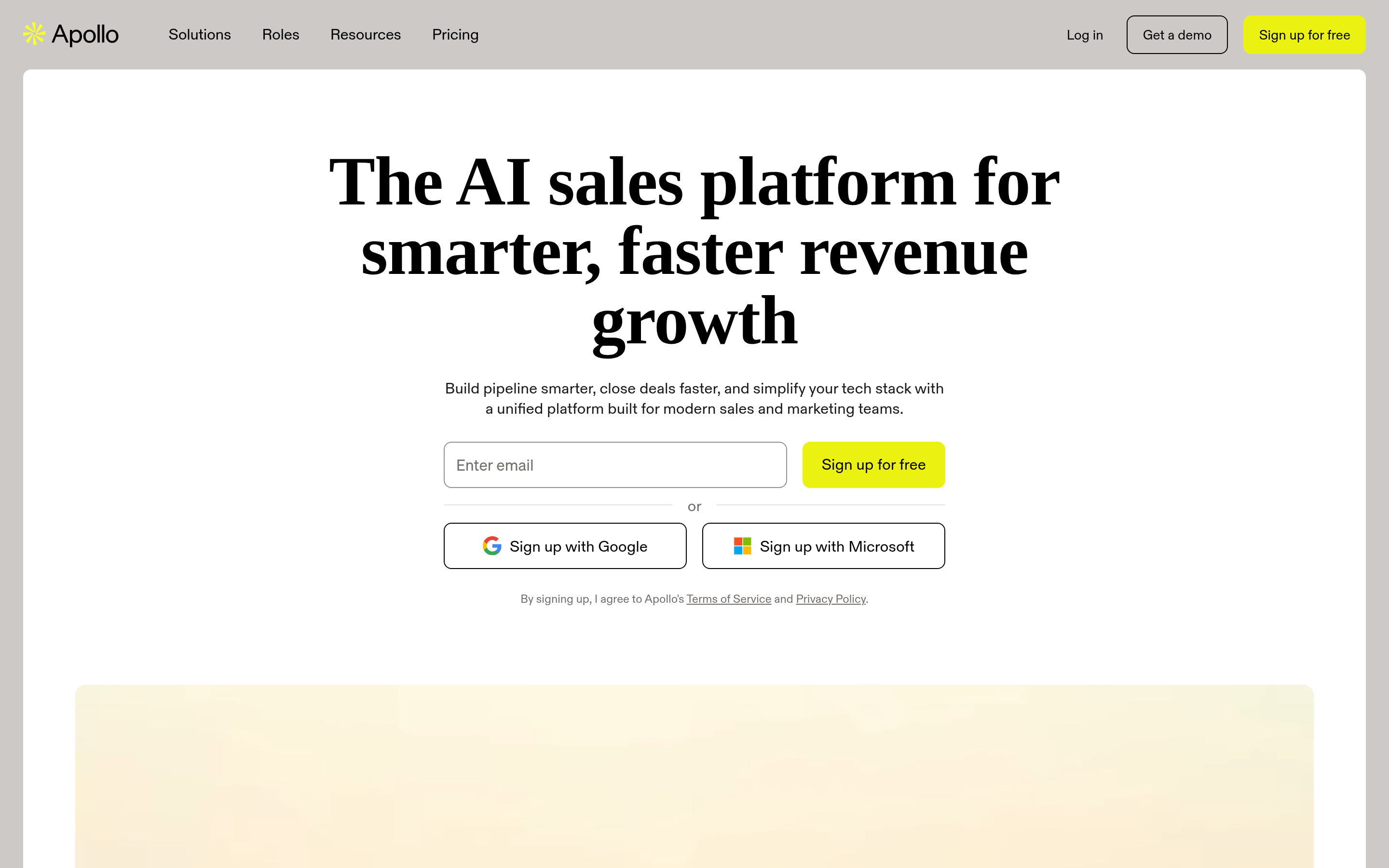
Apollo bundles a contact database, sequencing, and basic intent signals. It's a reasonable single-vendor option if you want everything in one login, though data accuracy varies by region and role. Teams evaluating it often also weigh an Apollo alternative when export limits or credit caps bite.
- Pricing: Free tier, then roughly $49–$99/user/mo for paid plans.
- Best for: SMB sales teams wanting database + outreach in one place.
3. BookYourData — Best for pay-as-you-go verified lists#
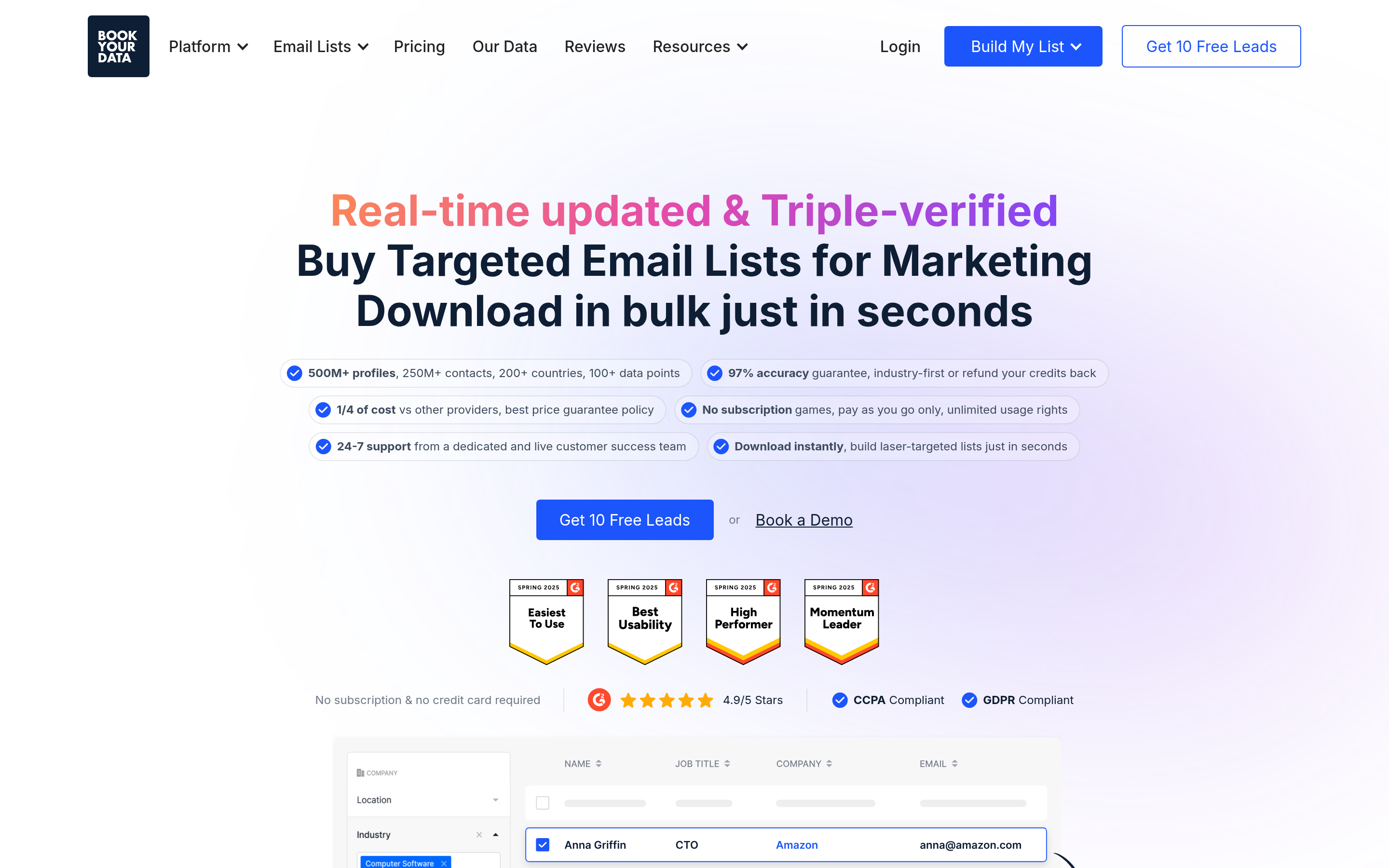
BookYourData is a respected data provider with a strong pay-as-you-go model and a verified-on-download guarantee. If you'd rather buy a targeted list outright than manage a subscription, it's a solid, credible option — especially for teams that spin up campaigns in bursts rather than continuously.
- Pricing: Credit packs, pay-as-you-go.
- Best for: Occasional, targeted list buys with an accuracy guarantee.
4. Clearbit — Best for enrichment inside a big GTM stack#
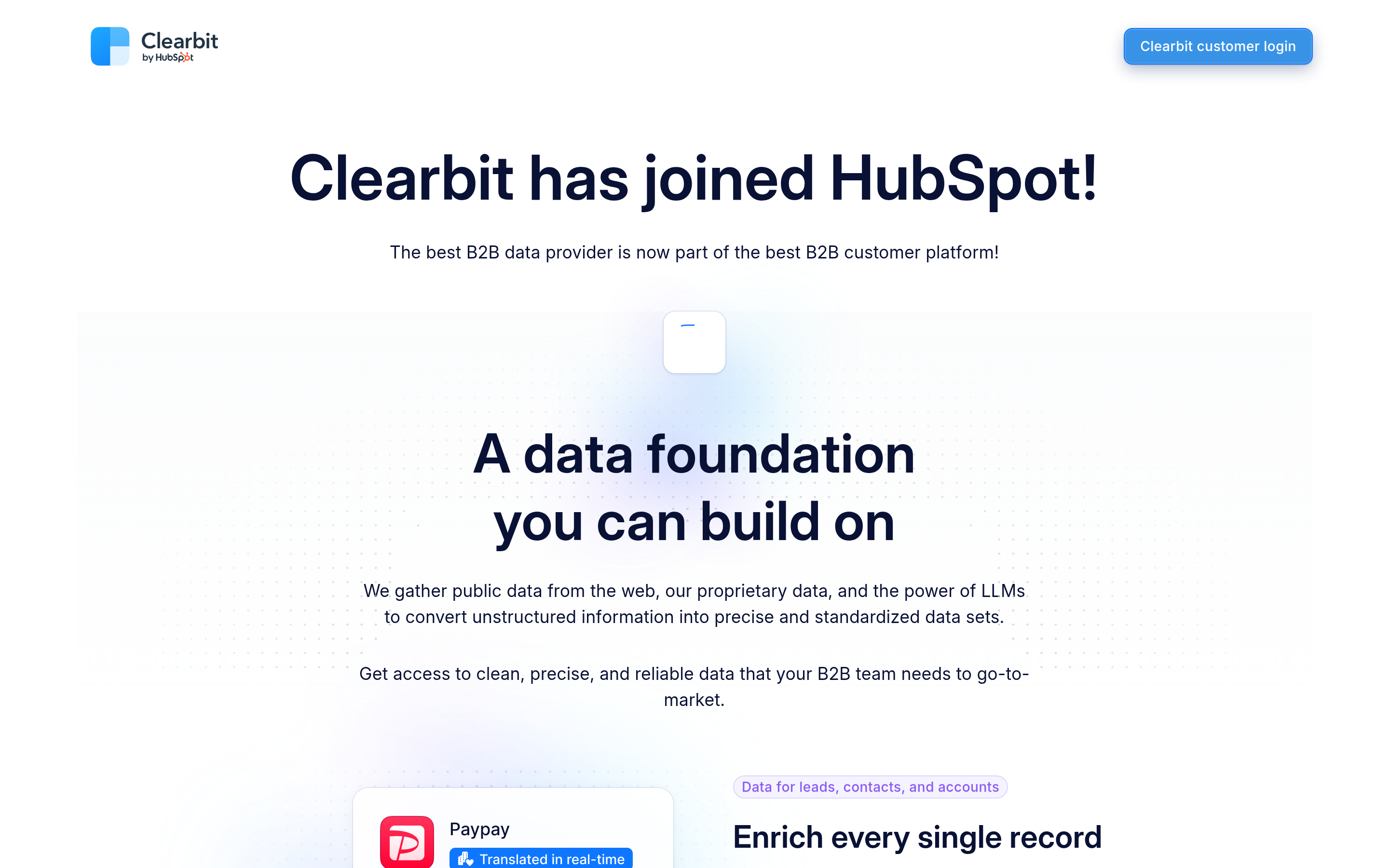
Clearbit (now inside HubSpot's ecosystem) shines at enrichment and firmographic data on records you already have. It's less of a "find new emails" tool and more of a "make my existing data richer" tool. Cost climbs fast at scale.
- Best for: Enterprises standardizing enrichment across marketing and sales.
5. RocketReach — Best for personal + professional contact coverage#
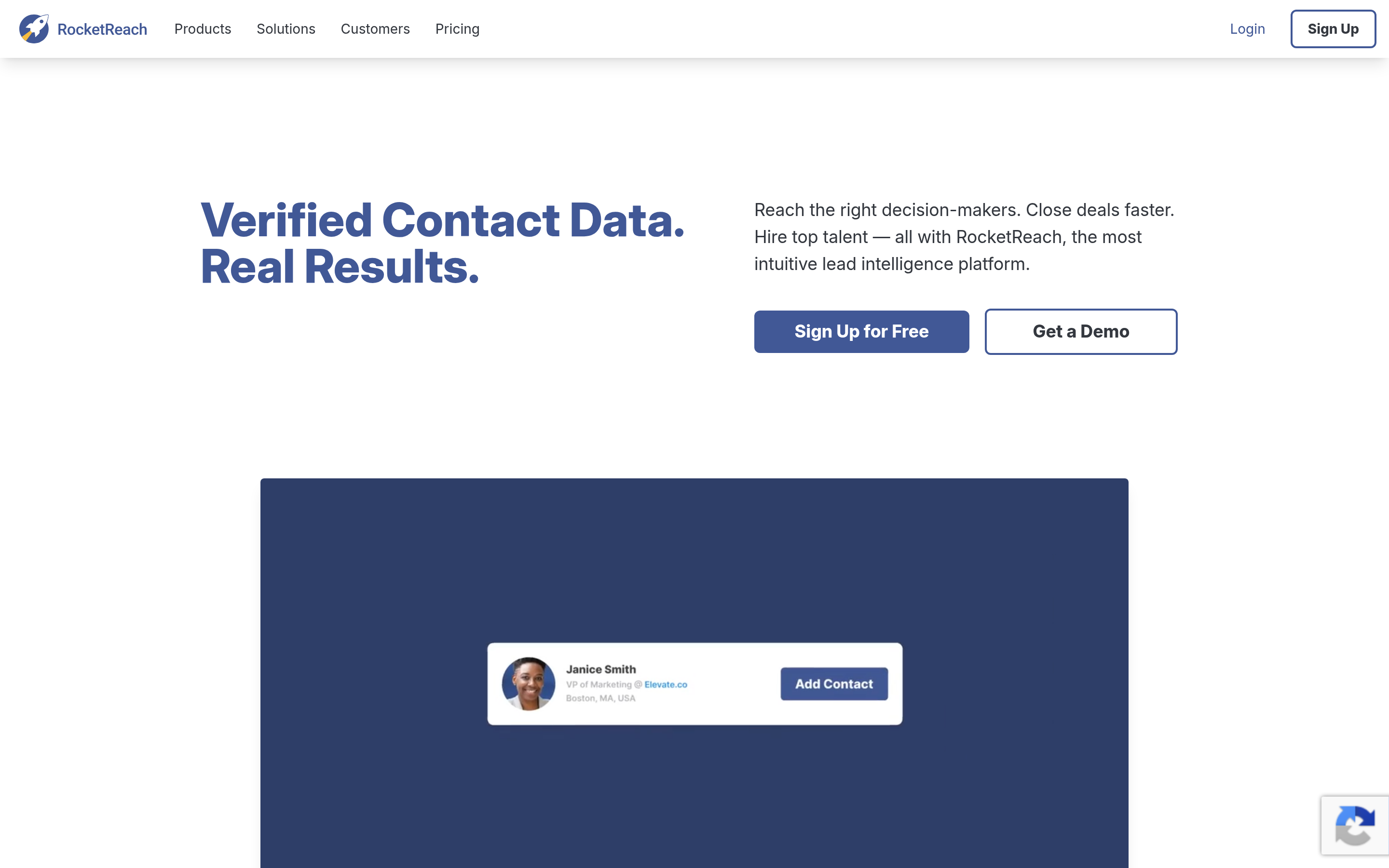
RocketReach leans into broad coverage, including some personal emails and phone numbers. Useful for recruiting and hard-to-reach roles, though you'll want to verify before sending.
6. Hunter — Best for lightweight, single-user email lookups#
Hunter is clean and easy for individual reps doing occasional domain lookups. It's capable but thinner on enrichment and phone data than the fuller platforms.
7. Lusha — Best for quick browser-based grabs#
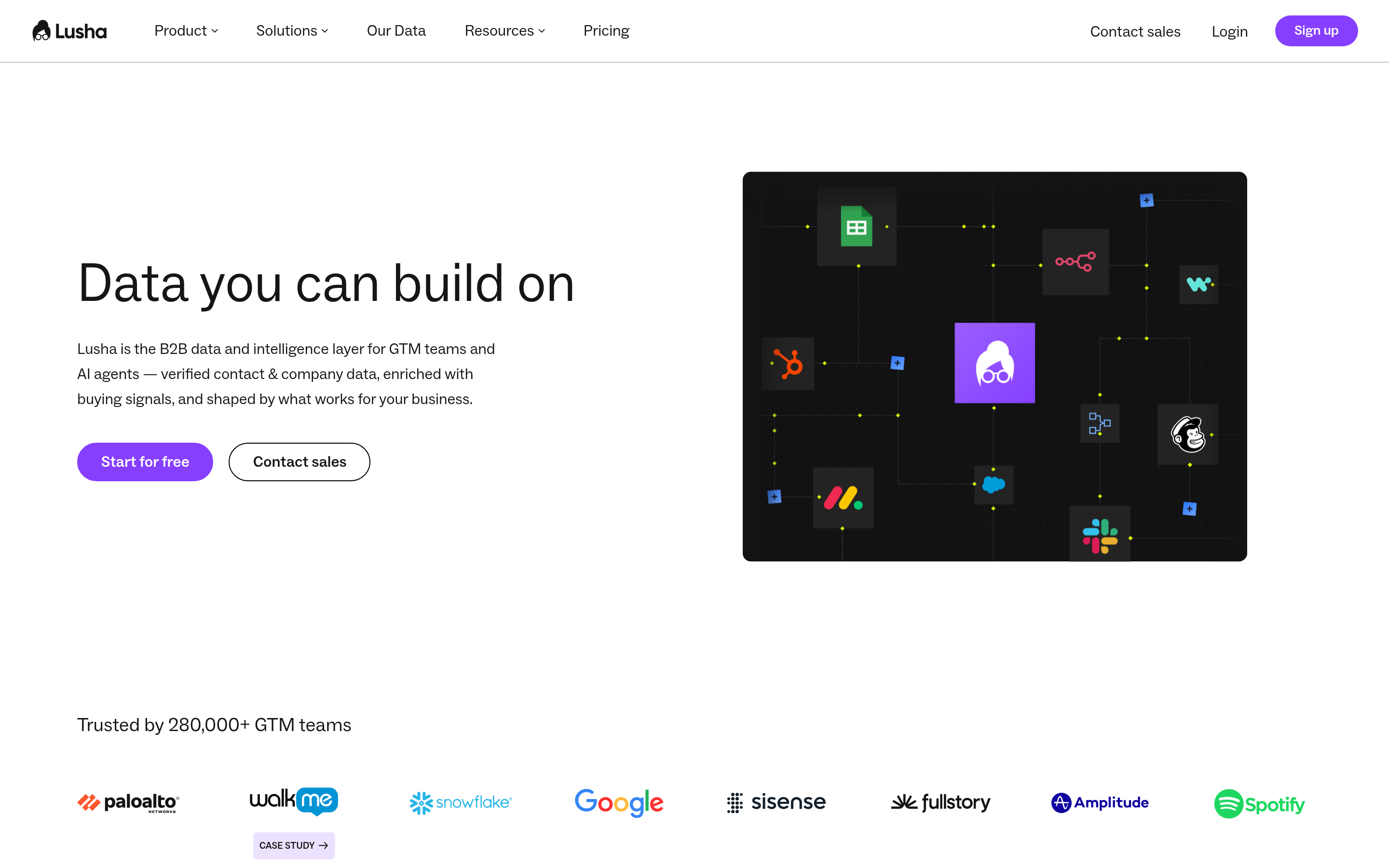
Lusha's Chrome extension makes one-off contact grabs fast while you browse LinkedIn or company sites. Credits deplete quickly on heavy use.
8. Seamless.AI — Best for high-volume list building#
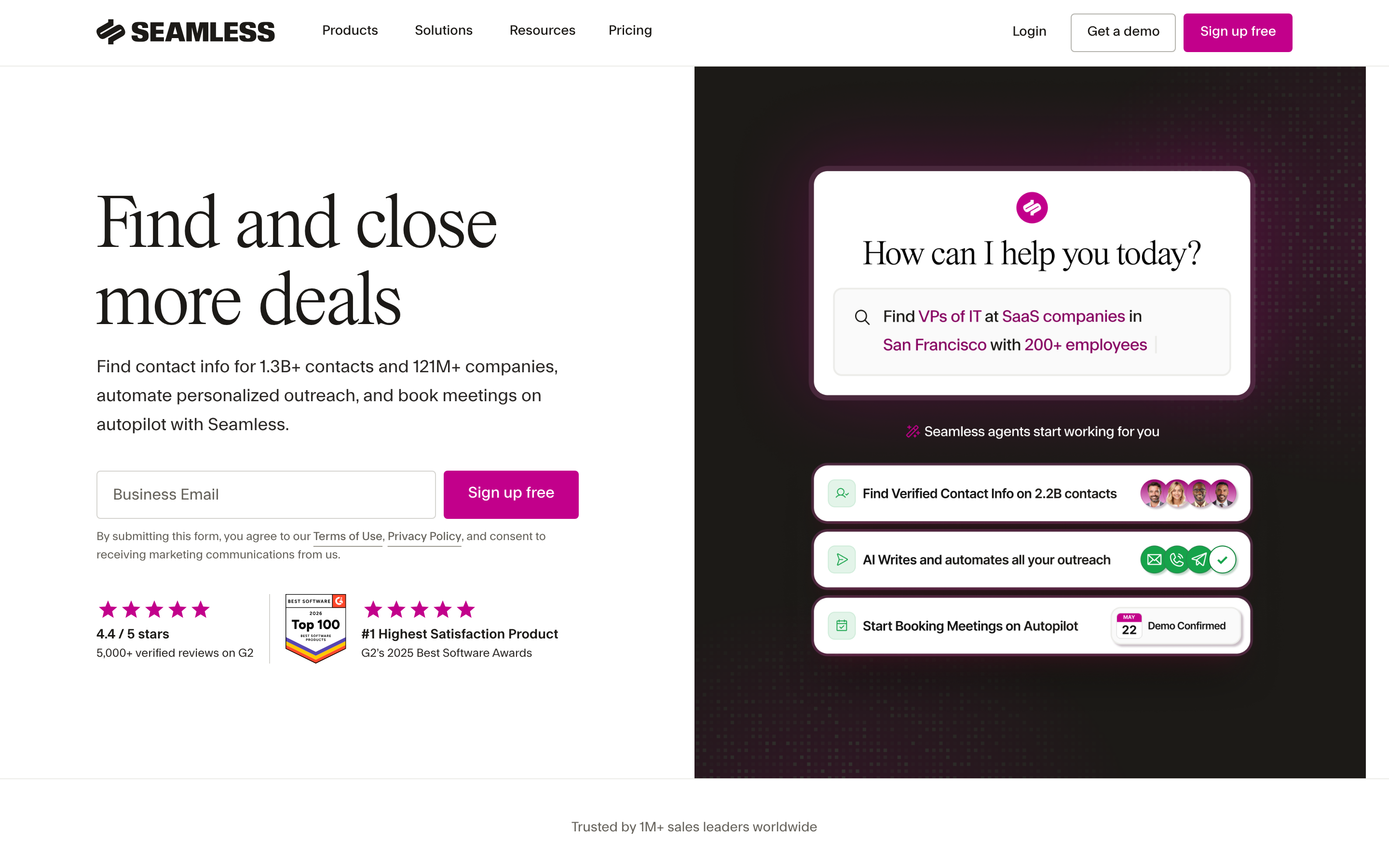
Seamless pushes volume and real-time search. Accuracy is polarizing, so verification is non-negotiable here.
9. Cognism — Best for compliant EU/UK phone data#
Cognism is strong on GDPR-compliant mobile numbers in Europe. Pricing is enterprise-oriented and usually quote-based.
How Do These Alternatives Compare on Price and Fit?#
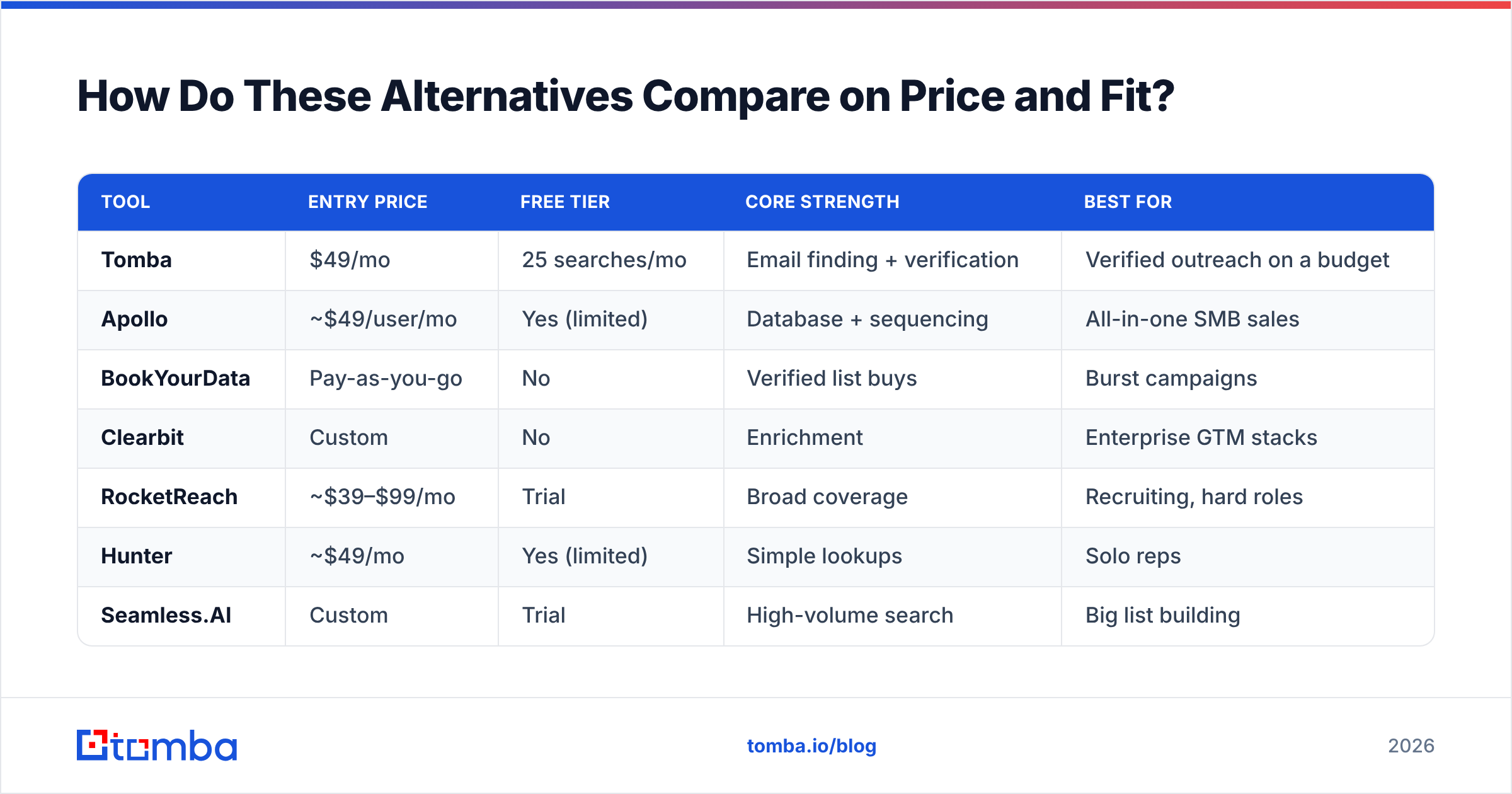
Use this table as a quick filter, then dig into the two or three that match your job-to-be-done.
| Tool | Entry price | Free tier | Core strength | Best for |
|---|---|---|---|---|
| Tomba | $49/mo | 25 searches/mo | Email finding + verification | Verified outreach on a budget |
| Apollo | ~$49/user/mo | Yes (limited) | Database + sequencing | All-in-one SMB sales |
| BookYourData | Pay-as-you-go | No | Verified list buys | Burst campaigns |
| Clearbit | Custom | No | Enrichment | Enterprise GTM stacks |
| RocketReach | ~$39–$99/mo | Trial | Broad coverage | Recruiting, hard roles |
| Hunter | ~$49/mo | Yes (limited) | Simple lookups | Solo reps |
| Seamless.AI | Custom | Trial | High-volume search | Big list building |
A few honest takeaways from the table:
- Free tiers are not equal. A "free" plan that blocks exports isn't free for a working rep. Tomba's free tier includes real searches you can act on, which makes it a low-risk way to test accuracy first.
- Per-user pricing scales differently than per-account pricing. A five-rep team can pay dramatically more on a per-seat suite than on an account-wide credit model.
- "Custom" usually means enterprise minimums. If you're a small team, quote-based tools can price you out before you start.
Which Competitors App Alternative Is Most Accurate?#
Accuracy is the whole game, so it deserves its own look. The honest answer: accuracy depends on the segment you're targeting, not just the vendor's headline claim.
Two things separate the accurate tools from the guessers:
- Real-time verification, not just pattern-matching. Many tools "find" an email by guessing the pattern (
first.last@company.com) and calling it a day. The better approach guesses and checks the address against the mail server before returning it. Tomba pairs discovery with a built-in catch-all verifier so you know when a domain accepts everything (and a "valid" result means less). - Transparent data sourcing. You should be able to see where a provider gets its data. Tools that publish their data sources tend to hold up better under audit than black-box databases.

The practical rule of thumb: never trust a single tool's "valid" flag for a high-stakes campaign. Run found emails through a verifier — ideally the same platform's verifier so the confidence scoring is consistent — and drop anything below your risk threshold. A tighter, verified list protects your email deliverability and keeps your domain out of spam folders.
For independent signal beyond vendor claims, cross-reference user reviews on G2 and Capterra — patterns in complaints (stale data, credit clawbacks, export limits) tell you more than any feature grid.
How Do You Choose the Right Tool for Your Team?#
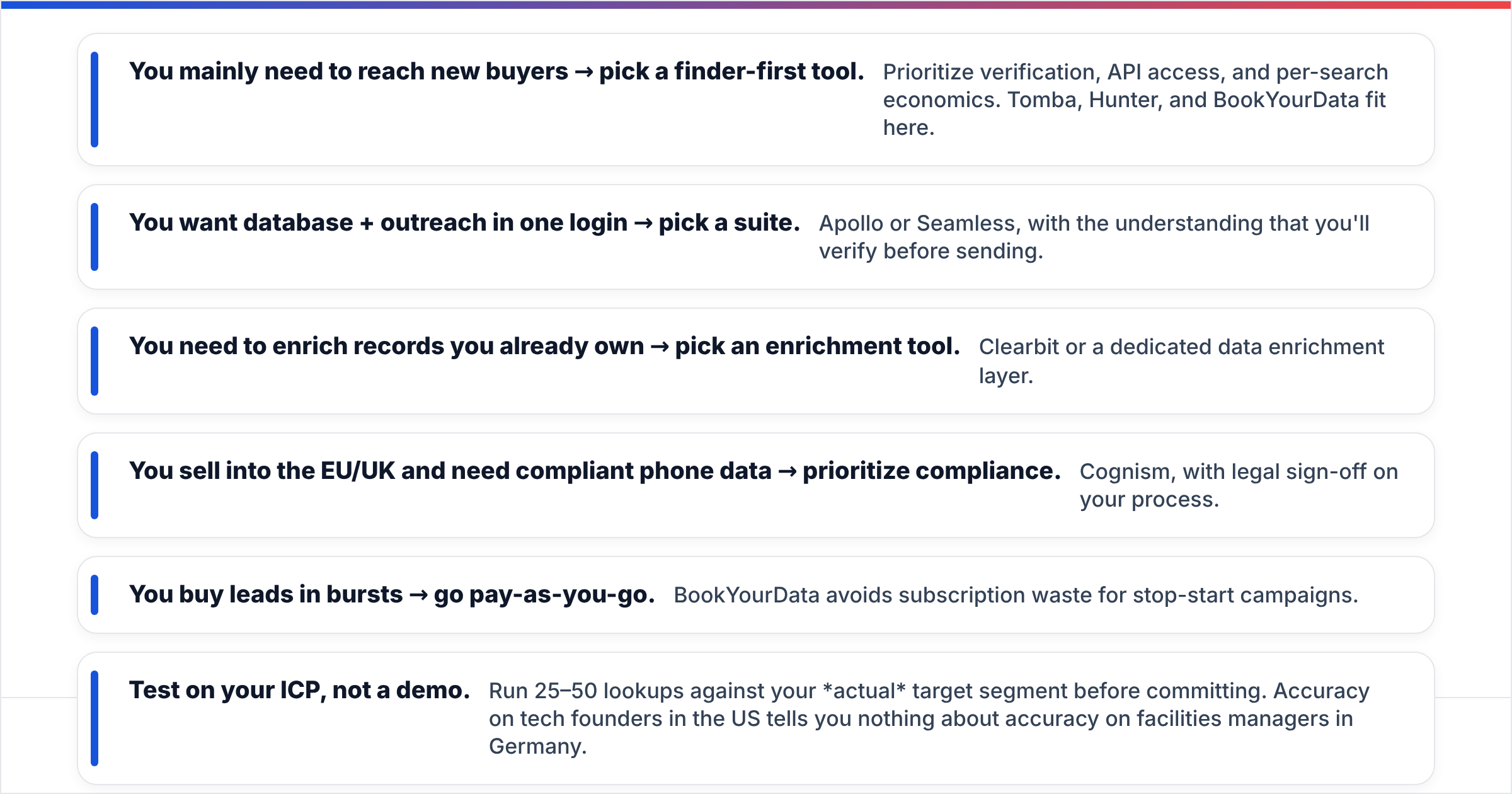
Match the tool to the job, not the hype. Here's a simple decision path:
- You mainly need to reach new buyers → pick a finder-first tool. Prioritize verification, API access, and per-search economics. Tomba, Hunter, and BookYourData fit here.
- You want database + outreach in one login → pick a suite. Apollo or Seamless, with the understanding that you'll verify before sending.
- You need to enrich records you already own → pick an enrichment tool. Clearbit or a dedicated data enrichment layer.
- You sell into the EU/UK and need compliant phone data → prioritize compliance. Cognism, with legal sign-off on your process.
- You buy leads in bursts → go pay-as-you-go. BookYourData avoids subscription waste for stop-start campaigns.

Two more filters that save money:
- Test on your ICP, not a demo. Run 25–50 lookups against your actual target segment before committing. Accuracy on tech founders in the US tells you nothing about accuracy on facilities managers in Germany.
- Check the exit. Can you export everything you paid for, in a standard format, without an upgrade? If not, you don't own your data — you're renting it.
What Does a Smarter Prospecting Stack Look Like?#
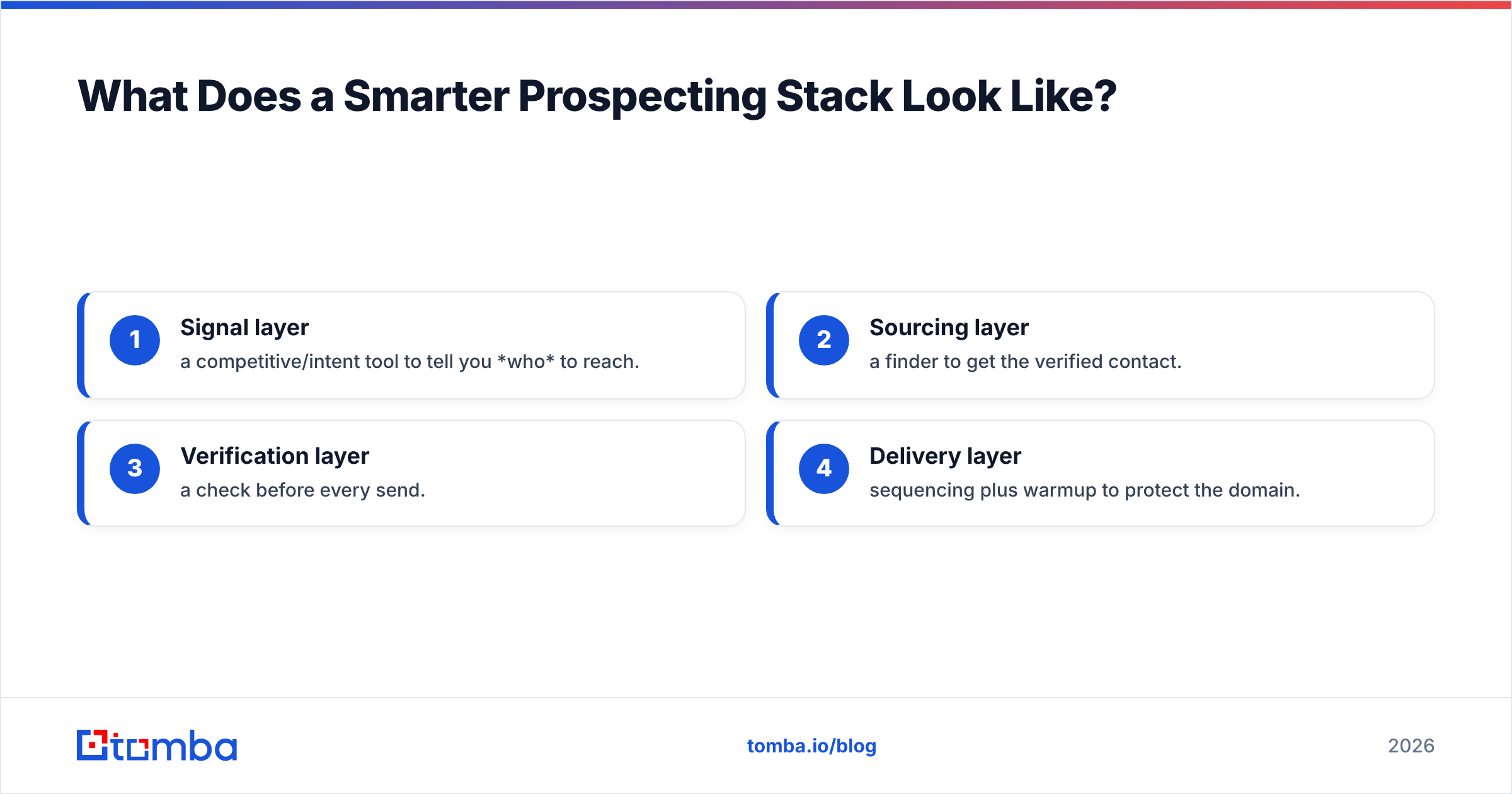
The teams getting the best results in 2026 rarely rely on one app. They split the work:
- Signal layer — a competitive/intent tool to tell you who to reach.
- Sourcing layer — a finder to get the verified contact.
- Verification layer — a check before every send.
- Delivery layer — sequencing plus warmup to protect the domain.
The beauty of this split is that each layer stays best-in-class and swappable. If your competitive tool gets worse, you replace one layer, not your whole stack. And because a good finder exposes an email finder API, you can wire the sourcing and verification layers directly into your CRM or workflow tools without manual CSV shuffling.
That composability is the real argument against a single locked-in "Competitors" app: it forces you to accept the weakest component along with the strong ones.
The Bottom Line#
The best Competitors app alternative isn't a like-for-like clone — it's the tool that fixes your weakest layer. For most teams, that weak layer is contact data: stale records, credit anxiety, and export walls. Fix that with a verify-first email finder and you'll see the difference in reply rates within a campaign or two.
If accurate, verified email finding is what you're missing, start with the free tier of the Tomba Email Finder — 25 searches a month, real exports, and a built-in verifier — and run it against your own ICP before you spend a dollar. Compare the results to whatever your current app returns, and let the accuracy make the decision for you. When you're ready to scale, the transparent Tomba plans grow with your volume instead of punishing it.
Related guides#
Ready to find emails that actually work?
Join 150,000+ professionals who stopped guessing and started sending. Free credits on signup — no credit card required.
Get the Tomba newsletter
Practical outbound tactics and product updates — once every two weeks.
About the author