Connect Rate Explained: How to Reach More Prospects in 2026
Connect rate is the metric that decides whether your dials turn into conversations. Here's how it's calculated, what good looks like in 2026, and the data and tactics that actually move it.
Your reps can make 100 dials a day and still book nothing. The number that explains why sits upstream of every talk track, every objection handler, and every "just circle back next quarter." It's your connect rate, and most teams measure it wrong or ignore it entirely.
TL;DR#
- Connect rate is the percentage of dials that reach a live, intended human, not a voicemail, gatekeeper, or dead line.
- Healthy B2B phone connect rates in 2026 land between 8% and 20%, depending on segment, seniority, and data quality.
- The single biggest lever is data accuracy, wrong or stale numbers cap your ceiling before talk track ever matters.
- Local presence, call timing, and multi-channel warm-up lift connect rate more than dialing harder.
- Track connect rate alongside conversation rate so you don't optimize for reaching people you can't convert.
What is connect rate?#
Connect rate is the share of your outbound dials that result in a real conversation with the person you meant to reach. Think of it like a basketball free-throw percentage: total shots don't tell you much, but the ratio of shots that go in tells you whether the fundamentals are sound.
The formula is simple:
Connect rate = (Connected calls ÷ Total dials) × 100
The nuance is in what counts as "connected." A voicemail is not a connect. A gatekeeper who takes a message is not a connect. A wrong number is definitely not a connect. A true connect means the buyer, or a decision-influencer you intended to reach, picked up and spoke with your rep, even if the answer was a hard no.
Teams that count voicemails or gatekeeper conversations as connects flatter themselves into ignoring a broken funnel. Keep the definition strict and the metric stays useful.

How is connect rate different from other outbound metrics?#
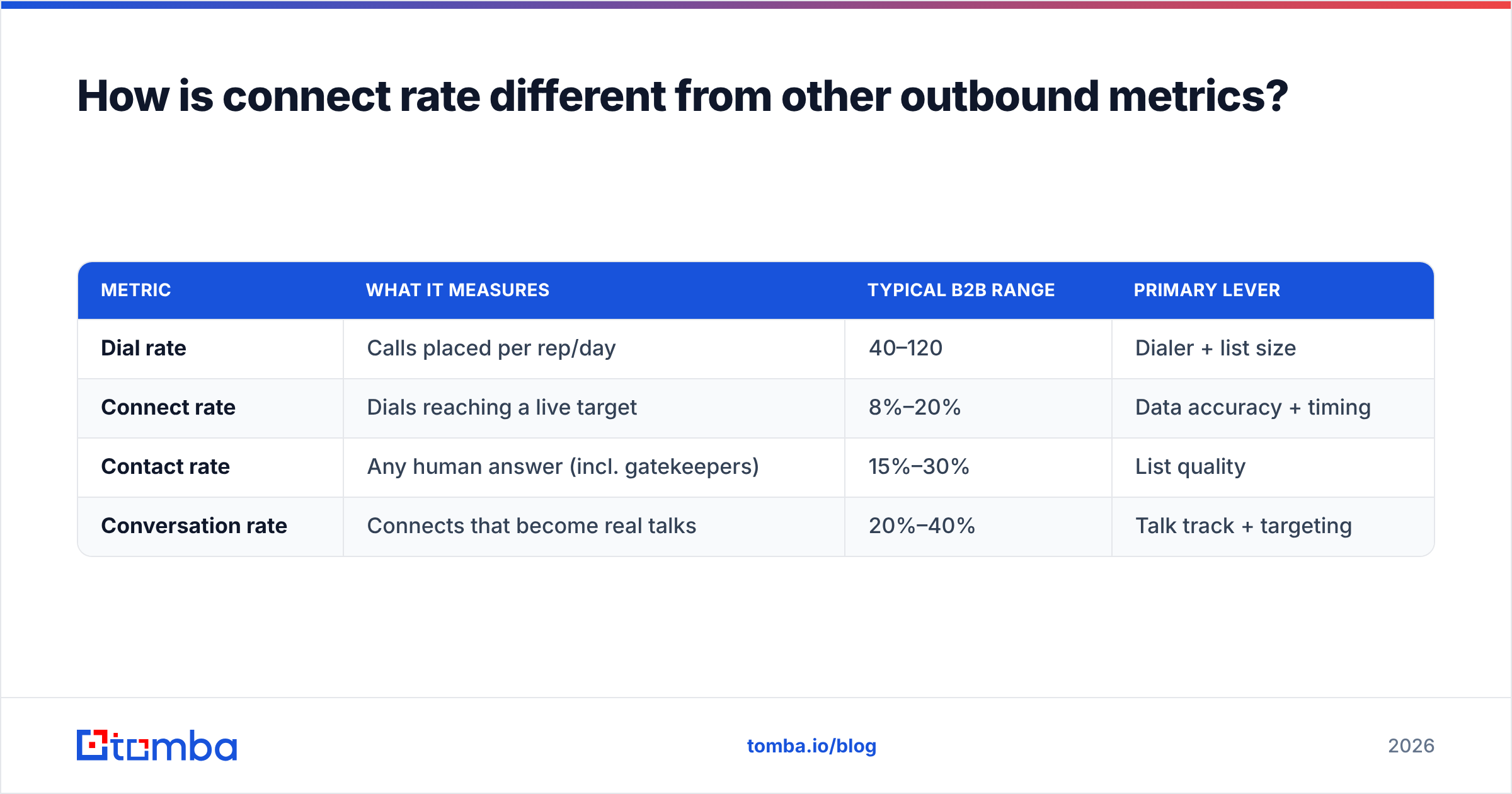
Connect rate gets confused with three neighbors: dial rate, contact rate, and conversation rate. They measure different stages, and mixing them up hides where your funnel leaks.
- Dial rate — how many calls a rep places per hour or day. A volume metric, not an outcome metric.
- Connect rate — the percentage of those dials that reach a live intended human. This is the reachability metric.
- Contact rate — sometimes used interchangeably with connect rate, but often broadened to include any human answer, including gatekeepers.
- Conversation rate — of the people you connect with, how many hold a real, qualifying conversation.
Here's the trap: you can juice dial rate by auto-dialing garbage lists, and your connect rate collapses. Or you can push connect rate up by only calling mobile numbers of junior contacts who always answer, and your conversation rate cracks because none of them can buy. The metrics only make sense together.
| Metric | What it measures | Typical B2B range | Primary lever |
|---|---|---|---|
| Dial rate | Calls placed per rep/day | 40–120 | Dialer + list size |
| Connect rate | Dials reaching a live target | 8%–20% | Data accuracy + timing |
| Contact rate | Any human answer (incl. gatekeepers) | 15%–30% | List quality |
| Conversation rate | Connects that become real talks | 20%–40% | Talk track + targeting |
What is a good connect rate in 2026?#
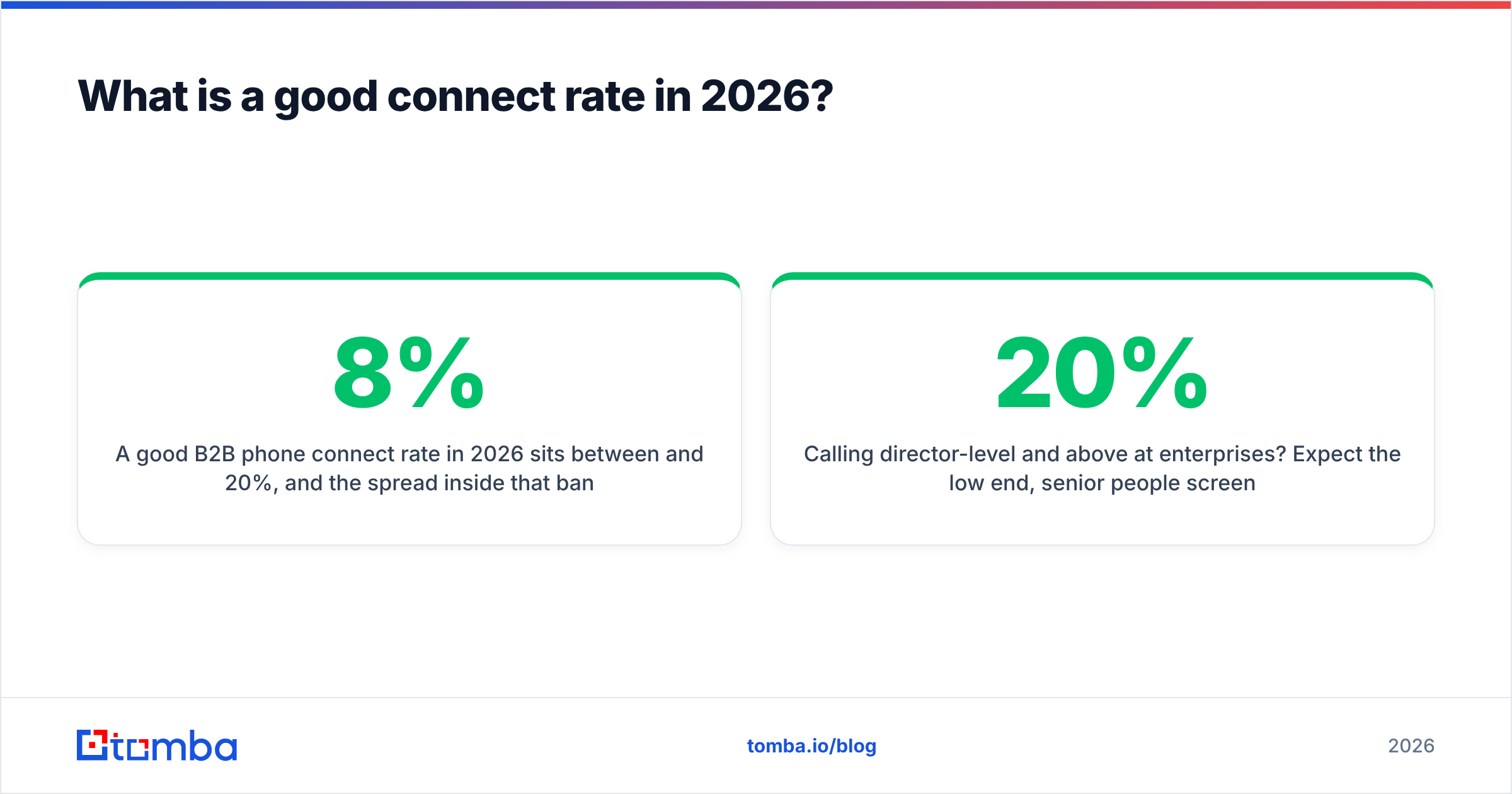
A good B2B phone connect rate in 2026 sits between 8% and 20%, and the spread inside that band is explained almost entirely by who you're calling and how clean your data is.
Calling director-level and above at enterprises? Expect the low end, senior people screen calls and route through assistants. Calling operational owners at SMBs on direct mobiles? You can push past 20% with clean numbers and good timing. Spam labeling, mobile carrier filtering, and remote-work habits have all pushed raw connect rates down over the past few years, which makes the quality of your list matter more, not less.
Benchmarks from call-analytics vendors and sales-engagement platforms cluster around these ranges, but treat any external number as a starting reference, not a target. Your own trailing 90-day connect rate is the only benchmark that reflects your data, your segment, and your dialing setup. Measure it, then beat it.
Why is your connect rate low? The five real causes#
Most low connect rates trace back to a short list of fixable problems. Work them in order, because the first one caps everything below it.
- Bad or stale phone data. If 30% of your numbers are wrong, disconnected, or point to the wrong person, your connect-rate ceiling is broken before a rep says a word. This is the number-one cause and the one teams most love to ignore.
- Spam-flagged caller IDs. Buyers see "Spam Likely" and never answer. Carrier reputation on your outbound numbers decays with volume and complaint rates.
- Wrong timing. Calling at the wrong hour or day for a segment slashes pickup. Time zones alone destroy connect rates for teams selling across regions.
- No prior touch. A cold, unknown number gets ignored. A number the buyer half-recognizes from an email or LinkedIn view gets answered.
- Wrong number type. Office desk lines sit empty in a remote world. Direct mobiles connect. If your data is all switchboards, your connect rate reflects it.
Notice that four of the five are upstream of the call itself. You cannot talk-track your way out of a bad list.
How does data accuracy drive connect rate?#
Data accuracy is the foundation because connect rate is a reachability metric, and you can't reach a number that's wrong. Everything else, timing, local presence, warm-up, is optimization on top of whether the digits are correct in the first place.
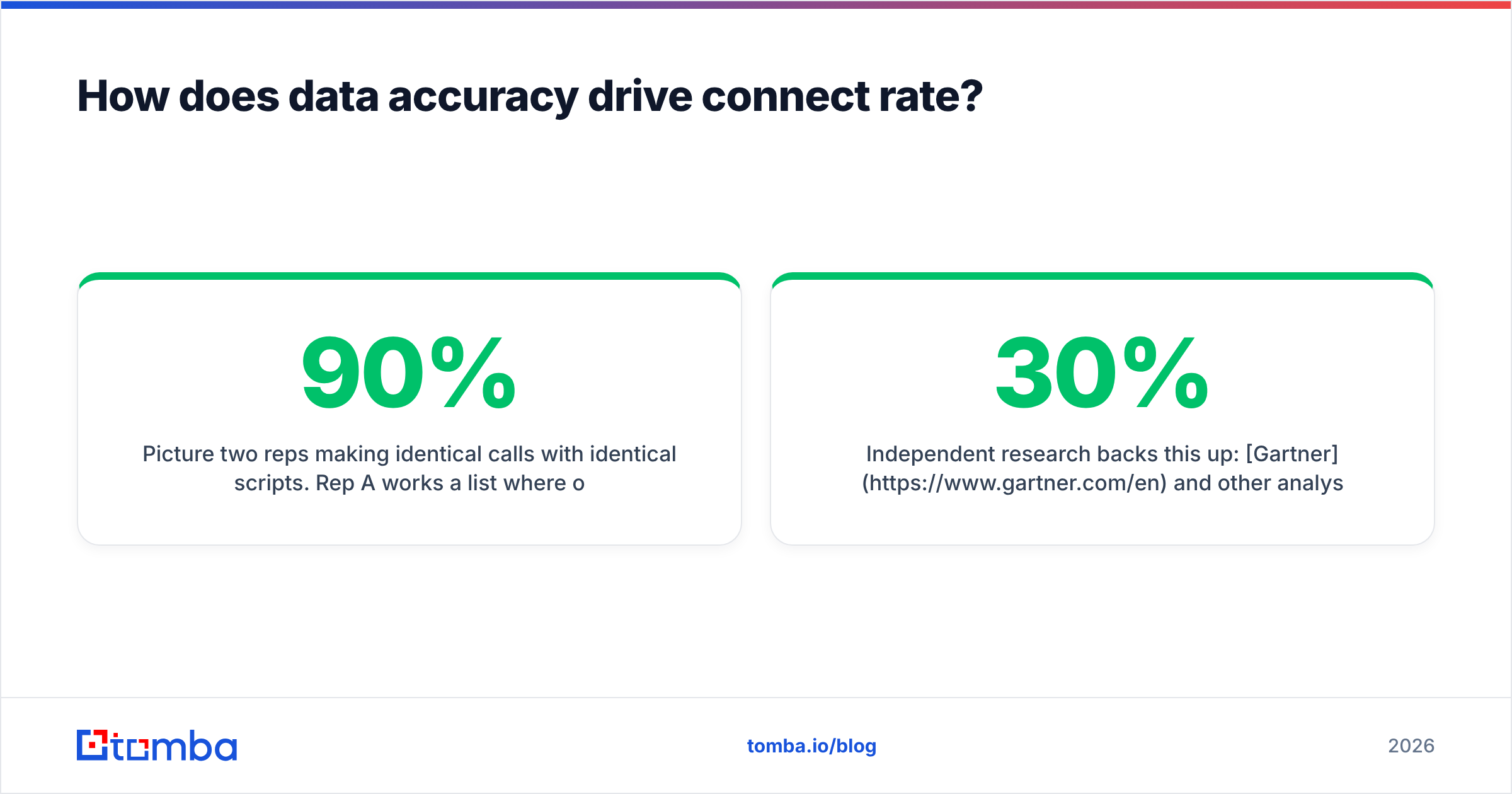
Picture two reps making identical calls with identical scripts. Rep A works a list where 90% of the direct dials are current and correct. Rep B works a list where 55% are correct. Rep A will roughly double Rep B's connect rate on effort alone, and no coaching closes that gap. The list did the work.
This is why serious teams verify phone data before a campaign rather than discovering the rot mid-quarter. A phone validator checks whether numbers are live and correctly formatted, and a phone finder sources current direct dials tied to the right person rather than a generic switchboard. Pairing accurate numbers with data enrichment so you also know title, seniority, and time zone means you're not just reaching a human, you're reaching the right human at a sane hour.
Independent research backs this up: Gartner and other analysts consistently tie CRM and contact-data decay of 20–30% per year to falling outbound performance. Numbers go stale as people change jobs, and job changes are exactly when your best-fit buyers are most reachable and most in-market. Refreshing your data isn't hygiene, it's pipeline.
What tactics lift connect rate fastest?#
After the data is clean, a handful of tactics move connect rate without asking reps to simply dial more.
- Local presence dialing. Show a caller ID with the prospect's area code. Pickup rates climb because the number looks familiar and local, not like a national spam block.
- Manage caller-ID reputation. Rotate numbers, monitor spam flags, and register your lines with carrier programs so you don't get auto-labeled "Spam Likely."
- Call at the right window. For most B2B segments, mid-morning and late afternoon in the prospect's local time beat lunch and early morning. Test your own data, but respect the time zone.
- Warm the number first. A LinkedIn view, a relevant email, or a voicemail before the live attempt makes the next dial land on a semi-recognized number. Multi-channel sequencing lifts connect rate, it doesn't just fill activity dashboards.
- Double-dial strategically. A second call within a few minutes of a missed first one connects more often than people expect, buyers assume urgency.
For a deeper multi-channel foundation, HubSpot's sales research and sales-engagement platforms like those reviewed on G2 document how sequencing across email and phone compounds reachability. The phone doesn't work in isolation anymore.
Connect rate vs. conversation rate: which should you optimize?#
Optimize connect rate first, but never at the expense of conversation rate, because reaching the wrong people efficiently is just faster failure.
Here's the discipline: connect rate tells you whether your list and dialing setup can reach humans. Conversation rate tells you whether those humans are the right ones and whether your rep can hold them. If you chase connect rate by dialing easy-to-reach junior contacts, connect rate goes up and pipeline goes down. If you chase conversation rate on a tiny, over-qualified list, conversation rate looks great and volume starves.
Watch them as a pair on the same dashboard:
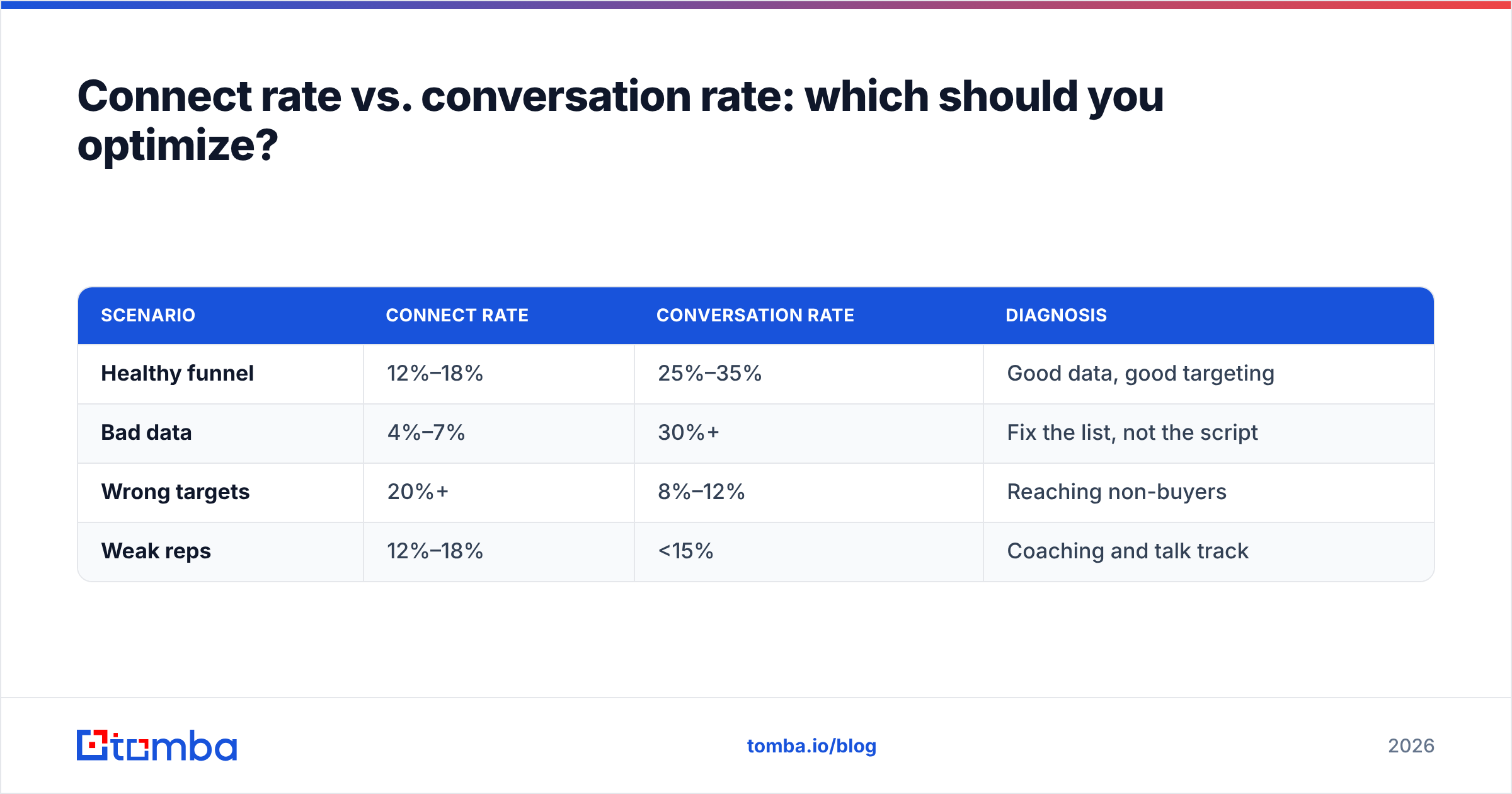
| Scenario | Connect rate | Conversation rate | Diagnosis |
|---|---|---|---|
| Healthy funnel | 12%–18% | 25%–35% | Good data, good targeting |
| Bad data | 4%–7% | 30%+ | Fix the list, not the script |
| Wrong targets | 20%+ | 8%–12% | Reaching non-buyers |
| Weak reps | 12%–18% | <15% | Coaching and talk track |
The pattern in the table is the whole point: a low connect rate with a fine conversation rate is almost always a data problem, and a high connect rate with a weak conversation rate is almost always a targeting or rep problem. Read them together and the fix names itself.
How do you measure and track connect rate correctly?#
Measure connect rate on a strict definition, over a rolling window, segmented by the variables that actually change it. A single blended number across all segments hides more than it reveals.
Set it up like this:
- Define a connect strictly — live conversation with the intended target only. Log voicemails and gatekeepers separately.
- Use a rolling 30- or 90-day window so one bad week doesn't swing the number and you can see trend.
- Segment by seniority, industry, region, and number type — because a blended average across a VP list and an SMB-owner list is meaningless.
- Tie it to data source — track connect rate by where the number came from so you can see which sources decay fastest.
- Review weekly with the team — connect rate is a leading indicator; by the time pipeline dips, the connect-rate signal was three weeks old.
Most modern dialers and sales-engagement tools calculate connect rate automatically, but they inherit whatever definition you configure. Set the definition deliberately, or the tool will happily count voicemails and lie to you.
Frequently asked questions#
What counts as a connect? A live conversation with the intended target. Voicemails, gatekeepers, and wrong numbers do not count if you want the metric to stay honest.
Is 10% a good connect rate? For most B2B segments, yes, 10% is solidly within the healthy range. For SMB direct-mobile lists it's a bit low; for enterprise VP outreach it's strong.
Can you improve connect rate without more dials? Yes, and you should. Cleaning data, fixing caller-ID reputation, and calling at the right time all lift connect rate on the same dial volume.
Does connect rate matter for email? The term is primarily a phone metric. Email's parallel concepts are deliverability and reply rate, related ideas, different mechanics.
Fix the data first, then the dialing#
Your connect rate is a mirror. When it's low, it's almost always reflecting a list full of stale, wrong, or switchboard numbers, not a rep who needs another script. Fix the input and the output follows.
Start by getting current, verified direct dials for the people you actually want to reach. Tomba's Phone Finder sources accurate B2B phone numbers tied to the right contact, and pairs with the email finder so you can warm every number with a multi-channel touch before you dial. Clean data raises your ceiling; everything else is optimization underneath it. See Tomba pricing to find the plan that fits your outbound volume, and give your reps a list worth calling.
Related guides#
Ready to find emails that actually work?
Join 150,000+ professionals who stopped guessing and started sending. Free credits on signup — no credit card required.
Get the Tomba newsletter
Practical outbound tactics and product updates — once every two weeks.
About the author