ConnectAndSell Pricing Reviews Pros and Cons (2026 Guide)
A neutral 2026 breakdown of ConnectAndSell pricing, real user reviews, and the honest pros and cons — plus who it actually fits and a cheaper way to feed it clean numbers.
Want the honest take on ConnectAndSell pricing reviews pros and cons? Here it is. This 2026 guide covers what a seat costs, what real users say, and who it fits. Short version: it works well, but only for the right team.
TL;DR
- ConnectAndSell is a live-conversation (agent-assisted parallel dialing) platform that hands reps real, connected decision-makers — not a self-serve auto-dialer. It is powerful and expensive.
- Pricing is quote-only and annual. Real-world reviews and third-party estimates put it in the ~$1,000–$3,000+ per seat, per month range, usually with a minimum seat count and a 12-month commitment.
- The core value is conversations per hour: reps can 5–10x their live talk time. The core risk is utilization — if reps aren't ready to talk all day, the cost per conversation balloons.
- Reviews praise the conversation volume and coaching data; complaints center on price, contract rigidity, and the fact that dial-fed pipelines still rise or fall on data quality.
- The cheapest way to protect that ROI is feeding it accurate mobile and direct numbers. Pair any dialer with a real data source like Tomba's phone finder and email backup.
What is ConnectAndSell?#
ConnectAndSell is a sales acceleration platform built around one promise: put a live, human conversation with a decision-maker in your rep's ear, on demand. Think of it less like a dialer app and more like a pit crew. While your rep waits, a layer of agents and automation navigates gatekeepers, phone trees, and voicemails, then transfers only the connected human. Under the hood it blends parallel dialing, human-assisted navigation, and its "Flow" conversation engine. The result: a rep can go from one live conversation an hour to eight or more.
That's the headline. It matters because in outbound, conversations — not dials — are the currency. A rep who talks to 30 prospects a day learns and closes faster than one who talks to four. ConnectAndSell sells that compression of time.
You can read the vendor's own framing on the ConnectAndSell website, but this post is the neutral version: what it costs, what users actually say, and where it wins or loses.
How much does ConnectAndSell cost in 2026?#
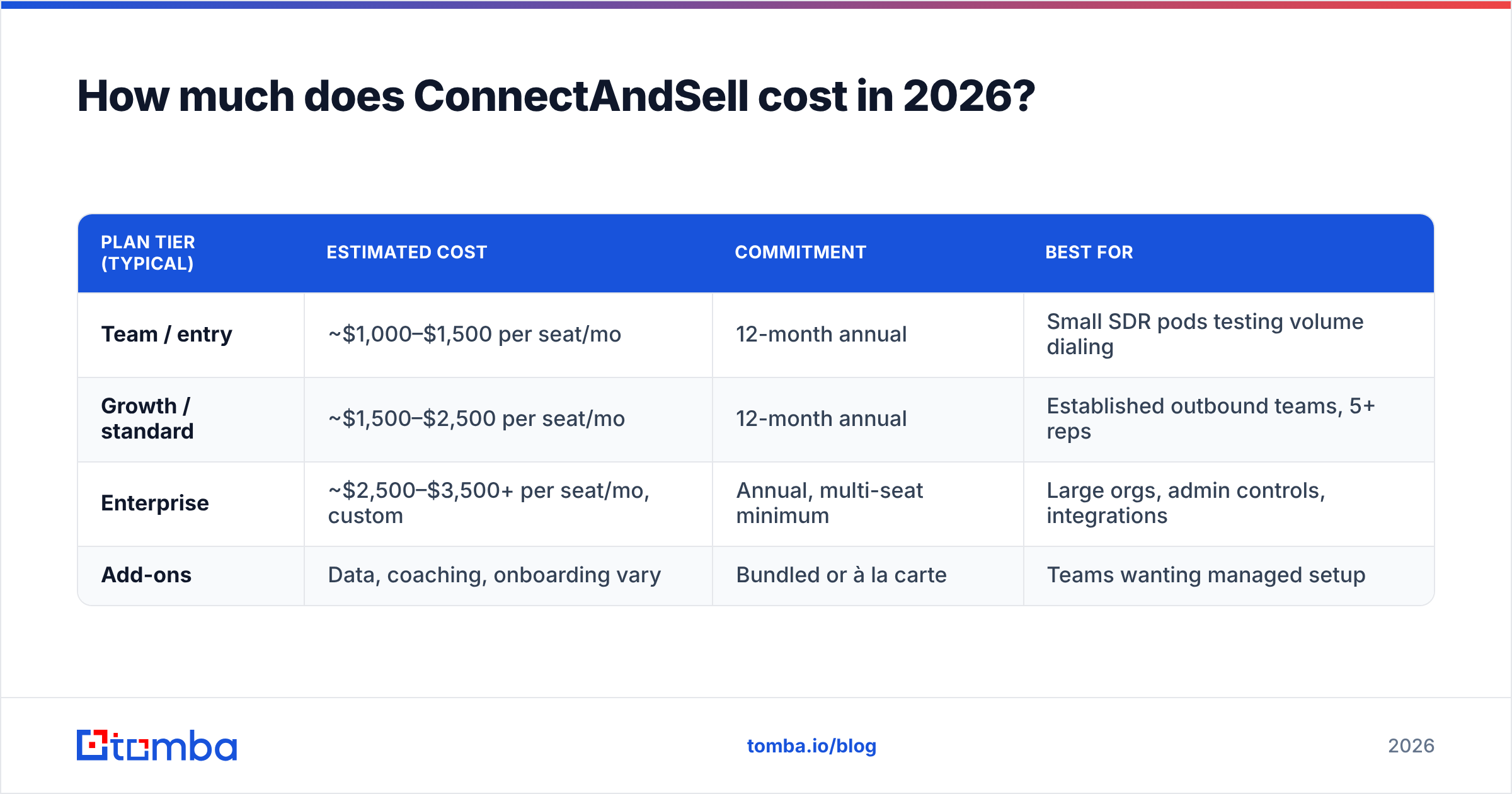
Short answer: there is no public price — expect a custom annual quote, and budget four figures per seat, per month. ConnectAndSell does not publish a pricing page, and it does not offer a self-serve monthly plan. Everything runs through a sales conversation and an annual contract.
Based on aggregated user reviews on G2 and buyer reports on Capterra, plus what prospects report from sales calls, the ranges below are the realistic 2026 picture. Treat them as directional, not a rate card.
| Plan tier (typical) | Estimated cost | Commitment | Best for |
|---|---|---|---|
| Team / entry | ~$1,000–$1,500 per seat/mo | 12-month annual | Small SDR pods testing volume dialing |
| Growth / standard | ~$1,500–$2,500 per seat/mo | 12-month annual | Established outbound teams, 5+ reps |
| Enterprise | ~$2,500–$3,500+ per seat/mo, custom | Annual, multi-seat minimum | Large orgs, admin controls, integrations |
| Add-ons | Data, coaching, onboarding vary | Bundled or à la carte | Teams wanting managed setup |
A few things reviewers consistently flag about the cost structure:
- Annual only. There is effectively no cheap monthly trial-and-cancel path. You commit for a year.
- Seat minimums. Pricing assumes a team, not a solo rep. One-seat pilots are rare and pricier per seat.
- Utilization is the real price. The quote is per seat, but the effective cost is per conversation. Idle seats are expensive seats.
- Data is usually separate. The platform dials the numbers you give it. Bad numbers mean paid dials into dead ends.
That last point is where a lot of the "expensive" reviews actually come from — not the sticker, but the wasted dials. More on that below.
Is ConnectAndSell worth the price? The pros#
The value case is real when reps are conversation-constrained, not lead-constrained. Here's what holds up in reviews:
- Raw conversation volume. This is the whole point. Users routinely report going from 1–2 live conversations per hour of manual dialing to 8–10. If a conversation is worth money to you, multiplying them changes the math fast.
- Rep morale and ramp. New reps hit "reps" — literal live conversations — in days, not weeks. The awkward dialing-and-voicemail grind is offloaded, so reps practice the part that matters: talking.
- Coaching data. Call recordings, connect analytics, and talk-time dashboards give managers a real feedback loop. It pairs naturally with a healthy view of your team's win rate and messaging.
- Gatekeeper navigation. The human-assisted layer is genuinely good at getting past phone trees and receptionists — a task most auto-dialers can't do.
- Focus. Reps stop context-switching between dialing, note-taking, and CRM. They stay in conversation mode.
For a heavy outbound motion — think high-ACV B2B where one extra meeting pays for a lot of seats — the ROI story is defensible.
What are the cons and complaints in ConnectAndSell reviews?#
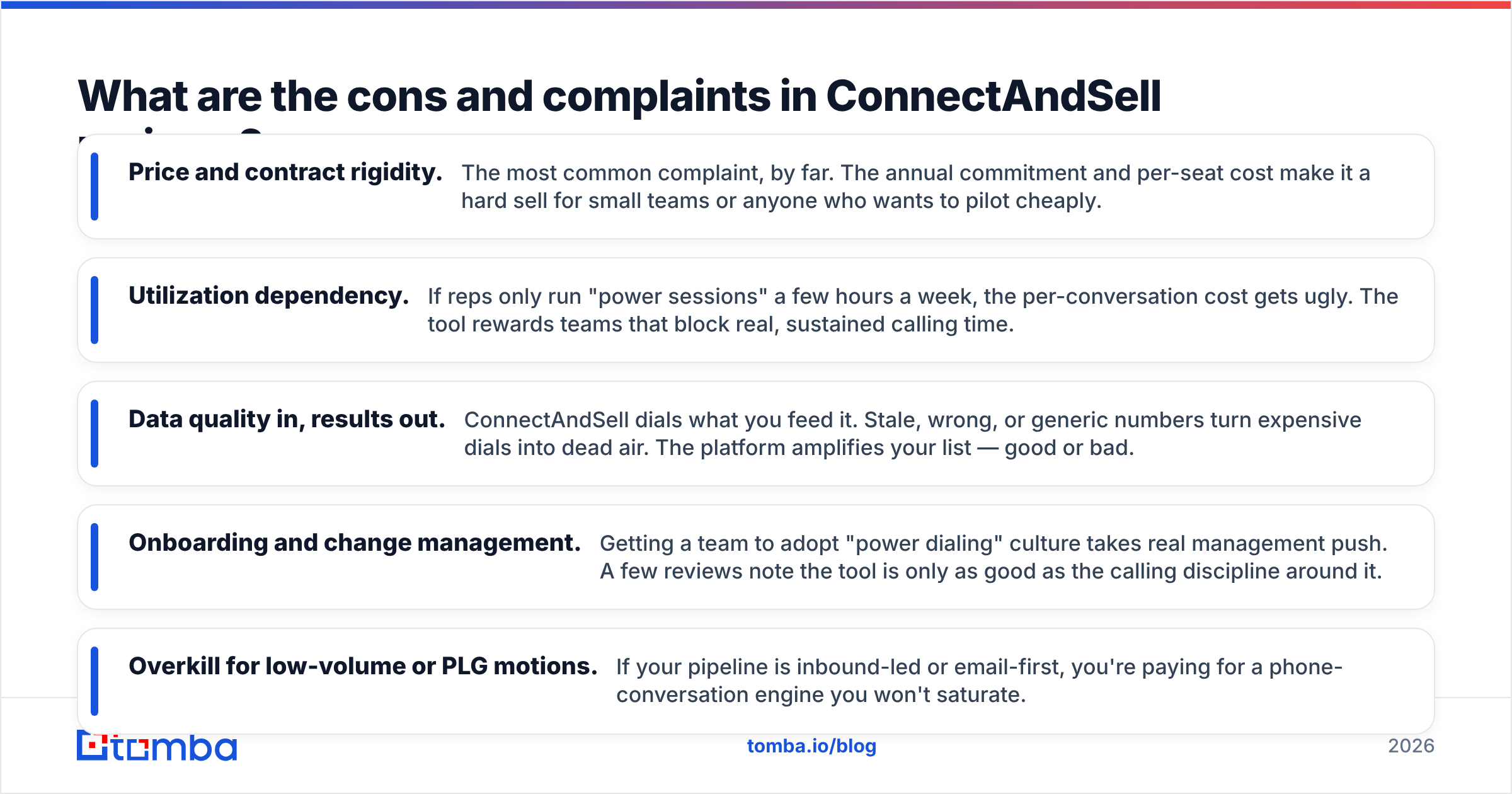
No tool is free of tradeoffs, and the honest reviews cluster around a handful of themes:
- Price and contract rigidity. The most common complaint, by far. The annual commitment and per-seat cost make it a hard sell for small teams or anyone who wants to pilot cheaply.
- Utilization dependency. If reps only run "power sessions" a few hours a week, the per-conversation cost gets ugly. The tool rewards teams that block real, sustained calling time.
- Data quality in, results out. ConnectAndSell dials what you feed it. Stale, wrong, or generic numbers turn expensive dials into dead air. The platform amplifies your list — good or bad.
- Onboarding and change management. Getting a team to adopt "power dialing" culture takes real management push. A few reviews note the tool is only as good as the calling discipline around it.
- Overkill for low-volume or PLG motions. If your pipeline is inbound-led or email-first, you're paying for a phone-conversation engine you won't saturate.
The recurring throughline: ConnectAndSell doesn't create demand or fix a bad list. It compresses time. So the teams that regret the spend are usually the ones who bought volume without first fixing who they were calling and whether the number was right.

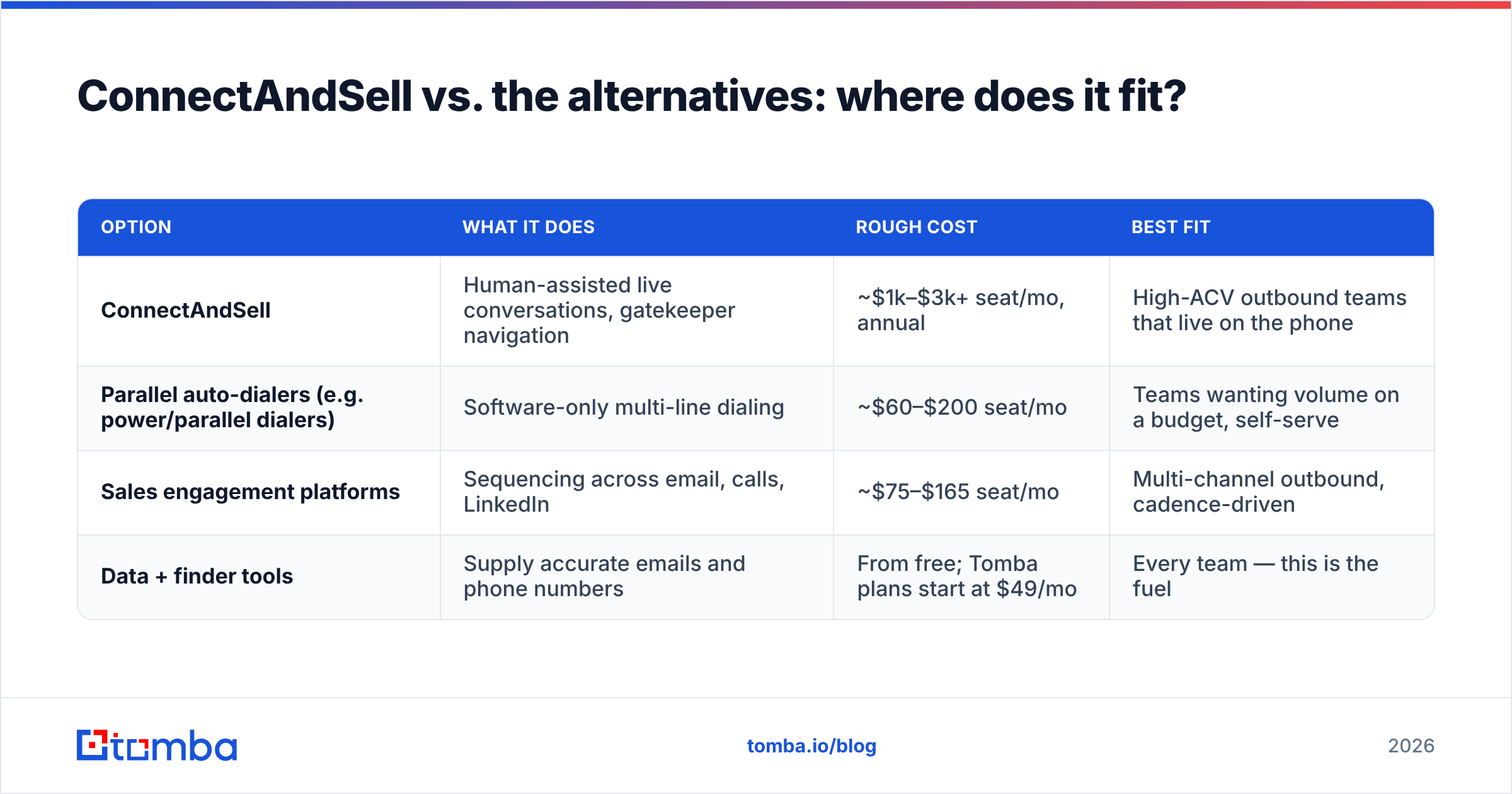
ConnectAndSell vs. the alternatives: where does it fit?#
It helps to place ConnectAndSell against the other ways teams buy "more conversations." They are not all the same category.
| Option | What it does | Rough cost | Best fit |
|---|---|---|---|
| ConnectAndSell | Human-assisted live conversations, gatekeeper navigation | ~$1k–$3k+ seat/mo, annual | High-ACV outbound teams that live on the phone |
| Parallel auto-dialers (e.g. power/parallel dialers) | Software-only multi-line dialing | ~$60–$200 seat/mo | Teams wanting volume on a budget, self-serve |
| Sales engagement platforms | Sequencing across email, calls, LinkedIn | ~$75–$165 seat/mo | Multi-channel outbound, cadence-driven |
| Data + finder tools | Supply accurate emails and phone numbers | From free; Tomba plans start at $49/mo | Every team — this is the fuel |
The key insight: the first three columns are engines, and the last is the fuel. You can buy the most powerful conversation engine on the market and still stall if the numbers are wrong. That's why cost-conscious teams often start by fixing data before they spend four figures per seat on acceleration.
If you're specifically weighing phone-first tooling, it's worth reading how your list quality feeds any of them — the find phone numbers workflow and a quick phone validator pass do more for connect rates than most people expect.
Who should buy ConnectAndSell — and who shouldn't?#
Buy it if:
- You run a dedicated outbound team of 5+ reps whose job is talking to people all day.
- Your average deal size is high enough that one extra meeting justifies a premium seat.
- Your reps are conversation-starved, not lead-starved — you have targets, you just can't reach enough of them.
- Management is ready to enforce real power-session discipline.
Skip it (for now) if:
- You're a small team or solo founder who needs a cheap, cancel-anytime option.
- Your motion is inbound- or email-led, and phone is a minor channel.
- Your contact data is thin or unverified — fix that first, or you'll pay to dial garbage.
- You can't guarantee reps will actually run sustained calling blocks.
For that middle group — teams that want more conversations but aren't ready to commit annually — the smarter first move is almost always improving the list, not buying a bigger dialer. A verified, well-enriched list makes even a cheap dialer perform, and it makes an expensive one worth the money. That's where data enrichment and accurate contact discovery pay for themselves.
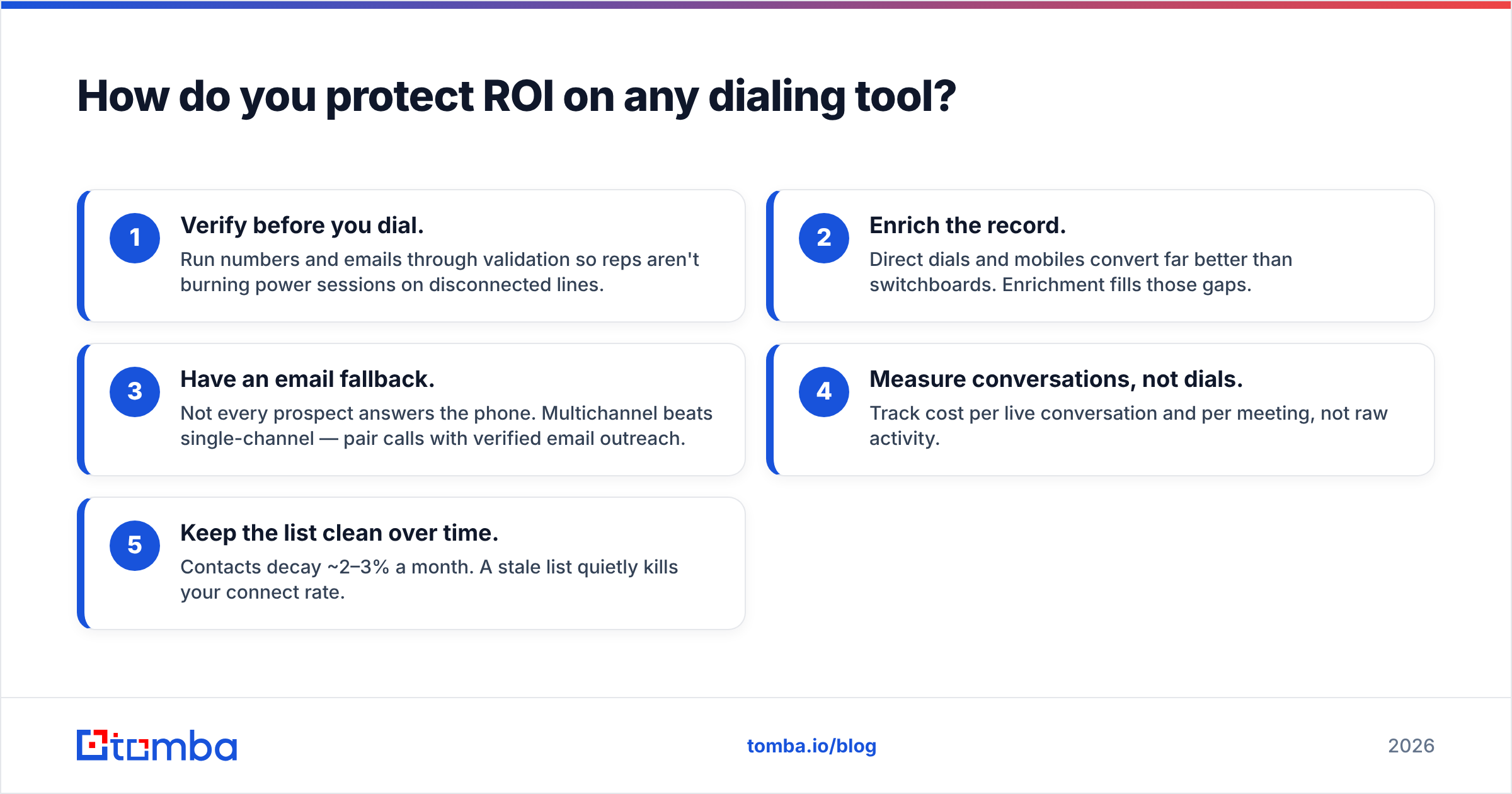
How do you protect ROI on any dialing tool?#
Whatever you buy, the same rule applies: connect rate is a data problem before it's a dialer problem. A few concrete moves:
- Verify before you dial. Run numbers and emails through validation so reps aren't burning power sessions on disconnected lines.
- Enrich the record. Direct dials and mobiles convert far better than switchboards. Enrichment fills those gaps.
- Have an email fallback. Not every prospect answers the phone. Multichannel beats single-channel — pair calls with verified email outreach.
- Measure conversations, not dials. Track cost per live conversation and per meeting, not raw activity.
- Keep the list clean over time. Contacts decay ~2–3% a month. A stale list quietly kills your connect rate.
Do those five, and a mid-tier dialer can outperform a premium one running on bad data. Skip them, and no amount of acceleration saves you.
The bottom line on ConnectAndSell pricing reviews pros and cons#
Here's the full picture on ConnectAndSell pricing reviews pros and cons. It is a genuinely strong platform for the narrow, high-value case it's built for: teams that need to multiply live phone conversations and can afford — and saturate — a premium annual seat. The pros (volume, ramp, coaching) are real. The cons (price, contracts, and total dependence on your list quality) are equally real. It's not a tool you "try cheaply"; it's a commitment.
Before you sign anything four-figure per seat, fix the fuel. Accurate, verified contact data is the single highest-leverage thing you can do for connect rates — and it costs a fraction of a dialer seat. Start by finding and verifying the right numbers and emails with Tomba's Email Finder and its companion phone finder and email verifier. Feed any dialer clean data, and the ROI question answers itself. The free tier gives you 25 searches to test it, and paid Tomba plans start at $49/mo — a rounding error next to a ConnectAndSell contract.
Related guides#
Ready to find emails that actually work?
Join 150,000+ professionals who stopped guessing and started sending. Free credits on signup — no credit card required.
Get the Tomba newsletter
Practical outbound tactics and product updates — once every two weeks.
About the author