Connection Email Subject Line: 40+ That Get Opens in 2026
A weak connection email subject line kills your open rate before the intro lands. Here are 40+ proven lines, a formula, and the mistakes to avoid in 2026.
Connection Email Subject Line: 40+ That Get Opens in 2026
You can write the warmest, most relevant connection email in your pipeline, and none of it matters if the subject line dies in the inbox. The subject line is the doorway. If it looks like spam, reads like a pitch, or feels automated, your prospect never walks through it.
This guide breaks down what actually makes a connection email subject line work in 2026, gives you 40+ tested examples grouped by scenario, and shows you the formula so you can write your own instead of copying a list forever.
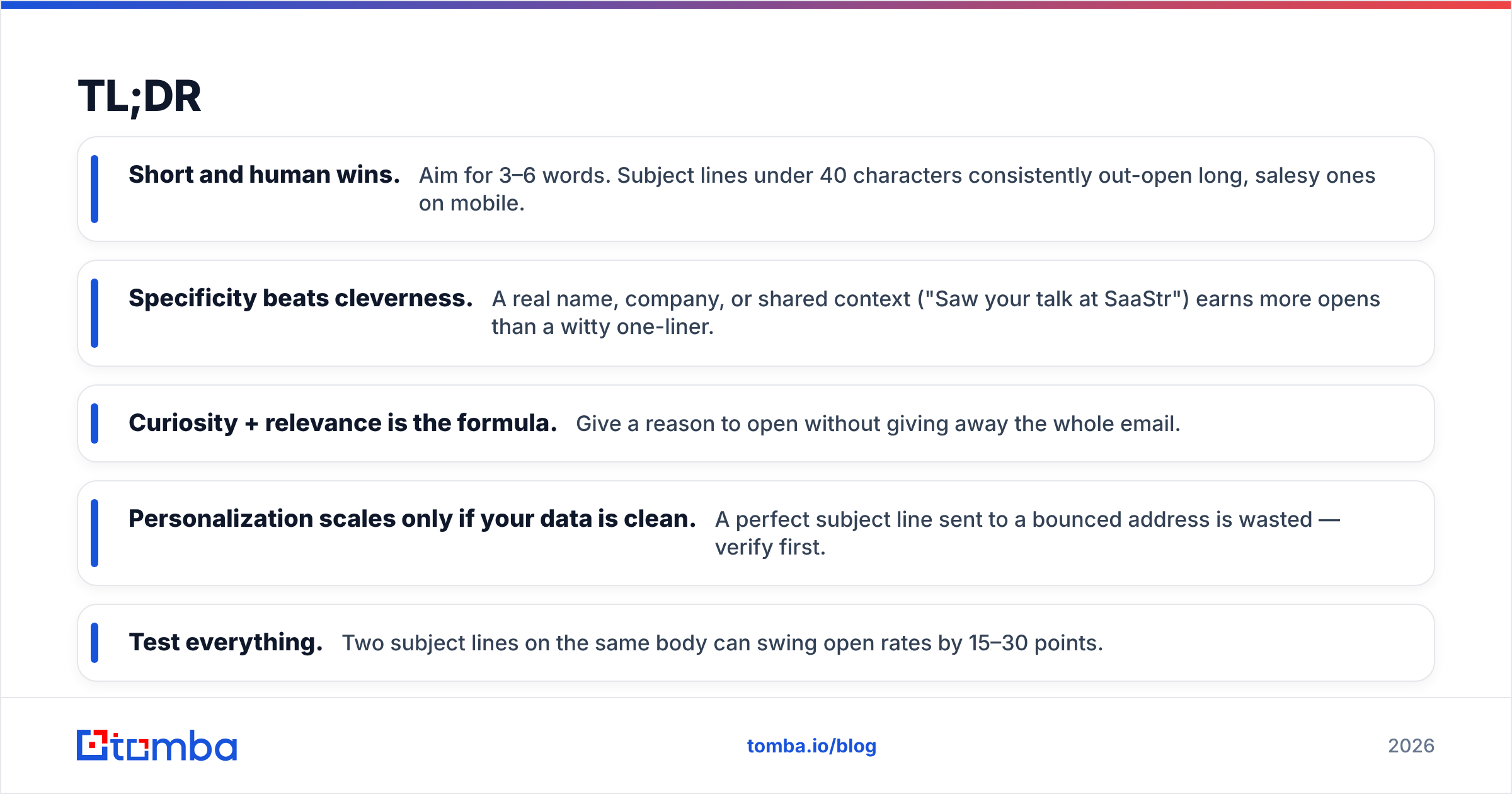
TL;DR#
- Short and human wins. Aim for 3–6 words. Subject lines under 40 characters consistently out-open long, salesy ones on mobile.
- Specificity beats cleverness. A real name, company, or shared context ("Saw your talk at SaaStr") earns more opens than a witty one-liner.
- Curiosity + relevance is the formula. Give a reason to open without giving away the whole email.
- Personalization scales only if your data is clean. A perfect subject line sent to a bounced address is wasted — verify first.
- Test everything. Two subject lines on the same body can swing open rates by 15–30 points.
What makes a connection email subject line different?#
A connection email is not a cold pitch and not a newsletter. It is the first genuine, one-to-one touch — you're reaching out because of a shared context: a mutual contact, an event, a piece of content they published, a role change, or a common community.
That context is your unfair advantage, and the subject line is where you cash it in. The reader is deciding, in about two seconds, whether this is a human who knows something about them or a machine blasting a template to 5,000 people.
So the job of a connection email subject line is narrow: signal relevance and low commitment. It should feel like a message a colleague would send, not a campaign. That means no "Quick question???", no fake "Re:", no ALL CAPS urgency, and no promise the body can't keep.
Before we get to the lists, here's the mental model that separates lines that get opened from lines that get deleted.
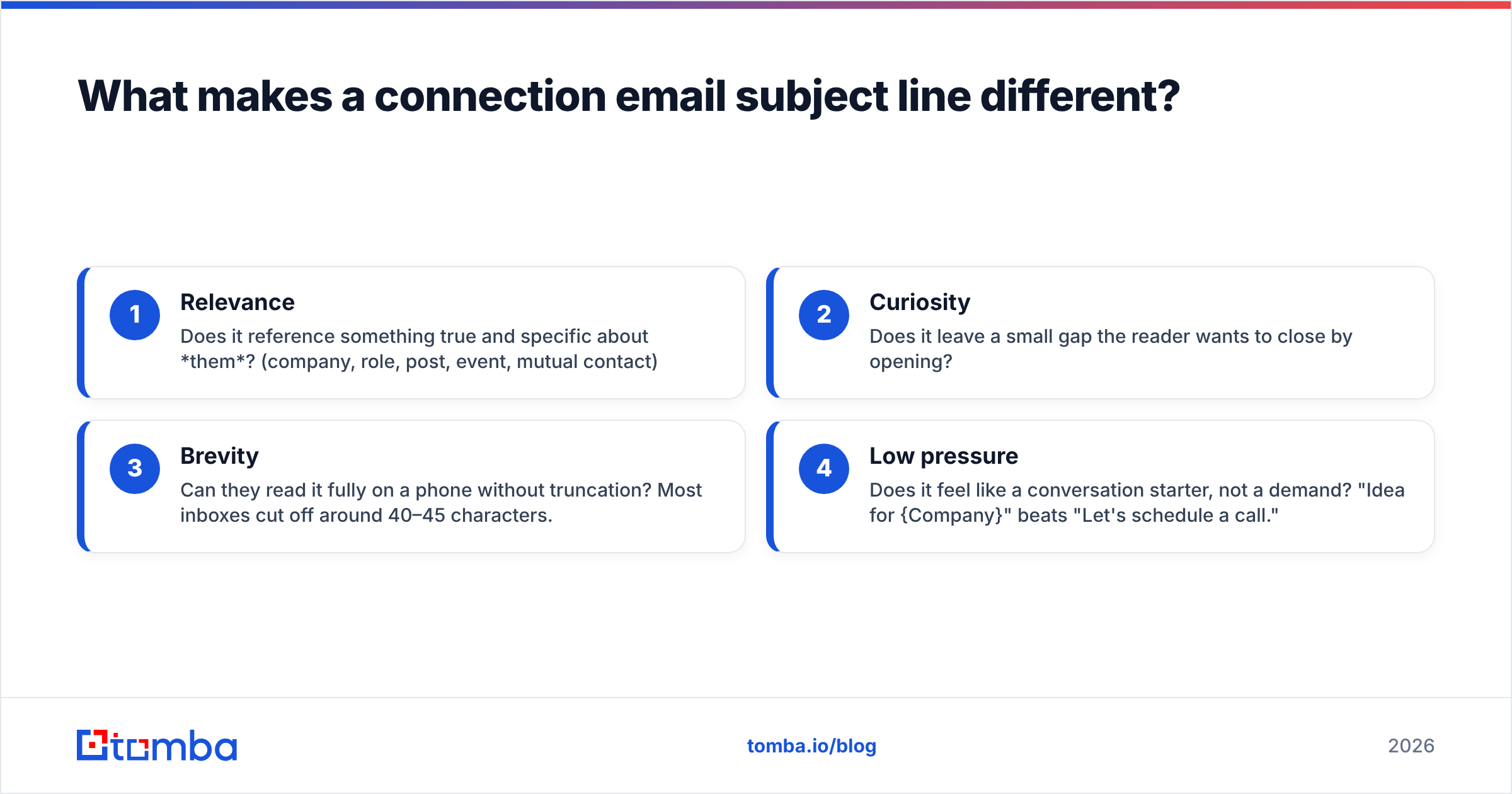
The four levers of an openable subject line#
- Relevance — Does it reference something true and specific about them? (company, role, post, event, mutual contact)
- Curiosity — Does it leave a small gap the reader wants to close by opening?
- Brevity — Can they read it fully on a phone without truncation? Most inboxes cut off around 40–45 characters.
- Low pressure — Does it feel like a conversation starter, not a demand? "Idea for {Company}" beats "Let's schedule a call."
Hit three of these four and your open rate climbs. Miss relevance and brevity together, and no amount of cleverness saves you.
What are the best connection email subject lines by scenario?#
Copy these, then swap in real details. The {curly} fields are non-negotiable — a connection line with an empty merge field is worse than no line at all.
Mutual connection or referral#
{Mutual name} suggested I reach out{Mutual name} mentioned you'd be a good person to knowWe both know {Mutual name}Intro via {Mutual name}{Mutual name} thought we should connect
After an event, webinar, or conference#
Great meeting you at {Event}Following up from {Event}Your question at {Event} stuck with me{Event} — the resource I promisedCoffee line at {Event} 👋(use the emoji sparingly and only if your audience is casual)
Reacting to their content or a role change#
Loved your post on {topic}Your take on {topic} — one questionCongrats on the {new role} roleSaw {Company} just raised — congratsYour {podcast/newsletter} episode on {topic}
Shared community, alumni, or peer group#
Fellow {community} member saying hi{School} alum reaching outAnother {job title} — quick helloFound you in the {community} directory
Straightforward and low-key (when in doubt)#
Quick introReaching out from {Your company}Idea for {Company}{Your name} <> {Their name}Worth a conversation?
Notice the pattern: nearly every strong line is under six words and contains a specific, verifiable detail. That's not a coincidence — it's the formula.
Is a short subject line always better than a long one?#
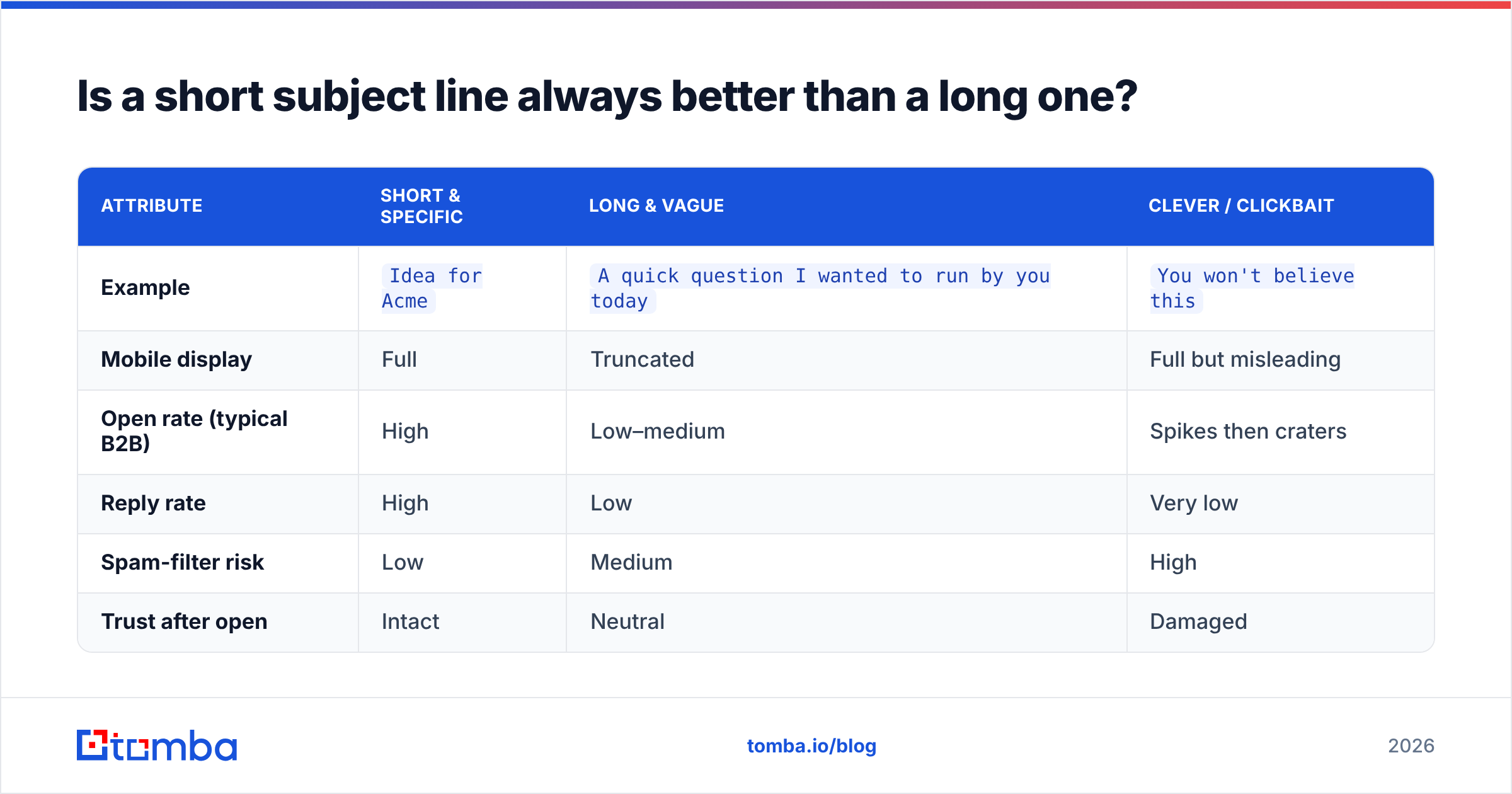
Short usually wins, but relevance wins more. The reason short lines perform is mechanical, not magical: most people read email on mobile, where subject lines truncate around 40 characters. A 9-word line that gets cut mid-thought loses its hook.
But "short" is a proxy for "gets the point across fast." A slightly longer line packed with specific context ("Congrats on the VP Sales role at Acme") can beat a short vague one ("Quick question"). The mistake is padding length with filler words that add no information.
Here's how the tradeoffs actually shake out:
| Attribute | Short & specific | Long & vague | Clever / clickbait |
|---|---|---|---|
| Example | Idea for Acme |
A quick question I wanted to run by you today |
You won't believe this |
| Mobile display | Full | Truncated | Full but misleading |
| Open rate (typical B2B) | High | Low–medium | Spikes then craters |
| Reply rate | High | Low | Very low |
| Spam-filter risk | Low | Medium | High |
| Trust after open | Intact | Neutral | Damaged |
Clickbait is the trap worth calling out. A line like "You won't believe this" might spike opens once, but when the body doesn't deliver, you've taught the reader to ignore your name forever. In a connection sequence — where you may send three or four touches — that reputation cost compounds. Protect the relationship over the single open.
If you want to see how the words themselves score before you hit send, run a draft through a free subject line generator or test subject lines to catch spam triggers and length problems early.
What is the formula for writing your own?#
Stop hunting for the perfect list and learn the pattern. Every high-performing connection email subject line is some combination of:
[Specific context] + [low-pressure hook]
- Context = the true detail only a real human would know: their name, company, post, event, or mutual contact.
- Hook = the small curiosity gap or clear, low-commitment reason to open.
Examples of the formula in action:
Loved your post on RevOps= context (their post) + implied hook (I have something to add){Mutual} suggested I reach out= context (mutual contact) + hook (why now)Idea for {Company}= context (their company) + hook (there's a specific idea inside)
Then apply three filters before sending:
- The mobile test — Read it on your phone. Does it fit without truncation?
- The "would a coworker send this?" test — If it sounds like marketing, rewrite it.
- The promise test — Does the first line of your email pay off the subject? If not, one of them is wrong.

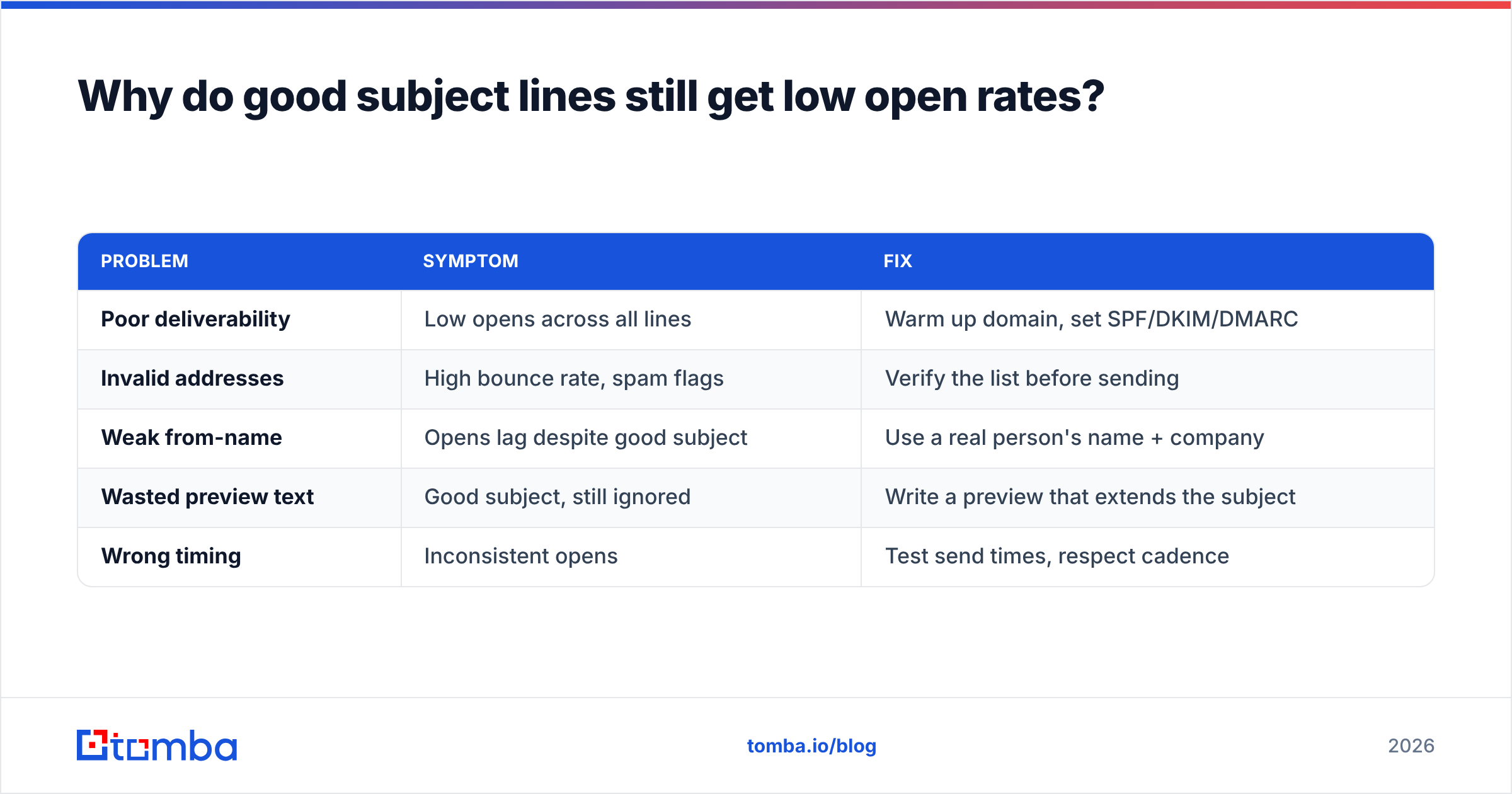
Why do good subject lines still get low open rates?#
Because the subject line isn't the only variable — and often not the one that's broken. If your open rate is stuck below 30% on a genuinely personalized connection email, the problem is usually upstream.
1. Deliverability, not copy. If your emails land in spam or Promotions, the subject line never gets a fair shot. Sender reputation, SPF records, and domain warmup matter more than word choice. A great line in the spam folder opens at 0%. Review your email deliverability fundamentals before blaming the copy.
2. Bad data. You can't personalize a subject line for a person whose email you got wrong. Invalid, outdated, or catch-all addresses inflate your bounce rate, which tanks sender reputation, which sends future emails to spam. This is the silent killer of connection campaigns.
3. From-name and preview text. The subject line is read alongside the sender name and the preview snippet. A trustworthy "First Last, Company" from-name plus a preview that continues the thought ("Hi Sarah, I saw your post about…") does half the work. Wasting your preview text on "View in browser | Unsubscribe" throws that away.
4. Timing and cadence. The same line sent Tuesday at 9am and Saturday at 11pm performs differently. And a connection email that arrives after four unrelated blasts from you is already tainted.
Here's how those failure points stack up against the fix:
| Problem | Symptom | Fix |
|---|---|---|
| Poor deliverability | Low opens across all lines | Warm up domain, set SPF/DKIM/DMARC |
| Invalid addresses | High bounce rate, spam flags | Verify the list before sending |
| Weak from-name | Opens lag despite good subject | Use a real person's name + company |
| Wasted preview text | Good subject, still ignored | Write a preview that extends the subject |
| Wrong timing | Inconsistent opens | Test send times, respect cadence |
The takeaway: a connection email subject line is a multiplier, not a magic wand. It multiplies the reach you already have. If the underlying deliverability and data are broken, you're multiplying by zero.
How do you make personalized subject lines actually scale?#
The tension every outbound team hits: personalized subject lines work, but personalizing 500 of them by hand doesn't scale. The answer isn't to give up personalization — it's to build a clean, structured data layer so the merge fields are always right.
That means every prospect record needs a verified email, a correct name, a company, and ideally a trigger (recent post, role change, funding). Get those four fields right and templated lines like Congrats on the {role} role at {Company} read as fully personal at any volume.
This is where your data source does the heavy lifting:
- Use a reliable email finder to pull verified professional addresses by name or company, so your merge fields point at real people.
- Run the list through an email verifier to strip invalid and risky addresses before they bounce and drag your reputation down.
- For account-based outreach, domain search gives you the right contacts and email patterns at a target company in one pass.
- Enrich records with data enrichment so you have the role, seniority, and context that make subject lines specific instead of generic.
You can compare accuracy and pricing across providers on independent sites like G2 before you commit, and HubSpot's email marketing benchmarks are a useful sanity check on what "good" open rates look like in your industry.
With clean data feeding your merge fields, the subject line stops being a bottleneck. You write five formulas, verify your list, and every send reads like a one-to-one message — because it is.
Quick checklist before you hit send#
- Subject line is under ~40 characters and fits on mobile
- It contains one specific, true detail about the recipient
- No spam triggers (ALL CAPS, "free", excessive punctuation, fake "Re:")
- The first line of the email pays off the subject line's promise
- The recipient's email is verified, not guessed
- From-name is a real person, and preview text continues the hook
- You have a second variant queued to A/B test
The bottom line#
A great connection email subject line does one job: it makes a real human feel recognized in two seconds. Keep it short, make it specific, leave a small curiosity gap, and never write a check the body can't cash. Then remember the part most guides skip — the best line in the world can't rescue a message sent to the wrong address or from a burned domain.
Fix the data first, then the words, then test relentlessly. That order is what separates a 25% open rate from a 55% one.
Ready to make every merge field land on a real person? Start with the Tomba Email Finder to pull verified, up-to-date professional emails by name, company, or domain — so your carefully written subject lines actually reach the humans you wrote them for. Check the Tomba pricing to find the plan that fits your outreach volume, starting free with 25 searches a month.
Related guides#
Ready to find emails that actually work?
Join 150,000+ professionals who stopped guessing and started sending. Free credits on signup — no credit card required.
Get the Tomba newsletter
Practical outbound tactics and product updates — once every two weeks.
About the author