How to Write a Consultant Introduction Email That Gets Replies
A consultant introduction email lives or dies on relevance, timing, and one clear ask. Here are the structures, templates, and mistakes that decide whether you get a reply.
You have a service worth paying for. The prospect has an inbox with 120 unread messages. A consultant introduction email is the 12 seconds you get to prove you belong in the 5% they actually open, read, and answer. Get the structure right and you book calls. Get it wrong and you become one more archived name.
This guide breaks down exactly what a high-reply consultant introduction email looks like in 2026 — the anatomy, the templates, the personalization that scales, and the mistakes that quietly tank your response rate.
TL;DR#
- Lead with them, not you. The first line should reference the prospect's world (a trigger, a result, a problem), never your credentials.
- One email, one ask. A single, low-friction call to action beats a menu of options every time.
- Personalization at scale needs clean data. A verified email and an accurate name beat a clever subject line sent to a dead inbox.
- Keep it under 150 words. Long intros signal "this will take work to read." Short ones get answered from a phone.
- Follow up 2–3 times. Most replies to a consultant introduction email come after the first send, not on it.
What is a consultant introduction email?#
A consultant introduction email is a short, targeted message you send to a prospect who does not yet know you, with the goal of starting a conversation — not closing a deal. Think of it like the first 10 seconds of a networking handshake: you are not pitching your entire methodology, you are earning the right to a second sentence.
It differs from a generic cold email in one important way: as a consultant, you sell expertise and trust, not a widget. That means your introduction has to demonstrate relevance and credibility fast, without sounding like a resume. The reader should finish the email thinking "this person understands my situation," not "this person wants my money."
There are three common flavors:
- Cold introduction — the prospect has never heard of you. Highest volume, lowest baseline reply rate, most dependent on research and data quality.
- Warm introduction — you share a mutual connection, attended the same event, or were referred. Reply rates jump 3–5x because trust is borrowed.
- Re-introduction — you met once (a webinar, a conference, a LinkedIn comment) and are reconnecting. The trigger is the shared context.

What should a consultant introduction email include?#
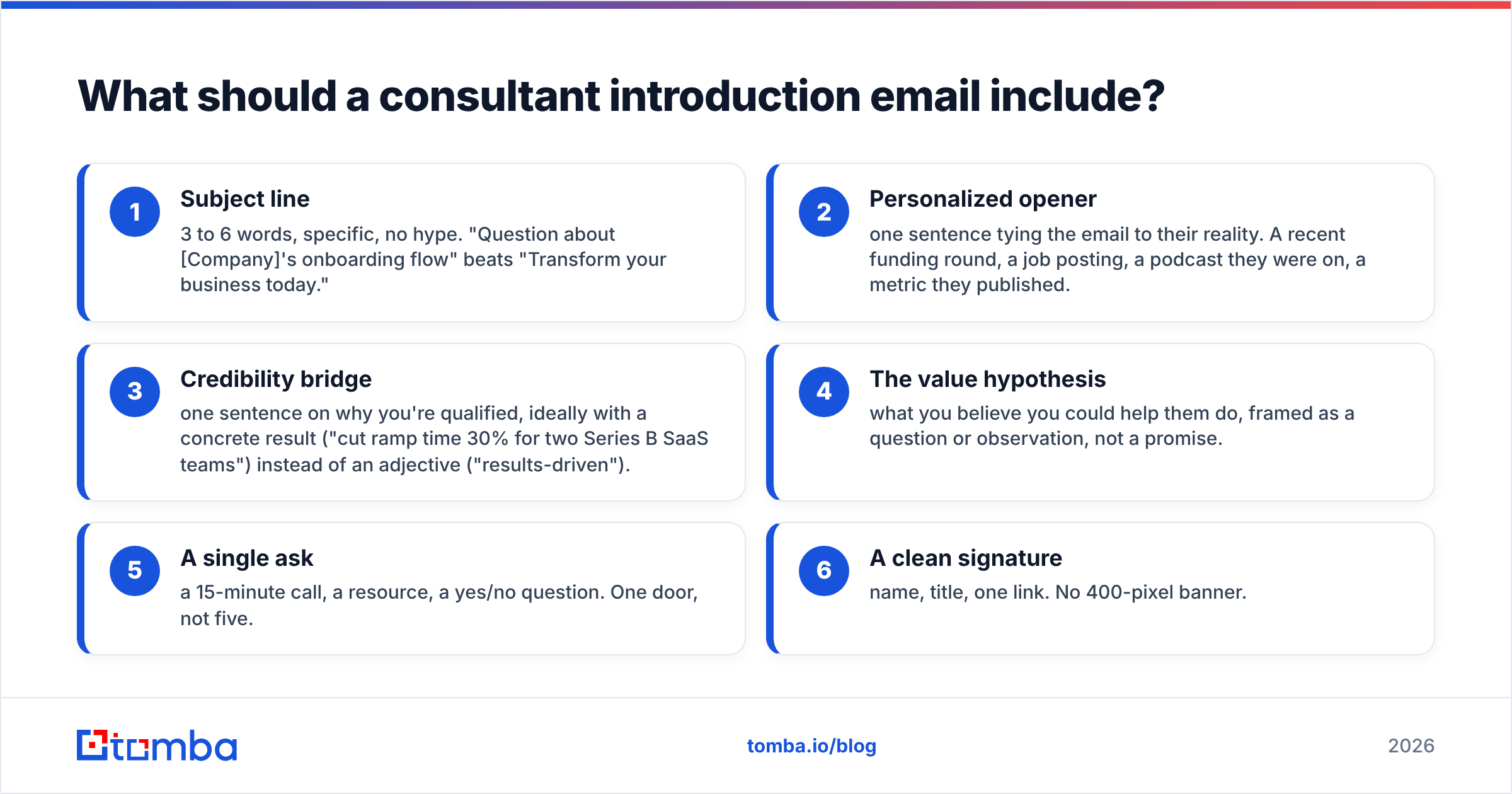
Every strong consultant introduction email answers four silent questions the reader is asking: Who are you? Why are you emailing me specifically? What's in it for me? What do you want me to do? Miss any one and the message stalls.
Here is the anatomy that consistently converts:
- Subject line — 3 to 6 words, specific, no hype. "Question about [Company]'s onboarding flow" beats "Transform your business today."
- Personalized opener — one sentence tying the email to their reality. A recent funding round, a job posting, a podcast they were on, a metric they published.
- Credibility bridge — one sentence on why you're qualified, ideally with a concrete result ("cut ramp time 30% for two Series B SaaS teams") instead of an adjective ("results-driven").
- The value hypothesis — what you believe you could help them do, framed as a question or observation, not a promise.
- A single ask — a 15-minute call, a resource, a yes/no question. One door, not five.
- A clean signature — name, title, one link. No 400-pixel banner.
The difference between an amateur and a professional introduction is rarely the writing. It is the research and the data underneath it. A perfectly worded email sent to info@ or a bounced address never gets read. This is where an accurate email finder and an email verifier do more for your reply rate than any subject-line trick.
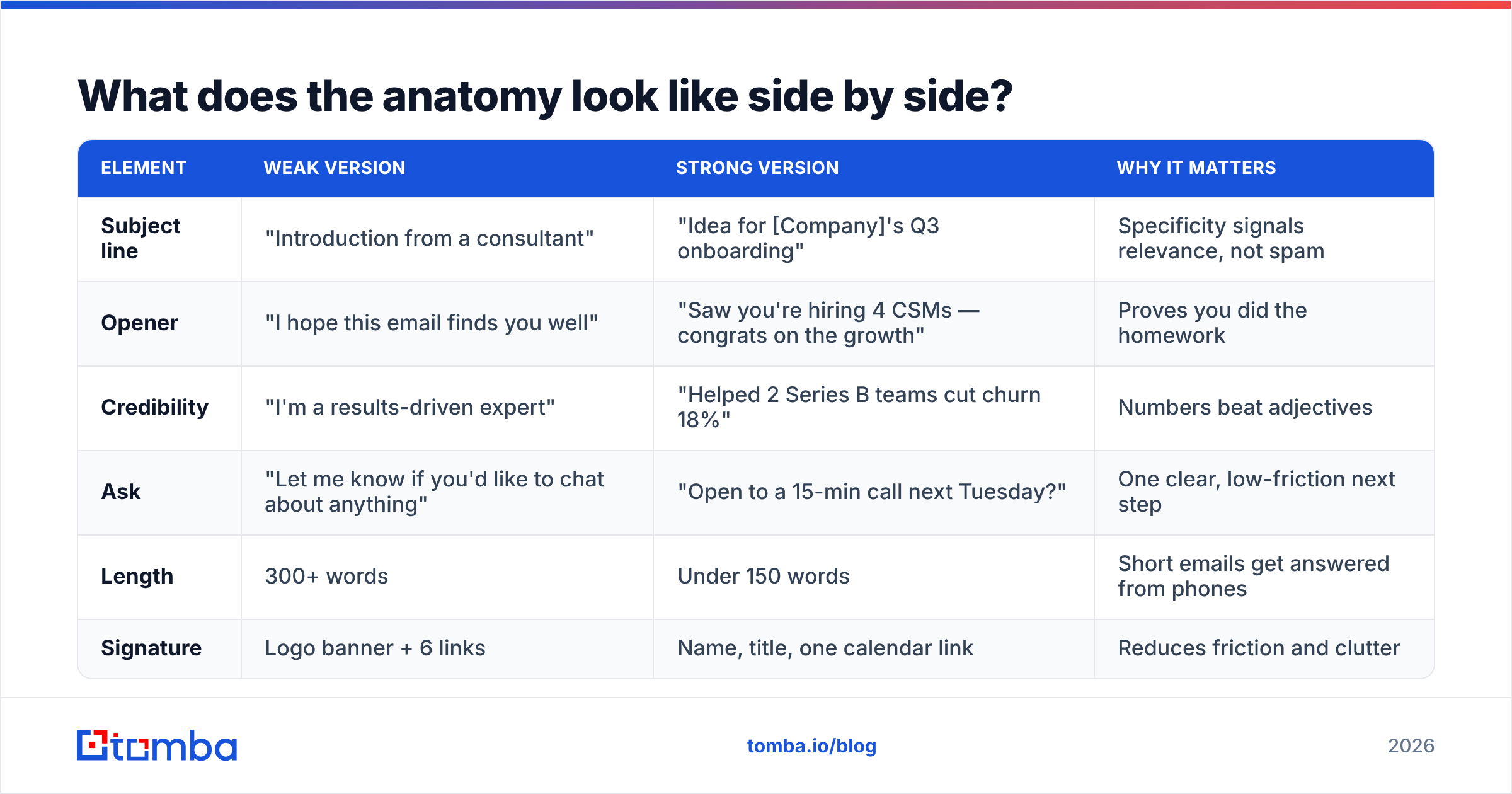
What does the anatomy look like side by side?#
| Element | Weak version | Strong version | Why it matters |
|---|---|---|---|
| Subject line | "Introduction from a consultant" | "Idea for [Company]'s Q3 onboarding" | Specificity signals relevance, not spam |
| Opener | "I hope this email finds you well" | "Saw you're hiring 4 CSMs — congrats on the growth" | Proves you did the homework |
| Credibility | "I'm a results-driven expert" | "Helped 2 Series B teams cut churn 18%" | Numbers beat adjectives |
| Ask | "Let me know if you'd like to chat about anything" | "Open to a 15-min call next Tuesday?" | One clear, low-friction next step |
| Length | 300+ words | Under 150 words | Short emails get answered from phones |
| Signature | Logo banner + 6 links | Name, title, one calendar link | Reduces friction and clutter |
Read that table top to bottom and you have a checklist. Before you hit send, every row should land in the "strong" column.
What are proven consultant introduction email templates?#
Steal these, then rewrite the bracketed parts so they sound like you. Templates are scaffolding, not a script — the personalization is what earns the reply.
Template 1 — The trigger-event cold intro
Subject: Congrats on the [Series B]
Hi [First name],
Saw the news about [Company]'s raise — exciting stage. Scaling from here usually means [specific challenge, e.g., "your onboarding breaks before your headcount does"].
I help [ICP, e.g., "B2B SaaS teams post-Series B"] fix exactly that. Last year I cut ramp time 30% for two similar teams.
Worth a 15-minute call to see if the same applies to you? I'm free Thursday.
[Name]
Template 2 — The referral / warm intro
Subject: [Mutual contact] suggested I reach out
Hi [First name],
[Mutual contact] mentioned you're rethinking [problem area] and thought we should talk. I've spent the last [X] years helping [ICP] with exactly that.
No pitch — just happy to share what's working for teams like yours right now. Do you have 15 minutes this week?
[Name]
Template 3 — The value-first intro
Subject: A quick idea for [specific process]
Hi [First name],
I noticed [observation about their public-facing process]. One change that worked well for a similar company: [specific, giveaway-quality tip].
I help [ICP] go deeper on this. If it's useful, I'll send over a short breakdown — no strings. Interested?
[Name]
Template 4 — The re-introduction
Subject: Following up from [event]
Hi [First name],
We spoke briefly at [event] about [topic]. I've been thinking about [their challenge] and put together a couple of ideas.
Can I grab 15 minutes next week to walk you through them?
[Name]
Notice what none of these do: they don't open with "My name is," they don't list every service, and they don't ask for an hour of someone's calendar in the first message.
How do you personalize introduction emails at scale?#
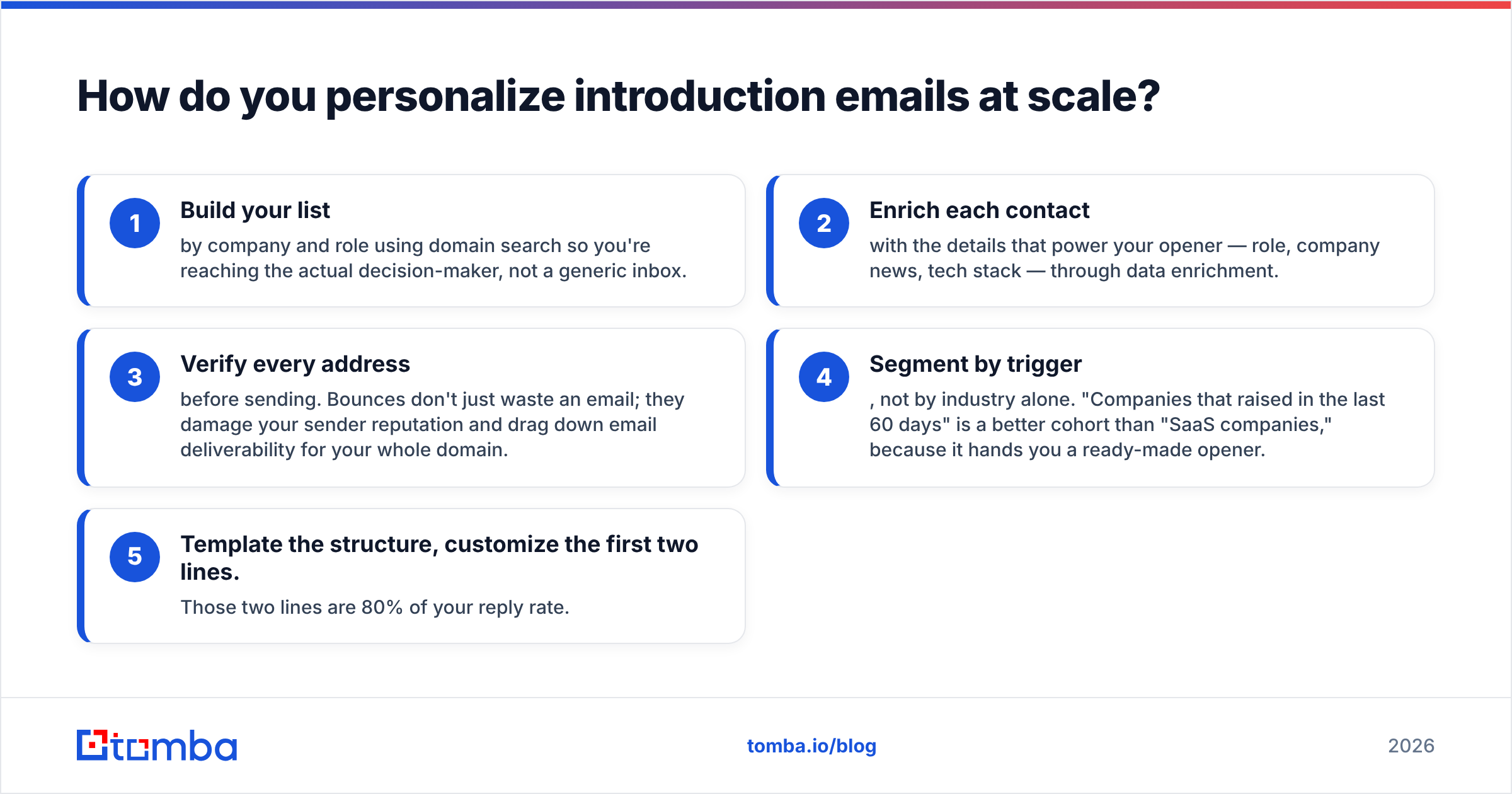
Personalization does not mean writing 200 emails by hand. It means building a repeatable system where the research inputs are accurate and the variable slots are filled with real, specific data. The bottleneck is almost never writing — it is getting the right contact and a deliverable address.
A practical workflow looks like this:
- Build your list by company and role using domain search so you're reaching the actual decision-maker, not a generic inbox.
- Enrich each contact with the details that power your opener — role, company news, tech stack — through data enrichment.
- Verify every address before sending. Bounces don't just waste an email; they damage your sender reputation and drag down email deliverability for your whole domain.
- Segment by trigger, not by industry alone. "Companies that raised in the last 60 days" is a better cohort than "SaaS companies," because it hands you a ready-made opener.
- Template the structure, customize the first two lines. Those two lines are 80% of your reply rate.
According to research aggregated by HubSpot, personalized subject lines and relevant openers measurably lift open and reply rates — but only if the message reaches a real, monitored inbox. Data quality is the multiplier on every other tactic.

Cold vs. warm introductions: which converts better?#
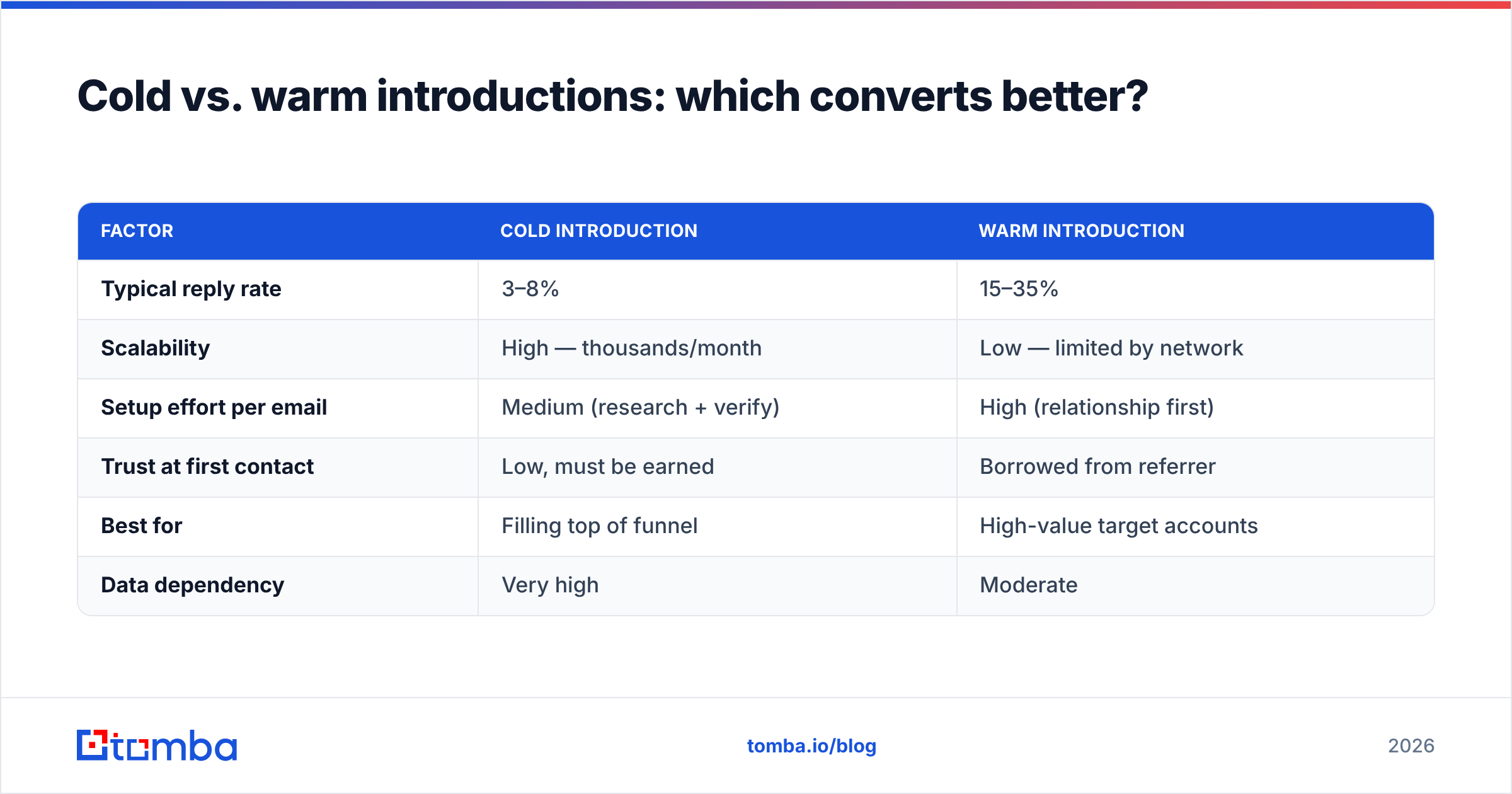
Warm wins on rate, cold wins on volume — and most consultants need both. The right mix depends on how big your referral network already is.
| Factor | Cold introduction | Warm introduction |
|---|---|---|
| Typical reply rate | 3–8% | 15–35% |
| Scalability | High — thousands/month | Low — limited by network |
| Setup effort per email | Medium (research + verify) | High (relationship first) |
| Trust at first contact | Low, must be earned | Borrowed from referrer |
| Best for | Filling top of funnel | High-value target accounts |
| Data dependency | Very high | Moderate |
The strategic move is to treat them as a system: use warm introductions for your dream 50 accounts, and cold introductions — backed by verified data — to keep a predictable flow of new conversations. Don't force one channel to do the other's job.
What mistakes kill a consultant introduction email?#
Most failed introductions fail for boring, fixable reasons. Watch for these:
- Talking about yourself first. "I am a strategy consultant with 15 years of experience" is a snooze. Lead with them.
- The multi-ask. Offering a call or a resource or a coffee or a demo gives the reader a decision to make. Give them one obvious yes.
- Sending to unverified addresses. High bounce rates get your domain flagged. Run your list through a bulk email finder and verifier first.
- No follow-up. A single send is a coin flip. Two or three spaced, polite follow-ups routinely double total replies.
- Fake urgency. "Act now" and "limited spots" read as sales pressure and erode the trust a consultant is supposed to project.
- Wall-of-text formatting. If it looks like homework, it gets archived. Short paragraphs, one idea each.
Fixing the data-quality mistakes alone — verified addresses, correct names, right decision-maker — often moves the needle more than any rewrite, because you stop wasting perfectly good copy on inboxes that will never see it.
How many times should you follow up?#
Two to four total touches, spaced 3–5 business days apart, is the sweet spot for a consultant introduction email sequence. The first follow-up should add a new angle (a case study, a different benefit), not just say "bumping this." The final message can be a polite "breakup" email that gives the prospect an easy out — which, counterintuitively, often prompts a reply.
Keep the whole sequence anchored to the same single ask. If your first email asked for a 15-minute call, your follow-ups reinforce that, they don't introduce three new offers.
Put it together with better data#
The best consultant introduction email in the world is worthless if it lands in a dead inbox. Before you obsess over subject lines, make sure you're reaching the right person at a verified address. Tomba's Email Finder helps you find the exact decision-maker by name, company, or domain, and verify the address before you send — so your carefully written intro actually gets read. Start on the free tier (25 searches a month), and when you're ready to scale outreach, the Tomba plans run from $49/mo for Starter up to Pro and Enterprise. Write the email people want to answer, then make sure it reaches them.
Related guides#
Ready to find emails that actually work?
Join 150,000+ professionals who stopped guessing and started sending. Free credits on signup — no credit card required.
Get the Tomba newsletter
Practical outbound tactics and product updates — once every two weeks.
About the author