ContactOut vs No2Bounce (2026): Finder vs Verifier Compared
ContactOut finds contacts. No2Bounce cleans lists. They solve different halves of the same problem — here's how they compare on coverage, accuracy, pricing, and which one your outbound stack actually needs first.
TL;DR#
- ContactOut and No2Bounce are not really competitors. ContactOut is a contact-discovery tool built around LinkedIn; No2Bounce is a bulk email verification service. Comparing them head-to-head is like comparing a well to a water filter.
- If you have no list yet, a verifier is useless to you. Start with discovery (ContactOut, or a domain-first finder) and add verification once you have volume.
- If you already have a list — from a CRM export, a scrape, or a purchased database — a verifier is the higher-ROI purchase. Dirty lists are the single fastest way to burn a sending domain.
- The hidden cost in both models is stacking. Buying a finder and a verifier and a catch-all checker means three vendors, three credit systems, three failure points.
- Our pick for most B2B teams: consolidate. A platform that does finding, verification, and catch-all handling on one credit pool beats two point tools for the same monthly spend.
What are ContactOut and No2Bounce, actually?#
Let's kill the false equivalence first, because the query "contactout vs no2bounce" hides a category error that costs teams money.
ContactOut is a contact-discovery platform. Its core product is a Chrome extension that sits on top of LinkedIn profiles and surfaces personal and work emails plus phone numbers. It also ships a searchable contact database, an ATS/CRM integration layer, and bulk export. Recruiters made it popular; SDR teams adopted it because a LinkedIn-native workflow is fast. You can see how the product positions itself on contactout.com.
No2Bounce is an email verification service. You feed it a list; it runs syntax checks, MX record lookups, SMTP handshakes, disposable-domain detection, and role-account flagging; it hands you back a scored list of valid, invalid, risky, and unknown addresses. It does not find anything. It cleans.
So the honest framing of ContactOut vs No2Bounce is not "which is better." It's which half of the pipeline are you missing right now?
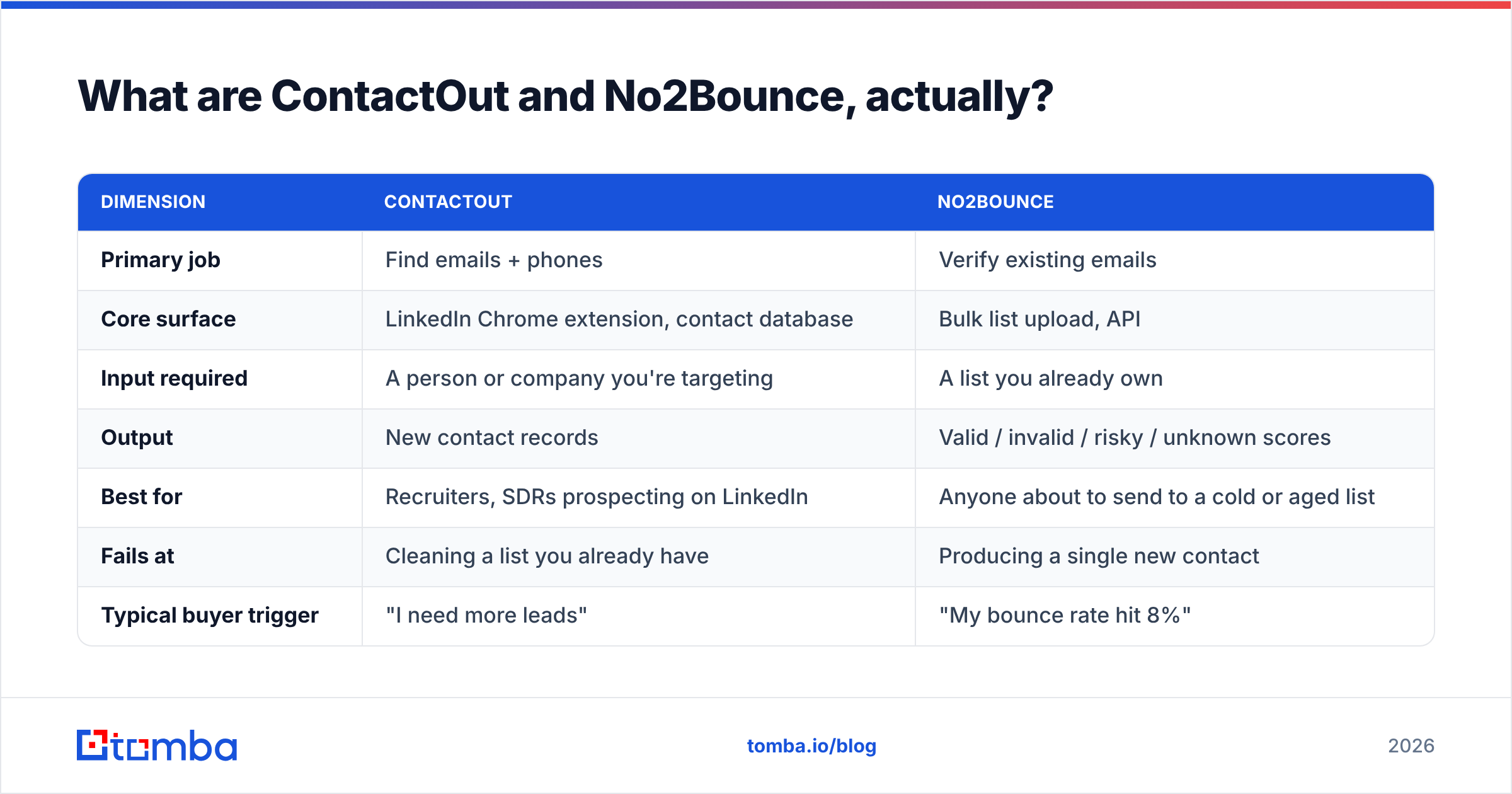
| Dimension | ContactOut | No2Bounce |
|---|---|---|
| Primary job | Find emails + phones | Verify existing emails |
| Core surface | LinkedIn Chrome extension, contact database | Bulk list upload, API |
| Input required | A person or company you're targeting | A list you already own |
| Output | New contact records | Valid / invalid / risky / unknown scores |
| Best for | Recruiters, SDRs prospecting on LinkedIn | Anyone about to send to a cold or aged list |
| Fails at | Cleaning a list you already have | Producing a single new contact |
| Typical buyer trigger | "I need more leads" | "My bounce rate hit 8%" |
If you nodded at both rows in the last line, you've just discovered why most teams end up paying two vendors — and why consolidation is the real story of this comparison.

How accurate is each tool, and how would you even know?#
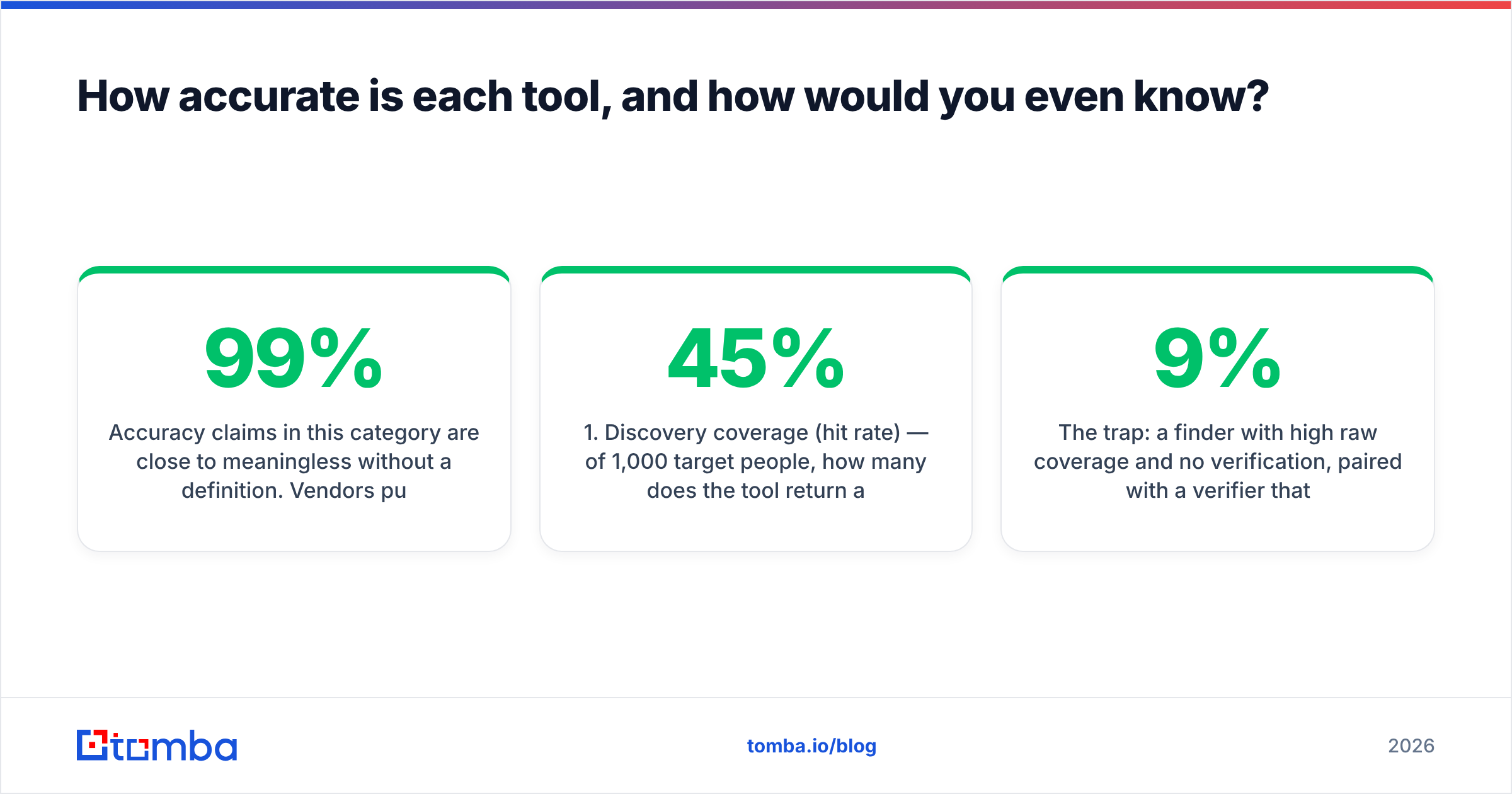
Accuracy claims in this category are close to meaningless without a definition. Vendors publish numbers like "99% accuracy" without saying accuracy of what.
Here's the distinction that matters:
- Discovery coverage (hit rate) — of 1,000 target people, how many does the tool return an email for at all? This is ContactOut's metric. A tool with 45% coverage on your ICP is worse than one with 70%, even if both are "accurate" on what they return.
- Discovery precision (deliverable rate) — of the emails it does return, how many actually land? A finder that returns a guessed permutation with no verification pass will inflate coverage and destroy your sender reputation.
- Verification accuracy (true-positive rate) — of the addresses a verifier marks "valid," how many actually accept mail? This is No2Bounce's metric.
- Verification honesty (catch-all handling) — how does the tool treat domains that accept everything at the SMTP layer? A verifier that marks every catch-all address "valid" is lying to you. One that marks them all "unknown" is useless. The good ones do additional pattern and historical-signal work.
The trap: a finder with high raw coverage and no verification, paired with a verifier that rubber-stamps catch-alls, produces a list that looks clean and bounces at 9%. Both vendors will point at the other.
How to actually test this yourself, in an afternoon:
- Build a 200-row ground-truth sample. Pull contacts you've already emailed successfully in the last 90 days from your CRM. You know these are real.
- Strip the emails and feed the names + domains to the finder. Measure coverage (how many returned) and precision (how many match the known-good address exactly).
- Feed the known-good emails to the verifier. Any "invalid" verdict on an address you demonstrably emailed last month is a false negative — count them. That's your false-rejection rate, and it's money you're throwing away.
- Salt the verifier list with 20 addresses you know are dead (departed employees, bounced sends). Anything marked "valid" is a false positive — the expensive kind.
- Run 20 catch-all domains through both. Note whether the tool says "unknown," "risky," or confidently "valid." Confidence without evidence is a red flag.
Run this before you sign an annual contract, not after. Every serious vendor will give you enough free credits to do it — and one that won't is telling you something.

ContactOut vs No2Bounce: pricing, limits, and where the costs hide#
Both vendors publish tiered, credit-based pricing, and both revise it — always check the live pricing page before you budget. The structural shape, though, is stable and worth understanding.
ContactOut prices around per-seat plans with monthly email and phone credit allocations. Phone credits are usually metered separately and are the expensive line item. Bulk/API access typically sits on higher tiers, and team plans gate the shared database and ATS integrations.
No2Bounce prices like most verification services: pay-as-you-go credit packs plus monthly subscriptions, with the per-credit cost dropping as volume rises. The economics only work in your favor if you verify in large, infrequent batches.
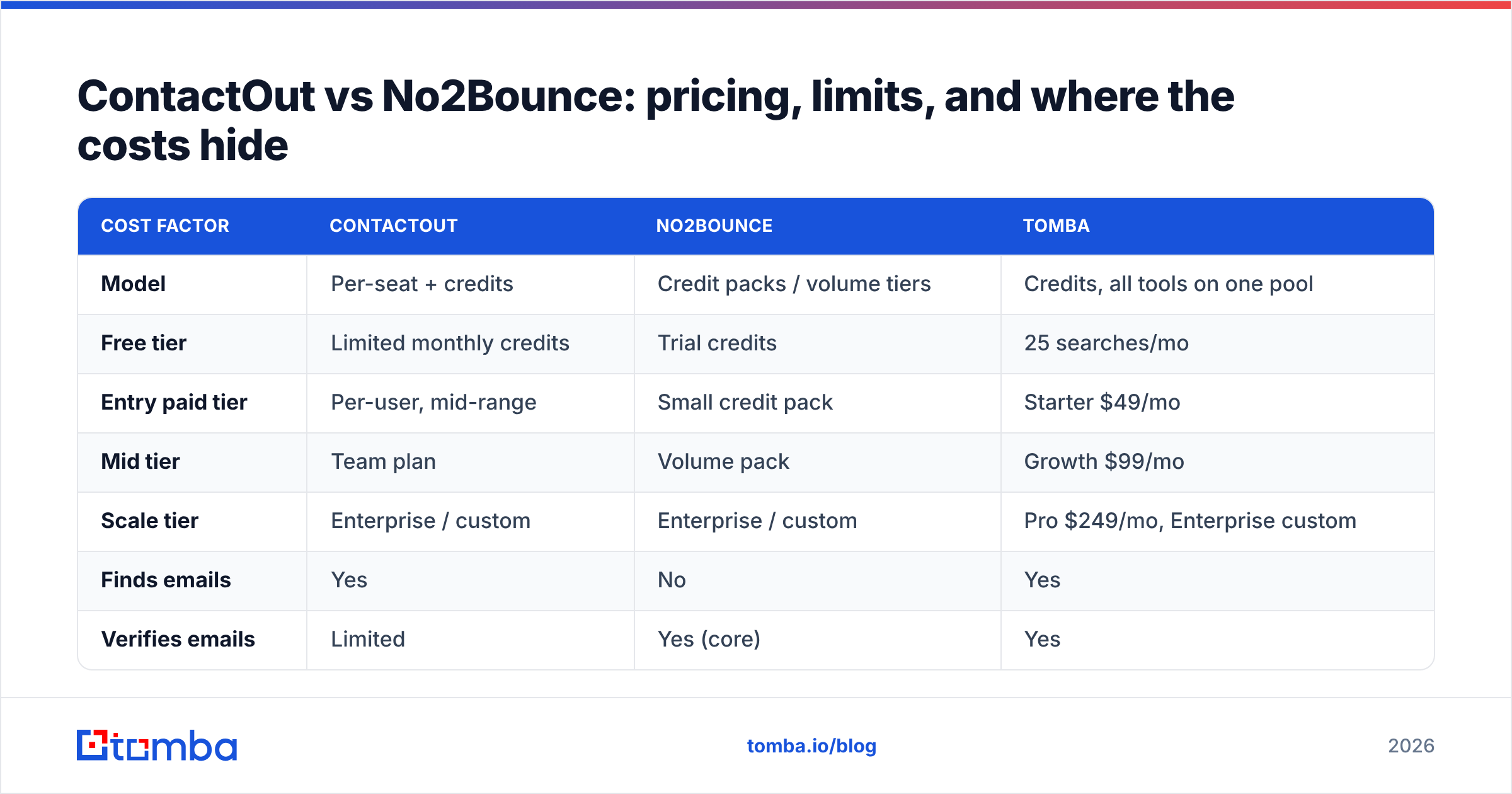
| Cost factor | ContactOut | No2Bounce | Tomba |
|---|---|---|---|
| Model | Per-seat + credits | Credit packs / volume tiers | Credits, all tools on one pool |
| Free tier | Limited monthly credits | Trial credits | 25 searches/mo |
| Entry paid tier | Per-user, mid-range | Small credit pack | Starter $49/mo |
| Mid tier | Team plan | Volume pack | Growth $99/mo |
| Scale tier | Enterprise / custom | Enterprise / custom | Pro $249/mo, Enterprise custom |
| Finds emails | Yes | No | Yes |
| Verifies emails | Limited | Yes (core) | Yes |
| Catch-all handling | Not the focus | Depends on tier | Dedicated catch-all verifier |
| Phone numbers | Yes (metered) | No | Yes |
| API | Higher tiers | Yes | All paid tiers |
Three costs that don't appear on any pricing page:
- Credit fragmentation. Unused finder credits don't pay for verification, and vice versa. Two vendors means two pools of expiring, non-fungible credit. Teams routinely overbuy on both sides to avoid running dry mid-campaign.
- The re-verify tax. Emails decay at roughly 2-3% per month as people change jobs — that's a churning list, not a static asset. Anything you sourced 6 months ago needs re-verification before it goes into a sequence. If your finder doesn't verify at the point of discovery, you pay a second vendor for the same address, twice.
- Integration surface. Every extra vendor is another API key, another rate limit, another status page, another SOC 2 questionnaire for your security team.
Tomba's pricing collapses those pools deliberately: the same credits that run the email finder run the email verifier and the catch-all verifier. That's not a feature so much as a billing decision — but it's the one that changes your monthly bill.

Is ContactOut better than No2Bounce for cold outbound?#
Wrong question, but here's the useful answer: it depends entirely on where your list comes from.
Choose a discovery tool like ContactOut if:
- Your prospecting motion starts on LinkedIn. You're browsing profiles, building lists person by person, and you want an in-context extension rather than a separate tab.
- You're recruiting. Personal emails and mobile numbers matter more than work addresses, and ContactOut's data has historically been strong there.
- You have no list. Verification of an empty CSV returns an empty CSV.
Choose a verification tool like No2Bounce if:
- You inherited a list. CRM exports, event scans, purchased data, an old marketing database — all of it is stale and none of it is safe to send to.
- Your bounce rate crossed 3%. At 5%+, mailbox providers are actively throttling you. At 8%, you're being filtered before you're read. This is an emergency, not an optimization.
- You send high volume from a domain you can't afford to lose. Verification is cheap insurance against a very expensive fire.
You probably need both if:
- You do outbound at any real scale. Which is exactly the position most B2B teams find themselves in — and the reason the "vs" framing collapses.
The unpleasant math: a finder subscription plus a verifier subscription plus a catch-all add-on, at typical mid-market volumes, lands you in three-vendor territory for a workflow that should be one API call. Compare that against a ContactOut alternative that returns a verified email as the response to a find request, and the stack question answers itself.

What about catch-all domains — the thing both tools struggle with?#
Catch-all (or "accept-all") domains are configured to accept mail to any address at the domain, then bounce or discard it silently after the fact. The SMTP handshake succeeds. The mailbox may not exist.
This is where verification vendors diverge sharply, and where a lot of "99% accuracy" claims quietly break down. If you want the protocol-level detail, the SMTP spec explains why a server can return a 250 OK for an address it will later throw away.
Roughly 15-20% of B2B domains are catch-all, and they're concentrated in exactly the segment you care about — enterprises with mature mail infrastructure. Three ways a tool can handle them:
- Mark everything valid. Fast, dishonest, and the fastest route to a bounce spike.
- Mark everything unknown/risky. Honest, safe, and useless — you've just excluded a fifth of your TAM.
- Apply additional signals. Known company email patterns, historical delivery data, engagement signals from prior sends. This is the only approach that produces a usable answer, and it's the hardest to build.
When you evaluate any pair of tools in this space, hand each one the same 20 catch-all domains and read the verdicts carefully. A tool that gives you a confidence score with a stated basis is doing real work. A tool that gives you a green checkmark is guessing with your sender reputation.
Tomba's catch-all verifier exists as a distinct product precisely because the general-purpose verify endpoint can't honestly resolve these — and pretending otherwise would be the easy, wrong thing to build.
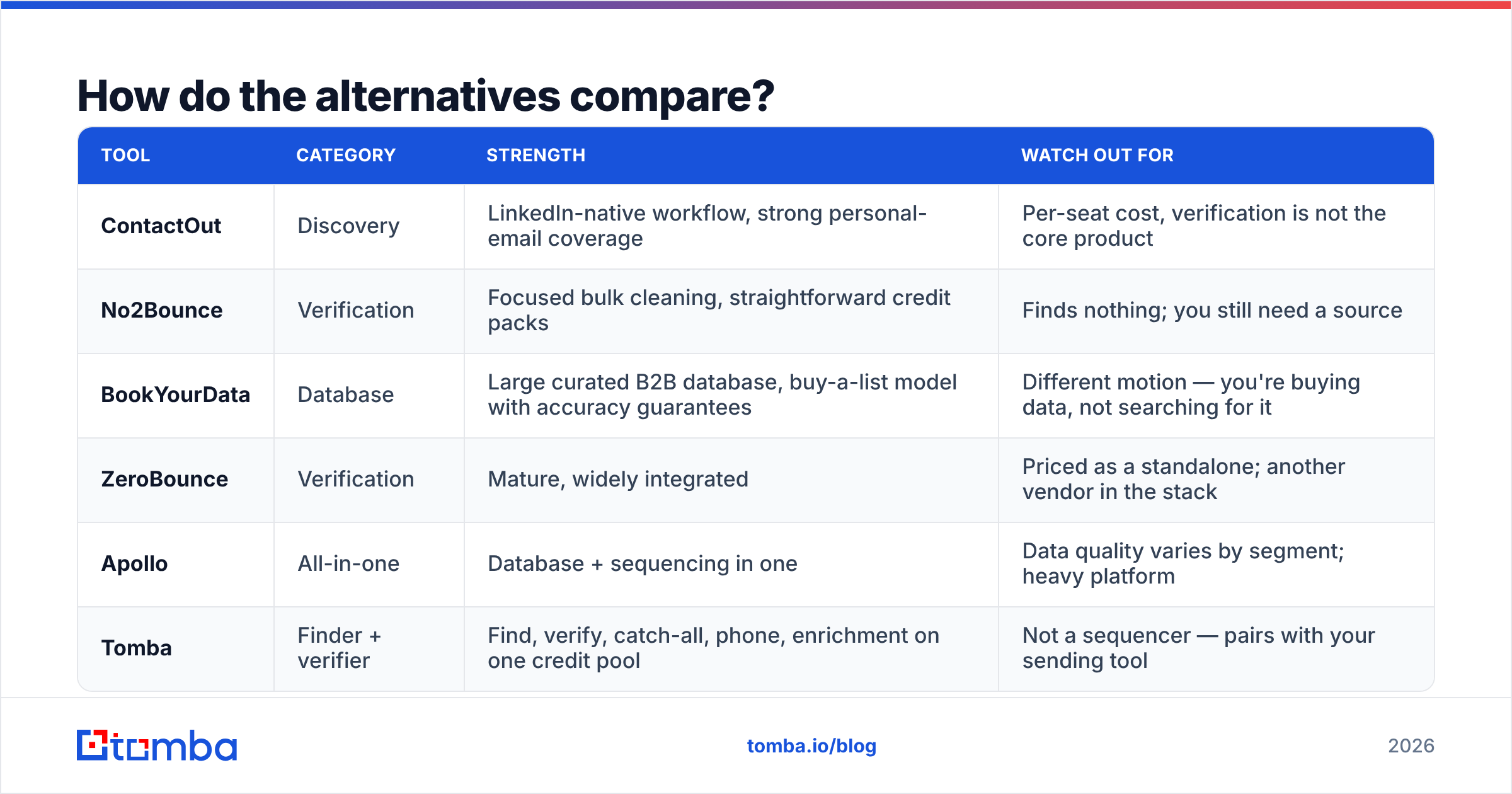
How do the alternatives compare?#
Neither ContactOut nor No2Bounce operates in a vacuum. The broader landscape, with the honest positioning:
| Tool | Category | Strength | Watch out for |
|---|---|---|---|
| ContactOut | Discovery | LinkedIn-native workflow, strong personal-email coverage | Per-seat cost, verification is not the core product |
| No2Bounce | Verification | Focused bulk cleaning, straightforward credit packs | Finds nothing; you still need a source |
| BookYourData | Database | Large curated B2B database, buy-a-list model with accuracy guarantees | Different motion — you're buying data, not searching for it |
| ZeroBounce | Verification | Mature, widely integrated | Priced as a standalone; another vendor in the stack |
| Apollo | All-in-one | Database + sequencing in one | Data quality varies by segment; heavy platform |
| Tomba | Finder + verifier | Find, verify, catch-all, phone, enrichment on one credit pool | Not a sequencer — pairs with your sending tool |
Two honest notes. First, database vendors like BookYourData solve a genuinely different problem: if you want a pre-built, guaranteed list for a defined ICP rather than a search tool, that's a legitimate and often faster path — it's worth pricing alongside the search-based options rather than against them. Second, all-in-one platforms trade data depth for convenience; if data quality is your bottleneck, adding a sequencer won't fix it.
Independent review sites are the right place to sanity-check any of this — G2 and Capterra both carry enough volume in this category that patterns in the one-star reviews tell you more than the feature matrix does. Read the complaints, not the praise.
What should you actually do this week?#
A concrete decision path:
- Audit your bounce rate. Pull the last 30 days from your sending tool. Under 2%, discovery is your bottleneck. Over 5%, stop sending and clean the list first — nothing else matters until that number comes down. HubSpot's email deliverability guidance is a reasonable baseline for what "healthy" looks like.
- Count your vendors. If you're paying for a finder and a verifier and considering a catch-all add-on, price a consolidated platform against the sum. The comparison is usually not close.
- Run the 200-row ground-truth test described above on whatever you're considering. Free credits exist for exactly this.
- Verify at the point of discovery, not before the send. The re-verify tax is real, and it compounds every month your list ages.
- Re-verify anything older than 90 days. Non-negotiable at 2-3% monthly decay.
The verdict on ContactOut vs No2Bounce#
ContactOut wins if your motion lives on LinkedIn and you need a source of new contacts — particularly for recruiting, where personal emails and mobiles are the deliverable.
No2Bounce wins if you already hold a list and your job today is to stop it from torching your domain.
Neither wins if what you actually need is both, which is the position most B2B outbound teams are in. Two subscriptions, two credit pools, two integrations, and an unsolved catch-all problem sitting between them is not a stack — it's a tax.
If you're rebuilding your prospecting layer this quarter, start with a source that hands you a verified address on the first call. Tomba's Email Finder returns emails with a confidence score attached, runs verification and catch-all checks on the same credits, and starts free at 25 searches a month so you can run the ground-truth test on your own data before you spend anything. Paid plans open at $49/mo, and everything — finder, verifier, catch-all, phone, enrichment — draws from one pool.
Test it against your own known-good contacts. That's the only benchmark that counts.
Related guides#
Ready to find emails that actually work?
Join 150,000+ professionals who stopped guessing and started sending. Free credits on signup — no credit card required.
Get the Tomba newsletter
Practical outbound tactics and product updates — once every two weeks.
About the author