ContactOut vs Prosperfleet Valgen: Which Email Finder Wins?
One of these email finders has public pricing, real reviews, and a documented API. The other has almost no verifiable footprint. Here is the honest comparison — plus what to demand before you wire money to a vendor you cannot audit.
TL;DR
- ContactOut is a real, auditable vendor. It has a public site, a Chrome extension with a five-figure install base, thousands of third-party reviews, published plans, and an API you can read the docs for before you pay.
- Prosperfleet Valgen has almost no verifiable public footprint. No public pricing page we can cite, no meaningful third-party review volume, no accuracy methodology, no documented API. That is not a feature gap — it is a due-diligence red flag.
- In a head-to-head, ContactOut wins by default, because you cannot lose a comparison to a vendor whose claims you cannot test.
- But "beats an unverifiable vendor" is a low bar. If your real job is finding and verifying B2B emails at scale, judge both against tools that publish accuracy methodology and per-credit costs — that is where Tomba, Hunter, and Findymail actually compete.
- The buying rule: never pay for a data vendor you cannot audit. Demand a live sample test on 100 of your contacts, a written bounce-rate SLA, and a GDPR/CCPA data-provenance statement. If a vendor cannot produce all three, walk.
What are ContactOut and Prosperfleet Valgen?#
ContactOut is a LinkedIn-first contact finder. Its core surface is a browser extension that overlays LinkedIn profiles and Sales Navigator lists, surfacing work emails, personal emails, and phone numbers directly next to the profile you are viewing. It also ships a searchable contact database, a bulk CSV workflow, and an API. Its audience skews heavily toward recruiters — the personal-email angle exists because recruiters need to reach candidates who ignore work inboxes. You can read its own positioning at contactout.com, and you can read what buyers actually say on G2. Both of those exist. That matters more than it sounds like it should.
Prosperfleet Valgen is where this comparison gets uncomfortable. Searching for it turns up no substantive product documentation, no public pricing page we can quote, no accuracy benchmark, no API reference, and no meaningful volume of independent reviews on the platforms where B2B data vendors normally accumulate them. It may be a very early-stage tool, a rebrand in progress, a regional product with no English footprint, or a name that surfaced in a listicle and propagated from there.
We are not going to invent specs to fill a table. That is exactly the behavior that makes "vs" content useless. Instead, this post does two things: it gives you the honest state of the matchup, and it gives you the framework to evaluate any opaque vendor — because you will hit this problem again.

Why can't you find real data on Prosperfleet Valgen?#
There are only a few explanations, and each one changes your decision:
- It is genuinely new. Pre-launch or seed-stage tools legitimately lack reviews. Fine — but a new vendor should still publish pricing, docs, and a data-source statement. Youth explains thin reviews, not missing documentation.
- It is a white-label or reseller layer. Plenty of "email finders" are thin UIs over someone else's waterfall. If so, you are paying a markup for data you could license directly, and the reseller has no control over accuracy.
- It is a niche or regional product. Possible. If it dominates a market you sell into, ask for regional bounce data rather than global claims.
- It does not meaningfully exist as a commercial product. The uncomfortable option, and one you must price in.
None of those is disqualifying on its own. All of them are disqualifying if the vendor will not answer questions. A data company that cannot tell you where its data comes from is telling you where its data comes from.
How do ContactOut and Prosperfleet Valgen compare on features and pricing?#
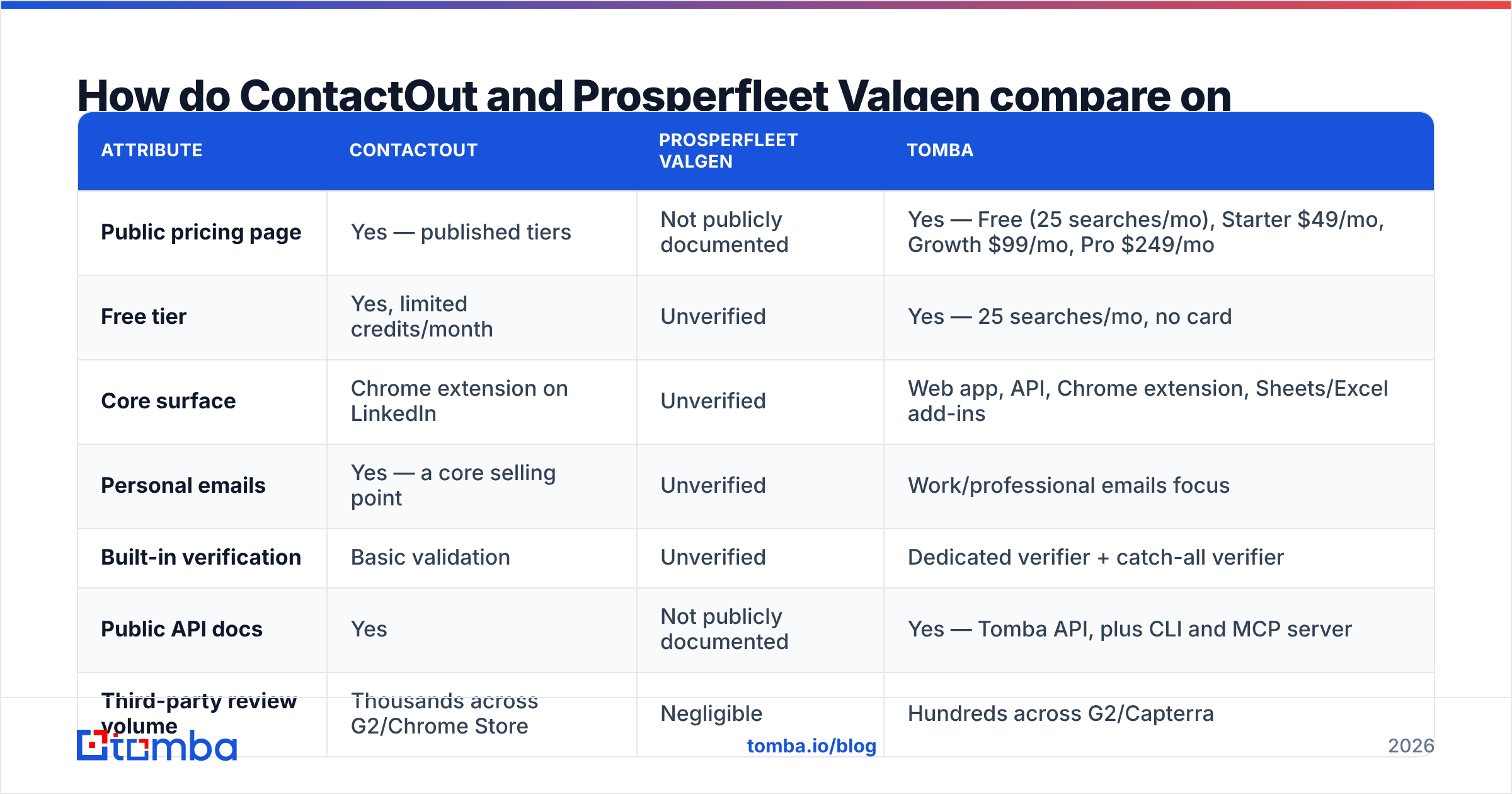
Here is the honest scoreboard. Anything we cannot verify is marked as such rather than guessed. Tomba is included as a documented reference point so you have a real baseline for what "auditable" looks like.
| Attribute | ContactOut | Prosperfleet Valgen | Tomba |
|---|---|---|---|
| Public pricing page | Yes — published tiers | Not publicly documented | Yes — Free (25 searches/mo), Starter $49/mo, Growth $99/mo, Pro $249/mo |
| Free tier | Yes, limited credits/month | Unverified | Yes — 25 searches/mo, no card |
| Core surface | Chrome extension on LinkedIn | Unverified | Web app, API, Chrome extension, Sheets/Excel add-ins |
| Personal emails | Yes — a core selling point | Unverified | Work/professional emails focus |
| Built-in verification | Basic validation | Unverified | Dedicated verifier + catch-all verifier |
| Public API docs | Yes | Not publicly documented | Yes — Tomba API, plus CLI and MCP server |
| Third-party review volume | Thousands across G2/Chrome Store | Negligible | Hundreds across G2/Capterra |
| Bulk enrichment | Yes (CSV) | Unverified | Yes — bulk email finder |
| Primary buyer | Recruiters, talent teams | Unknown | Sales, RevOps, growth, developers |
| Data-source disclosure | Partial | None found | Published — data sources |

Read that table as a governance document, not a feature list. Nine of eleven rows for Prosperfleet Valgen say "unverified." You are not comparing two products. You are comparing a product to a hypothesis.
How accurate is each tool, really?#
Accuracy is the only metric that survives contact with a live campaign, and it is the one every vendor inflates. "99% accurate" is a marketing sentence, not a measurement, unless the vendor tells you three things: what dataset the claim was measured on, whether catch-all domains were included or excluded, and how bounces were counted.
ContactOut markets aggressive accuracy numbers and, to its credit, has enough public review volume that you can triangulate. The recurring theme in buyer feedback is that LinkedIn-sourced work emails land reliably for mid-size and enterprise targets, while personal-email coverage and small-company coverage are more variable. That is a normal, believable shape for a LinkedIn-native tool.
For Prosperfleet Valgen there is nothing to triangulate. No published methodology, no review corpus, no bounce data.

The practical move is to ignore every vendor's self-reported number and run your own benchmark. Take 100 contacts you can independently confirm — customers, past deals, people whose addresses live in your CRM already. Strip the emails. Feed the names and domains to each tool. Measure three things:
- Coverage: what percentage returned any address at all?
- Precision: of the addresses returned, how many match the known-good email?
- Catch-all rate: how many came back as "accept-all," which is a maybe dressed up as a yes?
That third number is where most tools quietly lose. A catch-all domain accepts every address at the SMTP layer, so a naive finder reports success on an address that will hard-bounce or land in a black hole. Running results through a proper email verifier — and specifically a catch-all verifier — turns an inflated coverage number into a usable one.
What does each one actually cost per verified email?#
Sticker price is a distraction. The number that matters is cost per email that lands in an inbox and does not bounce.
Work it out with real arithmetic:
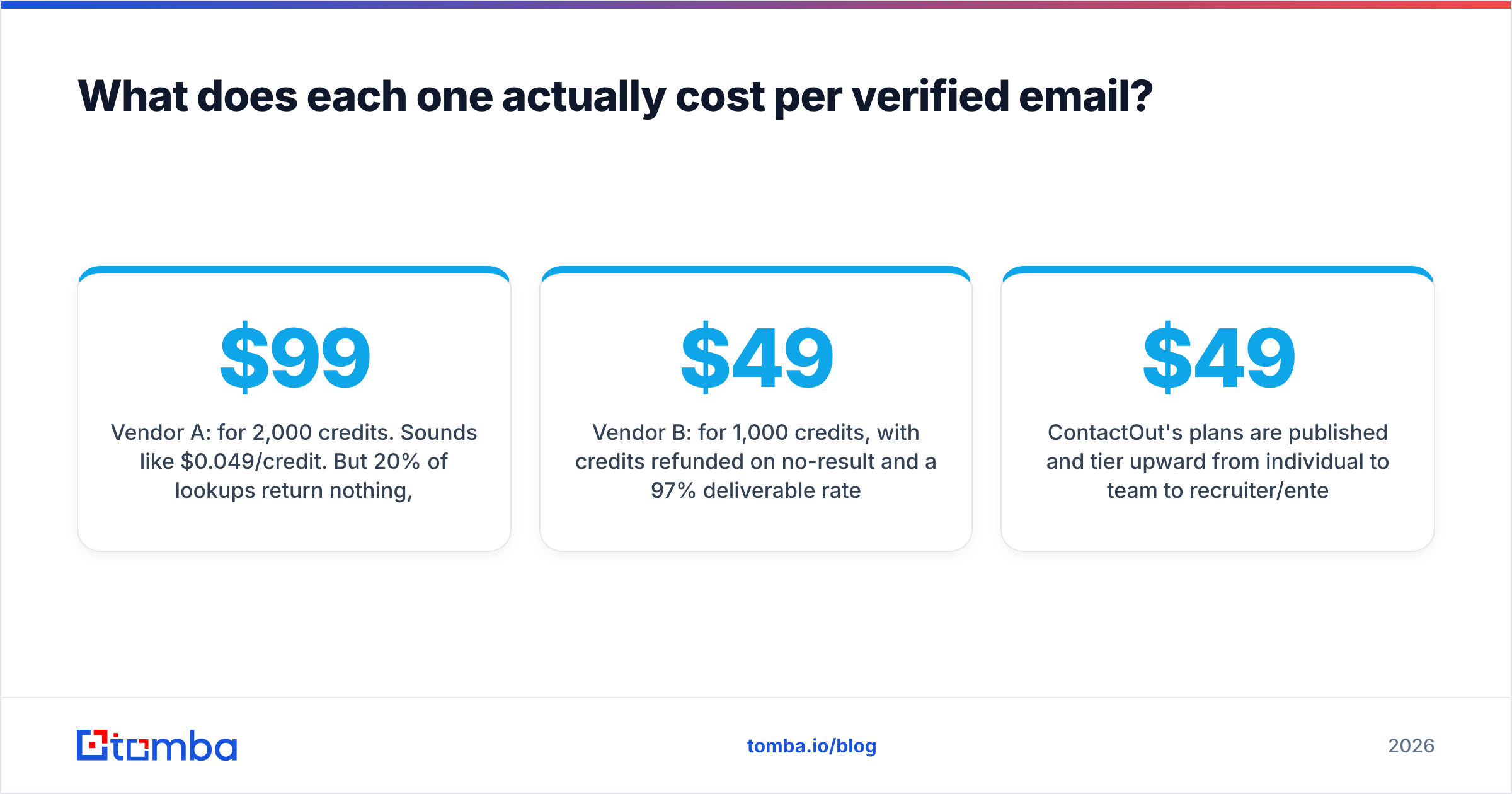
- Vendor A: $99/mo for 2,000 credits. Sounds like $0.049/credit. But 20% of lookups return nothing, and 15% of what remains bounces. You get roughly 1,360 usable emails. True cost: $0.073 each.
- Vendor B: $49/mo for 1,000 credits, with credits refunded on no-result and a 97% deliverable rate. You get roughly 970 usable emails. True cost: $0.051 each.
Vendor B is half the sticker price and cheaper per usable contact. This is why credit-refund policy and bounce rate matter more than the number on the pricing page — and it is why a vendor with no published pricing cannot even enter the calculation. You cannot model an unknown.
ContactOut's plans are published and tier upward from individual to team to recruiter/enterprise; check its pricing page for current numbers, since data vendors reprice frequently. Tomba's plans are flat and public: Free at 25 searches/month, Starter at $49/month, Growth at $99/month, Pro at $249/month, Enterprise custom. Prosperfleet Valgen: unquotable.
Which tool fits which workflow?#
Assume for a moment Prosperfleet Valgen turns out to be a real, competent tool. Even then, the workflow question separates these three cleanly:
- You live inside LinkedIn all day and need personal emails and mobiles. ContactOut is built for exactly this. Recruiters reaching passive candidates get real value from personal-email coverage that work-email-focused tools deliberately do not chase. A ContactOut alternative only makes sense here if you also need API-scale enrichment.
- You are building outbound at scale and need an API, bulk jobs, and verification in one pipeline. Extension-first tools become a bottleneck the moment your list is bigger than your browsing patience. You want a bulk email finder, a verification step, and a programmatic interface. This is where Tomba's email finder plus API, CLI, and Sheets add-on is the stronger architecture.
- You need to enrich an existing CRM list, not discover new people. Neither an extension nor a search UI is the right tool — you want data enrichment or a domain-wide sweep via domain search.
- You are evaluating an opaque vendor of any kind. Skip the demo. Go straight to the sample test below.
What should you demand before paying an unverifiable vendor?#
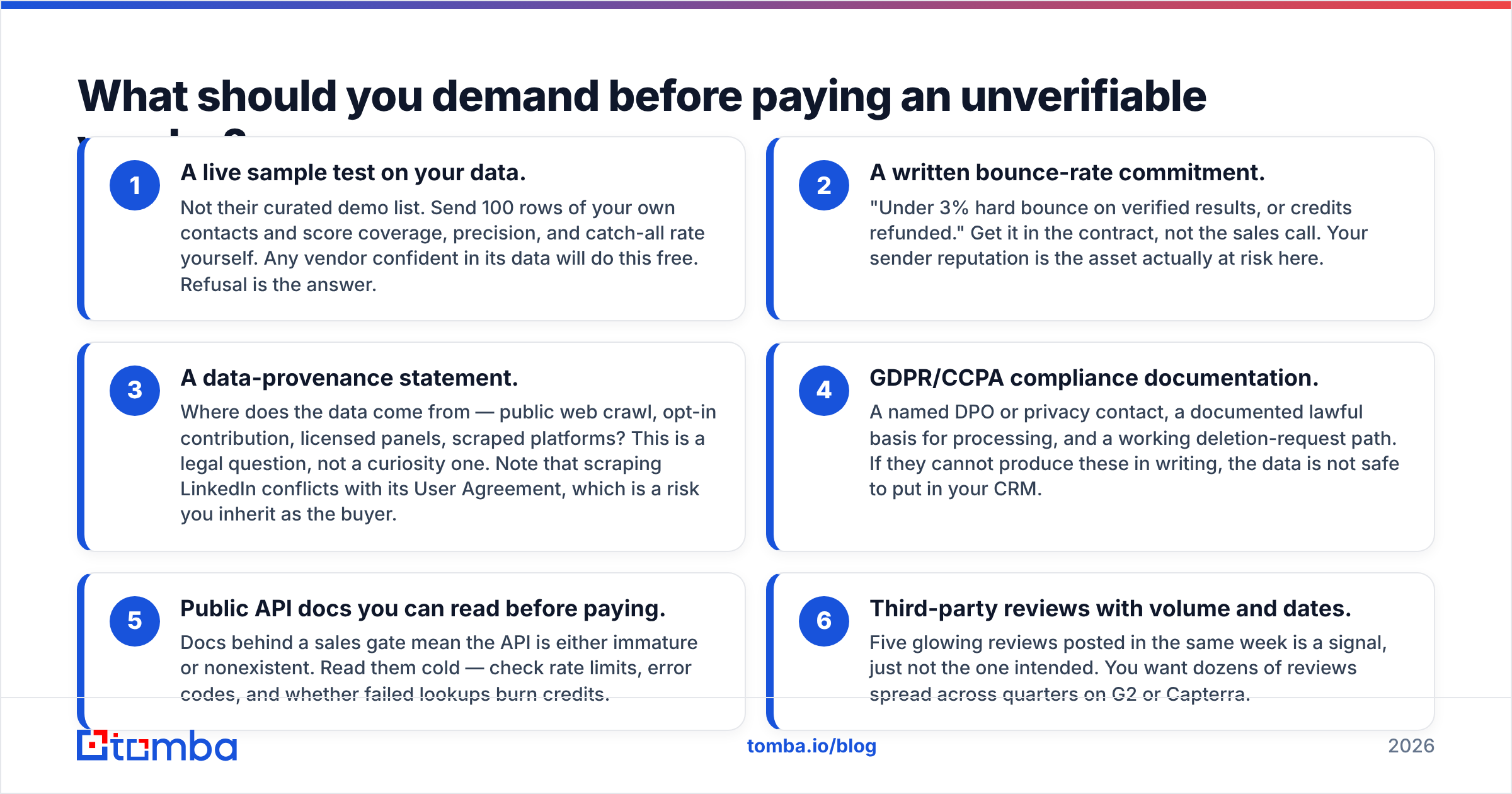
Treat this as a hard checklist. Any vendor — Prosperfleet Valgen, a tool from a listicle, a cold outreach from a data reseller — must clear all six or you do not buy.
- A live sample test on your data. Not their curated demo list. Send 100 rows of your own contacts and score coverage, precision, and catch-all rate yourself. Any vendor confident in its data will do this free. Refusal is the answer.
- A written bounce-rate commitment. "Under 3% hard bounce on verified results, or credits refunded." Get it in the contract, not the sales call. Your sender reputation is the asset actually at risk here.
- A data-provenance statement. Where does the data come from — public web crawl, opt-in contribution, licensed panels, scraped platforms? This is a legal question, not a curiosity one. Note that scraping LinkedIn conflicts with its User Agreement, which is a risk you inherit as the buyer.
- GDPR/CCPA compliance documentation. A named DPO or privacy contact, a documented lawful basis for processing, and a working deletion-request path. If they cannot produce these in writing, the data is not safe to put in your CRM.
- Public API docs you can read before paying. Docs behind a sales gate mean the API is either immature or nonexistent. Read them cold — check rate limits, error codes, and whether failed lookups burn credits.
- Third-party reviews with volume and dates. Five glowing reviews posted in the same week is a signal, just not the one intended. You want dozens of reviews spread across quarters on G2 or Capterra.
Vendors like BookYourData, Hunter, and Tomba all clear these bars — you can read their pricing, their sourcing, and their docs without talking to a salesperson. That transparency is the baseline, not a bonus. When a vendor falls short of it, the shortfall is the review.
Is Tomba a better fit than either?#
Honestly: it depends on the job, and here is the honest split.
Pick ContactOut if your work happens inside LinkedIn, you need personal emails and mobile numbers for candidates, and browser-native speed beats programmatic scale. It is genuinely good at the thing it was built for, and recruiters are right to like it.
Pick Tomba if your bottleneck is scale and verification rather than LinkedIn browsing. The reasons are structural, not promotional:
- Finding and verifying live in the same system. The email finder hands off to the verifier and catch-all check without a CSV export in the middle, so the accuracy number you see is the one you actually get.
- The API is a first-class product, not an afterthought bolted onto an extension. Tomba's API, CLI, and MCP server let you wire lookups into your own pipeline, your CRM, or an AI agent.
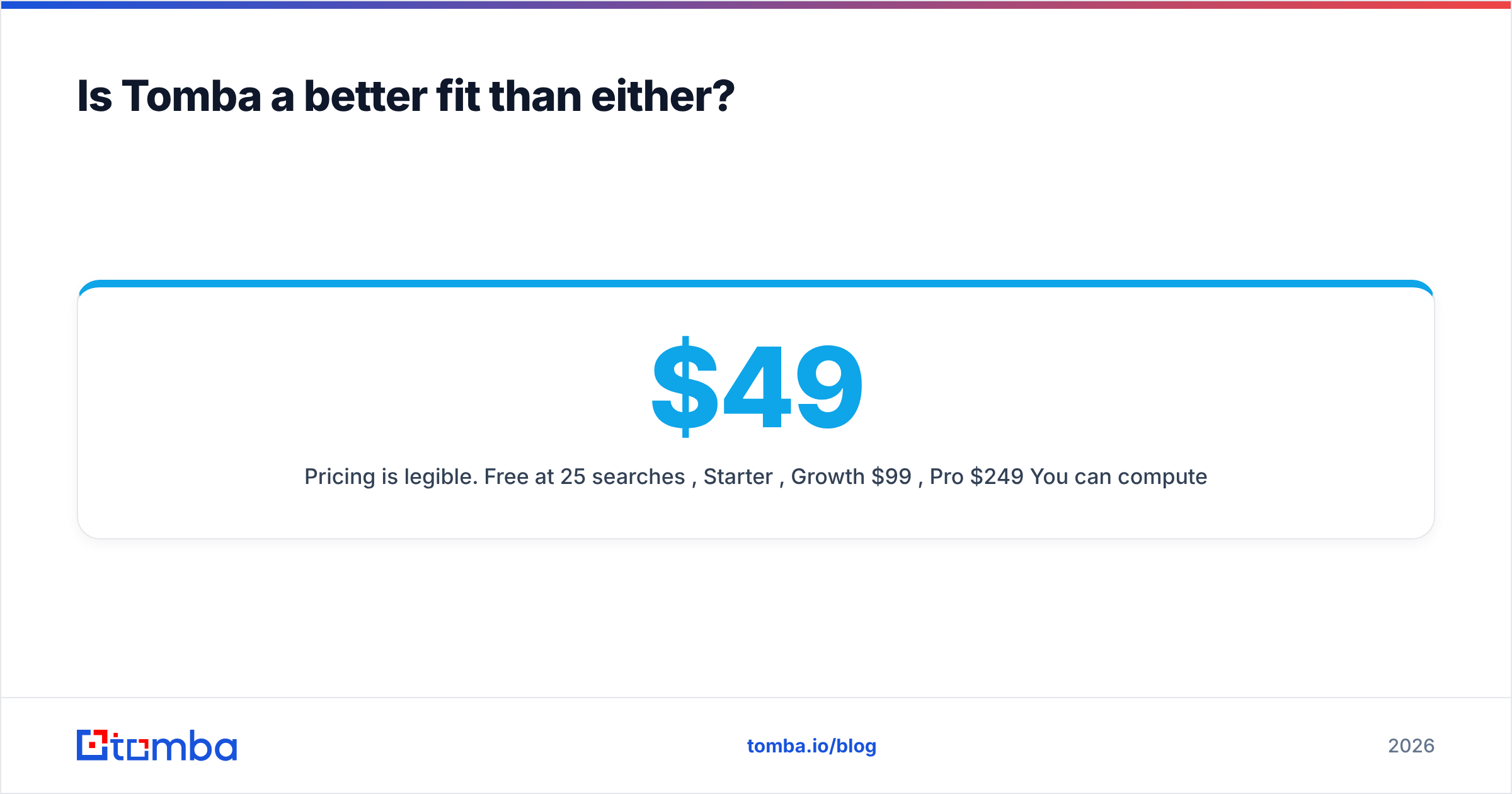
- Pricing is legible. Free at 25 searches/month, Starter $49/month, Growth $99/month, Pro $249/month. You can compute cost-per-usable-email before you spend a dollar.
- Sourcing is published. You can read where the data comes from instead of guessing.
Pick Prosperfleet Valgen only after it clears the six-point checklist above. Not before. If it does clear it, run the 100-contact benchmark and let the bounce rate decide — that is the same standard we would hold any vendor to, including Tomba.
FAQ#
Is ContactOut worth it in 2026? For LinkedIn-centric recruiting, yes. For API-driven outbound at volume, its extension-first design becomes the constraint, and a finder-plus-verifier stack will cost you less per landed email.
Is Prosperfleet Valgen a scam? We have no evidence of that, and we are not claiming it. We are claiming something narrower and more actionable: it is currently unverifiable, and unverifiable vendors do not belong in a production data stack. Ask for the sample test.
What is the safest way to test any email finder? Free tier, 100 known-good contacts from your own CRM, three metrics: coverage, precision, catch-all rate. Thirty minutes of work that prevents a quarter of bounced campaigns and a damaged sending domain.
Get a finder you can actually audit#
The point of this comparison is not that one tool crushed the other. It is that you should never hand your sending reputation to a vendor whose accuracy you cannot check.
Start with the Tomba Email Finder. The free tier gives you 25 searches a month with no card, which is enough to run the 100-contact benchmark in this post against your own CRM data — and enough to see the coverage, precision, and catch-all numbers for yourself instead of taking anyone's word for them. Run it against ContactOut. Run it against any vendor you are considering. Then buy the one whose numbers survive your test, not the one with the loudest claim.
Related guides#
Ready to find emails that actually work?
Join 150,000+ professionals who stopped guessing and started sending. Free credits on signup — no credit card required.
Get the Tomba newsletter
Practical outbound tactics and product updates — once every two weeks.
About the author