ContactOut vs RampedUp: Which B2B Contact Tool Wins in 2026?
ContactOut is a LinkedIn-first contact extractor. RampedUp is an enrichment and intent database. They solve different halves of the same problem — here is which one your team actually needs, and where a pure email finder beats both.
TL;DR
- ContactOut is a LinkedIn-native Chrome extension: you browse a profile, it reveals personal and work emails plus phone numbers. Great for rep-by-rep, manual prospecting.
- RampedUp is a data platform: it enriches CRM records, appends contacts to target accounts, and layers intent and job-change signals on top. Great for RevOps, weak for a single SDR who just wants an email.
- They are not really substitutes. ContactOut wins on LinkedIn-sourced individual lookups; RampedUp wins on account-level enrichment inside Salesforce.
- Both price per seat and push you toward annual contracts. If your actual job is "find and verify work emails at scale," a dedicated email finder like Tomba starts at $49/mo with a free tier and an API that neither tool matches on flexibility.
- Best move for most teams: pick a source-of-truth enrichment layer, then bolt on a cheap, accurate finder + verifier for the long tail.
What is ContactOut and who actually uses it?#
ContactOut started life as a recruiter tool, and it still shows. The product is a browser extension that sits on top of LinkedIn and reveals contact details the platform hides: work email, personal email, mobile number, and social profiles. There's a web search app and a Recruiter/Sales Navigator integration, plus a Chrome-based list builder that lets you push contacts to a CRM or export CSV.
The core use case is one person, one profile, one reveal. A recruiter scrolls candidates, a sales rep works a Sales Navigator list, and each click burns a credit. That workflow is fast and, importantly, it produces personal emails — the Gmail-style addresses that recruiters live on and that most B2B databases simply do not carry.
Where ContactOut struggles:
- It is LinkedIn-shaped. If your ICP does not maintain a LinkedIn presence — trades, regional manufacturing, a lot of EMEA mid-market — coverage falls off a cliff.
- Credits are per-seat, per-user. Ten reps means ten subscriptions.
- It reveals, it does not govern. There is no meaningful "keep my CRM clean" story. It hands you a contact and moves on.
- Bulk work is awkward. You can build lists, but it is not a bulk enrichment engine, and the API is a paid add-on with real limits.
What is RampedUp and how is it different?#
RampedUp comes at the same problem from the opposite end. It is a B2B data and intent platform built primarily for Salesforce and HubSpot teams. Instead of "show me this person's email," the pitch is "tell me which of my accounts are in-market, fill in the missing contacts, and flag when my champion changes jobs."
Its four practical jobs:
- Account and contact enrichment — append firmographics, technographics, and net-new contacts to existing CRM records.
- Intent and buying signals — surface accounts researching your category so reps prioritise correctly.
- Job-change alerts — track when a known contact moves, which is the single highest-converting trigger most teams ignore.
- CRM hygiene — dedupe, normalise, and refresh stale records on a schedule.
That is a RevOps product, not an SDR product. A rep does not open RampedUp; a rep opens Salesforce and finds it already populated. Which is exactly why comparing it head-to-head with ContactOut is a bit like comparing a fuel pump to a refinery.

ContactOut vs RampedUp: how do they compare feature by feature?#
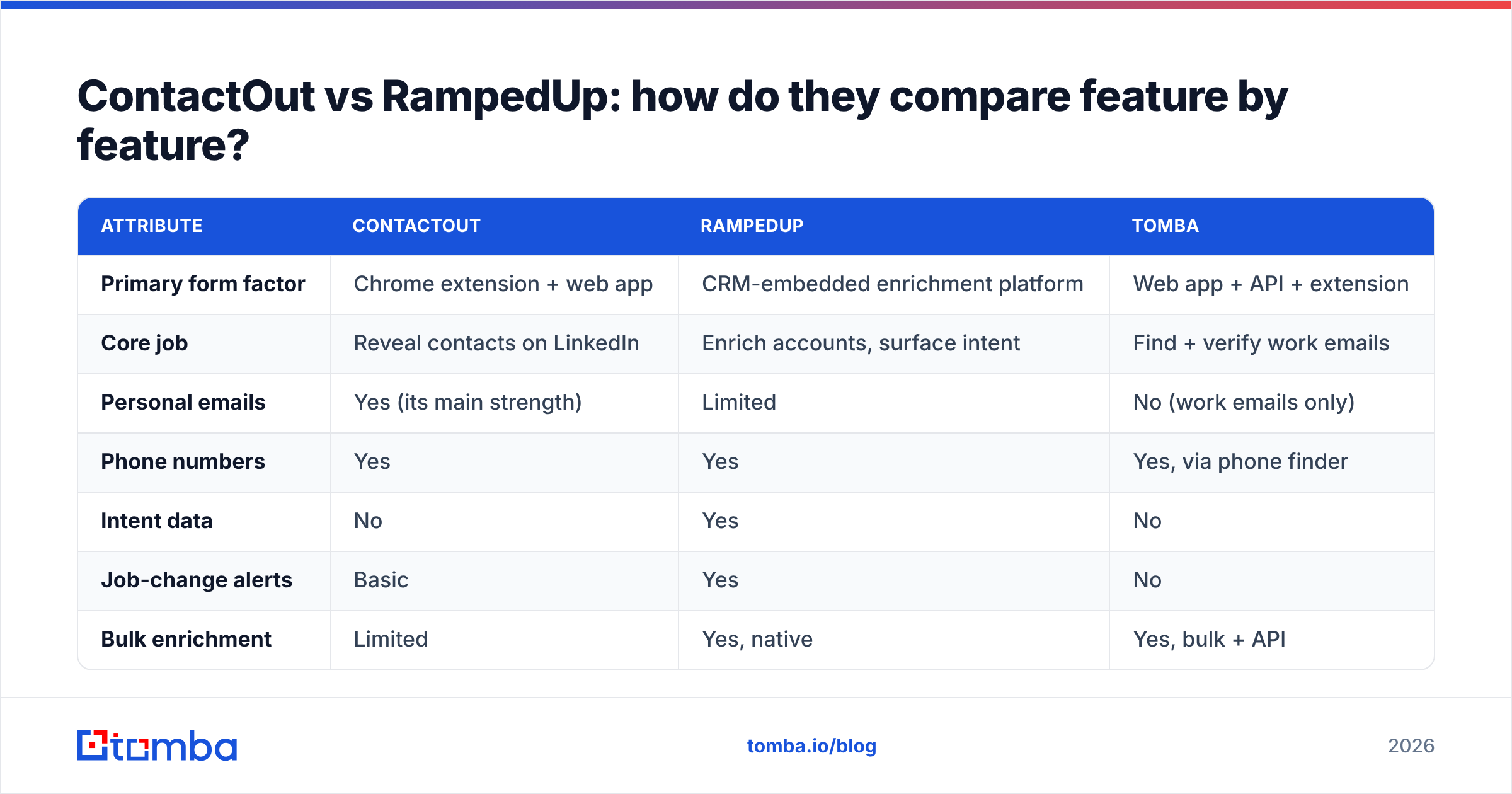
Here is the honest side-by-side. Pricing reflects publicly listed and commonly reported figures as of 2026 — both vendors negotiate, and both gate the good stuff behind annual deals.
| Attribute | ContactOut | RampedUp | Tomba |
|---|---|---|---|
| Primary form factor | Chrome extension + web app | CRM-embedded enrichment platform | Web app + API + extension |
| Core job | Reveal contacts on LinkedIn | Enrich accounts, surface intent | Find + verify work emails |
| Personal emails | Yes (its main strength) | Limited | No (work emails only) |
| Phone numbers | Yes | Yes | Yes, via phone finder |
| Intent data | No | Yes | No |
| Job-change alerts | Basic | Yes | No |
| Bulk enrichment | Limited | Yes, native | Yes, bulk + API |
| Free tier | Small monthly credit allowance | Trial / demo only | 25 searches/mo |
| Entry paid price | ~$29–$49/user/mo (annual) | Custom, typically 4-figure annual | $49/mo (Starter) |
| API access | Paid add-on | Yes, platform tier | Yes, on all paid plans |
| Best for | Recruiters, individual SDRs | RevOps, CRM-driven GTM teams | Teams needing accurate work emails cheaply |
Two things jump out of that table.
First, the free tier gap. ContactOut's free allowance is real but thin, and RampedUp effectively has none — you talk to sales. If you are evaluating tools with your own list rather than a canned demo, that matters. A tool you can't test on your ICP before signing is a tool you're buying on faith.
Second, the API story. ContactOut treats API access as an upsell. RampedUp's API is real but built around CRM sync, not ad-hoc lookups. If you are building anything — a lead router, an internal enrichment service, a signup-time enricher — the Tomba API is available on every paid plan and is documented for direct HTTP use, which is a materially different developer experience.
How accurate is each tool's data?#
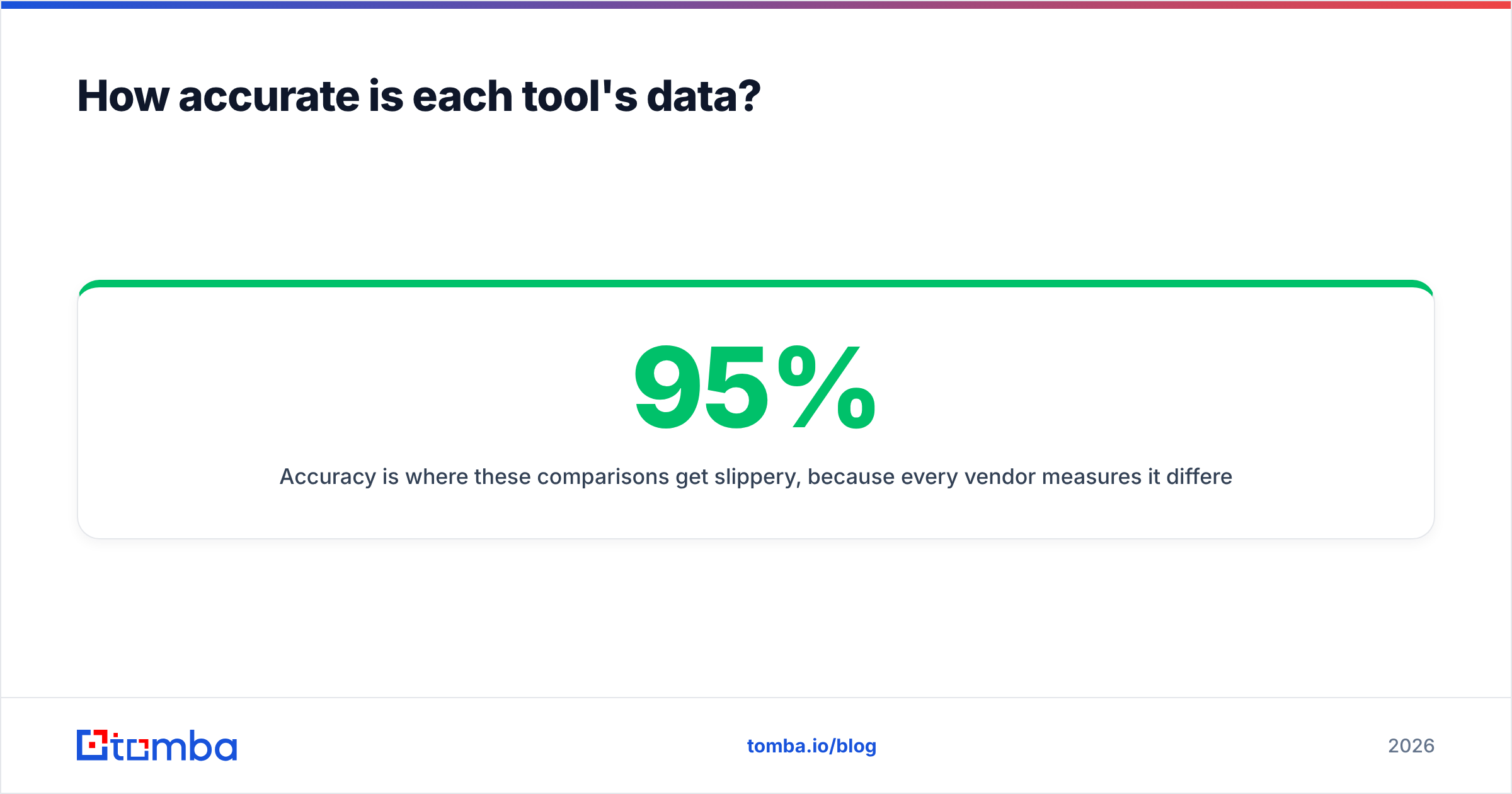
Accuracy is where these comparisons get slippery, because every vendor measures it differently. "95% accurate" usually means "95% of the emails we returned passed our own verification" — not "we found 95% of the people you asked for." Those are wildly different numbers, and the second one is the one that decides whether your sequence has 400 or 700 prospects in it.
Split it into two metrics and hold every tool to both:
- Hit rate (coverage): of 1,000 target contacts, how many did the tool return anything for?
- Deliverability (validity): of the emails returned, how many actually accept mail?
ContactOut posts strong validity numbers and, in practice, deserves them on LinkedIn-sourced profiles — especially for personal emails, where it is genuinely best-in-class. Its weakness is coverage outside that graph.
RampedUp's accuracy is decent for firmographics and account-level data. Contact-level email quality is more variable, which is common for platforms whose primary product is enrichment breadth rather than email discovery depth. If you are running cold email at volume off RampedUp exports, run them through an email verifier before they hit your sending domain. That is not a knock on RampedUp specifically — it's true of nearly every enrichment platform, and skipping it is how teams torch a domain.

The practical test, which takes an afternoon:
- Pull 200 real contacts from your ICP — not a vendor's sample list.
- Run them through each tool's trial.
- Record hit rate and, separately, run every returned address through a neutral verifier.
- Compute cost-per-valid-contact, not cost-per-credit.
Almost every team that does this discovers their ranking flips. The tool with the best marketing accuracy number frequently has the worst cost-per-valid-contact, because it burns credits returning results it can't stand behind.
Which is cheaper — and what does each actually cost?#
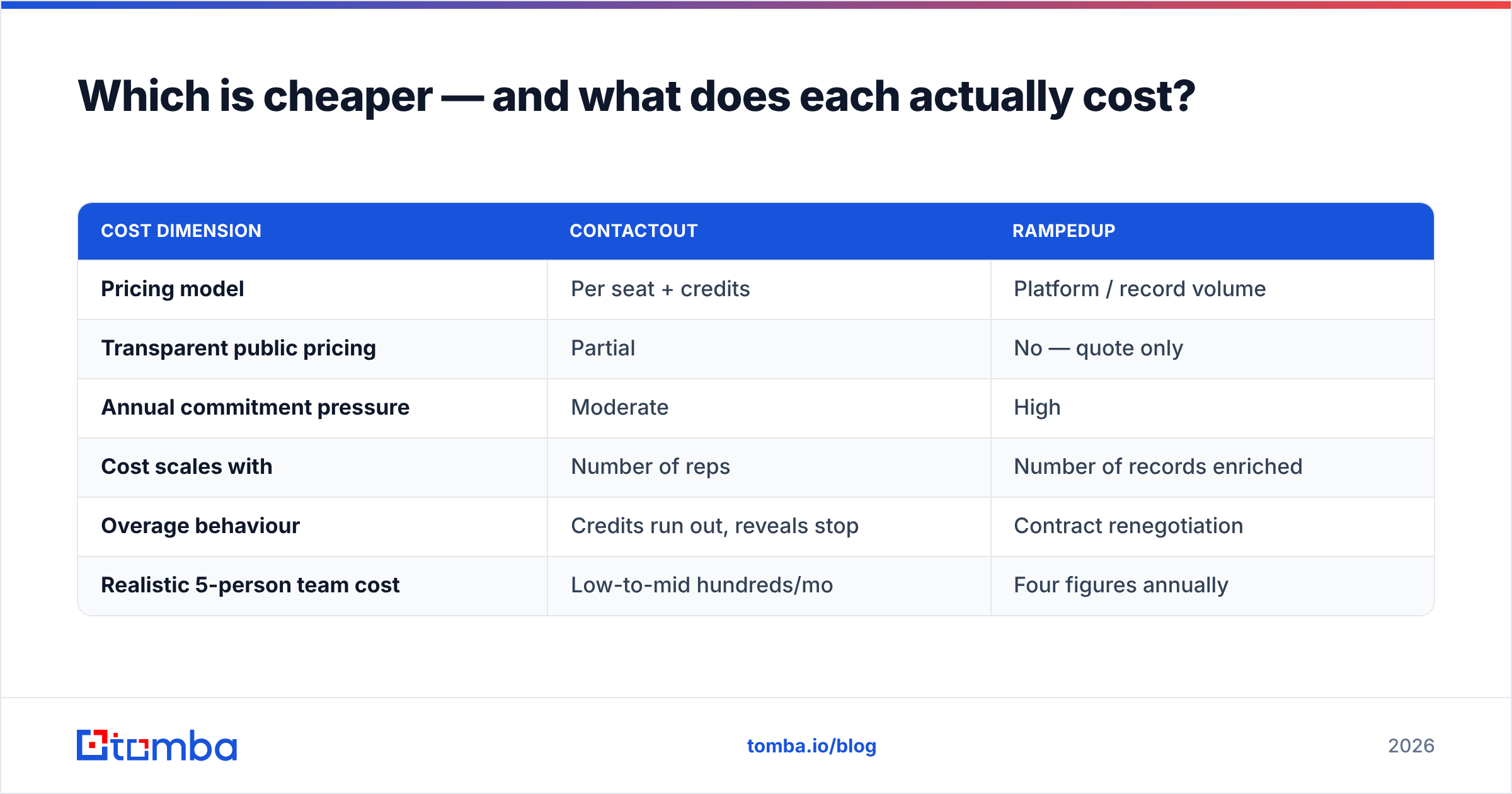
ContactOut's list pricing is per user, per month, with credit tiers. It looks cheap for one seat and stops looking cheap at eight. Team plans and annual commitments bring the per-seat number down, but you are still multiplying.
RampedUp does not publish transparent self-serve pricing for its platform tiers; you get a demo and a quote shaped by record volume, CRM seats, and whether you want intent. Expect a four-figure annual number for a real deployment. That is not unreasonable for what it does — enrichment platforms are priced like infrastructure because that's what they are — but it means RampedUp is a budget-line decision, not a corporate-card decision.
| Cost dimension | ContactOut | RampedUp |
|---|---|---|
| Pricing model | Per seat + credits | Platform / record volume |
| Transparent public pricing | Partial | No — quote only |
| Annual commitment pressure | Moderate | High |
| Cost scales with | Number of reps | Number of records enriched |
| Overage behaviour | Credits run out, reveals stop | Contract renegotiation |
| Realistic 5-person team cost | Low-to-mid hundreds/mo | Four figures annually |
For comparison, Tomba pricing runs Free (25 searches/mo), Starter $49/mo, Growth $99/mo, Pro $249/mo, and Enterprise custom — published, self-serve, no demo gate. That does not make Tomba a replacement for RampedUp's intent engine. It does make it an unusually cheap way to solve the specific problem of "we need correct work emails, at volume, without a procurement cycle."

Is ContactOut better than RampedUp for cold outbound?#
For a pure cold-outbound motion where reps source from LinkedIn: yes, ContactOut is the better fit. It matches the workflow. The rep is already on the profile; the reveal is one click; the personal email gives a second channel when the work email bounces.
For an outbound motion driven by target account lists and CRM ownership: RampedUp wins, because the bottleneck isn't "reveal this person," it's "which 200 of my 4,000 accounts should we touch this quarter, and who works there now." Intent plus job-change alerts answers that. ContactOut does not try to.
The mistake teams make is buying one and expecting it to do the other job. Symptoms:
- You bought ContactOut for a RevOps problem. Reps are manually re-entering contacts into Salesforce and nobody trusts the CRM.
- You bought RampedUp for an SDR problem. Reps still tab out to LinkedIn to find the person they actually want, then complain the enriched contact is a former employee.
- You bought both and still bounce at 8%. Neither tool is a verifier. Verification is a separate step, and it is the cheapest insurance in your stack.
What is the third option most teams miss?#
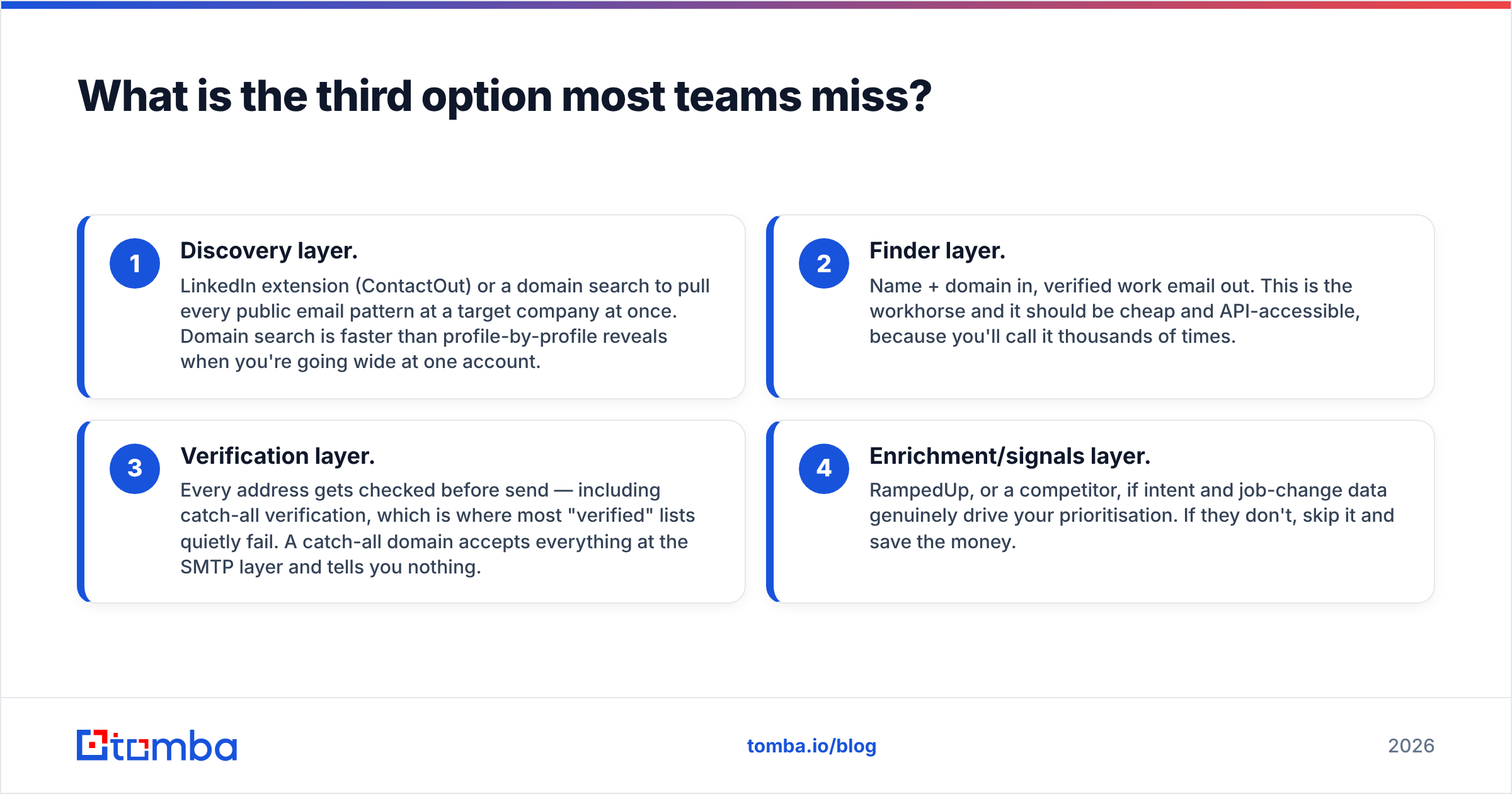
Unbundle. The three jobs — discover, verify, enrich — do not have to come from one vendor, and bundling them is usually how you end up overpaying for the two you don't use.
A stack that works, and costs less than most single-vendor deals:
- Discovery layer. LinkedIn extension (ContactOut) or a domain search to pull every public email pattern at a target company at once. Domain search is faster than profile-by-profile reveals when you're going wide at one account.
- Finder layer. Name + domain in, verified work email out. This is the workhorse and it should be cheap and API-accessible, because you'll call it thousands of times.
- Verification layer. Every address gets checked before send — including catch-all verification, which is where most "verified" lists quietly fail. A catch-all domain accepts everything at the SMTP layer and tells you nothing.
- Enrichment/signals layer. RampedUp, or a competitor, if intent and job-change data genuinely drive your prioritisation. If they don't, skip it and save the money.
Check reviews on G2 for both vendors before committing — pay attention to reviews from companies your size, in your region, because coverage complaints are almost always geography-specific.
Which should you choose in 2026?#
Choose ContactOut if: you're a recruiter or an SDR who lives inside LinkedIn, you need personal emails and mobiles, you have fewer than ~10 seats, and you don't need CRM governance.
Choose RampedUp if: you're RevOps, your GTM runs on Salesforce or HubSpot, your bottleneck is account prioritisation and record decay, and you have budget for a platform-tier contract.
Choose neither — or add to them — if: your real problem is "we need thousands of accurate work emails per month, cheaply, and we'd like to call it from our own code." That's an email-finder problem, and paying platform prices for it is the most common line item waste in an outbound budget.
Start with the free tier and run your own 200-contact bake-off. Tomba's Email Finder gives you 25 searches a month at no cost, $49/mo when you outgrow it, and API access on every paid plan — enough to prove the hit rate and deliverability numbers on your own ICP before you sign anything with anybody.
Related guides#
Ready to find emails that actually work?
Join 150,000+ professionals who stopped guessing and started sending. Free credits on signup — no credit card required.
Get the Tomba newsletter
Practical outbound tactics and product updates — once every two weeks.
About the author