ContactOut vs Sparklane (2026): Which B2B Data Tool Wins?
ContactOut sells personal emails scraped off LinkedIn profiles. Sparklane sells predictive account intelligence for European markets. They solve different problems — here is which one belongs in your stack, and when neither does.
TL;DR
- ContactOut is a LinkedIn-first contact-data tool: a Chrome extension plus a searchable database, strongest at pulling personal and work emails off individual profiles.
- Sparklane is a predictive sales-intelligence platform aimed mostly at European (and especially French) mid-market and enterprise teams: account signals, scoring, and triggers — not a bulk email-lookup engine.
- They are not really the same product. If you're comparing them, you're usually asking one of two different questions: "how do I get contacts off LinkedIn?" or "which accounts should I even work?"
- Pricing shape differs badly for lean teams: ContactOut is per-seat with monthly credit caps; Sparklane is quote-based enterprise contracting.
- If what you actually need is high-accuracy work emails at API prices without seat licences, a dedicated email finder is the cheaper third path — and it plugs into either workflow.
What are ContactOut and Sparklane, actually?#
Most "X vs Y" posts pretend the two tools overlap 90%. These two overlap maybe 25%.
ContactOut (contactout.com) started life as a recruiter tool. You install the browser extension, open a LinkedIn profile, and it surfaces email addresses — including personal Gmail/Yahoo addresses, which is unusual and is the whole reason recruiters love it. It has since grown a search portal, a bulk exporter, and an API. Its centre of gravity is still: person on LinkedIn → contact details.
Sparklane (sparklane-group.com) came at the market from the opposite end. It's a predictive lead-generation and sales-intelligence platform built for European markets, with deep company-level data (legal filings, hiring signals, funding, tech installs, news triggers) and a scoring engine that tells you which accounts look most like your best customers. Contact records exist, but they are the last mile — not the product's reason for being.
So the honest framing:
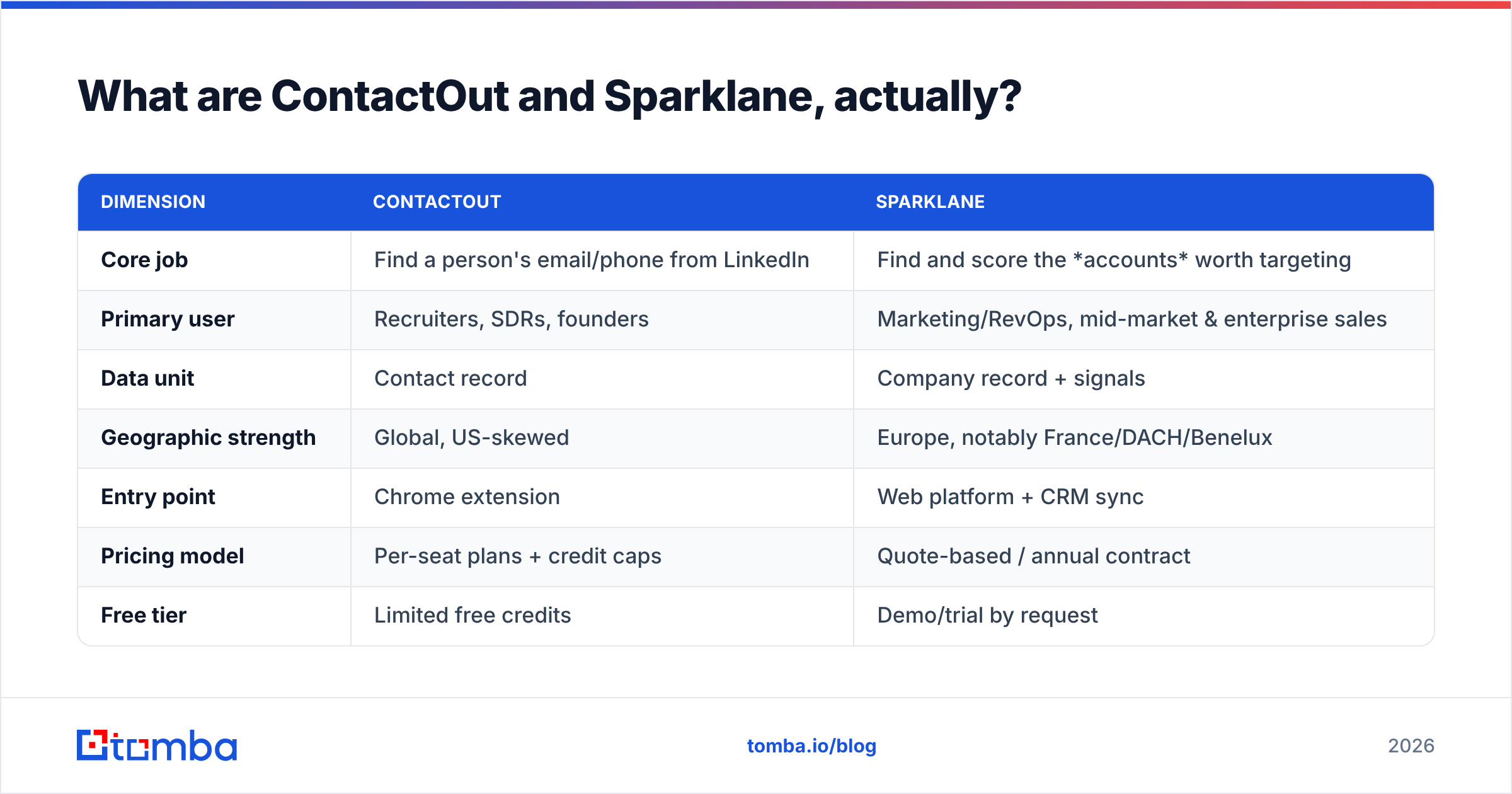
| Dimension | ContactOut | Sparklane |
|---|---|---|
| Core job | Find a person's email/phone from LinkedIn | Find and score the accounts worth targeting |
| Primary user | Recruiters, SDRs, founders | Marketing/RevOps, mid-market & enterprise sales |
| Data unit | Contact record | Company record + signals |
| Geographic strength | Global, US-skewed | Europe, notably France/DACH/Benelux |
| Entry point | Chrome extension | Web platform + CRM sync |
| Pricing model | Per-seat plans + credit caps | Quote-based / annual contract |
| Free tier | Limited free credits | Demo/trial by request |
| Best at | Personal emails from profiles | Account prioritisation and trigger events |
If you only remember one line from this post: ContactOut answers "how do I reach this person?", Sparklane answers "who should I be reaching at all?"

Which one has better data coverage?#
It depends entirely on what you're counting.
ContactOut wins on person-level breadth. Because its index is built around LinkedIn profiles, coverage tracks LinkedIn coverage — which is enormous in North America, the UK, India, and English-speaking tech generally. Its differentiator is personal email addresses. For recruiting, that's gold: candidates ignore work inboxes. For B2B sales, personal emails are a mixed blessing — GDPR exposure in the EU, worse reply rates in enterprise, and deliverability risk when you cold-mail a Gmail account from a corporate domain.
Sparklane wins on account-level depth in Europe. It ingests company registry data, financial filings, hiring activity, and news events — the kind of firmographic and event data that a LinkedIn scraper simply does not carry. If your ICP is "French manufacturers over 200 employees who just posted a supply-chain role," Sparklane is built for exactly that query. ContactOut is not.
Where both get shakier is the middle: verified, deliverable work emails at scale. Person-level databases decay fast — roughly 25–30% of B2B contact data goes stale each year as people change jobs, per repeated vendor and analyst estimates. Any tool selling you a static database is selling you a depreciating asset. That's why the sane pattern is:
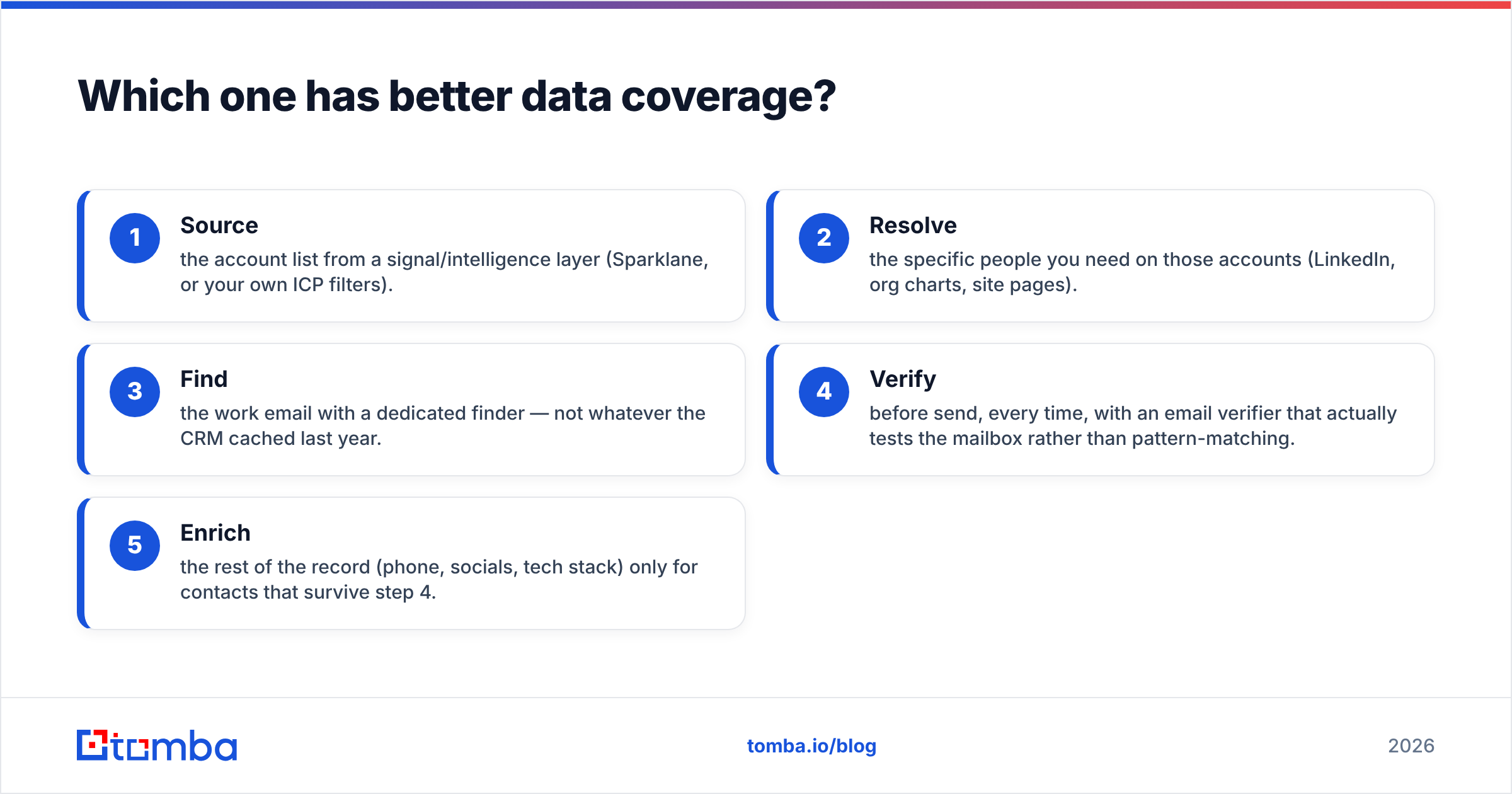
- Source the account list from a signal/intelligence layer (Sparklane, or your own ICP filters).
- Resolve the specific people you need on those accounts (LinkedIn, org charts, site pages).
- Find the work email with a dedicated finder — not whatever the CRM cached last year.
- Verify before send, every time, with an email verifier that actually tests the mailbox rather than pattern-matching.
- Enrich the rest of the record (phone, socials, tech stack) only for contacts that survive step 4.
Skip step 4 and your bounce rate does the talking. Google and Yahoo's bulk-sender rules put a hard 0.3% spam-complaint ceiling on senders, and mailbox providers treat high bounce volume as a reputation signal in its own right — see the sender guidelines if you want it from the source. Bad data is no longer just a wasted credit; it's a deliverability tax.
Is ContactOut better than Sparklane for outbound sales?#
For a classic SDR motion — build a list, find emails, sequence, follow up — ContactOut is the more directly useful of the two, with caveats.
What it does well:
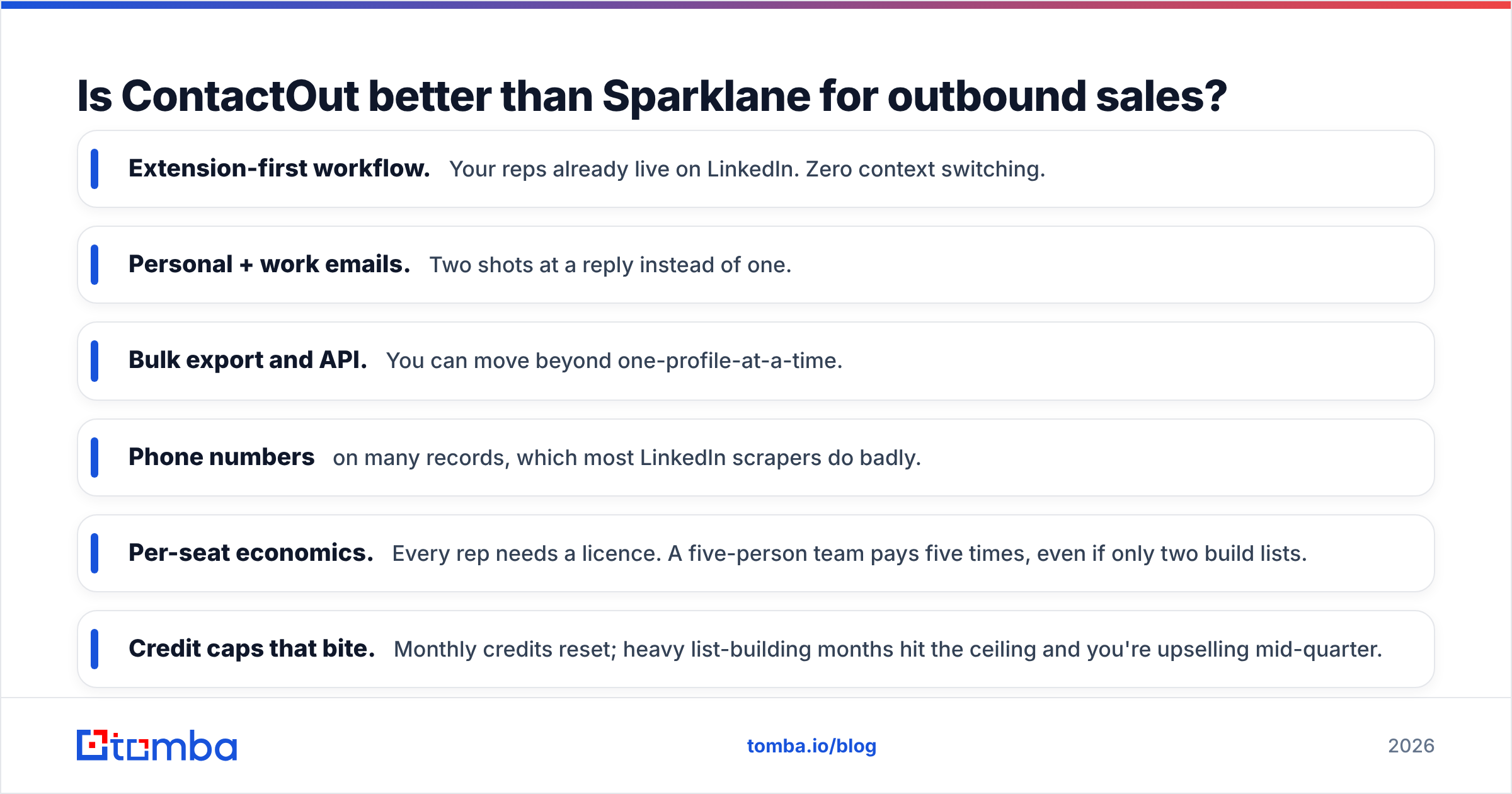
- Extension-first workflow. Your reps already live on LinkedIn. Zero context switching.
- Personal + work emails. Two shots at a reply instead of one.
- Bulk export and API. You can move beyond one-profile-at-a-time.
- Phone numbers on many records, which most LinkedIn scrapers do badly.
What it does less well:
- Per-seat economics. Every rep needs a licence. A five-person team pays five times, even if only two build lists.
- Credit caps that bite. Monthly credits reset; heavy list-building months hit the ceiling and you're upselling mid-quarter.
- GDPR posture. Personal emails on EU prospects are a legitimate-interest argument you may not want to have with your counsel.
- No account intelligence. It won't tell you the company just raised a round or opened a warehouse.
Sparklane, meanwhile, will happily tell you the company just raised a round — but it won't make your SDR's Tuesday any faster. It's a targeting investment that pays back over a quarter, not a velocity tool that pays back on Thursday. Teams that buy it expecting an email machine end up disappointed, and vice versa.
The uncomfortable truth for a lot of buyers: you're often better served by keeping the intelligence layer and the contact layer separate, because the vendors that are great at one are structurally mediocre at the other. That's also why the B2B data intelligence category keeps splitting into specialists rather than consolidating.
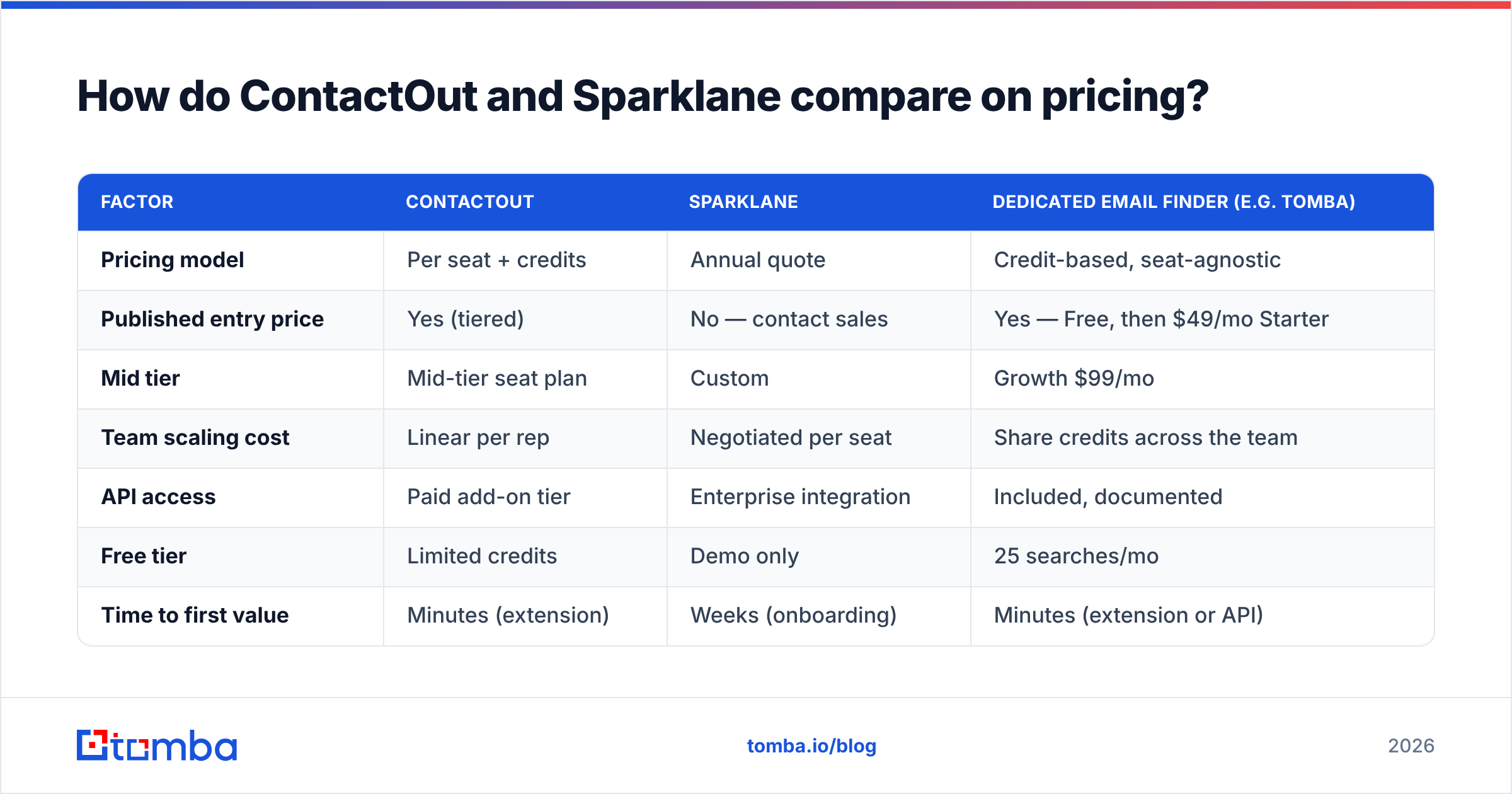
How do ContactOut and Sparklane compare on pricing?#
Neither is priced for a two-person startup, and they're opaque in different ways.
ContactOut publishes tiered plans built around seats and monthly credit allowances, with a small free tier to get you hooked. The list price looks reasonable until you multiply by headcount and then add the API as a separate line. Recruiting teams tend to swallow it because one placed candidate pays for the year. Sales teams doing volume outbound tend to feel the credit ceiling within two months.
Sparklane does not publish pricing. It's a quote, it's annual, and it's scoped to your seat count and data modules. Expect enterprise procurement: a demo, a scoping call, a pilot, a contract. That's appropriate for what it is — nobody buys predictive account scoring on a credit card at 11pm — but it means the "trial it this week" path doesn't exist.
Here's the shape of the trade-off, including the third option most comparison posts conveniently omit:
| Factor | ContactOut | Sparklane | Dedicated email finder (e.g. Tomba) |
|---|---|---|---|
| Pricing model | Per seat + credits | Annual quote | Credit-based, seat-agnostic |
| Published entry price | Yes (tiered) | No — contact sales | Yes — Free, then $49/mo Starter |
| Mid tier | Mid-tier seat plan | Custom | Growth $99/mo |
| Team scaling cost | Linear per rep | Negotiated per seat | Share credits across the team |
| API access | Paid add-on tier | Enterprise integration | Included, documented |
| Free tier | Limited credits | Demo only | 25 searches/mo |
| Time to first value | Minutes (extension) | Weeks (onboarding) | Minutes (extension or API) |
| Best fit | Recruiters, LinkedIn-heavy SDRs | EU mid-market/enterprise targeting | Any team that needs verified work emails cheaply |
Two things stand out. First, seat-based pricing punishes exactly the team shape most startups have: one or two people who build lists, several who send. Credit-based pricing lets three people share one pool. Second, API access shouldn't be a premium unlock. If you're automating enrichment into HubSpot or a warehouse, the API is the product — see Tomba pricing for what that looks like when it isn't gated behind an enterprise tier.

When should you pick Sparklane over ContactOut?#
Pick Sparklane when all of these are true:
- Your ICP is European, especially France, Benelux, or DACH, where registry and filings data is rich and LinkedIn coverage is comparatively thin.
- Your problem is prioritisation, not contact discovery. You have more accounts than capacity and no defensible way to rank them.
- You sell mid-market or enterprise, where a single deal justifies a five-figure data contract.
- You have RevOps capacity to wire scores into the CRM and actually route on them. Signal data that nobody actions is shelfware.
- Your marketing team is bought in. Predictive scoring dies in orgs where sales doesn't trust marketing's list.
Pick ContactOut when:
- Your workflow starts on a LinkedIn profile and ends in an email box.
- You recruit, or your outbound depends on reaching people at personal addresses.
- You need speed today, not an onboarding programme.
- Seat count is small — under five — so per-seat pricing doesn't compound.
Pick neither when — and this is more common than either vendor would like — what you actually needed was verified work emails at volume. That's a narrow, solvable problem, and paying enterprise-platform money for it is a category error. It's also why the ContactOut alternative search volume is what it is: people buy the extension, hit the credit wall, and go looking for the API-priced version of the same job.
What does a sane 2026 stack actually look like?#
The teams getting this right don't buy one tool. They compose:
- Signal layer — Sparklane, or Clay/Common Room/your own scraped triggers, or just a well-maintained ICP filter in your CRM. Cheap version: LinkedIn Sales Navigator saved searches plus funding alerts.
- Person layer — LinkedIn itself, plus a LinkedIn finder to resolve profiles to work emails without a per-seat licence for every rep.
- Contact layer — an email finder + verifier pair, run at send time rather than at list-build time, so you're validating fresh data instead of a three-month-old export.
- Enrichment layer — phone, tech stack, socials, applied after verification so you're not paying to enrich records that bounce.
- Delivery layer — warmed domains, SPF/DKIM/DMARC configured, complaint rate under 0.3%. G2's category reviews (g2.com) are a decent sanity check on which vendors have deliverability complaints piling up.
Note the ordering. Most teams enrich before they verify, which means they pay full price for records that were never deliverable. Flip those two steps and the same budget covers roughly a third more usable contacts — the exact figure depends on your list, but the direction never changes.
Note also what's not on that list: a single vendor doing all five. Nobody does all five well. The platforms that claim to are usually excellent at one layer and buying the other four from the same handful of upstream data brokers you could buy from directly.
Is ContactOut or Sparklane worth it in 2026?#
Yes, conditionally, for both — but almost never for the same buyer.
ContactOut is worth it if you are a recruiter or a LinkedIn-native SDR and the per-seat maths works at your headcount. It is genuinely the best-in-class at the specific trick of pulling a personal email off a profile, and no amount of API cleverness fully replicates that.
Sparklane is worth it if you sell into Europe at mid-market or above, you have RevOps to operationalise the scores, and your real bottleneck is that reps are working the wrong accounts. It's a strategy purchase, not a productivity one, and it should be evaluated on pipeline quality over two quarters — not on credits consumed in week one.
And if you read all of that and thought "neither of those is my problem — I just need work emails that don't bounce, at a price that doesn't scale with headcount": that's a third product category, and it costs a fraction of either.
Get the contact layer right first#
Before you sign an annual contract with anyone, fix the cheapest part of the funnel: the emails themselves. Tomba Email Finder finds verified work emails by name, domain, or company — with a documented API, a Chrome extension, credits your whole team shares instead of per-seat licences, and a free tier of 25 searches a month to test it against your own list before you pay anything. Starter is $49/mo, Growth is $99/mo, and the API isn't locked behind an enterprise call.
Run 50 of your hardest prospects through it, check the bounce rate, and then decide what else your stack actually needs. Most teams discover the answer is: less than they thought.
Related guides#
Ready to find emails that actually work?
Join 150,000+ professionals who stopped guessing and started sending. Free credits on signup — no credit card required.
Get the Tomba newsletter
Practical outbound tactics and product updates — once every two weeks.
About the author