ContactOut vs Tami AI (2026): Which Data Tool Wins?
ContactOut is a LinkedIn-first contact extractor. Tami AI is an AI research agent that builds lists from intent signals. Here's which one actually fits your outbound motion in 2026 — and where both fall short.
TL;DR — ContactOut vs Tami AI in one screen#
- ContactOut is a LinkedIn-first contact extractor. You browse a profile, click the extension, and it surfaces personal and work emails plus phone numbers. It is a lookup tool.
- Tami AI is an AI research agent. You describe an ICP in plain language and it goes and builds the list, reading websites, job boards, and public signals along the way. It is a discovery tool.
- They are not really competitors. They sit at different points in the pipeline, and teams that treat them as interchangeable end up paying for both and using neither properly.
- ContactOut's personal-email coverage is its real moat. Tami AI's moat is that it can qualify accounts before you spend a credit finding anyone.
- If your bottleneck is verified deliverable work email at scale, neither is the cheapest answer — a dedicated finder/verifier API is, and that's where Tomba fits.
What is ContactOut, actually?#
ContactOut started as a Chrome extension for recruiters. That origin still shapes the product. Open a LinkedIn profile, hit the extension, and you get a panel with work emails, personal emails (often Gmail/Outlook), and mobile numbers. It also ships a web search app, a Recruiter integration, and a bulk export.
The pitch has always been personal contact data. Recruiters can't reliably reach an engineer at firstname@bigcorp.com — that inbox is a firehose. A personal Gmail address gets read. ContactOut leaned into that gap and built one of the deeper personal-email indexes in the market. You can see the current feature set on contactout.com.
The cost of that positioning: ContactOut is only as good as the LinkedIn profile in front of you. It does not decide who you should contact. You bring the list; it fills in the contact fields.
Where ContactOut is strong:
- Personal email coverage — genuinely better than most B2B-only databases for reaching individuals outside work channels.
- Recruiter workflow — LinkedIn Recruiter integration, project exports, ATS pushes.
- Speed on a single profile — one click, contact revealed, no list-building overhead.
- Phone numbers — mobile coverage that beats most sales-intelligence tools on US tech profiles.
Where it gets thin:
- You must already know the target. No account discovery, no ICP reasoning.
- LinkedIn dependency. Profiles that are stale, private, or nonexistent are invisible to it.
- Credit burn on unqualified profiles. Every reveal costs, whether or not the person was worth reaching.
- Work-email accuracy varies by segment — strong in US tech, patchier in EU mid-market and non-English markets.

What is Tami AI, and how is it different?#
Tami AI belongs to the 2025–2026 wave of "AI SDR research agents." Instead of a database you query with filters, you give it a prompt: "Find Series B fintech companies in the UK that just hired a Head of Compliance and use Stripe." The agent goes off, reads career pages, tech-stack signals, funding announcements, and news, then returns a scored account list with reasoning attached.
That's a fundamentally different unit of work. ContactOut answers "what is this person's email?" Tami AI answers "which companies should I even be looking at, and why now?"
The mechanics matter for how you budget. Agentic research runs are slower (minutes, not milliseconds), priced by run or by seat rather than purely by contact credit, and non-deterministic — the same prompt on Tuesday and Thursday can return overlapping-but-different lists. That's a feature if you want fresh signal and a liability if you need reproducible pipeline reporting.
Where AI research agents win:
- Signal-first targeting. Hiring, funding, tech-stack, and news triggers are baked into the search rather than bolted on.
- Nuanced ICPs. Filter-based databases can't express "companies whose pricing page just added an enterprise tier."
- Reasoning you can audit. Good agents cite why an account matched.
- Less manual research. The work an SDR used to do in 20 browser tabs collapses into one run.
Where they struggle:
- Contact-level data is usually a bolt-on. Most research agents license or scrape emails downstream — accuracy is inherited, not owned.
- Verification is often skipped. An agent that hands you an unverified pattern-guessed address will torch your domain.
- Cost per account is high relative to a database lookup.
- Reproducibility. Hard to hand the same list to two reps and get the same result.
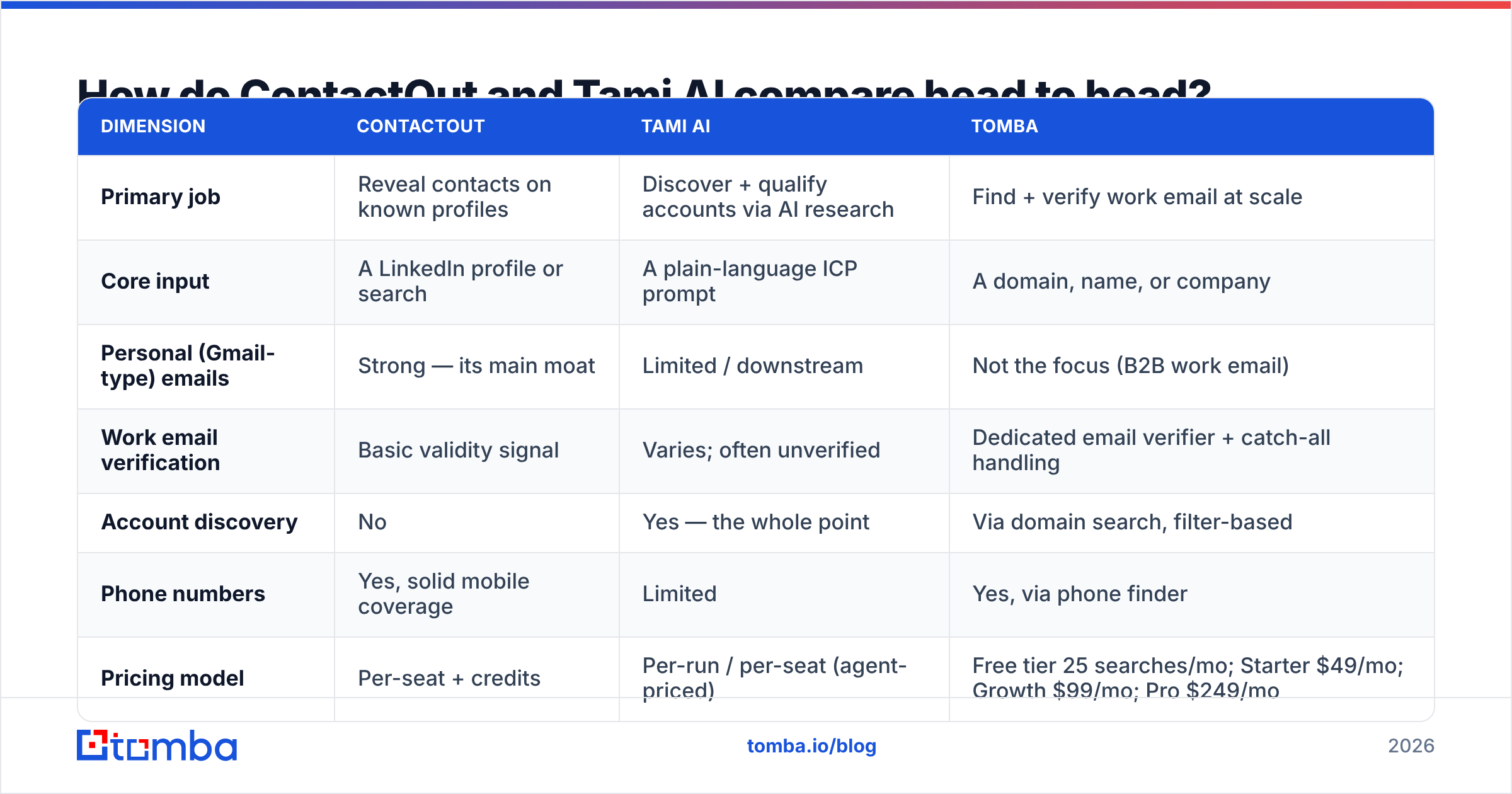
How do ContactOut and Tami AI compare head to head?#
| Dimension | ContactOut | Tami AI | Tomba |
|---|---|---|---|
| Primary job | Reveal contacts on known profiles | Discover + qualify accounts via AI research | Find + verify work email at scale |
| Core input | A LinkedIn profile or search | A plain-language ICP prompt | A domain, name, or company |
| Personal (Gmail-type) emails | Strong — its main moat | Limited / downstream | Not the focus (B2B work email) |
| Work email verification | Basic validity signal | Varies; often unverified | Dedicated email verifier + catch-all handling |
| Account discovery | No | Yes — the whole point | Via domain search, filter-based |
| Phone numbers | Yes, solid mobile coverage | Limited | Yes, via phone finder |
| Pricing model | Per-seat + credits | Per-run / per-seat (agent-priced) | Free tier 25 searches/mo; Starter $49/mo; Growth $99/mo; Pro $249/mo |
| API-first? | Available on higher tiers | Emerging | Yes — email finder API, CLI, MCP |
| Best for | Recruiters, talent teams | RevOps + founders defining new segments | Outbound teams needing deliverable volume |
| Weakest at | Deciding who to target | Guaranteeing an address lands | Reaching people on personal email |
Read that table honestly and the conclusion writes itself: these three tools are not substitutes. ContactOut is a reveal layer, Tami AI is a targeting layer, and a finder/verifier is a deliverability layer. Most teams that "switched" from one to the other were solving the wrong problem to begin with.
Which one is better for recruiting?#
ContactOut, and it isn't close.
Recruiting has a specific requirement almost no B2B sales tool optimizes for: reaching a person who is not trying to be reached at work. Candidates ignore work inboxes for good reason. A personal email or a mobile number is the whole ballgame, and ContactOut has spent years building exactly that index.
Tami AI can tell you which companies just raised a round and are likely to be hiring — useful for a recruiting agency doing BD. But once you're sourcing individual candidates, agentic account research is the wrong shape of tool.
If you're a recruiter, the honest stack is: ContactOut for reveal, an ATS for workflow, and a verifier only if you're running high-volume email campaigns where bounce rate affects your sending domain.
Which one is better for B2B outbound?#
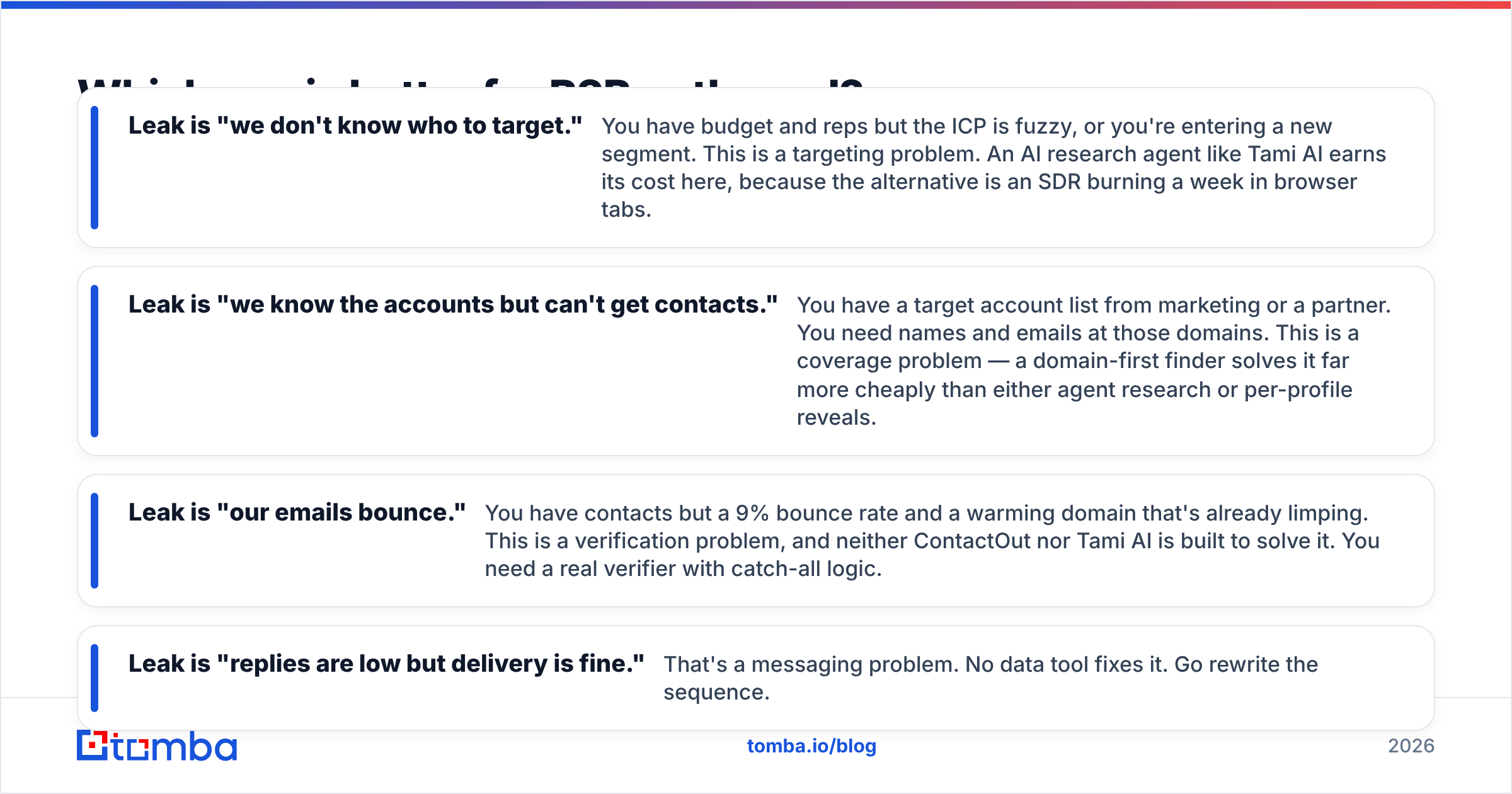
Depends entirely on where your pipeline is leaking. Diagnose before you buy.
- Leak is "we don't know who to target." You have budget and reps but the ICP is fuzzy, or you're entering a new segment. This is a targeting problem. An AI research agent like Tami AI earns its cost here, because the alternative is an SDR burning a week in browser tabs.
- Leak is "we know the accounts but can't get contacts." You have a target account list from marketing or a partner. You need names and emails at those domains. This is a coverage problem — a domain-first finder solves it far more cheaply than either agent research or per-profile reveals.
- Leak is "our emails bounce." You have contacts but a 9% bounce rate and a warming domain that's already limping. This is a verification problem, and neither ContactOut nor Tami AI is built to solve it. You need a real verifier with catch-all logic.
- Leak is "replies are low but delivery is fine." That's a messaging problem. No data tool fixes it. Go rewrite the sequence.
Most teams misdiagnose. They buy an AI research agent because it's the exciting category, then discover their real problem was that 30% of the emails they already had were dead. Data hygiene is boring and it is usually the bottleneck. Industry reviews on G2 show the same pattern in the complaint threads for nearly every tool in this space: the churn reason is almost never "bad UI," it's "the data didn't land."
What does each one actually cost in 2026?#
Pricing in this category is deliberately opaque, so treat published numbers as a starting point and expect a sales call for anything at volume.
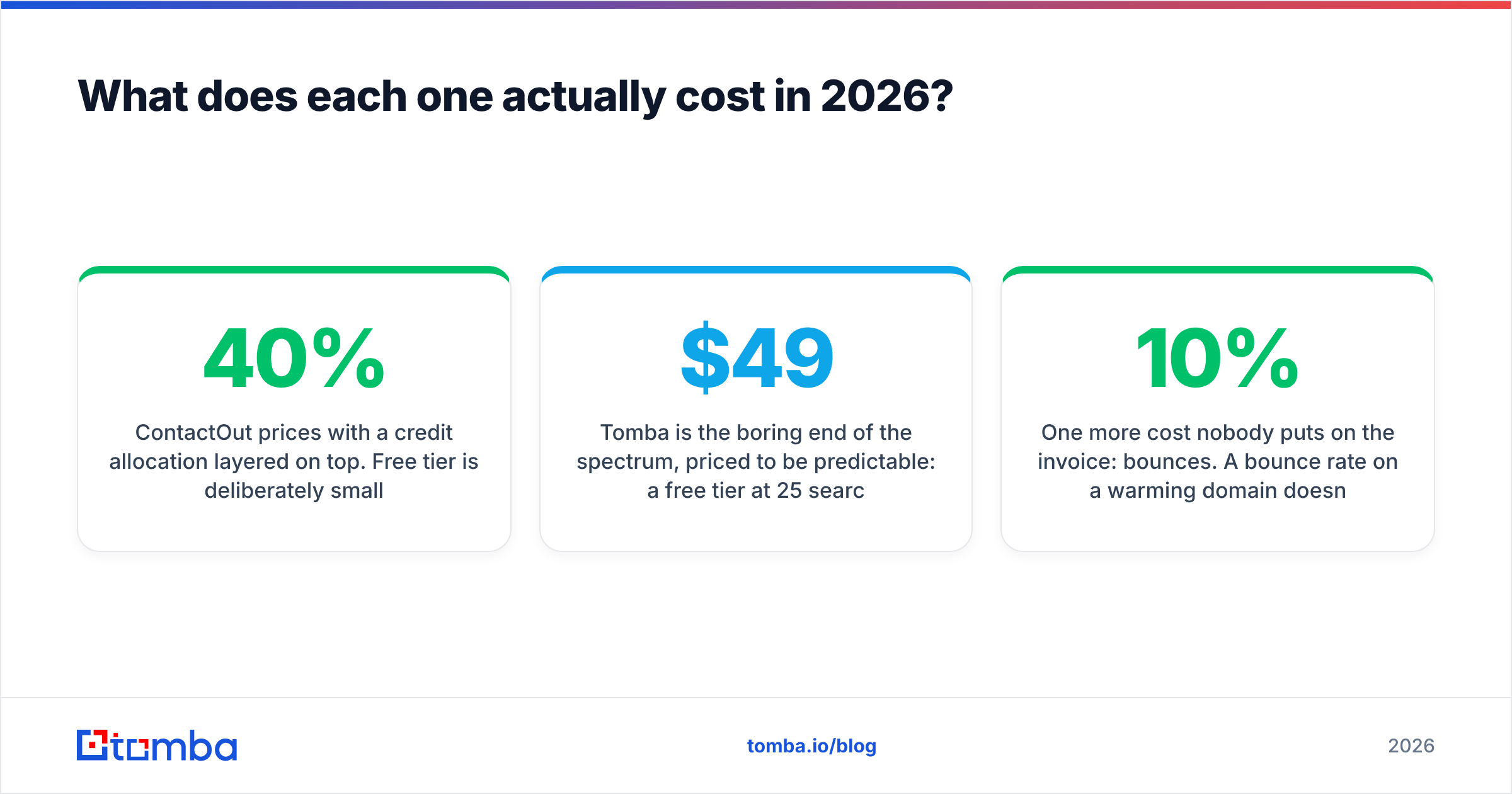
ContactOut prices per seat with a credit allocation layered on top. Free tier is deliberately small. Paid plans climb quickly once you need bulk export and API access, and the enterprise tier is quote-only. The practical cost driver is that reveals are consumed whether or not the profile was qualified — so your effective cost-per-usable-contact is meaningfully higher than the sticker rate suggests. Budget for 30–40% waste unless your list is pre-filtered.
Tami AI and its peer agents price by run or by seat, sometimes with a research-credit hybrid. The unit economics only work if the agent replaces human research hours. If an SDR was spending six hours a week building lists and the agent kills five of them, the math is trivially positive. If your ICP is already crisp and static, you are paying for reasoning you don't need.
Tomba is the boring end of the spectrum, priced to be predictable: a free tier at 25 searches/month, then Starter at $49/mo, Growth at $99/mo, Pro at $249/mo, and Enterprise on request. Full breakdown on the Tomba pricing page. Because finding and verifying are separate operations, you can qualify a domain cheaply before spending on contact-level lookups — which is the actual lever on cost-per-usable-contact.
One more cost nobody puts on the invoice: bounces. A 10% bounce rate on a warming domain doesn't just waste sends, it degrades sender reputation and drags down deliverability on the campaigns that were working. Mailbox providers have been explicit about this — Google's bulk-sender requirements (documented in Google's postmaster guidelines) put hard thresholds on spam complaints and invalid recipients. Cheap unverified data is the most expensive line item in outbound.
Are there better alternatives to both?#
For most B2B outbound teams, the honest answer is that you should buy narrower tools and compose them, not chase one product that claims to do all three jobs badly.
A composed stack that works:
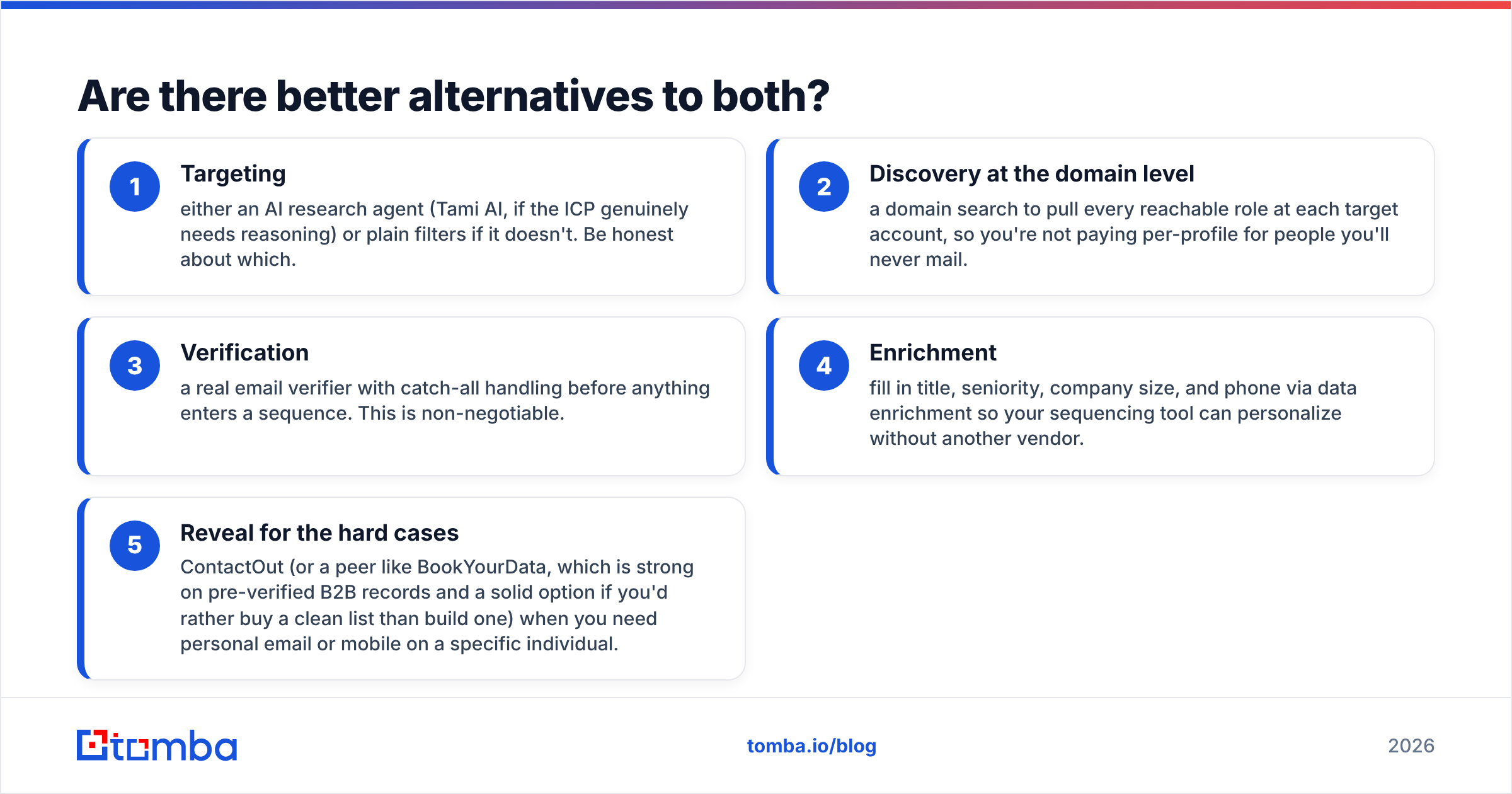
- Targeting — either an AI research agent (Tami AI, if the ICP genuinely needs reasoning) or plain filters if it doesn't. Be honest about which.
- Discovery at the domain level — a domain search to pull every reachable role at each target account, so you're not paying per-profile for people you'll never mail.
- Verification — a real email verifier with catch-all handling before anything enters a sequence. This is non-negotiable.
- Enrichment — fill in title, seniority, company size, and phone via data enrichment so your sequencing tool can personalize without another vendor.
- Reveal for the hard cases — ContactOut (or a peer like BookYourData, which is strong on pre-verified B2B records and a solid option if you'd rather buy a clean list than build one) when you need personal email or mobile on a specific individual.
The mistake is treating steps 1 and 5 as the whole pipeline while skipping 2, 3, and 4. That's how you end up with an expensive stack and a 12% bounce rate.
If you're currently evaluating ContactOut specifically, it's worth reading the ContactOut alternative breakdown before committing to an annual seat.
What should you actually buy?#
- You're a recruiter or talent partner. ContactOut. The personal-email index is the product, and no one else's is better for that job. Add a verifier only if you're mailing in volume.
- You're a founder or RevOps lead entering a new segment. Tami AI or a comparable research agent, for as long as the ICP is still being discovered. Cancel it once the ICP is stable — you'll be paying for reasoning you no longer need.
- You're an SDR team with a known ICP and a bounce problem. Neither. You need a finder + verifier that gives you deliverable work emails at a predictable cost per contact.
- You're an engineering-led team building outbound into a product. API-first, every time. Agent UIs and Chrome extensions don't scale into a pipeline job.
- You have budget for exactly one tool. Fix deliverability first. Verified contacts on a mediocre list outperform unverified contacts on a brilliant one, every single time.
Ready to fix the data layer?#
ContactOut and Tami AI both solve real problems — reveal and targeting, respectively. Neither one guarantees the email you send actually lands, and that's the step where most outbound programs quietly bleed pipeline.
Tomba's Email Finder is built for that layer: find work emails by domain, name, or company, verify them against catch-all and SMTP checks before they enter a sequence, and pull it all through an API, CLI, or spreadsheet add-in instead of a browser extension. Start on the free tier — 25 searches a month, no card — and run your current list through it. If more than 5% comes back undeliverable, you just found your real bottleneck, and it wasn't which AI agent you picked.
Related guides#
Ready to find emails that actually work?
Join 150,000+ professionals who stopped guessing and started sending. Free credits on signup — no credit card required.
Get the Tomba newsletter
Practical outbound tactics and product updates — once every two weeks.
About the author