ContactOut vs ZoomInfo: Which B2B Data Tool Wins in 2026?
ContactOut is a LinkedIn-first contact finder. ZoomInfo is a full GTM data platform with a contract to match. Here is how they actually compare on accuracy, export limits, and true annual cost.
TL;DR#
- ContactOut is a LinkedIn-first contact finder. You work inside LinkedIn, reveal personal and work emails plus phone numbers, and export lists. It is cheap to start and easy to learn.
- ZoomInfo is a GTM data platform. Contact data is one module among intent signals, org charts, technographics, conversation intelligence, and workflow automation. Pricing is quote-only and typically lands in the five figures per year.
- They are not really the same product. ContactOut competes on cost-per-contact and LinkedIn workflow. ZoomInfo competes on breadth, enrichment, and CRM integration depth.
- The hidden cost in both is credits and export caps. ZoomInfo's contract often limits how many records you can actually export per seat per year. ContactOut's plans limit reveals per month. Read those numbers before you sign anything.
- If you only need verified work emails at volume, a focused email finder like Tomba Email Finder at $49/mo does that job for a fraction of either.
What is ContactOut and who is it for?#
ContactOut is a browser extension plus web app that sits on top of LinkedIn. You open a profile, click the extension, and it surfaces work email, personal email, and phone number where available. There is a search portal for building lists without LinkedIn, and a Chrome-based bulk workflow for pulling contacts out of LinkedIn search results and Sales Navigator pages.
The audience is obvious once you use it: recruiters and individual SDRs who already live in LinkedIn. The value prop is that it finds personal emails, not just corporate ones. That matters a lot in recruiting, where a candidate's work inbox is the last place you want to land, and much less in B2B sales, where you generally want the work address anyway.
What ContactOut is not: a system of record. There is no intent data, no buying-committee mapping, no automated enrichment of your whole CRM on a schedule. It is a reveal tool with a list builder attached.
What is ZoomInfo and who is it for?#
ZoomInfo is the enterprise incumbent. It sells a database of company and contact records (tens of millions of contacts, with heavy US coverage) wrapped in a platform: intent signals from Bidstream and content consumption, websites visitor identification, org charts, technographic filters, workflow rules that push records into Salesforce or HubSpot automatically, and a sales engagement layer.
The buyer is a RevOps or sales leader with a team of 10 to 500 reps who needs one contract that covers data + routing + enrichment, and who has budget authority. If you are a two-person startup, you are not the customer, and the sales process will make that clear.
The trade-off is structural. ZoomInfo is not sold as a self-serve SKU with a public price. It is sold as an annual contract with seats, credit allotments, and module add-ons, and the number moves depending on how many of those you take.

How do ContactOut and ZoomInfo compare head to head?#
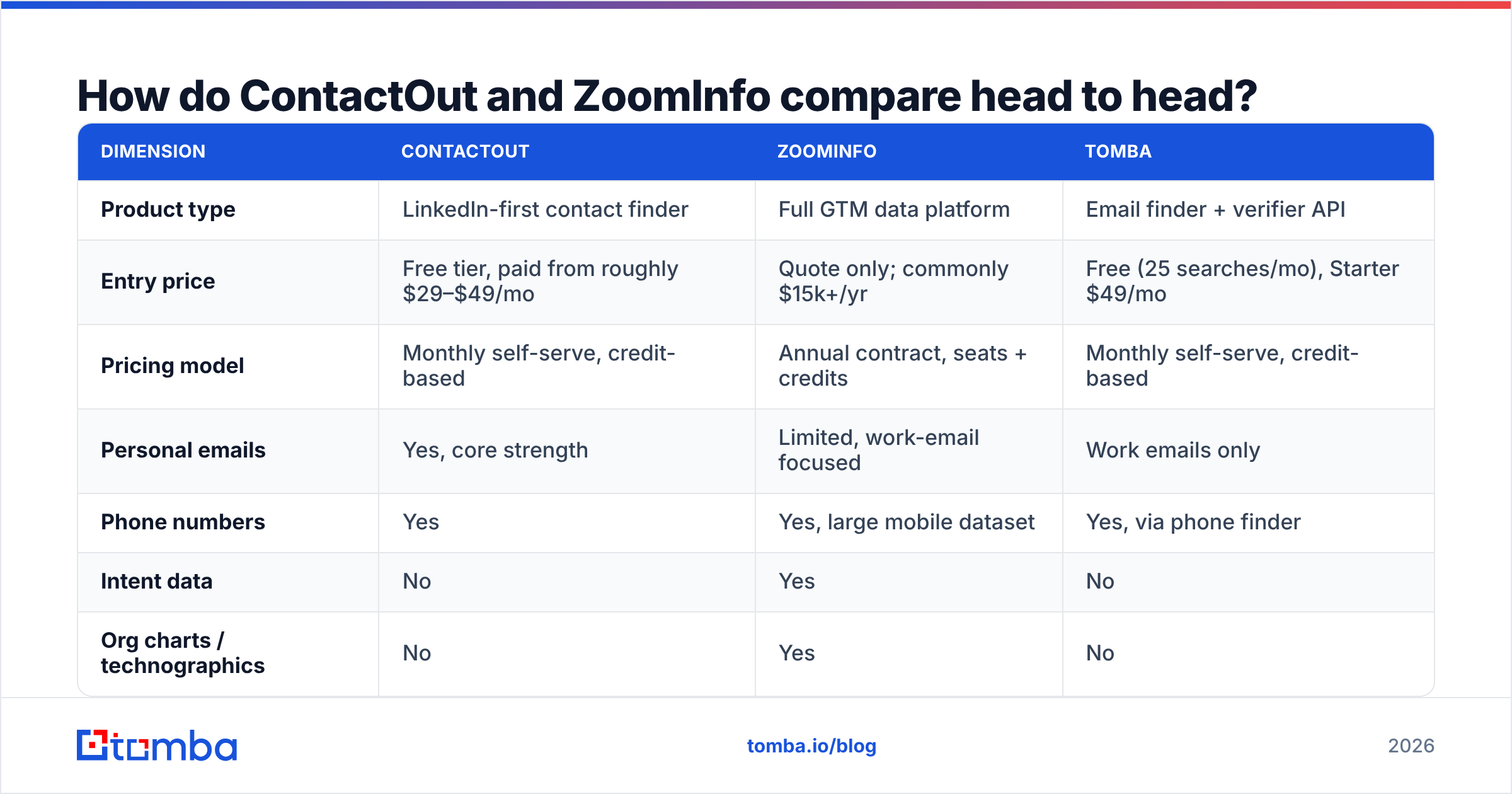
Here is the honest side-by-side. Pricing reflects publicly listed plans at the time of writing; ZoomInfo does not publish list pricing, so the figures below are the ranges buyers consistently report on review sites such as G2 and in procurement forums. Always confirm against a live quote.
| Dimension | ContactOut | ZoomInfo | Tomba |
|---|---|---|---|
| Product type | LinkedIn-first contact finder | Full GTM data platform | Email finder + verifier API |
| Entry price | Free tier, paid from roughly $29–$49/mo | Quote only; commonly $15k+/yr | Free (25 searches/mo), Starter $49/mo |
| Pricing model | Monthly self-serve, credit-based | Annual contract, seats + credits | Monthly self-serve, credit-based |
| Personal emails | Yes, core strength | Limited, work-email focused | Work emails only |
| Phone numbers | Yes | Yes, large mobile dataset | Yes, via phone finder |
| Intent data | No | Yes | No |
| Org charts / technographics | No | Yes | No |
| CRM auto-enrichment | Basic export / integrations | Deep, rules-based | Via API and native integrations |
| API access | Available on higher tiers | Available, priced separately | On all paid plans |
| Export caps | Monthly credit limit | Annual export cap in contract | Credit limit, no annual cap |
| Contract term | Month-to-month available | Typically 12 months minimum | Month-to-month |
| Best for | Recruiters, solo SDRs | Enterprise GTM teams | Dev teams, agencies, cost-sensitive outbound |
The row that decides most deals is not "intent data." It is contract term. ContactOut lets you cancel in a month. ZoomInfo generally does not, and that asymmetry changes how much risk you are taking on unproven data quality.
Which one has better data accuracy?#
This is where the marketing and reality diverge, so be precise about what you are measuring.
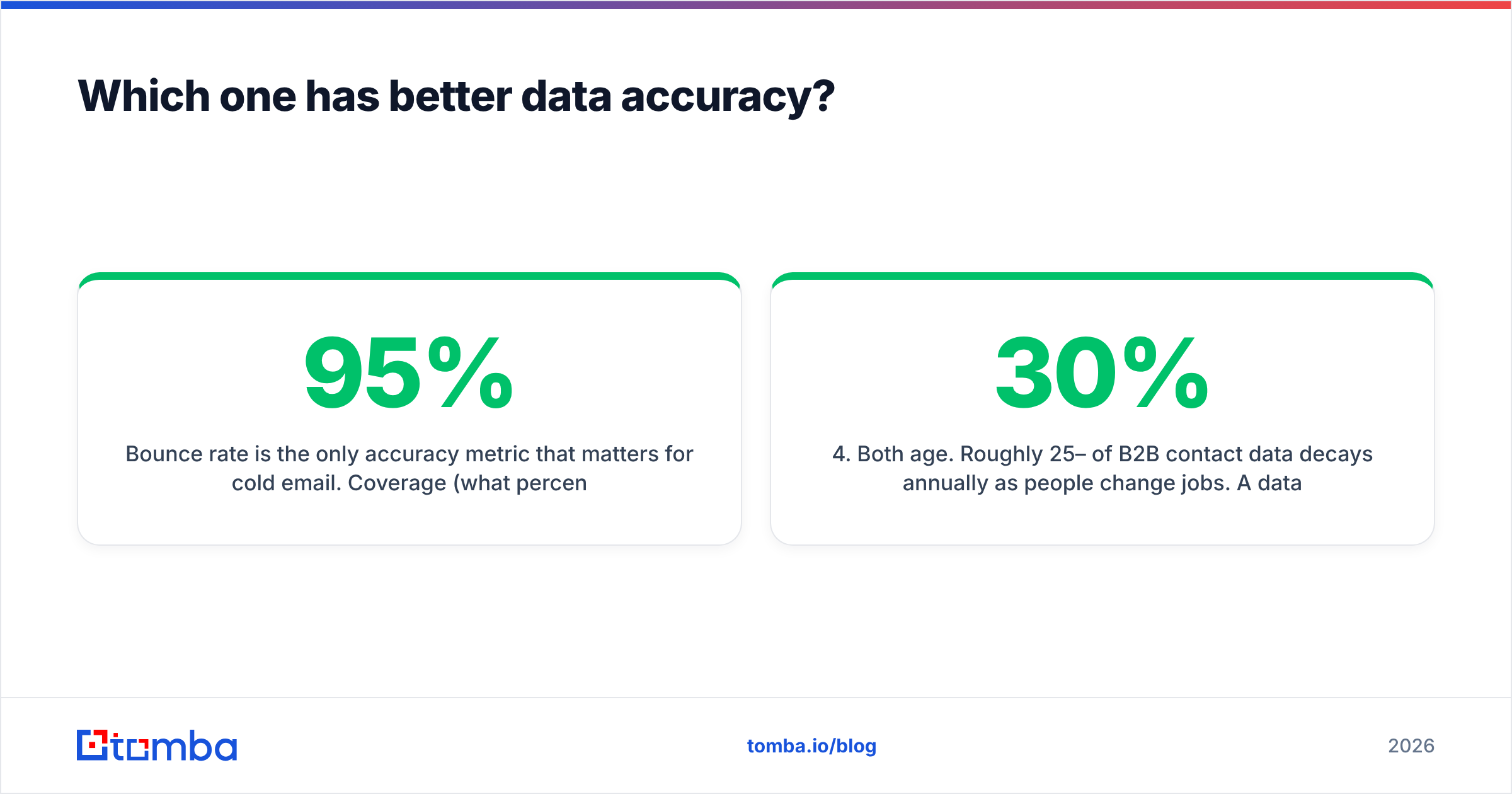
Bounce rate is the only accuracy metric that matters for cold email. Coverage (what percentage of your target list returns any email) and accuracy (what percentage of returned emails are deliverable) are different numbers, and vendors love to blur them. A tool that returns an address for 95% of your list but bounces on 20% of them is worse than a tool that returns 60% and bounces on 2%.
In practice:
- ZoomInfo wins on coverage for US enterprise contacts. If your ICP is VPs at Fortune 5000 companies, ZoomInfo will find someone in the building. That is what the money buys.
- ContactOut wins on personal email coverage. For recruiting outreach, this is not close. Nobody else has comparable depth on personal addresses tied to LinkedIn identity.
- Both degrade outside the US and outside large companies. SMB, EU, LATAM, and APAC coverage falls off for both, and ZoomInfo's premium does not fully protect you there.
- Both age. Roughly 25–30% of B2B contact data decays annually as people change jobs. A database refreshed quarterly is stale by definition on a rolling basis.
- Neither replaces verification. Whatever tool you use, run the list through an email verifier before you send. Vendor-claimed accuracy and your actual bounce rate are not the same number.

The practical test: take 100 contacts you already know are valid (your closed-won accounts, your own team), run them through a trial of each tool, and measure catch rate and bounce rate against ground truth. Vendors will resist giving you a trial large enough to do this. Insist anyway. A vendor who will not let you validate 100 records against your own data is telling you something.
How does pricing really work in ContactOut vs ZoomInfo?#
Sticker price is the least interesting part of this comparison. Both tools meter you, and the metering is where budgets break.
ContactOut charges per credit, with a credit consumed each time you reveal a contact. Free and low tiers are generous enough to evaluate but not to run a real outbound motion. Bulk export and API access sit on higher tiers. If you 3x your list volume, you 3x your bill, but predictably.
ZoomInfo charges per seat, per year, plus credits, plus modules. The parts buyers get surprised by:
- Export caps. Your contract specifies how many records you may export in the year. Viewing is not exporting. Teams routinely burn their annual export allotment in Q2 and then buy an overage package at a worse rate.
- Seat minimums. You typically cannot buy one seat.
- Module unbundling. Intent, websights, engagement, and enrich are often separate lines. The demo shows you everything; the quote may not include it.
- Renewal uplift. Multi-year deals commonly include a scheduled annual increase. Read the clause.
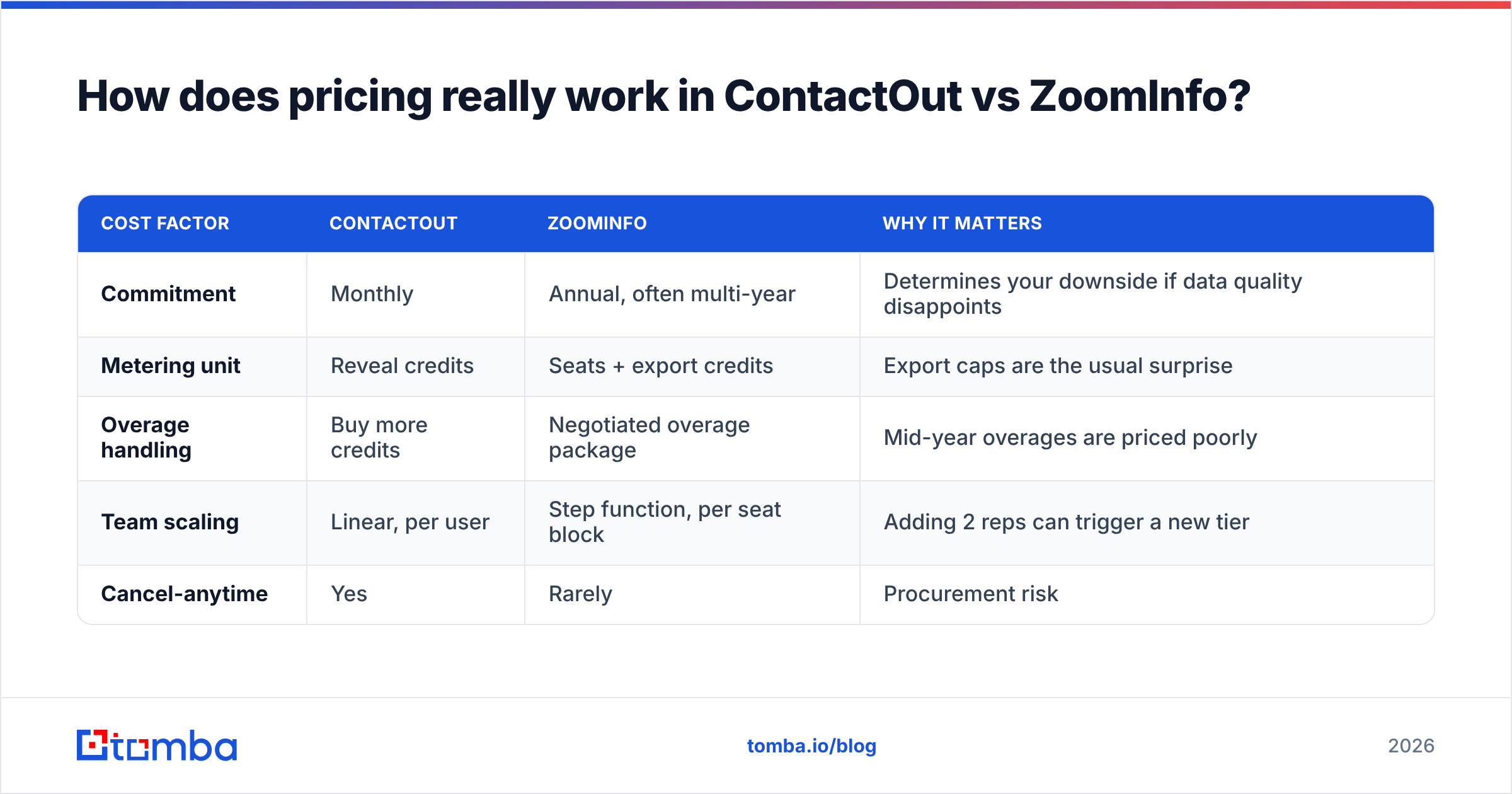
| Cost factor | ContactOut | ZoomInfo | Why it matters |
|---|---|---|---|
| Commitment | Monthly | Annual, often multi-year | Determines your downside if data quality disappoints |
| Metering unit | Reveal credits | Seats + export credits | Export caps are the usual surprise |
| Overage handling | Buy more credits | Negotiated overage package | Mid-year overages are priced poorly |
| Team scaling | Linear, per user | Step function, per seat block | Adding 2 reps can trigger a new tier |
| Cancel-anytime | Yes | Rarely | Procurement risk |

Is there a cheaper way to get the same result?#
Depends entirely on what "the same result" means to you.
If you need intent signals, org charts, and automated CRM enrichment across a 200-rep org, there is no cheap version of that. Pay ZoomInfo or one of its direct peers and negotiate hard on export caps.
If what you actually need is a verified work email for a named person at a named company — which is what most outbound teams need 90% of the time — you are buying a Ferrari to drive to the grocery store. That job is a solved, commoditized problem, and the commodity price is far below either tool.
That is the gap purpose-built tools fill:
- Tomba — email finder, domain search, verifier, catch-all handling, and phone finder, on a self-serve plan starting at $49/mo with a free tier for testing. Full Tomba API on every paid plan, so you can wire enrichment into your own stack rather than renting someone else's UI. See the ContactOut alternative breakdown for a direct feature map.
- BookYourData — a strong option if you would rather buy a pre-built, filtered list outright than run searches yourself. Pay-as-you-go pricing and a bounce guarantee make it a sensible fit for teams that need a clean list this week without a platform commitment.
- Hybrid stacks — many teams run a broad database for account discovery and a focused finder + verifier for contact-level accuracy. That is often cheaper and more accurate than forcing one vendor to do both jobs.
The bulk email finder workflow matters here. If your motion is "upload 5,000 rows of first name / last name / domain, get back verified emails," you do not need a platform. You need a good function.
Which should you choose: ContactOut or ZoomInfo?#
Pick by job, not by feature count.
Choose ContactOut if:
- You are recruiting and need personal emails and mobile numbers.
- Your workflow is already LinkedIn-native and you want a reveal button, not a new system.
- You need month-to-month flexibility and a small budget.
- You are one to five people and cannot absorb an annual contract.
Choose ZoomInfo if:
- You have a defined ICP in the US mid-market or enterprise and need deep account coverage.
- You need intent data and buying-committee mapping to prioritize accounts, not just contact records.
- You are enriching a CRM with tens of thousands of records on an automated schedule.
- You have the budget and the procurement muscle to negotiate export caps up front.
Choose a focused finder + verifier stack if:
- Your bottleneck is deliverable work emails, not account intelligence.
- You want to control cost per contact and see it on a dashboard, not in a renewal negotiation.
- You are building outbound into your own product or internal tooling via API.
- You already have account lists and just need the contacts filled in.
How should you run the evaluation?#
Do not evaluate on the demo. Evaluate on your data.
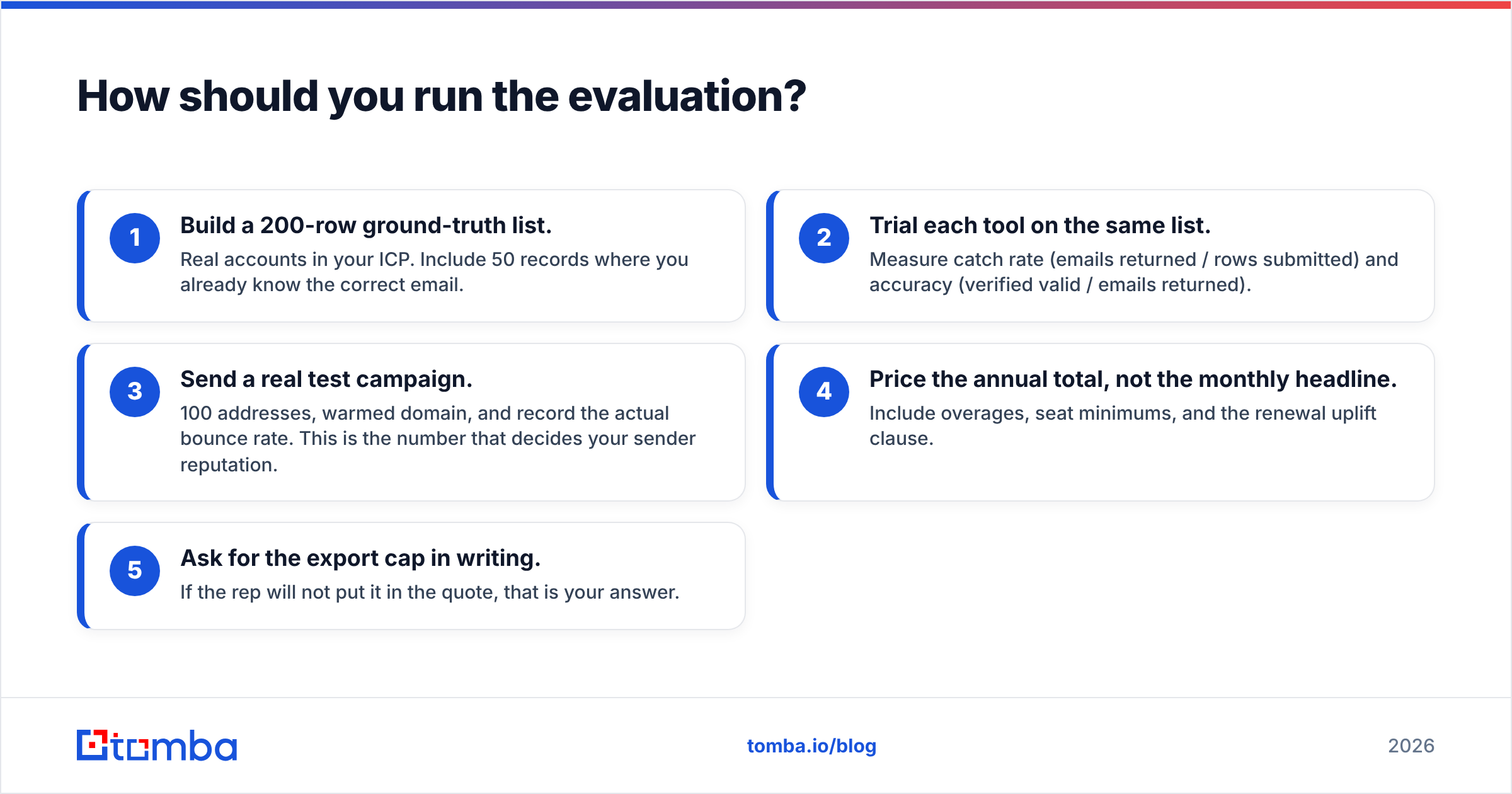
- Build a 200-row ground-truth list. Real accounts in your ICP. Include 50 records where you already know the correct email.
- Trial each tool on the same list. Measure catch rate (emails returned / rows submitted) and accuracy (verified valid / emails returned).
- Send a real test campaign. 100 addresses, warmed domain, and record the actual bounce rate. This is the number that decides your sender reputation.
- Price the annual total, not the monthly headline. Include overages, seat minimums, and the renewal uplift clause.
- Ask for the export cap in writing. If the rep will not put it in the quote, that is your answer.
Most teams that run this test honestly discover their real requirement is narrower than the platform they were about to buy. That is a good discovery to make before signing, not after.
The bottom line#
ContactOut and ZoomInfo are both good at what they were built for, and neither is a general-purpose answer. ContactOut is the right pick for LinkedIn-native recruiting and lean SDR work. ZoomInfo is the right pick when GTM intelligence, not just contact data, is the actual constraint on your pipeline. Their prices differ by an order of magnitude because they solve different problems.
If your problem is the third one, the common one, the unglamorous one, finding a deliverable work email for a person you already know you want to reach, then buy a tool that does exactly that and nothing else. Start free with Tomba Email Finder: 25 searches a month at no cost, $49/mo when you scale, verification built in, and an API you can point at your own pipeline. Run your ground-truth list through it alongside your ContactOut and ZoomInfo trials and let the bounce rate decide.
Related guides#
Ready to find emails that actually work?
Join 150,000+ professionals who stopped guessing and started sending. Free credits on signup — no credit card required.
Get the Tomba newsletter
Practical outbound tactics and product updates — once every two weeks.
About the author