Conversational AI for Sales: What Actually Works in 2026
Conversational AI promises to qualify leads, book meetings, and reply 24/7. Here's what it genuinely does well, where it quietly costs you pipeline, and how to pick a stack that pays for itself.
TL;DR
- Conversational AI for sales works best on two narrow jobs: instant inbound response and always-on qualification. It is mediocre at cold outbound and bad at complex discovery.
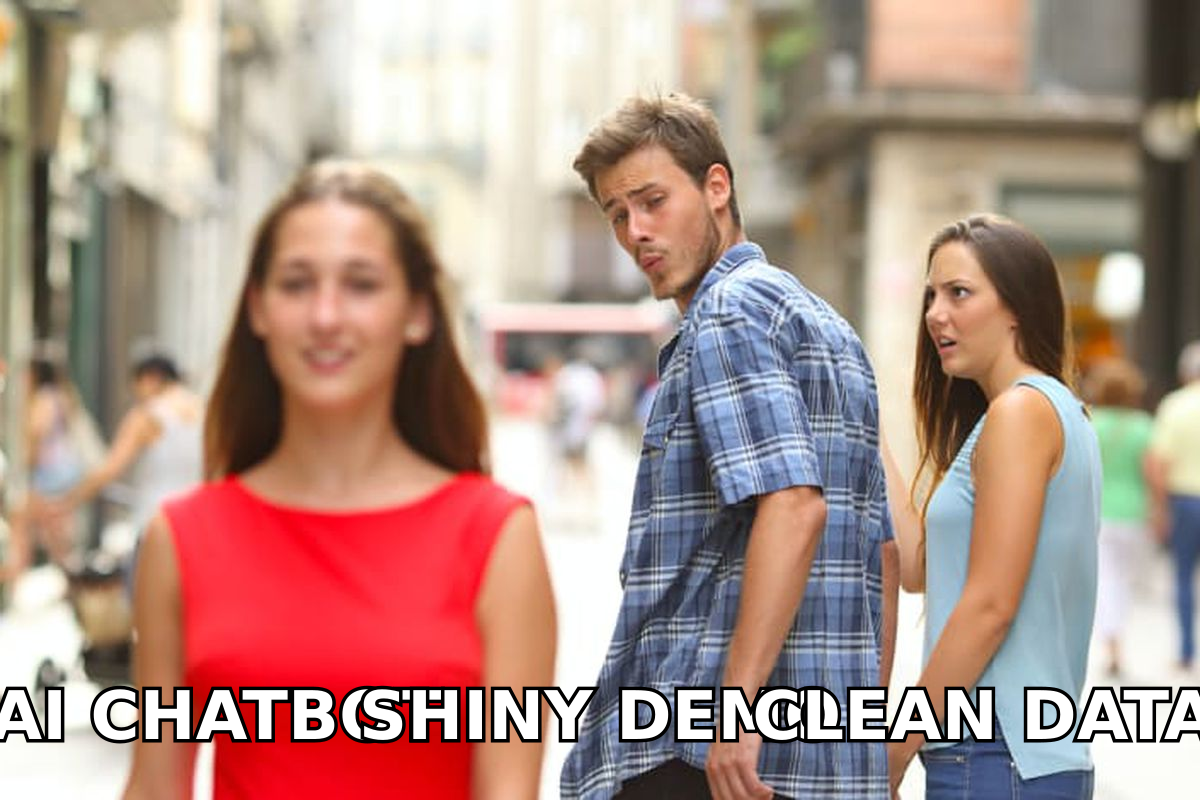
- The tools that win are the ones plugged into clean contact and account data. A bot with a bad database just fails faster and at scale.
- Realistic pricing in 2026: $50-$200/mo for chat widgets, $500-$2,000+/mo for AI SDR platforms, and per-conversation billing that quietly balloons.
- The measurable win is speed-to-lead. Responding in under 5 minutes vs. 30 minutes changes qualification odds by roughly an order of magnitude — that's the gap AI actually closes.
- Do not buy an AI SDR before you fix your data layer. Verified emails, correct titles, and current companies are the fuel; the bot is just the engine.
What is conversational AI for sales?#
Conversational AI for sales is software that holds a two-way, natural-language exchange with a buyer — over web chat, email, SMS, or voice — and drives that exchange toward a commercial outcome: a qualified lead, a booked meeting, a routed handoff.
That's broader than "chatbot." A 2019-era chatbot ran a decision tree: press 1 for pricing, press 2 for support. Modern conversational AI runs on large language models, so it can handle a question it has never seen, pull a fact from your knowledge base, check a calendar, and write a reply that doesn't read like a vending machine.
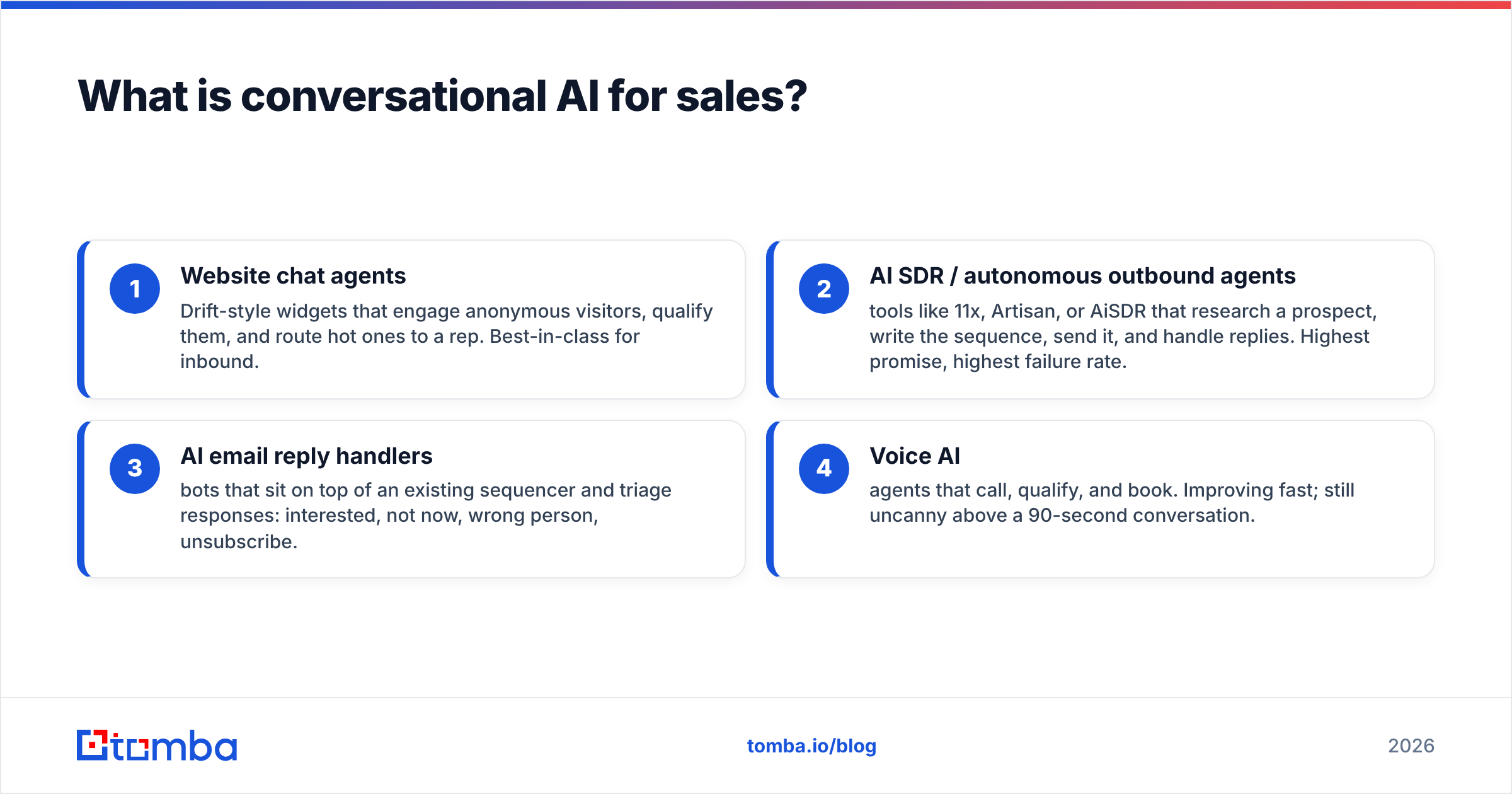
The category now covers four distinct product shapes, and buyers conflate them constantly:
- Website chat agents — Drift-style widgets that engage anonymous visitors, qualify them, and route hot ones to a rep. Best-in-class for inbound.
- AI SDR / autonomous outbound agents — tools like 11x, Artisan, or AiSDR that research a prospect, write the sequence, send it, and handle replies. Highest promise, highest failure rate.
- AI email reply handlers — bots that sit on top of an existing sequencer and triage responses: interested, not now, wrong person, unsubscribe.
- Voice AI — agents that call, qualify, and book. Improving fast; still uncanny above a 90-second conversation.
Each one has a different economic case. Bundling them into a single "AI for sales" budget line is how teams end up paying $2,000/month for something that books four meetings.
Where does conversational AI actually beat a human rep?#
In three places, and only three.
Speed. A human SDR replies to an inbound form fill in a median of hours. An AI agent replies in seconds. The canonical Harvard Business Review study on lead response time found firms that responded within an hour were ~7x more likely to have a meaningful conversation with a decision-maker than those that waited even two hours — and ~60x more likely than those that waited 24 hours. That gap is structural. No amount of SDR hustle closes it. Software does.
Coverage. Your reps sleep. Your buyers in Singapore do not care. A conversational agent covers nights, weekends, and the eleven-day stretch when your only SDR is on PTO.
Volume tedium. Answering "do you integrate with HubSpot?" for the 400th time is a task no human should own. Reclaiming that hour per rep per day is not glamorous, but it compounds.
Where it does not beat a human: multi-threaded enterprise discovery, price negotiation, anything requiring genuine domain credibility, and any moment where the buyer needs to feel like a person heard them. Deploy AI there and you will train your ICP to ignore you.
How do the main conversational AI tools compare in 2026?#
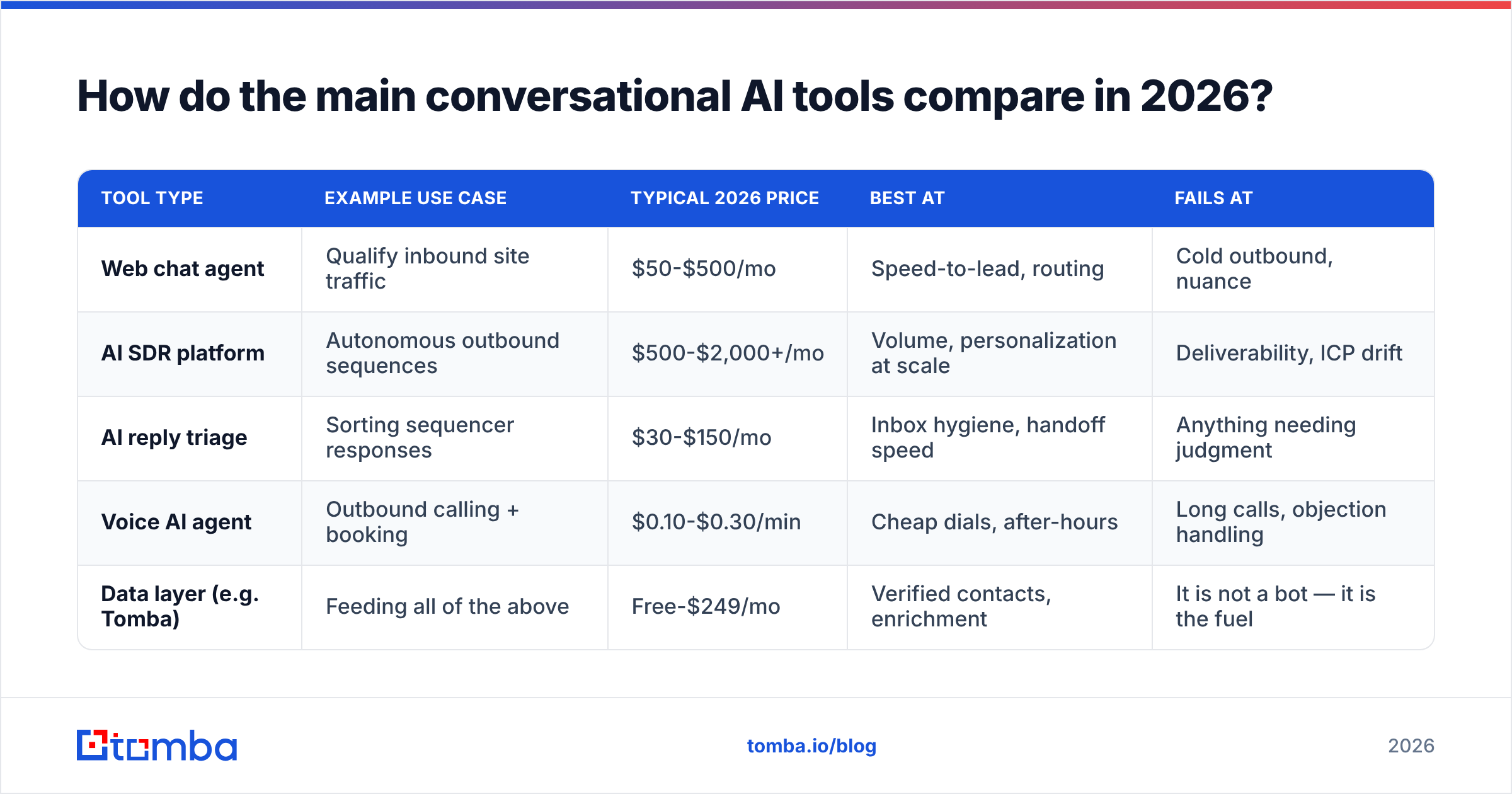
Here's the honest landscape. Pricing is list price as published; enterprise deals vary.
| Tool type | Example use case | Typical 2026 price | Best at | Fails at |
|---|---|---|---|---|
| Web chat agent | Qualify inbound site traffic | $50-$500/mo | Speed-to-lead, routing | Cold outbound, nuance |
| AI SDR platform | Autonomous outbound sequences | $500-$2,000+/mo | Volume, personalization at scale | Deliverability, ICP drift |
| AI reply triage | Sorting sequencer responses | $30-$150/mo | Inbox hygiene, handoff speed | Anything needing judgment |
| Voice AI agent | Outbound calling + booking | $0.10-$0.30/min | Cheap dials, after-hours | Long calls, objection handling |
| Data layer (e.g. Tomba) | Feeding all of the above | Free-$249/mo | Verified contacts, enrichment | It is not a bot — it is the fuel |
Notice the last row. It's not a conversational AI product at all, and that's the point. Every tool above is downstream of contact data. If your AI SDR emails a VP who left the company in 2024, the conversation quality is irrelevant — the message bounces, your domain reputation drops, and the next 500 legitimate sends land in spam.
For teams evaluating alternatives in this space, it's also worth looking at how established B2B data providers position themselves. BookYourData takes a pay-as-you-go, verified-contact approach that pairs cleanly with conversational tooling, and its accuracy guarantee is a reasonable benchmark to hold any vendor to. The broader point stands regardless of vendor: buy the data layer first.
What does a working conversational AI sales stack look like?#
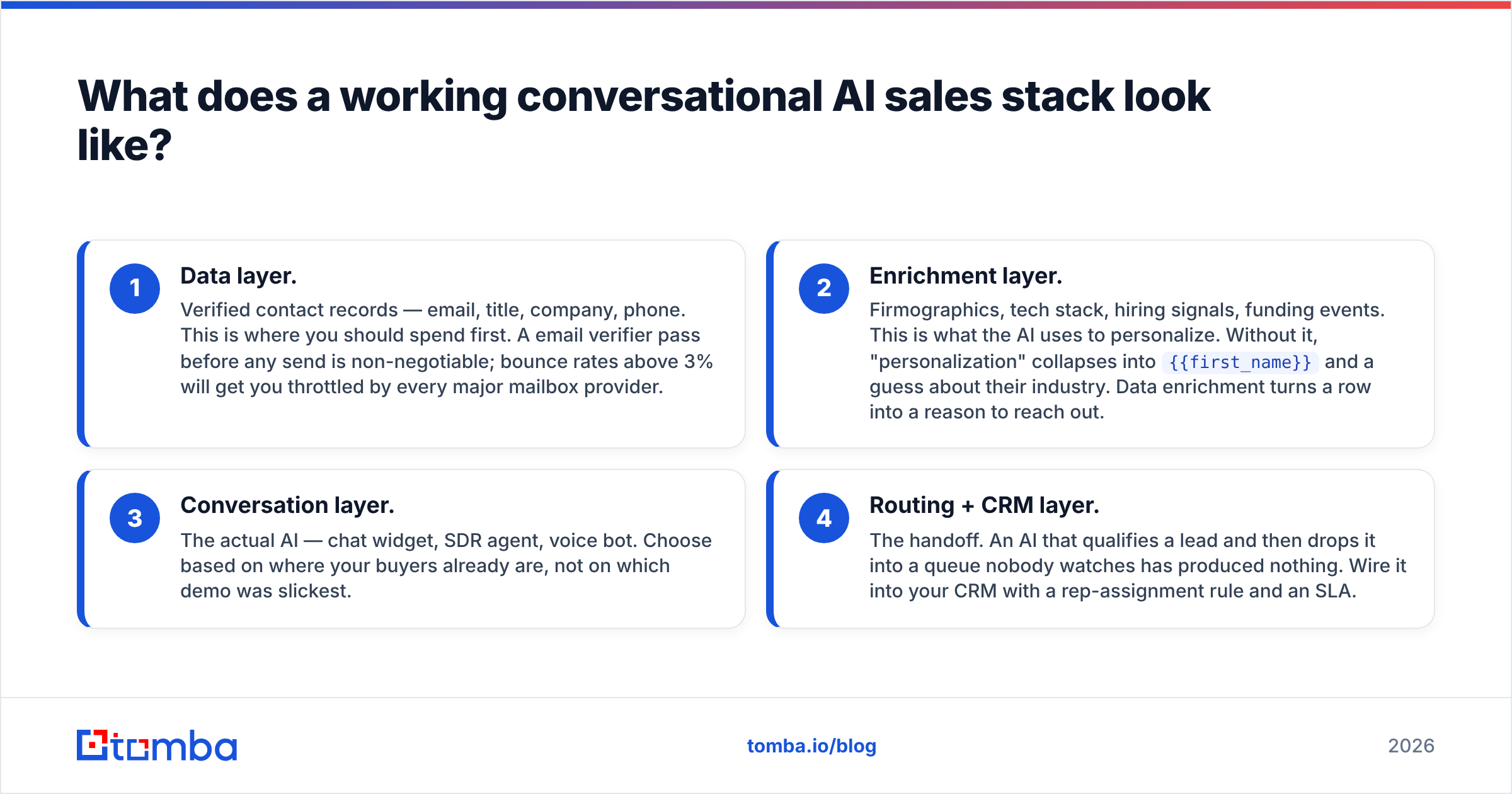
A stack that actually produces pipeline has four layers, in this order:
- Data layer. Verified contact records — email, title, company, phone. This is where you should spend first. A email verifier pass before any send is non-negotiable; bounce rates above 3% will get you throttled by every major mailbox provider.
- Enrichment layer. Firmographics, tech stack, hiring signals, funding events. This is what the AI uses to personalize. Without it, "personalization" collapses into
{{first_name}}and a guess about their industry. Data enrichment turns a row into a reason to reach out. - Conversation layer. The actual AI — chat widget, SDR agent, voice bot. Choose based on where your buyers already are, not on which demo was slickest.
- Routing + CRM layer. The handoff. An AI that qualifies a lead and then drops it into a queue nobody watches has produced nothing. Wire it into your CRM with a rep-assignment rule and an SLA.
Teams that skip layers 1 and 2 and buy layer 3 first are the reason "AI SDR" has become a punchline in half the GTM Slack channels. The model is fine. The inputs were garbage.
Is an AI SDR worth it, or should you just hire a human?#
Run the math instead of the vibes.
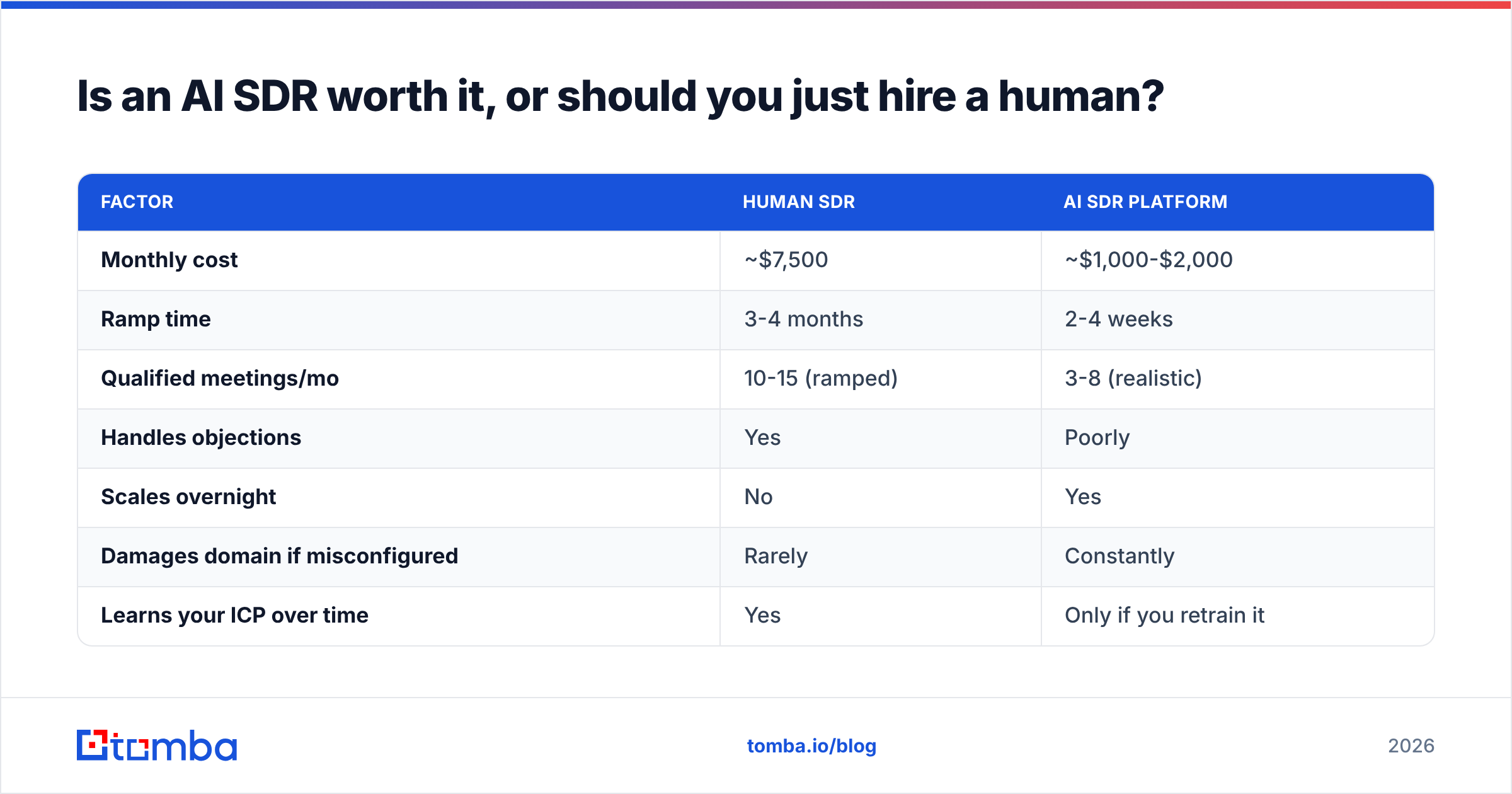
A US SDR fully loaded costs roughly $75,000-$110,000/year — salary, commission, tools, management overhead, ramp. Call it $7,500/month, and accept that they need 3-4 months to get productive. A strong SDR books 10-15 qualified meetings a month once ramped.
An AI SDR platform runs $1,000-$2,000/month all-in with credits. Vendors advertise "the output of 5 SDRs." In practice, teams I'd trust report 3-8 qualified meetings/month from a well-fed AI SDR — assuming clean data, a warmed domain, and a human reviewing the replies.
| Factor | Human SDR | AI SDR platform |
|---|---|---|
| Monthly cost | ~$7,500 | ~$1,000-$2,000 |
| Ramp time | 3-4 months | 2-4 weeks |
| Qualified meetings/mo | 10-15 (ramped) | 3-8 (realistic) |
| Handles objections | Yes | Poorly |
| Scales overnight | No | Yes |
| Damages domain if misconfigured | Rarely | Constantly |
| Learns your ICP over time | Yes | Only if you retrain it |
The honest read: cost per meeting is roughly comparable once you account for the AI's lower yield. AI wins on speed-to-deploy and marginal scale; humans win on complexity and reliability. Most teams under $5M ARR are better served by one good SDR plus a chat agent on the website than by an autonomous outbound bot.
The exception: if you have a large TAM, a low ACV, and a genuinely simple product, autonomous outbound is a real unlock. That's a narrow ICP for the ICP-targeting tools, which is a little funny, but true.
What breaks conversational AI in production?#
Five failure modes, in descending order of how often they'll bite you.
Deliverability collapse. The single biggest killer. AI SDRs send volume; volume without warmup and list hygiene torches your sender reputation. Google and Yahoo's bulk-sender requirements — documented by Google here — enforce a spam-complaint rate under 0.3% and mandate one-click unsubscribe. An AI that blasts unverified addresses will breach both.
Hallucinated commitments. Your bot promising a feature you don't ship, a discount you didn't authorize, or an integration that doesn't exist. Guardrail this with a strict knowledge base and a hard escalation trigger on any pricing or contractual question.
ICP drift. The agent optimizes for reply rate, so it starts talking to whoever replies — which is often junior, unbudgeted, or a competitor doing research. Meetings go up, pipeline does not. Watch qualified-meeting rate, not conversation count.
The uncanny handoff. A buyer spends nine minutes with "Sarah from RevOps," gets excited, then discovers Sarah is a language model. Disclose early. It costs you nothing and prevents a genuinely bad first impression.
Silent CRM failure. Field mismatches, deduplication errors, leads landing in an unwatched queue. Audit the handoff weekly for the first month.
How do you measure whether it's working?#
Ignore the vanity metrics the vendor dashboard puts front and center. Conversations started, messages sent, and "engagement rate" tell you nothing about revenue.
Track these four:
- Speed-to-lead (median, in minutes). This is the metric the AI is supposed to move. If it's not under 5 minutes for inbound, the deployment failed.
- Qualified meeting rate. Meetings that a rep accepts, not meetings that were booked. The gap between those two numbers is your AI's real accuracy.
- Meeting-to-opportunity rate vs. your human baseline. If AI-sourced meetings convert to opps at half the rate of rep-sourced ones, your AI is booking the wrong people and you're burning rep hours to find out.
- Bounce + complaint rate. Your early-warning system. Anything above 2% bounce means your data layer, not your bot, is the problem — go re-verify with a bulk email finder pass before you touch the AI's prompts.
Set a 90-day review. If AI-sourced pipeline doesn't cover the tool's cost by 3x within a quarter, the deployment isn't working — and the fix is almost always upstream in the data, not downstream in the prompt.
What should you do in the next 30 days?#
A concrete sequence, not a manifesto:
- Week 1 — Audit your data. Pull your last 500 outbound contacts. Run them through verification. If more than 5% are invalid, stop everything and fix this. Nothing downstream matters until this number is clean.
- Week 2 — Deploy the easy win. Put a conversational agent on your highest-intent pages (pricing, demo, integrations). Set the SLA at instant response, route to a human within 60 seconds when intent is high. This is the deployment with the best risk-adjusted return in the entire category.
- Week 3 — Instrument the handoff. Wire the agent into your CRM. Verify a test lead flows end to end and lands with an owner. Most failed deployments die here, quietly.
- Week 4 — Only now consider outbound AI. With verified data and a working handoff, an AI SDR has a chance. Without them, it's a very expensive way to damage your domain.
Conversational AI for sales is not a replacement for a sales team. It's a response-time machine and a coverage machine, and when you point it at the right jobs with the right data behind it, the ROI is unambiguous. Point it at the wrong jobs with bad data and it will manufacture activity that looks like progress for exactly one quarter.
Fuel the bot before you buy the bot#
Every conversational AI tool in this post — chat agent, AI SDR, voice bot — is only as good as the contact record it's working from. Wrong email, wrong title, wrong company, and the smartest model in the world writes a beautiful message to nobody.
Tomba's Email Finder gives your AI stack verified, current professional emails by domain, name, or company — with a free tier at 25 searches/month to test your list quality before you commit, then $49/mo Starter and $99/mo Growth as you scale. Check Tomba pricing for the full breakdown, or run your existing list through the email verifier first and see what your bounce rate would actually have been.
Fix the fuel. Then buy the engine.
Related guides#
Ready to find emails that actually work?
Join 150,000+ professionals who stopped guessing and started sending. Free credits on signup — no credit card required.
Get the Tomba newsletter
Practical outbound tactics and product updates — once every two weeks.
About the author