Conversational Intelligence Software: The 2026 Buyer's Guide
Conversational intelligence software records, transcribes, and scores every sales call. Here's what it actually changes, what it costs per seat, and how the major tools compare in 2026.
TL;DR
- Conversational intelligence software records, transcribes, and analyzes sales calls, then turns them into coaching signals, deal risk scores, and CRM fields you didn't have to type.
- The category has consolidated: Gong and Clari (Chorus) own the enterprise tier, Fireflies and Fathom own the cheap tier, and Salesforce/HubSpot ship "good enough" native versions bundled with your CRM seat.
- Real cost is $80–$150 per user per month at the enterprise end — plus a platform fee — and $0–$29 at the lightweight end. The gap is not transcription quality. It's forecasting, deal boards, and integrations.
- The tools fail for boring reasons: reps don't record, calls aren't matched to the right opportunity, and the CRM contact records are junk so the AI attributes conversations to the wrong buyer.
- Buy conversational intelligence when you have at least 5 reps and enough call volume to spot patterns. Below that, you're paying to watch your own calls back.
What is conversational intelligence software?#
Conversational intelligence software captures sales conversations — Zoom calls, Teams meetings, dialer calls, sometimes emails — transcribes them, and applies machine learning to extract things a manager would otherwise have to find by hand: which competitor got mentioned, whether pricing came up, who talked too much, whether next steps were agreed, whether the deal is stalling.
Think of it as a flight recorder for your revenue team. The black box doesn't fly the plane. It tells you, afterward and unarguably, what happened in the cockpit — so that the next crew doesn't repeat the same mistake.
The category grew out of two older ideas: call recording for compliance (contact centers have done it for decades) and speech analytics. What changed around 2018 was cheap, accurate automatic speech recognition plus a CRM to write results into. What changed in 2024–2026 is LLMs: instead of counting keyword matches, the software now summarizes, drafts follow-ups, answers "why did we lose this deal?" in plain English, and pushes structured fields into Salesforce or HubSpot without a human touching them.
The buyer is almost always a sales leader or a revenue operations team. The user is the rep and the frontline manager. That split matters — more on it below, because it's the single biggest reason rollouts stall.
How does conversational intelligence software actually work?#
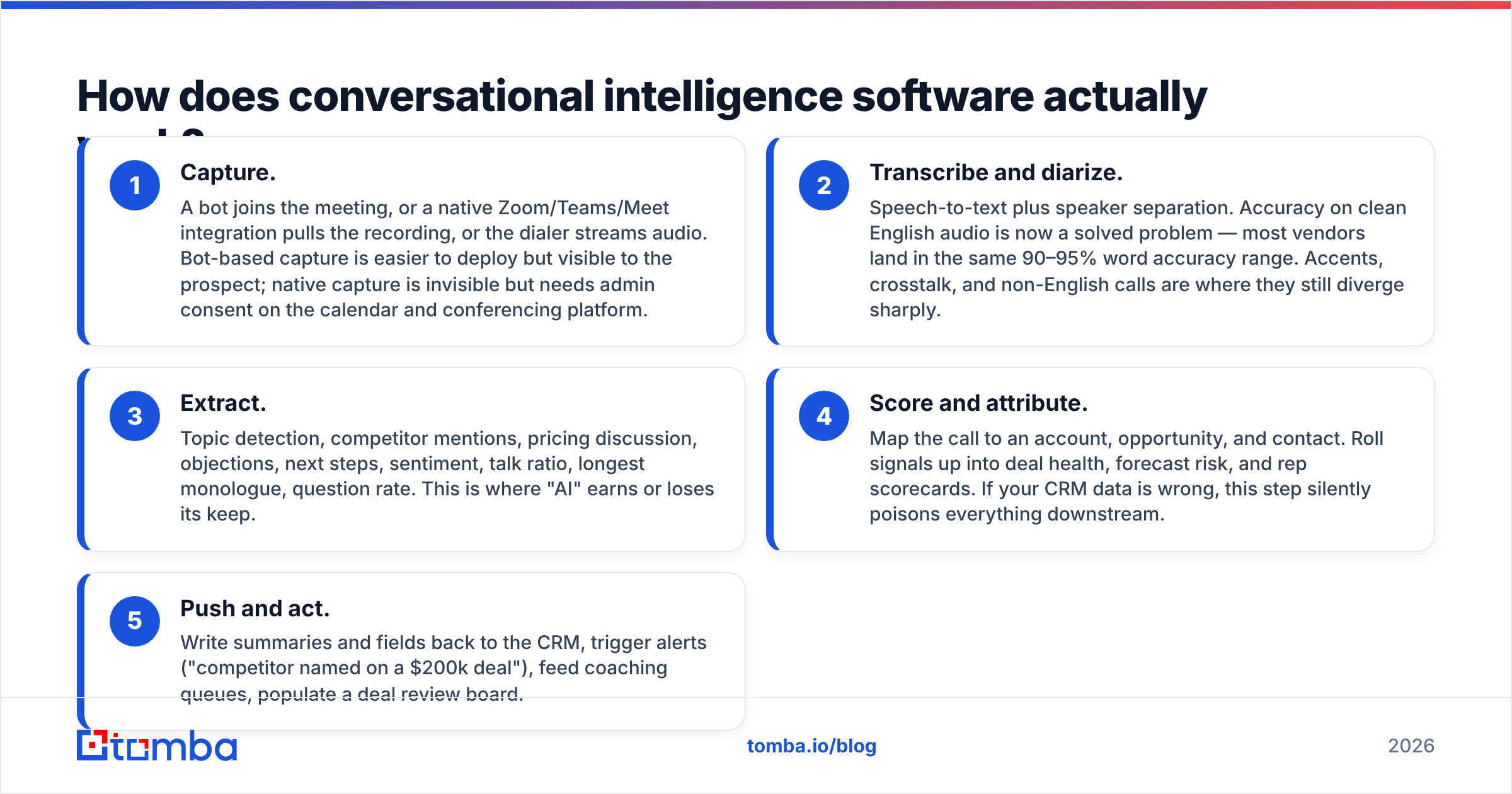
Under the marketing, every tool in this category runs the same five-step chain. Knowing the chain tells you where a given vendor is strong and where it is bluffing.
- Capture. A bot joins the meeting, or a native Zoom/Teams/Meet integration pulls the recording, or the dialer streams audio. Bot-based capture is easier to deploy but visible to the prospect; native capture is invisible but needs admin consent on the calendar and conferencing platform.
- Transcribe and diarize. Speech-to-text plus speaker separation. Accuracy on clean English audio is now a solved problem — most vendors land in the same 90–95% word accuracy range. Accents, crosstalk, and non-English calls are where they still diverge sharply.
- Extract. Topic detection, competitor mentions, pricing discussion, objections, next steps, sentiment, talk ratio, longest monologue, question rate. This is where "AI" earns or loses its keep.
- Score and attribute. Map the call to an account, opportunity, and contact. Roll signals up into deal health, forecast risk, and rep scorecards. If your CRM data is wrong, this step silently poisons everything downstream.
- Push and act. Write summaries and fields back to the CRM, trigger alerts ("competitor named on a $200k deal"), feed coaching queues, populate a deal review board.
Step 4 is the quiet killer. Conversational intelligence is only as good as the contact and account records it attaches conversations to. A call with j.rivera@acme.io maps to nothing if your CRM has jrivera@acme-corp.com — the transcript is perfect and the insight is worthless. This is why teams that pair CI with disciplined contact enrichment get clean deal boards, and teams that don't get a very expensive folder of MP4s.
Which conversational intelligence tools are worth comparing in 2026?#
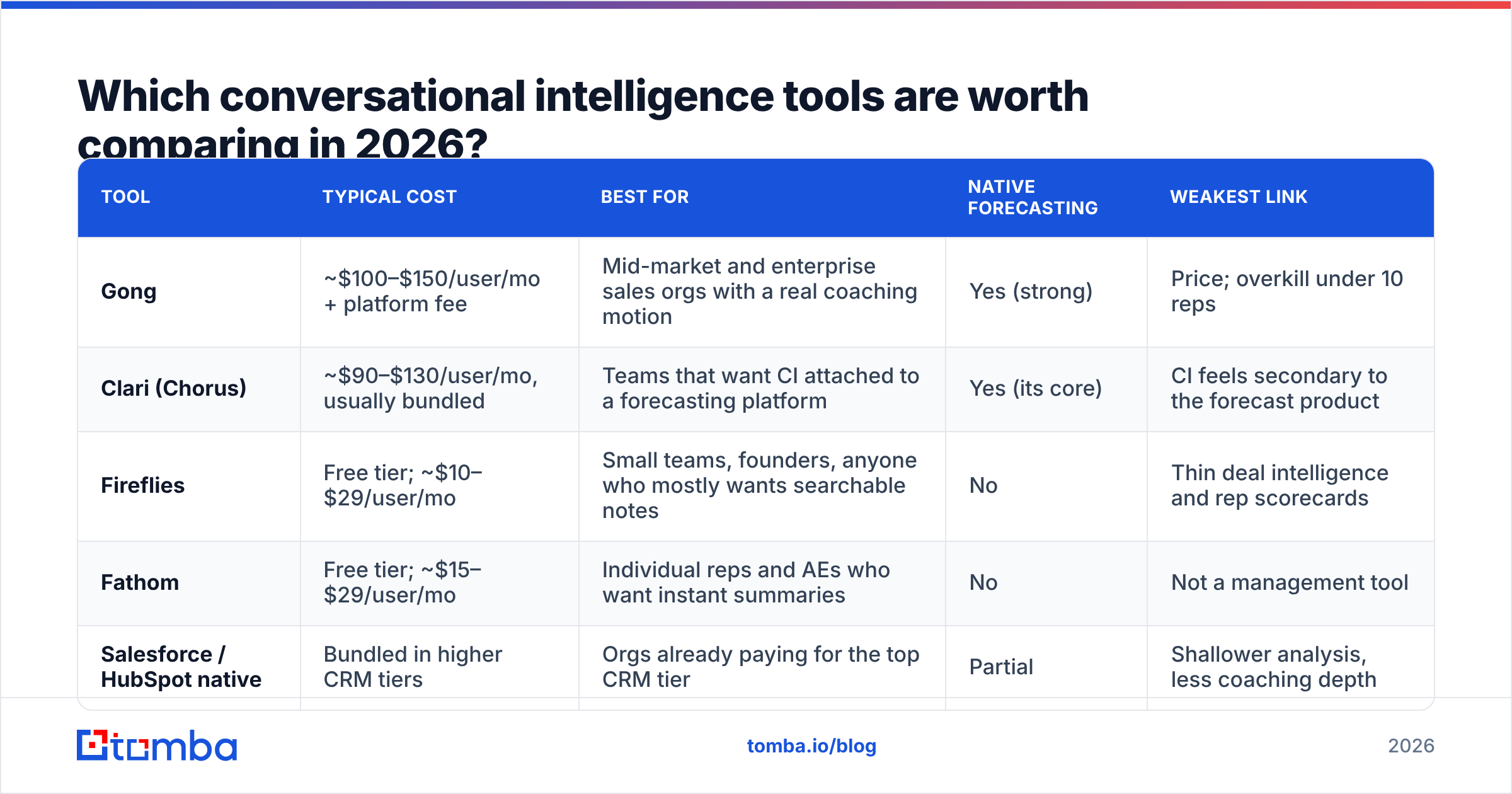
Five names cover most real shortlists. Prices below are typical list ranges reported by buyers on G2 and vendor sales conversations — nearly every enterprise vendor negotiates, and several don't publish figures at all.
| Tool | Typical cost | Best for | Native forecasting | Weakest link |
|---|---|---|---|---|
| Gong | ~$100–$150/user/mo + platform fee | Mid-market and enterprise sales orgs with a real coaching motion | Yes (strong) | Price; overkill under 10 reps |
| Clari (Chorus) | ~$90–$130/user/mo, usually bundled | Teams that want CI attached to a forecasting platform | Yes (its core) | CI feels secondary to the forecast product |
| Fireflies | Free tier; ~$10–$29/user/mo | Small teams, founders, anyone who mostly wants searchable notes | No | Thin deal intelligence and rep scorecards |
| Fathom | Free tier; ~$15–$29/user/mo | Individual reps and AEs who want instant summaries | No | Not a management tool |
| Salesforce / HubSpot native | Bundled in higher CRM tiers | Orgs already paying for the top CRM tier | Partial | Shallower analysis, less coaching depth |
The honest read: if you cannot articulate a coaching workflow — who reviews calls, when, and what changes as a result — you do not need the $130/seat tier. You need searchable transcripts, and Fireflies or your CRM's bundled feature will do it for a tenth of the money.
If you can articulate that workflow, and you have enough reps that patterns exist to be found, the expensive tools pay for themselves through faster ramp time on new hires more than through any single closed deal. Gong is candid about this in its own materials, and it matches what buyers report: the durable ROI is ramp and deal inspection, not a magic objection-handling insight.
What does conversational intelligence software actually cost?#
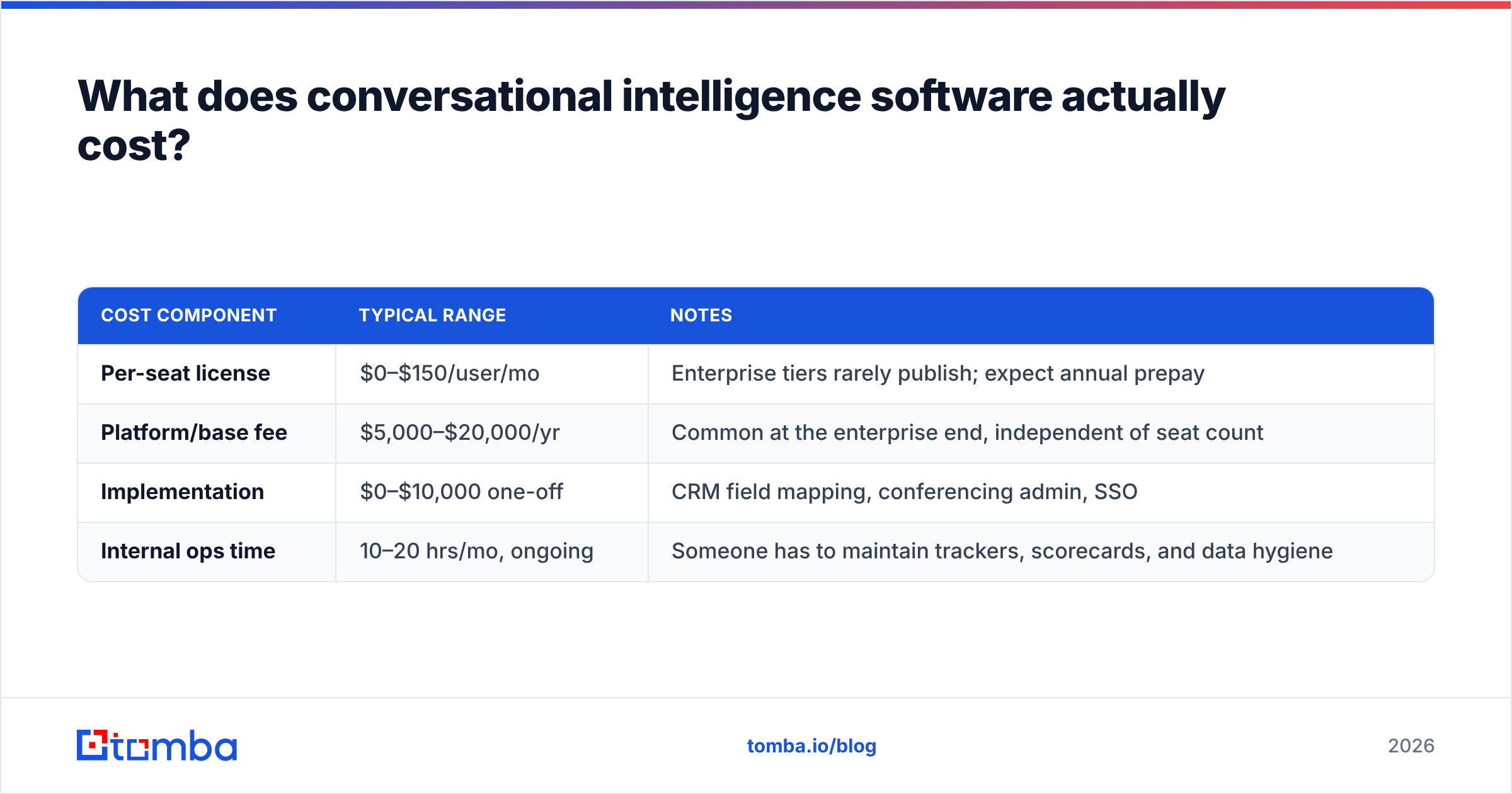
The sticker price per seat is the smaller half of the number. Budget for four line items:
| Cost component | Typical range | Notes |
|---|---|---|
| Per-seat license | $0–$150/user/mo | Enterprise tiers rarely publish; expect annual prepay |
| Platform/base fee | $5,000–$20,000/yr | Common at the enterprise end, independent of seat count |
| Implementation | $0–$10,000 one-off | CRM field mapping, conferencing admin, SSO |
| Internal ops time | 10–20 hrs/mo, ongoing | Someone has to maintain trackers, scorecards, and data hygiene |
A 20-rep team on an enterprise CI platform realistically spends $35,000–$50,000 in year one. That is a real number to defend, and it only pencils out if call volume is high enough that patterns emerge. Under roughly 5 reps, or under a few hundred recorded calls a quarter, you're paying enterprise prices to look at anecdotes.
Does conversational intelligence actually improve win rates?#
Sometimes — and the mechanism is less glamorous than the pitch deck.
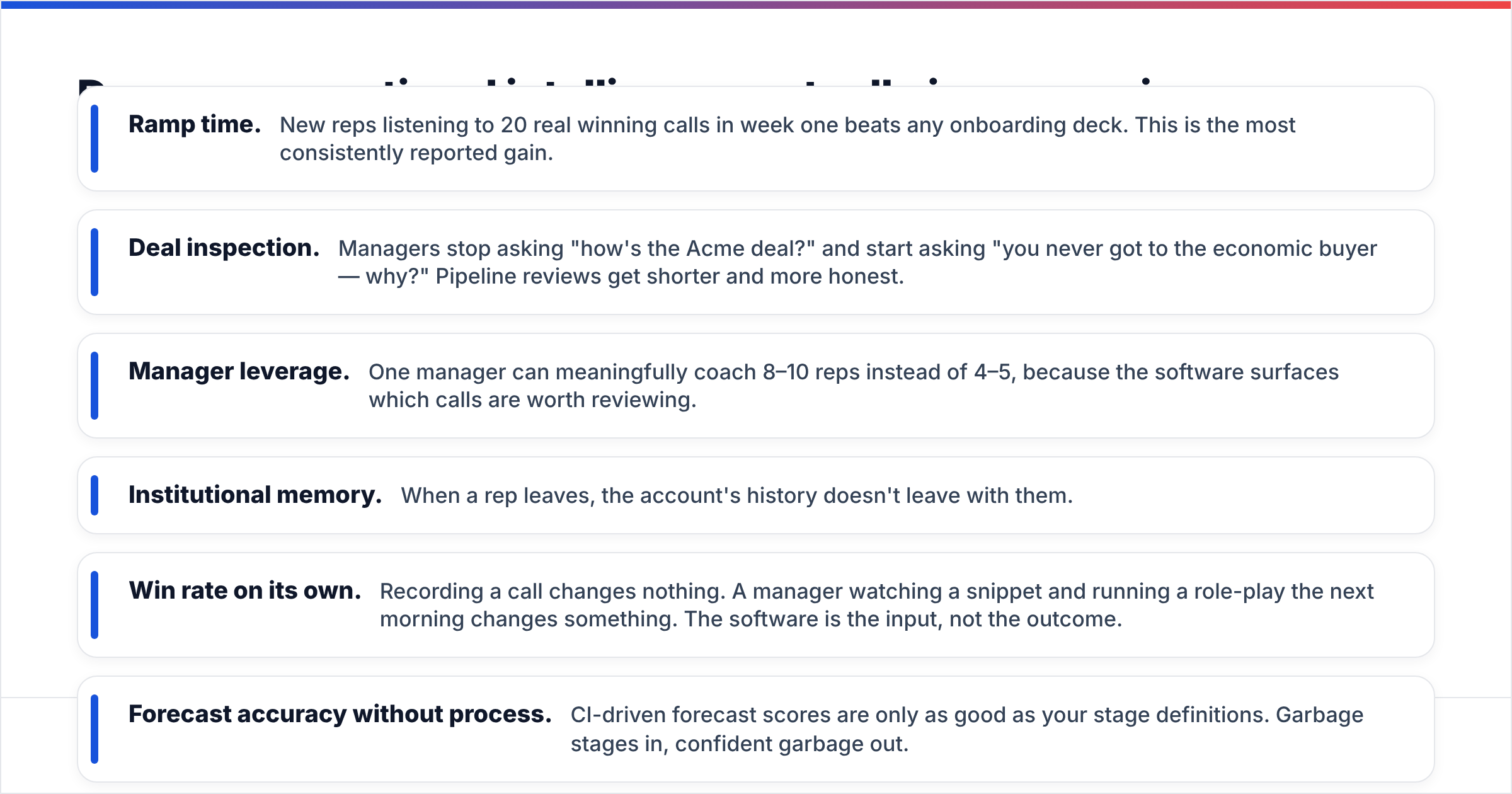
What it reliably improves:
- Ramp time. New reps listening to 20 real winning calls in week one beats any onboarding deck. This is the most consistently reported gain.
- Deal inspection. Managers stop asking "how's the Acme deal?" and start asking "you never got to the economic buyer — why?" Pipeline reviews get shorter and more honest.
- Manager leverage. One manager can meaningfully coach 8–10 reps instead of 4–5, because the software surfaces which calls are worth reviewing.
- Institutional memory. When a rep leaves, the account's history doesn't leave with them.
What it does not reliably improve:
- Win rate on its own. Recording a call changes nothing. A manager watching a snippet and running a role-play the next morning changes something. The software is the input, not the outcome.
- Forecast accuracy without process. CI-driven forecast scores are only as good as your stage definitions. Garbage stages in, confident garbage out.
- Talk-ratio fetishism. "Keep talk ratio under 45%" is a real correlation and a terrible target. Optimizing the metric detaches it from the behavior it proxies. Coach the behavior; ignore the leaderboard.
A useful gut check before you buy: pick three deals you lost last quarter. Ask whether a full transcript would have told you why. If the honest answer is "no — we lost because we were talking to the wrong person," you have a targeting and data problem, not a conversation problem. Fix that first. Conversational intelligence will faithfully record you having the wrong conversation with the wrong buyer, at $130 a seat.
What breaks first when you roll it out?#
In roughly this order:
- Reps don't record. Adoption is the whole ballgame. If recording is optional, coverage lands around 40% and every metric becomes unrepresentative. Make it default-on via native conferencing capture, not an opt-in bot.
- Legal and consent. Two-party consent states and GDPR mean you need a disclosure. Every serious vendor ships this; you still need your legal team to sign off before, not after, the pilot.
- Bad CRM matching. Calls attach to the wrong opportunity, or to no opportunity. This is the failure mode nobody demos. It stems from duplicate contacts, missing email addresses, and personal-domain addresses that don't map to a company. Clean contact data — accurate work emails, deduped records, correct account association — is the load-bearing wall. A bulk email verifier pass across your CRM before a CI rollout is unglamorous and pays for itself in matching accuracy.
- Manager apathy. The tool gets bought by leadership and used by nobody in the middle. Without a weekly ritual — 30 minutes, two calls, one specific behavior change — usage decays to zero inside a quarter, and you renew anyway because nobody wants to admit it.
- Insight overload. 47 trackers, 12 dashboards, nothing acted on. Start with three trackers: competitor mentions, pricing objections, and next-step confirmation. Add more only when someone actually asks.
Where does contact data fit into a conversational intelligence stack?#
Conversational intelligence sits at the bottom of the funnel. It analyzes conversations you already got. It has nothing to say about the conversations you never got — and for most B2B teams, that's the bigger leak.
The two layers work together, and the sequence matters:
- Targeting and contact data decide who you talk to. If you're reaching a manager instead of a VP, no amount of transcript analysis saves the deal.
- Conversational intelligence decides how well you talk to them, and captures what happened.
- CRM hygiene is the join key between the two. Every CI insight is filed under a contact record. If that record is stale, duplicated, or missing an email, the insight is orphaned.
Practically, that means the enrichment layer should run before the CI layer, not after. Get verified work emails and correct account mapping on the way in — through a domain search when you're building a target list, or through the Tomba API when you're enriching inbound leads at the point of capture — and your conversational intelligence platform inherits clean attribution for free. Do it the other way round and you'll spend the first two quarters of your CI contract fixing matching errors that have nothing to do with the CI tool.
How should you choose a conversational intelligence platform?#
Run this checklist before you take a single demo:
- Count your calls. Under ~200 recorded calls per quarter, buy the cheap tier. Patterns need volume.
- Name the ritual. Who reviews calls, when, and what changes as a result? If you cannot name a person and a recurring meeting, skip the enterprise tier.
- Test capture on your stack. Native Zoom/Teams/Meet capture beats bot-joins on adoption. Verify it works with your conferencing admin policy before signing.
- Audit your CRM first. Run a dedupe and an email verification pass. Measure what percentage of contacts have a valid, deliverable work email. Below 80%, fix that before you buy.
- Demand a coverage number in the pilot. Not accuracy — coverage. What percentage of calls actually got recorded and matched? That's the number that predicts whether year two is worth it.
- Check the exit. Can you export transcripts and recordings if you leave? Some contracts make this deliberately painful.
Pick the cheapest tool that supports the ritual you actually intend to run. The expensive platform doesn't create the ritual — it amplifies one that already exists.
Getting the data layer right first#
Conversational intelligence is a genuinely good category. It just sits downstream of a problem most teams haven't solved: knowing exactly who to call, with a verified email and a correctly mapped account record, before the conversation ever starts.
That's the part Tomba handles. Use the Tomba Email Finder to build target lists with verified work emails and clean company attribution, so every call your CI platform records lands on the right contact, the right account, and the right deal. Start free with 25 searches a month, or run it across your existing CRM on the Starter plan at $49/mo — see Tomba pricing for the full breakdown. Fix the input, then let the flight recorder do its job.
Related guides#
Ready to find emails that actually work?
Join 150,000+ professionals who stopped guessing and started sending. Free credits on signup — no credit card required.
Get the Tomba newsletter
Practical outbound tactics and product updates — once every two weeks.
About the author