Conversica vs Drift: Which AI Sales Assistant Wins in 2026?
Conversica chases leads over email until they reply. Drift catches buyers already on your site. They solve opposite halves of the funnel — here is the honest breakdown of pricing, fit, and which one actually earns its budget.
TL;DR
- Conversica is an AI agent that emails leads on your behalf and keeps following up until they reply, ignore, or opt out. It works the back of the funnel — leads you already have.
- Drift (now part of Salesloft) is conversational marketing: chat, chatbots, and live routing for buyers who are already on your website. It works the front of the funnel.
- They are not really competitors. Choosing between them is mostly a question of where your leads are stalling: sitting cold in a CRM, or bouncing off your pricing page.
- Neither publishes transparent pricing. Both land in enterprise territory — expect four figures a month minimum, plus onboarding.
- Both tools fail the same way: garbage contact data. An AI assistant emailing a dead address is just an expensive bounce generator.
What is Conversica, and what does it actually do?#
Conversica sells "Revenue Digital Assistants" — AI agents with names, email signatures, and a persistent habit of following up. You hand the assistant a list of leads (from your CRM, a webinar, a trade show, a dormant pipeline segment) and it emails each one in a human-sounding, two-way conversation. It reads replies, classifies intent, answers basic questions, and hands off to a human rep only when someone shows real buying signals.
The pitch is simple and, honestly, defensible: most inbound leads never get a second touch. Reps chase the hot ones and let the rest rot. Conversica works the rot. It will send touch four, five, and six at 9:14 p.m. on a Tuesday without complaining.
Where it earns its money:
- Dormant lead reactivation. Six months of unworked MQLs is Conversica's home turf.
- Speed-to-lead. It replies to a form fill in under a minute, every time.
- Lead qualification at volume. It sorts "just researching" from "send me a quote" before a rep spends a minute.
- Renewal and upsell nudges. Post-sale motions where a human touch is nice but not economically justified.
Where it does not help: it does not create demand, it does not source contacts, and it does not talk to anonymous website visitors. It needs a name and an email address to start with — which is the whole game, and we will come back to that.
What is Drift, and is it still Drift in 2026?#
Drift invented the "conversational marketing" category: the chat bubble that pops up when you land on a B2B site and asks whether you want to book a demo. Under the hood it is a playbook engine — targeting rules that fire different chat experiences depending on who the visitor appears to be, what page they are on, and whether they match a target account.
Important context: Drift was acquired by Salesloft in early 2024 and now sits inside the Salesloft revenue-orchestration platform. If you buy Drift today you are effectively buying into the Salesloft ecosystem, and you should evaluate it that way — including how it plays with whatever sequencing tool you already own. Some standalone Drift buyers see this as consolidation upside. Others see vendor lock-in. Both are reasonable readings.
Drift's strongest use cases:
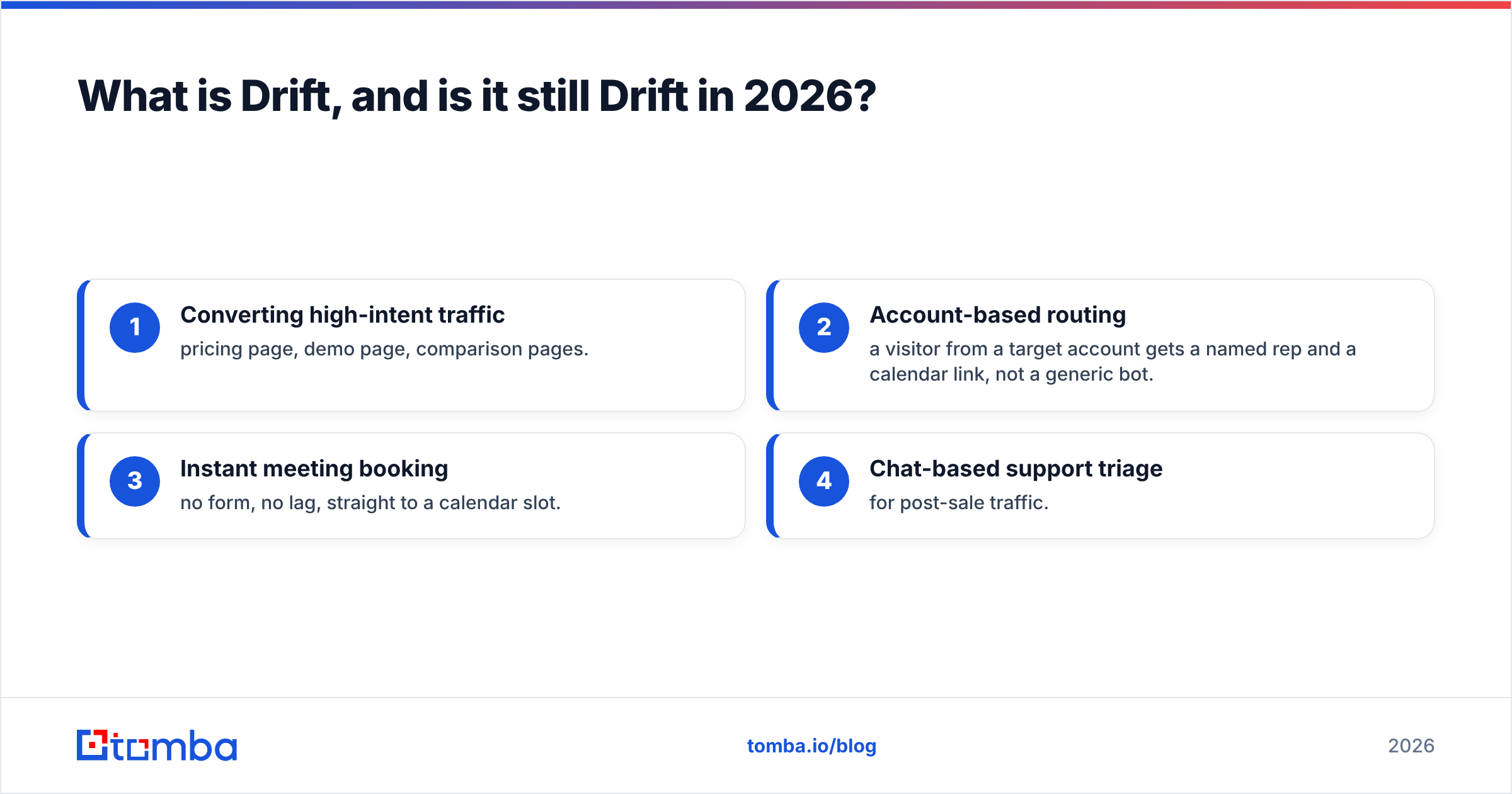
- Converting high-intent traffic — pricing page, demo page, comparison pages.
- Account-based routing — a visitor from a target account gets a named rep and a calendar link, not a generic bot.
- Instant meeting booking — no form, no lag, straight to a calendar slot.
- Chat-based support triage for post-sale traffic.
Its weakness is structural: Drift only ever talks to people who show up. No traffic, no conversations. A company doing 2,000 monthly visitors will not get value from a tool priced for companies doing 200,000.

Conversica vs Drift: how do they compare side by side?#
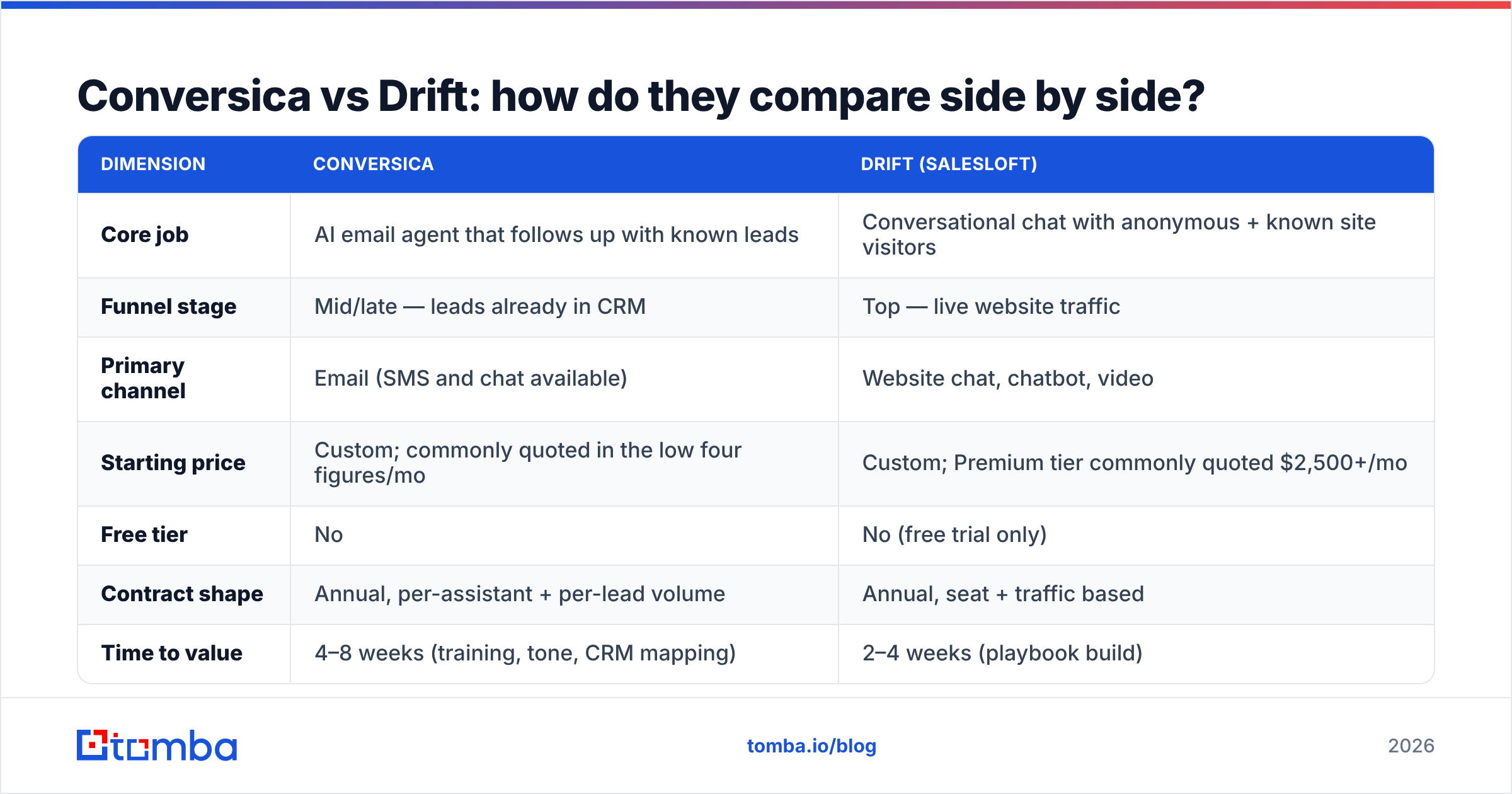
Here is the honest comparison. Pricing figures below are drawn from published vendor material, G2 reviews, and buyer-reported quotes — neither vendor lists prices publicly, so treat these as ranges, not invoices.
| Dimension | Conversica | Drift (Salesloft) |
|---|---|---|
| Core job | AI email agent that follows up with known leads | Conversational chat with anonymous + known site visitors |
| Funnel stage | Mid/late — leads already in CRM | Top — live website traffic |
| Primary channel | Email (SMS and chat available) | Website chat, chatbot, video |
| Starting price | Custom; commonly quoted in the low four figures/mo | Custom; Premium tier commonly quoted $2,500+/mo |
| Free tier | No | No (free trial only) |
| Contract shape | Annual, per-assistant + per-lead volume | Annual, seat + traffic based |
| Time to value | 4–8 weeks (training, tone, CRM mapping) | 2–4 weeks (playbook build) |
| Best for | Large dormant lead databases, high MQL volume | High-traffic sites with a real demand-gen engine |
| Fails when | Contact data is stale or unverified | Website traffic is thin |
| Human handoff | Yes — escalates on intent | Yes — live rep takeover in chat |
Read that table again and notice something: there is almost no overlap. The only row where they collide is "we want more meetings booked with less rep effort." That is a goal, not a category.
Which one should you actually buy?#
Buy Conversica if: your CRM holds tens of thousands of leads nobody has touched in a quarter, your reps admit they only work the top 10% of the list, and your average deal size is big enough that reviving 2% of the dead pile pays for the contract. Conversica is a database-monetization tool disguised as an AI assistant.
Buy Drift if: you already spend serious money on paid and organic demand, your site pulls meaningful B2B traffic, and your conversion path is a form that people abandon. Drift is a conversion-rate tool disguised as a chatbot.
Buy neither if: your problem is that you do not have enough qualified contacts in the first place. This is the most common misdiagnosis in B2B, and both vendors are happy to let you make it. Conversica cannot email a lead you never captured. Drift cannot chat with a visitor who never arrived. If your pipeline is thin at the source, an AI assistant is a very expensive way to discover that.
That upstream gap is where a B2B database and a solid email finder actually belong in the conversation — not as a Conversica or Drift replacement, but as the layer both of them silently depend on.
Why does contact data quality decide whether either tool works?#
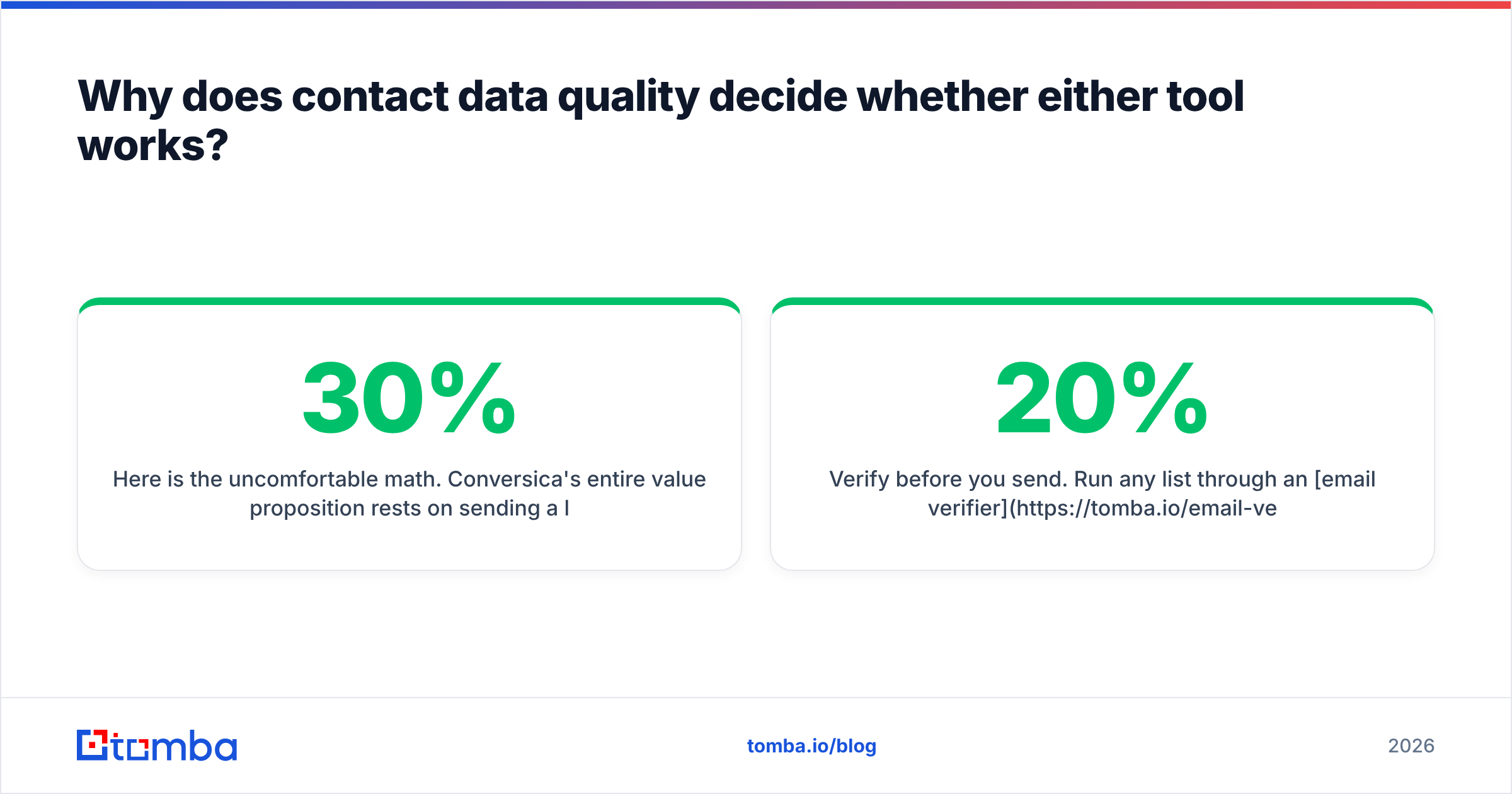
Here is the uncomfortable math. Conversica's entire value proposition rests on sending a lot of email. B2B contact data decays at roughly 25–30% per year as people change jobs — that is the widely cited industry figure, and it matches what anyone who has run a two-year-old list has felt. Point an AI assistant at a list with a 25% dead rate and it will cheerfully burn your sending reputation on hard bounces, at machine speed, before a human notices.
Once your sender reputation tanks, the well-crafted emails to your good leads land in spam too. The AI assistant is now actively destroying value. That is not a Conversica flaw — it is a data flaw that Conversica amplifies.
Drift has a quieter version of the same problem. Its account-based playbooks depend on correctly identifying which company a visitor belongs to and matching it against your target list. If your account records are stale, wrong-sized, or missing the decision-maker contacts, the routing logic misfires and your best-fit visitor gets the generic bot.
The fix is boring and unglamorous:
- Verify before you send. Run any list through an email verifier before it touches an automated sender. Catching a 20% invalid rate costs pennies; a blacklisting costs months.
- Enrich before you route. Contact enrichment fills in title, seniority, company size, and tech stack so segmentation rules actually fire correctly.
- Refresh quarterly. Treat your contact database like produce, not furniture.

How much do Conversica and Drift really cost?#
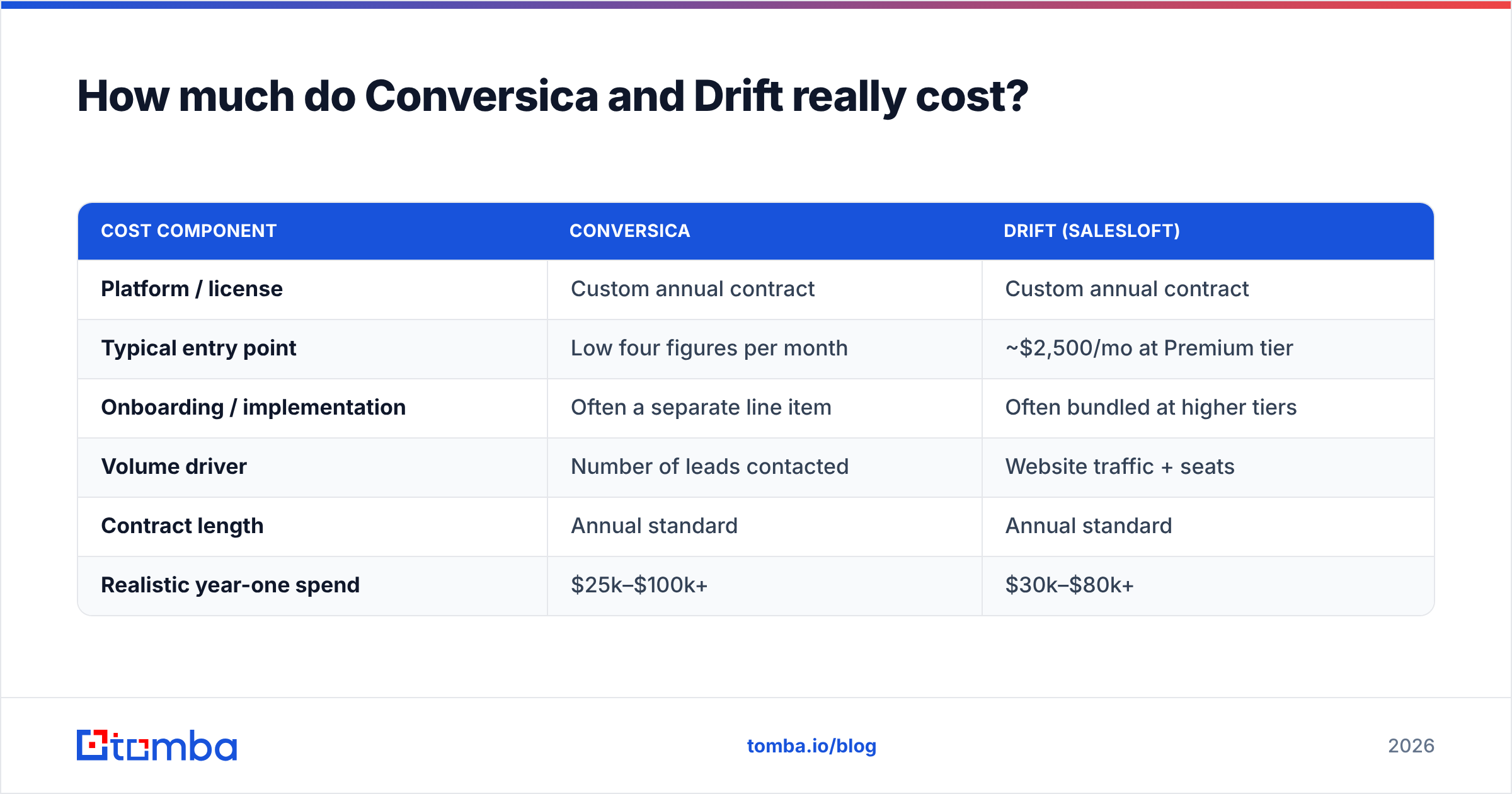
Neither vendor makes this easy, which is itself a signal about who they sell to. Based on public reviews and reported buyer quotes, here is the realistic shape of a deal in 2026:
| Cost component | Conversica | Drift (Salesloft) |
|---|---|---|
| Platform / license | Custom annual contract | Custom annual contract |
| Typical entry point | Low four figures per month | ~$2,500/mo at Premium tier |
| Onboarding / implementation | Often a separate line item | Often bundled at higher tiers |
| Volume driver | Number of leads contacted | Website traffic + seats |
| Contract length | Annual standard | Annual standard |
| Realistic year-one spend | $25k–$100k+ | $30k–$80k+ |
Two practical notes. First, both vendors price on volume, so your quote scales with the very thing you are trying to grow — model year two, not year one. Second, the implementation cost is not just money. Conversica needs conversation training and CRM field mapping; Drift needs playbooks somebody has to actually write and maintain. Budget internal hours or the tool will underperform and you will blame the software.
For comparison, the entire data layer that feeds these tools is an order of magnitude cheaper. Tomba pricing runs from a free tier at 25 searches/month up to $49/mo Starter, $99/mo Growth, and $249/mo Pro. That asymmetry is worth sitting with: teams routinely spend $50k on an AI assistant and refuse to spend $1,200 a year making sure it has valid addresses to talk to.
Is there a middle path between the two?#
Yes, and it is what most mid-market teams end up doing.
Rather than buying either enterprise platform, they assemble the same outcome from cheaper parts:
- Source contacts with an email finder and domain search so the list is built from real, current company data rather than a purchased CSV.
- Verify and enrich every record before it enters the CRM — no exceptions, no "we'll clean it later."
- Sequence with a standard outbound tool (Instantly, Saleshandy, Reply, Smartlead — pick your poison) that costs a few hundred a month, not a few thousand.
- Add chat later, once site traffic is genuinely high enough that a chat widget converts more than a well-designed form.
This stack does perhaps 80% of what Conversica does at a fraction of the price, and it forces you to fix the data problem first instead of papering over it with AI. The tradeoff is real: you get no autonomous conversation handling, no intent classification out of the box, and you own the follow-up logic yourself. If your team has the operational discipline, that is a fine trade. If it does not, Conversica's whole value is supplying that discipline — and that is worth paying for.
The honest test: if you cannot get a human-run, well-verified sequence to produce meetings, an AI assistant will not save you. It will just produce more of the same result, faster.
What do buyers complain about most?#
Pulling from the recurring themes in public reviews for both platforms:
Conversica, common complaints:
- Replies can feel scripted when a lead asks something off-script, and the escalation logic occasionally misses genuine buying signals.
- Configuration and tone-tuning take longer than the sales cycle suggests.
- Value collapses if the underlying lead data is poor — which shows up as a "the AI isn't working" complaint but is really a data complaint.
Drift, common complaints:
- Cost scales aggressively with traffic, which punishes exactly the growth you were buying it for.
- Playbook maintenance quietly becomes somebody's part-time job.
- Post-acquisition roadmap uncertainty — some buyers want clarity on where Drift ends and Salesloft begins.
Both critiques share a root cause: these are platforms, not features. They reward teams with the headcount to operate them and punish teams hoping to buy a result.
The verdict#
There is no winner in Conversica vs Drift, because they are not playing the same game. Conversica works your existing lead database harder. Drift works your existing traffic harder. Pick the one that matches the bottleneck you can actually name — and if you cannot name the bottleneck, do not buy either yet.
What is true of both: they are amplifiers. Feed them clean, current, verified contact data and they multiply a working motion. Feed them a stale list and they multiply your bounce rate, your spam complaints, and your CFO's skepticism about AI spend.
Start with the layer underneath. Before you sign a five-figure contract with any AI sales assistant, make sure the contacts it will work are real. Tomba Email Finder finds verified professional email addresses by name, domain, or company — with a free tier to test the accuracy on your own target accounts before you commit a dollar. Get the data right, and every tool downstream of it works better. Get it wrong, and no amount of AI will save the sequence.
Related guides#
Ready to find emails that actually work?
Join 150,000+ professionals who stopped guessing and started sending. Free credits on signup — no credit card required.
Get the Tomba newsletter
Practical outbound tactics and product updates — once every two weeks.
About the author