Conversion Blitz vs DealSignal: Which B2B Data Tool Wins?
Conversion Blitz bundles a dozen lead-gen tools for a low monthly fee. DealSignal sells verified, on-demand B2B data at enterprise prices. Here is which one actually fits your outbound motion, and when a focused email finder beats both.
TL;DR
- Conversion Blitz is a bundle play: one subscription, a dozen small tools (email finder, chatbot, review widget, extractor, cold email sender). Cheap, broad, shallow.
- DealSignal is a data play: on-demand verified contact and account data, human-plus-machine verification, annual contracts, enterprise price tags.
- They rarely compete for the same buyer. If your bottleneck is tooling, Conversion Blitz is tempting. If your bottleneck is data quality at scale, DealSignal is the serious option.
- Both make you pay for surface area you may not use. Most teams under 20 reps only need accurate emails, verification, and an API.
- If that's you, a focused stack — an email finder plus a real verifier — costs less and bounces less than either.
What are Conversion Blitz and DealSignal, actually?#
They get compared because both promise "more leads." That's where the similarity stops.
Conversion Blitz (conversionblitz.com) is an all-in-one growth suite. One login gets you an email finder, a domain/company search, a data extractor, an email campaign sender, a chatbot, a review widget, a notification widget, and a handful of other micro-tools. The pitch is consolidation: stop paying six vendors $30/mo each. The business model is volume — low monthly price, generous-sounding credit pools, occasional lifetime deals.
DealSignal (dealsignal.com) is a B2B data platform aimed at demand gen and RevOps teams at mid-market and enterprise companies. The pitch is freshness: instead of serving you a static database that decays 25–30% a year, DealSignal claims to verify records on demand, at the moment you request them, blending machine verification with human research. You buy credits, usually on an annual contract, and pipe records into Salesforce, Marketo, HubSpot, or your data warehouse.
So the honest framing of conversion blitz vs dealsignal is not "which tool is better." It's "which problem do you actually have?"
| Conversion Blitz | DealSignal | |
|---|---|---|
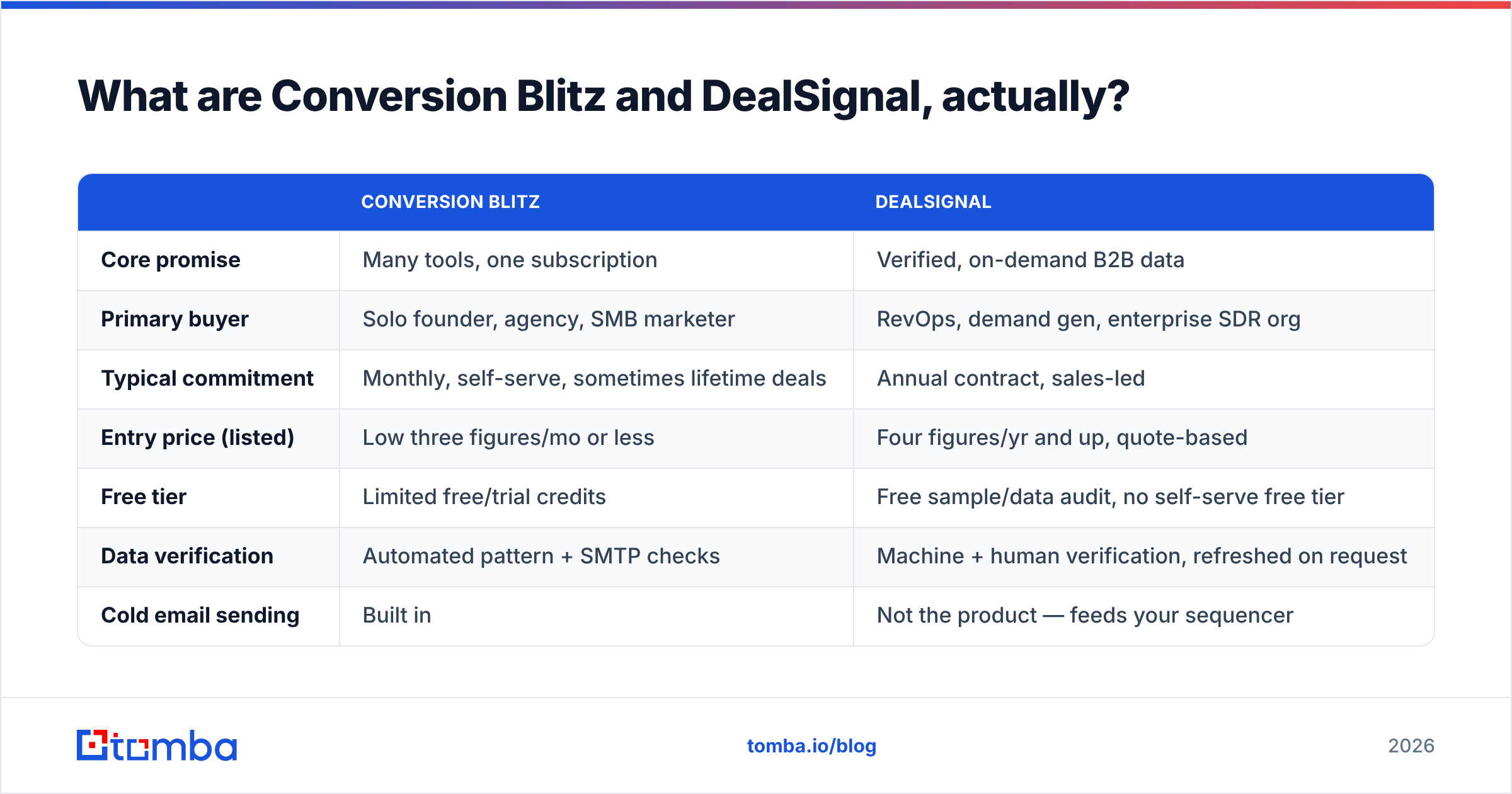
| Core promise | Many tools, one subscription | Verified, on-demand B2B data |
| Primary buyer | Solo founder, agency, SMB marketer | RevOps, demand gen, enterprise SDR org |
| Typical commitment | Monthly, self-serve, sometimes lifetime deals | Annual contract, sales-led |
| Entry price (listed) | Low three figures/mo or less | Four figures/yr and up, quote-based |
| Free tier | Limited free/trial credits | Free sample/data audit, no self-serve free tier |
| Data verification | Automated pattern + SMTP checks | Machine + human verification, refreshed on request |
| Cold email sending | Built in | Not the product — feeds your sequencer |
| API | Available, lighter | Full API + CRM/MAP integrations |
| Best at | Cheap breadth for scrappy teams | Data accuracy + coverage at scale |
| Worst at | Depth in any single tool | Small budgets, ad-hoc one-off lookups |
Pricing on both sides changes often and DealSignal is quote-based. Treat the numbers above as directional and confirm on the vendor pages before you buy.
Is Conversion Blitz's all-in-one bundle a real advantage?#
Sometimes. It depends on whether you would have bought those tools anyway.
The bundle math works when you're a one-person agency who genuinely needs a chatbot, a review widget, a lead extractor, and a cold email sender, and you would otherwise be paying four vendors. Consolidating to a single $50–$100/mo line item is a real saving and one less password.
The bundle math breaks in three common ways:
- You use one tool out of twelve. Then you're paying for a suite and using a search box. A dedicated tool at the same price is deeper.
- The bundled sender hurts your domain. Sending from a low-cost multi-tenant platform without rigorous warmup and per-mailbox throttling is how good domains get burned. Check your sender reputation before you trust any bundled sender with your primary domain.
- Credits are shared across tools. A pool that looks huge shrinks fast when extraction, enrichment, and verification all draw from the same bucket.
The generic failure mode of every all-in-one is depth. A suite that ships twelve tools cannot fund twelve best-in-class roadmaps. That's not a knock on Conversion Blitz specifically — it's arithmetic.

Is DealSignal's data actually more accurate?#
Directionally, yes — and you pay for it.
DealSignal's core architectural bet is that a pre-built database is a liability. Contact data decays constantly: people change jobs, companies rebrand, mailboxes get deprovisioned. A vendor that sold you a record in January and serves the same cached row in October is selling you decay.
DealSignal's answer is to verify at request time rather than at ingest time. Ask for 5,000 contacts matching an ICP, and the platform assembles and verifies those records against live sources, escalating to human researchers where automation is ambiguous. Vendors in this category typically publish accuracy guarantees in the high 90s and back them with credit refunds for bounces.
That model has two real costs:
- Latency. On-demand research is not instant. Bulk requests can take hours, not seconds. If your workflow is "rep finds a prospect on LinkedIn and wants the email now," that's a mismatch.
- Price. Human-in-the-loop verification cannot be sold at self-serve prices. Expect annual contracts and a sales call.
For a demand gen team feeding a marketing automation platform with tens of thousands of records a quarter, that trade is often correct — a bad list poisons deliverability, wastes SDR hours, and corrupts attribution. For a five-person outbound team building lists of 200 at a time, it's a mismatch of scale.

The accuracy question also gets misread. "98% accurate" from any vendor is an average across easy domains and hard ones. Accuracy on a 5,000-employee US software company is near-solved. Accuracy on a 40-person German manufacturer with a catch-all mail server is where vendors diverge — and where you should run your own test list before signing anything. Use a catch-all verifier on your own sample to see what a vendor is actually handing you.
How do Conversion Blitz and DealSignal compare on price?#
This is the cleanest dividing line between them, and the one most buyers get wrong.
Conversion Blitz sells like a SaaS app: land on the site, pick a plan, enter a card. DealSignal sells like a data contract: book a call, scope your ICP, negotiate a credit block, sign for a year. You are not choosing between two price points. You are choosing between two purchasing motions.
Ask these five questions before you compare any number:
- What is the true cost per usable contact? Not per credit. Per contact that is deliverable, in-ICP, and correctly titled. A $0.02 credit that bounces 18% of the time is more expensive than a $0.10 credit that bounces 2%.
- Do credits roll over? Unused credits that expire monthly are a hidden price increase for spiky teams.
- Are verification and enrichment billed separately? Some vendors charge to find an email and charge again to verify it.
- What happens on a bad record? Is there a bounce guarantee, a credit refund, or nothing?
- What is the minimum commitment? An annual floor of several thousand dollars is a different risk than a $49 monthly card charge you can cancel.
Run that grid and the comparison stops being "cheap vs expensive" and starts being "what am I actually buying." For reference, transparent self-serve Tomba pricing runs Free (25 searches/mo), Starter $49/mo, Growth $99/mo, and Pro $249/mo, with no annual lock-in — which is a useful anchor for judging whether a bundle or a contract is worth its premium.
Which one fits your team?#
Pick by bottleneck, not by feature count.
Choose Conversion Blitz if:
- You're a solo operator or small agency and genuinely want several of the bundled tools.
- Your list volumes are small (hundreds, not tens of thousands).
- Budget is the hard constraint and you can tolerate mid-tier data quality.
- You want to send from the same tool that found the contacts.
Choose DealSignal if:
- You are feeding a marketing automation platform or CRM at scale and bad data has measurable downstream cost.
- You need account-level firmographics, intent signals, and contact data in one governed pipeline.
- You have RevOps ownership and can sign an annual contract.
- Coverage in hard segments (non-US, mid-market, niche titles) matters more than per-credit price.
Choose neither if:
- Your actual need is "give me accurate B2B emails and verify them, via API, without a sales call."
That third case is the majority of teams, and it's where both of these products overcharge you — one in surface area you won't use, the other in contract minimums you don't need.
What does a focused alternative look like?#
Strip the problem down. Outbound needs four things from a data vendor:
- Find — resolve a name plus a domain to a working professional email.
- Verify — confirm it's deliverable before it touches your sequencer.
- Enrich — attach role, seniority, company, and phone where useful.
- Automate — do all three programmatically, at bulk, without a CSV round trip.
Everything else — the chatbot widget, the intent scoring model, the review popup — is either someone else's job or a nice-to-have you're financing.
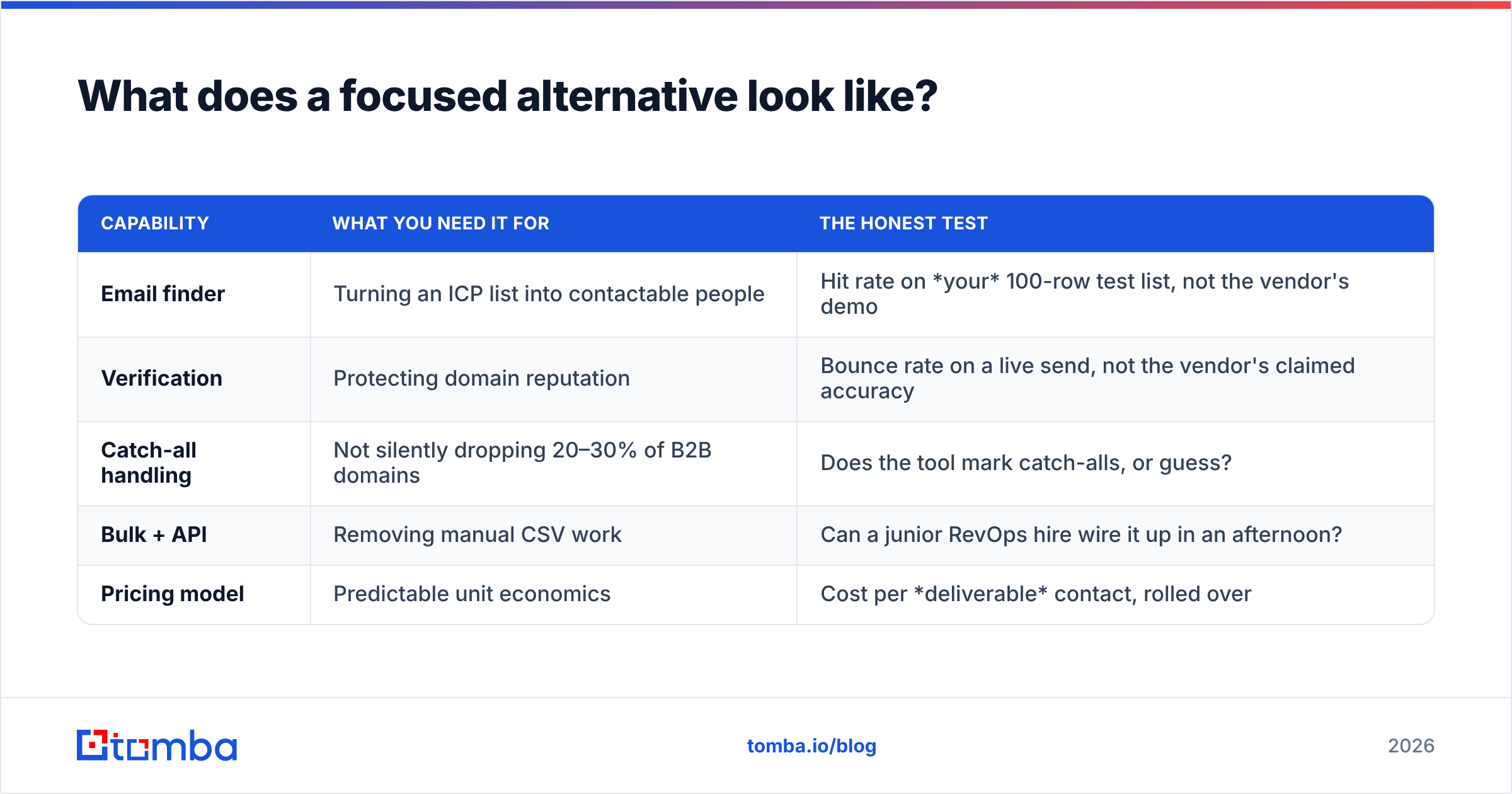
| Capability | What you need it for | The honest test |
|---|---|---|
| Email finder | Turning an ICP list into contactable people | Hit rate on your 100-row test list, not the vendor's demo |
| Verification | Protecting domain reputation | Bounce rate on a live send, not the vendor's claimed accuracy |
| Catch-all handling | Not silently dropping 20–30% of B2B domains | Does the tool mark catch-alls, or guess? |
| Bulk + API | Removing manual CSV work | Can a junior RevOps hire wire it up in an afternoon? |
| Pricing model | Predictable unit economics | Cost per deliverable contact, rolled over |
Tomba sits deliberately in that lane. It doesn't try to be a sequencer, a chatbot, or an intent platform. It finds emails, verifies them, handles catch-all domains explicitly instead of guessing, enriches records, and exposes all of it through an API and bulk workflows. If you want an outside read, check the category on G2 and compare how vendors are actually scored on data accuracy versus feature breadth — the two rankings look very different.

How should you actually run the evaluation?#
Do not buy on a demo. Run a bake-off. It takes an afternoon.
- Build a 100-row control list. Pull real target accounts from your CRM — a mix of easy (large US SaaS) and hard (small, non-US, catch-all domains). Include 10 contacts you know are correct.
- Run the same list through every candidate. Conversion Blitz, DealSignal, and a focused finder. Record hit rate, catch-all handling, and how each tool labels uncertainty.
- Verify the outputs with a neutral third tool. Never let a vendor grade its own homework. Run the results through an independent email verifier and compare.
- Send a small live batch. 200 emails from a warmed secondary domain. Measure the real bounce rate. This is the only number that matters.
- Compute cost per deliverable contact. Total spend divided by contacts that landed. Now the pricing pages become comparable.
If your bounce rate on a vendor's output exceeds 3%, no discount makes it worth it. Bounces don't just waste credits — they degrade email deliverability for every campaign you run afterward, which is a cost you pay for months.
For teams that need to run that test at volume, bulk verify your candidate lists first so you're comparing clean data against clean data, not one vendor's optimism against another's.
The verdict#
Conversion Blitz wins on breadth-per-dollar for scrappy, low-volume teams. If you'll use five of the twelve tools, it's a rational purchase.
DealSignal wins on data quality at enterprise scale. If bad records break a marketing automation pipeline and you have the budget and the RevOps maturity to govern a data contract, it earns its price.
Most teams should buy neither, because most teams' real bottleneck is narrower than either product's shape: they need accurate, verified emails, delivered by API, at a price that doesn't require a procurement cycle.
If that's your situation, start with the Tomba Email Finder. Free tier gives you 25 searches a month to run your own control list — no sales call, no annual minimum. Starter is $49/mo, Growth is $99/mo, and verification, catch-all handling, and the API come with it rather than as an upsell. Run your 100-row bake-off against whatever else you're considering, look at the live bounce rate, and let the numbers pick the winner instead of the pricing page.
Related guides#
Ready to find emails that actually work?
Join 150,000+ professionals who stopped guessing and started sending. Free credits on signup — no credit card required.
Get the Tomba newsletter
Practical outbound tactics and product updates — once every two weeks.
About the author